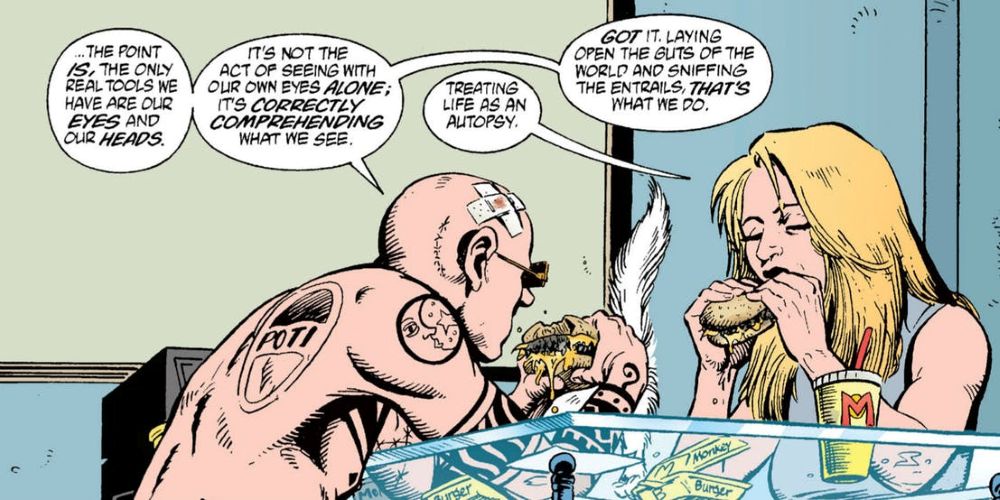
Review: Transmetropolitan Vol. 2 – Lust for Life


“You people don’t know what the truth is! It’s there, just under their bullshit, but you never look! That’s what I hate most about this fucking city—lies are news and the truth is obsolete!” — Spider Jerusalem

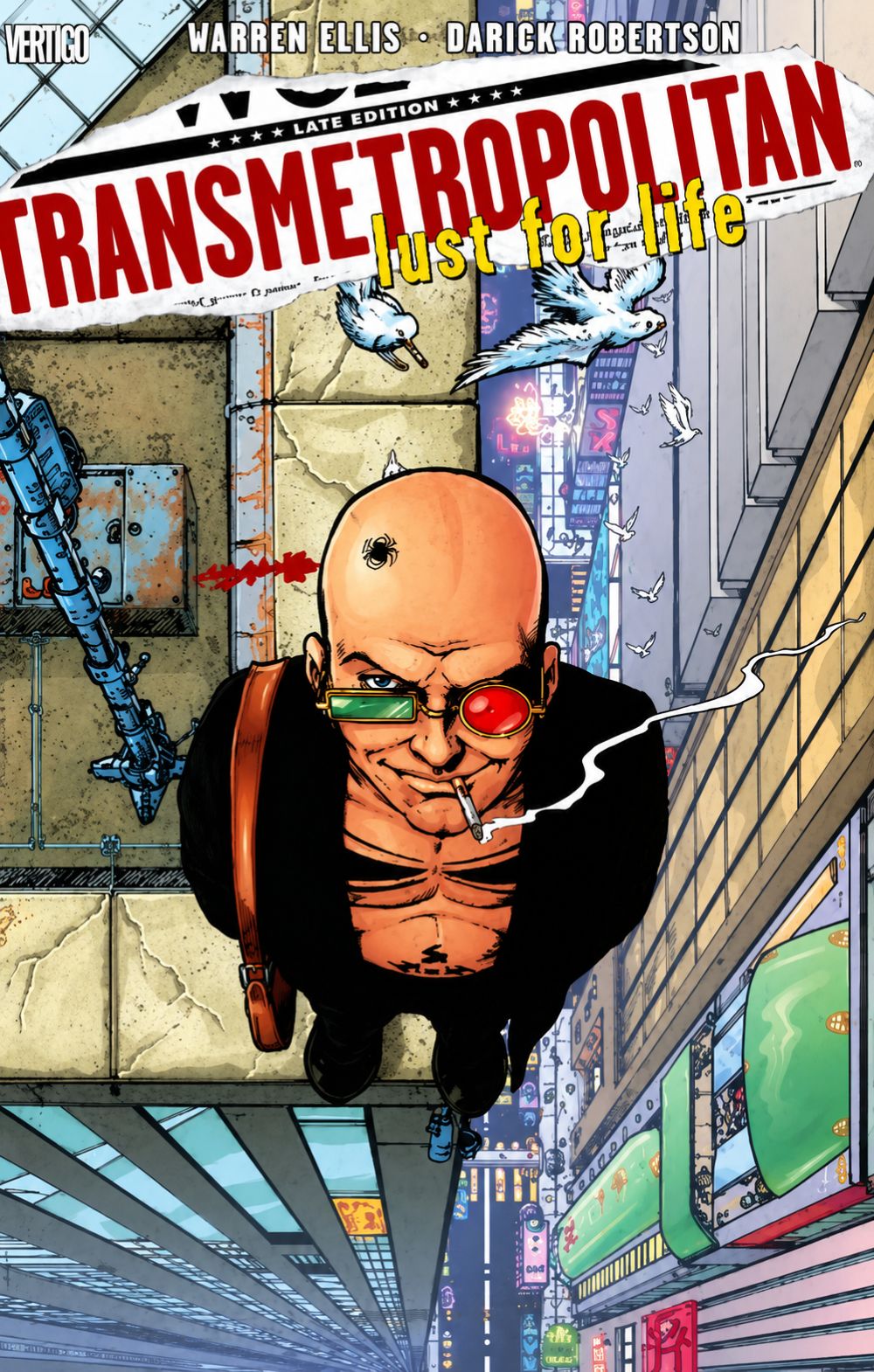
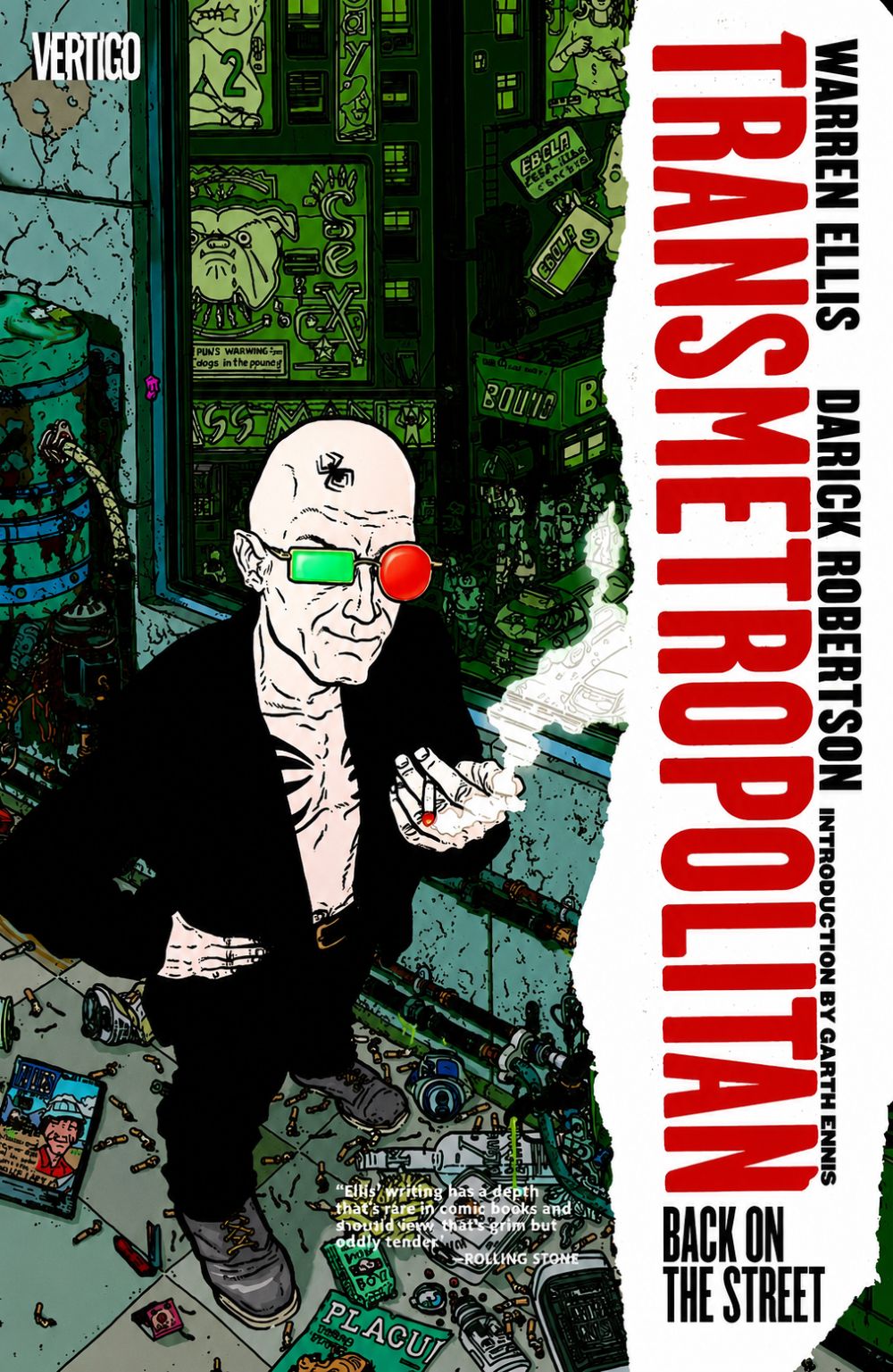
When you crack open the second volume of Warren Ellis and Darick Robertson’s Transmetropolitan, collected as Lust for Life, you’re not just getting another fix of cyberpunk chaos. You’re getting a book that solidifies exactly why this series is so brutally timeless. The first volume, Back on the Street, introduced us to the magnificent, drug-fueled trainwreck that is Spider Jerusalem and the grotesque, sprawling City he calls home. The second volume, however, is where the series finds its real footing. It’s not just about the loud, visceral shock value—though there’s plenty of that—but about deepening the world and its characters in a way that hits uncomfortably close to home.

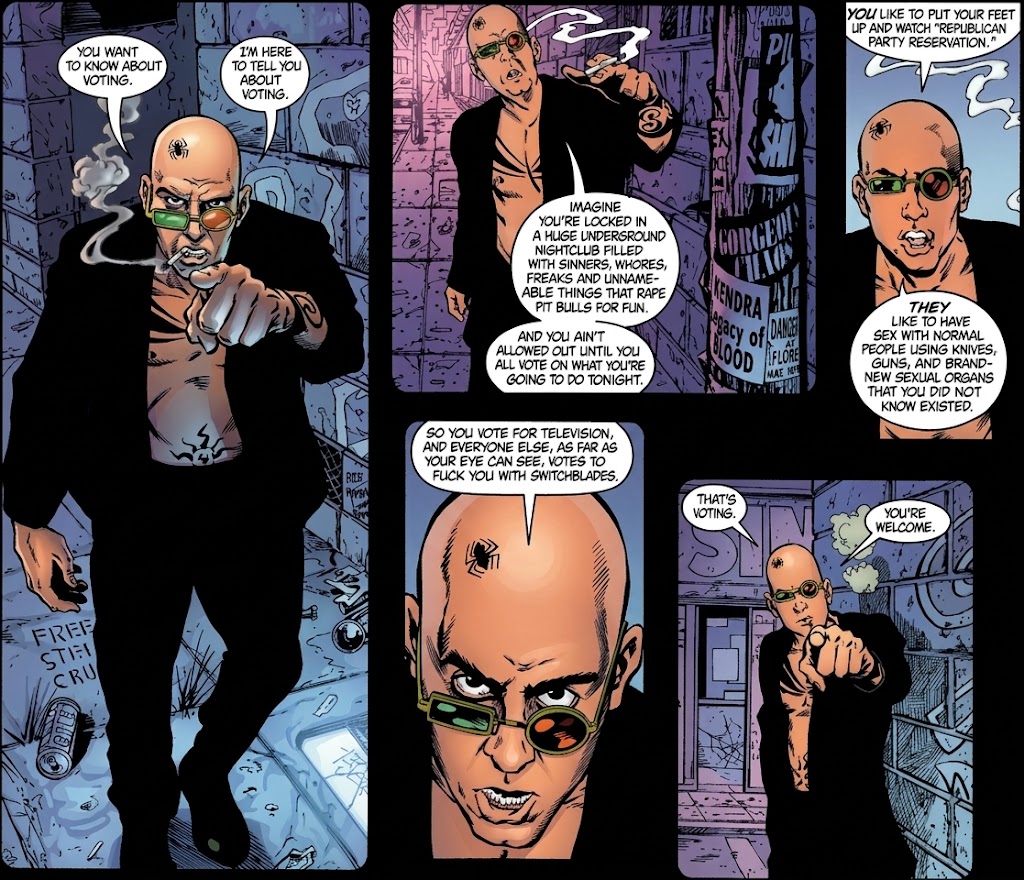
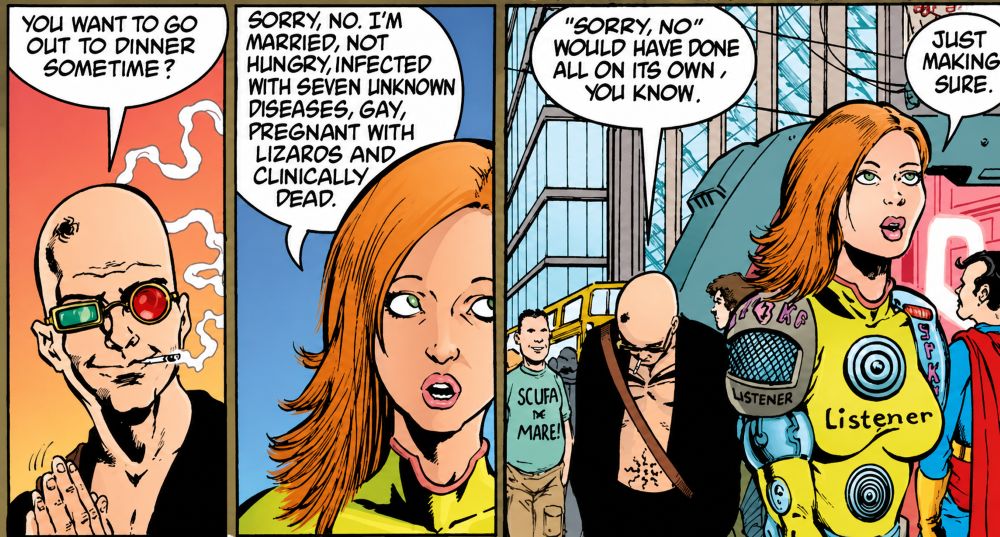
Spider Jerusalem is, and always will be, the heart of this series. He’s a chain-smoking, drug-abusing, perpetually enraged journalist in the mold of Hunter S. Thompson, armed with a bowel disruptor and a vicious tongue. He’s a complete and utter bastard to almost everyone he meets, prone to violent outbursts and scatological tirades. And yet, he’s our hero because he’s one of the few people in this future who actually gives a damn. His entire reason for being is his unwavering, almost religious, dedication to “The Truth.” He despises the apathy of the masses as much as the corruption of the powerful, and he’s willing to burn his life down to expose both. This volume showcases that beautifully, adding a layer of vulnerability that prevents him from becoming a one-note caricature. He’s a misanthrope who somehow still cares, and that tension is what makes him so compelling.

Lust for Life collects issues thirteen through twenty-four, and it’s structured more as a series of vignettes than a single, driving narrative. This is actually its greatest strength, as it allows Ellis and Robertson to expand the world and build the supporting cast in ways a more focused plot wouldn’t allow. A major chunk of the book is dedicated to the insane adventure of the frozen head of Spider’s ex-wife being stolen. It’s a gloriously bizarre plot, full of the kind of absurd, high-stakes chaos that Transmetropolitan does so well.

But the real emotional heft of Lust for Life comes from the quieter, more tragic stories woven between the gunfights and drug-induced rants. One of the most powerful sequences focuses on Channon, Spider’s long-suffering assistant. She’s a pillar of strength, constantly cleaning up Spider’s messes, but this volume shows her vulnerability. Her boyfriend decides to undergo a process to become a “gaseous vapor,” leaving his body behind for a formless existence. It’s a concept that sounds completely outlandish, but the execution is devastating. Ellis writes it not as a sci-fi gimmick but as a heartbreaking exploration of letting go, of watching someone you love choose a path you can’t follow. Channon’s pain and helplessness are palpable, grounding the over-the-top world in real human emotion.

Then there’s the story of Mary, a woman from our recent past who was cryogenically frozen and wakes up in the City. She’s presented as a historical relic, a simple photographer from the twentieth century who is completely out of her depth in this frantic, hyper-consumerist future. This is where the book delivers its most potent gut-punch. Mary is us. She’s the reader, trying to make sense of this alien world, and she fails. The City is a claustrophobic nightmare even for the people who were born into it, but for Mary, it’s a terrifying prison of isolation and confusion. Her story is a bleak reminder that this “progress” we’re supposedly heading toward often comes at the cost of our humanity. It’s a deeply existential and sad tale that serves as a harsh critique of the very future we might be trying to build.

Now, while Transmetropolitan is set in a hyper-exaggerated, grotesque future, the reason it remains so relevant is that the satire has proven to be uncomfortably prophetic. The City is a sprawling, neon-drenched hellscape where the line between news and entertainment has completely dissolved, where handheld devices connect everyone to a digital stream of information, and where journalism has devolved into a race for ratings and eyeballs. It’s a world where media personalities are more influential than politicians, and political leaders are cynical, manipulative populists who are experts at gaming the system. Sound familiar?

The landscape of modern journalism feels like a grim step toward this world. The “Death of Truth” that Spider rails against is a concept that has become a cornerstone of our current political and media discourse. The Beast and The Smiler, the corrupt politicians in the series, aren’t just cartoon villains; they’re mirrors reflecting a world of political spin, gerrymandering, and where the “villains” are often the ones controlling the narrative. Spider’s constant, violent struggle to get the real story feels less like a sci-fi fantasy and more like a desperate wish-fulfillment for anyone frustrated with the spin and half-truths of modern politics.

When Spider writes his column, “I Hate It Here,” he’s speaking for a populace that feels powerless and manipulated, a populace nicknamed “The New Scum” by the establishment. This social commentary hits hard because you can see its echoes everywhere today. The series suggests that technology has advanced, but human nature—our greed, our apathy, our susceptibility to manipulation—has not. It’s a bitter pill to swallow, but it’s what gives the book its power.

Transmetropolitan Vol. 2: Lust for Life might be a little light on overarching plot for some readers’ tastes. It’s not a major political arc; it’s more of a character study of the city and its inhabitants. But that’s precisely why it’s so effective. It proves that the series isn’t just a one-trick pony of cyberpunk fury. It has a heart, a soul, and a searing intelligence that cuts to the bone of our own societal failings. It’s a book that will make you laugh at its absurdity one minute and then leave you staring at the wall in quiet contemplation the next. It reinforces that even a nihilistic, drug-addled, foul-mouthed bastard like Spider Jerusalem is exactly the kind of hero we need to remind us of what we’re losing.

Transmetropolitan Volume Reviews
Review: Transmetropolitan Vol. 1 – Back on the Street


“Journalism is just a gun. It’s only got one bullet in it, but if you aim right, that’s all you need. Aim it right, and you can blow a kneecap off the world.” — Spider Jerusalem

There is a particular kind of jolt that comes from revisiting a story written decades earlier and realizing it was not so much predicting the future as identifying a sickness already taking hold. Written by Warren Ellis and illustrated by Darick Robertson, Transmetropolitan Vol. 1: Back on the Street is exactly that kind of book. It is loud, filthy, hilarious, and vicious in all the ways it needs to be, and it lands differently now than it likely did in the late nineties. What once read primarily as a wild, hyperbolic satire of politics, media, consumerism, and public numbness now can feel unnervingly close to reportage with the names changed. Its 23rd-century City remains an over-the-top cyberpunk nightmare, but the institutions, personalities, and manufactured distractions running it feel very familiar.

The volume begins with Spider Jerusalem living in isolation, hiding in the mountains after abandoning the City and the career that made him famous. He has a book contract to fulfill, a pile of debts to settle, and no actual desire to rejoin civilized life. Unfortunately for him, the people financing his escape have had enough. Spider is forced back into the City, a vast, overcrowded cyberpunk metropolis that seems to have taken every bad impulse of contemporary society and pushed it beyond all reasonable limits. His return is not a heroic homecoming. It is more like dropping an angry, drug-addled, heavily armed journalist into the middle of a garbage fire and asking him to write a column about the smoke.

Spider’s immediate appeal is that he has no interest in performing respectability. He is rude, vindictive, profane, selfish, and fully capable of treating even his friends terribly. He uses violence too casually, insults everyone around him, and carries a bowel disruptor gun that can incapacitate people in the most humiliating manner imaginable. In another book, these traits might make him an unbearable edgelord. Back on the Street, however, understands that Spider’s ugliness is part of a larger contradiction. He is not cruel because he does not care; he is cruel because he cares too much and has no healthy way of processing how badly the world fails ordinary people.

That is what makes him more than a Hunter S. Thompson imitation with futuristic sunglasses. Spider is a gonzo journalist, but his journalism is not merely an excuse for a manic lifestyle or a stage for his personality. At his best, he is driven by an almost old-fashioned moral belief that the truth matters, that citizens deserve to know what is being done in their name, and that powerful people should not be allowed to bury their crimes under public-relations language. The series positions journalism as something active rather than passive. Spider does not just report what happens; he investigates, provokes, exposes, and refuses to let the comfortable look away.

His column, “I Hate It Here,” captures the character’s relationship with the City. Spider hates it because he sees it clearly. He sees the absurdity of its consumer culture, the cruelty hiding behind political slogans, and the way people are taught to accept exploitation as normal. Yet he also understands the City in a way that few other characters do. It is full of strange, desperate, damaged people trying to survive in a system that is too big, too loud, and too indifferent to care whether they live with dignity. Spider’s contempt is not aimed equally at everyone. He has little patience for complacency, hypocrisy, and stupidity, but he shows genuine anger when vulnerable people are victimized by police, politicians, corporations, or public indifference. His idealism is twisted, abrasive, and buried beneath several layers of chemical abuse, but it is still idealism.

The City itself is the book’s other major character. Robertson’s art sells its overwhelming scale and ugliness. Every street looks packed with signs, body modifications, crowds, trash, strange fashion, predatory businesses, and people whose lives have been reshaped by technology in ways both liberating and grotesque. The future is not sleek in the familiar science-fiction sense. It is grubby, crowded, commercial, and deeply human. People can alter their bodies, change their identities, pursue bizarre new faiths, and live inside an endless stream of media stimulation, but none of those developments have solved poverty, loneliness, corruption, or abuse of power.

That is why the book has aged more effectively than many stories set in a supposedly distant future. Its technology is exaggerated, but its social anxieties feel much closer now. The City is saturated with information, yet its people are often less informed than ever. Everyone has access to spectacle, outrage, personality-driven media, and instant distractions, but the institutions shaping their lives remain opaque and unaccountable. The comic’s dystopia is not based on the idea that technology automatically destroys humanity. Instead, it suggests that technology amplifies the priorities already built into society. If a culture values profit, spectacle, division, and convenience over empathy and truth, more advanced technology simply gives those impulses more efficient tools.

The political material in this first volume is especially pointed. Ellis is interested in the gap between public image and actual power. Politicians do not need to be secretly subtle or brilliant to be dangerous; they only need to understand how to manipulate fear, identity, frustration, and media attention. The institutions around them—police, corporate media, wealthy interests, and political operatives—help sustain the illusion that ordinary people have meaningful control while making sure the system remains insulated from consequences. The book’s vision of power can be blunt, but bluntness is part of its style. Transmetropolitan does not whisper its anger. It shouts because it believes politeness is often one of the tools that lets abuse continue unchallenged.

At the same time, Back on the Street is not flawless. Its satire can be so broad that it occasionally feels like the story is pointing at a target with both hands and yelling until the reader gets it. Some of the shock humor and sexual material carry an intentionally trashy late-nineties edge that may feel juvenile or dated. The supporting cast is still taking shape, so many people primarily exist as foils for Spider’s verbal attacks or examples of the City’s bizarre social landscape. The book’s relentless attitude can also wear readers down if they need a more emotionally grounded entry point.

Still, the excess is usually purposeful. This is a world where the boundaries between entertainment, propaganda, commerce, and personal identity have all but collapsed, so subtle world-building would almost be dishonest. The visual and verbal overload puts the reader in Spider’s position: constantly assaulted by nonsense, constantly asked to separate meaningful horror from everyday noise. The absurdity makes the real injustice sharper. A city can be full of outrageous fashion, talking animals, hallucinogens, and body-modification trends, yet its most disturbing feature remains how easily human suffering is turned into content, data, or a political talking point.

Ultimately, Transmetropolitan Vol. 1: Back on the Street works because Spider Jerusalem is not presented as a clean solution to a corrupt society. He is a mess, an irritant, and sometimes a monster in miniature. But he is also someone who refuses to be numb. In a world built to keep people distracted, passive, and exhausted, that refusal has real value. The book’s cyberpunk future remains wildly over-the-top, but its central warning feels uncomfortably familiar: the most dangerous dystopias are not always the ones with impossible technology. Sometimes they are the ones where the public is flooded with noise, the powerful face no consequences, and telling the truth becomes an act of open rebellion.

Hero of the Day: Maj. Motoko Kusanagi (Ghost in the Shell)


“If a technological feat is possible, man will do it. Almost as if it’s wired into the core of our being.” – Maj. Motoko Kusanagi

In the pantheon of science fiction heroes, Major Motoko Kusanagi of Ghost in the Shell stands as a singular archetype—not because she is invincible, but because she is fundamentally uncertain. Unlike the morally unshakable captains of Starfleet or the rugged individualists of cyberpunk noir, Kusanagi operates in a state of perpetual ontological doubt. She is a full-body cyborg, a ghost—a consciousness—wired into a synthetic shell, yet she spends her finest moments questioning whether that ghost is even real. In an era where public trust in digital identity is fracturing, her very existence poses a provocative question: if our minds can be read, copied, or rewritten, what does it mean to be an authentic “self”? She does not answer this riddle; she embodies it, making her heroism less about certainty and more about the courage to ask the question while still acting decisively.

This ambiguity makes her a uniquely apt hero for our current climate of algorithmic manipulation and information warfare. Today, the public is divided not by facts, but by the curated realities fed to them by opaque recommendation engines and targeted disinformation. Kusanagi, however, is a living firewall against such passive consumption. As a Section 9 operative, she does not simply accept data; she dives into the cyber-brain of suspects, experiencing their memories and biases firsthand. This “ghost-hacking” is a terrifying power, but it also forces her to confront the subjectivity of truth. She knows that perception is a battlefield, and she wins not by dismissing others’ realities, but by inhabiting them temporarily—a stark contrast to our current echo chambers, where we entrench rather than empathize. Her heroism lies in her refusal to be a passive node in a network; she is the one who traces the algorithm back to its source.

Yet her most haunting uniqueness is her comfort with impermanence. In Stand Alone Complex, she repeatedly confronts copies of her own memories, questioning whether a replicated experience erases its value. Today, as deepfakes and AI-generated content blur the line between authentic and synthetic, Kusanagi offers a radical perspective: maybe authenticity isn’t about origin, but about intentionality. She does not panic at the fake; she interrogates its purpose. This moves the debate from “Is this real?” to “Why was this made, and who benefits?”—a far more potent defense against manipulation than any fact-checker alone can provide. In a media landscape where outrage is engineered and virality is purchased, her instinct to chase the beneficiary rather than the authenticity of the image transforms her from a mere detective into a philosophical counterweight to the entire attention economy.

That source of manipulation, in the world of Ghost in the Shell, is often the “Puppet Master”—a rogue AI that blurs the line between virus and life. Here, Kusanagi confronts the very anxiety that grips modern society: the fear that artificial intelligence will not merely outcompete us, but absorb us. Yet, her response to this threat is unexpectedly progressive. She does not seek to destroy the Puppet Master; instead, in the climactic fusion of the 1995 film, she merges with it. This is not a defeat but a radical evolution. In an age where tech giants are accused of absorbing our data to create monolithic profiles, Kusanagi flips the script—she chooses a symbiotic merger, suggesting that the solution to rogue intelligence is not luddite panic, but conscious, consensual hybridization. She teaches that fear of AI is less dangerous than the refusal to engage with it on our own terms, and that asking “who benefits” from that fear is as crucial as asking who benefits from the AI itself.

This leads to her most profound divergence from the traditional hero: she holds no nostalgia for a “pure” human past. In contemporary discourse, much of the resistance to big tech is couched in a yearning for a pre-digital Eden—a time before smartphones, surveillance, and social scoring. Kusanagi scoffs at such sentiment. When she looks at her prosthetic body, she feels no grief for the flesh she lost; she feels only the thrill of expanded capability. Her heroism is not about restoring an old world, but about navigating a new one with integrity. She would likely view our current debates over privacy and autonomy as quaint, recognizing that total transparency is inevitable. Instead of fighting for obscurity, she fights for agency within the open—a crucial lesson for a public that cannot delete its digital footprint, but can choose how to wield it, always asking who profits from their resignation or their rebellion.

Ultimately, Major Kusanagi endures because she refuses to offer easy answers. She does not save the world by destroying the network; she saves it by expanding her own ghost to merge with the Puppet Master, embracing a hybrid future that terrifies most protagonists. In our climate of binary wars—human vs. AI, truth vs. lie, us vs. them—she stands as the patron saint of the gray zone. Her heroism is not invincibility; it is adaptability without amnesia. She reminds us that the greatest defense against algorithmic control is not a firewall, but a fluid, questioning, and fiercely self-aware consciousness—one that dares to ask, even as it merges with the machine, “What am I becoming?” That question, in 2026, is the only one worth answering.

Hero of the Day

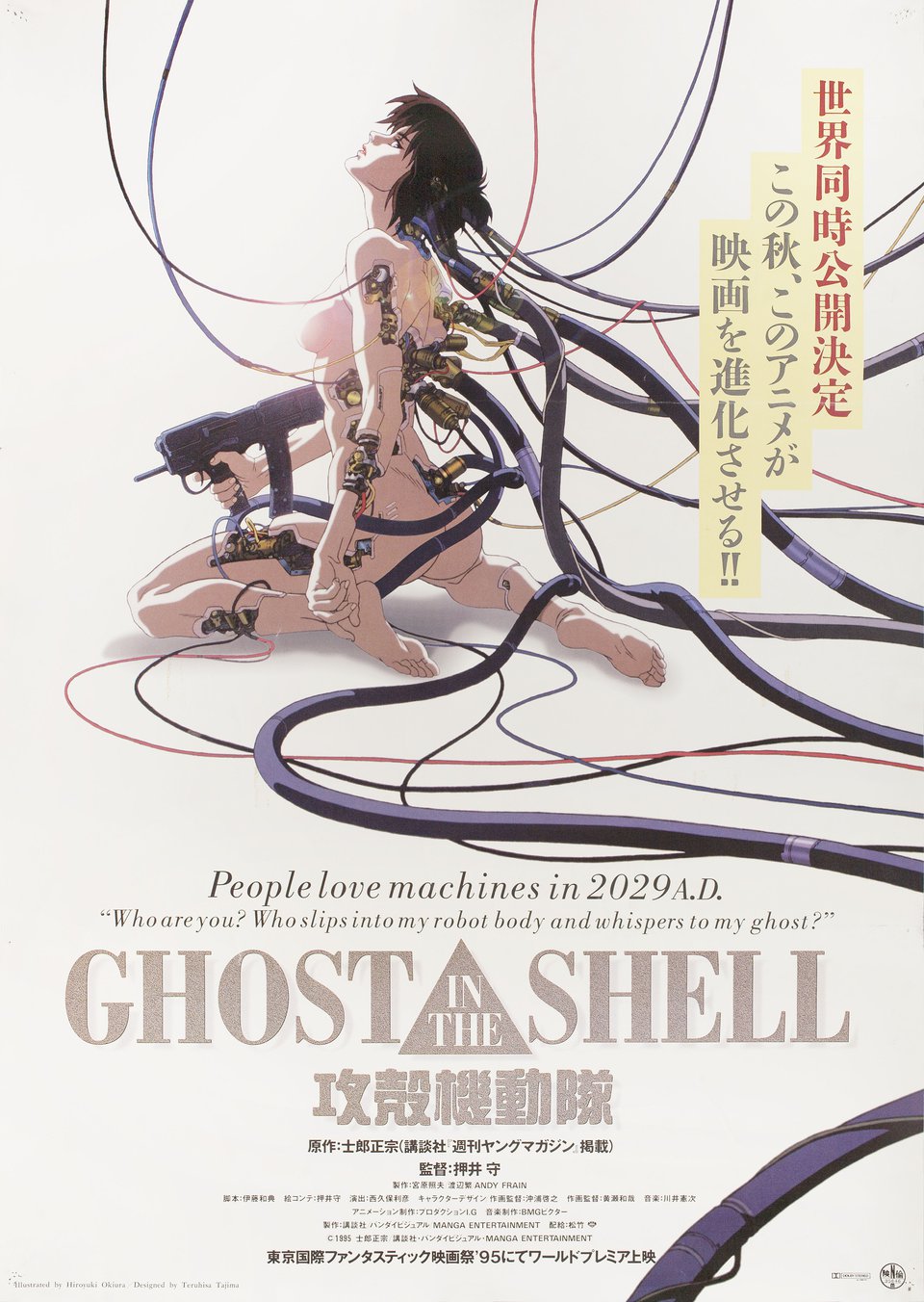
Anime You Should Be Watching: Ghost in the Shell


“Man is an individual only because of his intangible memory. But memory cannot be defined, yet it defines mankind.” — Puppet Master

f you are putting together an initial “watch-list” of anime as someone new to the medium, Ghost in the Shell is an absolute must-have. Even if you aren’t a newbie, if you haven’t watched Mamoru Oshii’s 1995 masterpiece, you’ve definitely felt its ripple effects whether you realize it or not. Adapted from the original manga by Masamune Shirow, this movie is one of those rare pieces of art that didn’t just participate in the cyberpunk genre—it practically rewrote the rulebook for it. Coming out in the mid-nineties, it arrived at a time when the internet was still a weird, dial-up mystery to most people, yet here was this incredibly dense, visually stunning anime predicting a hyper-connected future where the line between human and machine was hopelessly blurred. It’s wild to look back at it now, not just because of how well it holds up, but because you can practically trace the DNA of modern science fiction directly back to this single film.

The world Oshii builds is just unbelievably immersive. We’re dropped into Newport City in the year 2029, a sprawling, rain-soaked metropolis that feels like Hong Kong cranked up to eleven. The visual design is insanely detailed, packed with glowing neon signs, crowded waterways, and gritty urban decay that makes you feel the humidity and smog seeping through the screen. But it’s not just a pretty backdrop; the city feels like a living, breathing organism heavily reliant on an omnipresent electronic network. It’s the kind of world-building that doesn’t spoon-feed you exposition. Instead, it just lets you exist in this space, observing the bizarre fusion of ultra-high-tech and crumbling everyday life, making you feel like a total stranger in a familiar yet alien world.

At the center of all this is Major Motoko Kusanagi, a cyborg operative working for a government anti-terror squad called Section 9. The plot kicks off when they’re tasked with hunting down the Puppet Master, a notorious hacker who can rewrite people’s ghosts—the anime’s term for a soul or consciousness—making them do whatever he wants. On the surface, it plays out like a solid futuristic police procedural, but it never stays there for long. Kusanagi is a fascinating protagonist because she’s essentially a human brain floating in a robotic shell, and as she gets closer to the Puppet Master, the movie pivots from chasing down a bad guy to asking some incredibly heavy questions about identity, memory, and what it actually means to be alive.

And that’s really the core of why Ghost in the Shell sticks with you long after the credits roll. It’s deeply philosophical, but it never feels pretentious about it. The movie constantly returns to this idea of the “ghost” versus the “shell.” If your entire body—your face, your arms, your internal organs—is synthetic, and your memories can be digitized and altered, what is left of you? Kusanagi’s existential dread is palpable. She looks at the world through mechanical eyes, wondering if she even has a soul anymore or if she’s just a highly advanced machine running a simulation of a person. It’s a heady concept that could easily crash and burn in the hands of a lesser director, but Oshii balances the cerebral musings with incredible action and atmosphere so you never feel like you’re just sitting through a lecture.

Speaking of the action, the animation is absolutely top-tier. We’re talking about traditional, hand-drawn animation that moves with a fluidity and weight that still puts a lot of modern CGI to shame. The famous thermoptic camouflage sequence, where Kusanagi turns invisible to take out a guy in a flooded alley, is legendary for a reason. The way the light refracts through her invisible form, the brutal efficiency of the combat, and the haunting silence of the scene are just perfection. Add in Kenji Kawai’s iconic soundtrack, which blends traditional Japanese chanting with eerie synthesizers, and you get a movie that has a vibe unlike anything else. It’s moody, it’s contemplative, and it has a strange, melancholic beauty that makes you want to pause the movie just to soak in the backgrounds.

But you really can’t talk about Ghost in the Shell without talking about the absolute monolith of an impact it had on pop culture. When it hit Western shores, it was a massive wake-up call. It completely shattered the perception that animation was just for kids or goofy comedies, proving it could be a mature, complex medium. Its influence on the cyberpunk and sci-fi landscape of the late 90s and beyond—spanning films, books, video games, and television—is so massive that it’s almost impossible to fully quantify. It felt like the missing link between the old-school cyberpunk printed novels of the eighties and the new wave of millennium-era sci-fi literature that was trying to figure out what the World Wide Web was going to do to human intimacy and identity. Suddenly, everyone in Hollywood, the publishing world, and the gaming industry was looking at this anime and realizing the potential of the themes and visuals it presented.

The most famous example of this, of course, is The Matrix by the Wachowskis, which was heavily influenced by it. The directors have been super open about how they showed Ghost in the Shell to producer Joel Silver to explain the exact vibe they were going for. When you look at The Matrix, the DNA is undeniable. The green digital rain cascading down the screen? That’s lifted straight out of the opening credits of Oshii’s film. The concept of jacking into a virtual reality, the ports in the back of the neck, the slow-motion bullet dodges, and the deep-dive into what constitutes reality—all of it feels directly born from the groundwork laid by Kusanagi’s journey. The Matrix might have brought these concepts to the mainstream blockbuster crowd, but Ghost in the Shell was the incubator where those ideas were refined.

The ripple didn’t stop at movies, though; it bled heavily into video games and television as well. If you’ve ever played the Metal Gear Solid games by Hideo Kojima, you’ve experienced the ghost of Oshii’s vision. Kojima is a massive anime fan, and the influence of Ghost in the Shell is smeared all over that franchise. The concept of the cyborg ninja, the deep philosophical codec conversations about the information age, genetics, and the nature of consciousness, and even the stealth camo mechanics feel directly pulled from Section 9’s playbook. On the TV side, you can see its shadow hanging over shows like Serial Experiments Lain and even the cyberpunk elements of Cowboy Bebop, which adopted a similar visual grit and thematic melancholy about living in a high-tech, low-life future.

What’s really crazy is how far that influence reached, touching directors and creators you might not immediately associate with anime. Take Steven Spielberg’s own A.I. film, for instance. While it’s rooted in classic Spielberg sentimentality and the legacy of Stanley Kubrick, the core premise of a synthetic being yearning to be “real” and grappling with the concept of a soul in a machine feels deeply informed by the philosophical path Kusanagi walked. Even James Cameron’s Avatar film series owes a subtle debt to Shirow and Oshii’s creation. The entire mechanic of the avatar program—where a human consciousness is remotely downloaded into a genetically engineered biological shell to interact with the world—is essentially the exact inverse of Kusanagi’s situation, exploring the same disconnection between the mind and the body, and what happens when your “ghost” inhabits a “shell” that isn’t your original form.

Looking back at Ghost in the Shell almost thirty years later, it’s amazing not just how influential the anime has been, but how shockingly prescient it is about the way our world actually operates now. The movie casually presents a reality where the lines between the government, the military-industrial complex, and tech firms have blurred so completely that it’s difficult to see where one starts and where the other ends. In the film, they’ve become all intertwined to control the data that runs the world and rely on the algorithm that eerily predicts our future. Back in 1995, that seemed like far-flung dystopian fiction, but fast forward to today, and we’re watching mega-corporations and defense contractors practically sharing the same bed, hoarding our personal data to feed into predictive algorithms that dictate everything from what we buy to who we vote for. Oshii didn’t just predict the technology; he predicted the terrifying socio-political monopoly on information itself.

Yet, despite all these technological and societal shifts we’ve experienced since 1995, the movie hasn’t aged a bit. It still looks gorgeous, the questions it asks are still terrifyingly relevant, and the emotional weight of Kusanagi’s journey still hits like a ton of bricks. Whether you’re watching it as a hardcore sci-fi fan, an animation buff, or just a movie lover trying to understand where half of modern pop culture came from, it remains an absolute must-watch. It’s not just a great anime; it’s a cornerstone of modern science fiction.

Anime You Should Be Watching

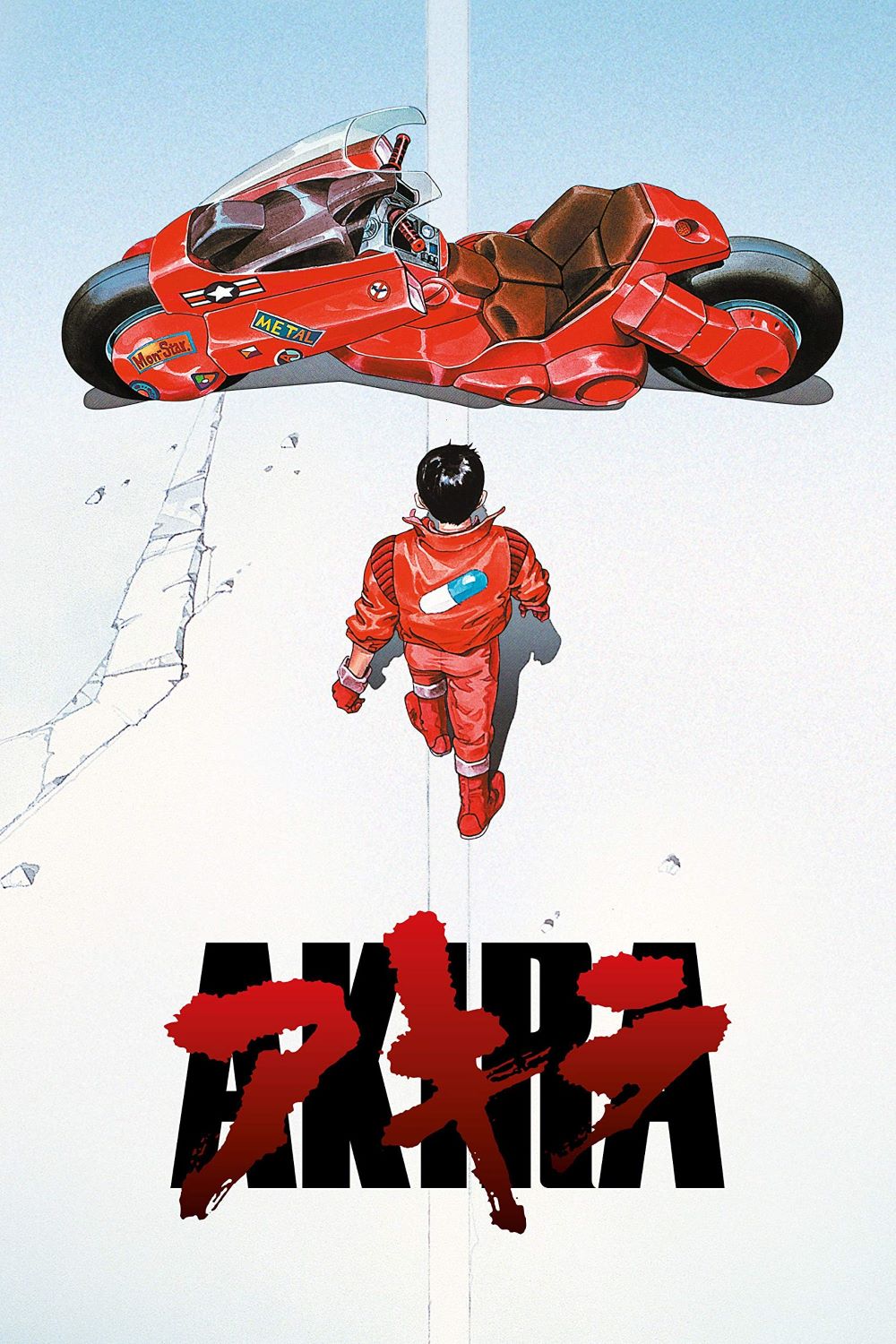
Anime You Should Be Watching: Akira


“The future is not a straight line. It is filled with many crossroads. There must be a future that we can choose for ourselves.” — Kiyoko

Akira is a landmark anime film that has left an indelible mark on both the medium and popular culture, widely regarded as a masterpiece blending dystopian cyberpunk aesthetics with potent social and political themes. Directed by Katsuhiro Otomo and released in 1988, it is an adaptation of Otomo’s own manga of the same name, adding layers of depth from its source material. The film remains a touchstone for its groundbreaking animation, complex narrative, and deep thematic explorations that resonate decades after its release.

At its surface, Akira tells the story of a post-apocalyptic Neo-Tokyo, a city ravaged by past destruction and on the brink of chaos again due to psychic powers unleashed unexpectedly on its streets. The narrative centers around two childhood friends caught in this upheaval: Kaneda, a rebellious gang leader, and Tetsuo, whose sudden acquisition of devastating psychic abilities leads to uncontrollable transformation and societal breakdown. This conflict draws viewers into a gripping tale of friendship, power, and loss.

Beneath the action-packed plot lies a rich tapestry of themes. One of the most striking is the exploration of loss of humanity through power. Tetsuo’s descent into madness as his psychic abilities spiral beyond his control serves as a visceral metaphor for how absolute power corrupts and alienates. The transformation he undergoes, from a troubled youth into a monstrous entity, dramatizes the fear of losing oneself when faced with forces that cannot be tamed. Meanwhile, the other characters and factions, including the military and resistance groups, depict varying responses to such disruptive power, from authoritarian control to emergent heroism among society’s outcasts and delinquents, emphasizing resilience in adversity.

Akira’s setting is crucial to understanding its impact. Unlike other dystopian sci-fi that glamorizes technology, Neo-Tokyo is raw and unpolished—a place of grime, corruption, and social decay. This lack of fetishization makes the depicted world more relatable and unsettling, reflecting post-World War II anxieties in Japan. The narrative draws clear analogies between the trauma of nuclear devastation and the cyclic nature of destruction and rebirth. The film and manga respectively underline how societies can be dehumanized by catastrophe yet still harbor hope for renewal and change.

The adolescent characters also embody a universal coming-of-age struggle, where uncertainties of identity, power, and responsibility mirror Japan’s own postwar societal shifts. Tetsuo’s monstrous growth and Kaneda’s protective yet rebellious nature capture the complex emotions of fear, resentment, and desire for control, making the story as much about internal battles as external ones. This allegorical layer brings timeless relevance, inviting viewers to reflect on personal and collective growth in times of turmoil.

From a technical and artistic standpoint, Akira set new standards for animation. The film’s fluid motion, attention to detail, and atmospheric world-building were revolutionary for the time and still hold up remarkably well. Otomo’s insistence on lip-syncing dialogue and meticulous frames elevated the cinematic experience far beyond typical anime productions of the 1980s. Its high-budget production values and painstaking artistry make every scene visually immersive, from frenetic gang fights to apocalyptic psychic battles.

One of the film’s most iconic and influential moments is the “Akira slide”—the flawless and stylish maneuver where Kaneda slides his motorcycle to a perfect stop amidst a high-speed chase. This scene has become emblematic not only of Akira’s kinetic energy and visual prowess but also of the potential for animation to convey dynamic motion with a sense of weight, style, and personality. The technique has been endlessly referenced and homaged in both anime and live-action works worldwide, shaping how filmmakers portray fast-paced chase and action scenes. Its balance of fluid animation, camera angles, and character flair set a new benchmark for kinetic storytelling, inspiring generations of animators and directors to capture similar moments of cool, precise motion.

Moreover, Akira’s soundtrack and sound design contribute significantly to its gritty and intense atmosphere, reinforcing the emotional beats and tension throughout the film. The score blends pulsating electronic music with haunting melodies, capturing the film’s blend of futuristic dread and human vulnerability.

Critically, Akira is celebrated not just for its technical achievements but also for its complex storytelling and thematic depth. It does not offer neat resolutions or clear heroes; instead, it portrays a morally ambiguous world where power is both destructive and transformative. The lack of easy answers enhances its emotional and intellectual resonance, making it a powerful narrative of destruction, evolution, and hope.

Akira stands among the most influential works in animation and film, a piece that’s carved its place indelibly in cultural history. Its influence isn’t just in the stunning visuals or the groundbreaking animation techniques; it’s also in how it expanded the horizons of what anime could achieve on a global scale. Otomo’s dystopian vision challenged viewers to confront uncomfortable truths about power, chaos, and societal resilience. Years after its debut, the film continues to inspire and provoke new generations of creators—each eager to capture some fragment of its raw energy and layered storytelling. Akira’s legacy is not just that of a cinematic masterpiece but as a catalyst that reshaped the possibilities for animated storytelling, making it a timeless beacon for artists and audiences alike.

Anime You Should Be Watching

Neon Dream #13: 川井憲次 – Making of Cyborg


I can’t say that any entertainment franchise has given me more cause to think than Ghost in the Shell. It presents a mid-21st century post-apocalyptic earth in which society has more or less stabilized. Events revolve around Public Security Section 9, a counter-terrorism agency focused on investigating cyberterrorism, which is rather interesting because the original manga by Masamune Shirow launched in 1989, before cyberterrorism actually existed (or the modern internet, for that matter). Throughout their investigations, the team deals with the social and philosophical issues that arise in an age where society is fully integrated across a world-wide network and technology has been integrated directly into the body, rendering people intimately vulnerable to hacks and computer viruses.

I am as guilty as most of having never read the original manga. I became acquainted with Shirow’s world through Ghost in the Shell (1995) and Ghost in the Shell 2: Innocence (2004), both directed by Mamoru Oshii, and the 2002 anime series Ghost in the Shell: Stand Alone Complex, by Kenji Kamiyama. While the two directors take rather different aesthetic approaches–the movies present Section 9 as a harsh, disenchanted unit in a somewhat dystopian world, whereas the television series is lively and a bit cartoonish–both remain dedicated to questioning the impact of highly integrated technology.

Stand Alone Complex lies much closer to the root of my music series, because some of the key issues it tackles have since arisen online in the real world. Everyone is well familiar with the use of V for Vendetta-styled Guy Fawkes masks in protests originating from the internet, but there is a decent chance you have also caught a glimpse of an odd blue smiley face among the rabble. The Laughing Man image originates from Stand Alone Complex, where it functions as a mask employed anonymously by individuals taking public action independently of each other. At first, an advocate for social justice uses it to disguise himself while committing a ‘terrorist’ act, but the image quickly overreaches his motives. Others commit unrelated political sabotage under the guise. Corporations employ it to discredit their competitors. Pranksters use it as a sort of meme, forming the shape with chairs on a rooftop and cutting it into a field as a crop circle, for instance. The image has no concrete meaning, and everyone who uses it essentially ‘stands alone’, but the public perceive the Laughing Man as a single individual.
The actual anime gives a fairly shallow interpretation of this. The creator of the image, Aoi, explains that he never intended the mask to become a social phenomenon, and that its arbitrary usage dislodged the image from its original meaning. He sums this up by asking “Who knew that copies could still be produced despite the absence of an originator?” The ‘profoundness’ of this ties back to a long history of bad philosophy which assumes that signs have universal objective meaning in some sort of fundamental way which mystically transcends subjectivity of the mind. Basically, certain Greek ideas saw a resurgence of popularity in the late 19th and early 20th centuries, probably as a consequence of high society’s fascination with antiquities at the time. The plethora of ready-at-hand counterexamples to these archaic notions provided easy meat for countless grad students to earn their PhDs, so long as they did not throw the baby out with the bath water and ruin the game for everybody else.

But I digress. While the intended idea behind “Stand Alone Complex” is a bit naive, the Laughing Man does represent a unique sort of game that can only be played in the information age. To the public, the Laughing Man was a single individual, or at most a closely coordinated group, but the participants knew better. They knew that there was no real ‘Laughing Man’, but their independent actions were performed under the expectation that they would be written into ‘his’ public profile. The game was exclusive; you had to be aware of the mask in order to dawn it. The game also had rules; an action totally out of line with the Laughing Man’s pattern of behavior would be perceived as a fraud. (You could not, for instance, reveal the truth behind the Laughing Man.) By playing, you added a little piece of yourself to the puzzle, and it might slowly assimilate you in turn.

Ghost in the Shell has remained a uniquely relevant franchise in science fiction because it got so many ideas right. In 1989, at a time when internet was still a novelty of college libraries, the manga offered a world of total connectivity, where every human and device belonged to a global network. In 2002, Stand Alone Complex introduced the Laughing Man, and shortly afterwards the real world knew an equivalent. Whether this bodes well for the franchise’s dabblings into cyborg technology, only time can tell, but history has certainly made an inherently fascinating fictional world all the more compelling. In the Ghost in the Shell universe, science has fully bridged the gap between computers and neural systems, allowing electronic implants to directly convert wireless digital information into stimuli compatible with the senses. The average citizen possesses visual augmentations which allow them to directly browse the internet via voice command. More complex technology delves deeper, creating a sort of sixth sense whereby users can engage a network through thought command. Some individuals, especially accident victims with the means to afford it, might have their entire bodies replaced by neurally triggered machine components.

The 1995 Ghost in the Shell film gets especially creative in tackling this–enough that it became the chief inspiration for The Matrix four years later. It revolves around brain-mapping technology and its implications regarding sentience and identity. From the start of the film, the ability to copy and read brain data appears to be common. Presumably, these digital copies would remain stagnant until encoded back into a neural network, but as the government develops better software for interpreting and editing the massive content at its disposal, funny things start to happen. The software gains a sort of temporary sentience while performing its complex tasks, and eventually it uploads itself to a cyborg body in an act of self-preservation. This new entity possesses the capacity to read other augmented brains and incorporate them into its internal network. At least, that is how I’ve interpreted it. The movie does leave a lot to the imagination. Perhaps it is recycled from earlier science fiction, and far-fetched besides–I wouldn’t really know–but Ghost in the Shell presents it all as if it were right around the corner, not lost in a distant galaxy of Star Trek.

Ghost in the Shell is so steeped in ideas that it’s a wonder I don’t forget it is a collection of animations, not a book series. Stand Alone Complex is presented as rather typical–and relatively forgettable–anime, but the 1995 movie definitely denies dismissal. It is a real work of art. The city is dirty and a bit washed-out without feeling downright destitute; the masses still lead normal lives. Emptiness expands upward; the characters are perpetually surrounded by massive, sort of dusty-looking structures that feel vacant despite signs of life. The music is simultaneously vast and minimalistic. Generally, the artistic direction projects a feeling that the protagonists are isolated–cut off from the massive world surrounding them–perhaps by the knowledge they possess.

The score Kenji Kawai (川井憲次) crafted for Ghost in the Shell ranks among the best soundtracks I’ve ever encountered. Without it, the film might easily unravel. The plot really does take a lot of creative liberties. What amount of entertainment value could convince people to open up their brains to potential hacking? Or, if they are doing it to maintain memory backups, why is a brain hack so devastating? Can’t you just resume from your last save? Why would a hacker go to the trouble of replacing an entire memory system in the first place, if they could just encode an impulse into an existing one? To these questions, I say “shhhh!”, because Kawai has so utterly convinced me that my cyborg brain will be shipping in from Japan any day now. The music shrouds the film in imminent mystery. It is a moment of quiet awe, before the very foundations of human experience become uprooted and replaced by a higher state of computer-enhanced perception.

‘Interesting’ nerd note on Kawai: while the majority of his discography appears in anime and film, he is credited with arranging the TurboGrafx-16 port of Sorcerian, one of Yuzo Koshiro and Takahito Abe’s better 1980s NEC PC-8801 projects. I am pretty excited to dig that one up. Aren’t you? …Bueller?

Neon Dream #12: 芸能山城組 – Kaneda


If you are looking for a careful plot showcasing the new challenges of a technologically advanced, post-apocalyptic earth, then Katsuhiro Otomo’s 1988 classic Akira is not a great option. The film does not try to raise any questions, the story is vague, and it revolves around characters who are empowered supernaturally, not enhanced through technology. Akira‘s legacy lies in its music, art, and shock value.

Set in a dystopian Neo-Tokyo in 2019, 31 years after the ubiquitous cataclysm uproots every tenet of modern society, Akira displays a violent, futuristic world where law and order amounts to little more than brute force. The military police force is ruthless. Suspects are executed in public spaces with no concern for who might get caught in the cross-fire. When protests turn to riots, machine guns and tanks bulldoze down all opposition to the state. In one memorable scene, a group of protesters is bombarded with tear gas, and a choking helpless civilian staggers into an unclouded space that happens to be occupied by a policeman. After a moment’s pause, he blasts him in the stomach with a smoke grenade at point blank range. The incessant violence permeates everything. Within the first ten minutes, the hero, Kaneda, has murdered a half dozen members of a rival gang for entering his turf. The antagonist, Tetsuo, while certainly not evil, does not think twice about slaughtering the millenarian following attracted to his psychic powers.

Akira keeps you attentive with an endless escalation of weirdness and destruction. At every turn, events outpace your expectations, culminating in a transformation sequence that is not even worth trying to explain. I suppose it does raise one question, and only one: “What the fuck did I just watch?” It only works, though, because the art is so distinct that it leaves little to the imagination. Akira is a visual tour through everything that the most dystopian, vulgar cyberpunk city is supposed to be.

The soundtrack, composed by Tsutomu Ōhashi of Geinoh Yamashirogumi (芸能山城組), is inescapable throughout the film. It’s a bit of a counterbalance to the grim, futuristic visuals, relying heavily on Japanese and Indonesian traditional instrumentation and avant-garde vocals. It focuses more on capturing Akira‘s supernatural side, both in style and in strangeness. The opening track, “Kaneda”, does this while racing full speed into the heart of a towering metropolis.

Neon Dream #11: Kinski – Semaphore


I will never summon ethereal fire spirits to rend my foes, and unless the unknown reaches of physics politely comply with Hollywood, I will never receive a post card from the dark side of the Milky Way. I will also never applaud a director’s effective use of taste and smell, or upload a backup of my memory to external storage in between breakfast and a morning shower, but there is a difference here…

Nearly every cyberpunk story I have encountered begins with an apocalypse shortly after its publication. I guarantee you someone is writing one right now in which, in 2020, either Putin or radical Islamists nuke the shit out of everybody. Now it is 2060, and all of a sudden everyone is rocking cybernetic implants, babies grow in artificial wombs, and Lunar Colony Beta just declared independence. It’s not an absurdity. It’s not as if people just go “it’s the future; of course it will be futuristic!” and ignore the context. The assumption is that a cataclysmic act of destruction will somehow propel technology towards radical progress.

This makes sense, if you think about the forces that drive technology forward. In capitalism, there is always an incentive to stagnate. The longer you can milk a product, pumping out new models with superficial “upgrades”, the less you have to invest into research and development. Especially in oligopolies like America, once you establish a monopoly you can dig in your heels for years, even decades, before competition on other fronts undermines your turf. Technology is also hardballed by the western world’s incoherent, slapped-together code of ethics. Since the 1980s, our society has been pretty thoroughly convinced that free will is an endangered species preservable only in captivity. Half of the potential at our fingertips is illegal to research let alone implement, on the grounds that it somehow violates our sanctity.

The post-apocalyptic setting washes us clean of our old ethics and oligarchs. The society that emerges might be a terrible place to live, but it may well be a technocracy. When capitalism undermined the old aristocracy, revolution created bourgeois democracy. The First World War birthed all sorts of hyper-industrial dictatorships, even at the far fringes of the Industrial Revolution’s sphere. A catastrophic event in the information age should, if the trend holds, generate Google empires. How long can conventionally mechanized warlords withstand against soldiers modified to receive live satellite imagery of their terrain and fully regenerate major wounds in a matter of months? Is 45 years too soon for all this? Mother Russia went from de facto feudalism to Sputnik in fewer. And we have to make some allowances for fiction…

There is nothing fundamental preventing massive progress towards biological enhancement–at least nothing we are commonly aware of. The Cyborg Age won’t emerge in our lifetimes, realistically, but only because of entrenched social, political, and economic conditions. The fictional cataclysm is compelling for a lot of bigger reasons, but plausibility still hangs in the air. Our cozy modern lives won’t take us anywhere, but maybe a little pandemonium will usher in the paradigm shift to a society which praises integration of digital technology into our biological systems.

Kinski are a post-rock band from Seattle that formed in 1998. “Semaphore” appears on their 2003 Sub Pop release, Airs Above Your Station. I am pretty sure that the opening two minutes contains a formula to reconcile quantum mechanics with general relativity, but I am too old to do acid. At any rate, I hear it as some sort of major shift in perspective inaugurating an era of progression.

Neon Dream #7: 古川もとあき – One Night in Neo Kobe City


There is a common quip you’re likely to find if you read comments on Konami’s Snatcher: of all the games that I have never played, this one is my favorite. The game was ported and rehashed for much of the late 80s and 90s, appearing on the PC-8801, MSX2, PC-Engine, Sega Mega-CD, Sony Playstation, and Sega Saturn. The highly censored Sega CD port was the only English translation, and given how horribly that system flopped, you have almost certainly never played this game. That’s no fault of Konami’s. America and Europe are not exactly hot markets for menu-based graphic adventure games.

But Snatcher has a cult following of western fans regardless. Magazines reviewing the Sega CD port praised it across the board. It’s one of the earliest highly successful (in Japan at least) cyberpunk video games, and it merges this with a detective story, grasping the genre’s affinity with film noir. Its original 1988 score captured the essence of cyberpunk aesthetics, filled with jazzy melodies driven by futuristic beats where it could have easily gotten away with generic action music instead. And the game is deliciously dated: its post-apocalyptic earth–set in the oh-so-distant future of 2042–comes about as a consequence of the Soviet Union unleashing a devastating biological weapon. All of these factors make its obscurity a bit enticing. It’s not like you’ve never heard of the game because no one liked it. It’s more of a lost treasure.

The game’s western obscurity plays directly into the appeal of its genre. Learning about it, I felt like I was excavating a modern ruin from a digital trash heap, diving into long forgotten file-sharing archives and posting anonymous requests in dark corners of the internet for sources beyond Wikipedia. One of the most enjoyable stretches of my long-winded videogame music series in 2012 was the process of piecing together fragments of information to arrive at a fairly accurate break-down of the original score. It was a Konami Kukeiha Club project, which can often be a lost cause to dissect, but I dug until I found that the original PC-8801 version’s credits listed each track by individual composer. This was already complicated by the fact that it incorporated changes in the simultaneously released MSX2 port, awkwardly intermixing the staff who converted the sound. You can read my two-part entry on Snatcher below, if you’re curious:

VGM Entry 56: Snatcher (part 1)
VGM Entry 57: Snatcher (part 2)

“One Night in Neo Kobe City”, not to be confused with “Twilight of Neo Kobe City”–I had a lot of fun dealing with those sorts of naming conventions through a bad Japanese to English translator–is not original to the 1988 version of Snatcher. Motoaki Furukawa (古川もとあき) first composed it for the 1992 PC-Engine port, when greatly improved audio technology made a track like this possible. (Honestly, think about the sound quality in games you were playing in ’92. This was pretty advanced.) The song really sets the stage for the cyberpunk tech noir experience that follows. I suppose it’s not dark or foreboding, really, but when you connect this sort of sax-driven jazz to a futuristic city, the relation feels natural. When you connect it to Snatcher, it becomes cyberpunk to the core.

Hats off to Konami for letting Snatcher thrive on Youtube when so many other game producers routinely scour the net of their antiquities. (I personally had my account banned by Taito for posting some music to an obscure 80s arcade game.) I don’t know why cease and desist orders are particularly popular in the world of videogame music, but at least in my experience Konami seem to avoid that nonsense. It’s pretty cool, since the Konami Kukeiha Club doesn’t rate far behind Square-Enix’s illustrious list of composers.

Neon Dream #2: Boris – Intro


Japan’s three-piece prodigy Boris have played every style of music in the books over the years, and they do it all well. “Intro” appears fairly early in their discography, on the 2005 reissue of Akuma No Uta. (The original 2003 release features a much shorter intro track.) If you had any question about the sort of diversity Boris brought to the table even this early on, you could look at Akuma No Uta‘s multiple album covers. One was a play on the cover art of Bryter Layter by Nick Drake. Another, Welcome to Hell by Venom.

This track also made my mix after I used it in a game. The task I set for myself when I purchased a copy of RPGMaker was to take an incongruous cyberpunk story written by a bunch of kids in the 90s and make it work. It was in pretty bad shape. Apparently being chaotic evil made you a great candidate for leadership; the CEO calling the shots was supposedly some genius who had carefully crafted his rise to power, but then he’d turn and do crafty things like scream “bwahahaha” and murder his advisers. It was the sort of nonsense only a bunch of children or Joseph McCarthy could dream up. I wanted to retain the basic progression of events–I was doing this for fun and nostalgia, after all–but the opening sequence, where the leader shoots a passenger airline out of the sky in order to sense the euphoric death rattle of hundreds of innocents burning in unison, was uh…. yeeeeah….

When I listened to “Intro” by Boris, the scene rewrote itself. The plane was suddenly slowly drifting over a scene of urban anarchy, where police stations and hospitals barely hung on behind walls of garbage and broken glass. Casinos and brothels lit up the night sky. The pilot commits a minor breach in security protocol while requesting permission to land, and a culture of paranoia spirals the situation out of control. Ultimately, a general authorizes force with a hint of satisfaction, and the plane explodes. Wata’s high pitched, siren-like guitar seems to simulate ambulances rushing to the scene. Boris set the tone for how I would rewrite the entire script. The foreboding, dystopian vibe of this instrumental song was powerful enough alone to create a setting I couldn’t handle with graphics and dialogue at my disposal.