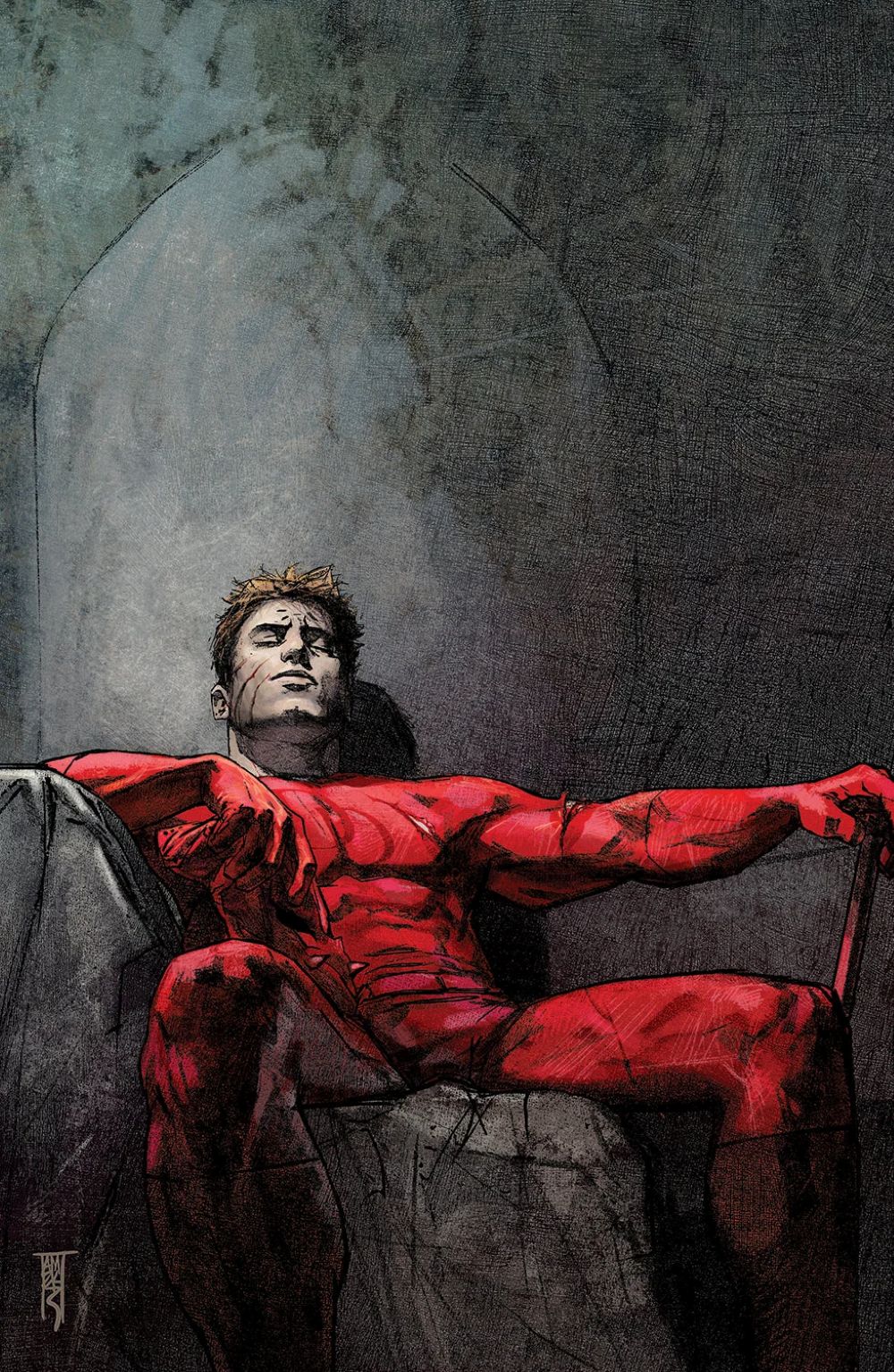
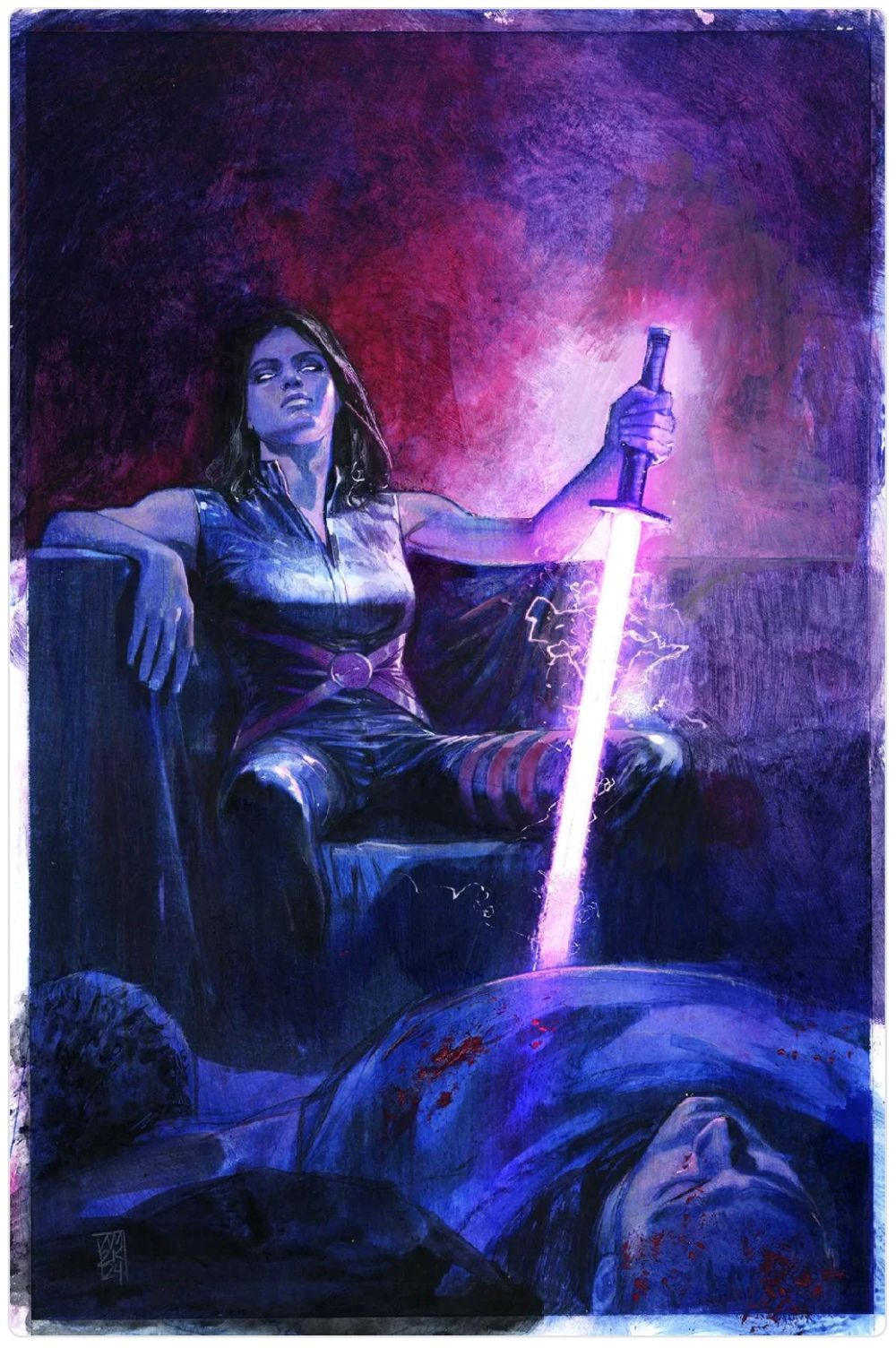
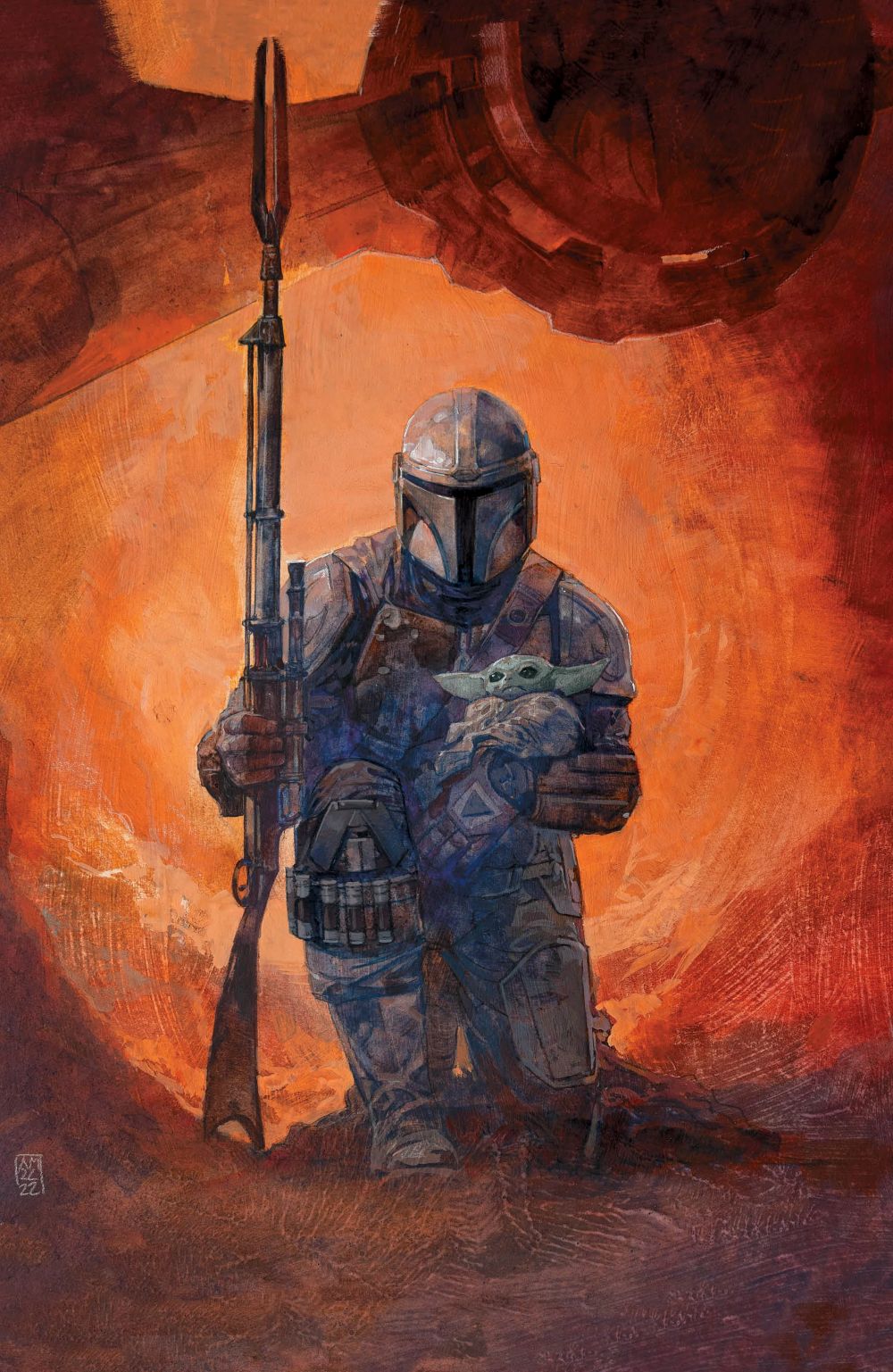
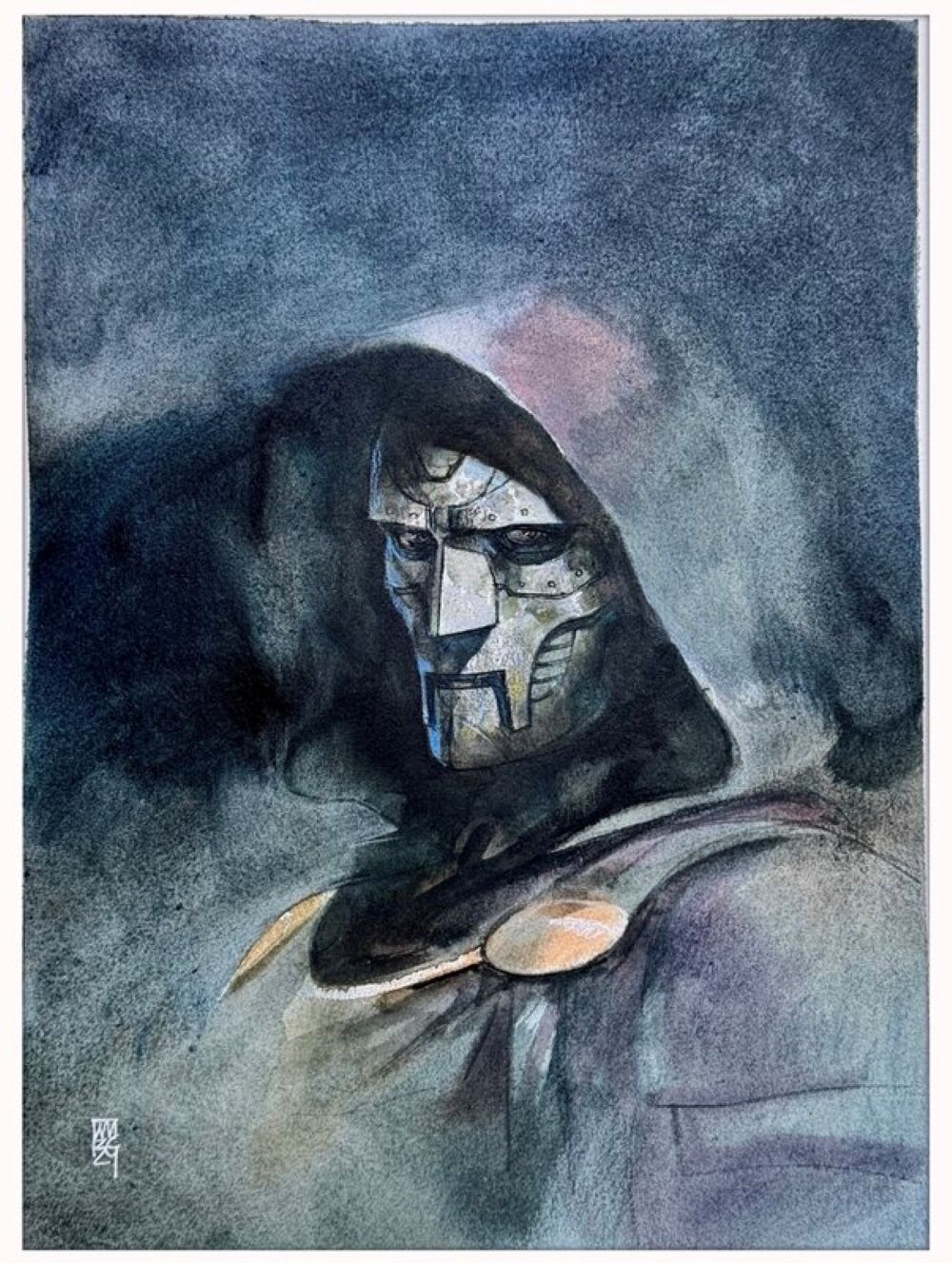
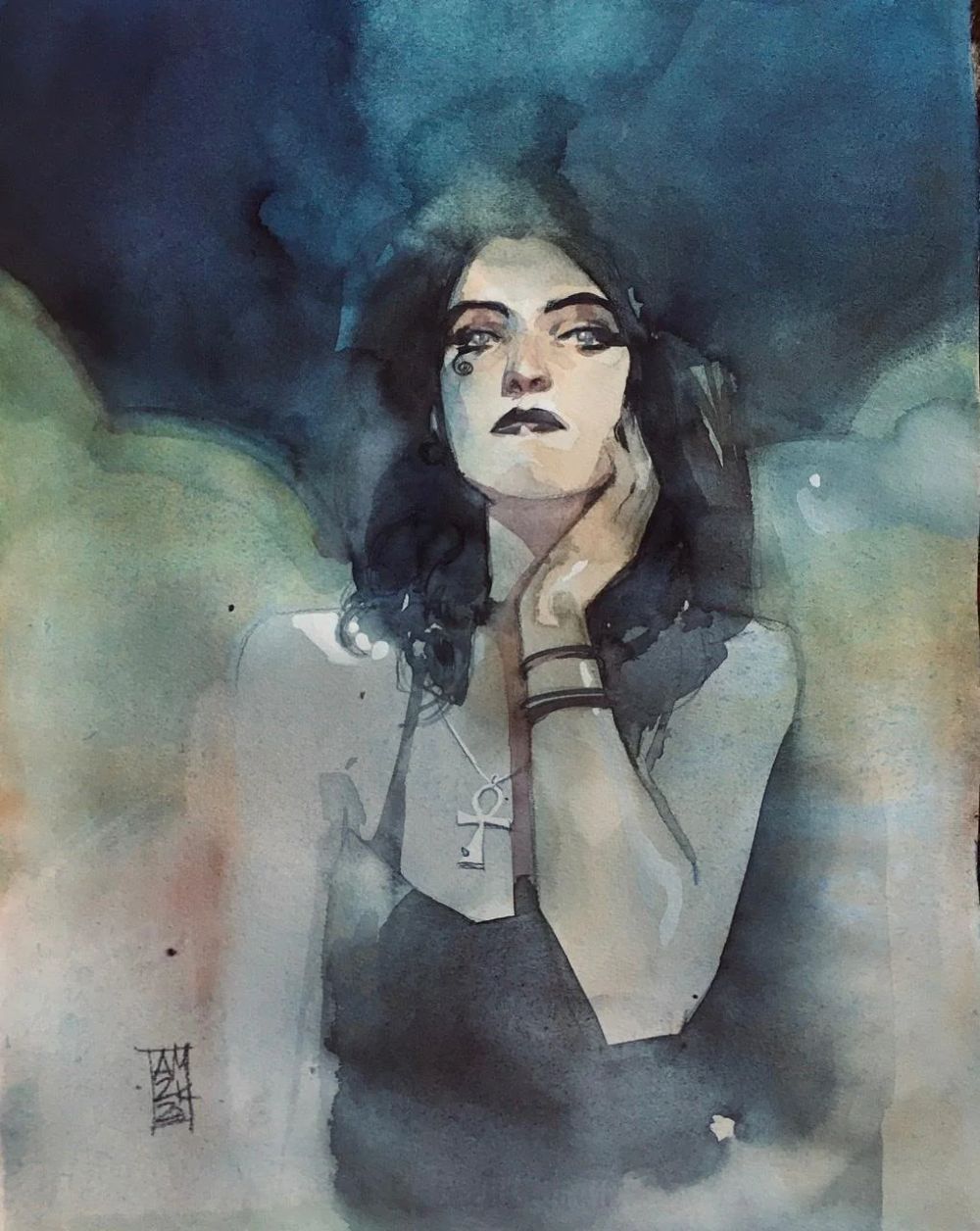
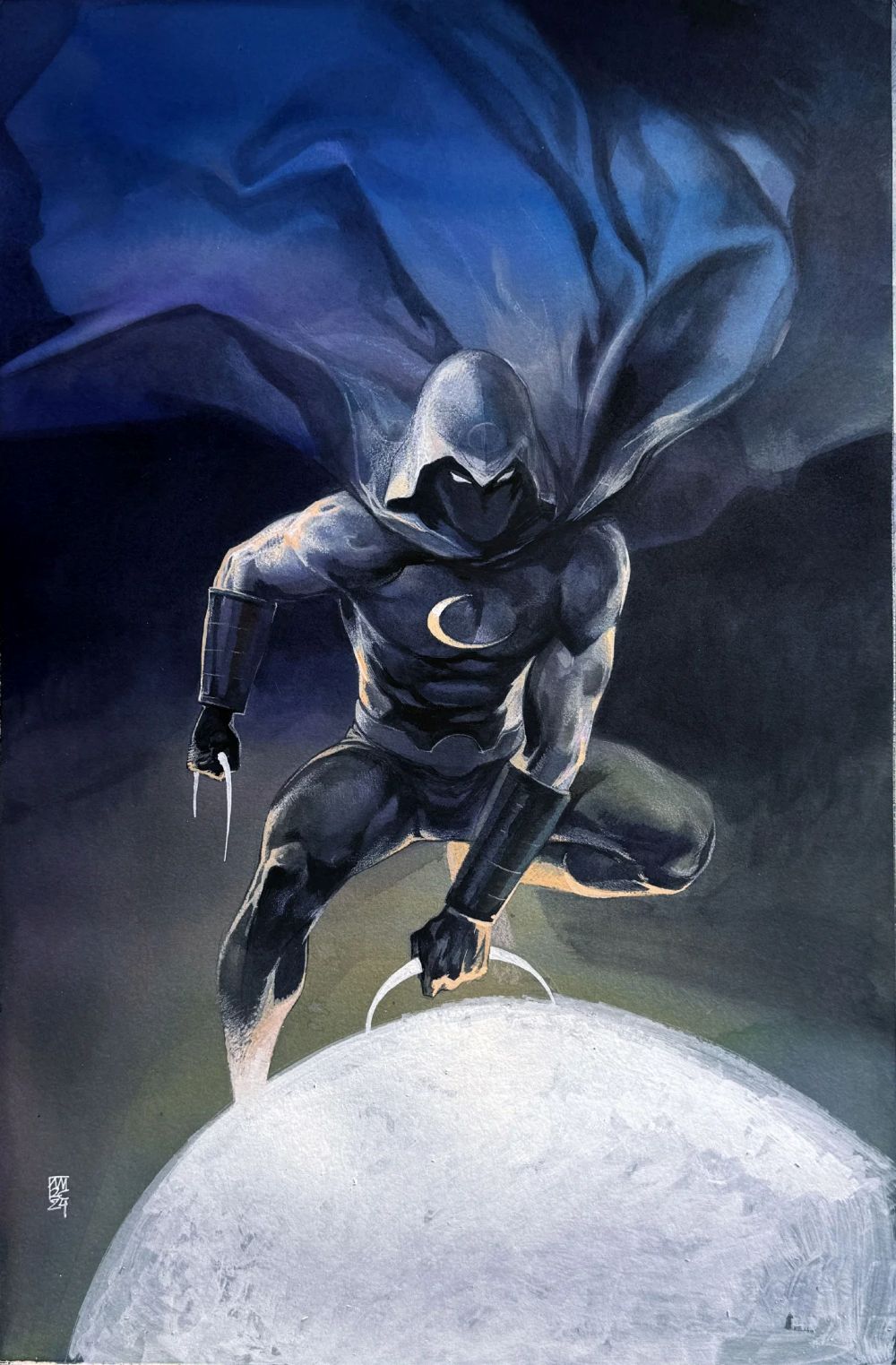
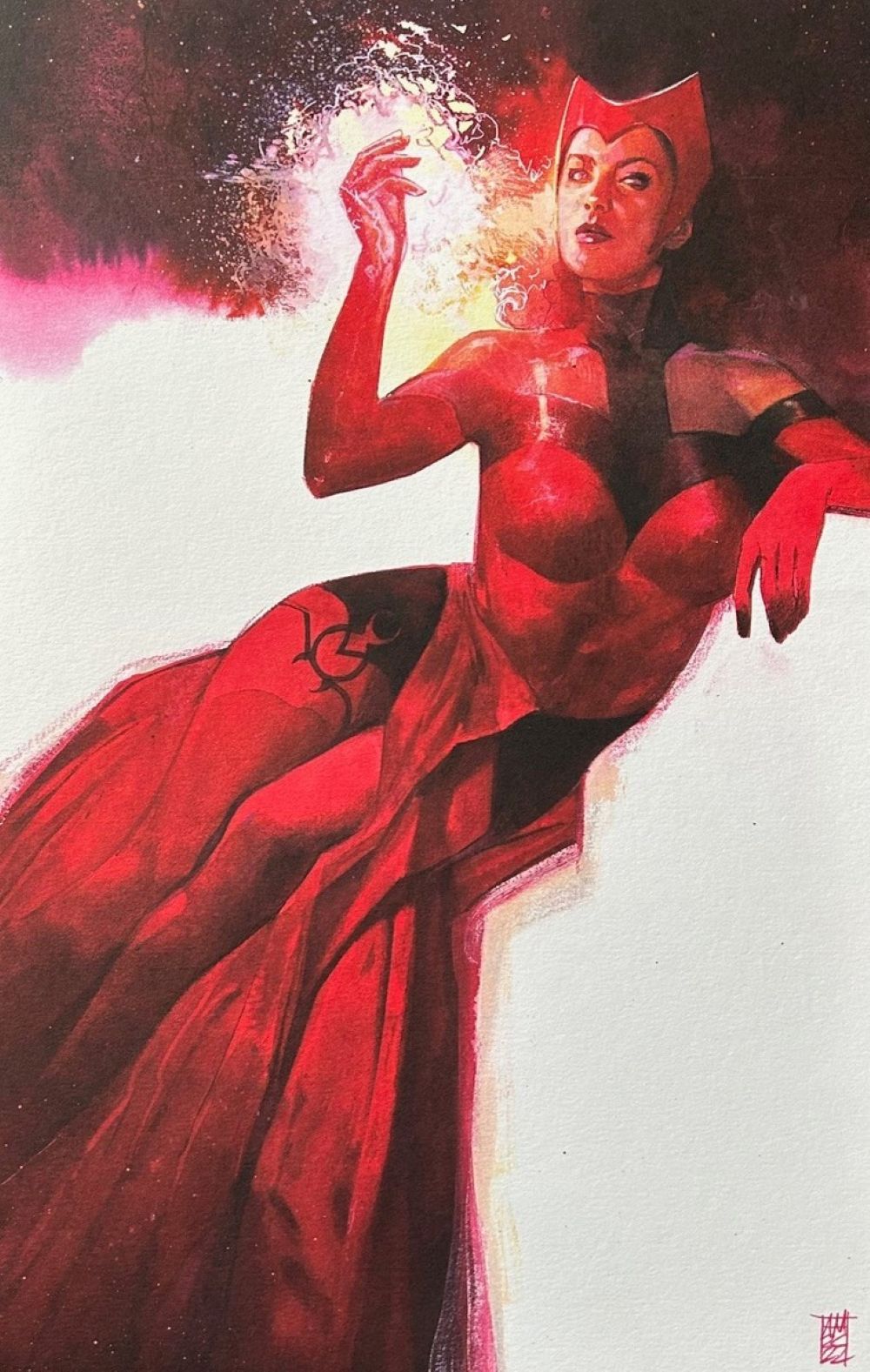
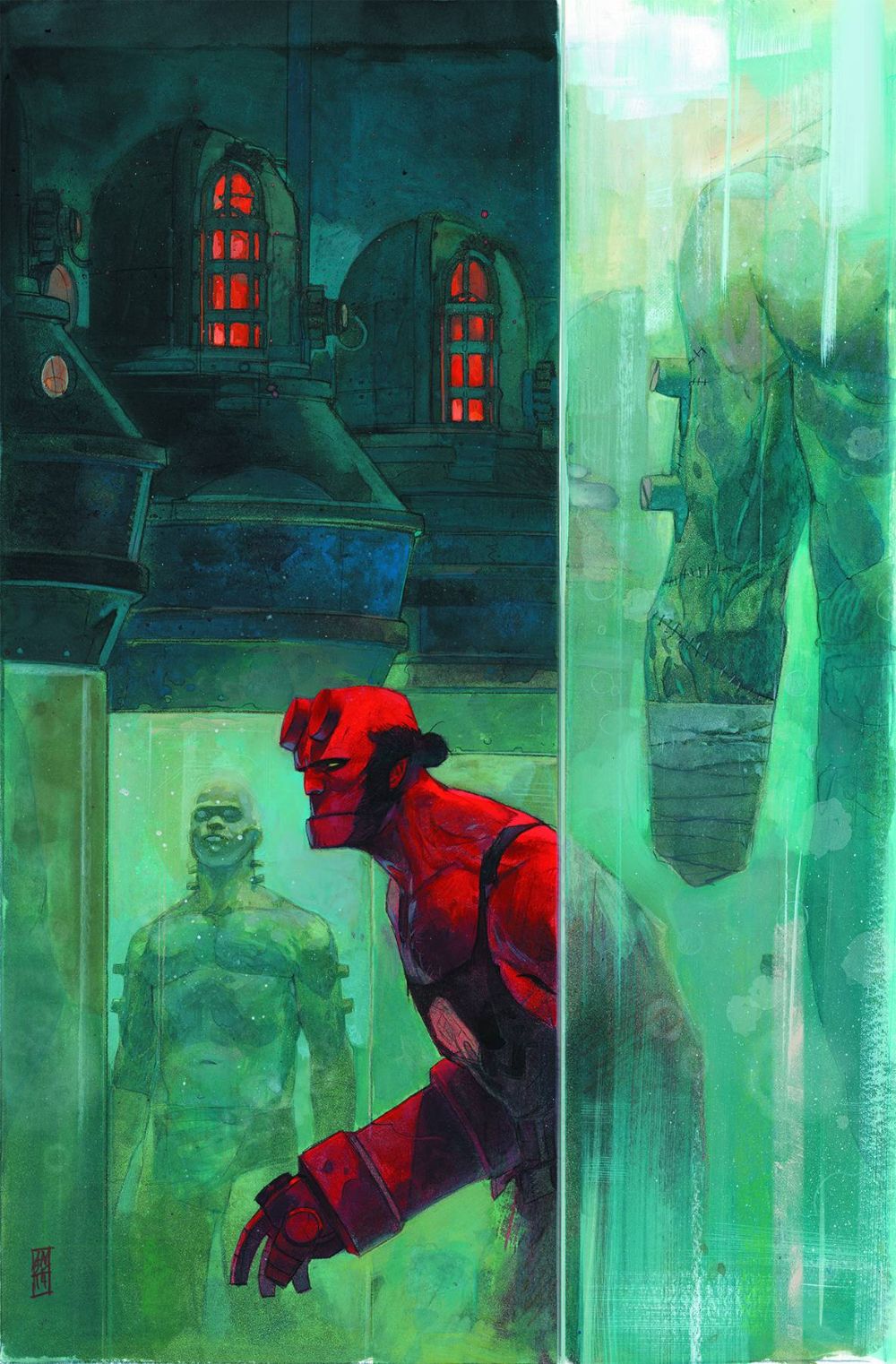
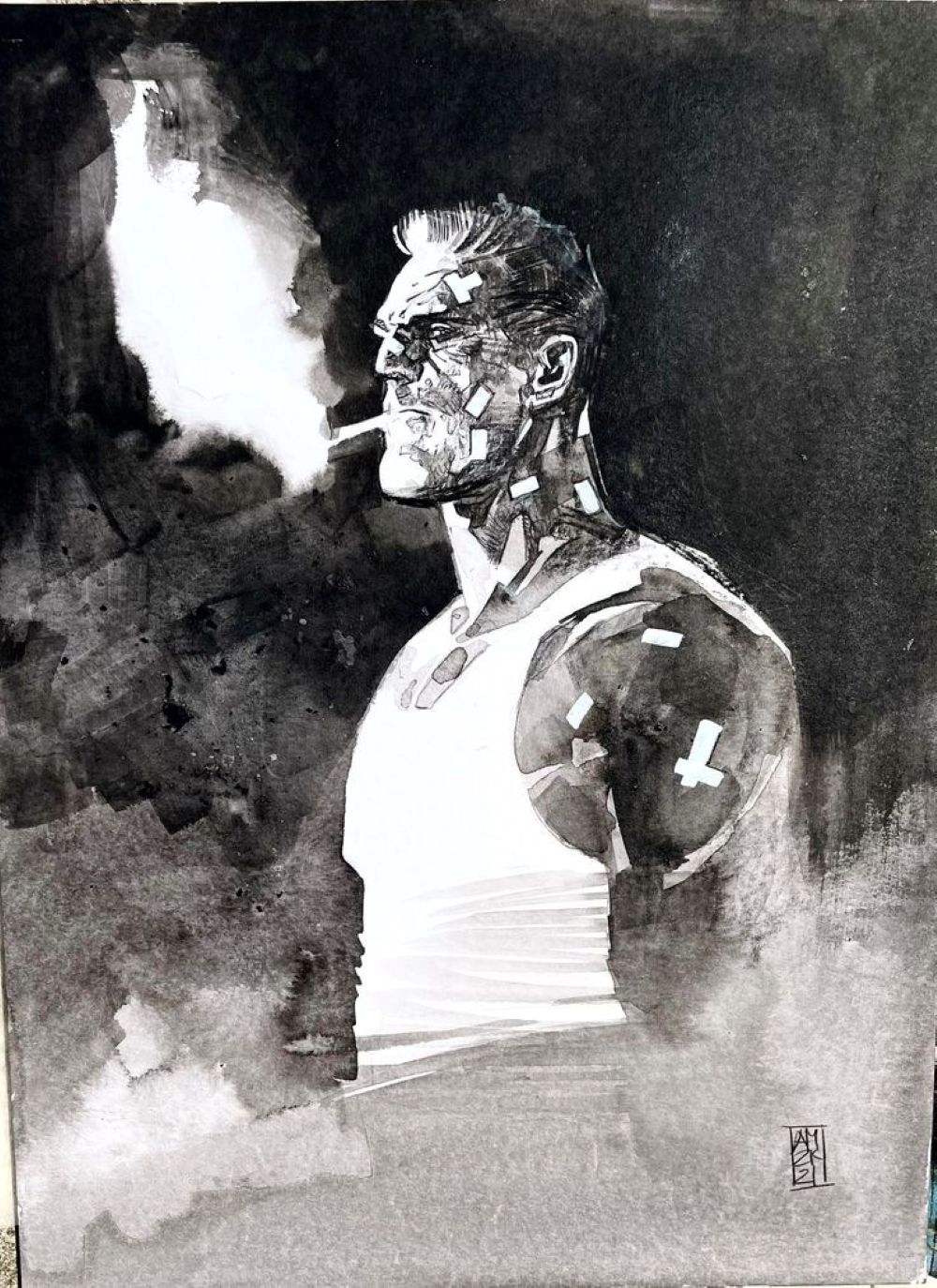
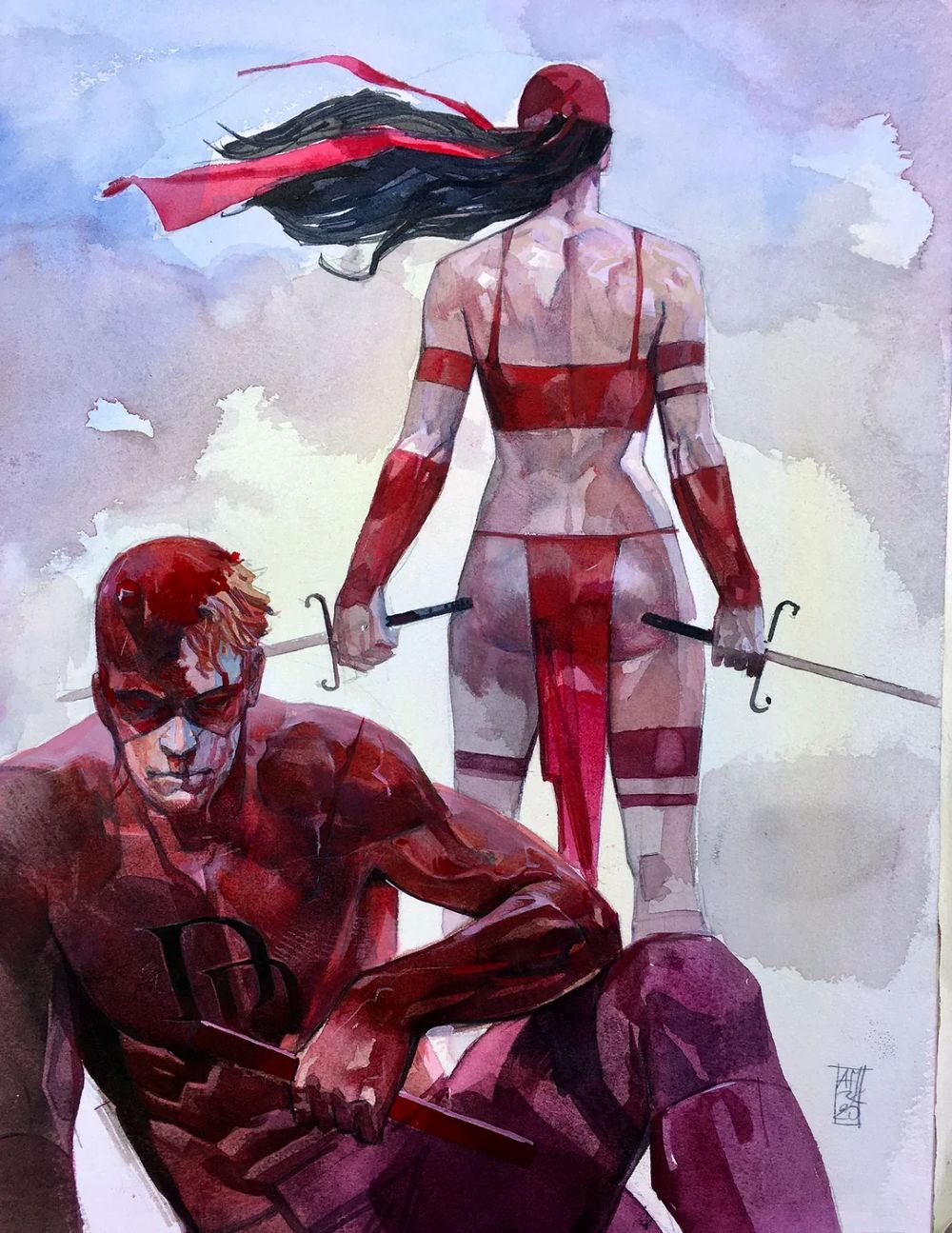
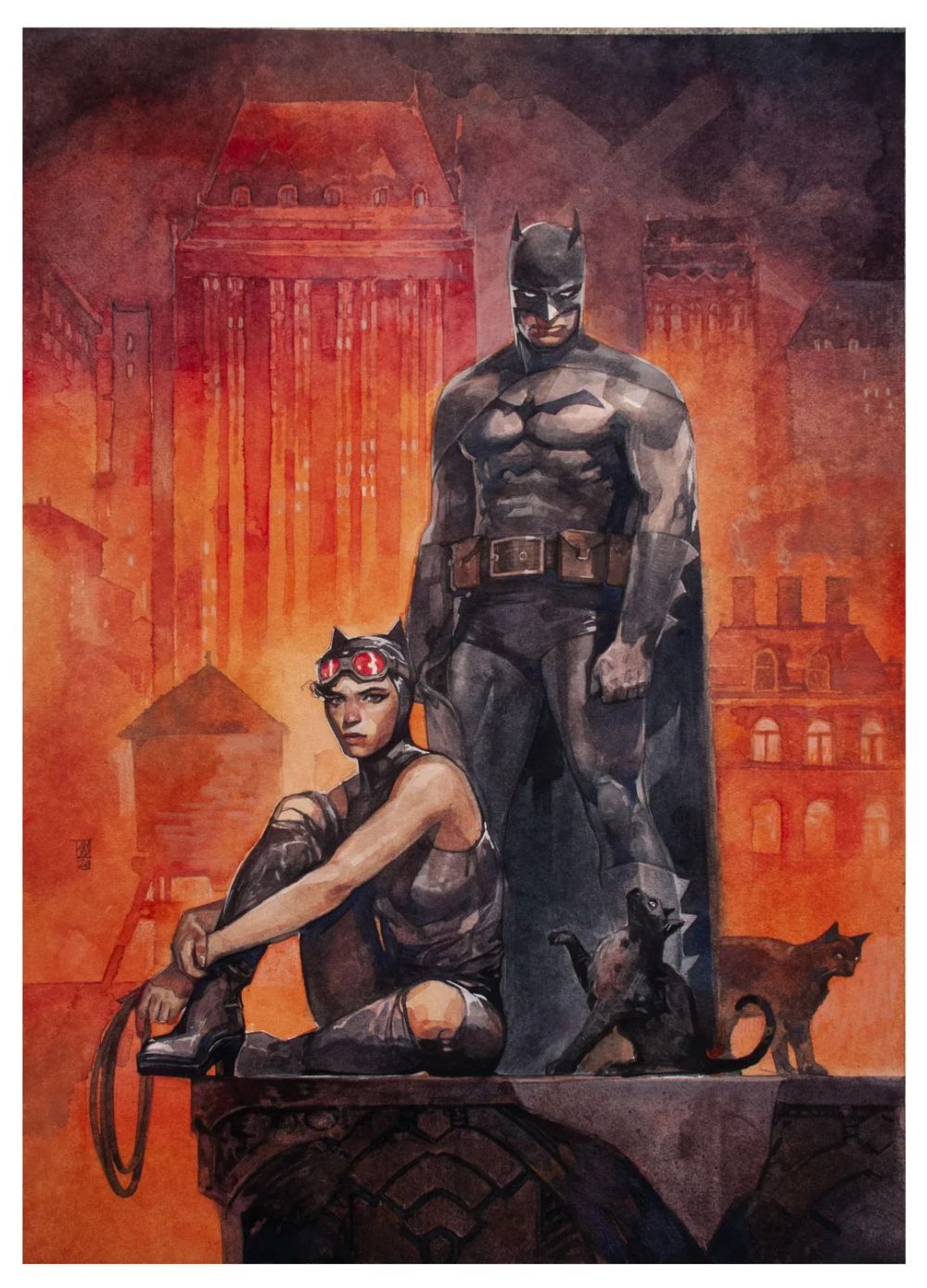
Alex Maleev’s work stands out because it makes superhero comics feel physically inhabited rather than merely illustrated. His figures are not polished icons frozen in clean, declarative poses; they look exhausted, wounded, watchful, and frighteningly close to the people one might pass on a city street. Through textured linework, severe shadows, photographic reference, digital manipulation, and painterly color, Maleev developed a noir-inflected visual language that lends even familiar Marvel characters a sense of emotional weather. The grime on a wall, the hard light on a face, or the oppressive darkness surrounding a figure can carry as much narrative force as dialogue. His approach favors mood, intimacy, and psychological pressure over conventional superhero spectacle, which is why his pages often feel closer to crime cinema or an urban thriller than to traditional four-color adventure comics.
That sensibility found its defining expression in his celebrated collaboration with writer Brian Michael Bendis on Daredevil. Maleev was not simply illustrating Matt Murdock’s stories; he helped redefine the character’s world as a bruised, morally unstable, and deeply personal version of Hell’s Kitchen. The Bendis–Maleev run brought a grounded visual credibility to Daredevil’s civilian life, legal battles, criminal enemies, and private anguish, making every close-up and every dimly lit room feel consequential. Their earlier work on Sam and Twitch, and subsequent collaborations including Spider-Woman, Moon Knight, Scarlet, New Avengers material, and Halo: Uprising, demonstrate how adaptable that partnership could be. Still, Daredevil remains the central achievement: an acclaimed run whose visual atmosphere helped establish the template for a darker, more adult, and more psychologically intimate kind of Marvel storytelling.
Maleev’s legacy is therefore not just that he produced memorable covers, faces, or grim cityscapes, but that he expanded what mainstream superhero art could communicate. At a time when the genre could easily default to glossy anatomy and kinetic bombast, he proved that visual discomfort, ugly realism, silence, and shadow could be as powerful as a splash page. His art also helped legitimize a more hybrid, mixed-media mode of comics illustration—one that uses painting, photography, design, and sequential storytelling without treating any of those tools as mutually exclusive. Emerging from Bulgaria’s comics scene before becoming a major American-comics figure, Maleev built a body of work that remains immediately recognizable: moody, tactile, cinematic, and relentlessly human.
“You don’t need a face to know who you are.” — Agent Graves
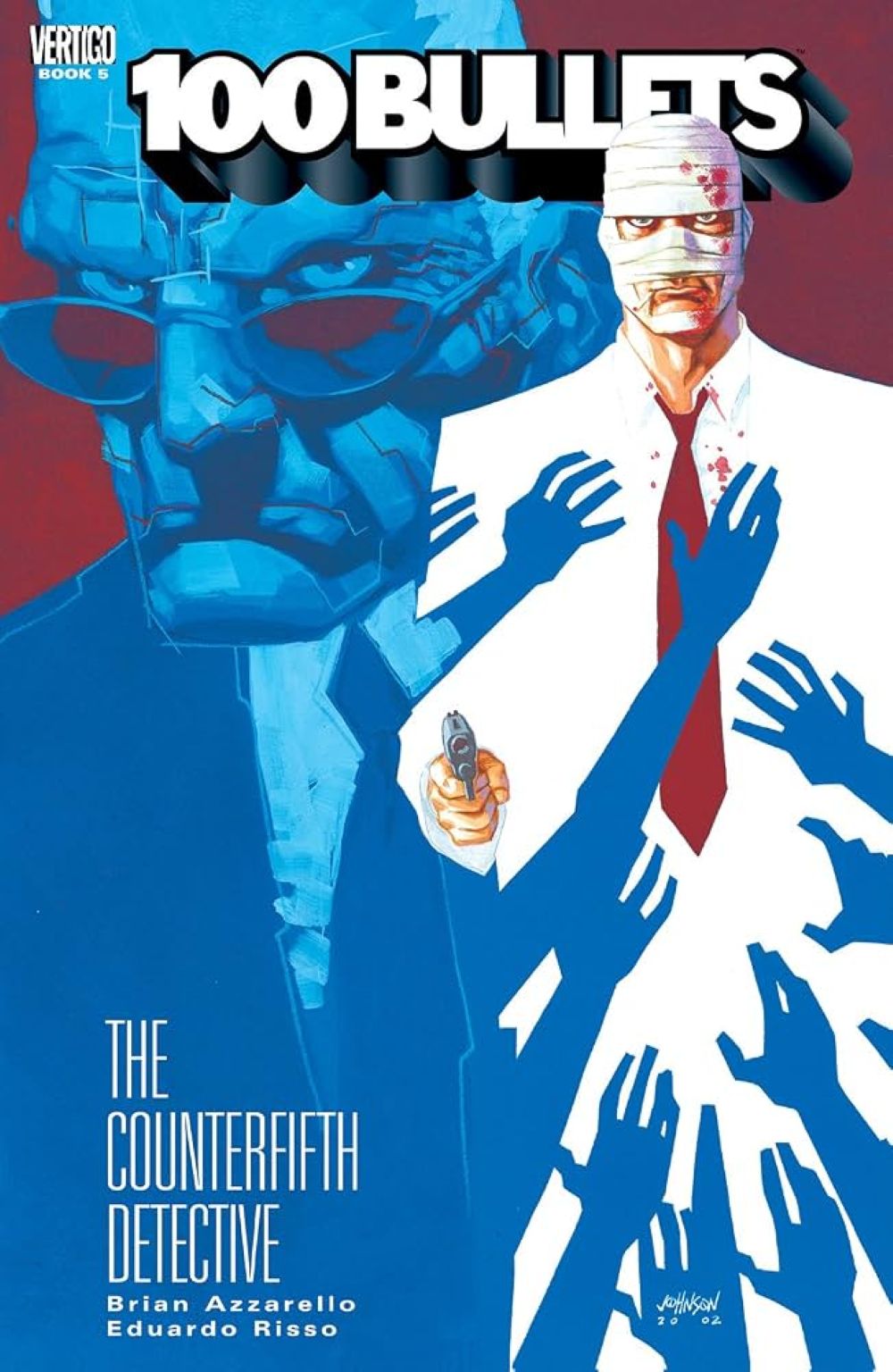
With The Counterfifth Detective, Brian Azzarello and Eduardo Risso pull 100 Bullets back toward the kind of hard-boiled detective story its title and visual style have been flirting with since the beginning. The series has spent four volumes building from Agent Graves’s deceptively simple revenge offer into a much wider conspiracy involving the Trust, the Minutemen, and a long list of people carrying old grudges, hidden loyalties, and enough baggage to sink a city block. This fifth collection does not exactly slow that larger story down, but it does give it a tighter, more focused mystery to work through.
The central character is Milo Garret, a Los Angeles private investigator who wakes up in a hospital after what appears to have been a very bad car accident. His face is wrapped in bandages, his memories are incomplete, and his life has somehow become even more miserable than the average 100 Bullets protagonist’s. Naturally, Agent Graves shows up at exactly the moment when Milo is vulnerable, angry, and looking for somebody to blame. Graves gives him the familiar attaché case containing a gun, proof, and one hundred untraceable bullets, then suggests that Milo’s accident may not have been accidental at all.
That setup brings the series back to its original premise, but there is an important difference this time. Milo is not merely an ordinary person presented with a chance to kill the person who ruined his life. He is a detective, or at least he very badly wants to be the kind of detective he has seen in old movies and read about in pulp novels. He drinks too much, gets knocked around constantly, talks like somebody trying to turn every conversation into a Bogart monologue, and keeps walking into dangerous situations because it is what he thinks a real private eye is supposed to do. It would be easy for that to become irritating, but Azzarello makes Milo’s self-conscious noir act part of what makes him interesting.
Milo is clearly performing an identity, even before the story begins questioning whether he really understands his own past. He treats the hard-drinking, wisecracking private detective routine like armor. With his face literally hidden beneath layers of bandages, he has even more reason to cling to the image of who he believes he is. That gives The Counterfifth Detective a stranger and more personal angle than the earlier revenge stories. Milo is not just trying to find out who hurt him. He is trying to find out what he has forgotten, why so many people seem to know more about him than he does, and whether the version of himself he believes in has ever been real.
The title itself is one of those Azzarello word games that sounds like nonsense until the book starts circling around identity, forgery, and false versions of the truth. Milo gets drawn into the search for a stolen painting, but the painting is not simply a MacGuffin to move the plot along. It becomes tied to memory, deception, and the larger secrets that have been buried around the Trust and the Minutemen. Like much of 100 Bullets, the plot does not always hand the reader clean explanations right away. People speak in half-truths, conversations seem to skip over the most important details, and every time Milo gets what looks like an answer, it creates two more questions.
That can make the volume feel deliberately tangled. Azzarello is not writing a traditional detective mystery where every clue fits neatly into place by the final chapter. This is a conspiracy story told from the point of view of a man who has been dropped into the middle of it with a damaged memory and a gun in his hand. Milo is confused because he should be confused. The reader is meant to feel that same instability as the people around him lie, betray each other, disappear, get beaten up, or turn up dead before they can explain what they know.
At the same time, this is one of the more accessible volumes since the early days of the series because Milo gives the story a strong point of view. A Foregone Tomorrow was important for expanding the scope of the Trust and making the Minutemen feel like a real part of the series rather than vague backstory, but it was also intentionally scattered. The Counterfifth Detective still feeds the larger mythology, yet it is built around one man trying to survive one increasingly ugly case. The result feels more focused, even when the actual plot becomes more complicated.
Agent Graves is especially effective here because his role has changed so much from the early volumes. He still presents himself as a man offering someone the tools to take revenge, but it is impossible to see him as a neutral facilitator anymore. Graves knows far more about Milo than Milo does. He is not just giving the detective a choice; he is guiding him toward a confrontation that has clear value in Graves’s wider war against the Trust. The attaché case remains a powerful symbol because it looks like freedom. It promises immunity, a weapon, and a chance to settle the score. But in this series, the case is never really freedom. It is an invitation into Graves’s game.
The presence of Lono also helps give the story some extra menace. Lono is one of the series’ most unnerving characters because he is not merely violent; he seems to enjoy making everybody else feel smaller, dirtier, and more helpless. Whenever he appears, the atmosphere immediately gets worse. He brings a kind of ugly unpredictability that contrasts nicely with Graves’s calm manipulation. Graves always seems like he has calculated the next ten moves. Lono feels like he might wreck the board just to hear the pieces crack.
Risso’s artwork continues to carry an enormous amount of the book’s personality. The bandaged Milo is a great visual creation because he looks both mysterious and ridiculous, like a cheap horror-movie monster trying to pass himself off as a tough guy. Risso finds the humor in that image without undercutting the danger around it. He is also excellent at making Los Angeles feel appropriately worn down and hostile. The city is not glamorous here. It is a place of cheap offices, dim bars, empty roads, battered cars, suspicious hotel rooms, and people who look like they have been awake for three days making terrible decisions.
His use of shadow remains one of the series’ biggest strengths. A room can be almost empty and still feel tense because of the angle of a lamp, the silhouette of somebody standing in a doorway, or the way a character’s face is half-covered by darkness. That visual approach suits a story about missing memories and hidden identities perfectly. Risso rarely needs to make a big flashy gesture to sell danger. Sometimes all it takes is someone sitting too calmly in the wrong place.
Azzarello’s dialogue is still sharp, vulgar, and often very funny in a nasty way. Not every line lands, and the characters can sometimes sound like they are competing to be the most quotable person in the room, but that heightened style has become part of the book’s identity. These are people who use tough talk as a weapon. They insult, threaten, flirt, and lie in the same breath because direct honesty would make them too vulnerable.
100 Bullets Vol. 5: The Counterfifth Detective is a strong installment because it combines the series’ expanding conspiracy with a satisfying noir setup. Milo Garret is not as immediately sympathetic as Dizzy Cordova or as tragically lost as Loop Hughes, but he is a memorable lead precisely because he is such an imperfect version of a classic private eye. He wants answers, revenge, and a sense of control, but the deeper he goes, the clearer it becomes that he may be chasing a life that was invented for him by somebody else.
This is not the cleanest or easiest 100 Bullets volume, and readers looking for every mystery to be fully explained may come away frustrated. But it is stylish, mean, funny, and packed with the kind of uneasy connections that make the larger series addictive. Azzarello keeps tightening the web around Agent Graves, the Trust, and the surviving Minutemen, while Risso makes every page look like it was pulled from the darkest corner of a crime film. By the end, Milo may have found some answers, but like everybody who accepts Graves’s offer, he has paid far more for them than he ever expected.
“On your feet, soldier. You’ve just been drafted. This is a war.” — Agent Graves
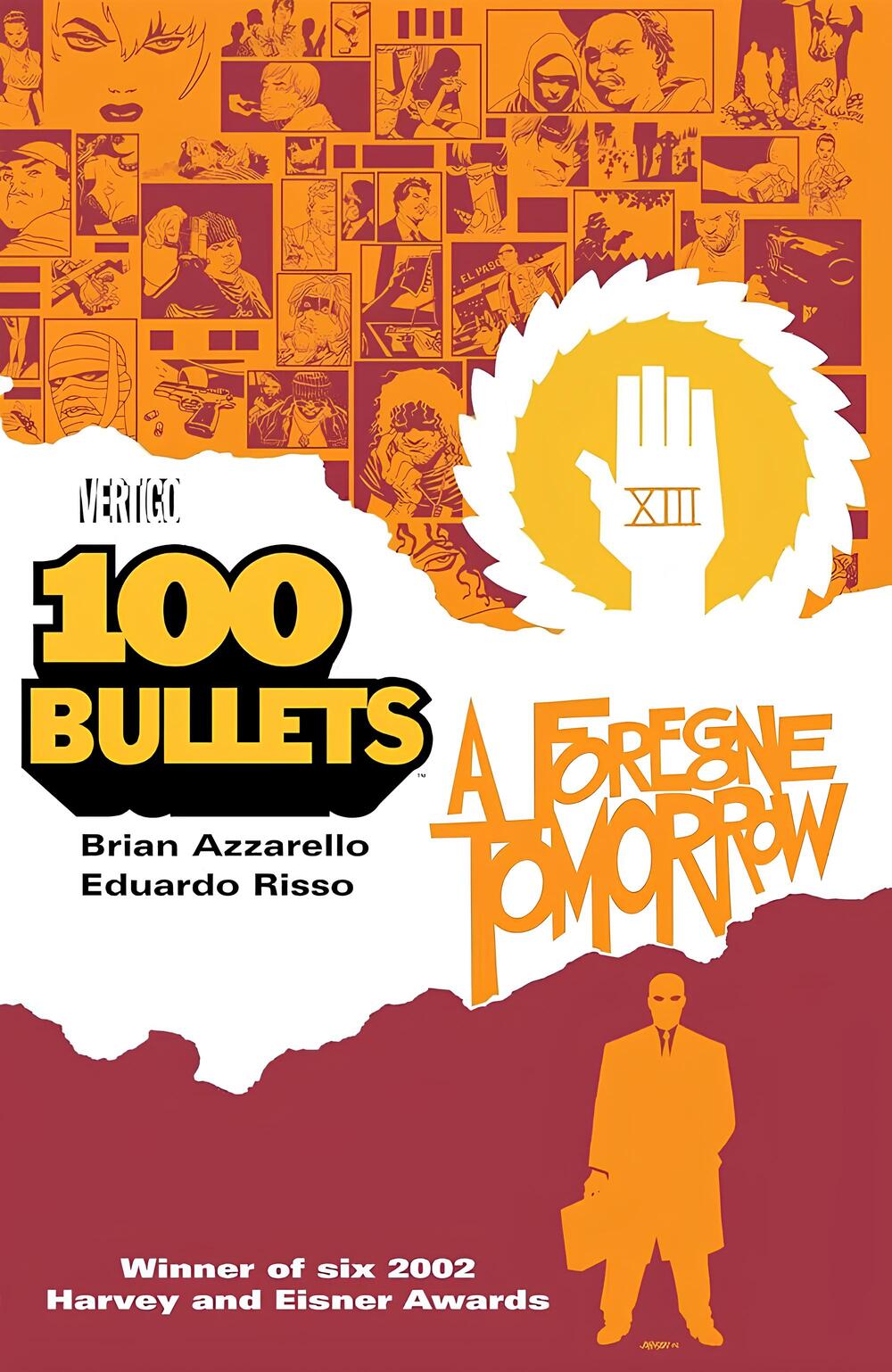
With A Foregone Tomorrow, Brian Azzarello and Eduardo Risso make it clear that 100 Bullets is done merely teasing the larger story behind Agent Graves, the Trust, and the Minutemen. The earlier volumes built their appeal around a very simple but powerful idea: Graves finds someone whose life has been ruined, hands them a briefcase containing a gun, proof, and one hundred untraceable bullets, then leaves them to decide what revenge is worth. That premise is still present here, but it no longer feels like the whole series. This fourth collection, which gathers issues #20-30, is where the long-running conspiracy really begins stepping out from the shadows. The Trust finally feels like a real organization rather than a few names being dropped in dark rooms, the Minutemen begin to take clearer shape, and Agent Graves starts to look less like a cryptic avenger and more like a man moving pieces around a board that only he fully understands.
The collection opens with “The Mimic,” and it is a good representation of what this volume does best. Azzarello ties together two conversations that seem unrelated at first: one involving Mr. Shepherd and Benito Medici, and another taking place at street level among people trying to survive in a world where even the smallest patch of territory has consequences. The contrast is important. On one side are the rich, insulated people who control entire criminal and financial networks without ever getting their own hands dirty. On the other are the desperate hustlers, dealers, addicts, and low-level criminals who are usually the first ones to bleed when those powerful people make a move. 100 Bullets has always had a strong sense of class anger under all the pulp dialogue and gunplay, but this volume puts that feeling more directly into the story.
Benito Medici is one of the most interesting additions here because he does not initially come across as the kind of polished, ruthless heir one would expect from the Trust. He seems immature, reckless, and more interested in enjoying the benefits of his family name than understanding what it costs other people. But Azzarello does not make him a joke. Benito is a spoiled rich kid, sure, but he is also a young man slowly realizing that he has been born into something dangerous and ancient. The Medici name gives him protection, money, and influence, but it also makes him a target. That uneasy realization gives his scenes some real tension. He is not just learning how much power his father Augustus has; he is learning that power in this world is never free.
The Trust itself is probably the biggest reason A Foregone Tomorrow feels like such a major turning point. Earlier books gave readers names like Augustus Medici and Megan Dietrich, along with hints about a hidden system that existed beyond regular crime families and street gangs. Here, the curtain gets pulled back much further. The Trust is revealed as a collection of powerful old families whose influence stretches across the country, while the Minutemen were created as their enforcers and internal police. The scope is suddenly much bigger than one person deciding whether to pull the trigger on somebody who wronged them. Agent Graves is not simply handing out opportunities for revenge. He is using those opportunities to destabilize a system that has spent generations protecting itself.
That expansion does make the book denser than the first three collections. Readers who liked the clean, self-contained revenge stories from First Shot, Last Call may need a little patience here. Azzarello is deliberately withholding information, and a lot of dialogue involves people speaking around the truth rather than plainly stating it. Characters mention events, names, and old betrayals that do not fully make sense until later. But that is also part of the fun. 100 Bullets is becoming a crime epic where every casual insult, odd coincidence, and brief appearance may eventually matter. The book trusts readers to keep up, and even when the plot gets murky, it rarely stops being compelling.
The Jack Daw material is probably the weakest portion of the collection, though it still has its uses. Jack is a huge, self-destructive junkie who already has one of Graves’s cases when the reader meets him. That is an interesting reversal of the usual formula because we do not see the initial pitch or the moment of temptation. We are instead dropped into the aftermath of a man who has already been given a chance to change his life and has clearly made a mess of it. Jack is not especially sympathetic, and the story never quite reaches the emotional impact of Dizzy Cordova’s or Loop Hughes’s earlier arcs. Still, he feels like another example of the kind of damaged person Graves is collecting. He is not a hero waiting to be awakened. He is a wrecking ball waiting for someone to point him in a direction.
The more memorable material comes from the way Azzarello keeps connecting old threads to new ones. Mr. Branch, who has spent much of the series trying to understand the conspiracy around Graves, becomes increasingly important as someone who sees patterns other characters are too close to notice. The story also takes a detour into the past with a strange, darkly funny episode involving baseball, Hollywood, and the Kennedy assassination. It is the kind of side story that might feel random in another series, but it works here because it reinforces the sense that Agent Graves has been active for a very long time. His briefcases are not a recent hobby. They are part of a much older game.
There is also an unexpectedly funny stretch involving a trip to Mexico, though the humor never makes the story feel safe. Azzarello has a talent for writing characters who can trade ridiculous insults and crude jokes one minute, then become frighteningly violent the next. That tonal balance is one of the things that keeps 100 Bullets from becoming unbearably grim. These people are living ugly lives in ugly places, but they still have personality. They still argue, posture, flirt, lie, and make each other laugh. The humor is usually mean, but it feels authentic to the world rather than forced comic relief.
Eduardo Risso remains the series’ secret weapon, even though by this point it is hard to call him a secret. His art gives every character an immediately recognizable silhouette and attitude. There are a lot of people in this volume, including gangsters, Trust members, old associates, street criminals, and potential Minutemen, yet Risso makes it easy to tell them apart. Benito looks like a privileged kid trying to wear confidence like a costume. Shepherd always carries himself with quiet control. Graves is still composed and unreadable, like somebody who has already calculated every possible outcome before entering the room.
Risso’s layouts are especially strong in the opening material, where different conversations and locations are visually paired to show how the powerful and powerless reflect each other. He can make a simple exchange in a park, a bar, or a hotel suite feel loaded with menace. His use of shadows, extreme angles, and stylized expressions gives the book its distinctive noir personality, but he never lets the style overwhelm the storytelling. You always know where to look and what emotional beat matters most. The guest pinup pages included around the original twenty-fifth issue are a neat bonus, though they do not have the same storytelling impact as Risso’s regular pages.
A Foregone Tomorrow is not as emotionally focused as Hang Up on the Hang Low, and it can feel more like a bridge volume than a completely self-contained story. But it is a very important bridge. This is where the series proves that its revenge setup was never just a clever anthology gimmick. The briefcases, bullets, and personal vendettas are all part of a larger conflict between men and women who believe they own the world and the people willing to burn that world down. By the end, Agent Graves is still mysterious, the Trust is still dangerous, and the Minutemen are only beginning to emerge from the past. But the road ahead is much clearer, and much more threatening.
100 Bullets Vol. 4: A Foregone Tomorrow is a strong, complicated, and occasionally messy installment that rewards readers who have been paying attention. Azzarello continues building the series into a sprawling noir conspiracy filled with damaged people, crooked power structures, and revenge that never comes without a price. Risso keeps the whole thing looking stylish, dangerous, and alive. It may not be the easiest volume to jump into, but for anyone following the series from the beginning, this is the point where the larger machine finally starts roaring to life.
“I never told you to kill him. I just gave you the opportunity.” — Agent Graves
With Hang Up on the Hang Low, Brian Azzarello and Eduardo Risso continue to prove that 100 Bullets is far more than a series about revenge fantasies and mysterious briefcases. The first two collections introduced the basic concept of Agent Graves approaching damaged people with a gun, one hundred untraceable bullets, and proof of who ruined their lives. That premise was already strong, but this third volume starts showing just how much uglier and more complicated the world around Graves really is. This is where the series begins to feel less like a set of loosely connected crime stories and more like a large, carefully constructed noir epic. The revenge angle is still present, but it is no longer the whole point. The people who receive Graves’s offer are getting pulled into a much bigger machine, whether they realize it or not.
The main character this time is Loop Hughes, a young man who has spent much of his life acting tougher, smarter, and more connected than he actually is. He is a small-time street hustler, someone who talks a good game but clearly has no real direction in life. That makes him an interesting choice for Agent Graves. Loop is not someone who has already been crushed by a terrible tragedy in the same direct way as Dizzy Cordova or Lee Dolan. His grievance is more personal and more complicated: his father, a man known as the Rain, abandoned him and his mother when he was still a child. Loop has built up years of anger around that absence, even if he has never really known what to do with it.
When Graves gives Loop one of his trademark attaché cases, it seems at first like another straightforward setup. Loop has the gun, the bullets, the evidence, and the freedom to act without legal consequences. The temptation is there, and Azzarello makes it easy to understand why Loop would want to pull the trigger. The Rain did not just leave; he left a hole in Loop’s life that the younger man has filled with insecurity, bravado, and bad decisions. But the story becomes much more interesting when Loop finally finds his father and discovers that the Rain is not some helpless old man waiting to be punished. He is deeply involved with dangerous people and has his own place in the criminal underworld.
That is where Hang Up on the Hang Low really finds its momentum. Rather than immediately becoming a story about a son taking revenge on his father, it turns into a story about Loop being drawn into the world that helped create his father in the first place. The Rain is connected to organized crime, old grudges, and the kind of people who can make a murder look like business as usual. Loop thinks he is finally getting some answers, but every answer only opens another door to something worse. He is in well over his head almost from the beginning, and the book does a great job of making the reader feel that constant pressure.
Loop is one of the more sympathetic characters in the series so far because, underneath all of his posturing, he does seem to have a conscience. He is not innocent, exactly, and he certainly makes some dumb choices, but he is not naturally cruel. He wants respect, money, and an explanation for why his father left, but he also cares about people in a way that many of the hardened gangsters around him do not. Azzarello does not turn him into a saint, though. Loop is still immature and easily manipulated, which is exactly why his journey through this volume becomes so tragic. He keeps thinking he has found a way to gain control over his life, only to learn that somebody else has already decided the terms.
Agent Graves remains the most fascinating figure in the book. In the early volumes, he could be seen as a mysterious avenger or a kind of grim wish-fulfillment figure, handing victims the tools to get justice on their own terms. This collection makes him feel more unsettling than heroic. Graves is not necessarily lying to Loop, but he is absolutely steering him toward a result that serves some larger purpose. He is a man who sees people as pieces on a board, and even when he gives them a choice, it is hard to believe that he does not already have an idea of how they will respond. The briefcase may offer freedom from prosecution, but it never offers freedom from consequences.
The book also continues expanding the larger mythology involving the Trust and the Minutemen. Azzarello is still not explaining everything, and that can be frustrating if someone wants clean answers right away. At the same time, the lack of full explanation is part of what gives 100 Bullets its pull. The reader gets the sense that every crime boss, stray conversation, and seemingly random killing could matter later. People who initially seem like minor players keep revealing hidden ties to the larger conspiracy. Even the deaths and betrayals carry an extra weight because they do not feel random. This series is building toward something, and by the end of this volume it is clear that Graves has been setting events in motion for a long time.
Eduardo Risso’s artwork continues to be one of the best things about the series. His characters look stylized without ever feeling too cartoonish, and he gives every person a distinct physical presence. You can tell who is dangerous just by the way they stand in a room. You can tell who is nervous by the way they avoid eye contact. Risso’s visual storytelling is especially effective in the bar scenes, street confrontations, and quiet moments when characters are trying to decide whether to trust someone. He knows how to make a room feel crowded, seedy, and tense without overloading the page with unnecessary detail.
Risso also has a great eye for the ugly atmosphere of this world. The bars look worn down, the apartments feel cramped, and the city streets always seem like they are one bad decision away from turning violent. The noir influence is obvious, but it does not feel like a cheap imitation of old detective stories. It feels more like a modern crime story filtered through noir imagery: low lighting, cigarette smoke, suspicious looks, crooked power structures, and people who keep trying to escape the past only to be dragged deeper into it. The coloring helps the art stand out as well, giving the grimy environments and tense confrontations a little extra visual bite without making the book look overly polished.
The ending is what really makes the volume stick. Azzarello does not rely on a giant surprise twist so much as a sense of inevitability. You can see the bad outcome coming, but that does not make it any easier to watch. Loop spends most of the story trying to become somebody who matters, somebody with control and power, and the cruel part is that the criminal world is more than happy to let him feel that way for a little while. By the time reality catches up with him, he has learned that the people offering him opportunity were never offering him a real way out.
100 Bullets Vol. 3: Hang Up on the Hang Low is the strongest collection in the series so far. It has a more focused central story than Split Second Chance, while still pushing the wider conspiracy forward in a meaningful way. Loop is a memorable lead because he is flawed, angry, and trying desperately to look fearless when he is really just lost. Azzarello keeps the dialogue sharp and streetwise, Risso keeps every page visually charged, and the larger story continues to get more dangerous the more we learn about it. This is the point where 100 Bullets stops merely promising that it has a major story to tell and starts delivering on that promise.
“Asking questions is free… but the answers—they can cost you your life.” — Agent Graves
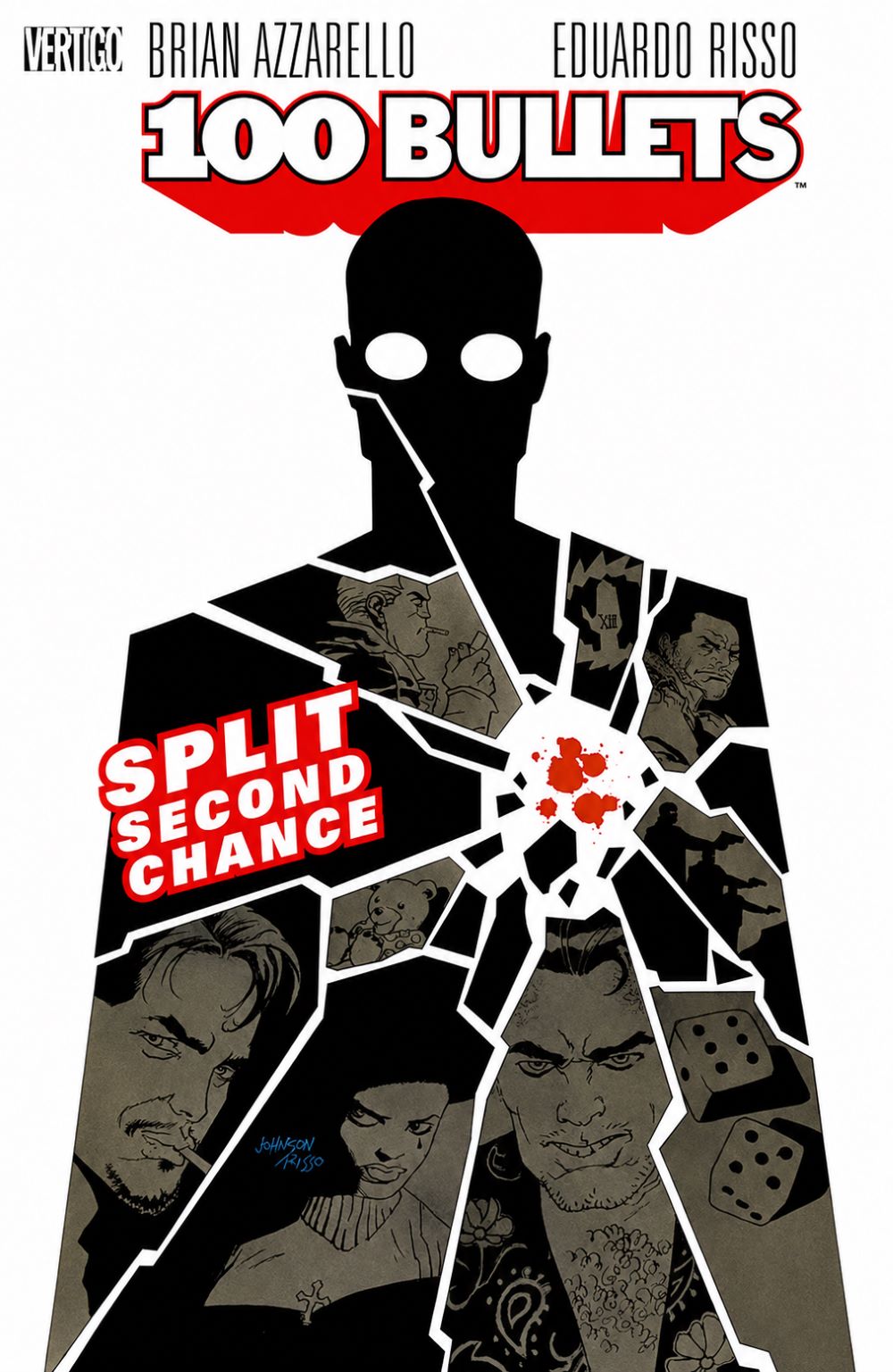
In the first volume of 100 Bullets, Brian Azzarello and Eduardo Risso laid down a stunning thesis for their magnum opus: a world where the wronged are offered the ultimate temptation of consequence-free vengeance. That volume, First Shot, Last Call, functioned as a potent thematic introduction, establishing the series’ central moral quandary through self-contained stories. With Split Second Chance, the creative team makes a crucial pivot. This collection, gathering issues #6-14, successfully preserves the gritty, anthology-style explorations of revenge while beginning to weave a much larger, more intricate conspiracy that feels poised to consume everything in its path. If the first book was a promise, this second volume is the first, gripping step toward its fulfillment, even if it occasionally stumbles under the weight of its own ambition.
The volume opens with “Short Con, Long Odds,” a two-part story that initially feels like familiar territory. We are introduced to Chucky, a small-time gambler fresh out of prison, who is approached by Agent Graves. As before, Graves offers incontrovertible proof of a betrayal and the tools for retribution—this time against Chucky’s childhood friend, Pony, who has seemingly built a successful gambling empire on his partner’s misery. What makes this story stand out is its focus on the petty, desperate world of gambling. Risso’s art is especially potent here, capturing the sad, seedy underbelly of street-corner hustles and back-alley games. The story’s conclusion, which unfolds off-panel, is a masterclass in implication, leaving the reader to piece together the grim aftermath. It is a solid entry that reinforces the series’ core premise, but its real purpose becomes clear retroactively as the larger plot comes into focus.
This is the volume where the series’ title begins to earn its meaning. Agent Graves is no longer just a cipher; he is revealed to be a man with a history, and Split Second Chance doles out those histories with deliberate, tantalizing precision. The most significant revelation comes in “Day, Hour, Minute… Man,” where we learn about The Trust and the enigmatic Minutemen. This arc peels back the curtain, suggesting that Graves and his associate, Mr. Shepherd, were once part of this shadowy organization before faking their deaths to escape its clutches. The introduction of Lono, the chilling hitman from the first volume’s “The Samurai,” becomes far more significant. His meeting with Graves is charged with a dangerous, unspoken history, confirming that Graves’s “gifts” are a part of a larger, more personal agenda. The plot is thickening nicely, and the promise of a sprawling, interconnected narrative starts to feel exhilaratingly real.
However, it is in the standalone stories that Azzarello’s writing truly shines, showcasing his ability to extract raw, human emotion from his noir framework. The standout is undoubtedly “Heartbreak, Sunnyside Up,” a single-issue story that follows a hard-working diner waitress named Rose. Rose’s life is a grinding cycle of poverty and worry for her runaway daughter. When Agent Graves appears, he doesn’t just offer her a gun and a target; he delivers a slow, agonizing explanation of how her daughter became a heroin-addicted prostitute after being molested by her own father. It is a moment of pure, unflinching tragedy. The brilliance of the story lies not in the revenge itself, but in the horror of the revelation. Azzarello forces the reader and the character to sit with the unbearable truth, making the subsequent act of violence feel less like empowerment and more like a desperate, last resort. It serves as a powerful reminder that “sometimes evil is closer to home than we think.”
“The Right Ear, Left in the Cold” offers a fascinating twist on the formula by introducing Cole Burns, a deadly assassin living undercover as a neighborhood ice cream man. This story introduces the concept of the “sleeper agent,” a tool that Graves and Shepherd can “reactivate” for their own ends. Cole is a more capable and cold-blooded protagonist than the average victim, which makes his story less about moral choice and more about professional obligation. Yet, it deepens the mythology, showing that Graves has an entire network of operatives at his disposal, further blurring the line between righteous avenger and puppet master. His ultimate task of retrieving the briefcase from Dizzy Cordova in the final arc, “Parlez Kung Vous,” masterfully ties this new plot thread back to the series’ very first protagonist.
Throughout it all, Eduardo Risso’s artwork remains the series’ undeniable and consistent anchor. His style, which perfectly captured the cold, deliberate mood in the first volume, continues to excel in Split Second Chance. Risso’s panels have a cinematic rhythm; his compositions are economical yet expressive, using deep shadows and stark contrasts to build a world that feels dangerous and morally unstable. He excels at conveying unspoken tension and character attitude through posture and expression, a vital skill for a noir story where much is left unsaid. While some readers may find the depiction of female characters hyper-sexualized, Risso and colorist Grant Goleash unquestionably create a visual language that is sleek, uneasy, and unmistakably noir. The story’s pace may occasionally lag, but the art is always arresting.
100 Bullets: Split Second Chance is a more challenging and rewarding book than its predecessor. It sacrifices some of the first volume’s focus and self-contained impact to lay the foundation for something much grander. This is the volume where the series starts to earn its reputation for dense, interwoven plotting. It is a work of deliberate, intricate world-building that asks the reader to be patient and pay close attention. It is not without its flaws—some stories feel more like necessary setups than complete narratives, and the unrelentingly grim tone can be exhausting. Yet, the moments of genuine human tragedy, like Rose’s story, and the thrilling expansion of the central mystery make Split Second Chance an essential step in the journey. It confidently expands the world of 100 Bullets, deepening its mythology and proving that this is a saga built for the long haul.
Happy Birthday in Heaven to one of my all time favorite actors, Rutger Hauer. I was so happy when his career hit a resurgence in 2005 with roles in SIN CITY and BATMAN BEGINS. Today, I’m celebrating my wife’s birthday, and I’m also celebrating Rutger’s birthday by sharing this scene from the amazing SIN CITY.
Enjoy my friends, and Happy Birthday Rutger! You have brought me so much joy over the years!
Hard to imagine it’s been 9 years since the original Sin City hit the big screen. It was a comic book adaptation that many thought wouldn’t work, especially how Rodriguez envisioned it to be slavishly loyal to not just Miller’s dialogue but also his unique art style.
The original film’s success quickly ramped up rumors that a sequel was already being planned using the second graphic novel in the Sin City series. Rodriguez himself stated he wanted Angelina Jolie for the role of Ava Lord, the titular “Dame to Kill For”, but after years and years of delay the role finally landed on Eva Green‘s lap (not a bad choice and one I fully support).
So, we’re now going back to Basin City for more tales of booze, broads and bullets in this hyper-noir film that should be loved or hated in equal measures by those who have followed Frank Miller’s career. Once again the directing duties have been split between Rodriguez and Miller. Here’s to hoping that Miller has learned how to be a much better directer after his last film, The Spirit, tanked.
Sin City: A Dame to Kill For is set for an August 22, 2014 release date.
Last Friday, I went and saw Zack Snyder’s new film Sucker Punch with my sister Erin and a group of our friends. Sucker Punch was a film that I had been looking forward to seeing for a while and not even all of the scathingly negative reviews that I read before leaving for the theater could dampen my enthusiasm. Somehow, I knew I would love this film (despite the fact that Zack Snyder is, usually, one of my least favorite directors). And you know what? I did love it.
The plot has been criticized for being both overly complicated and not being complicated enough and I actually think that a case can be made for either one of those complaints. The film opens in the 1950s. Teenage Babydoll (Emily Browning) is sent to a mental asylum by her evil father. Her father has made a deal with an orderly named Blue (Oscar Isaac) to have Babydoll lobotomized. (By the way, this was actually a pretty common thing back in the 50s. I shudder to think what would have been done to me if I had been born five decades earlier.) As Babydoll waits for her lobotomy (scheduled to occur at the end of her first week as a patient), she is subjected to the therapy of Dr. Gorski (Carla Gugino) who plays music and encourages her (all female) patients to find peace by controlling their fantasies.
Suddenly, we’re in a fantasy (just who exactly is having the fantasy is one of the film’s mysteries that’s never really explained but is actually kinda fun to debate). In the fantasy, the insane asylum is actually a brothel/dance hall that is owned by Blue. Gorski is a choreographer. The patients are now all lingerie-clad dancers/prostitutes. Babydoll is the latest girl to be put into service in the brothel and she is being held over for “the High Roller” who is expected to show up in five days.
(The fact that the movie explicitly compares forced lobotomy to rape is one of the many interesting facts that the majority of negative reviews have chosen to ignore.)
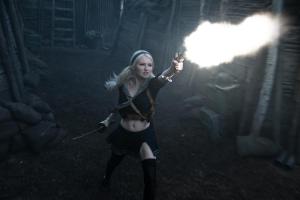
Babydoll soon discovers that 1) she’s such a good dancer that when she does dance, men can only watch in stunned silence and 2) whenever she does dance, she finds herself transported into a fantasy world where, along with getting advice from the Wise Old Man (Scott Glenn), she also battles (and defeats) everything from giant Samurai to dead Nazis who have been reanimated by “steam power” to a dragon. These battle scenes, as odd as they are, are actually pretty exciting. Say what you will, Snyder knows how to direct a battle scene and Browning and the rest of the almost entirely female cast all seem to be having a blast getting to do the type of things that usually, only boys are allowed to do.
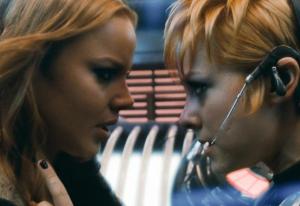
Anyway, as a result of her fantasies, Babydoll comes up with a plan to escape the brothel. She quickly recruits four other girls into her plan — Amber (Jamie Chung), Blondie (Vanessa Hudgens), the free-spirited (and really, really cool) Rocket (Jena Malone) and finally Rocket’s older sister, the world-weary Sweatpea (Abbie Cornish). In order to escape, they need to steal four different items. While Babydoll distracts their captors by dancing (and therefore going into one of her battle fantasies), the others steal whatever is needed. And everything works out just fine. Until it doesn’t….
Sucker Punch is a glorious mess of a movie and, perhaps because I’m a glorious mess myself, I loved it. In fact, it’s probably my favorite film of 2011 so far. In this regard, I know I’m going against the majority but so what? Throughout history, if one thing has always been consistent, it is that the majority sucks. Yes, Sucker Punch is a deeply flawed film that runs on for at least half-an-hour too long. And yes, I think it can be argued quite convincingly that this film is ultimately a happy accident, a film that’s strength comes not from directorial design but instead as the result of a few random elements that resonate in the subconscious. But no matter — happy accident or not, I loved Sucker Punch and I’m not ashamed to admit it.
Hmmm…that’s a familiar pose.
Let’s start with a few obvious points. As even those who hate this film seem to be admitting, it’s visually stunning. The battle scenes are kinetic and exciting, the film’s over-the-top production design (a mix of German Expressionism, 50s film noir, Bob Fosse choreography and old Zack Snyder films) is always a blast to look at, and the soundtrack kicks ass. Like other films in the so-called “Girls with Guns” genre, Sucker Punch allows its actresses to be something other than just scenery or helpless damsels.
Interestingly enough, for a film that takes place mostly in the world of fantasy, there’s no attempt to really make this film’s version of “reality” come across as anything other than an elaborate fantasy as well. The film’s opening scenes are played out in slow-motion and the film’s asylum (which, like most movie asylums, appears to have been borrowed from The Cabinet of Dr. Caligari) is so gray that the film might as well be in black-and-white. Blue and Babydoll’s father hold a melodramatic conference while standing directly behind Babydoll, their three heads filling the screen like flashes of manic paranoia. As such, the film — at times — becomes a fantasy taking place in a fantasy taking place in a fantasy. It takes a while for the viewer to get used to this and, at times, it can seem like there’s really nothing to give the film any sort of grounding. However, for me, the opening sequences are not meant to be “real” as much as they serve as a reflection for the way that the real world can imprison anyone but women in particular. As women, we know what its like to look up and suddenly realize that our entire world has somehow become gray and cold without our knowledge. Throughout history, when everything else has been taken away from us, fantasy has been our escape and salvation, our imagination being the one of those precious things that our fathers, our husbands, and our bosses would never be able to deny us.
One problem I did have with the film is that, for all the talk about how Babydoll’s dancing is essential to the escape plan, we never actually see her dance. Instead, we see Browning start to sway a little, her eyes cast down and then suddenly, we’re transported into a fantasy involving zombie Nazis or giant samurai. Once this fantasy mission has been completed, we’re suddenly back in the brothel where we see Babydoll ending her dance while her audience applauds.
To a large extent, I actually agree with Snyder’s approach here because I know, for me much as with the characters in this film, dance always presented an escape from the grayness of being. When I was dancing, I was literally living a fantasy and this seems to be the case with Babydoll as well. However, from simply a cinematic point of view, the constant talk of the importance of Babydoll’s dance leads the audience to naturally expect that they’ll get to see at least a little bit of the dance in question. When you don’t, it’s hard not to feel as if you’ve been teased. (I have to admit, as well, that all this dance talk got my competitive streak going as well. As I whispered to Erin, “They should see me dance.” “It’s a movie, Lisa Marie, not a challenge.” Erin replied.) Snyder, as a director, certainly probably has a strong enough visual sense that he could have found a way to make any dance that Emily Browning came up with look impressive and other worldly.
Oscar Isaac
As Arleigh has pointed out on both twitter and this site, Zack Snyder is a director who concentrates almost all of his effort on producing memorable visuals. That’s how he tells his stories and gets the whatever response he wants from his audience. Characters and dialogue are often kept simple so that they don’t get in the way of his visuals. Typically, I hate films like this and I’m hardly a fan of Snyder’s previous work. However, it didn’t bother me so much here, perhaps because I could relate to the overall theme of feeling trapped and needing an escape. (More on that later.) As with previous Snyder films, the performances here are mostly in service of the visuals. The actors don’t so much perform as much as they just pose against the stunning backdrops. As such, Emily Browning, Vanessa Hudgens, and Jamie Chung don’t really get much of a chance to make an individual impression. Playing sisters, Abbie Cornish and Jena Malone don’t have a lot to work with but they both are strong enough personalities that they manage to bring some life to their characters beyond simply serving as figures on a landscape.
(I should also mention — and Arleigh had the same reaction — that Cornish and Malone and their character’s relationship reminded me a lot of my relationship with my older sister, Erin — especially all the times that Rocket attempted to keep things fun and interesting just to be told, by Sweetpea, that she wasn’t being boring enough. I definitely related to that. Erin, for her part, says that she related to all the scenes where Sweatpea nearly got killed “because her bratty, little sister did something stupid that made absolutely no sense.”)
Abbie Cornish and Jena Malone (or Erin and Lisa) In Sucker Punch
I also have to mention Oscar Isaac and Carla Gugino, both of whom seem to understand just how far they can go with their characters without descending to the level of camp. Gugino — after this film, Sin City , and Watchmen — has got to be the Queen of digital filmmaking. She’s also the closest thing that American film has to an old school femme fatale right now. As well, as I told Erin as we watched the film, I can only hope that my tits look that good when I’m 60 years old. And speaking of looking good, Oscar Isaac certainly does look good here. Even when he has dark circles under his eyes and sports a glowering scowl, I would still throw Isaac on the ground and lick his face. Plus, he and Gugino contribute a great performance of Love Is The Drug which plays over the end credits.
Finally, Scott Glenn — looking a lot like the late David Carradine — plays the “Wise Old Man” who pops up as a father figure of sorts in Babydoll’s fantasies. Glenn does okay with his role though I wish his character had been a bit more clear. To be honest, simply from the point of view of empowerment, I kinda wish his character had been known as the “Wise Woman” and had been played by Cate Blanchett.
One huge issue that seems to be coming up a lot when people talk about Sucker Punch is the issue of “empowerment.” Does this film, which indulges in a massive schoolgirl fetish even while portraying girls kicking ass, empower or degrade women? Well, first off, I would suggest that the question itself is an inappropriate one because to argue that a film is either “empowering” or “degrading” and nothing else is basically the same as arguing that all women are going to have the exact same response to what they see regardless of their own life experiences or personal outlook. Quite frankly, because of some of my own personal experiences, I find the infamous, much-maligned 1970s rape/revenge film I Spit On Your Grave to be very empowering and I’m not alone in that regard. At the same time, I also know many very intelligent, very strong women who would consider that film to be anything other than empowering. It’s simply a matter of perspective.
I think the same can be said about Sucker Punch. To me, Sucker Punch was a very empowering film and, honestly, that’s the main reason that I loved it even with its flaws. First off, I think that any film in which women are allowed to do something other than stand around and panic until they’re rescued by a man, is going to be empowering because, far too often, we are taught that waiting for the right man to arrive is the only option available to us. As well, the main theme of Sucker Punch was the theme of escape, whether that escape was physical or mental. While I won’t presume to speak for all women, I can say that for many of us, escape is the usually the root of all fantasy and, at least to some extent, the ultimate goal. As I watched Sucker Punch on Friday night, it seemed to me that, for far too many of us, life is a series of prisons and asylums in which the walls are constructed out of the harsh judgments of patriarchal society. We allow ourselves to become trapped by the need to be a mother or a wife or a nurturer or a seductress or a whatever it is that society says a good woman has to be on any given day. The women in Sucker Punch are imprisoned because they’ve gone against the expectations of society and now, whether being lobotomized or sacrificing their bodies in the fantasy brothel, they are allowing their role and personality to be defined by men. Therefore, when Babydoll and her crew fight for their freedom, we can relate to them because that’s what we have to do every day of our lives.
My Dream Is Yours
But, the argument goes, how this be considered to be empowering when all the female images in the film are so hyper-sexualized? And it’s true that even when the film is supposed to be portraying reality, the camera does linger over the bodies of the actresses. In the brothel sequences, the film often looks like an outtake for some anime-inspired Victoria’s Secret fashion show. (Seriously, this film has a major lingerie fetish but you know what? So do I. Lingerie is fashion poetry and when I’m wearing something pretty, I feel like a poem.) Finally, there’s the image of Babydoll fighting her enemies and dodging explosions while flashing her underwear to the viewer. Many have argued that this is a degrading image, that it encourages male viewers to leer and to ogle.
Well, the fact of the matter is that this film was directed by a man and often times it is obvious that we’re watching the action through a male gaze. But, so what? Just as I believe that women should not be ashamed of their sexuality, I don’t see why men should be expected not to look. (Looking is not the problem. It’s the assumption that the right to look also gives one the right to judge.) And ultimately, I would argue, that being sexy is empowering because society, with its fucked up view of human sexuality in general, is so quick to tell us that the ideal woman is unaware of her sexuality or, at the very least, she should either hide it behind a facade of demure humility or else flaunt it to such an extent as to suggest that it’s all actually a sign of some deeper neurosis. What is rarely given as an option is the idea that we might want to show off a little just as a matter of pride. Men are applauded for showing off their muscles yet we are still expected to blush if we show a little cleavage. Being sexy is not degrading. What’s degrading are the conditions that society has attempted to impose on the right to be sexy. To me, it’s very empowering to see strong, independent women standing up for themselves and looking good while doing it.
Sexual Empowerment
And therefore, for me, Sucker Punch was a very empowering film. It’s entirely possible that this empowerment could be the result of a happy accident and that Snyder had no idea he was actually making a film that celebrated third wave feminism. In fact, I’m sure that’s probably the case.
Even with as much as I enjoyed Sucker Punch, I’m still not really sold on Zack Snyder as a director When his films work, they almost work despite his directorial flourishes than because of them. The slow-mo action thingee was kinda fun at first but now, everyone’s doing it and it’s hard to see why it was so exciting in the first place. Add to that, whenever I hear his name mentioned, I think about the Zach was on both seasons of Paradise Hotel and who, at one point, did this priceless drunken monologue about how he was apparently descended from lawyers. Seriously, he was such a tool. Well, why take my word for it? Here’s a clip of Zach that I found on YouTube…
But anyway, what about Zack Snyder? As I’ve mentioned earlier, there’s a lot of people right now who are gleefully hating on Sucker Punch in general and Zack Snyder in specific. What’s really odd is, to judge from twitter, a lot of these haters are people who previously loved Snyder’s more male-centric films. Which just goes to show what I’ve always said — men suck. Well, that and nothing breeds contempt quicker than success. The fact of the matter is that it was time, in the eyes many, for Snyder to take a fall. Personally, I think Zack Snyder could be a truly noteworthy director but his style — the slow-mo action and all that — is running the risk of becoming less a storytelling tool and more of a nervous tic.
In many ways, Sucker Punch is a happy accident, a film that works despite itself. I think that’s probably why so many male filmgoers are having such a negative reaction to it — in order to surrender to a happy accident, one has to surrender the illusion of control and men aren’t exactly good at that. (Of course, neither are most women but seriously, at least we’ll admit to being lost. I mean, goddamn, guys — if you don’t know where you are, you’re lost. Just deal with it.) I expect to have a lot of people disagree with me concerning my opinion of this film and I expect those same people will probably use Sucker Punch as some sort of code word for a “bad” or “disappointing” film from now until whenever David Fincher releases his Girl with The Dragon Tattoo remake. But I think, as time goes on, Sucker Punch will probably be one of the few Zack Snyder films to truly become a cult film. 300 will be forgotten but Sucker Punch will remain.
“I never told you to kill him. I just gave you the opportunity.” — Agent Graves
Brian Azzarello’s 100 Bullets stands as one of the strongest examples of mature storytelling to emerge from DC’s Vertigo imprint. From the outset, the series announces itself as something more than a standard crime comic. It is a hardboiled noir thriller, but one that pushes beyond mere style and atmosphere into the terrain of moral ambiguity, personal trauma, revenge, and consequence. In that sense, it recalls the classic detective and crime fiction of Dashiell Hammett, Mickey Spillane, and Raymond Chandler, while also feeling like a darker, more intricate evolution of the hyper-noir sensibilities Frank Miller explored in Sin City.
It would be easy to compare the two and simply declare one superior to the other, but the truth is more complicated than that. Sin City thrives on stark immediacy: its stories are blunt, violent, and stripped down to their most primal elements. 100 Bullets, by contrast, is more layered and methodical. Its stories take their time, constructing a web of motives, betrayals, and hidden histories that slowly reveal themselves. That extra complexity gives the series a different kind of power. Where Miller’s work depends on the force of simplicity, Azzarello and Risso create something that feels colder, more deliberate, and more psychologically unsettling.
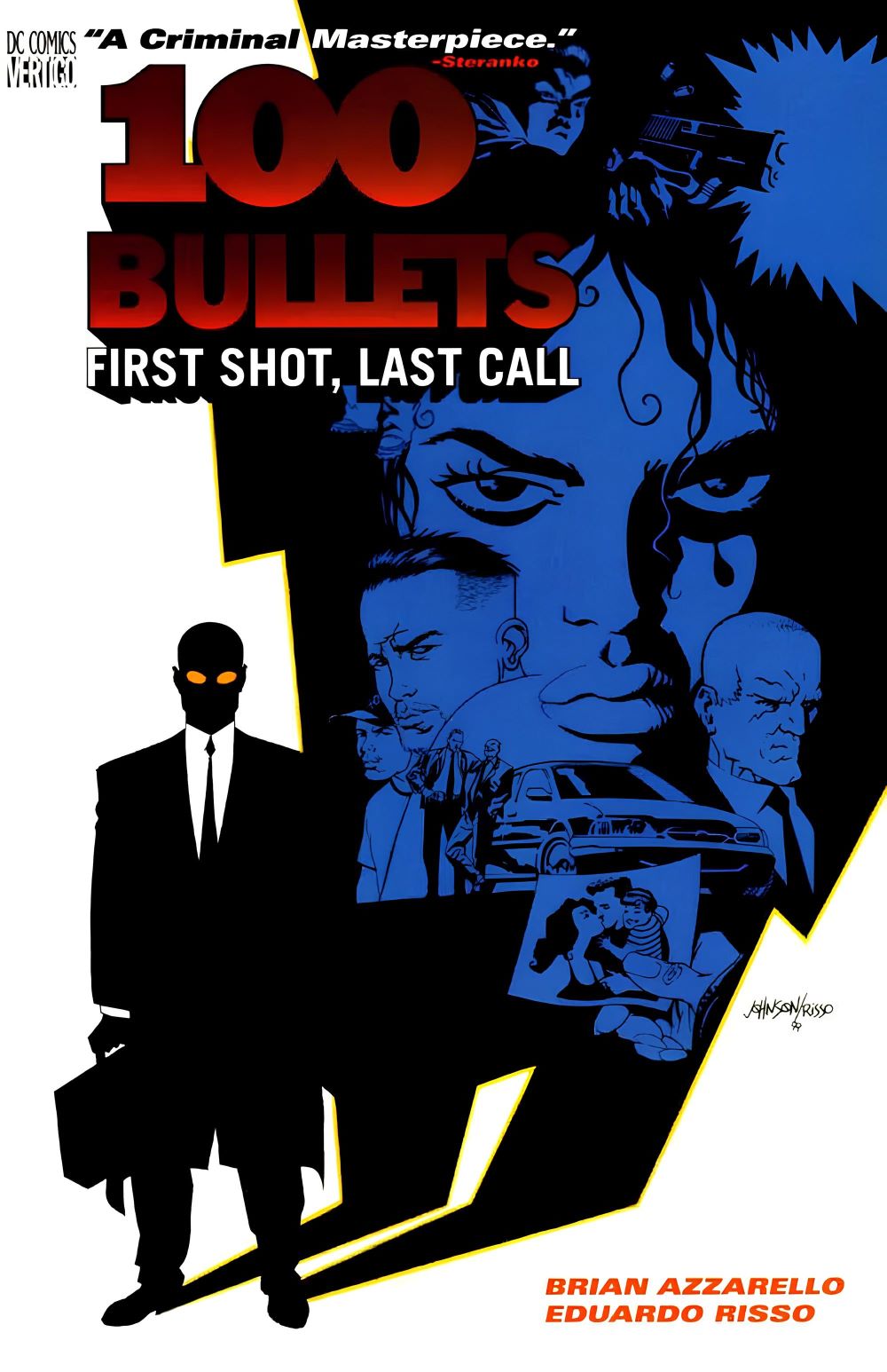
The first collected volume, First Shot, Last Call, serves as a perfect introduction to the series’ central premise and tone. It introduces Agent Graves, the enigmatic figure who functions as the series’ catalyst and perhaps its most important symbol. Graves looks like the kind of man who has walked out of a government conspiracy, a private war, or a decade-long nightmare and come out the other side untouched. He approaches recently paroled Dizzy Cordova with an offer that sounds impossible: an attaché case containing a gun, 100 untraceable bullets, and proof that the people responsible for destroying her life are known and reachable. The choice, however, is entirely hers. Graves does not force revenge; he simply places it within reach.
That premise is the genius of 100 Bullets. On the surface, it is a crime story built around assassination, hidden conspiracies, and the promise of vengeance. But underneath, it becomes a series about free will and the burden of choice. The question is never just whether a character will kill. It is whether revenge can ever truly heal the wounds that created the desire for it in the first place. Azzarello understands that vengeance is seductive precisely because it feels so simple. It offers closure where life has given none. Yet the series continually suggests that closure is an illusion, and that the acts people commit in the name of justice or revenge often become the first step toward deeper destruction.
Dizzy Cordova is a strong opening example of this theme. She is not written as a simplistic victim, nor as an idealized avenger. She is angry, wounded, and psychologically cornered, but she is also complicated and fully human. Her eventual decision feels earned because the story understands her pain rather than merely exploiting it. Azzarello writes her as someone whose past has stripped away the comfort of easy morality. The same can be said of Lee Dolan in the second major story arc. Dolan’s life has been shattered by an accusation that contaminated both his public identity and his personal relationships. He, too, is offered Graves’s case and the temptation of retaliation. But his response is different from Dizzy’s, and that difference matters. It shows how carefully Azzarello constructs his characters as individuals rather than as variations on a single revenge fantasy.
What makes these early stories especially effective is that each one feels self-contained while also contributing to a much larger design. Even in this first volume, Azzarello is laying the groundwork for a sprawling narrative that will eventually run exactly 100 issues. The structure gives the series an unusual density: every issue matters, every choice matters, and every seemingly isolated encounter feels like it may be part of a larger hidden architecture. That sense of design keeps the book from ever becoming repetitive. Instead, it feels like a slow-burning conspiracy thriller where the real mystery is not just who is manipulating whom, but why these people are vulnerable to manipulation in the first place.
Eduardo Risso’s artwork is the perfect visual counterpart to Azzarello’s writing. His style is often described in relation to other noir-influenced artists, but it would be inaccurate to call it merely minimalist. Risso’s pages have a cinematic rhythm that gives the book a visual identity all its own. His compositions are deceptively economical: characters are posed with dramatic clarity, shadows are used with purpose, and every panel seems designed to move the eye like a camera tracking through a scene. Even in moments where little physical action occurs, there is a sense of tension and motion in the framing.
Risso also has a strong eye for character design. His people are not rendered with perfect realism, nor are they reduced to exaggerated caricatures. Instead, they occupy a space that feels stylized but believable, which is ideal for a story like this. Their faces and bodies communicate attitude before they even speak. That matters in a noir story, where so much of the drama lies in what characters conceal as much as what they reveal. The women in particular are drawn with a confident sensuality that reflects the hard-edged world of the series without reducing them to empty decoration. Characters like Dizzy Cordova and Megan Dietrich feel distinct not just because of Azzarello’s writing, but because Risso gives them physical presence, posture, and visual identity that reinforce who they are.
What is especially impressive is that Risso’s art enhances the noir mood without becoming self-conscious about it. The book never feels like it is trying too hard to imitate classic crime fiction. Instead, the visuals and writing work together to create a world that is stylish, dangerous, and morally unstable. That balance is difficult to achieve, and 100 Bullets succeeds because both creators understand that atmosphere alone is not enough. The mood has to be supported by character, and the character has to be supported by consequences.
100 Bullets: First Shot, Last Call is therefore more than just a strong debut volume. It is a declaration of intent. Azzarello shows that he is willing to write adults as flawed, desperate, and self-deceiving people rather than as heroes or villains in any conventional sense. Risso, meanwhile, gives the story a visual voice that is sleek, uneasy, and unmistakably noir. Together, they create a comic that is intelligent, hard-hitting, and deeply memorable.
As an opening volume, it does exactly what it should: it hooks the reader, establishes the mythology, and makes clear that this is a story about choice, consequence, and the cost of acting on one’s darkest impulses. More importantly, it does so with confidence and style. 100 Bullets earned its reputation not because it imitates the best noir stories, but because it understands what makes noir endure: wounded people, dangerous opportunities, and the terrible freedom of deciding what to do next.