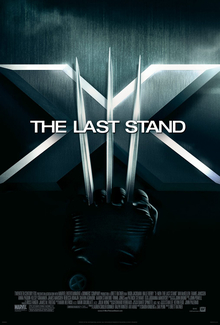
X-Men: The Last Stand (2006, directed by Brett Ratner)


Just as the world seems to be finally on the verge of accepting mutants, industrialist Warren Worthington II (Michael Murphy) announces that he has developed a shot that will suppress the X-gene, therefore “curing” mutants of their mutation. Magneto (Ian McKellen), Mystique (Rebecca Romijn), and a host of other mutants break out of prison to try to stop Worthington from offering up his cure. Meanwhile, at Charles Xavier’s school, Rogue (Anna Paquin) wonders if maybe she should take the shot and become a “normal” person.

Professor Xavier (Patrick Stewart) and Logan (Hugh Jackman) have an even bigger concern than Magneto and the cure. Jean Grey (Famke Janssen), thought to have died at the end of the previous movie, has returned but has given in to her dark side, the so-called Phoenix. She’s already destroyed Scott (James Marsden), and it doesn’t take her long to disintegrate Professor X. Can Logan and the Beast (Kelsey Grammer) rally what’s left of the X-Men to defeat both Magneto and the Dark Phoenix?

I can still remember seeing X-Men: The Last Stand on the day that it was first released. As an X-Men fan, I was excited to see how the Dark Phoenix storyline would be adapted for the big screen. It’s difficult to put into words how disappointed I was when Jean killed Scott. That one scene told me that X-Men: The Last Stand was not going to do the story justice. In the comic books, Jean and Scott’s relationship was the heart of the X-Men. When Jean became the Dark Phoenix, she proved herself capable of destroying an entire planet, but she couldn’t bring herself to kill Scott. She chose to destroy herself rather than him. (Marvel being Marvel, Jean was resurrected a few years later.) The X-Men films never really knew what to do with the characters of Scott and Jean. They weren’t as flamboyant as Logan or even Rogue, but fans of the comic knew who Scott and Jean were and understood their importance to the series, and having Jean destroy Scott showed that, unlike the previous two films, the third X-Men film was not being made for the fans.

A large part of the problem was that director Brett Ratner didn’t seem to be interested in the characters. X-Men: The Last Stand is a collection of action scenes with none of the small character moments that made the first two films memorable. Kelsey Grammer is a welcome addition to the cast as the Beast. (The Beast always was basically Frasier Crane with blue fur.) Otherwise, this is the most forgettable of all the X-Men films.

Even though the Dark Phoenix saga is one of the key X-Men storylines, it’s never really been given its due onscreen. A second attempt to tell the story, in Dark Phoenix, also failed to capture the drama and emotion of Jean’s transformation. The X-Men are now officially a part of the MCU, so I imagine the story will probably be told again. Maybe the third time will be the charm.
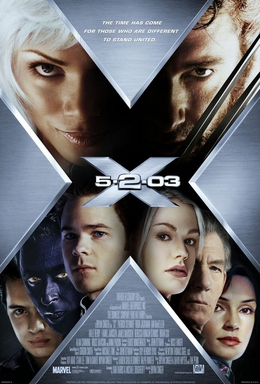
X2 (2003, directed by Bryan Singer)


After Nightcrawler (Alan Cumming) causes a national security crisis by teleporting into the White House, Colonel William Stryker (Brian Cox) is given the authority to invade Professor Xavier’s School and investigate its connection to the mutants. Stryker, who not only wants to investigate the mutants but also destroy them by manipulating the same technology that Xavier uses to find them, just happens to be an old enemy of Logan’s (Hugh Jackman). In fact, Stryker is responsible for Logan fusing the adamantium to his bones. That’s a hell of a coincidence.

A sequel to X-Men, X2 tells a bigger and more complex story than the first film. Professor Xavier’s students are spread out by the chaos. Rogue (Anna Paquin) sees prejudice firsthand when Bobby Drake (Shawn Ashmore) is betrayed by his own family. Pyro (Aaron Stanford) is tempted to reject the X-Men’s philosophy of coexistence. After being underused in the first film, both Scott (James Marsden) and Jean Grey (Famke Janssen) are key players here. Magneto (Ian McKellen) and Mystique (Rebecca Romijn-Stamos) return, this time temporarily allying with Professor X (Patrick Stewart) to stop Stryker. Logan has his own reasons to go after Stryker. Surprisingly, X2 is not only bigger than the first film but it’s also better. The actors are more convincing in their roles, the action is more exciting, and director Bryan Singer capably juggles all of the different parts without losing the plot. He even manages to ably set up the Dark Phoenix Saga. In the first film, the X-Men had it almost too easy when it came to battling opponents like Toad and Sabretooth. This film has not only Brian Cox’s William Stryker but also Kelly Hu’s Deathstrike.

Those of us who were shocked when X-Men turned out to be good were even more shocked when X2 turned out to be even better. For a little while, it seemed like there would never be a bad X-Men movie! Later, that’s the way a lot of us would also feel about the Marvel movies. Those were good days.

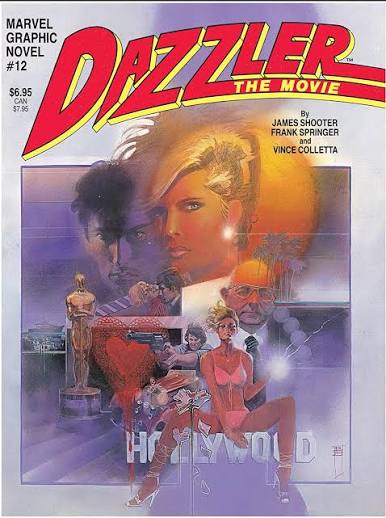
Graphic Novel Review: Dazzler The Movie (1984, by Jim Shooter, Frank Springer, and Vince Colletta)


During the day, Alison Blair is just your everyday aerobics instructor, leading exercise classes and getting hit on by sleazy Hollywood producers like Eric Beale. At night, she’s the Dazzler, an up-and-coming rock star who amazes her fans with the elaborate light shows at her concerts. What they don’t know is that Alison is a mutant and is creating the lights herself. Or, at least, they don’t know that until Alison’s boyfriend, over-the-hill singer Roman Nekobah, reveals the truth to the press. Roman thinks that it will make Alison a star. Instead, Alison finds herself hounded by the press, anti-mutant bigots, and the producers of a movie.

It really doesn’t get more 80s than this graphic novel about Dazzler. Unfortunately, this graphic novel was not a great moment in comic book history. Instead, it was just Alison in leotards and doing things with Roman that Jim Shooter and Marvel couldn’t get away with acknowledging in the monthly Dazzler comic book. A full page of art is devoted to just Alison undressing and looking at herself in the mirror. That was probably popular with readers of a certain age in 1984, but today, it’s just a reflection that there wasn’t much to Dazzler beyond how she looked. Not much happens plotwise. Eric Beale is a sleazy producer but he’s hardly a villain on the scale of Dr. Doom or even Sebastian Shaw. When writers and artists of the era complain about Jim Shooter’s commercialized vision for the company, Dazzler The Movie is a good example of what they were talking about.

Dazzler The Movie is mostly interesting as a roman à clef about how the character was created in the first place. Dazzler was developed by Marvel and Neil Bogart, the legendary (and legendarily erratic) manager of Casablanca Records. At first, Dazzler was going to be a multimedia project. Not only would there be the Dazzler comic book but there were plans to release Dazzler records and to have actual Dazzler concerts. A movie about Dazzler was a part of the plan but things fell through when Casablanca went bankrupt. Shooter continued to try to develop a Dazzler movie. When Bo Derek showed some interest, Dazzler was redesigned to resemble her. However, Bo insisted that the movie could only be directed by her husband, John Derek. After the box office failure of John and Bo’s version of Tarzan, the Ape Man, Marvel lost interest in the Dereks and the Dereks lost interest in Dazzler. It’s easy to see John Derek in the character of Eric Beale. Dazzler has a choice between selling out or continuing to do things her way and she decides that she doesn’t need an Eric Beale in her life.

The comic book lived on, though. Dazzler The Movie was Shooter’s attempt to draw more readers to the comic and to also express his hatred of Hollywood. It wasn’t much of a graphic novel. It was no God Loves, Man Kills. It didn’t get the acclaim of The Death of Captain Marvel. But it did keep Dazzler going. And she’s still going to this day.

Great Moments In Comic Book History #48: Kulan Gath Transforms Manhattan


Kulan Gath, an evil sorcerer from the Hyborian Age who fought both Conan and Red Sonja, emerges from a magic amulet in Manhattan and casts a spell that turns the city into an ancient city, complete with warriors, wizards, and other mythical monsters. Because he was defeated by Spider-Man the last time he showed up in modern times, Gath is obsessed with capturing and sacrificing the web-slinger. He recruits and transforms members of the X-Men, Avengers, New Mutants, and the Morlocks and uses them to hunt down Spider-Man. Those whom Gath has not succeeded in capturing try to return Manhattan to normal.

Today, we know that any time a comic book takes a trip to an alternate reality or timeline, almost everyone is going to end up dead. It almost feels like it’s a way for comic book artists and writers to get out their frustration over not being able to permanently change any of the characters. We’re used to the big slaughters that take place, and it’s no longer a big deal to read that an alternate version of our favorite character was killed in battle.

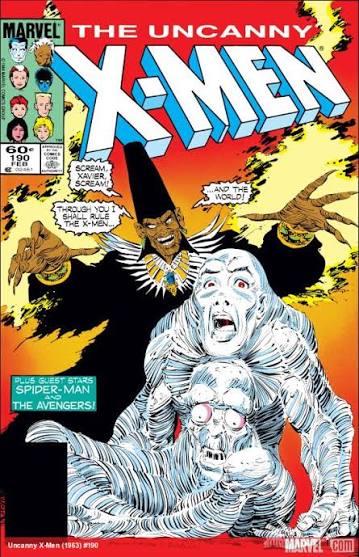
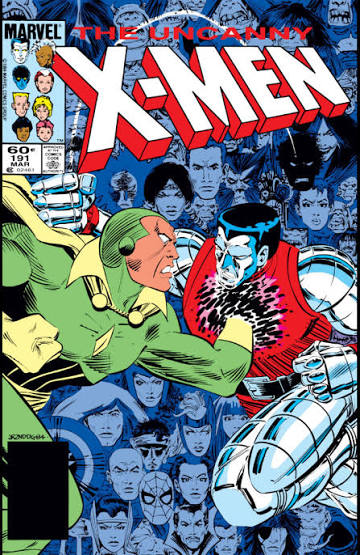
I don’t know if people were used to it in 1985, when X-Men #190 and #191 told the story of Kulan Gath conquering Manhattan and featured one of the biggest bloodbaths in Marvel history. Over the course of two issues, nearly every prominent Marvel hero was either transformed into a grotesque creature or horribly killed. Rogue gets stabbed in the back. Colossus explodes. Selene loses her mouth, Even Spider-Man eventually ended up dying. Things got so extreme that Dr. Strange and Magik had to team up to change history to keep Kulan Gath from even emerging from that amulet in the first place. By the end of it, there were only six heroes left alive. When Storm, one of the survivors, said that humanity would never know that they had been saved by mutants, Captain America made a point to thank her. He says he knows it’s probably not enough. You’re right, Cap. It’s not. Did you see what they did to Spider-Man?

Written by Chris Claremont with art by John Romita, Jr. and Dan Green, the saga of Kulan Gath is a classic X-Men story. X-Men #191 was entitled “Raiders of the Lost Temple.” It could have just as easily been called “No One Lives.” I’m glad Dr. Strange was there to set everything right.

Previous Great Moments In Comic Book History:

  1. Winchester Before Winchester: Swamp Thing Vol. 2 #45 “Ghost Dance” 
  2. The Avengers Appear on David Letterman
  3. Crisis on Campus
  4. “Even in Death”
  5. The Debut of Man-Wolf in Amazing Spider-Man
  6. Spider-Man Meets The Monster Maker
  7. Conan The Barbarian Visits Times Square
  8. Dracula Joins The Marvel Universe
  9. The Death of Dr. Druid
  10. To All A Good Night
  11. Zombie!
  12. The First Appearance of Ghost Rider
  13. The First Appearance of Werewolf By Night
  14. Captain America Punches Hitler
  15. Spider-Man No More!
  16. Alex Ross Captures Galactus
  17. Spider-Man And The Dallas Cowboys Battle The Circus of Crime
  18. Goliath Towers Over New York
  19. NFL SuperPro is Here!
  20. Kickers Inc. Comes To The World Outside Your Window
  21. Captain America For President
  22. Alex Ross Captures Spider-Man
  23. J. Jonah Jameson Is Elected Mayor of New York City
  24. Captain America Quits
  25. Spider-Man Meets The Fantastic Four
  26. Spider-Man Teams Up With Batman For The Last Time
  27. The Skrulls Are Here
  28. Iron Man Meets Thanos and Drax The Destroyer
  29. A Vampire Stalks The Night
  30. Swamp Thing Makes His First Cover Appearance
  31. Tomb of Dracula #43
  32. The Hulk Makes His Debut
  33. Iron Man #182
  34. Tawky Tawny Makes His First Appearance
  35. Tomb of Dracula #49
  36. Marvel Publishes Star Wars #1
  37. MAD Magazine Plays Both Sides
  38. The Cover of Green Lantern/Green Arrow #85
  39. LBJ Stands Up For The Hulk
  40. Chamber of Chills #2
  41. Tomb of Dracula #41
  42. Tomb of Dracula #27
  43. X-Men Meet Frankenstein’s Monster
  44. The Amazing Spider-Man #33
  45. The Red Skull Tempts Spider-Man To Sell Out America
  46. Godzilla Joins The Marvel Universe
  47. Classic Comics Series Featuring #28

X-Men (2000, directed by Bryan Singer)


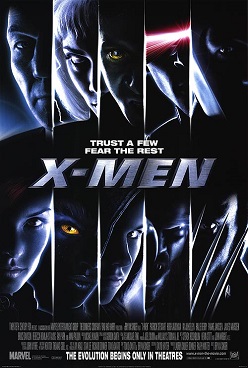
I saw X-Men on the first day that it opened in theaters. Actually, I saw it twice.

The first time I saw it was by myself. I had been planning on waiting to see it in the evening with my friends Johnny and Kyleigh, but I actually found myself with a few hours to spare, so I decided to go ahead and see it. I watched it in the later afternoon and, after that showing got out, I met up with Johnny and Kyleigh outside the theater and went straight back in.

It’s hard to describe what a big deal the X-Men movie was in 2000. This was before there was a new Marvel movie or show every three months. It was also at a time when comic book movies, following the failure of Batman and Robin, were no longer considered to be a sure thing. Johnny and I were lifelong Marvel fans and, having survived the trauma of The Phantom Menace, were very much looking forward to the X-Men movie. We knew that both Patrick Stewart and Ian McKellen were the perfect choices for Professor X and Magneto. Anna Paquin seemed like a good choice for Rogue. But would Hugh Jackman, an actor neither of us had heard of before, be able to bring Wolverine to life?

Even though we both rolled our eyes when we heard that Rogue’s name was apparently Marie, Johnny and I were shocked at how good X-Men was. Today, we take it for granted that comic books can be turned into movies, but in 2000, X-Men took us by surprise by being well-acted, well-directed, and surprisingly entertaining. Kyleigh was not a fan of comic books in general and she liked the movie considerably less than we did. (“Dr. Wheelchair” was her name for Charles Xavier.) But for Marvel fans, X-Men was the anti-Phantom Menace.

Looking back, the plot felt like it could have been lifted from the pages of the comic book. Sen. Robert Kelly (Bruce Davison) is leading a national political movement against the mutants. Magneto has created a machine that will induce mutations in human beings. (The movie opens with a flashback that establishes Magneto as a survivor of the Holocaust. Today, everyone knows his backstory, but in 2000, people were stunned that a comic book movie could also deal with reality.) Magneto and Professor X both try to recruit Rogue to their side, and Wolverine, as Rogue’s protector, reveals his claws and reluctantly becomes a member of the X-Men.

When X-Men was first released, Hugh Jackman was the big question mark, but he turned out to be the perfect choice for Wolverine, even if he did seem to be too tall for the role. Jackman was tough and surly and somehow, he looked credible with claws. He was everything that fans like me wanted out of Wolverine and, once he showed up, I knew it was going to be a good movie. Not surprisingly, Patrick Stewart and Ian McKellen were perfect for Xavier and Magneto, as was Anna Paquin as Rogue. Though they’re overshadowed by Stewart, McKellen, Jackman, and Paquin, the other members of the X-Men are played by James Marsden (Scott), Famke Janssen (Jean Grey), and Halle Berry (Storm). Ray Park plays Toad, Tyler Mane plays Sabretooth, and Rebecca Romijn-Stamos excited male viewers everywhere by playing the naked and blue Mystique.

A lot of time has passed since 2000. An entire Marvel Cinematic Universe was created that did not initially include the X-Men, though that has since changed. Bryan Singer is no longer on the A-list. But I still always look fondly on the day that I watched X-Men twice.

Morbius (2022, directed by Daniel Epinosa)


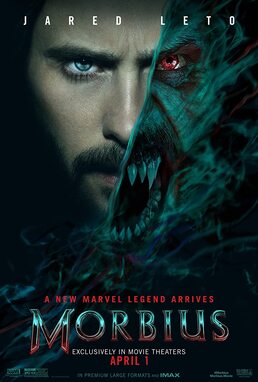
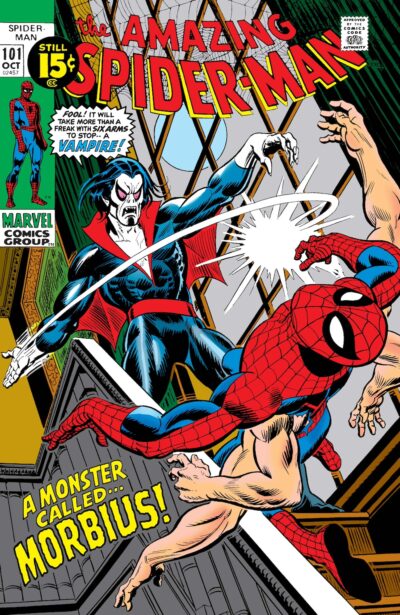
Michael Morbius (Jared Leto) has devoted his life to creating artificial blood, but he publicly declines to accept the Nobel Prize because he still hasn’t found a cure for the rare blood disease that is affecting not only him but also his best friend, a man he calls Milo (Matt Smith) for reasons that are too stupid to get into. Using the genes of Costa Rican bats, Morbius finally develops a cure, but there’s a side effect. Taking the cure transforms someone into a living vampire. Morbius is now strong and fast, but he also has a craving for blood. Morbius knows that the cure is even worse than the disease, but Milo doesn’t care and takes it anyway. Now, there are two living vampires wreaking havoc in New York City.

It’s not just New York that suffers due to Morbius. It’s also Sony Pictures, which released the film to terrible reviews and bad box office on April 1st, 2022. After the film was yanked out of theaters, someone at Sony noticed that a lot of people on Twitter were posting a meme that featured Morbius. Mistakenly thinking that this meant Morbius had become a so-bad-it’s-good cult phenomenon, Sony rereleased Morbius in theaters on June 3rd, and the film flopped a second time.

I know that I groaned when I first read that Sony was developing a Morbius film to be a part of their “extended Spider-Man universe.” That’s because Morbius was always one of my favorite Marvel characters, and I knew Sony would probably never be able to do the character justice. I was right. Morbius is mostly interesting as a throwback to what comic book films were like before the MCU and Zack Snyder came along. There’s no real affection for the characters and none of the type of big moments that usually made even the least inspired of the MCU films worth watching. It looks cheap, it feels cheap, and the whole thing is totally by the numbers. Matt Smith is given little to do as the villain, and, for all of his reputation for eccentricity, Jared Leto gives an anemic performance. He lets his beard and his hair do most of the acting. The worst thing about it is that it’s just boring. In the comic books, Morbius mixed his brilliance with a feral bloodlust. That’s what made him such a memorable character. In the movie, he’s just Jared Leto.

Morbius the Living Vampire deserved better.


Howard The Duck (1986, directed by Willard Huyck)


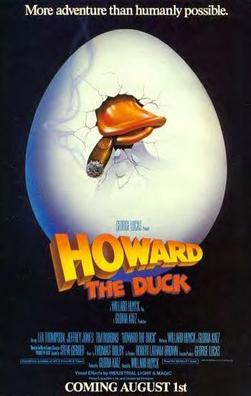
There’s a scene in Howard the Duck where Tim Robbins looks like he briefly wants to strangle the title character, and I don’t blame him. Howard the Duck (voiced by Chip Zien) is not a very likable character in this movie. Due to an experiment with a laser spectroscope, he’s been transported from his planet to Earth. He’s in a world he didn’t make, and he doesn’t stop complaining for one moment. As for Tim Robbins, he plays Phil Blumburtt, a laboratory assistant who is a friend of Beverly Switzler (Lea Thompson), the aspiring singer who is also Howard’s girlfriend. Beverly ends up getting abducted by Dr. Jennings (Jeffrey Jones), Phil’s boss, who has been possessed by a space monster that was brought to Earth by the same spectroscope that caught Howard. Howard wants to return to his planet, but he also wants to manage Beverly’s band; first, though, he has to defeat the space monsters.

Produced by George Lucas and based on the character created by Steve Gerber, Howard the Duck was a notorious box office bomb when it was first released in 1986, and it’s actually one of the reasons why it took so long for Marvel to start regularly producing films. I watched it recently to see if it had gotten any better with age, but no, it’s still pretty bad. Lea Thompson is cute, likable, and probably a little bit too sexy for a film about a talking duck, but otherwise, it’s a typical ’80s mix of action, comedy, and science fiction that gets too buried under its special effects to really be effective.

The main problem with the movie is its version of Howard himself. According to Steve Gerber, Howard the Duck was originally envisioned as being an animated film, but Lucas decided to do the film live-action, which meant creating a duck suit for Ed Gale to walk around in. Unfortunately, the suit doesn’t look like a duck, animated or real. It made Howard look like a puppet. The scenes of an underwear-clad Beverly rolling around with a duck were already strange enough without making the duck look like a ventriloquist dummy. The movie also didn’t capture the personality that made Howard so memorable in the comic books. In the comic books, Howard is cynical, easily irritated, and frustrated with the madness of everyday life. He’s an intellectual duck who wants to be left alone. In the movie, he tells a lot of bad jokes and is only once seen smoking his famous cigar. The satire that was at the heart of Gerber’s creation is lost as Howard instead tries to save Earth from being conquered by another group of aliens.

The movie never really decides if it wants to be a comedy or a big-budget action film. The movie not only damaged George Lucas’s reputation as a producer, but it also ended Willard Huyck’s career as a director. Howard the Duck is still a beloved character amongst readers. I remember the entire theater applauding when he showed up in Guardians of the Galaxy, looking like a real talking duck and voiced by Seth Green. He was featured in several episodes of What If…?. There might be a movie future for this duck yet.

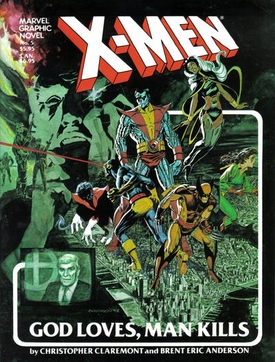
Graphic Novel Review: X-Men: God Loves, Man Kills by Chris Claremont and Brent Eric Anderson


X-Men: God Loves, Man Kills was the fifth Marvel Graphic Novel. It was first published in 1982. It’s 44 years old, and it still makes an impression. When I was a kid, there was a copy of it hidden among the periodicals and magazines at Waldenbooks. When I was in the store, I’d find it, open it, and pick up where I had left off. I knew there was no way I could get away with buying something called God Loves, Man Kills, but that’s because the story wasn’t for kids.

Two children are shot and killed in a playground and left hanging from a swing set. Why? Because they were mutants. Magneto, who until that point had been presented as a villain, is the one who gives them a proper burial. From the beginning, X-Men was a comic book that was actually about prejudice and racism, but God Loves, Man Kills made the message clear. The opening of the story wasn’t something you’d find in a normal monthly Marvel comic.

The villain is a white-haired televangelist named William Stryker. He preaches against mutants. He secretly leads the Purifiers. He kidnaps Professor X and attempts to use his powers to destroy the X-Men. The X-Men and Magneto team up and face an enemy so obsessed with their destruction that, for once, Magneto no longer seems like the fanatic. Even Professor X is tempted to give up his dream of coexistence.

Stryker appears to die, shot by a human security guard who fired to keep Stryker from killing a mutant. It’s a powerful ending. In typical Marvel fashion, the ending was ruined when they decided to bring Stryker back. Stryker died multiple times and somehow came back to life repeatedly. Eventually, he went from being a televangelist to being a Satanist. Marvel never knew how to leave well enough alone.

God Loves, Man Kills remains powerful, though. It was a true graphic novel, with a plot and themes worthy of a novel and graphics that were far more mature than anything to be found in the comics. I read it at Waldenbooks, and I’ve never forgotten it.

Great Moments In Comic Book History #46: Godzilla Joins The Marvel Universe


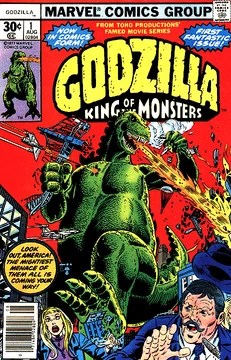
In 1977, Godzilla joined the Marvel Universe.

At the time, Toho was no longer making Godzilla films but they remained popular on American television.  Marvel’s Stan Lee, no longer constrained by the comics code’s restriction on monster and horror comics, approached Toho about licensing the character.  Lee bought the rights for Godzilla but not for any of the other monsters from the Godzilla films.  Mothra, Rodan, and all the others were just out luck.  Toho took the money and didn’t pay much attention to anything else that Lee and Marvel did with the character.

Unlike Marvel’s famous adaptation of Star Wars, Godzilla was dropped straight into the Marvel universe.  When he attacked San Francisco, the Champions saved what they could of their city.  When he roamed through New York, the Avengers and the Fantastic Four teamed up to fight him.  Godzilla’s most frequent nemesis was SHIELD.  Dum Dum Dugan found himself in charge of the anti-Godzilla effort.

It all started with the first issue of Godzilla, King of the Monsters.  Written by Doug Moensch and featuring the art of Herb Trimpe, the first issue was published in August of 1977 and featured Godzilla being awakened by nuclear tests in Alaska.  Soon, he was heading towards Washington State.  SHIELD saved Seattle.  I wonder if Nick Fury ever regretted that.

Godzilla was officially a part of the Marvel universe for two years.  After the series was canceled after twenty-four issues, Marvel lost the rights to the character.  However, Red Ronin, who was originally introduced as an opponent of Godzilla, continues to appear in other Marvel titles.  Godzilla is still there, even if no one is allowed to talk about him anymore.

Previous Great Moments In Comic Book History:

  1. Winchester Before Winchester: Swamp Thing Vol. 2 #45 “Ghost Dance” 
  2. The Avengers Appear on David Letterman
  3. Crisis on Campus
  4. “Even in Death”
  5. The Debut of Man-Wolf in Amazing Spider-Man
  6. Spider-Man Meets The Monster Maker
  7. Conan The Barbarian Visits Times Square
  8. Dracula Joins The Marvel Universe
  9. The Death of Dr. Druid
  10. To All A Good Night
  11. Zombie!
  12. The First Appearance of Ghost Rider
  13. The First Appearance of Werewolf By Night
  14. Captain America Punches Hitler
  15. Spider-Man No More!
  16. Alex Ross Captures Galactus
  17. Spider-Man And The Dallas Cowboys Battle The Circus of Crime
  18. Goliath Towers Over New York
  19. NFL SuperPro is Here!
  20. Kickers Inc. Comes To The World Outside Your Window
  21. Captain America For President
  22. Alex Ross Captures Spider-Man
  23. J. Jonah Jameson Is Elected Mayor of New York City
  24. Captain America Quits
  25. Spider-Man Meets The Fantastic Four
  26. Spider-Man Teams Up With Batman For The Last Time
  27. The Skrulls Are Here
  28. Iron Man Meets Thanos and Drax The Destroyer
  29. A Vampire Stalks The Night
  30. Swamp Thing Makes His First Cover Appearance
  31. Tomb of Dracula #43
  32. The Hulk Makes His Debut
  33. Iron Man #182
  34. Tawky Tawny Makes His First Appearance
  35. Tomb of Dracula #49
  36. Marvel Publishes Star Wars #1
  37. MAD Magazine Plays Both Sides
  38. The Cover of Green Lantern/Green Arrow #85
  39. LBJ Stands Up For The Hulk
  40. Chamber of Chills #2
  41. Tomb of Dracula #41
  42. Tomb of Dracula #27
  43. X-Men Meet Frankenstein’s Monster
  44. The Amazing Spider-Man #33
  45. The Red Skull Tempts Spider-Man To Sell Out America

Great Moments In Comic Book History #44: The Amazing Spider-Man #33


On what would have been Steve Ditko’s 98th birthday, let’s remember his greatest moment as the artist who first truly brought Spider-Man to life.

From The Amazing Spider-Man #33:

Previous Great Moments In Comic Book History:

  1. Winchester Before Winchester: Swamp Thing Vol. 2 #45 “Ghost Dance” 
  2. The Avengers Appear on David Letterman
  3. Crisis on Campus
  4. “Even in Death”
  5. The Debut of Man-Wolf in Amazing Spider-Man
  6. Spider-Man Meets The Monster Maker
  7. Conan The Barbarian Visits Times Square
  8. Dracula Joins The Marvel Universe
  9. The Death of Dr. Druid
  10. To All A Good Night
  11. Zombie!
  12. The First Appearance of Ghost Rider
  13. The First Appearance of Werewolf By Night
  14. Captain America Punches Hitler
  15. Spider-Man No More!
  16. Alex Ross Captures Galactus
  17. Spider-Man And The Dallas Cowboys Battle The Circus of Crime
  18. Goliath Towers Over New York
  19. NFL SuperPro is Here!
  20. Kickers Inc. Comes To The World Outside Your Window
  21. Captain America For President
  22. Alex Ross Captures Spider-Man
  23. J. Jonah Jameson Is Elected Mayor of New York City
  24. Captain America Quits
  25. Spider-Man Meets The Fantastic Four
  26. Spider-Man Teams Up With Batman For The Last Time
  27. The Skrulls Are Here
  28. Iron Man Meets Thanos and Drax The Destroyer
  29. A Vampire Stalks The Night
  30. Swamp Thing Makes His First Cover Appearance
  31. Tomb of Dracula #43
  32. The Hulk Makes His Debut
  33. Iron Man #182
  34. Tawky Tawny Makes His First Appearance
  35. Tomb of Dracula #49
  36. Marvel Publishes Star Wars #1
  37. MAD Magazine Plays Both Sides
  38. The Cover of Green Lantern/Green Arrow #85
  39. LBJ Stands Up For The Hulk
  40. Chamber of Chills #2
  41. Tomb of Dracula #41
  42. Tomb of Dracula #27
  43. X-Men Meet Frankenstein’s Monster