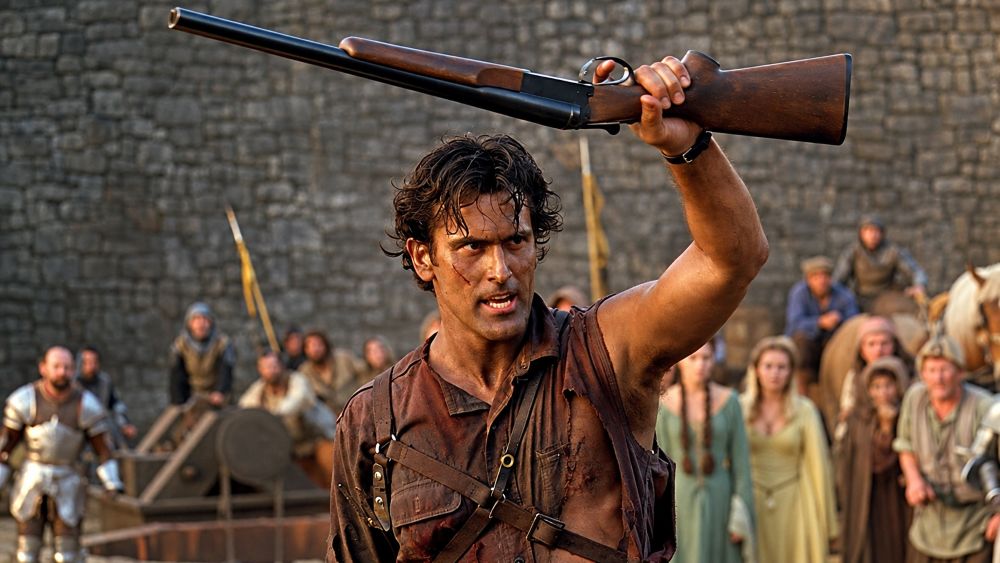
“Good. Bad. I’m the guy with the gun.” — Ash Williams
Ash Williams endures because he is not a conventional chosen-one hero. Across the Evil Dead franchise, he begins as an ordinary young man on a disastrous cabin getaway—vain, impatient, frightened, and spectacularly unprepared for supernatural horror. Yet the series turns those limitations into its central appeal. Ash is never compelling because he is innately noble or especially capable; he is compelling because demonic catastrophe repeatedly forces him to become capable. Every victory feels improvised, painful, and slightly ridiculous, earned through panic, rage, bad luck, and a stubborn refusal to die.
In The Evil Dead, Ash is primarily a survivor, defined by shock and escalating isolation as the people around him are possessed or killed. Bruce Campbell’s performance gives the character a physical vulnerability that later entries deliberately reshape: this Ash screams, hesitates, grieves, and looks genuinely overwhelmed by what he is witnessing. The cruel ingenuity of the Deadites makes survival an ordeal rather than a triumph. By the end, Ash has not cleanly conquered evil so much as endured an experience that has stripped away his normal life. That origin matters because the swagger of the later character retains a trace of trauma underneath it.
Evil Dead II transforms that shaken survivor into the archetypal Ash: a battered, increasingly unhinged fighter whose body becomes the franchise’s most elastic special effect and comic battlefield. His severed hand attacking him, the chainsaw prosthetic, and his mounting psychological collapse turn horror into a kind of brutal slapstick. But the comedy does not make the danger meaningless. Instead, it reveals Ash’s defining heroic quality: adaptability. Faced with a nightmare that cannot be reasoned with, he finds increasingly absurd practical solutions. He can be cowardly, selfish, and short-tempered, but when the moment demands it, he picks up the chainsaw and does what no one else can.
By Army of Darkness, Ash has become a deliberate parody of the macho action hero: a loud, arrogant time-displaced retail employee who talks like a conquering legend before fully earning the title. Lines such as “Groovy” and “This is my boomstick” work because Campbell delivers them with absolute, unearned confidence. Ash’s bravado is funny precisely because it is often defensive; he projects invincibility while repeatedly bungling spells, alienating allies, and creating new disasters. Even so, his eventual willingness to fight for people in a world that is not his own gives the character emotional weight. He may complain the entire time, but he does not ultimately abandon the fight.
That balance remains the foundation of Ash vs Evil Dead, which reunites the character with the consequences of his past rather than pretending he ever truly escaped them. Older Ash is still crude, impulsive, and prone to making catastrophically bad choices, but the series allows him to become a mentor and a protector without sanding down his worst qualities. The broader franchise, including comic-book continuations such as Army of Darkness and crossover material like Freddy vs. Jason vs. Ash, keeps returning to the same essential comic-book principle: Ash is an underqualified man facing impossibly large evil with whatever weapon is within reach. He is compelling because he never becomes a polished hero. He remains a damaged, vulgar, frightened human being who keeps stepping forward anyway—and in a horror universe built to reduce people to victims, that messy persistence is genuinely heroic.
Hero of the Day
- Inspector “Tequila” Yuen Ho-yan (Hard Boiled)
- Josey Wales (the Outlaw Josey Wales)
- Vince Majestyk (Mr. Majestyk)
- Monkey D. Luffy (One Piece)
- Leo Kessler (Ten to Midnight)
- Senku Ishigami (Dr. Stone)
- Marcus Fenix (Gears of War)
- Samwise Gamgee (Lord of the Rings)
- Haven Hamilton (Nashville)
- Bernardo O’Reilly (The Magnificent Seven)
- Maj. Motoko Kusanagi (Ghost in the Shell)
- Spike Spiegel (Cowboy Bebop)
- Chief Martin Brody (Jaws)
- Raylan Givens (Justified)

