Review: Dark City (dir. by Alex Proyas)


“First there was darkness. Then came the strangers.” — Dr. Schreber

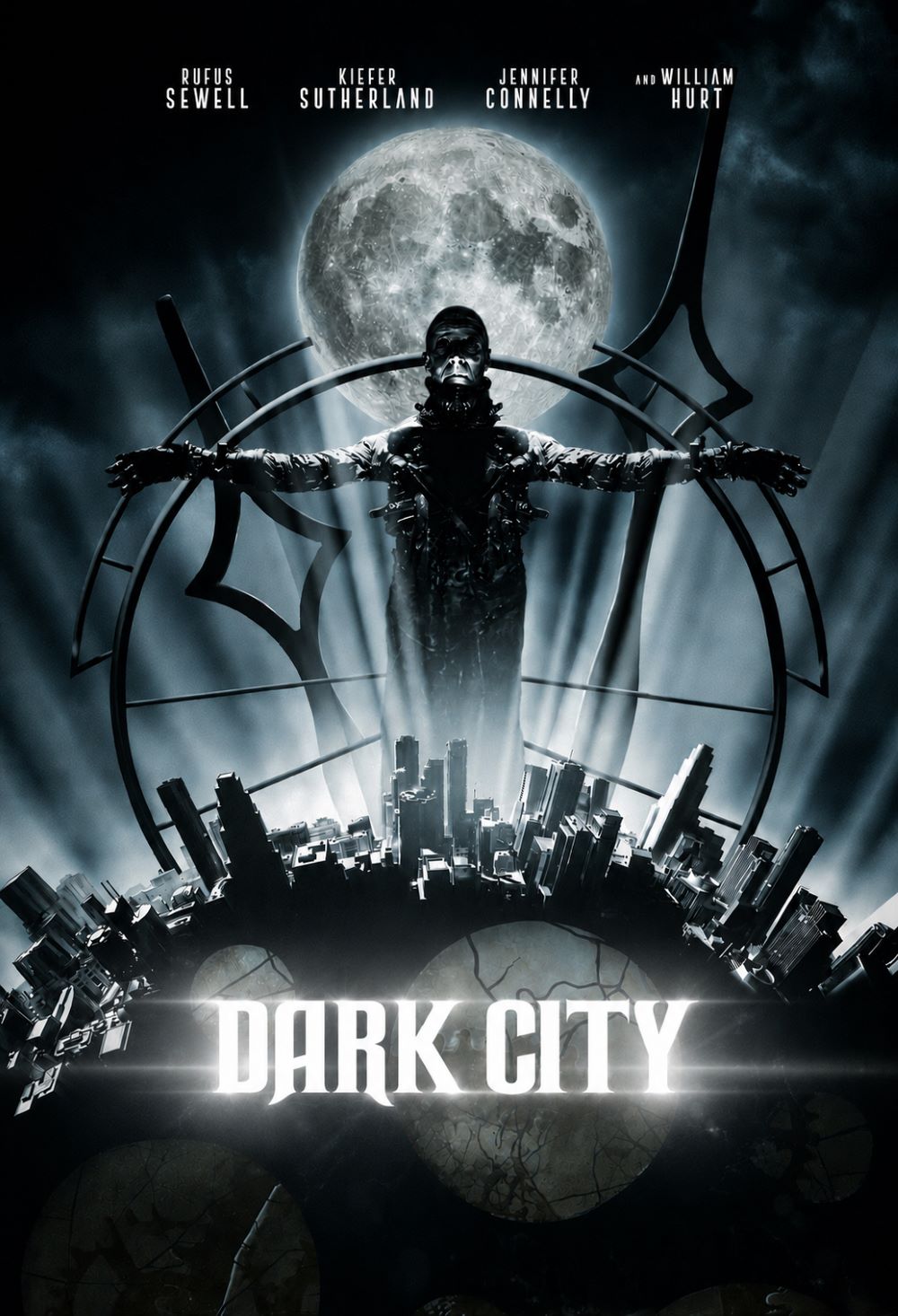
Dark City opens like a half-remembered nightmare, and that’s exactly the kind of vibe the movie sustains from start to finish. Alex Proyas builds a world that feels trapped between a detective story, a fever dream, and a sci-fi conspiracy, and the result is one of the most atmospheric films of the late ’90s.

What makes Dark City so distinctive is the way it treats its setting like an active force rather than a backdrop. The city itself feels oppressive and unstable, all sharp angles, heavy shadows, looming buildings, and damp streets that seem permanently stuck in the middle of the night. That visual approach owes a lot to German expressionism, with its warped architecture and unnatural spaces, and Proyas uses that legacy to make the city feel psychologically trapped and visually wrong in the best way. You can see the noir influence too, especially in the low-key lighting, the sense of fatalism, and the way the whole film feels like a detective story pushed through a nightmare filter.

The sci-fi side of the film is just as memorable because it doesn’t rely on shiny futurism. Instead, it leans into mystery, memory loss, and identity breakdown, which gives it a more unsettling and human quality. That’s part of why the film works so well: the weirdness is not just decorative, it’s built into the story’s central questions. The result is a movie that feels cerebral without becoming cold, and atmospheric without losing narrative momentum. Even when the film is being highly stylized, it still moves with purpose, and that keeps the viewer locked in.

The performances help sell all of that, especially Rufus Sewell as John Murdoch. He has to carry the audience through confusion, paranoia, and growing dread, and he does it with a mix of physical vulnerability and stubborn intensity. William Hurt gives the film a weary, grounded presence, while Kiefer Sutherland turns Dr. Schreber into one of those slippery, unforgettable supporting characters who always seems one step ahead of the audience. Jennifer Connelly brings warmth and melancholy to the film, which matters a lot because her character gives the story a human anchor amid all the conceptual chaos. The cast doesn’t play the material like it’s just an exercise in style; they commit to the oddness while keeping the emotional stakes legible.

What’s especially impressive is how the acting matches the movie’s visual language. A lesser cast could have made this feel overcooked or self-conscious, but here the heightened performances fit the artificial, dreamlike quality of the world. The characters are somewhat archetypal, yet that works because the film is so interested in identity as something constructed, remembered, and manipulated. In that sense, the performances aren’t just good in isolation; they’re part of the movie’s design, helping it feel like a living puzzle instead of a hollow aesthetic showcase.

The film’s influence on later sci-fi thrillers is hard to miss. A lot of movies after Dark City seem to borrow its basic flavor: the paranoid atmosphere, the reality-questioning premise, the noir-scifi crossover, and the feeling that the world itself is a conspiracy. Films like The Matrix, Memento, Minority Report, Equilibrium, and even Sin City all exist in a creative space that Dark City helped sharpen or popularize, whether directly or indirectly. It didn’t always get the mainstream recognition of some of those titles, but in terms of tone and visual influence, it was incredibly important.

Part of that legacy comes from the way Dark City captured a very specific late-’90s anxiety: the fear that memory, identity, and reality could all be manufactured. That idea became a major engine for sci-fi thrillers moving forward, especially films that wanted to combine philosophical unease with stylized action or mystery. Even the movie’s look, with its blend of noir shadows and surreal production design, became a kind of template for how to make sci-fi feel adult, moody, and psychologically unstable. It helped prove that science fiction didn’t need clean lines and sterile futures to feel intelligent; it could be dirty, haunted, and expressionist.

Dark City remains such a strong film because it understands that style and theme should feed each other. The shadows, the tilted buildings, the endless night, and the fractured sense of self all point in the same direction, creating a unified experience that feels deliberately unsteady. That’s why it lingers: not just because it looks incredible, but because it turns visual design into emotional pressure. It’s a smart, strange, and beautifully murky piece of sci-fi noir that helped clear the way for a whole wave of thrillers that wanted to feel just as paranoid and disorienting.

In the end, Dark City is the kind of movie that rewards both first-time viewers and people revisiting it years later. The plot twists are memorable, but the real achievement is the atmosphere, which is so complete it almost becomes the main character. Proyas made a film that feels like it came from the crossroads of German expressionism, classic noir, and modern sci-fi anxiety, and the result is a cult landmark that still casts a long shadow over the genre.

Review: Angel Heart (dir. by Alan Parker)


“They say there’s just enough religion in the world to make men hate one another, but not enough to make them love.” — Louis Cyphre

Angel Heart is one of those ’80s movies that sneaks up on you, starting like a gritty detective yarn before plunging into supernatural muck that leaves you questioning everything. Alan Parker’s 1987 neo-noir gem, adapted from William Hjortsberg’s Falling Angel, stars Mickey Rourke as Harry Angel, a down-and-out private eye in 1955 New York who gets pulled into a case that reeks of bad karma from the jump. It’s casual viewing at first—rain-slicked streets, fedoras, the whole bit—but Parker’s got a critical eye for blending hardboiled noir with occult horror, making it stick like gum on your shoe long after the credits roll.

Harry’s your classic hard luck of a gumshoe, hustling divorce cases in a dingy office when this slick mystery man named Louis Cypher (Robert De Niro, chewing scenery with devilish glee—get the name pun?) hires him to track down Johnny Favorite, a crooner who vanished after World War II. Cypher’s got cash to burn and an unsettling vibe that hints at deeper darkness, pulling Harry into a web of lies from the start. Harry follows the trail from NYC’s jazz dives to the steamy underbelly of New Orleans, where voodoo rituals, bloody murders, and hallucinatory nightmares start piling up like bodies in a back alley. Parker does a solid job adapting the source material’s clash of noir cynicism with Southern gothic rot, but his direction leans too heavily on the style of what he thinks a Southern gothic noir is supposed to look like—overripe with misty bayous and candlelit rituals—instead of letting the narrative drive the supernatural melding with the hardboiled detective beats.

What hooks you early is Rourke’s performance—he’s at his pre-meltdown peak here, all brooding intensity and rumpled charm, nailing the everyman unraveling under cosmic pressure. De Niro’s Cypher is a masterclass in minimalism; he lounges in that art deco office peeling a hard-boiled egg with surgical precision, dropping biblical barbs that land like gut punches. It’s not showy, but every word drips menace, elevating the whole film from B-movie territory to something almost operatic. Then there’s Lisa Bonet, fresh off The Cosby Show, diving headfirst into an X-rated role as Epiphany Proudfoot, Johnny’s daughter with a voodoo twist. Her steamy, sweat-drenched sex scene with Harry is erotic nightmare fuel—raw, uncomfortable, and unforgettable, pushing boundaries in a way that got the film slapped with an X rating before settling on R. Parker’s not afraid to get gory either; decapitations and ritual killings hit with visceral thud, but it’s the psychological slow burn that really twists the knife.

The film’s neo-noir DNA shines through in its voiceover narration, shadowy cinematography by Michael Seresin (those rain-lashed rooftops and fog-shrouded bayous are poetry), and a Trevor Jones score laced with eerie blues that pulses like a heartbeat from hell. Parker shifts gears from straight detective procedural to full-on supernatural dread, introducing occult hints gradually—a creepy voodoo ceremony here, a phantom vision there—until the genre flip feels inevitable yet shocking. New Orleans becomes a character itself, all humid decay and ritual undercurrents, contrasting sharp with New York’s cold urban grind. It’s Parker’s only stab at horror (he’s more Mississippi Burning or The Commitments guy), but while he nails the glossy nightmare aesthetic, the heavy stylistic hand sometimes overshadows the organic fusion of noir fatalism and otherworldly dread that the story begs for.

Critically, though, Angel Heart isn’t flawless. The late-game turns pack a wallop but drag a bit in laying out their logic, making you question the elaborate cat-and-mouse when a quicker path might’ve sufficed. Some dated effects in the dream sequences feel cheesy now, a minor blemish on an otherwise polished gem. Pacing sags slightly in the middle as Harry chases red herrings, and while the cast is gold, supporting players like Brownie McGhee as Toots Sweet add flavor without always deepening the mystery. Still, these are nitpicks; Parker’s atmospheric command and thematic depth—exploring guilt, denial, and the inescapability of one’s darker impulses—elevate it above pulp, even if the visuals occasionally feel more like a mood board than narrative propulsion.

Thematically, it’s a devil’s playground. Angel Heart riffs on classic Faustian tropes, but Parker’s critical lens probes deeper into fractured identity and moral rot. Harry’s journey mirrors the novel’s hardboiled cynicism, but the film amps the supernatural, turning noir fatalism into outright damnation. Mirrors recur obsessively—shattered glass, reflections warped by blood—symbolizing a crumbling self-image as buried truths bubble up. Voodoo isn’t just window dressing; it’s woven into the fabric, blending African diaspora mysticism with Catholic guilt for a uniquely American horror. Parker’s post-war setting adds layers, nodding to shell-shocked vets and racial undercurrents without preaching, letting the era’s shadows do the talking, though one wishes the story’s momentum had guided the gothic flourishes rather than the other way around.

Visually, it’s a feast. Seresin’s camera glides through rain-swept nights and candlelit rituals with painterly flair, while Parker’s British outsider gaze infuses Americana with alien menace—think Midnight in the Garden of Good and Evil but grimier. The egg-peeling scene alone is iconic, De Niro’s Cypher dissecting morality with yolk-stained fingers. And those final confrontations? Subtle, actor-driven tension that relies on faces, not effects, delivering chills through implication rather than revelation. Jones’ score weaves jazz horns with dissonant strings, amplifying the bluesy fatalism; it’s the perfect auditory companion to Harry’s descent, grounding the style in emotional truth.

For fans of the genre mashup, Angel Heart is essential—think Chinatown meets The Exorcist, with Parker’s glossy sheen making it pop. Rourke’s turn here is arguably his career best, raw and vulnerable before the tabloid implosion; De Niro proves he’s the king of charismatic evil. Bonet’s bold pivot shocked audiences, earning a career-defining role that proved her chops beyond sitcom smiles.

Rewatch value is sky-high; the slow build rewards patience, and clues hidden in plain sight make it a puzzle box. It’s not subtle—Cypher’s name screams spoilers—but that’s part of the fun, a winking nod to infernal cleverness. Parker’s eye for detail shines in production design: peeling wallpaper in tenements, incense-heavy apartments, gator-infested swamps. It’s immersive, oppressive, and oddly seductive, with every frame dripping atmosphere that pulls you deeper into the haze, even if the narrative sometimes plays catch-up to the visuals.

In a sea of jump-scare slop, Angel Heart stands tall as thoughtful horror-noir that lingers because it forces you to confront the monster in the mirror. If you’re digging into ’80s cult classics or just crave a detective tale with teeth, fire it up. It’s flawed, yeah—style occasionally eclipsing story—but those flaws make it human, much like Harry himself.

Concrete Jungle: REPORT TO THE COMMISSIONER (United Artists 1975)


gary loggins's avatarcracked rear viewer

REPORT TO THE COMMISSIONER usually gets lumped in with the plethora of 70’s cop films, but I viewed it as a neo-noir. It’s structure tells the tale mainly in flashback, from the participating character’s differing perspective, and is dark as hell. I’m sure co-screenwriters Abby Mann and Ernest Tidyman were well aware of what they were doing: both men were former Oscar winners (Mann for JUDGEMENT AT NUREMBERG, Tidyman for THE FRENCH CONNECTION   ) familiar with the conventions of the genre. The solid cast features a powerhouse collection of 70’s character actors, led by Michael Moriarty’s patented over-the-edge performance as protagonist Bo Lockley.

Lockley is a young, idealistic cop caught up in circumstances beyond his control, snaring him in an inescapable downward spiral. The film opens with a pair of New York City detectives discovering the body of a young woman, who turns out to be one of their own, an undercover…

View original post 501 more words

The Big Let-Down: CHANDLER (MGM 1971)


gary loggins's avatarcracked rear viewer

chandler1

“Some (producers) are able and humane men and some are low-grade individuals with the morals of a goat, the artistic integrity of a slot machine, and the manners of a floorwalker with delusions of grandeur”- Raymond Chandler, “Writers in Hollywood”, first published in Esquire Magazine, Nov. 1945

I had high hopes for CHANDLER, I really did. An homage to the hard-boiled fiction of Raymond Chandler (born July 23, 1888) with Warren Oates as the titular detective sounded like it’d be right up my dark alley. But as much as I wanted to like this movie, I was let down by its slow pace, convoluted script, and butchering by studio execs. Much of the film was cut, scenes were replaced, and the result is an evocative mood piece that ultimately doesn’t satisfy the noir lover in me.

chandler2

I don’t have a problem with Warren Oates as Chandler, with his Bogie-esque look and low-key performance…

View original post 342 more words

Somebody’s Watching Me: Jane Fonda in KLUTE (Warner Brothers 1971)


gary loggins's avatarcracked rear viewer

Original Cinema Quad Poster - Movie Film Posters

I was going to post on KLUTE last week, but between my Internet service going on the fritz and getting swept up in Oscar Fever, I never got around to it. Better late than never though, and KLUTE is definitely a film worth your time. It’s a neo-noir directed by that master of 70’s paranoia, Alan J. Pakula, who’s also responsible for THE PARALLAX VIEW, ALL THE PRESIDENT’S MEN, and SOPHIE’S CHOICE. KLUTE is both an intense thriller and character study, with an Oscar-winning performance by Jane Fonda.

PI John Klute is sent to New York City to investigate the disappearance of his friend, Tom Gruneman. Seems Gruneman has been sending obscene letters to Bree Daniels, a call girl he met there. Klute sets up shop in her apartment building, shadowing her and tapping her phone. When he finally goes to question her, Bree says she doesn’t remember Gruneman, but it’s possible he could…

View original post 370 more words

Marlowe at the Movies Pt 3: THE LONG GOODBYE (United Artists 1973)


gary loggins's avatarcracked rear viewer

lg1

Elliott Gould was a hot Hollywood commodity in the early 1970’s. The former Mr. Barbra Streisand broke through in the 1969 sex farce BOB & CAROL & TED & ALICE, earning an Oscar nomination for supporting actor. He was marketed as a counter-culture rebel, quickly appearing in MOVE, GETTING STRAIGHT, LITTLE MURDERS, and Robert Altman’s M*A*S*H. But his flame dimmed just as fast, and his erratic onset behavior and rumored drug abuse caused him to become unemployable. When Altman decided to make the neo-noir THE LONG GOODBYE, he insisted on casting Gould as Philip Marlowe. The film put Gould back on the map, and though critics of the era weren’t crazy about it, THE LONG GOODBYE stands up well as an artifact of its era and a loving homage to Raymond Chandler’s hard-boiled hero.

lg2

Philip Marlowe is clearly an anachronism is 70’s LA, with his ever-present cigarette, cheap suit, beat-up ’48 Lincoln…

View original post 583 more words

Philip Marlowe, TV Detective


gary loggins's avatarcracked rear viewer

Philip Marlowe’s Hollywood history saw the shamus portrayed on the big screen by some very big names. Dick Powell, Humphrey Bogart, Robert Montgomery, George Montgomery, James Garner, Elliott Gould, and Robert Mitchum (twice) all played Raymond Chandler’s hard-boiled private eye at one point in their careers, with varying degrees of success. Los Angeles’ favorite detective also appeared on the small screen, and I decided to do some sleuthing and investigate the TV life of Philip Marlowe.

MARLOWE LIVE!

It was Robert Montgomery who first brought Marlowe into America’s living rooms on his anthology series ROBERT MONTGOMERY PRESENTS. But this time around, Zachary Scott played the gumshoe in a 1950 adaptation of THE BIG SLEEP. Marlowe fans would have a four year wait until he came back in another anthology, CLIMAX! hosted by William Lundigan. This time around, Dick Powell returned to the role in a 1954 telecast of THE LONG GOODBYE. There’s not…

View original post 488 more words

SDCC 2011: Drive (dir. Nicolas Winding Refn) Red Band Trailer


One of the films I’ve really been following since last year and can’t wait to see this September is the latest film from Danish filmmaker Nicolas Winding Refn. I’ve loved his work since I first got introduced to his Pusher Trilogy and saw his two most recent work with Bronson and Valhalla Rising. He is following up the latter with what I could only describe as his own take on the neo-noir genre film, Drive.

At San Diego Comic-Con 2011, the latest trailer for Drive was introduced during the FilmDistrict panel which also had Guillermo Del Toro and his upcoming produced horror film, Don’t Be Afraid of the Dark. This latest trailer for Refn’s Drive is of the red band variety but from what I could tell from the trailer it shouldn’t be NSFW.

The trailer really doesn’t delve too much into all the plot points of the film. It does give a sense that the film has been influenced by past genre crime films and some of the classic grindhouse chase films of the 70’s. One thing I’m sure of is that this film’s cast looks to be one of the best for any film being released in 2011: Ryan Gosling, Carey Mulligan, Ron Perlman, Oscar Isaac, Albert Brooks, Bryan Cranston and Christina Hendricks just to name a few.

Drive is set for a September 16, 2011 release here in the United States.

Source: IGN

Scenes I Love: Seven


[MAJOR SPOILERS!!!!!]

My weekend was full of sleep, coughing and just vegetating in front of my bedroom tv as I tried to get better from my bout of the cold and flu. For some reason or another AMC channel decided to hold a mini-marathon of David Fincher’s classic neo-noir thriller, Seven, and I must say that I probably saw all three straight showings before sleep finally took over. It surely made for some very unusual, drug-induced dreams.

I’ve always seen Seven as Fincher at his most exploitative best. If there was ever a modern grindhouse exploitation film of the past twenty years I would have to consider Seven as one of them. From start to finish the film just felt grimy and made one feel dirty just for having seen it. Take away all the gloss and veneer afforded Fincher due to modern film technology and techniques this film was grindhouse to its core. No better scene exemplifies and solidifies Seven as a grindhouse exploitation film than it’s shocking, nihilistic ending which bucked traditional Hollywood happy ending (or at least and ambiguous one).

It’s been made famous due to the powerful performances from the three leads who dominate the scene. It is almost played off like a stage play with some gorgeous camera work from cinematographer Darius Khondji switching from Morgan Freeman to Kevin Spacey to Brad Pitt with mathematical precision as the scene unfolds through very strong dialogue by screenwriter Andrew Kevin Walker.

The performances shown by Spacey is both chilling and otherworldly as the sociopathic John Doe urging Pitt’s Det. Mills to become wrath and punish him for his sin of envy. Looking helpless and desperate is Freeman’s Det. Somerset trying to talk some sense and decency to the rapidly unraveling Mills who has just learned that what is inside the box he’s been screaming for is his wife’s head.

The fact that the unfolded and ended the way it did honors the grindhouse sensibilities of past exploitation films where the good guys never always win and even when they do it’s at a very heavy cost to the victor. This climactic ending to Seven is so nihilistic that when the film was first shown in 1995 many walked out grumbling at such a dark and heavy ending. Where was the Hollywood happy ending everyone was so used to. There was no cavalry charging last second to save the day. No deus ex machina intervening to show that Mill’s wife was still alive. No, Fincher and crew knew they had something special in their hands and went full tilt to see it through.

It’s no wonder I still consider Seven to be David Fincher’s best film to date.