Since I reviewed Robert Bloch’s Night of the Ripperearlier today, it only seems appropriate that Jack the Ripper should play a role in today’s horror scene that I love.
In the 1929 silent German film, Pandora’s Box, Louise Brooks plays Lulu who, through a series of misfortunes, goes from being the mistress of an upper middle class newspaper publisher to living in squalor in London. Reduced to working as a prostitute, Lulu picks up her first client on Christmas Eve. Little does she know that her client is actually the infamous murderer known as Jack the Ripper. At first, Jack attempts to resist his urges by throwing away his knife but once they reach Lulu’s apartment, he discovers another.
This scene, which served as the film’s finale, was considered to be so controversial in 1929 that it was edited out of some prints, which had the effect of turning a tragic story about a woman forced into prostitution into a story about a woman who, following some bad luck, moves to London and is redeemed by volunteering for the Salvation Army.
It certainly is! Today is the 55th anniversary of Dr. No and therefore, it’s the day when we celebrate all things Bond!
Now, it may seem strange to start a review of a classic giallo like 1972’s Who Saw Her Die? by talking about the James Bond franchise but the two do have something in common.
George Lazenby.
George Lazenby was the Australian model who was selected to replace Sean Connery in the role of 007. It was Lazenby’s first big break and it also nearly destroyed his career. Lazenby played the role only once, in On Her Majesty’s Secret Service. Though many modern critics have come to recognize that film as one of the best installments in the franchise, contemporary critics were far less impressed. After the disappointing reception of OHMSS, it was announced that Lazenby would be leaving the role and, in Diamonds Are Forever, Connery returned to the role.
What happened? Why did George Lazenby exit one of the biggest film franchises in the world? In my research, I’ve come across several different theories. Some say that Lazenby voluntarily quit because he either wasn’t happy with the direction of the franchise or he didn’t get want to get typecast. Others say that Lazenby was fired from the role because he was difficult to work with and was viewed as being a diva. Others have said that Lazenby was viewed as being too stiff of an actor to continue in the role of James Bond.
Obviously, I can’t say whether Lazaneby was difficult to work with or not. Nor can I even begin to speculate on what he thought of the franchise’s direction. But, as far as this idea that Lazenby wasn’t a good actor goes … well, all I can say is have you even seen Who Saw Her Die?
As you can probably tell from the trailer, Who Saw Her Die? might as well take place on a totally different planet from the Bond films. Who Saw Her Die? is an atmospheric and, at times, nightmarish giallo. A murderer of children — complete with black gloves and a black veil, because this is a giallo film, after all — is stalking Venice. When the daughter of architect Franco Serpieri (George Lazenby) is murdered, Franco and his ex-wife (Anita Strinberg) search for the murderer and discover a connection to a previous murder that occurred, years before, at a French ski resort.
It’s a dark and disturbing film, perhaps the most emotionally intense giallo film that I’ve ever seen. A year before Nicolas Roeg did the same thing with Don’t Look Now, director Aldo Lado captures Venice as a city of both great beauty and great decay. Every scene features the ominous shadow of death hanging over it and, after the murder of Roberta Serpieri (Nicolette Elmi), the viewer is painfully aware that everyone that we see is a potential child murderer. Is it the artist? Is it the priest? Or is it some random passerby? This film keeps you guessing.
And holding the entire film together is George Lazenby. At the time, I’m sure that some said it was a step down to go from playing James Bond to appearing in a low-budget Italian thriller but Lazenby gives such an emotional and empathetic performance that it should silence anyone who has ever said that Lazenby was a stiff actor. It’s not just that Franco wants justice for his daughter. It’s also that he’s haunted by his own guilt. Franco abandoned his daughter, leaving her on the streets of Venice, so that he could get laid. If he had been with there, the killer never would have targeted her. As played by Lazenby, Franco is motivated not just by rage but also by a need to redeem himself. He is equally matched by Anita Strindberg, who perfectly captures the raw pain and rage of a mother who has lost her child. Perhaps the film’s strongest moment features Franco and his ex-wife making love after their daughter’s funeral. The scenes of their love-making are intercut with scenes of them crying in bed afterwards, a technique that, a year later, Nicolas Roeg would also use for Don’t Look Now‘s famous sex scene. Together, Stindberg and Lazenby make Who Saw Her Die? into the rare whodunit where you care as much about the future of the characters as you do the solution to the mystery.
Who Saw Her Die? is an excellent and powerful giallo and proof that George Lazenby was more than just someone who once played James Bond.
4 Shots From 4 Films is just what it says it is, 4 shots from 4 of our favorite films. As opposed to the reviews and recaps that we usually post, 4 Shots From 4 Films lets the visuals do the talking.
Today, we celebrate the horrors of the London Fog!
Seriously, I know that everyone in the world is always going on about how brilliant he is but I have to admit that I always approach his film with a bit of trepidation.
I mean, yes, Soderbergh can be brilliant. He’s made some legitimately great films, some of the best that I’ve seen. The Informer! holds up brilliantly. So does Traffic and The Girlfriend Experience. Even a film like Logan Lucky remains amusing on a second viewing.
And yet, at the same time, he can be one of the most annoyingly pretentious directors around. Contagion was a raging bore and, with Haywire, Soderbergh squandered the potential of Gina Carano. Che started out strong before turning into a dull Marxist tract. With the exception of Out of Sight, his friendship with George Clooney always seems to bring out the worst instincts in both men. And don’t even start with me about the Ocean’s films. Have you tried to rewatch any of them lately?
Whenever I start a new Soderbergh film, I find myself wondering which Stephen Soderbergh am I going to get. Am I going to get the Soderbergh who is a crafty storyteller and a good director of actors? Or am I going to get the pretentious Soderbergh who always seems to think that he’s doing all of us favor by lowering himself to make a genre film?
With Unsane, which was released way back in March, I got both.
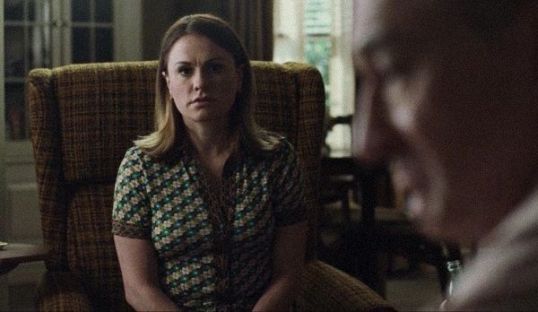
Claire Foy plays Sawyer Valentini. A year ago, Sawyer was working at a hospice when the son of one of her patients became obsessed with and started stalking her. Fearing for her life and realizing that the police weren’t going to be much help, Sawyer moved away from home and tried to restart her life.
Seeking help for dealing with her trauma, Sawyer makes an appointment with a counselor at the Highland Creek Behavioral Center. What she doesn’t realize is that Highland Creek is a scam. The papers that she signed at her appointment allow her therapist to hold her for a 24-hour evaluation. When Sawyer resists and attempts to call the police, her stay is extended by seven more days. Every time that Sawyer demands to be released, she’s judged to be a threat to herself and others and more days are added to her stay. As another patient explains it, Highland Creek basically holds onto its patients until their insurance runs out.
If that wasn’t bad enough, things get worse when Sawyer meets the new orderly (Joshua Leonard). He says that his name is George Shaw but Sawyer swears that he’s David, the man who has been stalking her. Of course, no one listens to her when she tries to tell them. After all, she voluntarily committed herself to Highland Creek….
Unsane received a lot of attention because Soderbergh shot the film in secret with an iPhone. The end results of Soderbergh’s experiment were mixed. At its best, this technique gives the film a gritty look and it visually captures the shaky state of Sawyer’s sanity. At its worse, it’s a distraction that leaves you feeling that you’re supposed to be more impressed by how Soderbergh made the film than by the story being told.
Fortunately, Soderbergh gets two wonderful performances from Claire Foy and the reliably creepy Joshua Leonard. Foy brings just the right combination of fragility and strength to the role of Sawyer and she gives such an empathetic performance that you get involved in her story even if Soderbergh’s style is often distracting. As for Leonard, you’ll recognize him as soon as you see him. He’s a character actor who specializes in playing off-balance people and he’s memorably menacing in this film.
I probably would have liked Unsane more if I didn’t always have the feeling that the movie was mostly made so that Soderbergh could show off. Whenever I see one of Soderbergh’s “genre” films, I get the feeling that he’s looking down on the material and that my reaction is supposed to be one of, “Soderbergh’s such a genius that he can even make crap like this entertaining!” (You get the feeling that Soderbergh might be willing to make a B-movie but he’d never be caught dead actually watching one.) That said, regardless of the motives behind it, Unsane was actually an effective and twisty psychological thriller.
A serial killer known as “The Avenger” is murdering blonde women in London (which, once again, proves that its better to be a redhead). And while nobody knows the identity of the Avenger, they do know that the enigmatic stranger (Ivor Novello), who has just recently rented a room at boarding house, happens to fit his description. They also know that the lodger’s landlord’s daughter happens to be a blonde…
Released in 1927, the silent The Lodger was Alfred Hitchcock’s third film but, according to the director, this was the first true “Hitchcock film.” Certainly it shows that even at the start of his career, Hitchcock’s famous obsessions were already present — the stranger accused of a crime, the blonde victims, and the link between sex and violence.
Also of note, the credited assistant director — Alma Reville — would become Alma Hitchcock shortly before The Lodger was released.
Once upon a time, when the fascists still controlled Spain, there was a man named Marcos (Vincent Parra) who lived in a tiny house that appeared to be sitting in the middle of trash dump. Marcos worked at a slaughterhouse and had a loving girlfriend named Paula (Emma Cohen). Marcos wasn’t a mean person but he did have a temper. Because he was poor and unedcuated, he was permanently on the outside of Spanish society.
One night, Marcos was out on a date with Paula when he got into an argument with a taxicab driver. The argument escalated until Marcos finally (and accidentally) killed the man. Paula thought that they should go to the police. Marcos disagreed. Eventually, to cover up his crime, Marcos strangled Paula in his tiny house.
Then, Marcos’s brother came by and discovered what had happened. So, Marcos killed him too. Then his brother’s fiancée came by and insisted on knowing what Marcos was hiding in the bedroom so Marcos killed her. Then his brother’s fiancee’s father showed up at the house and started asking too many questions so Marcos killed him.
And soon, Marcos’s house was full of dead people.
Towering over Marcos’s house was an apartment building. Living alone on the 13th floor was the handsome Nestor (Eusebio Poncela). Nestor use to spend his days watching Marcos through a pair of binoculars. Though he never knew what was happening in the house, Nestor still became fascinated with Marcos and his refusal to move out of his crummy house.
Eventually, Nestor befriended Marcos. Though Nestor was wealthy, his status as a gay man in 1970s Spain made him as much of an outsider as Marcos. Both Nestor and Marcos had reason to distrust and fear the police and this created a bond. With Nestor’s help, Marcos got a hint of the life that he could have been living if 1) he hadn’t been born poor, 2) he didn’t live in the middle of a garbage dump, and 3) if his house wasn’t full of dead bodies….
In the late 60s and early 70s, European art films were often disguised as being exploitation films when they were released in the United States. That’s certainly the case with this Spanish film from 1972. The original Spanish title of this film was La semana del asesino. In English, that translates to The Week of the Killer, an appropriate title since the film follows a week in the life of Marcos. However, when the film was released in the U.S., it was retitled Cannibal Man, despite the fact that there’s not any cannibalism to be found in the film.
Regardless of what it’s called, the film itself is a surprisingly sensitive and well-done portrait of two outsiders trying to survive and find some sort of happiness under an authoritarian regime. For all the murders that take place, the film itself is far more concerned with the friendship between Nestor and Marcos. When Nestor takes Marcos to his health club and they share a dip in the pool, it’s a rare chance for both Nestor and Marcos to escape their problems. It’s a nicely done scene, one that’s directed in such a way that you understand that this is one of the few times in Marcos’s life when he hasn’t been angry or scared. Even he’s not sure how to handle it.
Director Eloy de Iglesia combines scenes that have a gritty, documentary feel to them with sequences that seem almost dream-like. When Marcos kills his brother’s fiancee, the sound of the clock ticking in his house becomes almost deafening. Vincent Parra plays Marcos as being an inarticulate man who often seems to be in a daze, as if not even he can believe what he’s done and what his life has become. Eusebio Poncela is equally well-cast as the sympathetic Nestor.
Cannibal Man is a film that definitely deserves to be rediscovered.
Since I reviewed A Quiet Place earlier today, it seems appropriate that today’s scene that I love is taken from that film.
In this scene, Lee Abott (John Krasinski) and his son come across an old man in the woods. The old man is looking down at the remains of a woman who we presume to be his wife. What he does next is a reminder of just how brutal and unforgiving life can be. When the man screams, it’s the first human voice that we’ve heard in a while. It’s also a cry of surrender and sacrifice, one that sets up the conclusion of the film.
The 1980 film Cannibal Apocalypse begins in Vietnam.
Sgt. Norman Hopper (John Saxon) leads his troops into a Vietnamese village. A dog approaches. One of the soldiers starts to pet it.
“Watch it, asshole!” Hopper shouts.
Too late. The dog explodes and takes the soldier with him. That’s just the first of many explosive events in the film. Minutes after the dog blows up, Hopper discovers two American soldiers being held prisoner in an underground cage. One of them is named Charles Bukowski (yes, I know) and he’s played by the great Italian actor, Giovanni Lombardo Radice. The other one is named Tommy (Tony King).
“Hey,” Hopper says, “I know these guys! They’re from my hometown!” He reaches down to help them out of the cage. Charlie and Tommy promptly take a bite out of his arm….
Suddenly, Norman Hopper wakes up in bed, next to his wife. He’s been having another nightmare. In the years since returning from Vietnam, Hopper has married, started a family, and bought a nice house in Atlanta. He seems to have his life together but he’s still haunted by what happened that day in Vietnam.
Charlie and Tommy are also still haunted. Unlike Hopper, they haven’t been able to get their lives together. Charlie’s a drifter and, when he shows up in Atlanta and calls Hopper at his home, Hopper isn’t particularly happy to hear from him. After talking to Hopper, Charlie goes to a movie where he watches a couple make out in front of him. Soon, Charlie is trying to eat the couple while panicked movie lovers flee the theater. (“What type of cinema is this!?” one man cries out.)
Forced to eat human flesh while being held prisoner, Charlie and Tommy are both cannibals today. However, as the film makes clear, cannibalism travels like a virus. Anyone who gets bitten by Charlie and Tommy becomes a cannibal themselves. That includes Hopper. For years, Hopper has managed to resist the craving but, as soon as he gets that call from Bukowski, he finds himself tempted to take a bite out of his flirtatious neighbor.
With the authorities determined to eradicate not only the cannibalism plague but also those infected, Hopper finds himself forced to go on the run with Charlie, Tommy, and an infected doctor (Elizabeth Turner). Eventually, everyone ends up in the sewers of Atlanta where people are set on fire, one unfortunate is literally chopped in half by a shotgun blast, and the rats turn out to be just as hungry as the humans….
And here’s the thing. You’re probably thinking that this sounds like a really bad movie but it’s actually kind of brilliant. I may love Italian horror but, for the most part, I’m not a fan of cannibal movies. But, thanks to the performances and the energetic direction of Antonio Margheriti, Cannibal Apocalypse transcends the limits of the cannibal genre. Obviously, gorehounds will find what they’re looking for with this movie but far more interesting is Cannibal Apocalypse‘s suggestion that war (represented by the cannibalism that Hopper, Tommy, and Bukowski bring back from Vietnam) is an infectious virus. Once someone gets bitten, it doesn’t matter who they are or what type of life that they’ve led. The infection cannot be escaped.
In an interview that John Saxon gave for the film’s DVD release, Saxon said that making this film actually left him feeling suicidal. It wasn’t just the fact that the film itself presents a rather dark view of humanity. It’s because it upset him to know that there was an audience that was as rabid for violence as Norman Hopper is for human flesh. Saxon said that he had never seen the film and, in the interview, he had to be reminded what happened to Norman Hopper at the end of the film. It’s a bit of a shame because Saxon gives a brilliant performance as Norman Hopper. Saxon plays Hopper as being a sad man, a man who knows that he can’t escape his fate as much as he wants to. There’s a tragic dignity to Saxon’s performance, one that gives this cannibal film unexpected depth.
Also giving great performances are Giovanni Lombardo Radice and Tony King. As played by Radice, Charlie is a living casualty of war, a man who served his country and came home to be forgotten. You understand Charlie’s anger and his resentment. (When Bukowski finds himself in a stand-off with the police, one the cops explains away Bukowski’s actions by dismissively saying, “He’s a Vietnam vet,” a line of dialogue that not only explains Charlie’s anger at America but also calls out America for not taking care of its veterans,) Meanwhile, Tony King gets one of the best scenes in the film when, seeing Hopper for the first time in years, he grins at him and yells, “Remember these choppers!?”
As strange as it may seem to say about a film called Cannibal Apocalypse, this is a film that will bring tears to your eyes. It’s one of the classics of Italian horror.
As a film viewer, I am sometimes guilty of taking sound for granted.
That was the first thought that I had while watching A Quiet Place, a horror film that came out earlier this year. The film takes place in the near future, after the Earth has been invaded by aliens who track their prey by sound. Lee Abbott (John Krasinski, who also directed), his wife Evelyn (Emily Blunt), and their children (including Millicent Simmonds) have learned that the only way to survive is to do everything in silence. They communicate with sign lanague. They walk carefully, knowing that even the sound of a footstep could lead to doom.
If ever the old cliché about echoing silence was true, it’s true while watching A Quiet Place. Because Krasinski starts the film by showing us what happens when one forgets to be silent around the aliens, we know what will happen if Lee or his children make the slightest amount of noise and what’s interesting is that those of us watching find ourselves not making any noise as well. Krasinski, Blunt, and Simmonds give such effective performances that you’re drawn into their story. You don’t want them to get killed by the invaders so you make sure to remain quiet yourself.
That doesn’t mean that A Quiet Place is a silent film, of course. Since Lee spends the majority of the film in the woods with his children, there’s the occasional sounds of nature. And towards the end of the film, when someone finally speaks, it’s jarring both because we’ve gotten used to the silence and because we know what’s going to happen next.
My second thought while watching A Quiet Place was “Who knew John Krasinski was capable of this?” I’ve always liked Krasinski as an actor but his previous films as a director leaned a bit towards the pretentious side. There was nothing about his previous films that suggested Krasinski had it in him to direct one of the most creative and tension-filled horror movies of the year. Krasinski proves himself to be an unexpected master of suspense.
But it’s more than horror that makes A Quiet Place effective. A Quiet Place is a film about family. Despite the circumstances, Lee and Evelyn have managed to create a safe household for their children. It may be a silent household but it’s also a loving household and, with Evelyn being pregnant, it’s about to get bigger. Blunt and Krasinski are married in real life and their chemistry is evident every time that they exchange a glance. The film celebrates not only the love of family but the sacrifices that parents make for their children. It’s probably the most pro-family of the year.
A Quiet Place is a short and efficient film. At a time when the average film usually clocks over two hours, A Quiet Place is only 90 minutes long but it achieves so much in those 90 minutes! A Quiet Place is a powerful movie, one that will make you appreciate both families and the noise that they make.
For today’s horror on the lens, we have a real treat!
Produced for HBO in 1991, Cast a Deadly Spell takes place in an alternate 1948, where magic is used regularly and zombies are used as slave labor but the streets of Los Angeles are just as mean as they’ve ever been. Fred Ward gives a fantastic performance as Harry Phillip Lovecraft, a hard-boiled P.I. who refuses to use magic on general principle. Lovecraft, however, may have no choice when he finds himself embroiled in a case involving a magic book, Julianne Moore, and Clancy Brown!