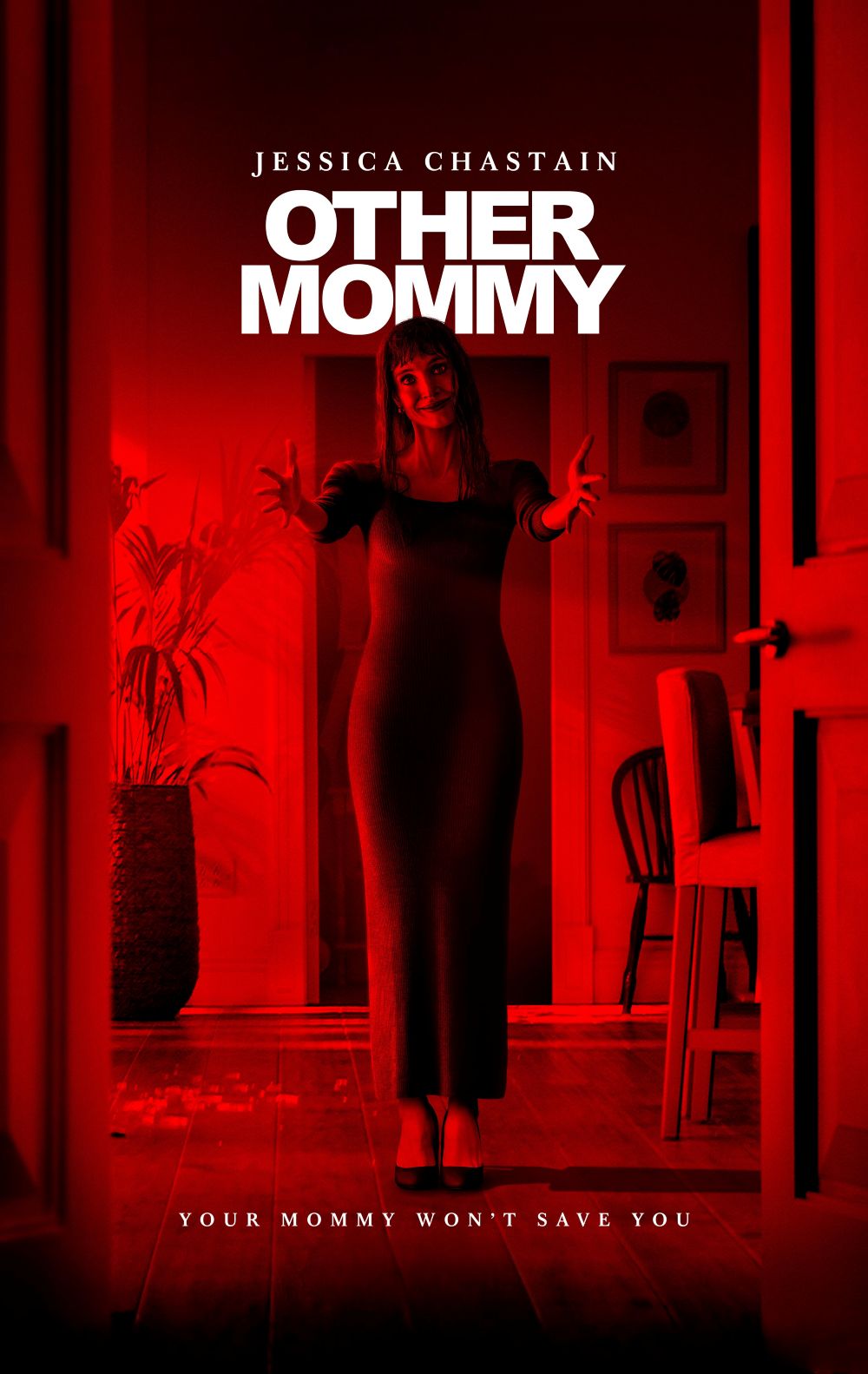
“Sometimes I think about when you and I were one person, and it makes me so happy, I cry. Do you remember that?” — Other Mommy
Jessica Chastain is the only reason Other Mommy works at all, and even she cannot quite save a horror movie that turns a genuinely strong premise into something silly through its own adaptation. Rob Savage’s 2026 film is based on Josh Malerman’s novel Incidents Around the House, and the source material’s central idea—a young girl discovers that the entity haunting her house looks exactly like her mother—is legitimately creepy and emotionally rich. The novel understands that a child’s fear of losing her mother, and a mother’s fear of being replaced, can carry an entire horror story. The movie takes that same foundation and rushes through it, leans into chaotic scares, and never finds a consistent tone, until the premise starts to feel ridiculous rather than frightening. What keeps it from being a total loss is Chastain’s double performance as both the struggling mother Ursula and the grotesque creature impersonating her. Without her, this would be an easy movie to forget. With her, it becomes a frustrating watch—good enough to keep you interested, bad enough to make you wish it had been better.
The story follows Bela, an eight-year-old girl played by Arabella Olivia Clark, who lives with her parents Ursula and Russ, played by Chastain and Jay Duplass. Their home is already unstable. The marriage is strained, the parents are distracted, and Bela is left to make sense of it all on her own. Into that environment comes Other Mommy, an entity that emerges from the closet wearing Ursula’s face. She does not simply attack Bela. Instead, she asks to be let into her heart, promising love and closeness while making it clear that refusal will have consequences. In Malerman’s novel, that setup works because the book takes its time exploring the psychological weight of it: a child caught between a mother who cannot fully show up for her and a monster who will happily pretend to. The film has the same ingredients but treats them more like a starting point for increasingly ridiculous scares than something it actually wants to sit with, and that is where the adaptation starts to lose the plot.
Chastain is the reason any of it works at all. Playing Ursula and Other Mommy gives her a chance to show two very different sides of the same face, and she makes the contrast convincing. As Ursula, she is tired, brittle, and emotionally unavailable in a way that feels believable even when the plot around her falls apart. She loves her daughter, but she is too overwhelmed and angry to show it consistently, and Chastain plays that failure without turning Ursula into a villain. As Other Mommy, she gets to go full nightmare fuel. The creature performs motherhood like someone who has studied it from the outside, smiling too widely, speaking in a warm but slightly off register, and moving with an unnatural confidence that makes every interaction feel wrong. Chastain understands that the scariest version of the monster is not the one that growls or lunges, but the one that almost gets the role right. She knows the words. She does not understand the feeling behind them.
That performance is what gives the film its few genuinely effective moments. When Other Mommy pleads with Bela to accept her, the scene works because the creature is both terrifying and pitiful. She wants to be loved, believed, and chosen, and she cannot comprehend why Bela would resist. There is something sad about that, and Chastain finds it without softening the character’s menace. She makes the entity feel like a desperate, needy thing wearing a mother’s face, and that is a much more interesting horror idea than the movie’s actual plot delivery system. If the film had leaned harder into that emotional contradiction and given it room to breathe, it might have come closer to capturing what makes the novel’s premise so effective. Instead, it keeps rushing past the interesting parts to get to the next loud, chaotic set piece.
That pacing is one of the movie’s biggest problems. At 93 minutes, Other Mommy moves fast, and not in a good way. It introduces the family’s problems, brings in the monster, and starts escalating the scares before the audience has had much time to connect with anyone. We understand that Ursula and Russ are unhappy, but we do not feel the specific weight of that unhappiness. We know Bela is lonely, but the film does not give her enough quiet moments to show what that loneliness looks like day to day. The result is a movie full of confrontations with the entity but very little emotional buildup between them. The family feels more like pieces in a horror machine than people whose survival actually matters, and that makes it hard to care when things go wrong. The novel earns its scares by making you care about the people first; the film skips that step and wonders why the scares do not hit as hard.
Savage’s direction does not help. He clearly likes big visual ideas, sudden movements, and scares that come out of nowhere, but the execution often feels more frantic than frightening. The creature design has some inventive moments—Other Mommy can stretch, contort, and squeeze herself into spaces no human body should fit—but the film rarely trusts quiet dread. It piles on noise, fast editing, and chaotic CGI effects until the tension flattens out. A scare that might have landed with a little patience becomes one more startle in a long line of startles. When the entity lingers at the edge of the frame, half-seen through a doorway or reflected somewhere she should not be, the movie creates real unease. Those moments are too rare. Most of the time, the film would rather show you everything immediately and hope volume substitutes for atmosphere, which is exactly the kind of choice that turns a creepy premise into a silly one.
The tonal swings make things worse. Other Mommy wants to be sad, scary, funny, and ridiculous all at once, and it does not know when to switch gears. There are sequences where the creature’s behavior becomes so exaggerated that it tips into camp, including a ball-pit scene that pushes the film into full-on absurdity. That campiness might work in a movie that fully embraces it, but this one keeps trying to have it both ways. It wants you to laugh at the monster’s physical comedy one minute and feel genuine dread the next, and the shifts are jarring rather than effective. The result is a film that never settles into a consistent identity. It is too silly to be truly scary and too serious to be fun camp, and that in-between space is where it lost me—and where it drifts furthest from the novel’s more controlled, unsettling tone.
The supporting cast does not do much to help. Duplass gives Russ a believable sense of helplessness, but the character is thinly written and mostly reactive. Karen Allen, Arian Moayed, and Dichen Lachman show up in roles that serve the plot rather than add dimension. Clark is better than the material deserves, bringing a real vulnerability to Bela that makes her more than just a screaming kid. She holds her own opposite Chastain, which is no small feat given how much the older actress is doing in every scene. But even a good child performance cannot fix a screenplay that does not know what it wants to say about the family at the center of the story.
In the end, Other Mommy is a movie with one great performance and an adaptation that takes a strong, genuinely unsettling premise and makes it feel silly through rushed pacing, chaotic direction, and tonal confusion. The idea of a mother-shaped entity trying to replace a child’s real mother is not the problem—Malerman’s novel proves it can be genuinely frightening. The problem is that Savage’s film does not know how to translate that idea to the screen without turning it into a series of loud, inconsistent set pieces. Chastain plays both sides of the dynamic with total commitment, and she is the only reason the movie stays watchable. It is not the worst horror movie of the year, but it is a disappointing one, because you can see the better version of this story trying to get out. If you watch it, watch it for her. Just do not expect the movie around her to hold up the way the book’s premise deserves.

