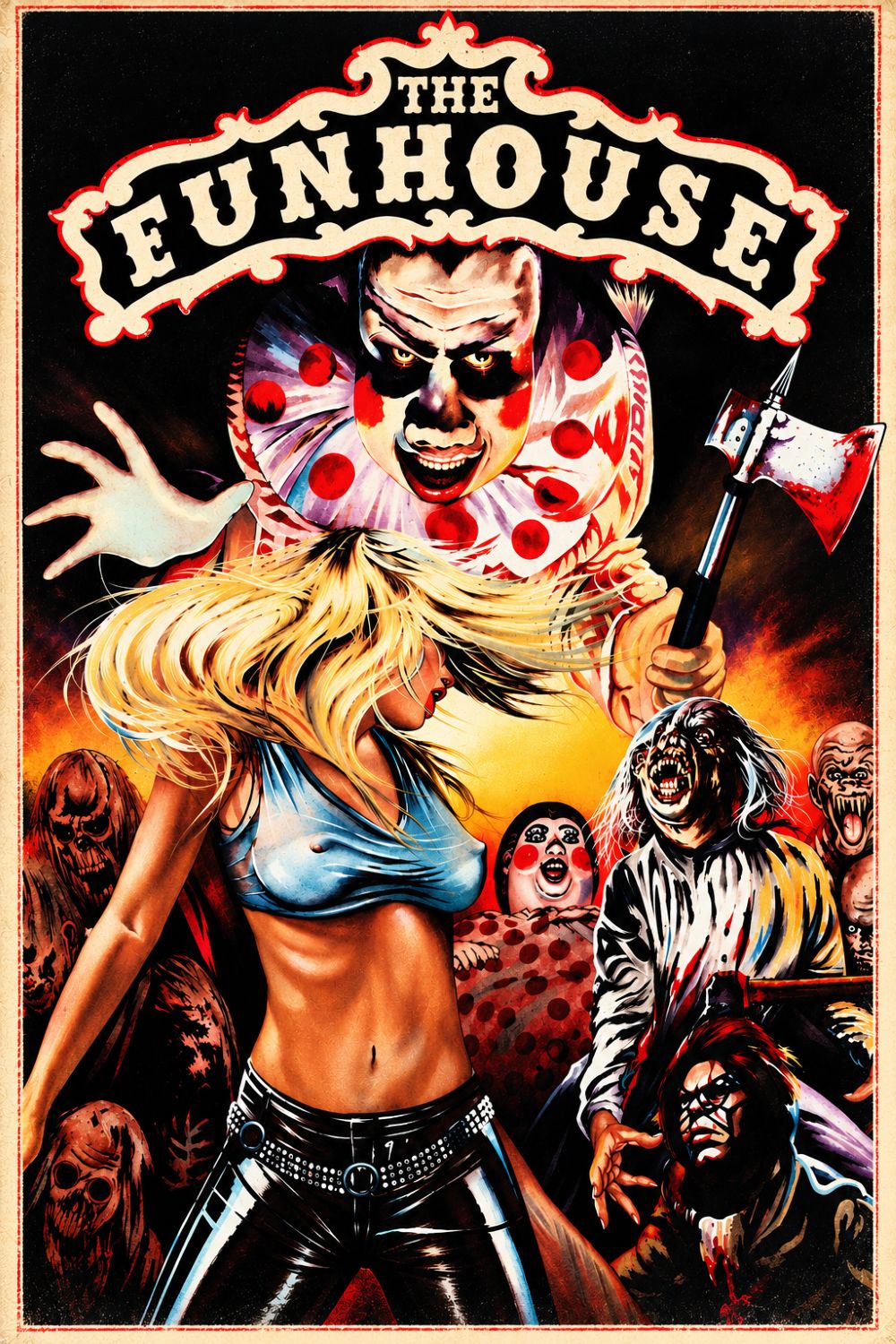
“Who will dare to face the challenge of the Funhouse? Who is mad enough to enter that world of darkness?” — Funhouse Barker
There’s something wonderfully sleazy about a horror movie that makes you feel like you need a shower before anyone has even been murdered. Tobe Hooper’s The Funhouse (1981) gets that feeling just right, turning a traveling carnival into a place where the entertainment seems questionable and whatever happens behind the scenes looks considerably worse. It’s not Hooper’s most relentless film, and its straightforward story sometimes struggles to justify the leisurely buildup. Still, there’s enough grime, menace, and visual imagination here to make a familiar teenagers-in-trouble premise feel like more than another ride around the slasher circuit.
The teenagers are Amy Harper, played by Elizabeth Berridge, her date Buzz, and their friends Liz and Richie. Their evening starts with the usual carnival activities: wandering around, checking out attractions, and looking for ways to entertain themselves. Eventually, they decide to hide inside the funhouse overnight. It’s the kind of bad idea that becomes irresistible when nobody wants to be the boring one who objects. After witnessing a murder involving a worker wearing a Frankenstein mask, they find themselves trapped inside with people who have a very good reason to make sure they never leave.
Before any of that, Hooper introduces a playful awareness of horror movies through Amy’s younger brother. He’s a horror fan whose enthusiasm spills into an elaborate prank, approaching Amy in the shower while wearing a mask. The sequence borrows from Halloween and Psycho, turning familiar suspense techniques into a kid’s obnoxious attempt to stage his own scary movie. It’s a neat little meta touch because horror already exists as entertainment within these characters’ lives. They recognize its costumes and enjoy its tricks. The trouble begins when that familiarity encourages them to treat danger as something they can safely play around with.
The carnival extends that idea on a larger scale. Its business depends on selling fear without consequences, and the teenagers arrive expecting every unsettling sight to be part of the experience. Hooper makes that expectation increasingly difficult to maintain. There’s a sourness underneath the attractions, a sense that the smiles and sales pitches barely cover the irritation of the people working there. The movie’s sleaze isn’t just a matter of dirty surroundings. It comes from the uneasy relationship between the customers looking for cheap thrills and the workers who seem to regard them with boredom, contempt, or something less easily identified.
Hooper spends a substantial amount of time letting us absorb that atmosphere. Depending on your patience, this either gives the movie its personality or makes the first half feel like an extended wait for something to happen. There are stretches where the teenagers’ wandering could have been tightened without losing much. On the other hand, rushing directly to the murders would sacrifice the sense that this place has an existence beyond the plot. By the time the group becomes trapped, the carnival feels less like a collection of convenient horror props than a shabby little world with its own unpleasant routines.
Once inside the funhouse, the visual design takes over. Mechanical figures, grotesque faces, and cluttered passageways make it difficult to separate an actual threat from another piece of scenery. Hooper gets suspense out of that uncertainty, giving your eyes plenty to investigate without always rewarding the effort with an immediate scare. The machinery keeps moving regardless of what happens around it, which becomes increasingly unnerving. Something designed to provide a few minutes of harmless excitement turns into an obstacle course whose mechanisms have no interest in whether anyone gets hurt. The attraction doesn’t become evil; its normal operation simply becomes dangerous.
The characters are less distinctive than their surroundings. Berridge gives Amy a believable vulnerability, and her discomfort never feels like an excuse for smugly announcing that everyone else should have known better. She’s simply a young woman whose evening gets horribly out of hand. Buzz, Liz, and Richie have enough personality to establish the group, but not enough to make their individual fates especially affecting. That’s the main limitation of the screenplay: the situation generates more investment than the people caught in it. You’re anxious about what might happen without necessarily feeling that you know these kids very well.
Kevin Conway adds a stronger dose of personality as three different carnival barkers, especially in his role as the masked killer’s father. His combination of aggression and warped protectiveness gives the horror an ugly domestic undercurrent. The creature is frightening, but his vulnerability makes the relationship more disturbing than a simple partnership between villains. The Frankenstein mask also pays off the movie’s interest in familiar horror imagery: a recognizable monster face initially offers something almost reassuring, until its removal destroys that comfort. The makeup is memorable, although the film’s use of physical difference as a source of monstrous terror remains an uncomfortable shortcut.
When the chase finally takes over, The Funhouse delivers tense, claustrophobic suspense without becoming an endless procession of elaborate kills. Its cramped spaces and unreliable hiding places make escape feel frustratingly difficult. The thin characterization and occasional sluggishness keep it from matching Hooper’s strongest work, but the setting remains potent enough to carry the film. From the brother playing horror director to the carnival packaging fear for paying customers, the movie keeps showing people enjoying pretend terror before confronting something they can’t control. It’s an effective, grimy little nightmare that makes the midway’s cheap pleasures look a lot less inviting.

