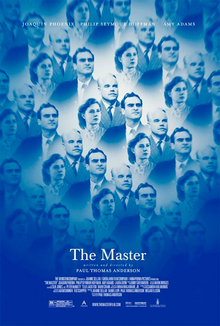
Today’s scene that I love comes from 2012’s The Master, written and directed by Paul Thomas Anderson (who is celebrating his birthday today).
Philip Seymour Hoffman and Joaquin Phoenix were never better than they were in Anderson’s enigmatic story of two very different men who become unlikely friends. Phoenix plays Freddie Quill, a World War II veteran who has never figured out how to adjust to life during peacetime. Hoffman plays Lancaster Dodd, a writer who claims to have all the answers but who is actually a charlatan. In this scene, Freddie and Dodd meet for one last time and, though they are both characters about who most viewers will have mixed feelings, there’s something undeniably poignant about their final moments together. Both of them realize that the time they had is over. And indeed, watching this scene today is all the more difficult because it reminds us of what a talent we lost when we lost Philip Seymour Hoffman.
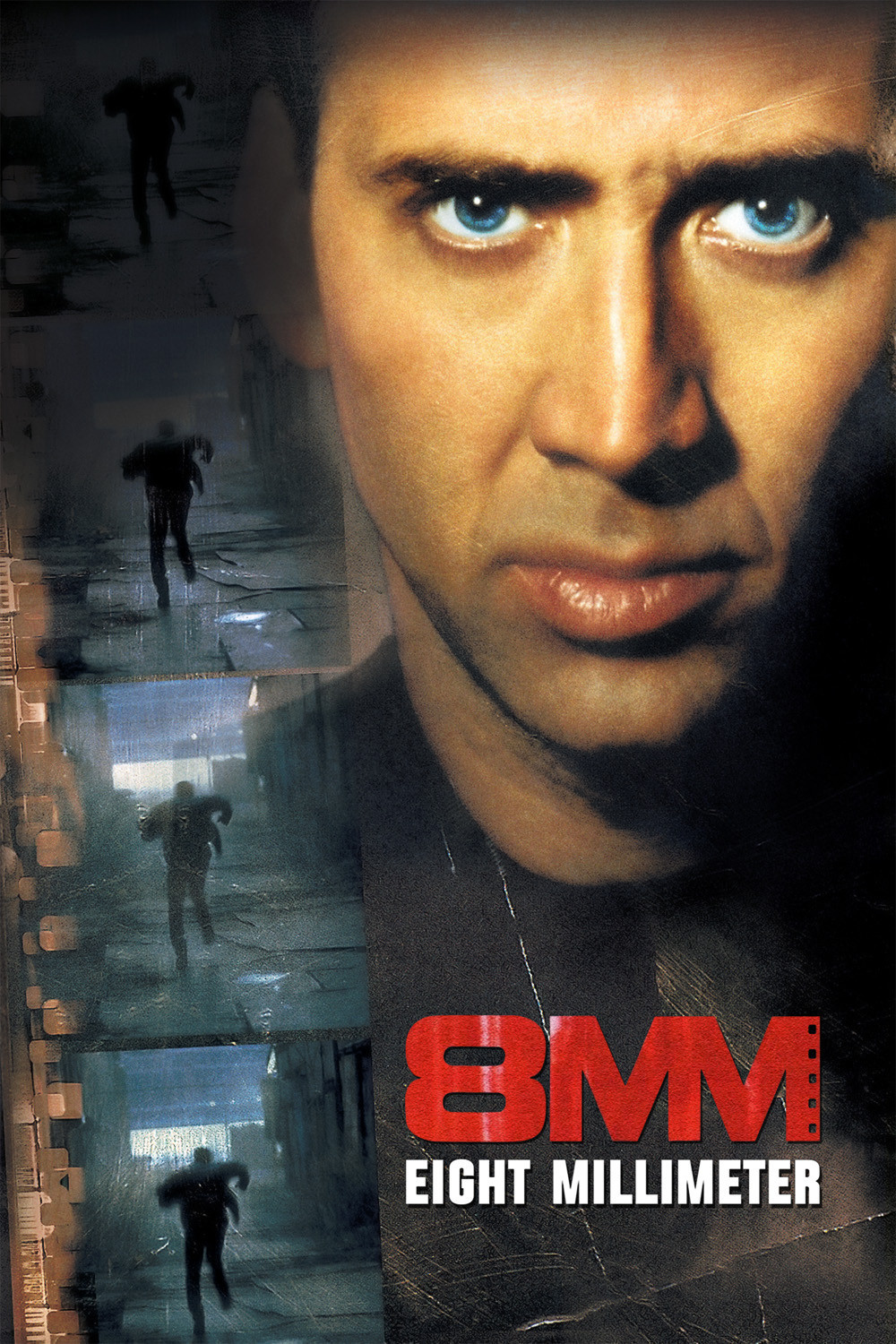
Joel Schumacher’s 8MM (1999) uncoils like a reel of forbidden footage you shouldn’t have found, pulling a buttoned-up private eye into the rancid shadows of underground smut peddlers and whispers of snuff films that may or may not exist. It’s a late-’90s thriller smack in the wake of Se7en and Kiss the Girls, starring Nicolas Cage as Tom Welles, a Harrisburg family man whose crisp suits and steady hands belie the unraveling ahead. Hired by a steel magnate’s widow to verify an 8mm tape depicting a girl’s torture-murder, Welles tumbles down a rabbit hole of L.A. peep shows and New York meatpacking sleaze, his moral compass spinning as the line between fantasy and atrocity blurs. Schumacher crafts a narrative engine that hums with procedural grit, doling out dread in measured doses while mirroring the protagonist’s corrosion, though it occasionally stumbles in its heavier-handed turns.
The setup hooks with surgical efficiency, painting Welles as everydad detective: he buries bodies for a living, kisses his infant daughter goodbye, and screens the tape in a vault-like study that feels like a confessional. Myra Carter’s Mrs. Christian trembles with decorous horror as the projector whirs to life, bathing the room in jaundiced flicker; the footage—grainy, handheld, a pleading teen bound for “Machine’s” blade—lands like a gut punch without lingering on gore. Lawyer Longdale (Anthony Heald, all patrician slime) waves it off as staged porn, but Welles digs anyway, tracing victim Mary Ann Mathews through missing-persons archives to her runaway dreams in Hollywood. Paired with Max California (Joaquin Phoenix), a Sunset Strip tape jockey with pawn-shop cynicism and a Zipperhead tee, they prowl fetish dens where vendors hawk needle-play loops and dismiss snuff as urban legend. Schumacher’s lens, via Robert Elswit, turns these dives into feverish grottos—neon strobes slicing steam, racks of VHS promising the forbidden—building unease through denial upon denial.
That mounting frustration propels the first hour’s finest stretches, a slow immersion where Welles’s calls home grow terse, his wife’s concern (Catherine Keener, quietly anchoring) a lifeline fraying in crosscuts. Max’s street-rat patter—”Snuff? Ain’t no such thing as snuff, man”—leavens the rot without undercutting it, Phoenix layering vulnerability beneath the snark that makes his arc genuinely affecting. Schumacher parcels revelations like a fuse burning short: a Florida trailer confirms Mary Ann’s vanishing, a porn mag scout nods toward “real death” commissions, and suddenly they’re in New York, knocking on Dino Velvet’s door. Peter Stormare vamps as the mulleted auteur of extremity, his studio a cathedral of spotlit chains where Machine (masked, hulking) performs for hidden lenses. The confrontation there explodes into sudden violence and betrayal, shattering assumptions about the tape’s origins and thrusting Welles into a desperate fight for survival, with devastating losses that harden his path forward.
This mid-film rupture peels back layers of the underworld’s machinery, revealing how far some will go to sate forbidden appetites—no vast conspiracy, just raw opportunism turning fantasy lethal. Chaos erupts in a brutal showdown that catapults Welles into lone-wolf payback, though the script’s mechanics creak here, tipping from investigation to vengeance saga with less finesse than its buildup promises. He tracks leads back to L.A., confronting scout Eddie Poole (James Gandolfini) in a derelict factory, beating out confessions amid rusted girders, then facing Machine—unmasked as unassuming accountant George Higgins (Chris Bauer), who shrugs, “I like it”—in a rain-slicked graveyard melee. Schumacher stages the violence as visceral toll, not catharsis: fists land with bone-crunching thuds, blood sprays real, and Welles emerges hollowed, sobbing in his wife’s arms over the unerasable stain. It’s raw consequence over triumph, indicting the watcher as much as the watched.
Cage shoulders the load masterfully, dialing back his manic energy for a portrait of competence curdling into obsession—hesitant stares post-tape, fists unclenching at home, exploding only when the dam breaks. It’s restrained Cage at his peak, the fury earned through incremental fracture, though some beats flirt with overemphasis. Phoenix shines brighter still, turning Max from sidekick gag into soulful foil; his death resonates because Joaquin sells the bravado as fragile armor. Stormare’s Dino struts operatic depravity, a Bond villain in wifebeater, while Gandolfini’s Poole simmers regretful everyman heft—pre-Sopranos groundwork for Tony’s shadows. Heald’s Longdale drips WASP entitlement, and bits like Norman Reedus’s twitchy dealer add lived-in texture. Schumacher elicits extremes without cartooning them, populating the underworld with deviants who feel plausibly human, not pulp cutouts.
Visually, 8MM thrums with Schumacher’s maximalist pulse tamed to noir grit: Elswit’s shadows swallow faces in peep booths’ crimson haze, the snuff reel’s jitter evokes cursed artifacts, and the loft showdown’s spotlights carve brutality like Bosch hellscapes. Mychael Danna’s score slithers—piano sparsity for Welles’s drift, synth throbs for dives—capped by Aphex Twin’s “Come to Daddy” warping a raid into glitch-rage frenzy. Production design nails the era’s analog underbelly: dog-eared tape boxes, industrial decay standing in for L.A. (shot cheap in Florida), all evoking a pre-digital void where evil hides on celluloid. The snuff aesthetic probes voyeurism smartly—we glimpse pleas and steel without exploitation, questioning our gaze alongside Welles’s, though the film’s flirtation with seediness risks tipping into the very prurience it critiques.
Andrew Kevin Walker’s script (fresh off Se7en) structures as moral diptych: procedural probe yields to vigilante spasm, bookended by domestic anchors that underscore the cost. No tidy psychologizing redeems the killers—Higgins kills because appetite wills it, Poole for “business,” others for greed—exposing evil’s flat banality over tortured backstories. The widow’s suicide post-truth, Mary Ann’s mom’s grateful note (“You cared enough to try”), and Welles’s scarred homecoming deny closure; vengeance hardens more than heals, bodies burned sans parade of justice. It’s a gut-punch thesis on film’s limits: some horrors defy capture, watching them unmakes the witness. Schumacher, slumming post-Batman gloss, revels in the ugly, though pacing drags early in porn prowls and the revenge rampage strains credulity.
Yet for all its stumbles—script contrivances like convenient turns, a third act veering punchy over precise—8MM endures as underrated descent, a thriller that stares unblinking into appetite’s void. Cage and Phoenix elevate genre tropes, Schumacher’s design makes depravity stick, and the core query lingers: does filming evil make it real, or us complicit? Flaws aside, it hums with the era’s dark electricity, a flawed reel worth unspooling for its unflinching grind.
“In order to know virtue, we must acquaint ourselves with vice. Only then can we know the true measure of a man.” — Marquis de Sade
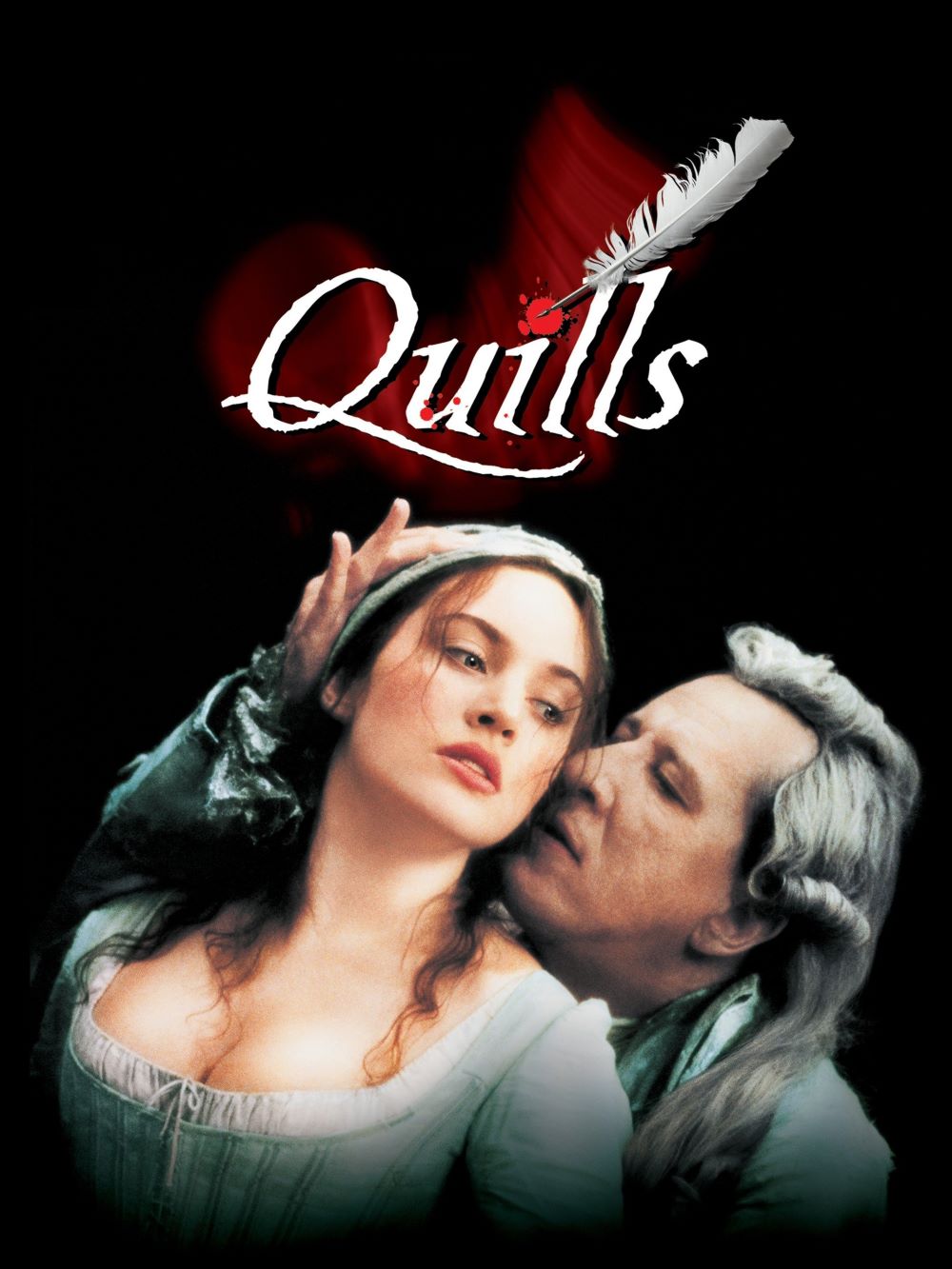
Quills, Philip Kaufman’s 2000 take on the infamous Marquis de Sade, dives headfirst into the messy clash between artistic freedom and societal repression. It’s a film that doesn’t shy away from the dark, provocative world of its subject, blending historical drama with a touch of theatrical flair. While it takes liberties with the facts, it captures the spirit of de Sade’s defiance in a way that’s both entertaining and thought-provoking.
Right from the start, Quills sets up its world inside the Charenton Asylum for the Insane, where the aging Marquis de Sade, played with gleeful abandon by Geoffrey Rush, is holed up under the watch of the kindly Abbé de Coulmier (Joaquin Phoenix). De Sade’s been churning out his scandalous writings—think Justine and other works that shocked 18th-century France—and smuggling them out via laundry baskets to a young laundress named Madeleine LeClerc (Kate Winslet). Napoleon’s regime isn’t thrilled, so they dispatch the stern Dr. Royer-Collard (Michael Caine) to tighten the screws and silence the madman once and for all. The stage is set for a battle of wills, with de Sade’s pen as his weapon against the forces of censorship.
Geoffrey Rush owns the screen as de Sade, turning what could have been a one-note villain into a complex, charismatic force of nature. He’s sly, unrepentant, and hilariously vulgar, spitting barbs that cut deep into hypocrisy and piety. Rush balances the man’s depravity with a genuine passion for expression, making you root for him even as his ideas repulse. It’s a performance that’s equal parts showman and philosopher, and it anchors the film’s energy. Joaquin Phoenix brings a quiet intensity to the Abbé, a man torn between his faith, his compassion, and the stirrings of forbidden desire—especially toward Madeleine. Phoenix nails the internal conflict, his wide eyes conveying a soul on the brink.
Kate Winslet shines as Madeleine, the innocent conduit for de Sade’s words, whose curiosity pulls her into his orbit. She’s got that Winslet spark—earnest yet fiery—and her scenes smuggling manuscripts or reading aloud add a layer of warmth to the asylum’s chill. Michael Caine, meanwhile, chews scenery as the pompous doctor, a hypocritical sadist in his own right, obsessed with his young bride Simone (Amelia Warner). Caine’s Royer-Collard is deliciously smarmy, a foil to de Sade who mirrors his cruelty under the guise of order. The ensemble clicks, with supporting turns like Tony Berthaud as the asylum’s rougemont adding comic relief amid the tension.
Kaufman’s direction keeps things visually striking without overwhelming the story. The asylum feels alive—claustrophobic cells contrast with grand halls where inmates stage de Sade’s plays under the Abbé’s misguided therapy. Cinematographer Rogier Stoffers bathes everything in earthy tones, with candlelit shadows that amp up the gothic vibe. The score by Angelo Badalamenti weaves eerie strings and harpsichord flourishes, underscoring the film’s blend of horror and humor. It’s not afraid to get graphic: scenes of self-mutilation and bodily fluids as writing tools push boundaries, but they’re more about desperation than shock value.
Thematically, Quills grapples with freedom of speech in a way that’s timeless. De Sade isn’t portrayed as a hero—his writings celebrate excess and cruelty—but as an indomitable spirit who won’t be silenced. Even stripped of paper, ink, clothes, and eventually his voice, he finds ways to provoke, dictating stories through inmates or scratching words into his skin. It’s a middle finger to censorship, questioning who the real monsters are: the libertine or the repressors enforcing “morality.” The Abbé represents liberal tolerance stretched to breaking, Royer-Collard conservative control gone tyrannical. Madeleine embodies the allure of forbidden ideas, her tragic arc highlighting how words can liberate or destroy.
That said, the film isn’t perfect—it’s a fictionalized riff on history, not a biopic. The real de Sade spent years at Charenton, but the timeline compresses events, amps up the drama, and softens his edges for modern tastes. He wasn’t quite the defiant artist Kaufman paints; his later years were more pathetic than poetic. Critics have noted it sanitizes Justine‘s true extremity—no orgies or murders here, just innuendo. Some see it as romanticizing a monster, turning him into a free-speech martyr rather than the predator he was. Fair point; the movie sympathizes more with his pen than his philosophy. Still, as entertainment, it works because it doesn’t pretend to be a documentary.
Humor peppers the darkness, keeping Quills from wallowing in gloom. De Sade’s quips land like punches—”There’s no sin in writing!”—and absurd moments, like inmates reenacting his tales or the doctor’s failed inventions, add levity. One standout sequence has de Sade dictating a racy novel through a chain of whispering patients, turning the asylum into a underground press. It’s One Flew Over the Cuckoo’s Nest meets Dangerous Liaisons, with inmates running wild in a riot of liberation gone wrong. The film’s pace builds masterfully to its brutal climax, where de Sade’s final “victory” leaves you unsettled, pondering if ideas can truly be killed.
Performances aside, the script by Doug Wright (adapted from his play) crackles with wit and insight. Dialogue zings without feeling stagey, and it probes hypocrisy head-on: the pious Abbé lusting after Madeleine, Royer-Collard bedding his teen bride while torturing others. Christianity takes hits—de Sade devours a crucifix, mocks scripture—but it’s broad satire, not preachy atheism. The ending, with its ironic twist on legacy, sticks with you, echoing how de Sade’s name endures despite efforts to erase him.
For fans of period dramas with bite, Quills delivers. It’s provocative without being pornographic, smart without being stuffy. At 124 minutes, it never drags, balancing spectacle and substance. Sure, it glamorizes a controversial figure, and history buffs might nitpick inaccuracies—like the Abbé’s real-life tolerance or Charenton’s theater program. But Kaufman’s track record (The Right Stuff, The Unbearable Lightness of Being) shows he knows how to humanize extremes. Rated R for good reason—nudity, violence, profanity—it’s adult fare that rewards attention.
Visually, the costumes pop: de Sade’s velvet robes give way to rags, symbolizing his fall, while Madeleine’s simple smocks highlight her purity amid corruption. Production design nails early 19th-century France, from ornate asylum architecture to the doctor’s sterile gadgets. Badalamenti’s music swells during key confrontations, heightening emotional stakes without overpowering.
In the end, Quills asks tough questions about art’s power and limits. Does provocation justify excess? Can society silence dangerous minds without becoming monstrous itself? It doesn’t provide easy answers, which is its strength. Rush’s tour-de-force makes de Sade magnetic, flaws and all, while the supporting cast elevates the ensemble. Not for the faint-hearted, but if you appreciate bold cinema that stirs debate, it’s a gem. Rewatch value is high—themes resonate in our cancel-culture age. Philip Kaufman crafted a film that’s as unruly as its protagonist: unapologetic, alive, and impossible to ignore.
Today’s scene that I love comes from 2012’s The Master, written and directed by Paul Thomas Anderson (who celebrated his birthday yesterday).
Philip Seymour Hoffman and Joaquin Phoenix were never better than they were in Anderson’s enigmatic story of two very different men who become unlikely friends. Phoenix plays Freddie Quill, a World War II veteran who has never figured out how to adjust to life during peacetime. Hoffman plays Lancaster Dodd, a writer who claims to have all the answers but who is actually a charlatan. In this scene, Freddie and Dodd meet for one last time and, though they are both characters about who most viewers will have mixed feelings, there’s something undeniably poignant about their final moments together. Both of them realize that the time they had is over. And indeed, watching this scene today is all the more difficult because it reminds us of what a talent we lost when we lost Philip Seymour Hoffman.
Now that the 2024 Oscars are over with, it’s time to move on to the 2025 Oscars!
Needless to say, there’s probably nothing more pointless than trying to guess which films are going to be nominated a year from now. I can’t even guarantee that all of the films listed below are even going to be released this year. And, even if they are released this year, I can’t guarantee that they’ll actually be any good or that the Academy will show any interest in them. I mean, someone like Martin Scorsese always seems like a safe bet but we all remember what happened with Silence. For months, everyone said Silence would be the Oscar front runner. Then it was released to respectful but not ecstatic reviews. Audiences stayed away. The film ended up with one technical nomination. And let’s not forget that last year, at this time, the narrative was that it was going to be Ridley Scott’s year.
My point is that no one knows anything. As much as I hate quoting William Goldman (because, seriously, quoting Goldman on a film site is such a cliché at this point), Goldman was right.
(Add to that, 2025 is starting to look like it’s going to be a seriously underwhelming year as far as the movies are concerned.)
Anyway, here are my random guesses for April! A few months from now, we can look back at this list and have a good laugh.
Best Picture
After The Hunt
Avatar: Fire and Ash
Deliver Me From Nowhere
Eddington
F1
Frankenstein
The Lost Bus
One Battle After Another
Wicked For Good
The Young Mothers Home
Best Director
Paul Thomas Anderson for One Battle After Another
Jon M. Chu for Wicked For Good
Jean-Pierre and Luc Dardenne for The Young Mother’s Home
With a little help from Radiohead’s The National Anthem (off Kid A, a fantastic album in its own right), Ridley Scott and Joaquin Phoenix are back in the saddle. The trailer for Napoleon seems to be pretty epic in scope. I’m hoping this is will be more along the lines of Gladiator and my favorite, Kingdom of Heaven.
Napoleon also stars Vanessa Kirby (Mission Impossible: Fallout), and will premiere in theatres this Thanksgiving. The film is produced by Apple Films.
Today’s scene that I love comes from 2012’s The Master, written and directed by Paul Thomas Anderson (who is celebrating his birthday today).
Philip Seymour Hoffman and Joaquin Phoenix were never better than they were in Anderson’s enigmatic story of two very different men who become unlikely friends. Phoenix plays Freddie Quill, a World War II veteran who has never figured out how to adjust to life during peacetime. Hoffman plays Lancaster Dodd, a writer who claims to have all the answers but who is actually a charlatan. In this scene, Freddie and Dodd meet for one last time and, though they are both characters about who most viewers will have mixed feelings, there’s something undeniably poignant about their final moments together. Both of them realize that the time they had is over. And indeed, watching this scene today is all the more difficult because it reminds us of what a talent we lost when we lost Philip Seymour Hoffman.
I can’t even begin to explain what this is about from the Trailer. Leave it to A24 and Ari Aster (Hereditary, Midsommar) to come up something so weird. Beau is Afraid stars Joaquin Phoenix (Joker), Nathan Lane & Amy Ryan (both from Only Murders in the Building), Michael Gandolfini (The Many Saints of Newark), Stephen McKinley-Henderson (Dune)and Patti Lupone (Penny Dreadful).
The Gotham Awards were held last night and the big winners were CODA and Maggie Gyllenhaal’s The Lost Daughter. The Gothams aren’t exactly the biggest or most influential of the Oscar precursors but they were are one of the first so a victory can only help!
The winners are listed in bold:
Best Feature
“The Green Knight” “The Lost Daughter”
“Passing”
“Pig”
“Test Pattern”
Best Documentary Feature
“Ascension”
“Faya Dayi”
“Flee”
“President”
“Summer Of Soul (…Or, When The Revolution Could Not Be Televised)”
Best International Feature
“Azor” “Drive My Car”
“The Souvenir Part II”
“Titane”
“What Do We See When We Look at the Sky?”
“The Worst Person In The World”
Bingham Ray Breakthrough Director Award Maggie Gyllenhaal for “The Lost Daughter”
Edson Oda for “Nine Days”
Rebecca Hall for “Passing”
Emma Seligman for “Shiva Baby”
Shatara Michelle Ford for “Test Pattern”
Best Screenplay
“The Card Counter,” Paul Schrader
“El Planeta,” Amalia Ulman
“The Green Knight,” David Lowery “The Lost Daughter,” Maggie Gyllenhaal
“Passing,” Rebecca Hall
“Red Rocket,” Sean Baker & Chris Bergoch
Outstanding Lead Performance Olivia Colman in “The Lost Daughter” Frankie Faison in “The Killing of Kenneth Chamberlain”
Michael Greyeyes in “Wild Indian”
Brittany S. Hall in “Test Pattern”
Oscar Isaac in “The Card Counter”
Taylour Paige in “Zola”
Joaquin Phoenix in “C’mon C’mon”
Simon Rex in “Red Rocket”
Lili Taylor in “Paper Spiders”
Tessa Thompson in “Passing”
Outstanding Supporting Performance
Reed Birney in “Mass”
Jessie Buckley in “The Lost Daughter”
Colman Domingo in “Zola”
Gaby Hoffmann in “C’mon C’mon” Troy Kotsur in “CODA”
Marlee Matlin in “CODA”
Ruth Negga in “Passing”
Breakthrough Performer Emilia Jones in “CODA”
Natalie Morales in “Language Lessons”
Rachel Sennott in Shiva Baby”
Suzanna Son in “Red Rocket”
Amalia Ulman in “El Planeta”
Breakthrough Series – Long Format (over 40 minutes)
“The Good Lord Bird”
“It’s A Sin”
“Small Axe” “Squid Game”
“The Underground Railroad”
“The White Lotus”
Breakthrough Series – Short Format (under 40 minutes)
“Blindspotting”
“Hacks” “Reservation Dogs”
“Run the World”
“We Are Lady Parts”
Breakthrough Nonfiction Series “City So Real”
“Exterminate All the Brutes”
“How To with John Wilson” “Philly D.A.”
“Pride”
Outstanding Performance in a New Series
Jennifer Coolidge in “The White Lotus”
Michael Greyeyes in “Rutherford Falls” Ethan Hawke in “The Good Lord Bird”
Devery Jacobs in “Reservation Dogs”
Lee Jung-jae in “Squid Game” Thuso Mbedu in “The Underground Railroad”
Jean Smart in “Hacks”
Omar Sy in “Lupin”
Anya Taylor-Joy in “The Queen’s Gambit”
Anjana Vasan in “We Are Lady Parts”
(Incidentally, I’m probably the only person not involved with the show to have noticed the victory for Philly D.A. I’m just going to be honest and say that is one of my least favorite results ever. Philly D.A. was a pure propaganda, nothing more.)
As a sign of how wrapped up I am in this year’s Horrorthon, consider this: the 2021 Gotham Nominations — the first precursor of Awards Season! — were announced on Thursday and I totally missed them! This is actually not the first year that this has happened. October is a busy month for me and sometimes, the Gotham noms get missed.
The Gothams, of course, only honor independent films and they have pretty strict rules as far as what they consider to be independent. The budget has to come in at a certain relatively low amount, for one thing. So, as a result, a lot of Oscar nominees are not Gotham eligible. But, at the same time, those Gotham rules also allow some films that otherwise might get overlooked a chance to get some precursor love. Being nominated for a Gotham is hardly a guarantee that the Academy will remember you. But it certainly doesn’t hurt.
Better late than never, here are the 2021 Gotham Nominations! As you’ll notice, the Gotham’s performance awards are gender neutral. This is the first year that the Gothams have done this. They also added categories for supporting performances and best performance in a series.
Anyway, here are the nominees:
Best Feature
“The Green Knight”
“The Lost Daughter”
“Passing”
“Pig”
“Test Pattern”
Best Documentary Feature
“Ascension”
“Faya Dayi”
“Flee”
“President”
“Summer Of Soul (…Or, When The Revolution Could Not Be Televised)”
Best International Feature
“Azor”
“Drive My Car”
“The Souvenir Part II”
“Titane”
“What Do We See When We Look at the Sky?”
“The Worst Person In The World”
Bingham Ray Breakthrough Director Award
Maggie Gyllenhaal for “The Lost Daughter”
Edson Oda for “Nine Days”
Rebecca Hall for “Passing”
Emma Seligman for “Shiva Baby”
Shatara Michelle Ford for “Test Pattern”
Best Screenplay
“The Card Counter,” Paul Schrader
“El Planeta,” Amalia Ulman
“The Green Knight,” David Lowery
“The Lost Daughter,” Maggie Gyllenhaal
“Passing,” Rebecca Hall
“Red Rocket,” Sean Baker & Chris Bergoch
Outstanding Lead Performance
Olivia Colman in “The Lost Daughter”
Frankie Faison in “The Killing of Kenneth Chamberlain”
Michael Greyeyes in “Wild Indian”
Brittany S. Hall in “Test Pattern”
Oscar Isaac in “The Card Counter”
Taylour Paige in “Zola”
Joaquin Phoenix in “C’mon C’mon”
Simon Rex in “Red Rocket”
Lili Taylor in “Paper Spiders”
Tessa Thompson in “Passing”
Outstanding Supporting Performance
Reed Birney in “Mass”
Jessie Buckley in “The Lost Daughter”
Colman Domingo in “Zola”
Gaby Hoffmann in “C’mon C’mon”
Troy Kotsur in “CODA”
Marlee Matlin in “CODA”
Ruth Negga in “Passing”
Breakthrough Performer
Emilia Jones in “CODA”
Natalie Morales in “Language Lessons”
Rachel Sennott in Shiva Baby”
Suzanna Son in “Red Rocket”
Amalia Ulman in “El Planeta”
Breakthrough Series – Long Format (over 40 minutes)
“The Good Lord Bird”
“It’s A Sin”
“Small Axe”
“Squid Game”
“The Underground Railroad”
“The White Lotus”
Breakthrough Series – Short Format (under 40 minutes)
“Blindspotting”
“Hacks”
“Reservation Dogs”
“Run the World”
“We Are Lady Parts”
Breakthrough Nonfiction Series “City So Real”
“Exterminate All the Brutes”
“How To with John Wilson”
“Philly D.A.”
“Pride”
Outstanding Performance in a New Series
Jennifer Coolidge in “The White Lotus”
Michael Greyeyes in “Rutherford Falls”
Ethan Hawke in “The Good Lord Bird”
Devery Jacobs in “Reservation Dogs”
Lee Jung-jae in “Squid Game”
Thuso Mbedu in “The Underground Railroad”
Jean Smart in “Hacks”
Omar Sy in “Lupin”
Anya Taylor-Joy in “The Queen’s Gambit”
Anjana Vasan in “We Are Lady Parts”