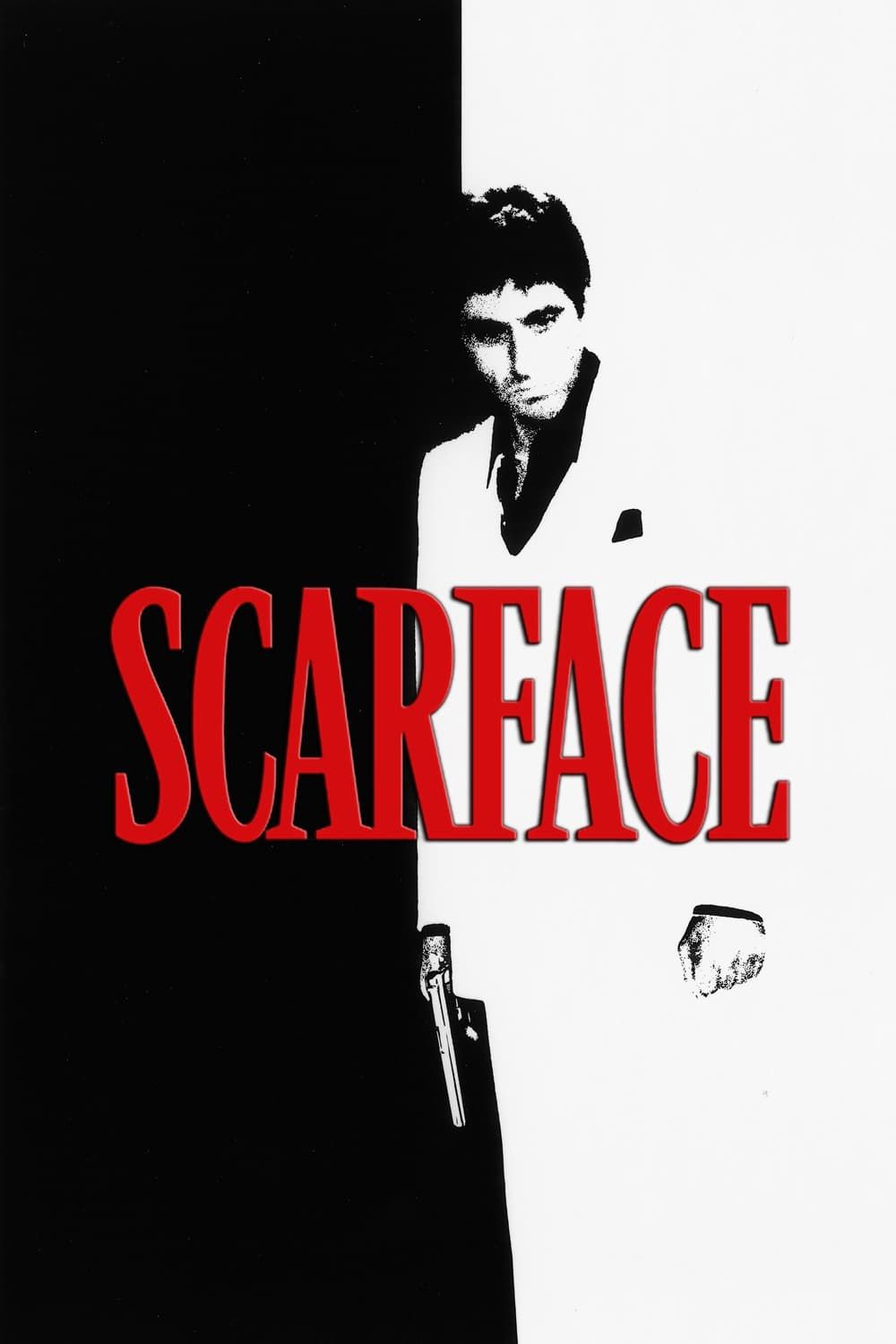
Produced by Martin Bregman, directed by Brian De Palma, written by Oliver Stone, and starring Al Pacino, the 1983 remake of Scarface is one of the best-known, most iconic gangster films ever made. It opened to mixed reviews but it’s gone on to be recognized as a classic. Everyone can quote the script: “Say hello to my little friend!” “In this country, you gotta make the money first. Then when you get the money, you get the power. Then when you get the power, then you get the women.” “Say goodnight to the bad guy!”
Scarface starts with one of my favorite opening scenes of all time. Powered by Giorgio Moroder’s score, the opening credits of Scarface play out over footage of the real-life Mariel boatlift. Combined with footage of Fidel Castro ranting that Cuba does not need the Marielitos, this opening gives real-world credibility to everything that follows. We then segue from the actual boatlift to Al Pacino as Tony Montana, answering questions with that shit-eating grin on his face.
Listen to the interrogation scene carefully and you’ll hear both Charles Durning and Dennis Franz, dubbing the lines of the actors who played the immigration agents.
“All I have in this world is my balls and my word.” — Tony Montana
Brian De Palma’s Scarface is one of those movies that seems almost impossible to discuss at a normal volume. Everything about it is loud, excessive, sweaty, violent, vulgar, and deliberately too much. The movie does not simply tell the story of Tony Montana, a Cuban immigrant who rises through Miami’s cocaine trade before destroying himself. It turns that rise and fall into a neon-lit, operatic explosion of greed, paranoia, sex, money, and violence. At first, Scarface can feel like an overlong, incredibly entertaining gangster fantasy. But underneath all the cocaine mountains and machine guns, it is also a deeply cynical story about the American dream and what happens when ambition is allowed to become a substitute for an actual soul.
Tony arrives in Miami during the Mariel boatlift, immediately presenting himself as someone who refuses to be intimidated. He is not interested in being grateful, polite, or patient. Tony wants power, and he wants it quickly. That impatience is both his greatest strength and the obvious source of his downfall. He is willing to do things that other people are too afraid to do, which helps him climb the criminal ladder. At the same time, he cannot understand the idea of limits. Every success only makes him want something bigger: more money, more cocaine, more influence, a bigger house, a more beautiful wife, and absolute control over everyone around him.
The screenplay by Oliver Stone gives Tony a kind of blunt, almost cartoonishly direct philosophy. He believes that the world belongs to people who take it. In Tony’s mind, morality is mostly an excuse invented by people who lack the courage to seize what they want. That attitude makes him magnetic, but the film never truly presents his worldview as admirable. Tony may have the confidence of a king, but he behaves more like a man who is constantly terrified that someone will discover he is not really in control. His bravado is a shield against humiliation, poverty, and powerlessness. The more successful he becomes, the more obvious it is that he is still fighting the same emotional battle he was fighting when he first arrived.
Al Pacino’s performance is the central reason Scarface remains so watchable. He plays Tony as a human grenade, a character who seems to be vibrating with anger even when he is sitting still. The accent, the posture, the rapid shifts in mood, and the exaggerated physical gestures could easily have turned Tony into a parody. In fact, there are moments when Pacino absolutely does push the character into parody. Yet that is also part of the performance’s strange power. Tony is a man who has constructed himself as a larger-than-life personality, so Pacino makes him seem like someone performing Tony Montana even while he is alone.
Pacino understands that Tony’s violence is not simply about cruelty. It is about insecurity, pride, and the panic of losing status. Tony cannot tolerate being laughed at, challenged, ignored, or treated as inferior. A casual insult can become a life-or-death confrontation because he experiences disrespect as an existential threat. Pacino makes those reactions frightening, but he also gives them a pathetic quality. Tony is powerful enough to terrify an entire room, yet emotionally he often behaves like a wounded child demanding recognition.
That contradiction is what keeps the performance from becoming empty scenery chewing. Tony is ridiculous, but he is also tragic. He is disgusting, but he has flashes of genuine feeling, especially in his relationship with his sister Gina. Unfortunately, even his love for her becomes possessive and destructive. Tony wants to protect Gina, but he also wants to own her choices, her sexuality, and her future. He cannot separate love from control. The same problem affects his relationship with Elvira, played by Michelle Pfeiffer, and eventually his entire empire. Tony does not know how to care for people without turning them into extensions of himself.
De Palma’s direction matches Tony’s personality. The film is staged like a gangster epic filtered through a fever dream. Miami becomes a place of bright colors, glass surfaces, giant mansions, tropical heat, and constant artificial light. The city feels less like a real environment than a hallucination of wealth. Tony’s home is especially important because it looks like a monument to success but gradually becomes a prison. The famous final shootout transforms that mansion into a battlefield, with Tony defending his kingdom even after it has already collapsed around him.
The violence in Scarface is often shocking, but it is also theatrical. De Palma uses suspense, wide compositions, sudden bursts of brutality, and moments of grotesque visual humor to make the violence feel both horrifying and unreal. The movie’s excess can be exhausting, particularly in the middle section, where Tony’s rise begins to blur into an endless parade of deals, parties, arguments, and drug use. The length is part of the point: we are meant to feel Tony’s world becoming bloated and unstable. Still, some of the film’s scenes repeat ideas that it has already established. Tony is ambitious, Tony is paranoid, Tony is violent, and eventually Tony is high. The movie sometimes keeps shouting after the audience has already heard it.
That criticism matters because Scarface is not a flawless film. Its dialogue can be clumsy, its supporting characters are sometimes more functional than fully developed, and its treatment of women is frequently limited by Tony’s perspective. The film wants to condemn male domination and criminal capitalism, but it is also fascinated by the same things it condemns. It shows us the luxury, the clothes, the cars, the glamorous parties, and the apparent freedom of Tony’s lifestyle. Even while warning that this life ends in misery, it makes the fantasy visually seductive.
That tension helps explain the movie’s complicated legacy. When Scarface was first released in 1983, many critics found it excessive, ugly, and morally confused. Over time, however, its reach expanded dramatically through home video and popular culture. The movie became especially important to hip-hop, where artists recognized Tony’s language of survival, hustle, ambition, and self-invention. Al Pacino has credited hip-hop with helping the film find its audience, saying that rappers understood and embraced it. That relationship became one of the most important parts of Scarface’s afterlife.
Hip-hop did not simply treat Tony as a cool gangster. It also turned him into a symbol. The character could represent ruthless ambition, immigrant struggle, street credibility, material success, or the danger of becoming trapped by one’s own myth. Lines from the movie entered rap lyrics, album skits, music videos, and stage names. The film’s imagery became a shorthand for a certain kind of rise-from-nothing fantasy, even when the original movie was trying to show how poisonous that fantasy could be. In this sense, Scarface became bigger than its initial critical reputation. It stopped being only a crime film and became a cultural text that people could quote, remix, parody, and reinterpret.
Its influence on video games is just as obvious, especially in Grand Theft Auto: Vice City. That game’s 1980s Miami setting, neon colors, criminal empire structure, radio culture, and flamboyant protagonist clearly operate in the same general territory as Scarface. The film has also been connected directly to other games, including Scarface: The World Is Yours, which imagines an alternate continuation after the movie’s ending. The game allows players to rebuild Tony’s empire, purchase businesses, intimidate rivals, and expand across Miami. It turns the movie’s rise-and-fall structure into an interactive fantasy in which the player gets to ignore the ending and keep climbing.
That difference between film and game is revealing. Scarface ultimately insists that Tony’s dream cannot survive because Tony himself is incapable of moderation, trust, or self-knowledge. Video games can take the same world and make the player feel rewarded for doing exactly what Tony does: acquiring territory, collecting money, buying weapons, and becoming more powerful. In that format, the critique of excess can easily become a celebration of excess. Yet that is also why the film remains so influential to games. It provides an instantly understandable fantasy of criminal ascent, complete with a distinctive visual style and a protagonist whose personality is impossible to ignore.
In the end, Scarface is both a warning and a temptation. It tells us that Tony Montana is doomed, but it makes his climb so entertaining that we understand why generations of viewers, rappers, and game designers kept returning to him. Al Pacino’s performance is the movie’s beating heart: outrageous, funny, frightening, and occasionally heartbreaking. De Palma’s film may be messy and overstuffed, but its messiness is part of its identity. Scarface does not want to be tasteful or balanced. It wants to overwhelm you, seduce you, and then leave you staring at the wreckage of a man who mistook having everything for being somebody.
Before I say anything else about Gus Van Sant’s new film, I feel that I should make something clear.
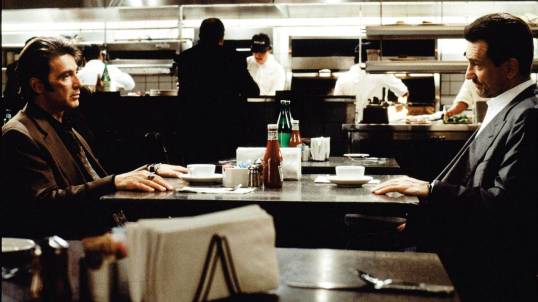
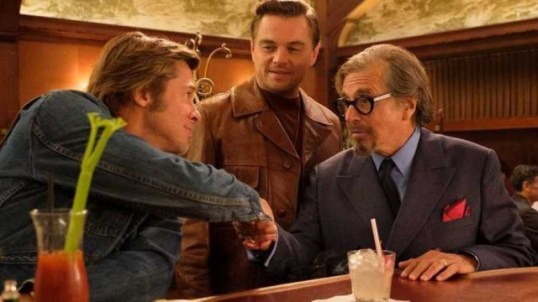
I am a huge Al Pacino fan. My love for the Godfather films (even the third one!) should be obvious to anyone who regularly reads this site. I love the majority of Pacino’s work, even the roles that occurred after he started bellowing all of his lines. I think his cop in Heat is one of the most entertaining characters to ever appear in a crime film. I loved his performance as Jimmy Hoffa in The Irishman. I enjoyed the humor that he brought to his role in Once Upon A Time In Hollywood. I will always be happy to defend Al Pacino.
So, it gives me no pleasure to say that Al Pacino gives one of his worst performances in this film. He plays M.L. Hall, the owner of Meridian Mortgage Company in Indianapolis, Indiana. Pacino only appears in three brief scenes. Wearing a ridiculous wig, he delivers his lines in one of the worst Southern accents that I’ve ever heard. Playing a businessman who is so heartless that he won’t even negotiate with the man who is holding his son hostage, Pacino gives a performance that isn’t even entertaining enough to be considered cartoonish. It’s the type of performance that one might expect from the villain-of-the-week on a particularly heavy-handed episode of Law & Order. It’s not the type of performance that you would expect from Al Pacino.
Fortunately, despite all of that, Dead Man’s Wire is still a fairly compelling film.
Based on a true story, Dead Man’s Wire stars Bill Skarsgard as Tony Kiritsis, a real estate developer in 1970s Indianapolis who feels that Meridian Mortgage Company has cheated him out of the money that he hoped to earn through some land he developed. Because M.L. Hall is on vacation in Florida, Tony takes M.L. son, Richard (Dacre Montgomery), hostage. Tony wires a shotgun to Richard’s neck so that any sudden movement by either one of them will lead to Richard getting his head blown off. Tony announced that he’ll only release Richard in return for immunity and an apology from M.L. Hall.
For three days, the city of Indianapolis watches as the situation plays out. Detective Michael Gable (Cary Elwes) tries to negotiate with Tony but Tony is only willing to talk to the DJ (Colman Domingo) at his favorite radio station. Meanwhile, Tony picks up some support from other people who feel that they’ve been screwed over by the M.L. Halls of the world.
Indeed, while watching this movie, it was hard not to think about the creepy cult that has sprung up around Luigi Mangione. Of course, being a blue collar guy who appears to have simply been pushed past his breaking point, Tony is a much more compelling figure than a phony intellectual like Luigi. That said, director Gus Van Sant is more interested in Tony as an outsider on the fringes of polite society than as a political symbol. Skarsgard plays Tony as a man who can go from being friendly to enraged in a matter of seconds and he’s actually quite frightening in the role. Meanwhile, Dacre Montgomery makes Richard into a rather sympathetic character. Even if you don’t agree with the actions of his father, it’s hard not to respect the way that Richard handles the situation. Watching this film, one gets the feeling that the unstable Tony thinks that he and Richard are developing a common ground but in reality, there’s no way that anyone could expect Richard to sympathize with a man who held him hostage for three days. The film respects the characters and the actors too much for that type of false sentimentality.
Towards the end of the film, there’s a rather odd moment where breaking news about the hostage situation interrupts John Wayne presenting the award for Best Picture at the Oscars. In reality, the 1977 Academy Awards were held a month after the hostage situation had been resolved and the ceremony seen in Dead Man’s Wire was held in 1979. (Wayne presented the Oscar just a few months before his own death from cancer.) It’s classic Van Sant move in that it seems like it should mean something but, in the grand scheme of things, it really doesn’t. Van Sant is one of those directors who has been around long enough and who has made enough interesting films that he can get away with something like that.
Dead Man’s Wire is Van Sant’s first film in seven years and his best film since Elephant. It’s flawed but always watchable and it has a sense of humor and enough odd but memorable details to balance out the film’s angrier moments. There are a few moments where the film falls into the trendy and intellectually shallow anti-capitalism that is all the rage nowadays but, for the most part, this is a compelling recreation of a true story and a character study of two men who will be forever linked.
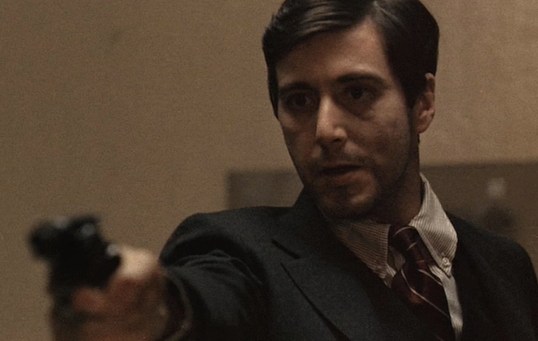
Since today is Al Pacino’s birthday, it only seems right to share a classic scene from The Godfather.
In the scene below, which is perfectly directed by Francis Ford Coppola, Michael proves that he truly is a Corleone. Am I the only one who yelled, “Don’t forget to drop the gun!,” the first time that I saw this scene?
4 (or more) Shots From 4 (or more) Films is just what it says it is, 4 (or more) shots from 4 (or more) of our favorite films. As opposed to the reviews and recaps that we usually post, 4 (or more) Shots From 4 (or more) Films lets the visuals do the talking.
It’s Al Pacino’s birthday!
In others words, it’s time for….
6 Shots From 6 Al Pacino Films
The Godfather (1972, dir by Francis Ford Coppola, DP: Gordon Willis)
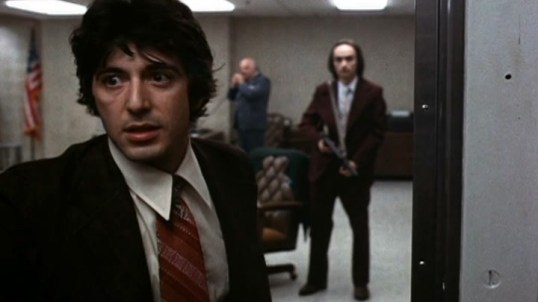
Dog Day Afternoon (1975, dir by Sidney Lumet, DP: Victor J. Kemper)
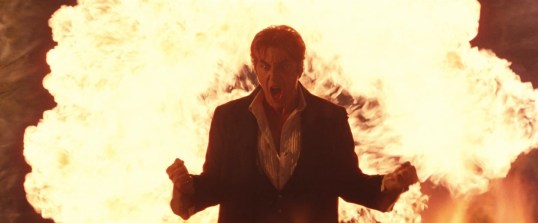
Scarface (1983, dir by Brian DePalma, DP: John A. Alonzo)
Heat (1995, dir by Michael Mann, DP: Dante Spinotti)
The Devil’s Advocate (1997, dir by Taylor Hackford, DP: Andrzej Bartkowiak)
Once Upon A Time In Hollywood (2019, dir by Quentin Tarantino, DP: Robert Richardson)
Today would have been Diane Keaton’s 80th birthday.
In today’s scene that I love, from 1972’s The Godfather, Keaton plays Kay Adams Corleone, the wife of Michael (Al Pacino). In this scene, Michael has “allowed” Kay to ask him about the family business. She asks him if he had his brother-in-law, Carlo, killed. Michael says, “No.” Kay is relieved …. until she steps out into the hallway and realizes, as the door is shut in her face, that her husband just lied to her.
This is a beautifully acted scene and one of the most powerful endings in film history.
Well, the clock has now struck midnight on the West Coast and that officially means that it is 2026 in the United States! What better way to start things off than by sharing a scene that I love from one of the greatest and most important films of all time, 1974’s The Godfather Part II?
The scene below takes place on New Year’s Eve. The scene starts in 1958 and it ends in 1959. Michael Corleone (Al Pacino) and his brother Fredo (John Cazale) are in Havana at the invitation of Hyman Roth (Lee Strasberg). Roth know that Cuba could be a gold mine for the American mob but Michael, from the start, realizes that the country’s corrupt government is on the verge of collapse and that it’s about to be replaced by something even worse. (Admittedly, that’s my opinion. Director Francis Ford Coppola had a much higher opinion of Castro and the communists than I did.) Tragically, it’s also in Havana that Michael realizes that Fredo betrayed him to his enemies. On December 31st, 1958, as the new year is celebrated in Havana, the rebels ride into the city. While the President of Cuba prepares to announce that he will be fleeing the country, Michael confronts his brother and tells him that he knows the truth. Later, as they both attempt to flee the country, Michael and Fredo see each other on the streets. Fredo runs from Michael, refusing his offer to help. Though Fredo would eventually return to the family, the film’s ending revealed Fredo’s first instinct was the correct one.
Here’s a scene that I love, featuring great work from both Al Pacino and the brilliant John Cazale:
Today’s scene that I love comes from my favorite film of all time, 1972’s The Godfather.
In this scene, Kay Adams (Diane Keaton) has moved on and is working as a teacher. Suddenly, Michael Corleone (Al Pacino) shows up. He’s been back from Sicily for a year and he’s working with his father. Michael promises her that the Corleone family is getting out of the rackets. We, of course, know that is never going to happen.
First released in 1979, ….And Justice For All will always be remembered for one scene.
Yell it with me, “YOU’RE OUT OF ORDER! THE WHOLE TRIAL IS OUT OF ORDER! THEY’RE OUT OF ORDER!”
When attorney Arthur Kirkland (Al Pacino) starts screaming in the middle of the courtroom, it’s a cathartic moment. We’ve spent nearly two hours watching as Arthur deals with one insane situation after another. One of Arthur’s partners, Warren (Larry Bryggman), cares more about his car than actually delivering the right documents to a judge. Another of Arthur’s partners, Jay (Jeffrey Tambor), has a nervous breakdown and, after shaving his head, ends up throwing cafeteria plates at people in the courthouse. Arthur has three clients, one of whom is indigent, one of whom is innocent, and one of whom is a wealthy and despised judge (John Forsythe) who has been accused of a rape that Arthur suspects he committed. The system offers no mercy for Arthur’s innocent (or, at the very least, harmless) clients while going out of it’s way to defend the judge. Meanwhile, another judge (Jack Warden), is driven to take suicidal risks, like flying a helicopter until it runs out of fuel and comes down in a nearby harbor. The assistant district attorney (Craig T. Nelson) only cares about his political ambitions and finally, after one incident after another, Arthur snaps. And it’s cathartic because we’re all on the verge of snapping as well.
That final moment, with its signature Al Pacino rant, is such a strong and iconic scene that it’s easy to forget that the film itself is actually rather uneven. The script, by Barry Levinson and Valerie Curtin, owes a good deal to the work of Paddy Chayefsky. Just as Chayefsky often wrote about men being driven mad by institutional failure, ….And Justice For All features character after character snapping when faced with the screwed-up realities of the American justice system. The final “out of order” speech is obviously meant to be this film’s version of Howard Beale’s “I’m as mad as Hell and I’m not going to take it!” speech from Network and, much like George C. Scott in the Chayefsky-written The Hospital, Arthur spends a lot of time talking about what he doesn’t like about his job. The thing that sets ….And Justice For All apart from the best works of Chayefsky is that Levinson, Curtin, and director Norman Jewison all take Arthur Kirkland at his word while one gets the feeling that Chayefsky would have been a bit more willing to call out Arthur on his self-righteousness. Arthur has every right to be angry when Warren forgets to give a judge an important document while Warren is substituting for him in court. At the same time, Arthur is the one who trusted Warren to do it. In the end, the document was not about one of Warren’s client. In fact, Warren knew absolutely nothing about the case or Arthur’s client. The document was about Arthur’s client and Arthur was the one who decided trust someone who had consistently shown himself to not be particularly detailed-orientated. One gets the feeling that Chayefsky would not have let Arthur off the hook as easily as Levinson, Curtin, and Jewison do. Arthur’s perpetual indignation can sometimes be a little hard to take.
It’s a very episodic film. Arthur goes from one crisis to another and sometimes, you do have to wonder if Arthur has ever had any human or legal interactions that haven’t ended with someone either going insane or dying. There’s no gradual build-up to the film’s insanity, it’s right there from the beginning. And while this means the narrative often feels heavy-handed, it also makes that final speech all the more cathartic. It’s an uneven film and, of all of the characters that Pacino played in the 70s, Arthur is probably the least interesting. But that final rant makes up for a lot and, fortunately, Pacino was just the actor to make it memorable. For all it’s flaws, the final few minutes of ….And Justice For All make the film unforgettable.