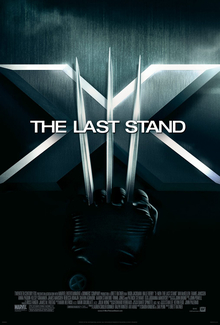
X-Men: The Last Stand (2006, directed by Brett Ratner)


Just as the world seems to be finally on the verge of accepting mutants, industrialist Warren Worthington II (Michael Murphy) announces that he has developed a shot that will suppress the X-gene, therefore “curing” mutants of their mutation. Magneto (Ian McKellen), Mystique (Rebecca Romijn), and a host of other mutants break out of prison to try to stop Worthington from offering up his cure. Meanwhile, at Charles Xavier’s school, Rogue (Anna Paquin) wonders if maybe she should take the shot and become a “normal” person.

Professor Xavier (Patrick Stewart) and Logan (Hugh Jackman) have an even bigger concern than Magneto and the cure. Jean Grey (Famke Janssen), thought to have died at the end of the previous movie, has returned but has given in to her dark side, the so-called Phoenix. She’s already destroyed Scott (James Marsden), and it doesn’t take her long to disintegrate Professor X. Can Logan and the Beast (Kelsey Grammer) rally what’s left of the X-Men to defeat both Magneto and the Dark Phoenix?

I can still remember seeing X-Men: The Last Stand on the day that it was first released. As an X-Men fan, I was excited to see how the Dark Phoenix storyline would be adapted for the big screen. It’s difficult to put into words how disappointed I was when Jean killed Scott. That one scene told me that X-Men: The Last Stand was not going to do the story justice. In the comic books, Jean and Scott’s relationship was the heart of the X-Men. When Jean became the Dark Phoenix, she proved herself capable of destroying an entire planet, but she couldn’t bring herself to kill Scott. She chose to destroy herself rather than him. (Marvel being Marvel, Jean was resurrected a few years later.) The X-Men films never really knew what to do with the characters of Scott and Jean. They weren’t as flamboyant as Logan or even Rogue, but fans of the comic knew who Scott and Jean were and understood their importance to the series, and having Jean destroy Scott showed that, unlike the previous two films, the third X-Men film was not being made for the fans.

A large part of the problem was that director Brett Ratner didn’t seem to be interested in the characters. X-Men: The Last Stand is a collection of action scenes with none of the small character moments that made the first two films memorable. Kelsey Grammer is a welcome addition to the cast as the Beast. (The Beast always was basically Frasier Crane with blue fur.) Otherwise, this is the most forgettable of all the X-Men films.

Even though the Dark Phoenix saga is one of the key X-Men storylines, it’s never really been given its due onscreen. A second attempt to tell the story, in Dark Phoenix, also failed to capture the drama and emotion of Jean’s transformation. The X-Men are now officially a part of the MCU, so I imagine the story will probably be told again. Maybe the third time will be the charm.
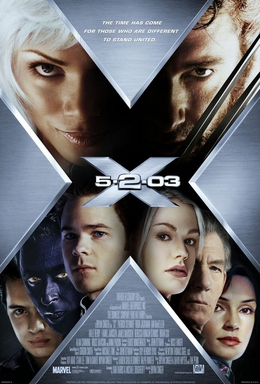
X2 (2003, directed by Bryan Singer)


After Nightcrawler (Alan Cumming) causes a national security crisis by teleporting into the White House, Colonel William Stryker (Brian Cox) is given the authority to invade Professor Xavier’s School and investigate its connection to the mutants. Stryker, who not only wants to investigate the mutants but also destroy them by manipulating the same technology that Xavier uses to find them, just happens to be an old enemy of Logan’s (Hugh Jackman). In fact, Stryker is responsible for Logan fusing the adamantium to his bones. That’s a hell of a coincidence.

A sequel to X-Men, X2 tells a bigger and more complex story than the first film. Professor Xavier’s students are spread out by the chaos. Rogue (Anna Paquin) sees prejudice firsthand when Bobby Drake (Shawn Ashmore) is betrayed by his own family. Pyro (Aaron Stanford) is tempted to reject the X-Men’s philosophy of coexistence. After being underused in the first film, both Scott (James Marsden) and Jean Grey (Famke Janssen) are key players here. Magneto (Ian McKellen) and Mystique (Rebecca Romijn-Stamos) return, this time temporarily allying with Professor X (Patrick Stewart) to stop Stryker. Logan has his own reasons to go after Stryker. Surprisingly, X2 is not only bigger than the first film but it’s also better. The actors are more convincing in their roles, the action is more exciting, and director Bryan Singer capably juggles all of the different parts without losing the plot. He even manages to ably set up the Dark Phoenix Saga. In the first film, the X-Men had it almost too easy when it came to battling opponents like Toad and Sabretooth. This film has not only Brian Cox’s William Stryker but also Kelly Hu’s Deathstrike.

Those of us who were shocked when X-Men turned out to be good were even more shocked when X2 turned out to be even better. For a little while, it seemed like there would never be a bad X-Men movie! Later, that’s the way a lot of us would also feel about the Marvel movies. Those were good days.

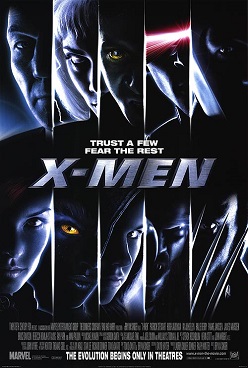
X-Men (2000, directed by Bryan Singer)


I saw X-Men on the first day that it opened in theaters. Actually, I saw it twice.

The first time I saw it was by myself. I had been planning on waiting to see it in the evening with my friends Johnny and Kyleigh, but I actually found myself with a few hours to spare, so I decided to go ahead and see it. I watched it in the later afternoon and, after that showing got out, I met up with Johnny and Kyleigh outside the theater and went straight back in.

It’s hard to describe what a big deal the X-Men movie was in 2000. This was before there was a new Marvel movie or show every three months. It was also at a time when comic book movies, following the failure of Batman and Robin, were no longer considered to be a sure thing. Johnny and I were lifelong Marvel fans and, having survived the trauma of The Phantom Menace, were very much looking forward to the X-Men movie. We knew that both Patrick Stewart and Ian McKellen were the perfect choices for Professor X and Magneto. Anna Paquin seemed like a good choice for Rogue. But would Hugh Jackman, an actor neither of us had heard of before, be able to bring Wolverine to life?

Even though we both rolled our eyes when we heard that Rogue’s name was apparently Marie, Johnny and I were shocked at how good X-Men was. Today, we take it for granted that comic books can be turned into movies, but in 2000, X-Men took us by surprise by being well-acted, well-directed, and surprisingly entertaining. Kyleigh was not a fan of comic books in general and she liked the movie considerably less than we did. (“Dr. Wheelchair” was her name for Charles Xavier.) But for Marvel fans, X-Men was the anti-Phantom Menace.

Looking back, the plot felt like it could have been lifted from the pages of the comic book. Sen. Robert Kelly (Bruce Davison) is leading a national political movement against the mutants. Magneto has created a machine that will induce mutations in human beings. (The movie opens with a flashback that establishes Magneto as a survivor of the Holocaust. Today, everyone knows his backstory, but in 2000, people were stunned that a comic book movie could also deal with reality.) Magneto and Professor X both try to recruit Rogue to their side, and Wolverine, as Rogue’s protector, reveals his claws and reluctantly becomes a member of the X-Men.

When X-Men was first released, Hugh Jackman was the big question mark, but he turned out to be the perfect choice for Wolverine, even if he did seem to be too tall for the role. Jackman was tough and surly and somehow, he looked credible with claws. He was everything that fans like me wanted out of Wolverine and, once he showed up, I knew it was going to be a good movie. Not surprisingly, Patrick Stewart and Ian McKellen were perfect for Xavier and Magneto, as was Anna Paquin as Rogue. Though they’re overshadowed by Stewart, McKellen, Jackman, and Paquin, the other members of the X-Men are played by James Marsden (Scott), Famke Janssen (Jean Grey), and Halle Berry (Storm). Ray Park plays Toad, Tyler Mane plays Sabretooth, and Rebecca Romijn-Stamos excited male viewers everywhere by playing the naked and blue Mystique.

A lot of time has passed since 2000. An entire Marvel Cinematic Universe was created that did not initially include the X-Men, though that has since changed. Bryan Singer is no longer on the A-list. But I still always look fondly on the day that I watched X-Men twice.

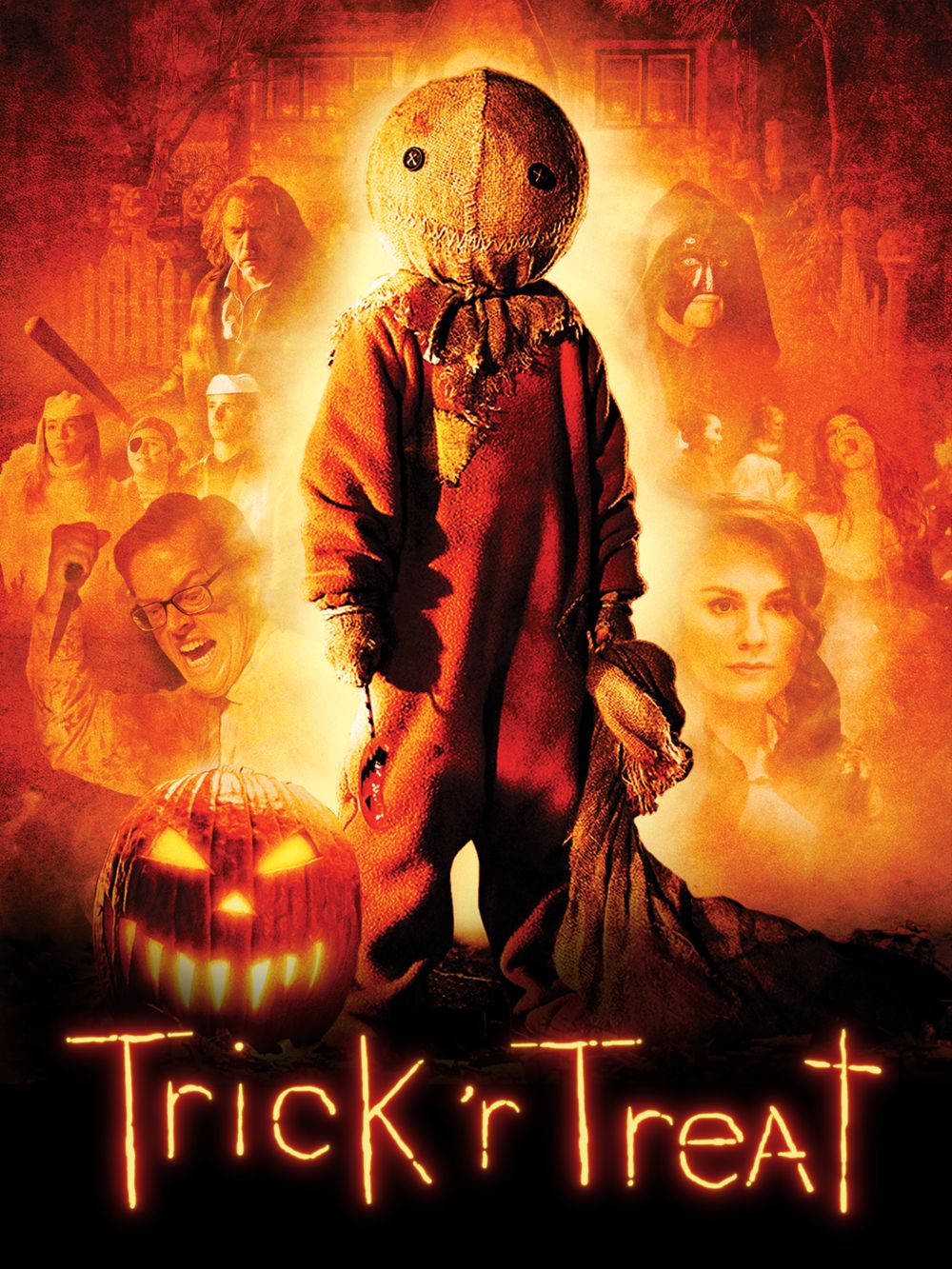
Horror Review: Trick ‘r Treat (dir. by Michael Dougherty)


“All these traditions, jack-o’-lanterns, putting on costumes, handing out treats, they were started to protect us, but nowadays… no one really cares.” — Principal Steven Wilkins

What better and more fun way is there to celebrate the full month of scares and horror that October has become than with Michael Dougherty’s 2007 film Trick ’r Treat? It is the kind of Halloween movie that feels less like it was merely set on the holiday and more like it was built out of everything people love about it. Trick ’r Treat has jack-o’-lanterns glowing on porches, costumes ranging from charming to grotesque, chilly nighttime streets, old local legends, candy bowls, haunted-school-bus stories, werewolves, serial killers, and that ever-present feeling that something is watching from behind a tree. It is funny, nasty, creepy, and strangely cozy at the same time. More than almost any modern horror film, it understands Halloween as a whole atmosphere rather than a collection of familiar props.

At first glance, the movie looks like an anthology film. It is divided into several distinct stories with their own central characters, premises, and horror styles. One segment involves a principal with a murderous secret, another follows a group of kids investigating a grim local legend, another centers on young women looking for dates at a costume party, and another focuses on a bitter old man dealing with a small but persistent visitor. Each story could almost function as its own short horror movie. Dougherty clearly enjoys shifting tones, moving from slasher material to ghost-story melancholy, then into monster-movie lunacy and dark comedy. But the key difference is that Trick ’r Treat is not simply an anthology stitched together by a host or a framing device. Every story told in the film ties into an overarching story unfolding across one night of Halloween.

That structure is one of the movie’s smartest features. Characters drift in and out of one another’s narratives, sometimes briefly and sometimes in ways that completely change the audience’s understanding of what they have already seen. A person who seems like a background extra in one sequence becomes the focus of another. A strange sound, a distant scream, a passing school bus, or a visual detail in one story can gain much more meaning when it reappears elsewhere. The movie plays with chronology too, allowing events to overlap and occasionally revealing that scenes which seemed straightforward were occurring at a different point in the night than viewers assumed. It rewards attention without becoming confusing for the sake of being clever.

Dougherty handles those connections smoothly because the film never stops feeling like one continuous Halloween night. The transitions are playful rather than showy. The camera may follow a character down a street, past a decorated yard, into another group’s story, and suddenly the audience has entered a different kind of nightmare. That makes the town itself feel like a character. It is not a generic horror-movie setting where bad things happen because the script requires them to. It feels like a community with traditions, buried crimes, local myths, annual rituals, and plenty of people who are either hiding something or about to discover something unpleasant.

The town’s Halloween obsession is also what gives the film its personality. Trick ’r Treat treats Halloween rules almost like ancient laws: wear a costume, hand out candy, never blow out a jack-o’-lantern before midnight, and always respect the dead. Breaking those rules does not guarantee immediate punishment in a simple moralistic way, but it certainly puts people at risk. The film’s central icon, Sam, embodies that idea. Wearing orange pajamas, a burlap sack mask, and carrying a lollipop that can become a weapon, Sam is one of the great modern horror mascots because he is both adorable and deeply unsettling. He is not presented as a typical slasher villain with a detailed backstory or a conventional motivation. He feels more like the living spirit of Halloween itself: mischievous, ceremonial, cruel when necessary, and completely devoted to the holiday’s traditions.

Sam’s presence gives the movie a connective thread beyond plot mechanics. He appears in the background, watches over events, and eventually takes center stage in a way that is both amusing and genuinely tense. There is something almost storybook-like about him. He resembles a child going door to door for candy, but his behavior suggests an old supernatural force enforcing rules everyone else has forgotten. The movie wisely never overexplains him. Horror icons often become less interesting once every mystery is reduced to lore, family trees, and exposition. Sam works because Dougherty lets him remain partly unknowable.

The cast is another reason the film holds together so well. Dylan Baker is excellent as Steven Wilkins, the seemingly mild suburban principal whose cheerful politeness becomes much more disturbing once the movie reveals what he is doing after dark. Baker has a talent for making every smile look just slightly too controlled. His storyline is especially effective because it mixes grotesque humor with an unsettling domestic quality. He is not stalking victims through a foggy forest or living in an abandoned asylum. He is cleaning up a mess in his backyard while trying to maintain a normal family routine. That contrast makes his scenes nastier and funnier.

Brian Cox brings real weight to Mr. Kreeg, the grumpy old man at the center of the film’s most memorable Sam-focused material. Cox could have played him as a broad caricature, but he gives the character enough fear, frustration, and hidden sadness to make the confrontation feel more substantial than a simple old-man-versus-monster sequence. The movie’s final act uses his house almost like a haunted maze, with the warm, cluttered interior gradually becoming a battlefield. The tone remains playful, yet there is a real sense of danger whenever Sam drops the cute disguise and shows what he can do.

Anna Paquin also stands out in the segment involving Laurie and her friends. At first, it seems like the film is setting up a familiar vulnerability narrative: young women in costumes, a dark forest, strange men, and the possibility of a predatory attacker. Then Trick ’r Treat gleefully twists expectations. The reveal is not subtle, but it is staged with enough energy and confidence that it lands as a crowd-pleasing monster-movie moment. Dougherty knows that horror does not always need to be grim to be effective. Sometimes the best reaction is an audience laughing in surprise right before a scene turns bloodier than expected.

The school-bus story is probably the film’s creepiest material. The idea of children killed by adults and returning as drowned, decayed figures could have been handled in a cheap or overly cruel way, but the movie gives it a sad, mythic edge. The ghosts are frightening, but the story is also about guilt, buried history, and a town that has allowed its ugliest secret to become a campfire legend. The children may be supernatural monsters by the time they reappear, but the adults who wronged them are even more horrifying. That is a recurring theme throughout Trick ’r Treat: Halloween monsters are dangerous, but human selfishness, cowardice, and cruelty tend to create the worst consequences.

Visually, the film has aged remarkably well because it does not chase a slick, overly polished look. It has a rich autumnal color palette full of oranges, blacks, deep reds, and warm porch-light yellows. The night scenes are dark enough to feel threatening but clear enough that viewers can appreciate the costumes, decorations, and production design. Every street seems covered in leaves, every house has candles or carved pumpkins, and every shadow seems capable of hiding a creature. It feels like a heightened version of childhood Halloween memories, except those memories have been invaded by murderers, werewolves, demons, and ghosts.

The practical effects and creature work add a lot to that charm. The movie uses CGI when needed, but it does not depend on weightless digital spectacle. Sam’s physicality, the werewolf transformations, the decayed school-bus children, and the various masks and props all have a tactile quality. They look like things that belong in a haunted attraction, a particularly elaborate costume shop, or an old EC Comics-style horror story. That handmade texture fits the film perfectly. Trick ’r Treat is polished, but it never feels sterile.
What makes the movie so rewatchable is how comfortably it moves between tones. It can be goofy without becoming stupid, gruesome without becoming exhausting, and sentimental about Halloween without turning saccharine. It embraces the holiday’s childish excitement while acknowledging the darker folklore underneath it. There is candy, costumes, and neighborhood fun, but there are also old grudges, punished sinners, restless dead, and things that hunt after midnight. Dougherty understands that those two sides belong together. Halloween is fun partly because it lets people play with fear in a safe, communal way, and Trick ’r Treat captures that balance better than most horror movies.

The film’s anthology-like design gives it variety, while its overlapping characters, recurring events, and shared setting make it feel like one cohesive story rather than a disconnected collection of shorts. Its lasting popularity has also made the lack of a sequel feel increasingly strange. Fans have been clamoring for another trip through Sam’s Halloween night for years, and Dougherty has repeatedly hinted that he has ideas for where a follow-up could go. He has discussed multiple script drafts, storyboards, concept art, and the possibility of giving Sam a new adversary, but the project still has not received an official greenlight.

That uncertainty is frustrating, especially because Trick ’r Treat feels like a world with plenty more stories left to tell. At the same time, it is probably better that Dougherty has not rushed out a sequel just to cash in on the film’s cult status. The original works because it feels carefully constructed, visually specific, and completely committed to its Halloween setting; any follow-up would need to preserve that same mix of horror, comedy, folklore, and interconnected storytelling. For now, Trick ’r Treat remains an annual October rewatch because it honors Halloween’s old traditions while creating its own: a funny, spooky, blood-soaked celebration of costumes, candy, campfire legends, and the things that come out once the porch lights go dark.

Insomnia File #59: True Spirit (dir by Sarah Spillane)


What’s an Insomnia File? You know how some times you just can’t get any sleep and, at about three in the morning, you’ll find yourself watching whatever you can find on cable or Netflix? This feature is all about those insomnia-inspired discoveries!

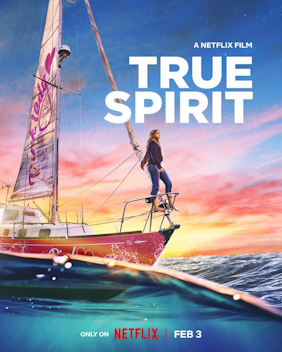
If you were having trouble getting to sleep last night (or this night, for that matter), you could have turned over to Netflix and passed the time watching True Spirit, a rather wholesome biopic from Australia.

Teagan Croft stars as Jessica Watson, who, at the age of 16, became the youngest person ever to sail solo, non-stop around the world.  For Jessica, it was not only the fulfilment of a childhood dream but it was also a true test of survival as, towards the end of her journey, she got trapped in a very violent storm and, at one point, her boat was actually 15 feet below the surface of the ocean.  For the nation of Australia, it was a moment of great pride despite the fact that many of the same people who celebrated Jessica’s accomplishment had earlier tried to prevent her from making the journey.  (Indeed, the film suggests that one reason why Jessica was in such a hurry to start her voyage was because the Queensland legislature was literally putting together a bill that, once passed, would have made it illegal for her to do so.)  The film begins with Jessica already in training for her voyage.  One mistake during a trial run leads to her boat nearly crashing into a tanker, a reminder that, as beautiful as the ocean may be, it can still be a dangerous place.  With the help of Ben Bryant (Cliff Curtis) and the support her parents (Anna Paquin and Josh Lawson), Jessica is determined to make her voyage.  She not only wants to set a world record but she also wants to prove that, even though she’s dyslexic, she can still accomplish anything that she sets her mind too.

There’s really nothing that surprising to be found in True Spirit.  Even if you didn’t already know the true story on which the film was based, you wouldn’t be surprised by how Jessica’s voyage goes.  But, at the same time, it’s a well-intentioned and almost achingly sincere film, one that celebrates a worthy accomplishment and which features a likable lead performance from Teagan Croft.  It’s a film that is determined to focus on the positive, though it certainly doesn’t shy away from the fact that nature can be frightening and unpredictable.  There’s nothing particularly edgy about True Spirit.  Despite a nicely executed storm scene, this isn’t All is Lost.  But it will hold your attention and it’ll probably leave you in a good mood.  It did for me!

Finally, I can’t complete this review without mentioning that Todd Lasance plays a rather obnoxious television journalist named Atherton.  Would it be too much to hope that his name was meant to be a reference to William Atherton, who played a similar reporter in the first two Die Hards?

Previous Insomnia Files:

  1. Story of Mankind
  2. Stag
  3. Love Is A Gun
  4. Nina Takes A Lover
  5. Black Ice
  6. Frogs For Snakes
  7. Fair Game
  8. From The Hip
  9. Born Killers
  10. Eye For An Eye
  11. Summer Catch
  12. Beyond the Law
  13. Spring Broke
  14. Promise
  15. George Wallace
  16. Kill The Messenger
  17. The Suburbans
  18. Only The Strong
  19. Great Expectations
  20. Casual Sex?
  21. Truth
  22. Insomina
  23. Death Do Us Part
  24. A Star is Born
  25. The Winning Season
  26. Rabbit Run
  27. Remember My Name
  28. The Arrangement
  29. Day of the Animals
  30. Still of The Night
  31. Arsenal
  32. Smooth Talk
  33. The Comedian
  34. The Minus Man
  35. Donnie Brasco
  36. Punchline
  37. Evita
  38. Six: The Mark Unleashed
  39. Disclosure
  40. The Spanish Prisoner
  41. Elektra
  42. Revenge
  43. Legend
  44. Cat Run
  45. The Pyramid
  46. Enter the Ninja
  47. Downhill
  48. Malice
  49. Mystery Date
  50. Zola
  51. Ira & Abby
  52. The Next Karate Kid
  53. A Nightmare on Drug Street
  54. Jud
  55. FTA
  56. Exterminators of the Year 3000
  57. Boris Karloff: The Man Behind The Monster
  58. The Haunting of Helen Walker

Lisa Reviews An Oscar Nominee: The Irishman (dir by Martin Scorsese)


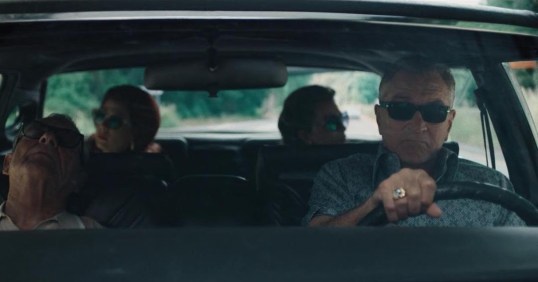
Released by Netflix in 2019 and clocking in at close to 4 hours, the Martin Scorsese-directed Best Picture nominee, The Irishman, is a film about many different things.

At its simplest, it’s a film about a very old man named Frank Shearan (played by Robert De Niro).  Frank is an Irish-American from Philadelphia.  Frank is a veteran of World War II and a former truck driver who was briefly a fairly important figure in the Teamsters union.  He did a few years in prison.  At the start of the film, though, he’s just another elderly man living in a retirement community.  All of his friends are dead.  His wife passed away years ago.  His children never comes to visit.  In fact, the only people interested in talking to Frank are the FBI but Frank doesn’t have much to say to them.  That’s not to say that Frank isn’t talkative.  For the first time in his life, he wants to talk to people but there’s no one left to talk to.  The only people who listen are those who are required to do so.  A nurse politely nods along as as he tells her about his old friend Jimmy Hoffa.  (She’s never heard of him.)  A priest listens to the story of Frank’s life and offers him absolution.  At times, Frank looks straight at Scorsese’s camera and appears to be talking straight to the audience.  Frank has a lot of interesting stories but who knows how truthful he’s being or if his memory can be trusted.

The Irishman, though, is not just the story of Frank.  It is also a secret history of America during the latter half of the 20th Century.  Frank may look old and harmless in that nursing home but, to hear him tell it, he was once acquainted with some of the most powerful men in America.  He went from executing Italian POWs during World War II to executing hits for the Mafia in post-war America.  Along the way, he became close to crime bosses like Skinny Razor (Bobby Cannavale), Angelo Bruno (Harvey Keitel) and Russell Bufalino (Joe Pesci), men who may not have been household names but who still wielded a lot of power.  These are men who, Frank flatly states, fixed the presidential election of 1960 and who later quite possibly killed the man they had elected president.  Frank also became a close associate of Jimmy Hoffa (Al Pacino), the labor leader who was reputed to have mob connections and who disappeared in 1975.

The Irishman is also a tribute to the modern gangster film, featuring role for nearly every living actor associated with the genre.  De Niro, Pacino, Pesci, Keitel, Bobby Cannavale, Domenick Lombardozzi, Gary Basaraba, they’ve all played their share of gangsters in films and television show that were both good and bad.  Having them all appear in one film together serves to remind the viewer of just how much of America’s popular entertainment has revolved around stories of organized crime.  Even as the old school Mafia has declined as a real-world power, it’s become a permanent part of pop culture.  Everyone loves a gangster, except for the people who actually have to deal with them on a daily basis.

Not surprisingly, considering the stars and the director, it’s a film full of smart, detailed performances.  When the film was originally released, Pacino and Pesci got the lion’s share of the praise and they certainly deserved it.  Pacino gets the best lines and brings some unexpected wit to his performance as Jimmy Hoffa.  Pesci, meanwhile, finally gets to play a gangster who is not psychotic and shows that he can be just as compelling when he’s not raising his voice as when he is.  Still, some of my favorite performances came from actors who one wouldn’t necessarily associate with a Scorsese gangster film.  I liked the nervous humor that Ray Romano brought to the role of a corrupt union lawyer.  I liked the seething resentment that Stephen Graham brought to the role of Jimmy Hoffa’s main rival in the union.  (The scene where Graham and Pacino argue over who is more owed an apology for all of their past disagreements is both funny and, due to the people involved, somewhat frightening.)  Jesse Plemons is poignantly dumb in his brief role as Hoffa’s stepson.  Louis Cancelmi doesn’t get a lot of screen time but he steals every scene in which he appears as a paranoid hitman.  (Cancelmi plays a character named Sally Bugs, proving that not everyone in the Mafia gets a cool nickname.)

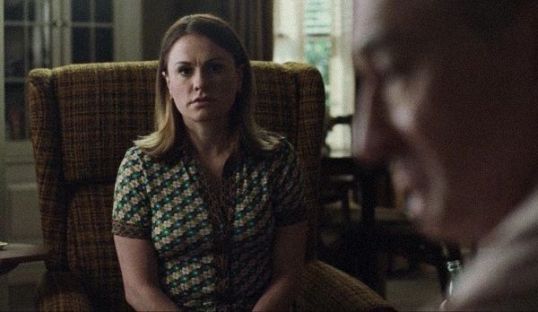
And then there’s Anna Paquin, who provides the film with its moral center.  When the film was first released, many Twitter critics complained that Paquin, who played Frank’s daughter Peggy, only a had a handful of lines.  It was one of the stupidest controversies of 2019, which is saying something when you consider how much time Film Twitter devotes to generating stupid controversies.  Peggy doesn’t say much because she’s decided that she doesn’t want to be a part of her father’s life.  From the moment that she first sees Frank beating up a store owner, Peggy knows that her father and his associates are violent men.  She not only fears them but she resents the damage that Frank does to not only her family but to the families as other as well.  The only one of her father’s associates who she likes is Jimmy Hoffa, because Hoffa cares about helping others.  When Hoffa disappears, Peggy makes a decision to disappear from Frank’s life and Paquin’s withering stare says more than any lengthy monologue could.  Peggy doesn’t say much because she knows that her words would be wasted on a man who she knows is a liar.  The scene where she silently walks away from her now elderly father tells us everything we need to know about the emotional consequences of the life that Frank has chosen to live.  Regardless of how many lines she did or didn’t have, Paquin gave one of the best performances of 2019.

Famously (or, depending on which critics you read, infamously), de-aging technology was used so that De Niro, Pacino, Pesci, and Keitel could play both the younger and the older version of their characters.  At first, it can be a bit jarring.  The de-aging works fine with Pesci and Keitel, both of whom are already supposed to be middle-aged when they first meet Frank.  (Admittedly, Keitel only has a few minutes of screen time.)  With De Niro and Pacino, it’s a bit less successful.  Even when they’re playing younger versions of themselves, De Niro and Pacino still move and stand like old men.  Fortunately, in the case of Pacino, his natural movie star charisma wins out over his obvious age.  In the end, we believe that he’s Hoffa because we want to believe that all of our important historical figures were as interesting and entertaining as Al Pacino is in The Irishman.

And yet, ultimately, even the awkward de-aging works to the film’s advantage because it reminds us that we’re not necessarily seeing what happened.  Instead, we’re seeing what Frank says happened.  We’re seeing his memories, or at least what he claims to remember.  It makes sense that, when Frank thinks about himself as a young truck driver in 1956, he would picture himself not as he was but instead as just a slightly less weathered version of who he would eventually become.  Throughout the film, there are hints that Frank’s memory should not be trusted.  Some of his stories are incredibly detailed while others — like when he transports weapons for the failed invasion of the Bay of Pigs — are a bit more vaguely presented.  Is Frank lying or is he misremembering or are we just expecting too much detail from a man who is now essentially waiting to die?  The film leaves that up for us to determine.

The Irishman is Scorsese at his most reflective.  Compared to Goodfellas and Casino, The Irishman is certainly one of Scorsese’s less “flashy” films.  But, on repeat viewings, it becomes cleat that The Irishman is the perfect conclusion to the gangster trilogy that began with Goodfellas and continued with Casino.  All three of these films deal with someone who rises up the ranks in the mob while remaining, as a result of their ethnicity, an outsider.  (Henry Hill and Frank Shearan are both Irish.  Ace Rothstein was Jewish.)  All three of them are briefly on top of the world and all three of them are left wondering how they’re going to continue their lives after their days at the top are over.  In Goodfellas, Henry Hill makes no secret of his disgust at having to live in the bland anonymity of the suburbs.  In Casino, Ace Rothstein ends the film with a mournful acceptance the fact that he will never return to his beloved Vegas.  (“And that’s that.”)  In The Irishman, Frank finally realizes that he has comes to the end of it all, alone and with nothing but death in his future.  All three of them made their decisions and, in the end, all three of them are left to deal with the consequences.  The trilogy goes from Henry’s anger to Ace’s depression to Frank’s acceptance.

It may seem strange to describe a film like The Irishman as being underrated, seeing as how it was nominated for 10 Oscars and got a Criterion release in record time.  And yet, when the film first came out, there was a vague sense of disappointment to found in even some of the positive reviews.  It was a Scorsese film that was so eagerly awaited and arrived with so much hype that there was no way it could live up to some of the expectations that had been set for it.  (And, of course, there’s also a whole set of people who were predestined to dislike the film precisely because it was a Scorsese film and it was so anticipated.)  It’s a long film and, while Netflix should be praised for allowing Scorsese the freedom to make his epic, it’s also not a film that should be viewed in bits and pieces on a tiny screen.  The Irishman is a film that should be watched in one sitting and it’s definitely a film that most viewers should watch more than once.  It takes more than one viewing to truly grasp the the world that Scorsese has recreated.

The Irishman was nominated for Best Picture.  It lost to a worthy competitor, Parasite.  Still, regardless of who took him the Oscars, The Irishman is a film that will live forever.

Here Are The 2019 Nominations of the Detroit Film Critics Society!


Earlier on Friday, the Detroit Film Critics Society released their nominations for the best of 2019!

Now, back in 2018, the DFCS honored some great films that were overlooked by the Academy, films like Eighth Grade, A Quiet Place, and First Reformed.  I mean, I really, really loved the 2018 DFCS awards.  And you know what?  I’m pretty happy with what they came up with for 2019 as well!  I especially like the nomination for Anna Paquin in The Irishman.  With all the overblown controversy about how many lines she spoke in the film, it is often overlooked that she gave a great performance and, with just the power of her withering glare, pretty much transformed Peggy into the conscience of the film.

Here are the DFCS nominees for the best of 2019!  The winners will be announced on December 9th!

BEST PICTURE
The Irishman
Jojo Rabbit
Marriage Story
Once Upon a Time… in Hollywood
Parasite

BEST DIRECTOR
Noah Baumbach – Marriage Story
Bong Joon-ho – Parasite
Martin Scorsese – The Irishman
Quentin Tarantino – Once Upon a Time… in Hollywood
Taika Waititi – Jojo Rabbit

BEST ACTRESS
Scarlett Johansson – Marriage Story
Julianne Moore – Gloria Bell
Lupita Nyong’o – Us
Charlize Theron – Bombshell
Renee Zellweger – Judy

BEST ACTOR
Robert De Niro – The Irishman
Adam Driver – Marriage Story
Robert Pattinson – The Lighthouse
Joaquin Phoenix – Joker
Adam Sandler – Uncut Gems

SUPPORTING ACTOR
Willem Dafoe – The Lighthouse
Tom Hanks – A Beautiful Day in the Neighborhood
Joe Pesci – The Irishman
Brad Pitt – Once Upon a Time… in Hollywood
Sam Rockwell – Richard Jewell
Wesley Snipes – Dolemite Is My Name

SUPPORTING ACTRESS
Kathy Bates – Richard Jewell
Laura Dern – Marriage Story
Scarlett Johansson – Jojo Rabbit
Anna Paquin – The Irishman
Florence Pugh – Little Women

BEST SCREENPLAY
The Irishman
The Lighthouse
Marriage Story
Once Upon a Time… in Hollywood
Parasite

BEST ANIMATED FILM
Frozen II
How to Train Your Dragon: The Hidden World
I Lost My Body
Klaus
Toy Story 4

BEST USE OF MUSIC
1917
Once Upon a Time… in Hollywood
Rocketman
Uncut Gems
Wild Rose

BEST ENSEMBLE
Dolemite Is My Name
The Farewell
The Irishman
Once Upon a Time… in Hollywood
Parasite

BEST DOCUMENTARY
Amazing Grace
Apollo 11
Horror Noire: A History of Black Horror
Knocking Down the House
Rolling Thunder Review: A Bob Dylan Story by Martin Scorsese

BREAKTHROUGH
Ana de Armas – actress (Knives Out, The Informer, Yesterday)
Jessie Buckley – actress (Wild Rose, Judy)
Kaitlyn Dever – actress (Booksmart, Them That Follow)
Aisling Franciosi – actress (The Nightingale)
Paul Walter Hauser – actor (Richard Jewell)
Florence Pugh – actress (Fighting with My Family, Midsommar, Little Women)
Lulu Wang – director (The Farewell)
Olivia Wilde – director (Booksmart)

Oh Hell Yeah! It’s The Trailer for The Irishman!


Oh hell yeah!

The trailer for Martin Scorsese’s The Irishman has been released!

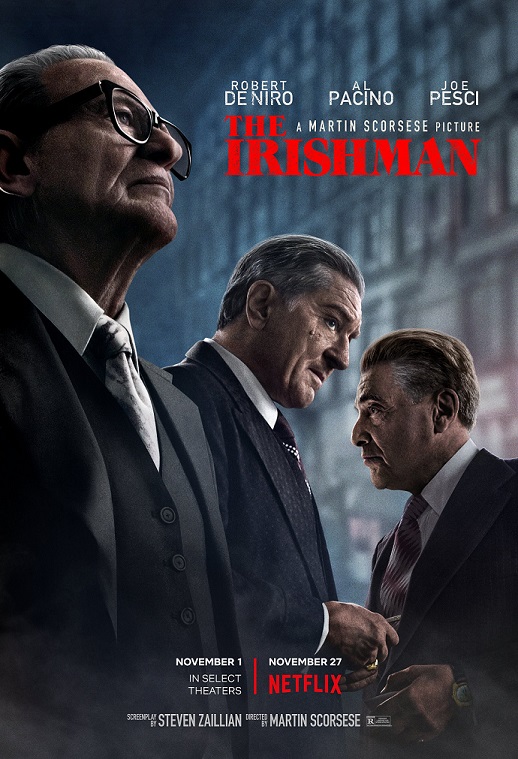
In The Irishman, Robert De Niro plays Frank Shearan, a hitman who was active in the mob for decades.  Before his death, he claimed that he was not only responsible for the death of Teamsters president Jimmy Hoffa, Sr. but also that he played a role in the assassination of John F. Kennedy!

Robert De Niro plays the Irishman.  Al Pacino plays Hoffa.  Joe Pesci, Harvey Keitel, Ann Paquin, and Ray Romano all have supporting roles!  (Don’t roll your eyes at that last one.  Romano has actually developed into a fairly interesting character actor.)  Apparently, a huge amount of money was spent on de-aging CGI so that the elderly De Niro, Pacino, Pesci, and Keitel could all play men in their 30s and 40s.  It’s either going to be brilliant or it’s going to be like Captain Marvel, where you were happy to see Samuel L. Jackson looking so young but you couldn’t help but notice that he didn’t seem to be quite as expressive as usual.

Listen, I love conspiracy movies.  I love gangster movies.  I love historical movies.  And I love Scorsese movies!

Bring it on, Netflix!

What If Lisa Had All The Power: 2019 Emmy Nominations Edition


In a few hours, the 2019 Emmy nominations will be announced!

Since I love awards and I love making lists, it’s an annual tradition that I list who and what would be nominated if I had all the power.  Keep in mind that what you’re seeing below are not necessarily my predictions of what or who will actually be nominated.  Many of the shows listed below will probably be ignored tomorrow morning.  Instead, this is a list of the nominees and winners if I was the one who was solely responsible for picking them.

Because I got off to a late start this year, I’m only listing the major categories below.  I may go back and do a full, 100-category list sometime tomorrow.  Who knows?  I do love making lists.

Anyway, here’s what would be nominated and what would win if I had all the power!  (Winners are listed in bold.)

(Want to see who and what was nominated for Emmy consideration this year?  Click here!)

(Want to see my picks for last year?  Click here!)

(Want to see my picks for 2012?  I know, that’s kinda random.  Anyway, click here!)

Programming

Outstanding Comedy Series

Barry

Brooklyn Nine-Nine

GLOW

It’s Always Sunny In Philadelphia

The Marvelous Mrs. Maisel

One Day At A Time

Veep

Vida

Outstanding Drama Series

Better Call Saul

Dynasty

Flack

Game of Thrones

The Magicians

My Brilliant Friend

Ozark

You

Outstanding Limited Series

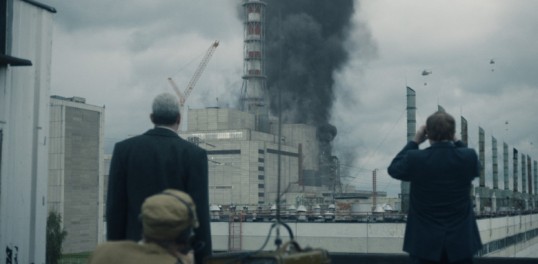
Chernobyl

Fosse/Verdon

The Haunting of Hill House

I Am The Night

Maniac

Sharp Objects

True Detective

A Very English Scandal

Outstanding Television Movie

The Bad Seed

Bandersnatch (Black Mirror)

Brexit

Deadwood

King Lear

Native Son

No One Would Tell

O.G.

Performer

Outstanding Lead Actor in a Comedy Series

Iain Armitage in Young Sheldon

Ted Danson in The Good Place

Bill Hader in Barry

Pete Holmes in Crashing

Glenn Howerton in A.P. Bio

Andy Samberg in Brooklyn Nine Nine

Outstanding Lead Actor in a Drama Series

Penn Badgley in You

Jason Bateman in Ozark

James Franco in The Deuce

John Krasinski in Tom Clancy’s Jack Ryan

Bob Odenkirk in Better Call Saul

Dominic West in The Affair

Outstanding Lead Actor In a Limited Series

Hugh Grant in A Very English Scandal

Jared Harris in Chernobyl

Jonah Hill in Maniac

Chris Pine in I Am The Night

Sam Rockwell in Fosse/Verdon

Henry Thomas in The Haunting of Hill House

Outstanding Lead Actor In An Original Movie

Benedict Cumberbatch in Brexit

Anthony Hopkins in King Lear

Rob Lowe in The Bad Seed

Ian McShane in Deadwood

Timothy Olyphant in Deadwood

Jeffrey Wright in O.G.

Outstanding Lead Actress In A Comedy Series

Melissa Barrera in Vida

Kristen Bell in The Good Place

Alison Brie in GLOW

Rachel Brosnahan in The Marvelous Mrs. Maisel

Julia Louis-Dreyfus in Veep

Zoe Perry in Young Sheldon

Outstanding Lead Actress in A Drama Series

Emilia Clarke in Game of Thrones

Gaia Girace in My Brilliant Friend

Maggie Gyllenhaal in The Deuce

Laura Linney in Ozark

Margherita Mazzucco in My Brilliant Friend

Anna Paquin in Flack

Outstanding Lead Actress in a Limited Series

Amy Adams in Sharp Objects

India Eisley in I Am The Night

Carla Gugino in The Haunting of Hill House

Charlotte Hope in The Spanish Princess

Emma Stone in Maniac

Michelle Williams in Fosse/Verdon

Outstanding Lead Actress in an Original Movie

Shannen Doherty in No One Would Tell

Chelsea Frei in Victoria Gotti: My Father’s Daughter

McKenna Grace in The Bad Seed

Paula Malcolmson in Deadwood

Molly Parker in Deadwood

Christina Ricci in Escaping The Madhouse: The Nellie Bly Story

Outstanding Supporting Actor In A Comedy Series

Fred Armisen in Documentary Now!

Andre Braugher in Brooklyn Nine Nine

Anthony Carrigan in Barry

Tony Hale in Veep

Sam Richardson in Veep

Stephen Root in Barry

Outstanding Supporting Actor In A Drama Series

Jonathan Banks in Better Call Saul

Nikolaj Coster-Waldau in Game of Thrones

Peter Dinklage in Game of Thrones

Giancarlo Esposito in Better Call Saul

Peter Mullan in Ozark

Luca Padovan in You

Outstanding Supporting Actor In A Limited Series

Stephen Dorff in True Detective

Timothy Hutton in The Haunting of Hill House

Chris Messina in Sharp Objects

Stellan Skarsgard in Chernobyl

Justin Thereoux in Maniac

Ben Whishaw in A Very English Scandal

Outstanding Supporting Actor In An Original Movie

Jim Broadbent in King Lear

Bill Camp in Native Son

Theothus Carter in O.G.

Rory Kinnear in Brexit

Gerald McRaney in Deadwood

Will Poulter in Bandersnatch (Black Mirror)

Outstanding Supporting Actress in A Comedy Series

Caroline Aaron in The Marvelous Mrs. Maisel

Alex Borstein in The Marvelous Mrs. Maisel

Anna Chlumsky in Veep

Sarah Goldberg in Barry

Rita Moreno in One Day At A Time

Sarah Sutherland in Veep

Outstanding Supporting Actress In A Drama Series

Summer Bishil in The Magicians

Elisa Del Genio in My Brilliant Friend

Julia Garner in Ozark

Lena Headey in Game of Thrones

Elizabeth Lail in You

Shay Mitchell in You

Outstanding Supporting Actress In A Limited Series

Jessie Buckley in Chernobyl

Patricia Clarkson in Sharp Objects

Sally Field in Maniac

Patricia Hodge in A Very English Scandal

Connie Nielsen in I Am The Night

Emily Watson in Chernobyl

Outstanding Supporting Actress In An Original Movie

Kim Dickens in Deadwood

Florence Pugh in King Lear

Margaret Qualley in Favorite Son

Emma Thompson in King Lear

Emily Watson in King Lear

Robin Weigert in Deadwood