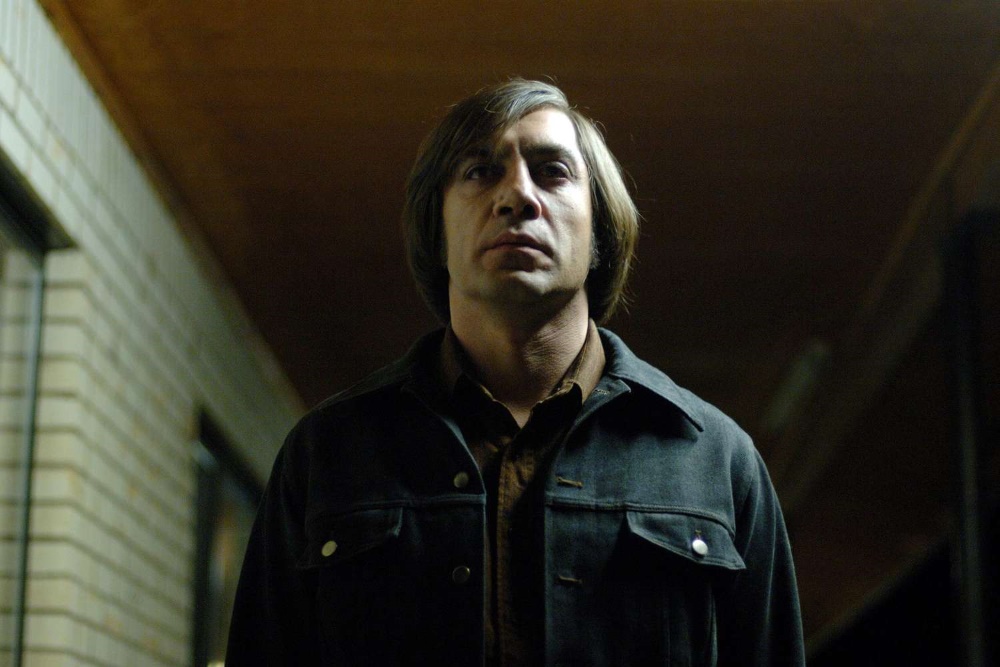
What makes for a great onscreen psychopath? Is it intelligence, unpredictability, complete emotional detachment, or the ability to make audiences uncomfortable without saying very much at all? Few characters embody all of those qualities more effectively than Anton Chigurh in No Country for Old Men. From the moment he appears, there is something unnervingly controlled about him. He rarely raises his voice, almost never shows panic, and carries himself with a cold certainty that makes every interaction tense. What makes Chigurh so mesmerizing is that the film refuses to explain him away with easy psychological answers. He is not presented as a tragic antihero or a charismatic mastermind with grand speeches. Instead, he exists less as a person and more as an unfolding force of inevitability—something closer to a natural disaster than a traditional villain.
Chigurh also carries a clear literary lineage as another Cormac McCarthy creation, and he shares unsettling DNA with Judge Holden from Blood Meridian. Like Holden, Chigurh feels less like a human being and more like a presence that has stepped outside normal moral reality. Both characters operate as if they are not bound by human frameworks of empathy, guilt, or justification. In that sense, they resemble forces of nature rather than characters with inner conflict. Just as Judge Holden moves through the world with an almost mythic authority over violence and meaning, Chigurh moves with the same sense of inevitability—quiet, methodical, and indifferent to the emotional weight of his actions.
This is where the question of morality around Chigurh becomes deliberately unstable. Is he evil, or is he something beyond the concept of evil entirely? Like Judge Holden, he resists moral categorization because he does not appear to participate in the same value system as the people around him. Evil implies choice, intention, even some recognition of wrongdoing, but Chigurh operates as though he is merely enacting a set of principles that already exist independent of him. His coin toss philosophy, for instance, suggests not cruelty but submission to randomness or fate. The horror comes from the fact that human beings experience this as evil, while Chigurh seems to experience it as something closer to logic.
A major reason Chigurh leaves such a strong impression is Javier Bardem’s performance. Bardem strips the character down to the bare essentials, creating someone who feels emotionally alien without becoming cartoonish. His speech patterns are calm and deliberate, often forcing other characters into uncomfortable silence. Even simple conversations become threatening because Chigurh treats life-and-death decisions with the same tone someone else might use to discuss the weather. The famous coin toss scene perfectly captures this quality. Chigurh frames chance as something almost sacred, shifting responsibility away from himself while still remaining the instrument through which fate is delivered. That combination of politeness, inevitability, and menace makes him unforgettable.
The film also makes Chigurh especially unsettling by positioning him in contrast to Sheriff Bell’s worldview in No Country for Old Men. Bell represents an older moral framework where violence, while still real, at least had recognizable motives and boundaries. Chigurh breaks that expectation entirely. He is not driven by greed or revenge, and he does not appear to be psychologically damaged in a way that explains his actions. Instead, he behaves as though he is simply carrying out the consequences of a system that no one else fully understands. That gap between human expectation and Chigurh’s apparent indifference is where his terror truly lies.
Ultimately, Anton Chigurh endures as a villain because he refuses containment within normal storytelling or moral logic. Like Judge Holden, he reads less like a character and more like an embodiment of something larger—chaos given structure, or inevitability given form. No Country for Old Men never fully explains or defeats him because doing so would shrink him into something understandable. Instead, he remains ambiguous, almost elemental. Whether he is evil or something beyond evil is never resolved, and that uncertainty is precisely what makes him so disturbing. He becomes a figure of inevitability itself, a reminder that what humanity calls “evil” may sometimes feel indistinguishable from the indifferent mechanics of the world.


He is scary.
LikeLike
I’ve read so many analysis and papers breaking down this character and they all seem to agree that Anton Chigurh is a hyperrealisitc example of the perfect psychopath which in turn makes him unrealistic which is a good thing they all seem to agree on. He is a prime psychopath with no flaws and drawbacks which even the most brilliant ones tend to have one or two of.
LikeLike
What a great film…and what a character – the ending with the wife kills me!
LikeLike
Pingback: Villain Of The Day: Willie Cicci (The Godfather & The Godfather Part II) | Through the Shattered Lens
Pingback: Villain of the Day: Griffith (Berserk) | Through the Shattered Lens
Pingback: Villain of the Day: Klaus Wortmann (Antropophagus) | Through the Shattered Lens
Pingback: Villain of the Day: Emilio Barzini (The Godfather) | Through the Shattered Lens
Pingback: Villain of the Day: Gul Dukat (Star Trek : Deep Space Nine) | Through the Shattered Lens
Pingback: Villain of the Day: Judge Holden (Blood Meridian) | Through the Shattered Lens
Pingback: Villain of the Day: Vic Mackey (The Shield) | Through the Shattered Lens
Pingback: Villain of the Day: Reinhard Heydrich (Conspiracy) | Through the Shattered Lens
Pingback: Villain of the Day: Kai Proctor (Banshee) | Through the Shattered Lens
Pingback: Villain of the Day: Matthew Hopkins (Witchfinder General) | Through the Shattered Lens
Pingback: Villain of the Day: Boyd Crowder (Justified) | Through the Shattered Lens
Pingback: Villain of the Day: Darkness (Legend) | Through the Shattered Lens
Pingback: Horror Villain of the Day: Pinhead (Hellraiser) – Through the Shattered Lens
Pingback: Villain of the Day: Jody Joad (Earthquake) – Through the Shattered Lens