Horror Film Review: Thirteen Ghosts (dir. by Steve Beck)


“Did I say there’s a petting zoo downstairs? No! There are ghosts downstairs, Arthur!” — Dennis Rafkin

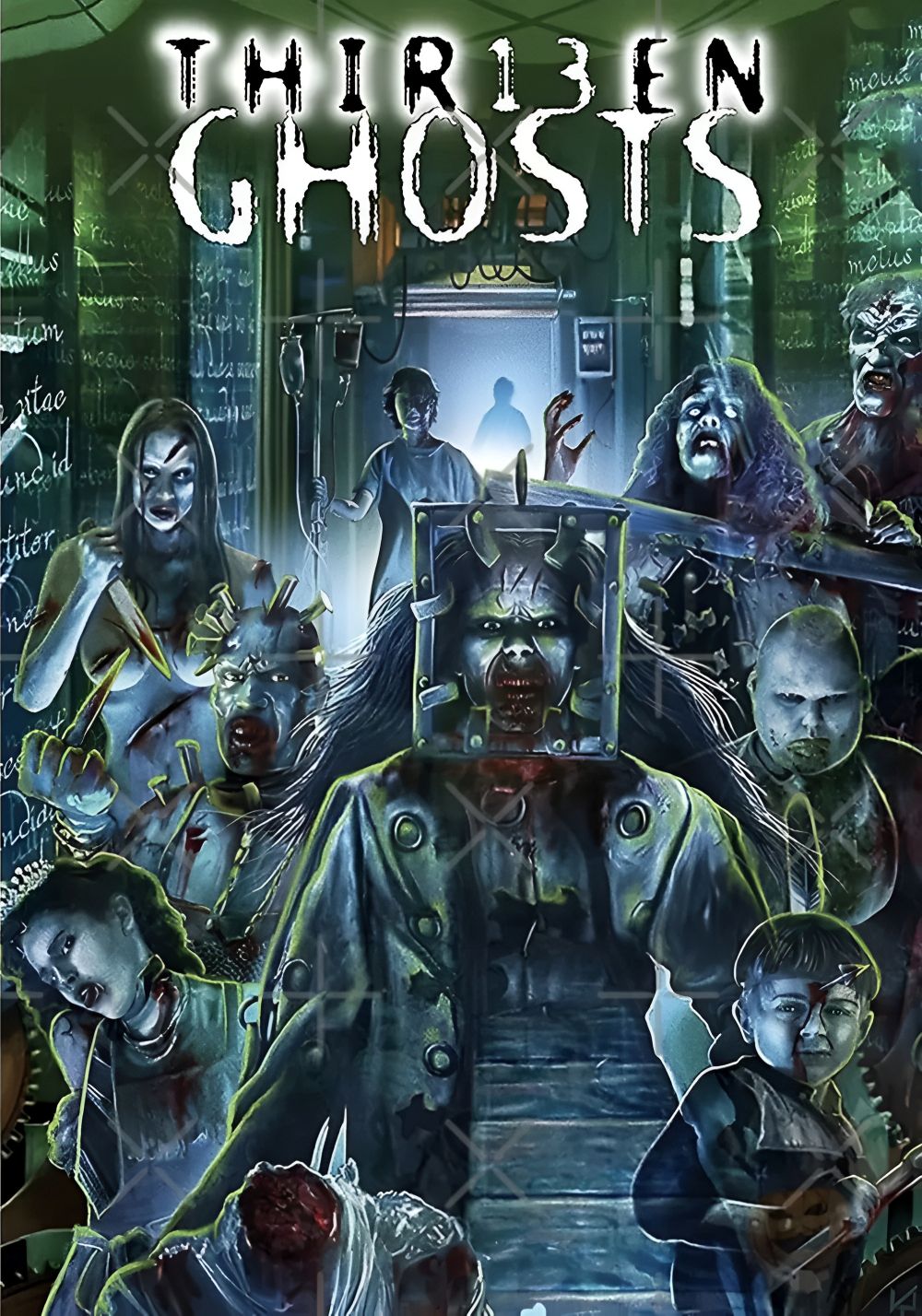
In Thirteen Ghosts, getting a spectacular house for free turns out to be considerably worse than struggling to afford one. That cruel little reversal gives Steve Beck’s 2001 horror film a promising starting point: a family’s apparent good fortune becomes another nightmare they have to survive. As a remake of William Castle’s 1960 film 13 Ghosts, though, it isn’t interested in preserving much of its predecessor’s low-budget charm. Beck trades playful spook-show entertainment for grotesque creatures and brutal violence. The result has an unmistakable identity, but its impressive visual imagination often outpaces its ability to tell a compelling story.

Tony Shalhoub plays Arthur Kriticos, a widowed father trying to provide some stability for his children. When his wealthy uncle Cyrus, played by F. Murray Abraham, leaves him an extraordinary house, it looks like the kind of opportunity he can’t afford to question. Arthur arrives with his family and their nanny, only to discover that their new home contains trapped spirits and some deeply suspicious machinery. Naturally, the house isn’t simply haunted. Its design has a purpose, and the people walking through it have become part of something they don’t understand.

There’s a nasty streak running through that setup, and the remake embraces it. Castle’s original has the scrappy appeal of an old carnival attraction, where the modest effects and ghost-viewing gimmick contribute to the fun. Beck’s version wants to hit harder. The ghosts look tortured, their attacks feel vicious, and the atmosphere offers little of the earlier film’s playful reassurance. That approach separates the remake from the original rather than leaving it feeling like a glossy imitation. Still, the difference is enormous. It keeps the basic inheritance premise while taking the experience about as far from Castle’s charmingly cheap thrills as possible.

The strongest part of that transformation is the house itself. Its glass walls, strange inscriptions, and mechanical components make it feel more like an elaborate trap than somewhere anyone could live. The transparency is especially effective. Haunted-house movies usually make darkness and concealment threatening, but here the characters can look through walls without knowing what they’re seeing or how to reach safety. Everything appears exposed, yet very little feels understandable. Even during stretches when the plot becomes clumsy, the setting holds your attention. There’s almost always an unsettling detail somewhere in the frame.

The special glasses that reveal the ghosts make good use of that environment. Without them, a seemingly empty room can contain something capable of killing you. With them, the house becomes even less inviting. It’s a clever connection to the original’s viewing gimmick, repurposed to suit the remake’s harsher personality. The bathroom encounter with the Angry Princess is particularly effective because it builds danger around a character’s limited awareness. For a moment, the film doesn’t need complicated explanations or frantic action. The simple possibility of sharing a confined space with an unseen threat does the work.

The creatures are equally important to the movie’s appeal. Their makeup, clothing, and physical behavior suggest distinct personalities and horrible histories. They aren’t interchangeable figures waiting to jump into the camera. Several look interesting enough to support much longer sequences, which makes their treatment frustrating. The movie introduces these elaborate designs and then rushes toward the next confrontation. You want to understand what separates one spirit from another, but the screenplay too often treats them as obstacles in a supernatural obstacle course. The imagination behind their appearances is stronger than the storytelling that puts them to use.

That hurry extends to the scares. Beck frequently pushes the action with rapid editing, loud sound effects, and sudden bursts of violence. There’s some fun in that aggressive approach, especially if you enjoy horror that refuses to be restrained. But the constant pressure eventually flattens the suspense. When nearly every encounter arrives at full volume, there’s little room for dread to build. An ugly figure lingering behind glass can be more disturbing than another noisy attack. The movie creates plenty of striking images, then seems nervous about letting the audience sit with them.

The actors help keep the chaos watchable. Shalhoub gives Arthur a weary sincerity that makes his concern for his children believable. Matthew Lillard brings an anxious, twitchy energy that fits the increasingly frantic situation, while Shannon Elizabeth and Rah Digga add life to the ensemble. Unfortunately, the family’s emotional circumstances get less attention than the machinery surrounding them. Arthur’s desire to turn an inheritance into security should make the house’s betrayal sting. Instead, the film keeps interrupting that thread to explain another supernatural complication or send everyone running. The characters remain likable enough, but they rarely become as interesting as their surroundings.

By the time the house has revealed its true colors, Thirteen Ghosts has made a better case for its production design than its storytelling. There’s real pleasure in its elaborate nastiness, and Beck deserves credit for giving the remake a personality separate from Castle’s original. This isn’t the same haunted-house ride with a fresh coat of paint; it’s a colder, bloodier attraction built on the old foundation. Whether that trade works depends on how much creature design and frantic violence you need to stay entertained. For me, there’s enough to enjoy, but not enough to stop wishing the movie would slow down and let its best ideas haunt us.
Icarus File No. 34: Carrie (dir by Mike Flanagan, Kate Siegel, Axelle Carolyn, Kyra Sedgwick, Hiromi Katana)


If I had to choose two words to describe Mike Flanagan’s “reimagining” of Carrie, they would probably be “fan fiction.”

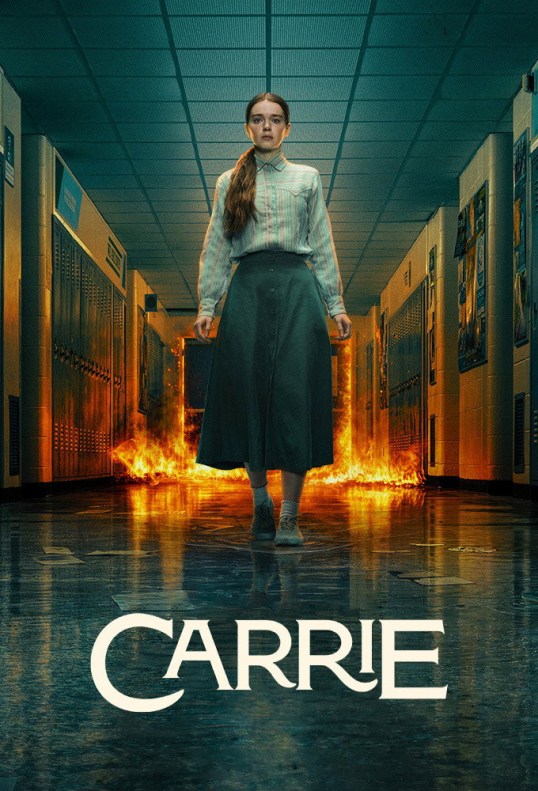
In fact, it’s sometimes humorous just how obviously this miniseries is a work of fan fiction. Carrie White (blandly played by Summer Howell) may be a bullied and sheltered girl with telekinetic powers, but now she has a best friend, Emaline (an equally bland Thalia Dudek, who looks less like a 2026 teenager and more like the bassist in a 1990s riot grrrl band), who also has a power and always has the best advice and the snarkiest comebacks! What would Carrie do without her best friend Emaline? And while Margaret White (Samantha Sloyan) is still present as an overprotective and paranoid force in Carrie’s life, there’s now another maternal figure named Adelaide (Kate Siegel) who exists to talk about how those with secret powers are always being held down by a society that’s just not capable of accepting how important they are. Adelaide opens each episode with a monologue that feels like it was written by a 2017 college freshman who has just watched Linda Sarsour on YouTube. Watching the miniseries, one gets the feeling that Flanagan and his writers really wanted to make a show called Emaline and Adelaide and decided to graft them onto Carrie.

Ever since this miniseries was announced, there’s been a lot of talk about how Flanagan has updated the story. In this case, that means there’s an emphasis on phones and social media, as if teenagers couldn’t find a way to hurt each other even before technology caught up with them. In fact, social media is pretty much to blame for everything that happened. The audience is meant to violently roll their eyes at Margaret White for believing in conspiracy theories and religion while, at the same time, accepting a portrayal of the dangers of social media that makes Aaron Sorkin look even-handed and calm. One gets the feeling that if this show had been made just a few years earlier, it would have found a way to blame Margaret White and Chris Hargensen for the January 6th riots. There is a riot in the sixth episode, but it just involves all of the students doing a massive walkout to protest Chris Hargensen’s secret Instagram account. “Death to Hargensen!” the students chant, and it briefly seems like maybe Flanagan is going to make a bigger point about how the bullies can become the bullied, but ultimately, this is too much of a work of fan fiction to delve too deeply into anything that complex. It’s also too much of a work of the streaming era to introduce an idea that can’t be neatly summed up in 15 seconds.

Yes, this is a new version of Carrie. If King’s novel and De Palma’s film gave us a Carrie White who was never happy until that one prom night and who lashed out after that happiness was stolen from her, the Mike Flanagan miniseries gives us a Carrie who becomes the most popular girl in school even before prom night. No longer does Tommy (Joel Oulette) ask Carrie to prom as a favor to his guilt-ridden girlfriend, Sue Snell (Siena Agudong). Instead, he asks Carrie as a friend. Carrie’s no longer sheltered and shy. Instead, she’s somewhat smug and annoying. She sneaks out of the house many times before prom night. She goes to a party. She goes to the junkyard and curses like a sailor while showing off her powers. Her best friend Emaline is impressed. What would Carrie do without her best friend, Emaline? Of course, by changing all of this, Flanagan robs the story of all of its emotional power. This is probably the first version of Carrie where I’ve actually found myself getting annoyed with Carrie as a character. Towards the end of the miniseries, she just becomes so smug and self-righteous, like the girl at school who used to sweetly pull you aside to tell you that your skirt was too short. This is a version of the story that lets Carrie off the hook. Emaline is the one who suggests that she use her powers to get revenge. Adelaide and her dumbass cult are the ones who accidentally set fire to the school. Carrie dances in the street with Emaline and, for a few seconds, you actually find yourself wishing for the calming hand of Ryan Murphy.

Yes, I know that Stephen King has endorsed Mike Flanagan’s changes. That doesn’t mean that I have to. The fact of the matter is that Stephen King has consistently shown that he will endorse just about anything, and it’s also been a while since King has written anything that can match the power of his earlier work. There’s a world of difference between the youngish and struggling writer who originally wrote Carrie and the wealthy boomer who is now probably better known for his angry tweets than his more recent literary output. As well, it’s obvious that King likes Flanagan. Flanagan is the ultimate fan. And yet, considering that Flanagan’s best film, Hush, was also his simplest, one can’t help but feel that Flanagan would do well to stop adapting his heroes and maybe just try to focus on creating unapologetic suspense.

It’s the curse of elevated horror. Right now, the critics who hate entertaining horror love slow-moving elevated horror. They go on and on about the subtext, as if there wasn’t subtext to be found in the horror movies that were made in the past. The truth of the matter is that the subtext is usually the least interesting thing about these films and series. Making a film or a show that is critical of capitalism and religion is hardly the radical act that the critics seem to think it is. There’s nothing particularly interesting or special to be found between the lines when it comes to this version of Carrie. Indeed, for all the time and effort that the series puts into villainizing Margaret White and Chris Hargensen, they’re ultimately the most interesting characters because Samantha Sloyan and Alison Thornton are the only two performers who are allowed to break free from the show’s rigid ideological structure. (Samantha Sloyan especially deserves a lot of credit for finding a hint of reality in her portrayal of Margaret.) Chris and Margaret are compelling because they’re the only characters who don’t just parrot the accepted lines and the accepted thinking. They’re the only characters who seem to have a life and an outlook that was formed by something other than the demands of the show. We’re meant to shake our heads when Margaret becomes an online celebrity with a podcast, but instead, we’re interested and almost happy for her because Margaret is actually doing something unexpected and making an effort to take actual control of her life. It’s hard not to feel that this version of Margaret White deserved a better ending than what the show gave her. In the end, Margaret feels less like a villain and more like a victim of the show’s writers and their own feelings about religion and politics. (One wonders if the writers realize that their show ultimately makes the case that all of the tragedy could have been avoided if the government had simply stayed out of it and just allowed Margaret to continue to homeschool her daughter.) If previous versions of Carrie seemed to be designed to appeal to shy outsiders, this version of Carrie is designed to compliment self-styled victims who don’t have the self-awareness necessary to realize that they are now the bullies.

In the end, Carrie feels like a forgotten Showtime series from 2018 and, if it had been made by anyone other than Mike Flanagan, no one would care.

Previous Icarus Files:

  1. Cloud Atlas
  2. Maximum Overdrive
  3. Glass
  4. Captive State
  5. Mother!
  6. The Man Who Killed Don Quixote
  7. Last Days
  8. Plan 9 From Outer Space
  9. The Last Movie
  10. 88
  11. The Bonfire of the Vanities
  12. Birdemic
  13. Birdemic 2: The Resurrection 
  14. Last Exit To Brooklyn
  15. Glen or Glenda
  16. The Assassination of Trotsky
  17. Che!
  18. Brewster McCloud
  19. American Traitor: The Trial of Axis Sally
  20. Tough Guys Don’t Dance
  21. Reach Me
  22. Revolution
  23. The Last Tycoon
  24. Express to Terror 
  25. 1941
  26. The Teheran Incident
  27. Con Man
  28. Looker
  29. 1776
  30. Here
  31. The Adventures of Brisco County, Jr.
  32. The Cable Guy
  33. A Chorus Line


Retro Television Review: Area 57


Welcome to Retro Television Reviews, a feature where we review some of our favorite and least favorite shows of the past!  This Thursday, I will be reviewing Area 57, which was produced for NBC in 2007.  The show can be found on YouTube!

Episode 1.1 “Pilot”

(Dir by Dean Parisot, filmed in 2007, never aired)

Col. Steven Isaac (Matthew Lillard) has been assigned to Area 57, a military base in the Nevada desert. Isaac is excited to read his orders and discover that Area 57 is home to an extraterrestrial. He arrives at the base. He meets by-the-book Lt. Irene Maloof (Jane Lynch). He meets the plain-spoken General Keller (Bruce McGill). He meets head scientist Dr. Annabelle Fermi (Kelly Hu). Finally, Isaac announces that he really wants to meet the alien.

Suddenly, Dr. Fermi emerges from her laboratory and says that the alien has died. General Keller announces that Area 57 is being shut down. All of the soldiers cheer. The general explains that the alien wasn’t always popular. Isaac still insists on seeing the body. With Dr. Fermi at his side, he gets his first look at the alien and accidentally spills his coffee on him. The alien (played by Paul Reubens) comes back to life.  It turns out that he was just going through a sleep cycle. General Keller announces that Area 57 is not closing and no one is going home.

With the entire base still angry with him, Isaac still insists on meeting the alien. The alien asks him about his education. Isaac says that he attended college through an endowment. The alien says that many of the soldiers like Dr. Fermi. Isaac agrees that she’s attractive. The alien then announces to Irene that Isaac was making crude comments about Fermi and bragging about how endowed he was.

Isaac realizes the truth. The alien is a jerk. He also learns that the alien has been at Area 57 for 40 years and that, so far, the government has learned nothing from him.

That’s the plot of Area 57. NBC thought enough of the idea to commission a pilot, but the network never aired it. It’s available on YouTube. Watching it, you can see what the problem was. The alien is established as such a jerk that it’s hard to imagine anything else that could have been done with the character. Paul Reubens plays the role under a good deal of makeup, and he’s more off-putting than intriguing. That said, Matthew Lillard was genuinely funny as the earnest and idealistic Col. Isaac. He was so excited about meeting an alien that it was impossible not to feel sorry for him when the alien turned out to be a jerk.

If we ever do meet aliens, I have a feeling that something like Area 57 might be seen as prophetic. There’s a tendency to assume that alien visitors will be interesting, erudite, and worth knowing. I think that if there are aliens out there, they’re just as likely to be as annoying as the average human.

Area 57. The truth is out there!

Things are heating up in the trailer for Mike Flanagan’s Carrie!


It’s not always easy to adapt someone else’s work. 

Stick too close to the source material, and you end up with Gus Van Sant’s Psycho. Veer just a bit away from it, and you may end up with surprises like Stanley Kubrick’s The Shining or Frank Darabont’s The Mist. Tossing out the source material or rushing the story gives you Nikolaj Arcel’s The Dark Tower. Sometimes it works, sometimes it doesn’t. Even Stephen King had a rough time adapting his own work to film with Maximum Overdrive. 

So seeing that we have yet another adaptation of King’s first novel, Carrie, I was a little confused and surprised when Mike Flanagan’s name came up. I know I haven’t kept up on everything online these days, but wasn’t he working on an adaptation for The Exorcist? Either way, we have it, and it looks like it has the potential to be pretty great. Flanagan’s no stranger to King’s works, having adapted Gerald’s Game and Doctor Sleep.

As always, Flanagan’s invited some of this friends to join in on the fun. For me, the standout returning actor is Samantha Sloyan, who previously worked on Hush, Midnight Mass, and The Life of Chuck, among others. Samantha’s playing Margaret White, and while Piper Laurie’s portrayal in Brian DePalma’s 1976 classic still scares me, I’m excited to see how this will turn out. Additionally, we have Midnight Mass‘ Michael Trucco and Rahul Kohli on hand. Of course, Flanagan production would be complete without his Hush lead actress, muse and wife, Actor/Director Kate Siegel. Matthew Lillard (Five Nights at Freddy’s) and Amber Midthunder (Prey, Novocaine) are also featured, with Summer H Howell (Night of the Reaper) as Carrie. 

Carrie premieres on Amazon Prime early this October, just in time for Halloween. 

There’s a lot of music being made in Tony Gilroy’s Behemoth!


The teaser for Behemoth didn’t do anything for the first 30 seconds. Yeah, I like Pedro Pascal. He’s fun to watch. Is he a bit overexposed these days? Sure, but then again, so are Tom Holland, Zendaya and Robert Pattinson. Doesn’t mean they can’t act. Still, it wasn’t holding me. 

“This is going to be another Tar, isn’t it?” I said to myself. 

Then Tony Gilroy’s name popped up. I leaned forward in my chair. I was like Robert Downey, Jr. and Robert Rusler’s characters in John Hughes’ Weird Science, watching Lisa pass them by on the escalator at the Mall. I love and own Michael Clayton, and was on board for both seasons of Disney Plus’ Andor. His stories aren’t the most exciting, admittedly (his brother Dan handled that better in Nightcrawler), but I love the conversations his characters have. 

As the music played, I started smiling and quickly opened another browser window. Tony Gilroy usually works with James Newton Howard, and as far as I knew, I hadn’t heard a Howard score since maybe Malecifent, Red Sparrow, maybe? . The score of this film may be larger than the story itself. Not only is James Newton Howard involved, but so are Alan Silvestri (The Avengers), Michael Giacchino (The Fantastic Four: First Steps), Henry Jackman (X-Men: First Class), and Michael Abels (Us & Nope), along with Emily Bear (Our Little Secret), Brandon Roberts (Underwater and Andor), Nami Melumad (Star Trek: Strange New Worlds) and Lukas Frank (East of Wall). I’m curious to hear what kind of soundtrack that could be. James Newton Howard has been known to work with other composers, like with Hans Zimmer on Christopher Nolan’s first two Batman films.

As for the film itself, it looks like Pascal’s cellist has a number of issues going on. On hand are Olivia Wilde (Booksmart), Will Arnett (The Lego Batman Movie), and Eva Victor (Dating & New York), Margarita Levieva (Adventureland) , Matthew Lillard (Five Nights at Freddy’s) and JoBeth Williams (Poltergeist). It’s hard to say what it’s all about in just a teaser, but we’ll find out if when it’s released this December. 

Enjoy!

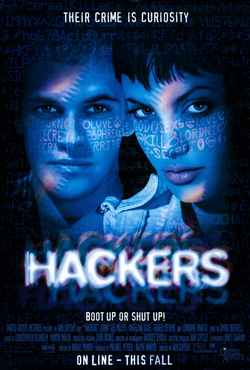
Insomnia File #76: Hackers (dir by Iain Softley)


What’s an Insomnia File? You know how some times you just can’t get any sleep and, at about three in the morning, you’ll find yourself watching whatever you can find on cable or streaming? This feature is all about those insomnia-inspired discoveries!

If you’re having trouble getting to sleep tonight, you can always go over to Prime or Tubi and enjoy 1995’s Hackers.

Hackers is a film about …. well, it’s right there in the title.  They’re hackers.  They’re cool.  They’re hot.  They’re sexy.  And they are way into computers!  They know everything that there is to know about exploring the internet, breaking into protected accounts, and rewriting code.  They know all about viruses, both how to spread them and how to cure them.  And they’re all teenagers!  The coolest kids at school are totally into computers and they’ve all got nicknames.

Hackers is very much a film of the 90s.  When this film came out, the Internet was still exotic and it was assumed that anyone who could write code had to be an eccentric genius with a larger-than-life personality.  Johnny Lee Miller is Dade Murphy, a.k.a. Zero Cool.  When he was a kid, he almost crashed the global economy.  Matthew Lillard is Emmanuel Goldstein, also known as Cereal Killer.  Lillard is hyperactive and he yells a lot but one can be sure that he’ll be a Silicon Valley billionaire by the time he’s 22.  Angelina Jolie is Kate Libby, also known as Acid Burn.  Hackers was early in Jolie’s career, back when she had so much personality and charisma that she seemed like she might literally step off of the screen and ask you if you wanted to step outside to smoke a joint or maybe do something a bit wilder.  All of the hackers go to high school together.  They all hack computers together.  And they all find themselves targeted by The Plague (Fisher Stevens), a super hacker who is so evil that he rides a skateboard to work.

It’s a perfectly ludicrous film but it’s so cheerfully and excessively stylish and Miller and Jolie have so much chemistry that it doesn’t really matter whether or not the film makes any sense.  This is one of those films where The Plague hatches his evil scheme while standing in a neon room surrounded by screens, as if the film is suggesting that The Plague actually lives in the middle of the Internet.  The music is early EDM.  The action is fast.  The cast has charisma to burn.  This film is about as 90s as a film can get.

Johnny Lee Miller and Angelina Jolie (who was 20 when she shot this film) were married shortly after the film’s release and, though the marriage may not have lasted, their chemistry is explosive.  For lack of a better term, they are totally into each other and it’s exiting to watch them interact.  The end credits roll over a scene of them undressing and making love in a pool and it’s the perfect ending for this film, a jolt of energy that feels like the proper way to celebrate having saved the world from collapse.  It’s also the type of thing that few studio films would be willing to do today.  Somehow, 2026 has turned out to be more puritanical than 1995 and progressiveness has, for many, come to mean either chastity or performative asexuality.  It’s as if both Hollywood and many modern critics have been captured by Orwell’s Anti-Sex League.  (Just consider the bizarre reaction that many had to Christopher Nolan including a sex scene in Oppenheimer.)  Hackers may not be a realistic portrayal of programmers or hackers but it is reminder of a time when movies were not only fun but they were also sexy.  Watching the film, one regrets that Johnny Lee Miller never became a big star and that Angelina Jolie is no longer the unpredictable force a nature that she once was.

Hackers is a trip to a time that may have only existed in our imaginations but it’s still nice to go back and visit on occasion.

Previous Insomnia Files:

  1. Story of Mankind
  2. Stag
  3. Love Is A Gun
  4. Nina Takes A Lover
  5. Black Ice
  6. Frogs For Snakes
  7. Fair Game
  8. From The Hip
  9. Born Killers
  10. Eye For An Eye
  11. Summer Catch
  12. Beyond the Law
  13. Spring Broke
  14. Promise
  15. George Wallace
  16. Kill The Messenger
  17. The Suburbans
  18. Only The Strong
  19. Great Expectations
  20. Casual Sex?
  21. Truth
  22. Insomina
  23. Death Do Us Part
  24. A Star is Born
  25. The Winning Season
  26. Rabbit Run
  27. Remember My Name
  28. The Arrangement
  29. Day of the Animals
  30. Still of The Night
  31. Arsenal
  32. Smooth Talk
  33. The Comedian
  34. The Minus Man
  35. Donnie Brasco
  36. Punchline
  37. Evita
  38. Six: The Mark Unleashed
  39. Disclosure
  40. The Spanish Prisoner
  41. Elektra
  42. Revenge
  43. Legend
  44. Cat Run
  45. The Pyramid
  46. Enter the Ninja
  47. Downhill
  48. Malice
  49. Mystery Date
  50. Zola
  51. Ira & Abby
  52. The Next Karate Kid
  53. A Nightmare on Drug Street
  54. Jud
  55. FTA
  56. Exterminators of the Year 3000
  57. Boris Karloff: The Man Behind The Monster
  58. The Haunting of Helen Walker
  59. True Spirit
  60. Project Kill
  61. Replica
  62. Rollergator
  63. Hillbillys In A Haunted House
  64. Once Upon A Midnight Scary
  65. Girl Lost
  66. Ghosts Can’t Do It
  67. Heist
  68. Mind, Body & Soul
  69. Candy
  70. Shortcut to Happiness
  71. Dallas Cowboy Cheerleaders
  72. Dallas Cowboy Cheerleaders II
  73. Don’t Kill It
  74. Listen To Me
  75. 300 Miles For Stephanie

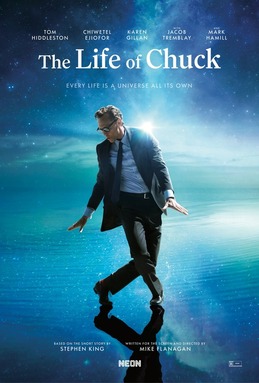
Catching Up With The Films of 2025: The Life of Chuck (dir by Mike Flanagan)


The Life of Chuck is a story told in reverse.

The world is ending and teacher Marty Anderson (Chiwetel Ejiofor) wonders why he keeps seeing signs that announce, “Charles Krantz: 39 Great Years! Thanks, Chuck!”  Marty’s ex-wife (Karen Gillan) calls him and tells him that, at the hospital where she works, she and her co-workers have taken to calling themselves “the suicide squad.”  It would be an effective moment if not for the fact that the film’s narration (somewhat predictably voiced by Nick Offerman) had already informed us of that fact.  Everyone wonders why the world is falling apart.  Why has the internet gone off-line?  Why has California finally sunk into the ocean?  Why are people rioting?  Several characters say that it’s the end times before then adding that it’s not the same end time that the “religious fanatics” and “right-wing nuts” always talk about.  Thanks for clarifying that!  It’s nice to know that, at the end of the world, people will still talk like an aging Maine boomer.

Nine months earlier, a straight-laced banked named Chuck Krantz (Tom Hiddleston) comes across a busker playing her drums on a street corner and feels inspired to start dancing.

Years earlier, a young boy named Chuck Krantz is raised by his grandmother (Mia Sara) and his grandfather (Mark Hamill).  Young Chuck (Jacob Tremblay) inherits a love of dance from his grandmother but, after she dies in a supermarket, his grandfather turns to drinking.  His grandfather keeps one room in their house locked.  (There’s even an absurdly huge lock on the door because The Life of Chuck is not a subtle one.)  Eventually, Chuck discovers what is hidden away in the room and it shapes the rest of his life.

Occasionally, solid genre craftsmen will fill the need to prove that they’re actually deeper than people give them credit for.  In 2020, Stephen King published a novella called The Life of Chuck.  In October of 2023, director Mike Flanagan announced that he had begun filming on his adaptation of The Life of Chuck.  Both King and Flanagan are better-known for their contributions to the horror gerne, though, around 2017, King apparently decided that he was also meant to be a political pundit.  (No writer, with the possible exception of Joyce Carol Oates, has done more damage to their reputation by joining twitter than Stephen King.)  There are elements of horror to be found in The Life of Chuck.  There’s the world ending during Act One.  There’s the locked rom in Act Three.  There’s the terrible acting of the woman playing the drummer in Act Two.  But this definitely is not a horror film.  Instead, it’s King and Flanagan at their most sentimental, heartfelt, and ultimately simplistic.

It’s ultimately a bit too self-consciously quirky for its own good.  Flanagan seems to be really concerned that we’ll miss the point of the film so he directs with a heavy-hand and, at times, he overexplains.  Sometimes, you have to have some faith in your audience and their ability to figure out things on their own.  The scenes of Chuck’s childhood are so shot through a haze of nostalgia that they feel as overly stylized as the scenes that don’t necessarily take place in our reality.  For the most part, the narration could have been ditched without weakening the film.  That said, the film is hardly a disaster.  There are moments that work, like the joyous scene of Tom Hiddleston dancing.  The film tries a bit too hard to be profound but there’s joy to be found in the performances of Hiddleston and Jacob Tremblay.  Chucks seems like a nice guy.

Thanks, Chuck!

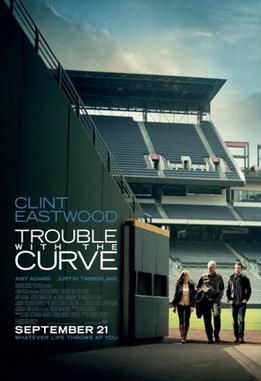
I Watched Trouble With The Curve (2012, Dir. by Robert Lorenz)


I love baseball  and all of its traditions.

I love the idea that a pitcher has a mental connection with his catcher.  I love the stories of the minor leaguers who get their chance in the majors and who stun the world by coming out of nowhere to hit a home run on their first at bat.  I love all the stories about which batters corked their bats and which pitchers could still manage to get away with throwing a spitball.  I love baseball because watching it is a relaxing way to spend an afternoon but at the same time, the game is unpredictable.  Just one hit can change the momentum of an entire game and, until that final out, the game could be won by anyone.  I especially have a place in my heart for the legendary baseball scouts, the grouchy old men who would drive out to the middle of nowhere to watch a game and search for the next great homerun hitter.

That’s one reason why I hated Moneyball.  I thought Brad Pitt, Philip Seymour Hoffman, Chris Pratt, and Jonah Hill all did a good job and I loved Brent Jennings’s performance as Ron Washington but I hated the idea that the scouts and their instincts weren’t necessary because everything could just be determined by sabermetrics.  The idea that an algorithm could tell you everything you needed to know about how to put a team together felt like a crime against everything that makes baseball special and it deeply offended me as a fan.  Moneyball may feature a baseball team but it’s a movie about business, not the game.

That’s why I’m thankful for Trouble With The Curve.

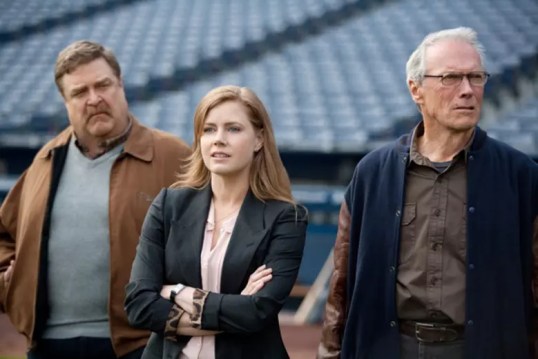
Clint Eastwood stars as Gus Lobel, one of those plain-spoken, no-BS scouts that I love so much.  All of the team owners might be into sabermetrics but Gus knows that the best way to scout a player is to actually hit the road and see him play.  For Gus, scouting is all about instincts and his own gut feeling.  Gus is everything that I love about baseball.  He’s knows the game, he knows the players, and he doesn’t need an algorithm to tell him whether or not someone should be on the field.

The movie is about Gus scouting a player who has trouble hitting the curve.  That’s something that Gus notices but the algorithm overlooks.  Accompanying Gus is his daughter, Mickey (Amy Adams), who is proud to have grown up surrounded by plain-spoken, unpretentious baseball scouts like her father and who doesn’t understand why Gus never took her on the road when she was younger.  Mickey falls for a younger scout named Johnny (Justin Timberlake), their love based on their shared knowledge of baseball.  I liked Mickey and Johnny as a couple and I appreciated the scenes where Mickey and Gus worked on their strained relationship but the best thing about this movie is that  Gus gets to prove that he knows more about baseball than all the young whipper-snappers who think they understand the game.

Trouble With The Curve is a tribute to everything that baseball is truly about.  It’s a movie that loves the game as much as I do.  Clint Eastwood and Amy Adams are a perfect father/daughter duo.  Who needs an algorithm when you’ve got Clint and Amy?

Here’s The Trailer For Five Nights At Freddy’s


Who here is excited about Five Nights At Freddy’s!?

I will admit that I am, even though I’ve never played the game on which the film is based.  The trailer looks like fun and isn’t it time for Matthew Lillard to make a comeback?

Here’s the trailer: