Retro Television Review: Miami Vice 4.14 “Baseballs of Death”


Welcome to Retro Television Reviews, a feature where we review some of our favorite and least favorite shows of the past!  On Mondays, I will be reviewing Miami Vice, which ran on NBC from 1984 to 1989.  The entire show can be purchased on Prime!

I saw the title of this week’s episode and I immediately called my sister….

Episode 4.14 “Baseballs of Death”

(Dir by Bill Duke, originally aired on February 19th, 1988)

“Watch this with me,” I told Erin, “it’s a baseball episode!”

“It is?” Erin asked.

“Look at the title!”

I was excited.  I always like to find things that I can watch with my sister and, as we all know, she loves baseball.  She certainly loves baseball more than she loves tv shows about bombs that blow up when you step on them.

Unfortunately, it turned out that this episode was not about baseball.  Instead, it featured a bunch of bombs that blow up when you step on them.  According to this episode, those bombs are known as baseballs.  Sorry, Erin!  Honest mistake….

Misleading title aside, this is a really good episode.  It features Tony Plana as a Chilean diplomat who is trying to buy a shipment of weapons, including the explosive baseballs.  Plana is a chilling villain.  In fact, he’s the first villain of season 4 to actually feel dangerous.  When we first meet him, he’s coldly executing the girlfriend of a tabloid reporter.  Plana’s lack of emotion as he kills and plots to kill feels like a throwback to the soulless sociopaths who made the first season’s rogue gallery.  A very young Oliver Platt shows up as an arms dealer and his nerdy confidence adds to some comedy to what is an otherwise fairly grim episode.  Just as with Plana’s cold villainy, Platt’s cheerful amorality felt like a throwback to the first season.

Indeed, this entire episode felt like a return to what the show used to be.  After a season that’s involved televangelists, bull semen, UFOs, and Crockett getting married to Sheena Easton, it was nice to see an episode that actually felt like an episode of Miami Vice.  Director Bill Dule gave this episode a stylish and, at times, almost surrealistic feel.  Crockett was back to be a cynic.  Castillo stared at the floor and spoke through clenched teeth while Switek actually got to put his phone-tapping skills to good use.  In the end, Tony Plana may have been the villain but, in old school Miami Vice style, the majority of the blame was still put on the U.S. government.  The episode even ended with an exciting boat chase.  All this episode needed was Phil Collins on the soundtrack and it could have passed for something from the first two seasons.

Season 4 has been uneven but this episode felt like classic Vice.  Erin thought the episode would have been better with actual baseballs and I agree with her that the title was misleading.  That said, this was still an enjoyable throwback to what the show used to be.
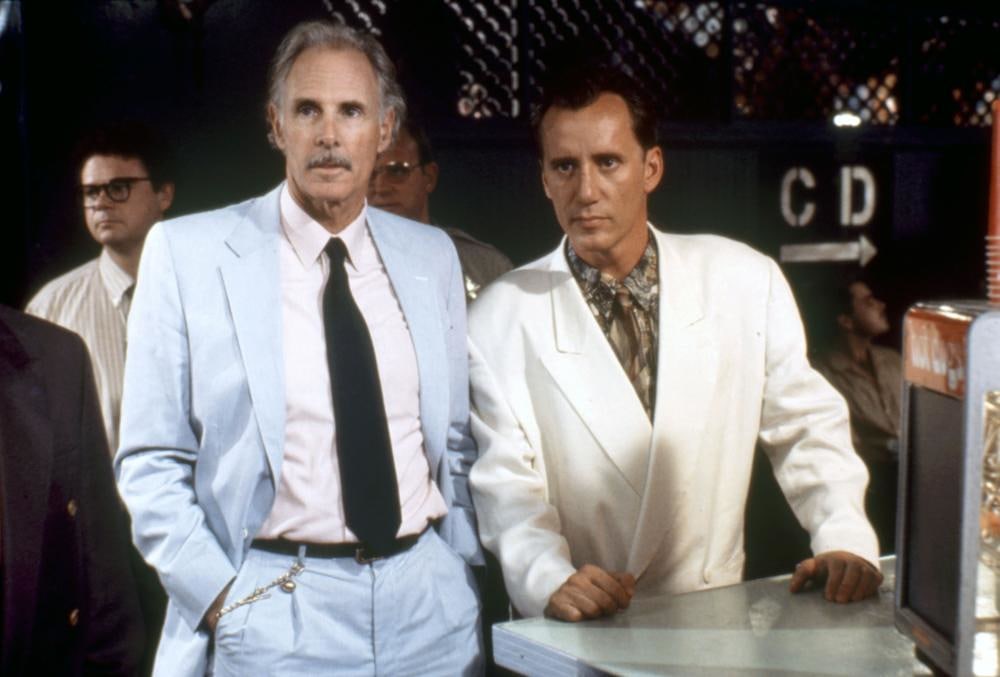
Brad reviews DIGGSTOWN (1992), starring James Woods, Lou Gossett Jr. and Bruce Dern!


Gabriel Caine (James Woods) is a fast-talking con man fresh out of prison who’s already set up his next big scam. Along with his partner Fitz (Oliver Platt), Caine is targeting Diggstown, a small, boxing-obsessed community ruled over by the corrupt John Gillon (Bruce Dern). Gillon controls the town because he rigged a fight that left local boxing legend Charles Macum Diggs (Wilhelm von Homburg) completely brain-damaged. The scam involves getting Gillon to take a $100,000 bet that 48 year old “Honey” Roy Palmer (Louis Gossett Jr.) can defeat any ten Diggstown fighters in one 24-hour period. Once the fights start, you can bet that both sides will have lots of surprises up their sleeves, but the question is who will be standing when the final bell rings?!! 

Since today is Bruce Dern’s 89th birthday, I decided to watch DIGGSTOWN, one of my favorite movies featuring the birthday boy. A box office flop when it was released in 1992, making less than $5 million at the box office, the reputation for the film seems to have gotten stronger over the years. The film has an excellent cast! James Woods exudes cockiness and intelligence as conman, Gabriel Caine. He somehow pulls off the feat of being both sleazy and very likable, which is a testament to Woods’ skills as an actor. Louis Gossett Jr. is great as “Honey” Roy Palmer. I remember when I first saw the trailer for DIGGSTOWN, I thought he was too old for the role. After watching it though, he’s able to make the boxing scenes work, especially when you consider some of the help he’s given as part of the con. With the huge personalities of Woods and Bruce Dern surrounding him, Gossett’s more grounded performance anchors the film. Bruce Dern is perfectly cast as the villainous scuzzbucket, Gillon. He’s the type of guy you really want to see get his comeuppance at the end. Now that I think about it, Gillon is such an A-hole, Caine can’t help but seem likable in comparison! Finally, I did want to give a shout out to Oliver Platt, who’s extremely funny in his role as Caine’s partner in con. It’s one of the first movies I remember seeing Platt in, and he’s great!

For DIGGSTOWN to really work though, the boxing scenes need to work and the con needs to be smart. Director Michael Ritchie (THE BAD NEWS BEARS) does a good job setting up both. The boxing sequences are well choreographed by Benny “The Jet” Urquidez, and you can’t help but root for the old guy as his opponents keep on coming. Of the 10 fights, some are funny, some are quick, and some are very intense depending on the situation. Ritchie is able to keep the stakes high enough during the boxing scenes to make sure we remain invested in the story. It’s a nice balancing act as the con plays out in the background of each fight. And what a con it is! I won’t spoil it for you, but it’s a stroke of genius that resulted in a massive amount of satisfaction for this audience member! 

Overall, DIGGSTOWN is one of those movies I’m sure to watch every few years. With its great cast, punchy sense of humor, and genius triple-twist of an ending, I can’t imagine anyone leaving disappointed. I highly recommend it! 

The trailer is included below:

Happy 89th Birthday, Bruce Dern! 


Is there anyone who plays a scuzzbucket better than Bruce Dern? He doesn’t always play a scuzzbucket, but that seems to be where his true talent lies. On his 89th birthday, I’m sharing this clip from a favorite movie of mine, DIGGSTOWN (1992), where he plays a scuzzbucket! Did I mention he’s great at it?!! 

Happy Birthday, Bruce!! 

Film Review: Executive Decision (dir by Stuart Baird)


In 1996’s Executive Decision, terrorists hijack an airplane.  Their leader, Nagi Hassan (David Suchet) demands that the U.S. government not only give him and his men safe passage but that they also release Hassan’s commander, Jaffa (Andreas Katsulas).

In Washington D.C., it is decide to use a stealth plane to transport Col. Austin Travis (Steven Seagal) and his men into the passenger plane.  Accompanying them will be Dr. David Grant (Kurt Russell), a consultant for U.S. Intelligence.  Dr. Grant is the world’s leading expert on Hassan, even though neither he nor anyone else is even sure what Hassan looks like.  Travis distrusts Grant because he’s a civilian and also because he holds Grant responsible for a botched raid on a Russian safehouse in Italy.  Dr. Grant is going to have to prove himself to Col. Travis because Travis doesn’t have any time for people who can’t get the job done.  And Travis is determined to get on that plane and save all those passengers.

In other words, Travis is a typical Steven Seagal character and, for the first fourth of this movie, Seagal gives a typical Steven Seagal performance.  He delivers his line in his trademark intimidating whisper, he glares at everyone else in the film, and essentially comes across as being a total douchebag who can still handle himself in a fight..  However, when it’s time to board the airplane through a docking tunnel, something goes wrong.  Everyone — even nervous engineer Dennis Cahill (Oliver Platt) is able to slip through the stealth plane’s docking tunnel and get into the hijacked airplane cargo hold without being detected.  But the two planes are hit by severe turbulence.  Suddenly, it becomes apparent the one man is going to have to sacrifice his life and close the hatch before the docking tunnel decompresses.

David, already in the cargo hold, looks down at Austin in the tunnel.  “We’re not going to make it!”

“You are!” Austin replies before slamming the hatch shut and getting sucked out of the tunnel.  (There’s your Oscar Cheers Moment of 1996!)  After all that build-up, Steven Seagal exits the film early and now, it’s up to Kurt Russell and what’s left of Austin Travis’s men to somehow stop the terrorists.  Not only do they have to stop Hassan but they also have to do it before the Air Force — which has no way of knowing whether or not any of their men were able to get on the plane before the tunnel fell apart — shoots down the airliner.

(If the airplane looks familiar, that’s because Lost used the same stock footage whenever it flashed back to the plane crash that started the show.)

It’s actually a rather brilliant twist.  When this film came out, Seagal was still a film star.  He played characters who always got the job done and who were basically infallible.  He wasn’t a very good actor but he did manage to perfect an intimidating stare and that stare carried him through a lot of movies.  No one would have expected Seagal to die within the first 30 minutes of one of his movies and when Col. Travis, who the film has gone out of its way to portray as being the consummate warrior, is suddenly killed, there really is a moment where you find yourself wondering, “What are they going to do now?”  In just a matter of minutes, Executive Decision goes from being a predictable Steven Seagal action film to a genuinely exciting and clever Kurt Russell thriller.  For once, Russell is not playing a man of action.  He’s an analyst, a thinker.  And, to the film’s credit, he uses his mind more than his brawn to battle Hassan’s terrorists.  With excellent support from Halle Berry (as a flight attendant who discreetly helps out David and the soldiers), Oliver Platt, B.D. Wong, Whip Hubley,  David Suchet, Joe Morton, and even John Leguizamo (as Travis’s second-in-command), Executive Decision reveals itself to be an exciting and ultimately rewarding thrill ride.

And to think, all it took was sacrificing Steven Seagal.

Horror Film Review: Shut In (dir by Farren Blackburn)


The 2016 film, Shut In, is yet another film in which Naomi Watts plays an intelligent woman who is forced to do stupid things because, otherwise, there would be no story.

This time, Watts is cast as Dr. Mary Portman, a psychologist who is taking care of her stepson, Stephen (Charlie Heaton).  Stephen was left in a vegatative state by a tragic accident that not only killed Mary’s husband but which also totaled a brand new SUV.  Mary and Stephen are in an isolated house so there’s no way anything could go wrong, right?

Mary has a lot on her mind.  Not only does she have to take care of Stephen but she’s also starting to date again.  Plus, one of her patients, a child named Tom (Jacob Tremblay), has disappeared.  She’s worried about Tom.  He disappeared near her house and no one has been able to find him.  Mary occasionally thinks that she sees Tom but her psychologist (played by poor Oliver Platt, who looks embarrassed to be there) says that Mary is just seeing what she wants to see.  And when two little hands come out of the darkness to keep Mary from entering a crawlspace, that’s just a coincidence, too.

Right.

Because it’s not like totally obvious, from the freaking start, that Tom is hiding out in her house.

Now, before anyone gets excited, this film does not feature Jacob Tremblay as an evil child who torments Naomi Watts.  (Jacob Tremblay is 15 years old now, just in case you needed an excuse to feel old.)  Instead, it turns out that Mary’s tormenter is….

What?

Spoiler alert?

Really, I have to give a spoiler alert before revealing the most obvious twist of all time?  How is that fair?

Okay, fine.  SPOILER ALERT!  Stop crying, you babies.

Mary is being menaced by Stephen, who it turns out woke up from his coma long ago and is now faking his vegetative state.  That seems like that would be a difficult thing to fake but, whatever.  Anyway, it turns out that Stephen has really enjoyed having Mary all to himself and he’s not really happy about the idea of having to share her with Tom.  So, Stephen’s idea is to trap Tom in the crawlspace and hold Mary hostage.  Or something.  I don’t know.  It doesn’t seem like Stephen’s really thought this out.  Normally, that would be understandable because it takes a lot of planning to trap someone in a crawlspace while pretending to be in a coma.  But Stephen spends all day lying around so he should have used that time to give a little more thought to his plan.

Eventually, Oliver Platt realizes that something strange is happening so he goes up the house to rescue her but — surprise! — Stephen kills him.  Seriously, Oliver — you deserved better than this movie.

For that matter so does Naomi Watts.  Watts is a good actress who can play both comedy and drama and yet, she keeps showing up in these movies where she basically spends the whole movie being held prisoner, either physically or mentally.  She always does a good job in them and, when I first heard that Woman In The Window was being turned into a movie, she was my choice for the role played by Amy Adams but, still, Watts definitely deserves better than a by-the-numbers film like Shut In.  Too often, the film requires Mary to act in a totally illogical, rather stupid manner.  Watts does her best with the character but the script lets her down.

Along with being totally predictable, Shut In moves at a glacial pace.  A lot of time is spent in an attempt to establish mood and atmosphere but again, the big twist is so obvious that no amount of mood and Kubrickian atmosphere is going to save it..  Shut In is a movie that very slowly takes us to exactly where we think it’s going to take us.  Everyone involved deserved better.

Here Are The Nominees of the 2020 Indiana Film Journalists Assosciation!


Bad Education

The Indiana Film Journalists Association (IJA) has announced their nominees for the best of 2020!  They’ll be announcing the winners on December 21st!

What I like about these nominations is that there’s a lot of them.  2020 may have been a difficult year for many but there were a lot of good films released and it does seem kind of silly (as it does every year) to limit things to some sort of arbitrary number.  Why only nominate 10 films when you could nominate 20 or 30?  Many of the nominees below will appear on my own personal best lists in January.

The other thing that I like about these nominees is that the include films like Bad Education and Mangrove.  There’s some debate as to whether or not these films should be considered Oscar eligible.  I feel that they should be so it’s nice to see that the folks in Indiana agree with me!

Here are the nominees:

BEST FILM
Da 5 Bloods
Another Round
The Assistant
Athlete A
Bad Education
Crip Camp: A Disability Revolution
Dick Johnson is Dead
Emma.
The Father
First Cow
I’m Thinking of Ending Things
Ma Rainey’s Black Bottom
Minari
The Nest
Never Rarely Sometimes Always
Nomadland
One Night in Miami
Palm Springs
The Personal History of David Copperfield
Possessor
Promising Young Woman
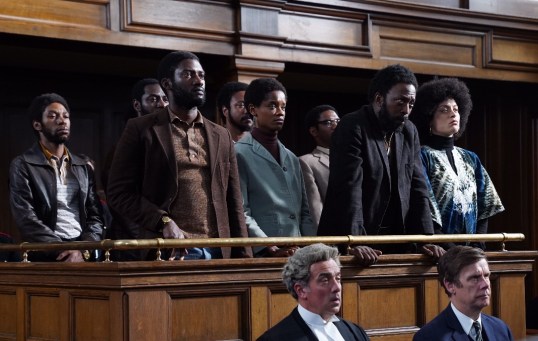
Small Axe: Mangrove
Song Without a Name
Soul
Sound of Metal
The Trial of the Chicago 7
The Twentieth Century
The Vast of Night

BEST ANIMATED FEATURE
Onward
Soul
Wolfwalkers

BEST FOREIGN LANGUAGE FILM
76 Days
Another Round
Bacurau
Beanpole
La Dosis
Song Without a Name

BEST DOCUMENTARY
76 Days
All In: The Fight for Democracy
Athlete A
Boys State
Crip Camp: A Disability Revolution
Desert One
Dick Johnson is Dead
Disclosure
John Lewis: Good Trouble
The Last Out
Miss Americana
MLK/FBI
Time
Totally Under Control
Welcome to Chechnya

BEST ORIGINAL SCREENPLAY
Lee Isaac Chung – Minari
Brandon Cronenberg – Possessor
Pete Docter, Mike Jones and Kemp Powers – Soul
Sean Durkin – The Nest
Emerald Fennell – Promising Young Woman
Kitty Green – The Assistant
Eliza Hittman – Never Rarely Sometimes Always
Tobias Lindholm and Thomas Vinterberg – Another Round
James Montague and Craig W. Sanger – The Vast of Night
Matthew Rankin – The Twentieth Century
Andy Siara – Palm Springs
Aaron Sorkin – The Trial of the Chicago 7
Alice Wu – The Half of It

BEST ADAPTED SCREENPLAY
Christopher Hampton and Florian Zeller – The Father
Armando Iannucci and Simon Blackwell – The Personal History of David Copperfield
Charlie Kaufman – I’m Thinking of Ending Things
Mike Makowsky – Bad Education
Kemp Powers – One Night in Miami
Jonathan Raymond and Kelly Reichardt – First Cow
Ruben Santiago-Hudson – Ma Rainey’s Black Bottom
Chloé Zhao – Nomadland

BEST DIRECTOR
Lee Isaac Chung – Minari
Brandon Cronenberg – Possessor
Pete Docter – Soul
Sean Durkin – The Nest
Emerald Fennell – Promising Young Woman
Kitty Green – The Assistant
Eliza Hittman – Never Rarely Sometimes Always
Kirsten Johnson – Dick Johnson is Dead
Charlie Kaufman – I’m Thinking of Ending Things
Regina King – One Night in Miami
Spike Lee – Da 5 Bloods
Melina Léon – Song Without a Name
Steve McQueen – Small Axe: Mangrove
Matthew Rankin – The Twentieth Century
Kelly Reichardt – First Cow
Aaron Sorkin – The Trial of the Chicago 7
George C. Wolfe – Ma Rainey’s Black Bottom
Alice Wu – The Half of It
Chloé Zhao – Nomadland

BEST ACTRESS
Haley Bennett – Swallow
Jessie Buckley – I’m Thinking of Ending Things
Carrie Coon – The Nest
Viola Davis – Ma Rainey’s Black Bottom
Sidney Flanigin – Never Rarely Sometimes Always
Julia Garner – The Assistant
Han Ye-ri – Minari
Leah Lewis – The Half of It
Rachel McAdams – Eurovision Song Contest: The Story of Fire Saga
Frances McDormand – Nomadland
Pamela Mendoza – Song Without a Name
Cristin Milioti – Palm Springs
Elisabeth Moss – The Invisible Man
Carey Mulligan – Promising Young Woman
Aubrey Plaza – Black Bear
Margot Robbie – BIrds of Prey (and the Fantabulous Emancipation of One Harley Quinn)
Anya Taylor-Joy – Emma.

BEST SUPPORTING ACTRESS
Jane Adams – She Dies Tomorrow
Maria Bakalova – Borat Subsequent Moviefilm
Toni Collette – I’m Thinking of Ending Things
Olivia Colman – The Father
Olivia Cooke – Sound of Metal
Allison Janney – Bad Education
Margo Martindale – Blow the Man Down
Talia Ryder – Never Rarely Sometimes Always
Youn Yuh-jung – Minari

BEST ACTOR
Christopher Abbott – Possessor
Ben Affleck – The Way Back
Riz Ahmed – Sound of Metal
Kingsley Ben-Adir – One Night in Miami
Paul Bettany – Uncle Frank
Chadwick Boseman – Ma Rainey’s Black Bottom
Eli Goree – One Night in Miami
Anthony Hopkins – The Father
Hugh Jackman – Bad Education
Jude Law – The Nest
Delroy Lindo – Da 5 Bloods
Mads Mikkelsen – Another Round
Jesse Plemons – I’m Thinking of Ending Things
Eddie Redmayne – The Trial of the Chicago 7
Steven Yeun – Minari

BEST SUPPORTING ACTOR
Chadwick Boseman, Da 5 Bloods
Bo Burnham – Promising Young Woman
Bill Burr – The King of Staten Island
Peter Capaldi – The Personal History of David Copperfield
Colman Domingo – Ma Rainey’s Black Bottom
Aldis Hodge – One Night in Miami
Caleb Landry Jones – The Outpost
Alan Kim – Minari
Frank Langella – The Trial of the Chicago 7
Orion Lee – First Cow
Ewan McGregor – BIrds of Prey (and the Fantabulous Emancipation of One Harley Quinn)
Bill Murray – On the Rocks
Leslie Odom, Jr. – One Night in Miami
Paul Raci – Sound of Metal
J.K. Simmons – Palm Springs
Dan Stevens – Eurovision Song Contest: The Story of Fire Saga
David Strathairn – Nomadland
David Thewlis – I’m Thinking of Ending Things

BEST VOCAL / MOTION CAPTURE PERFORMANCE
Sean Bean – Wolfwalkers
Tina Fey – Soul
Jamie Foxx – Soul
Oliver Platt – I’m Thinking of Ending Things
Donald Ray Pollock – The Devil All the Time
Ben Schwartz – Sonic the Hedgehog

BEST ENSEMBLE ACTING
Da 5 Bloods
Another Round
The Devil All the Time
I’m Thinking of Ending Things
The King of Staten Island
Ma Rainey’s Black Bottom
Minari
One Night in Miami
The Personal History of David Copperfield
She Dies Tomorrow
The Trial of the Chicago 7
Uncle Frank

BEST MUSICAL SCORE
Erick Alexander and Jared Bulmer – The Vast of Night
Terence Blanchard – One Night in Miami
Ludovico Einaudi – Nomadland
Ludwig Göransson – Tenet
Emile Mosseri – Minari
Richard Reed Parry – The Nest
Trent Reznor and Atticus Ross – Soul
William Tyler – First Cow
Jay Wadley – I’m Thinking of Ending Things
Isobel Waller-Bridge and David Schweitzer – Emma.
Benjamin Wallfisch – The Invisible Man
Jim Williams – Possessor

BREAKOUT OF THE YEAR
Maria Bakalova (actress) – Borat Subsequent Moviefilm
Max Barbakow (director) – Palm Springs
Emerald Fennell (writer / director) – Promising Young Woman
Sidney Flanigin (actress) – Never Rarely Sometimes Always
Alan Kim (actor) – Minari
Orion Lee (actor) – First Cow
Leah Lewis (actress) – The Half of It
Darius Marder (writer / director) – Sound of Metal
Andrew Patterson (director) – The Vast of Night
Tayarisha Poe (writer / director) – Selah and the Spades
Kemp Powers – co-writer / co-director for Soul and writer for One Night in Miami
Matthew Rankin (writer / director) – The Twentieth Century
Andy Siara (writer) – Palm Springs
Autumn de Wilde (director) – Emma.

HOOSIER AWARD
Athlete A
Eliza Hittman, writer / director of Never Rarely Sometimes Always and graduate of Indiana University

ORIGINAL VISION AWARD
After Midnight
Assassin 33 A.D.
Dick Johnson is Dead
I’m Thinking of Ending Things
Possessor
Promising Young Woman
She Dies Tomorrow
The Twentieth Century
The Vast of Night
Vivarium

Mangrove

Professor Marston and the Wonder Women- (Dir. Angela Robinson), Review By Case Wright


PMWW.jpg

What does Wonder Woman, S&M, and Polyamory have in common?  Pretty much everything.  Professor Marston and the Wonder Women (PMWW) was…dull.  You’d think with all the whips and ropes that the movie would pull some interest, but the scenes were shot hamfisted and clinical.  I guess that makes sense to a degree because the stars were playing Harvard nerds who liked kinky sex, but man what a snore!

The movie was a Biopic about Professor Marston the creator of the lie detector test and I will forever know this because it was repeated over and over and over and over again.  UGGHHHH.  Professor Marston was a Harvard Professor who was married to fellow professor Elizabeth Marston.  They are social psyche professors who are developing a lie detector test and are determined to bring Olive Byrne into their cult-like love life.  This would be considered very creepy today, not for the S&M stuff, but because of the professor/student boundary crossing.  They aren’t shy at all about their relationship, causing everyone to get expelled/fired.  Honestly, I don’t blame Harvard on this one.  He not only seduced a student, got her pregnant, and they all lived together.  It reminded me of those separatist compounds.

Since no one is working, money gets tight. Eventually, Professor Marston puts his kink into high gear with ropes etc and this gives him the idea of Wonder Woman.  He uses the two personalities of his two wives to give Wonder Woman a dual identity.  It’s not a terrible analogy, just a terrible movie.   Their unconventional marriage is discovered by their suburban neighbors and as a result; they split up for what seemed like 6 days.  I blame the director on that.

There’s nothing wrong with being into an unconventional marriage or bondage, but I just didn’t expect it to be so boring.  If anyone has an interest in S&M, just watch this film and you’ll be so bored of it, you’ll try something much more exciting like papier-mache!  The movie concludes with a bookended plot line of him being investigated for using Wonder Woman to normalize bondage and polyamory and he even admits as much.  So??  I don’t know if I’m supposed to care or not.  Basically, I might be done with sex for good because I like a little excitement in my life and this apparently is a dead end.

HMM2

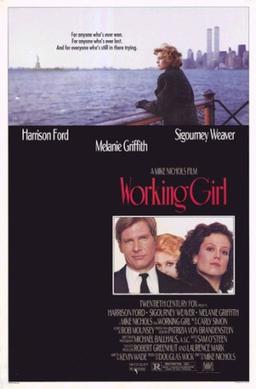
Lisa Reviews An Oscar Nominee: Working Girl (dir by Mike Nichols)


(With the Oscars scheduled to be awarded on March 4th, I have decided to review at least one Oscar-nominated film a day.  These films could be nominees or they could be winners.  They could be from this year’s Oscars or they could be a previous year’s nominee!  We’ll see how things play out.  Today, I take a look at the 1988 best picture nominee, Working Girl!)

Welcome to the 80s!

Yes, Working Girl is definitely a film of its time.  It’s a film that’s obsessed with big things: big dreams, big offices, big money, and big hair.  It’s a movie where the heroes talk about hostile takeovers and where everyone’s dream is to eventually to be an executive on Wall Street.  You know all of those people who claim that The Big Short is the greatest movie ever made?  I can guarantee that the majority of them would totally hate every character in Working Girl.  Working Girl is such a film of the past that it even features Alec Baldwin doing something other than bellowing at people.  In fact, Baldwin’s actually sexy in Working Girl.  It was strange to see him in this film and realize that he was the same actor who currently spends all of his time picking fights on twitter and defending James Toback.

Of course, Alec Baldwin has a relatively small role in Working Girl.  He plays Mick Dugan, the type of blue-collar guy who gives his girlfriend lingerie for her birthday (“I just wish you would get me something that I could wear outside,” she says as she tries it on) and who then proceeds to cheat on her while she’s off at work.  From the minute we first meet Tess McGill (Melanie Griffith), we know that she deserves better than Mick.

Tess is a professional administrative assistant.  She’s just turned 30 but she’s not ready to give up her dreams and settle for a life of fighting off coke-snorting executives and coming home to some guy like Mick.  (Speaking of early performances from infamous actors, one of the coke-snorting executives is played by Kevin Spacey.)  Tess has got a bachelor’s degree in Business.  As she puts it, she has a “mind for business and a bod for sin.”

She’s also got a new boss, an up-and-coming executive named Katharine Parker (Sigourney Weaver).  It turns out that Katherine is 29 years old.  (“I’ve never worked for someone younger than me before,” Tess says as Katherine gives her a condescending smile.)  Katharine encourages Tess to think of her as being a mentor.  If Tess has any ideas for investments, she should feel free to bring them to Katharine.  Of course, when Tess does so, Katharine claims that her bosses shot the idea down.  It’s only after Katharine breaks her leg in a skiing accident and is laid up in Europe that Tess discovers that Katharine has actually been stealing her ideas and not giving her any credit for them.

What is Tess to do?  Well, she does what any of us would do.  She passes herself off as an executive and presents her idea to Jack Trainer (Harrison Ford) herself.  Jack is impressed with the idea but he’s even more impressed with Tess.  Of course, complicating things is that Jack was once in a relationship with Katharine and Katharine still thinks that she’s going to eventually marry Jack.  And, of course, there’s the fact that Tess is lying about actually being an executive…

Working Girl is a frequently amusing film, elevated by performances of Melanie Griffith and, in the role of Tess’s best friend, Joan Cusack.  Add to that, Harrison Ford is remarkable non-grouchy as Jack Trainer and Sigourney Weaver appears to be having the time of her life playing a villain.  Even as I laughed at some of the lines, here was a part of me that wished that the film had a bit more bite.  At times, Working Girl tries too hard to have it both ways, both satirizing and celebrating Wall Street culture.  In the end, the film works best as a piece of wish-fulfillment.  It’s a film that says that not only can you win success and Harrison Ford but you can get your bitchy boss fired too.

Despite being a rather slight (if likable) film, Working Girl was nominated for Best Picture of 1988.  However, it lost to Rain Man.

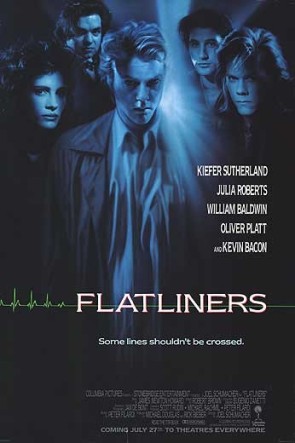
Horror Film Review: Flatliners (dir by Joel Schumacher)


“Our sins have come back in a physical form … and they’re pissed!”

That one line pretty much sums up the original 1990 version of Flatliners.  It’s a good line in that it’s one that you remember and it’s a line that you can use in almost any situation.

Have you gotten a phone call from an unknown caller?  “Our sins have come back in physical form … and they’re pissed!”

Have you and your boyfriend recently been driving across Texas and suddenly noticed that a car has been following you all the way from Lake Dallas to the border of Oklahoma.  “Our sins have come back in physical form … and they’re pissed!”

Have you ever had a stranger fail to hold a door open for you?  There’s only one possible reason for that rudeness.  “Our sins have come back in physical form .. and they’re pissed!”

And don’t even get me started on people who leave negative comments under my reviews.  We all know what’s going on with that!  “Our sins have come back in physical form … and they’re pissed!”

It’s a line that is both oddly memorable and also deeply stupid.  The same description can be applied to Flatliners.  It’s a film about a group of medical students (played by Julia Roberts, William Baldwin, Oliver Platt, and Kevin Bacon) who help Kiefer Sutherland investigate whether or not there’s actually an afterlife.  Sutherland believes that there is but he needs an atheist to be a part of the group, that’s where Kevin Bacon comes in.  And he needs a potential love interest and a Baldwin brother to be a member of the group as well, that’s why Julia Roberts and William Baldwin are there.  And, of course, someone has to provide comedic relief whenever things start to get too dark.  Say hello to Oliver Platt!  Anyway, Sutherland’s plan is to die for a minute or two and then have his fellow medical students bring him back to life.  It sounds like kind of a dumb idea but everyone agrees to it.

Anyway, it turns out that the afterlife looks a lot like an overproduced student film, full of weird camera angles, tinted lighting and disembodied voices.  When Sutherland dies, he sees a boy that he used to bully.  Julia Roberts sees her father, who committed suicide when she was younger.  Kevin Bacon sees a little girl that he used to bully.  (There are a lot of bullies in this movie.)  William Baldwin, a sex addict who is chronically unfaithful to his fiancée, sees hundreds of women, all saying, “But you said you loved me.”  Oliver Platt never actually gets to die and therefore, he sees nothing.  He does make a joke about how his vision would probably involve an angry babysitter.  I laughed.

What happens next?  “Our sins have come back in physical form … and they’re pissed!”

Flatliners has an intriguing premise but oh my God, is it ever a silly film.  It’s not really a spoiler to tell you that all of these returned sins want the characters to either atone for their mistakes or make peace with their past.  For Kevin Bacon, this means tracking down the girl that he used to bully and allowing her to bully him.  For Julia Roberts, it means getting an apology from her Dad and understanding that he was addicted to heroin.  For William Baldwin, it means making peace with never being as well-known as either Alec or Steven.  As for Kiefer … well, things are a bit more complicated for Kiefer Sutherland.

Flatliners starts out as a horror film but then it turns into a squishy movie about letting go of bitterness and learning how to forgive oneself.  It’s kind of annoying that the film couldn’t just stick to being scary because the first half of the film does have some effectively tense moments.  However, it all gets lost as the film’s plot sinks into sentimental, New Age-y quicksand.

Flatliners was directed by Joel Schumacher, who generally does well with shallow films that 1) don’t really mean anything and 2) don’t involve super heroes.  And really, the only film that I can think of that’s more shallow than the original Flatliners is the remake.  (But we’ll talk about that later…)  Schumacher’s direction here is not particularly bad — everyone looks good and the film is never boring.  It’s a very, very pretty film and one that doesn’t add up to much.

I would suggest watching it with your sins, especially after they take physical form.  Maybe they’ll be a little less pissed off afterward.

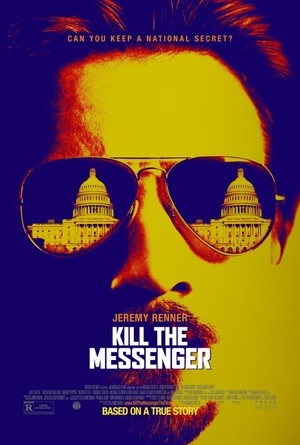
Insomina File No. 16: Kill The Messenger (dir by Michael Cuesta)


What’s an Insomnia File? You know how some times you just can’t get any sleep and, at about three in the morning, you’ll find yourself watching whatever you can find on cable? This feature is all about those insomnia-inspired discoveries!

Kill_the_Messenger_poster

Last night, if you were awake and unable to get any sleep at 1:45 in the morning, you could have turned over to Cinemax and watched the 2014 conspiracy thriller, Kill The Messenger.

Kill The Messenger opens with one of those title cards that assures us that the movie we’re about to see is based on a true story.  We are then introduced to Gary Webb (Jeremy Renner), a California-based reporter who we know is a rebel because he has a precisely trimmed goatee.  Gary is interviewing a suspected drug smuggler (Robert Patrick) at the smuggler’s luxurious mansion.  Suddenly, the DEA storms the house, shouting insults and roughly throwing everyone to the ground, including Gary.  It’s actually exciting and promising opening, one that perfectly establishes both Gary as a truth seeker and the U.S. government as an invading army that’s fighting a war that’s full of collateral damage.

Gary, of course, has nothing to do with smuggling drugs.  He was just in the wrong place at the wrong time.  If he was treated unfairly by the DEA, it’s just because the government is serious about winning the war on drugs!

Or is it?

Following up on a tip, Gary comes across evidence that, in order to raise money for pro-Amercian rebels in Central America, the CIA not only helped to smuggle drugs into the U.S. but also arranged for the drugs to largely be sold in poor, minority neighbors where, in theory, no one would notice or care.

When the story is finally published, Gary is briefly a celebrity.  Not surprisingly, the government denies his accusations and start tying to discredit him.  However, Gary also finds himself being targeted by his fellow journalists.  Angry over being outscooped by a relatively unknown reporter, The Los Angeles Times and The Washington Post both launch their own investigations.  Instead of investigating Gary’s allegations, they jealously and viciously investigate Gary himself.

Soon, both Gary’s career and his family are falling apart and Gary finds himself growing more and more paranoid…

Remember when everyone was expecting Kill The Messenger to be a really big deal?  It was due to come out towards the end of 2014, right in the middle of Oscar season.  Jeremy Renner was being talked up as a contender for best actor.  Then the film came out, it played in a handful of theaters for a week or two, and then it sunk into obscurity.  Some commentators even complained that Focus Features buried the release of Kill The Messenger and that the film was ignored because of its leftist politics…

Of course, it’s just as probable that Focus Features realized that The Theory of Everything was more likely to charm audiences than a movie that suggested the U.S. government was behind the drug epidemic.

Or it could have just been that, despite telling a potentially intriguing story, Kill The Messenger was an oddly bland film.  Other than one scene in which he admits to cheating on his wife, Gary Webb is portrayed as being such a saint that it actually causes the film to lose credibility.  (Don’t get me wrong.  For all I know, he was a saint.  But, from a cinematic point of view, sainthood is never compelling.)  This is one of those earnest films that gets so heavy-handed that, even if you agree with what the movie is saying, you still resent being manipulated.  (Of course, some of us have grown so cynical about the media that we automatically doubt the veracity any movie that opens with those dreaded words: “Based on a true story.”)  Watching Kill The Messenger, one gets the feeling that a documentary about Gary Webb would probably be more compelling (and convincing) than a fictionalized dramatization.

(Unfortunately, if you think it’s difficult to get an audience to watch a movie that suggested the U.S. government was behind the drug epidemic, just try to get them to watch a documentary about … well, anything.  I know most of our readers would probably happily watch a documentary but that’s because y’all are the best and a thousand times better than the average person.  Love you!)

Here’s what did work about Kill The Messenger: the performances.  Jeremy Renner, who also produced this film, gives an excellent performance as Gary, especially in the scenes where he realizes that both the government and the press are now conspiring about him.  Rosemarie DeWitt has the traditionally thankless role of being the supportive wife but she still does a good job.  And finally, Ray Liotta shows up for one scene and is absolutely chilling in that way that only Ray Liotta can be.

Kill The Messenger doesn’t quite work but, thanks to the cast, it is, at the very least, a watchable misfire.

Previous Insomnia Files:

  1. Story of Mankind
  2. Stag
  3. Love Is A Gun
  4. Nina Takes A Lover
  5. Black Ice
  6. Frogs For Snakes
  7. Fair Game
  8. From The Hip
  9. Born Killers
  10. Eye For An Eye
  11. Summer Catch
  12. Beyond the Law
  13. Spring Broke
  14. Promise
  15. George Wallace