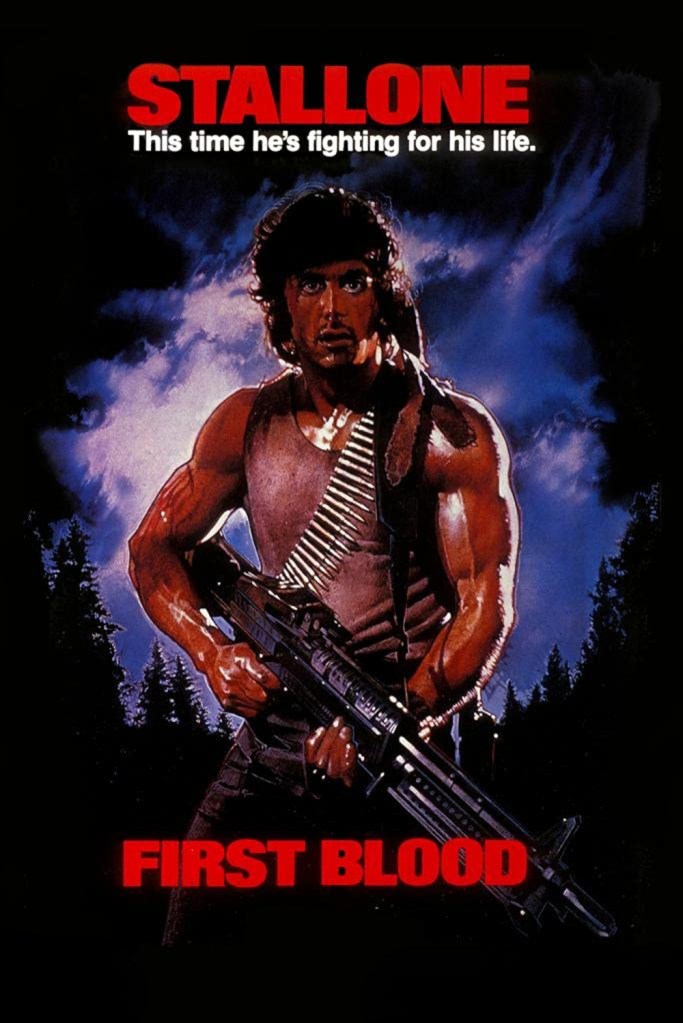
Review: First Blood (dir. by Ted Kotcheff)


“In the field we had a code of honor: you watch my back, I watch yours. Back here there’s nothing!” — John Rambo

You sit down expecting a brainless 80s action flick, and instead you get a meditation on trauma, bureaucracy, and the American wilderness. That’s First Blood for you. Directed by Ted Kotcheff and released in 1982, this is the movie that introduced the world to John Rambo, but don’t go in hoping for a body count or one-liners. What you actually get is a lean, gritty, and surprisingly sad drama about a guy who just wants to eat a hot meal and ends up accidentally declaring war on an entire small-town police force. And honestly? It holds up to this day. The film is adapted from David Morrell’s 1972 novel of the same name, but if you’ve read the book, you’ll notice some serious tonal differences right away. Morrell’s novel is bleak, brutal, and deeply nihilistic—a product of its era’s raw disillusionment with Vietnam. Kotcheff and Stallone sanded down some of those rougher edges, not to sell out, but to make Rambo a more sympathetic figure. The bones are the same, but the spirit is just a little warmer, and that choice changes everything.

Let’s break down the plot, because it’s deceptively simple. Sylvester Stallone plays John Rambo, a former Green Beret and Vietnam War hero who wanders into the town of Hope, Washington, looking for a fellow soldier he served with. He finds out the guy died of cancer from Agent Orange exposure. That’s the first gut punch. Rambo, already drifting and clearly struggling with PTSD, just wants to grab some food and keep moving. But the local sheriff, Will Teasle (a perfectly cast Brian Dennehy), takes one look at Rambo’s long hair, army jacket, and tired face and decides he’s a vagrant who needs to be run out of town. From a structural standpoint, Teasle isn’t a cartoon villain—he’s a classic dramatic antagonist: a rigid, small-town authoritarian who sees drifters as a threat to his orderly world. That realism makes the whole thing sting because you can almost see both sides. Almost.

When Teasle tries to escort Rambo to the city limits, Rambo walks back into town. That’s his big crime. He gets arrested, and at the station, the deputies start pushing him around. One of them, a veteran deputy named Galt (played with sneering menace by Jack Starrett), is the real problem here. Galt isn’t some young hothead. He’s an older, seasoned deputy who’s clearly been in his role for years, and he’s become entitled on the power of his badge. You can see it in the way he leans into the booking process, the casual cruelty in his eyes, the way he treats Rambo like a stray dog he’s finally allowed to kick. During the shaving scene, as deputies try to clean Rambo up after the arrest, Galt is the one who holds Rambo down, restraining him while another deputy wields the straight razor. He’s not waving the razor himself, but that almost makes it worse—he’s the enforcer, the guy who pins you in place while someone else does the dirty work. It’s a veteran cop who knows exactly how to exert control without getting his own hands bloody. That makes Galt far more chilling than some screaming bully. He represents the rot of unchecked authority, the way small-town power can curdle into casual sadism over time. And that whole humiliating process—being held down, having a straight razor brought to his face—triggers a full-blown flashback for Rambo. Then something clicks. Rambo explodes, beats down half the station, and escapes into the nearby mountains.

Now the hunt begins. Teasle calls in the State Patrol, the National Guard, and eventually his old mentor, Colonel Trautman (Richard Crenna), who knows exactly what kind of animal they’re chasing. Trautman warns Teasle that Rambo isn’t just a drifter; he’s a trained killer with a “purple heart, a silver star, and a congressional Medal of Honor.” And here’s the core irony: Rambo doesn’t want to hurt anyone. He just wants to be left alone. But the chase escalates, people die, and by the end, you’re not cheering for the hero to win—you’re hoping he gets some peace.

From an analysis perspective, where First Blood really earns its stripes is its restraint. The action sequences are tense but never escalate into cartoon violence. Rambo uses the forest like a ghost, setting traps, crawling through mud, and surviving on raw squirrel meat. He doesn’t mow down dozens of cops with a machine gun. In fact, the only person he kills is Galt, who falls to his death while hanging off a helicopter because Rambo throws a rock at the chopper. And Rambo immediately looks horrified. That’s the key. Even Galt, as entitled and cruel as he is, isn’t a villain Rambo wants to execute. The kill is accidental, a desperate act of survival. The movie takes its time showing how the very skills that made Rambo a hero in Vietnam—his survival instincts, his aggression, his ability to turn anything into a weapon—now make him a monster in peacetime America. The local cops are out of their depth, but aside from Galt, they’re mostly just scared men doing a job. Nobody else is pure evil. Just broken systems and broken people.

But let’s talk about that novel, because the comparison is crucial for understanding the film’s choices. David Morrell’s First Blood is a much darker animal. In the book, Rambo is more feral, less a wounded hero and more a walking death sentence. He kills multiple cops, not by accident or in self-defense, but with cold, tactical efficiency. The novel has no Colonel Trautman to serve as a moral anchor—Trautman is there, but he’s just as ruthless. And the ending? Devastating. In Morrell’s version, Rambo and Teasle essentially murder each other in a final, bloody standoff. Trautman finishes Rambo off with a shotgun blast to the gut. There’s no catharsis, no plea for understanding. Just bodies and regret. The tone is nihilistic to the core: the system destroyed these men long before the first page, and there was never any hope. Kotcheff’s film pulls back from that abyss. It keeps the violence lean and mostly off-screen. It gives Rambo that famous final monologue where he sobs about his friend dying next to him, about protesters spitting on him, about not being able to turn off the war inside his head. That scene isn’t in the book—not like that. The movie says, “This man is suffering, and maybe he can still be saved.” The novel says, “This man is already dead, and he’s taking everyone with him.” Both are valid responses to Vietnam, but the film’s slightly toned-down approach is why Rambo became an icon instead of a footnote.

From a performance standpoint, Stallone gives the work of his career here. Forget the grunting one-liners of later sequels. In First Blood, he barely speaks, and when he does, his voice cracks. Watch his eyes during that final monologue. After Trautman finally talks him down, Rambo dissolves into a sob. “Nothing is over!” he screams at Trautman. “You don’t just turn it off!” It’s raw, uncomfortable, and genuinely moving. You realize that the whole movie has been one long panic attack for this character. The Rambo that pops up in Rambo: First Blood Part II is a cartoon superhero. The Rambo here is a guy who needed a therapist and a hug about thirty years ago. That vulnerability is the film’s great deviation from the source material. Morrell’s Rambo never asks for understanding. Kotcheff’s does. And that small shift in tone—from nihilism to wounded humanity—is what elevates the film from a grim exploitation picture to a legitimate character study.

On the technical side, Ted Kotcheff’s direction is patient and atmospheric. He shoots the Pacific Northwest like a character—vast, wet, dark, and full of hiding places. The chase scenes are grounded, with long takes and practical stunts. When Rambo jumps off a cliff into a tree and lands with a thud that sounds real, it hurts. There’s no CGI safety net. Jerry Goldsmith’s score is mournful, with lonely woodwinds and a simple, haunting main theme that never pumps you up for a fight. It just makes you sad. The movie even has the guts to end on a downer—but not as brutal as the book’s. Rambo surrenders, crying in Trautman’s arms, and the final shot is him walking away in handcuffs into the rain. No freeze-frame high five. No sequel tease. Just rain. And yet, compared to the novel’s blood-soaked finale, that rain feels almost like mercy. That’s tonal balancing at its finest: the film acknowledges the darkness without drowning in it.

Of course, the cultural memory of First Blood has been completely buried by its sequels. Most people under thirty know Rambo as the muscle-bound machine gun guy from memes and video games. But the original is closer to a western like The Deer Hunter meets a paranoid 70s thriller like The French Connection. It’s a movie about a country that used its soldiers and then discarded them. Teasle represents the willful ignorance of middle America—“I don’t care about your war” is basically his attitude. And Rambo represents the bill coming due. Galt, as that entitled veteran deputy, represents the everyday cruelty of those who’ve held power too long and forgotten what it’s for—the guy who doesn’t need to swing the blade because he’s the one holding you still. That theme hits even harder today, decades later, when veterans are still fighting for basic support and stories of badge-heavy misconduct still dominate headlines. The novel took that theme to its logical, horrific conclusion: no survivors, no lessons learned. The film pulls back just enough to let you breathe, and that one small change turned First Blood from a bleak cult artifact into a mainstream classic. You can argue which version is more honest. But you can’t argue that Stallone and Kotcheff made the right call for the screen.

First Blood rules. It’s a rainy, sad, surprisingly smart action movie that will stick with you longer than any explosion-fest. It’s also a masterclass in adaptation, showing how a slight shift in tone—from nihilistic to wounded—can transform a story without betraying its core. Brian Dennehy is perfect as the stubborn but not evil sheriff. Jack Starrett makes Galt a quietly terrifying portrait of bureaucratic sadism, a veteran deputy who’s learned to love the leash and the privilege of pinning a man down while someone else does the cutting. Richard Crenna brings real weight as Trautman, a father figure who knows he helped raise a weapon he can no longer control. And Stallone acts his soul out. When he whispers “I could have killed them all” in the final scene, he’s not bragging. He’s confessing. That’s why First Blood is a classic. It’s not a recruitment poster. It’s a eulogy—just a little less hopeless than the novel that birthed it. Four stars, easily. Just don’t go in expecting explosions every five minutes. Go in expecting to feel bad, and you’ll leave feeling like you watched something real.

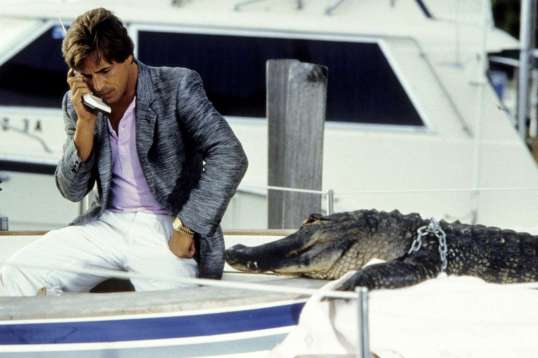
Retro Television Review: Miami Vice 5.21 “Too Much, Too Late”


Welcome to Retro Television Reviews, a feature where we review some of our favorite and least favorite shows of the past!  On Mondays, I will be reviewing Miami Vice, which ran on NBC from 1984 to 1989.  The entire show can be purchased on Prime!

This week, Miami Vice comes to a close.

Episode 5.21 “Too Much, Too Late”

(Dir by Richard Compton, originally aired on January 25th, 1990)

Tough NYPD detective Valerie Gordon (Pam Grier) returns to Miami after she learns that her friend Yvonne (CCH Pounder) has become addicted to crack cocaine and has been using her teenage daughter, Lynette (Malinda Williams), to pay her dealer, Swayne (John Toles-Bey).  Returning to Miami also allows Valerie to meet up with her former lover, Tubbs.  Tubbs is happy to see her again and even starts to think about marriage.  When Yvonne turns up dead, Valerie insists that Swayne killed her.  However, Crockett isn’t so sure.  Eventually, it turns out that Lynette murdered her own mother and that Valerie has been trying to frame Swayne for the crime.  Both Swayne and Lynette are arrested.  Valerie returns to New York where, she tells Tubbs, she is going to turn in her badge and retire from the police force.

Meanwhile, Switek tries to resist the temptation to start gambling again.  He even goes to meetings of Gamblers Anonymous but, when he’s stuck alone in his apartment and dealing with the guilt that he still feels over Zito’s death, Switek finds himself overwhelmed.  Soon, he is again placing bets.

This was not intended to be the final episode of Miami Vice.  Switek giving into his gambling addiction and Tubbs growing increasingly burned out were all plot points that were obviously designed to lead straight into Freefall.  Even Tubbs’s decision to return to New York makes a lot more sense once we know that Valerie is there.  However, NBC did not air this episode during the show’s original run because of its subject matter.  Yvonne selling her daughter for crack was considered to be too controversial.  As such, it didn’t air until the show went into syndication.  That’s a shame.  This was a strong episode, one that featured the melancholy atmosphere that made Miami Vice so memorable in the first place.

Well, that’s it for Miami Vice.  It’s a show that started out strong.  The first two seasons were consistently outstanding.  The third season was entertaining, even if it was obvious that the show was starting to run on autopilot.  The fourth season is where the show lost itself.  As for the fifth season, it had its flaws but it was a definite improvement over the fourth season.  While it was obvious that Don Johnson was eager to move on, the fifth season still provided enough good episodes that the show managed to redeem itself before it finally ended.

I’m going to miss Miami Vice.  Even at its worse, it had style to burn.

(I should mention that the whole reason I started reviewing Miami Vice back in 2023 was because I assumed Ron DeSantis would be elected President in 2024 and that people would naturally be curious about a show set in Florida.  Whoops.)

Next week, something new will premiere in this time slot.  What will it be?  I’ll let you know as soon as I know.  For now, let’s just take a moment to remember Crockett, Tubbs, and Elvis.

Retro Television Review: Miami Vice 5.19 “Miracle Man”


Welcome to Retro Television Reviews, a feature where we review some of our favorite and least favorite shows of the past!  On Mondays, I will be reviewing Miami Vice, which ran on NBC from 1984 to 1989.  The entire show can be purchased on Prime!

This week, the Miracle Man arrives in Miami!

Episode 5.19 “Miracle Man”

(Dir by Alan Myerson, originally aired on June 21st, 1989)

Who is the Miracle Man?

The Miracle Man (played by Jose Perez) is an overweight, middle-aged man who sometimes wears an eye mask and a t-shirt with a big M on it.  He rallies the good people of Miami to take back their neighborhoods from the drug dealers.  He thwarts drug deals, even the ones that are actually a part of an undercover operation.  He’s something of a pest.  The cops wants to stop him.  The criminals want to kill him.  A news reporter (Zach Grenier) wants to make him a star.

In real life, he’s actually Gregory Esteban and he is Izzy’s cousin.  A former junkie, he blames himself for the overdose death of his daughter and he’s now determined to launch a one-man war against crime.  He’s also bipolar and running low on his meds, which makes him unpredictable.  Switek and Tubbs eventually catch the Miracle Man but he still manages to escape from the safehouse.  His actions lead to the death of this week’s drug dealers but they also lead to him getting killed as well.  That’s not really a surprise.  Guest stars almost always died on Miami Vice.

This episode didn’t work for me.  The Miracle Man character was too over-the-top to be taken seriously and, as a result, his story and his death didn’t have the emotional impact that it should have.  As well, the villains were forgettable and generic.  Considering how surreal Miami Vice could be, one would be justified in expecting this episode to be much more stylized than it was.  Unfortunately, it was just dull.  The Miracle Man could not save it.

Don Johnson is only in this episode for the first two minutes.  Edward James Olmos isn’t in it at all.  (Crockett and Castillo are described as being absent to prepare for a trial.)  The whole episode feels like filler.  I can kind of understand why it wasn’t aired during season 5’s original run.

Sorry, Miracle Man.

Retro Television Review: Miami Vice 5.18 “World of Trouble”


Welcome to Retro Television Reviews, a feature where we review some of our favorite and least favorite shows of the past!  On Mondays, I will be reviewing Miami Vice, which ran on NBC from 1984 to 1989.  The entire show can be purchased on Prime!

This week, Al Lombard retuns.

Episode 5.18 “World of Trouble”

(Dir by Alan Myerson, originally aired on Jun 14th, 1989)

Way back in the first season, Dennis Farina appeared as an honorable gangster named Al Lombard who did not want his son, Sal, to follow him into the family business.  During his first appearance, Lombard considered ratting out his associates in return for an immunity deal but, in the end, he refused.  Al Lombard was old school.  He was not a rat.  That didn’t make much difference to his associates.  The episode ended with an ambiguous freeze frame and gunshot that suggested they had executed him.

In this episode, it is revealed that Al Lombard faked his death and has spent the last few years in Europe.  When a judge dismisses the years-old indictment against him, Al returns to Miami so he can visit his son, Sal (Timothy Patrick Quill).  Despite the fact that Lombard went back on his promise to testify against his associates, Crockett and Tubbs are still happy to see him.  Al is a likable guy!

Unfortunately, the whole thing is a set-up.  Rival gangster Federico Librizzi (Ned Eisenberg) arranged for the indictment to be dismissed in order to lure Al back to Miami.  Once in Miami, Al is upset to discover that Sal is now involved in the family business and that a gang war is about to break out over a new superweapon that Sal stole from the DEA.  When Librizzi’s hitmen try to take out Al, they hit Sal instead.

Sal is dead and Al wants revenge.  Al is smart enough to show up at a meeting between Librizzi and Burnett and Cooper (*sigh* the undercover thing again).  Librizzi shoots Al, forcing Crockett and Tubbs to shoot Librizzi.

This was one of the fifth season episodes that did not originally air during the show’s network run.  It was included in syndication as a “lost episode.”  Dennis Farina gives a charismatic performance as Al Lombard but that’s about all this episode really has going for it.  The other performances are nowhere close to being as good as Farina’s and the whole plot to bring Lombard back to Miami is ludicrously convoluted.  Seriously, there aren’t mob hitmen in Europe?

Retro Television Review: Miami Vice 5.17 “Freefall”


Welcome to Retro Television Reviews, a feature where we review some of our favorite and least favorite shows of the past!  On Mondays, I will be reviewing Miami Vice, which ran on NBC from 1984 to 1989.  The entire show can be purchased on Prime!

This week, Crockett and Tubbs are burned out.

Episode 17 “Freefall”

(Dir by Russ Mayberry, originally aired on May 12th, 1989)

As this episode begins, we find Crockett and Tubbs at their most cynical.  After five years as partners, they’ve seen a lot of bad guys go down.  They’ve seen a lot of innocent people die.  Larry Zito was killed by drug dealers.  Switek has developed a gambling addiction.  Gina has shot numerous men in cold blood.  Trudy was kidnapped by aliens.  Castillo has never once smiled.  None of it seems to make any difference.

When the government approaches them and orders Crockett and Tubbs to go into a war-torn island country and smuggle out dictator General Manuel Borbon (Ian McShane), Crockett is not happy about the assignment.  Tubbs, however, believes that the government is telling the truth about Borbon having information that could take down the world’s biggest drug cartel.  The government, for their part, think that Crockett and Tubbs have the undercover experience to pull off the operation.  Has the government not noticed that Crockett and Tubbs have had their covers blown in nearly every episode?

Of course, it turns out that the government is lying.  They just wanted Borbon out of the country so he wouldn’t reveal what he knows about American intelligence’s activities in Central America.  Crockett and Tubbs manage to get Borbon to Miami but they then find themselves under constant attack from the drug gangs that want Borbon dead.  Borbon proves to be untrustworthy.  Because of his gambling addiction, Castillo suspects that Switek may have sold out his partners.  Switek responds by tracking down three hitmen and gunning them down.  Did Switek sell out Crockett and Tubbs?  The answer isn’t clear but it does seem like his time as a detective is coming to an end.

Finally, Tubbs and Crocket do what they have to do.  They go on a “suicide” mission that involves them firing their weapons at Borbon’s sea plane until it explodes.  Borbon is killed and so are several of his American associates.  When the CIA man in charge of the operation threatens to have their badges, Crockett and Tubbs toss their badges on the ground.  Castillo offers to back them up if they chose to stay on the force.  Tubbs says thanks but no thanks.  Tubbs is going back to New York.  Crockett is heading further south, presumably to live in the Florida everglades.

And so, Miami Vice ends.

Except it doesn’t!  There were four so-called “lost episodes” that aired in syndication.  We’ll take a look at them over the next four weeks.

As for Freefall, it’s not a terrible conclusion to the story of Crockett and Tubbs.  It stays true to the cynicism that ran though the entire series.  Crockett and Tubbs finally admit that the War on Drugs is a sham and they quit.  It’s a shame that Gina and Trudy didn’t get to do much in the finale.  I wasn’t happy with the idea of Switek being a traitor but it actually did work for his character.  Switek had been spiraling ever since Zito was killed.  This episode has a lot of surprisingly violent action, the show’s trademark political subtext, and Johnson and Thomas bringing their characters to life one last time.

Apparently, this episode was originally envisioned as ending with both Crockett and Tubbs dying.  That actually would have been a totally appropriate ending as both characters have often seemed as if they had a death wish.  However, the network turned down that idea because they were hoping to do a spin-off series.  Crockett and Tubbs were spared by the higher-ups.  The series ends — or it would end if not for the four extra episodes — with Crockett and Tubbs speeding through the streets of Miami and it’s had not to feel that’s the way it should be.

Retro Television Review: Miami Vice 5.16 “Victim of Circumstances”


Welcome to Retro Television Reviews, a feature where we review some of our favorite and least favorite shows of the past!  On Mondays, I will be reviewing Miami Vice, which ran on NBC from 1984 to 1989.  The entire show can be purchased on Prime!

This week, Crockett goes undercover as a Neo-Nazi.

Episode 5.16 “Victim of Circumstances”

(Dir by Colin Bucksey, originally aired on May 5th, 1989)

When a Miami coffeeshop is the scene of a violent shooting that leaves several dealers and the coffeeshop’s owner dead, Crockett and Tubbs assume that it’s just another part of an ongoing drug war.  However, when it’s discovered that the owner of the coffeeshop was a Holocaust survivor who was scheduled to testify against a former guard named Hans Kozak (William Hickey), Crockett comes to suspect that the hit was ordered by a Neo-Nazi group.  Crockett and Switek go undercover to infiltrate the group but it turns out that the killer was actually Helen Jackson (Karen Black), a reporter who is the daughter of Hans Kozak and who is trying to kill everyone who can testify against her father.  Crockett and Tubbs manage to capture Helen but Helen is subsequently gunned down by Angelo Alvarez (John Leguizamo), the brother of one the dealers who was killed at the coffeeshop.

This was an interesting episode.  On the one hand, it was based in reality.  In the days following World War II, several concentration camp commandants were put on trial and executed for war crimes but the Allies were so busy going after the people in charge that there were several guards, doctors, and other personnel who were able to escape justice and who immigrated elsewhere.  Quite a few went to South America.  Several turned up in the Middle East.  And there were many who ended up in America.  It wasn’t until decades after the war that people started to get serious about tracking down and putting on trial the camp personnel who were often as brutal as the people giving the orders.  By the time many of them started going on trial, they were elderly and often frail, like Hans Kozak.  And, just as in this episode, there were many Neo-Nazi groups who protested the trials and sometimes tried to help the accused escape justice.

On the other hand, this episode played out in such a surreal manner that it often felt rather dream-like, with Hans Kozak being haunted by nightmares and the Neo-Nazis themselves meeting in ceremonies that felt as if they could have been lifted from one of Fritz Lang’s Dr. Mabuse films.  Karen Black plays her role with such wild-eyed intensity that the revelation that she was the killer isn’t really that much of a surprise.  As for William Hickey, he doesn’t so much chew the scenery as he treats it like a buffet.  This was one of those episodes that felt like it could spin off into space at any given moment.  If James Brown had returned as the alien who abducted Trudy, I would not have been surprised.

This episode was definitely watchable and Stefan Gierasch gave a strong performance as the Nazi hunter who was determined to track down Hans Kozak.  There was nothing subtle about it but it’s still one of the more memorable episodes of the show’s final season.

Speaking of final season, next week will feature Crockett and Tubbs in their final adventure.  And then, we’ll look at the four “lost” episodes, which aired in syndication after the show’s network run ended.  And then, we’ll done with Miami …. for now.

(No one is every truly done with Miami.)

Retro Television Review: Miami Vice 5.15 “Over The Line”


Welcome to Retro Television Reviews, a feature where we review some of our favorite and least favorite shows of the past!  On Mondays, I will be reviewing Miami Vice, which ran on NBC from 1984 to 1989.  The entire show can be purchased on Prime!

This week, the Vice Squad learns that a man has to know his limitations.

Episode 5.15 “Over The Line”

(Dir by Russ Mayberry, originally aired on April 28th, 1989)

“All of our heroes are dead.”

That line was delivered in 1973’s Magnum Force, by a motorcycle cop-turned-vigilante who justified his murderous actions by claiming that he was a part of the first generation without heroes.  That line could have just as easily been delivered by the cops in this episode of Miami Vice.

Crockett and Tubbs are recruited by Walter Stevens (Thomas Arana), a cop-turned-vigilante who explains to them that, once they join his organization, they can never leave.  Of course, Crockett and Tubbs are only pretending to be vigilantes so that they can take down both the drug dealers and Walter’s organization.  They do this despite the fact that, in many ways, Crockett agrees with Walter.  But when Walter’s methods lead to three good cops getting killed, Crockett realizes that Walter has to be stopped.  Even worse, he discovers that Walter is funding his operation by selling the cocaine that he confiscates from the dealers.

When Crockett pulls his gun on Walter and tells him to surrender, Walter appears to be doing so.  Walter warns Crockett that there’s a lot more to the organization than Crockett realizes.  Suddenly, a police captain named Robert Highsmith (Robert Fields) pops up and shoots Walter.  Crockett says that Walter was surrendering.  Highsmith insists that he saved Crockett’s life.

With the drug dealers and the bad cops taken down, Highsmith takes all the credit.  Highsmith is not only a police captain but he’s also a candidate for Dade County Supervisor.  At a televised “meet-the-candidate” forum, Highsmith brags about how he personally is helping to clean up the city.  Crockett watches and says, “Whatever it takes, right?”

Agck!

Seriously, this episode is cynical even by the standards of Miami Vice.  Legitimate cops like Crockett and Tubbs can’t do their job because of budget cuts.  The vigilante cops are taking down the drug dealers but they’re also stealing and selling cocaine so they’re not actually doing anything to stop the flow of drugs into Miami.   Walter becomes the first Miami Vice bad guy to both show remorse and to willingly surrender but he’s still gunned down by Captain Highsmith who, at the end of the episode, appears poised to be elected to political office.  Miami Vice was often critical of the War on Drugs.  This episode showed why the war couldn’t be won, despite the best efforts of soldiers like Crockett, Tubbs, and Castillo.  Men like Highsmith had to appear to be winning the war so that they could accumulate more power but if they actually did win the war, they would no longer be given carte blanche to do whatever they wanted.

This was a dark but effective episode.  Crockett’s hair has never been longer and he’s never appeared more defeated.

Retro Television Review: Miami Vice 5.14 “The Lost Madonna”


Welcome to Retro Television Reviews, a feature where we review some of our favorite and least favorite shows of the past!  On Mondays, I will be reviewing Miami Vice, which ran on NBC from 1984 to 1989.  The entire show can be purchased on Prime!

This week, Crockett and Tubbs — or is it Burnett and Cooper? — enter the art world.

Episode 5.14 “The Lost Madonna”

(Dir by Chip Chalmers, originally aired on March 17th, 1989)

When Crockett and Tubbs take down what they think is a drug deal, they’re shocked to discover that Stanley Costa (Stephen G. Anthony) was actually smuggling two paintings!  They could always ask Stanley what’s going on but — whoops!  They killed him during the show’s precredit sequence.

Detective Whitehead (Michael Chiklis) comes down from New York City and explains that the two paintings are the side pieces for a triptych called The Last Madonna.  It was recently stolen from a Paris museum and Whitehead is convinced that theft was masterminded by Joey Scianti (Peter Dobson).

It’s time for Tubbs and Crockett to — *sigh* — go undercover.  Why they’re still always going undercover, I have never really understood.  Every time they go undercover, their cover gets blown.  Do the members of the Miami underworld just not communicate with each other?  Shouldn’t everyone know, by this point, that Tubbs and Crockett are cops?  In this case, Tubbs goes undercover as someone who appreciates art.  Crockett goes undercover as the crude Sonny Burnett….

Yes, Crockett is still using the Burnett cover.  He’s doing this despite the fact that he just recently had a mental breakdown that led to him not only thinking that he actually was Burnett but also becoming Miami’s biggest drug lord.  Even if the Scianti family was dumb enough to not know that Crockett was a cop, surely they would have heard enough about drug lord Sonny Burnett to wonder why he would be hanging out with a connoisseur of fine art.

(Indeed, it’s hard not to notice that everyone has apparently moved on rather quickly from Sonny’s mental breakdown and his time as a drug lord.  For that matter, Sonny certainly doesn’t seem to ever give much thought to his dead second wife.  Remember her?  The world-famous singer who was literally gunned down in front of him?  She appears to have been forgotten.)

This episode was dull, largely because the Scianti family was never really a credible threat.  They came across as being a bunch of buffoons and, as such, it was hard to really get that concerned about whether or not they would figure out that Crockett and Tubbs were actually cops.  This is another episode that features a twist that you’ll see coming from miles away.  From the minute Michael Chiklis first showed up, I knew that he was eventually going to try to steal the The Lost Madonna for himself.

Considering that there was a lot of humor in this episode (Crockett, not surprisingly, struggled with understanding modern art), there’s also some surprisingly graphic violence.  Crockett and Tubbs gun down Stanley Costa and blood splatters all over the wall.  Whitehead shoots Joey Scianti and the shocked Joey looks down at his wound and says that it’s “real blood.”  Tonally, this episode is all over the place.

Everyone seemed kind of bored with this episode.  This was definitely a final season entry.

Retro Television Review: Miami Vice 5.13 “The Cell Within”


Welcome to Retro Television Reviews, a feature where we review some of our favorite and least favorite shows of the past!  On Mondays, I will be reviewing Miami Vice, which ran on NBC from 1984 to 1989.  The entire show can be purchased on Prime!

This week, Tubbs gets kidnapped and the entire episode is oddly dull.  Presumably because it’s the final season and no one was paying attention, the show took a risk and it did not pay off.

Episode 5.13 “The Cell Within”

(Dir by Michael B. Hoggan, originally aired on March 10th, 1989)

Former criminal Jake Manning (John P. Ryan) has apparently reformed himself.  As getting busted by Tubbs, Manning spent years in a tiny cell where he read Shakespeare and Dostoevsky.  Sponsored by renegade film director Robert Phelps (L.M. Kit Carson), Jake is now a free man and a published author.  Tubbs is convinced that Jake has changed his ways and when Jake invites him to a dinner party, Tubbs accepts.

(Crockett is on vacation, spending time with his son.  During his brief appearance on the episode, Crockett jokes about what a great book he and Tubbs could write if they were ever arrested.  Uhmm …. you were arrested, Crockett.  Remember when you were a drug lord?  The show appears to have forgotten but I haven’t.)

Anyway, it turns out that Jake has built a prison under his house where he keeps undesirables locked up and every few days, he electrocutes them.  He kidnaps Tubbs so that Tubbs can see and hear about Jake’s view of how justice should be meted out.  Jake likes to talk and talk and talk and talk.

Ugh, this episode.

I’m honestly surprised that I got through this episode because it was just so mind-numbingly dull.  The show attempted to do something different with its format and that’s fine.  But Jake was so long-winded and his cartoonish prisoners were such thinly drawn stereotypes that it didn’t take me long to lose interest.  I’ve never liked episodes of cop shows that center around hostage situations or kidnappings.  It’s hard to build much narrative momentum when no one can really move around.  It gets boring to watch and that was certainly the case here.  That John P. Ryan spent most of the episode wearing a flowing robe did not help matters.  It made him look like a Saruman cosplayer at a Lord of the Rings convention.  I probably would have laughed if it all hadn’t been so dull.

As always, it’s interesting to see Tubbs at the center of a story but even the normally smooth Philip Michael Thomas didn’t seem to know what to make of all these nonsense.  As I watched Tubbs rather easily fall victim to Jake’s trap, I wondered why Tubbs has suddenly become such a stupid character.  I mean, seriously, anyone should have been able to see through Manning’s invitation.  For Tubbs, this episode was the equivalent of that time Trudy got kidnapped by the alien who looked like James Brown.

All in all, this was not a good episode.  It’s the final season so it makes sense that you’re going to get a few clunkers.  Hopefully, next week will be better.

Retro Television Review: Miami Vice 5.11 “Miami Squeeze”


Welcome to Retro Television Reviews, a feature where we review some of our favorite and least favorite shows of the past!  On Mondays, I will be reviewing Miami Vice, which ran on NBC from 1984 to 1989.  The entire show can be purchased on Prime!

This week, the British are coming!

Episode 5.11 “Miami Squeeze”

(Dir by Michelle Manning, originally aired on February 17th, 1989)

There’s a new drug lord in Miami.  He’s a British dandy named Sebastian Ross (Robert Joy) and it’s impossible to take him seriously as a legitimate threat.   The show continually tells us how dangerous Sebastian is.  When the son (Daniel Villarreal) of anti-drug Congresswoman Madeleine Woods (Rita Moreno) attempts to double-cross Sebastian, Sebastian blackmails the Congresswoman and also tries to make Castillo look like a dirty cop.  Castillo ends up getting shot, all as a result of Sebastian’s schemes.

And yet, despite all of that, it’s impossible to take Sebastian seriously.  He’s just a ridiculous character, a drug dealer who dresses like an Edwardian gentleman and who carries a can and who speaks with a remarkably bad British accent.  (Robert Joy is himself Canadian.  I should mention that Joy is also a very good character actor.  He’s just miscast here.)  As a character, Sebastian threw off the entire episode.  When you include Rita Moreno acting up a storm, this episode almost felt like a self-parody.

Joey Hardin (Justin Lazard),  the undercover cop from Line of Fire, returned in this episode.  Sonny recruited him to go undercover in order to infiltrate Sebastian’s organization.  Considering that Joey was a returning character and that there was a lengthy scene of Sonny asking if Joey felt confident enough to put his life on the line, it was kind of surprising that Joey didn’t really do much in this episode.  One got the feeling that perhaps this was meant to be a backdoor pilot for a show featuring Joey as an undercover cop who could pass for a teenager.  There’s nothing wrong with that, of course.  Who wouldn’t want to keep a franchise going?  But Joey ultimately felt like a red herring and a bit of a distraction.

This episode was a misfire.