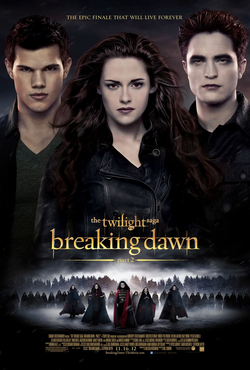
Earlier today, Lis and I finished up the Twilight Saga with Breaking Dawn Part 2.
Bella (Kristen Stewart) is now a vampire and a mother to Renesmee (Mackenzie Foy), who is developing quicker than a normal child because she is half-vampire. Before Edward (Robert Pattinson) even lets Bella see her daughter, he takes her hunting, and he has to stop her from attacking a mountain climber who has scratched his arm on a rock. While Bella adjusts to being a vampire, Jacob (Taylor Lautner) adjusts to being Renesmee’s soul mate, and the Volturi prepare to make their move against the Cullens.
I’m going to get in trouble with my sister for saying this, but I was a little disappointed with the second Breaking Dawn movie. It bothered me that the entire movie was about the Cullens bringing together allies for their inevitable battle with Aro (Michael Sheen) and the Volturi, but then, when the big battle finally happens, it turns out that it was just one of Alice’s visions, and they end up deciding not to fight. After two hours of everyone talking about this huge battle and how everyone had to be prepared to fight for the lives, it was anticlimactic not to have a real one. It seemed like the whole movie could have just been 30 minutes long without really losing anything important. I really didn’t see the point of splitting the book into two movies because hardly anything happened during the second one.
Breaking Dawn Part 2 might not work as a standalone movie, but it does work as an end to the saga. After four movies and the longest senior year on record, Bella and Edward are finally together and they’re happy. And Jacob is happy too. At the end of the movie, when they showed everyone who had appeared over the course of the entire saga, I was really touched.
And that’s it for the story of Bella, Edward, and Jacob.
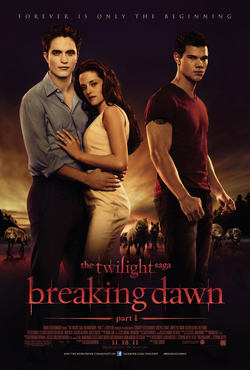
Earlier today, Lis and I watched the second-to-last Twilight film, The Twilight Saga: Breaking Dawn: Part One.
The movie starts with Bella (Kristen Stewart) finally marrying Edward (Robert Pattinson). They get married in the woods, and almost everyone from the entire saga is there, including Bella’s mother. Bella’s father (Billy Burke) and Jacob (Taylor Lautner) don’t approve of her marrying Edward, and Jessica (Anna Kendrick) thinks Bella is pregnant—why else would she be getting married at 18? I probably would have thought the same thing if I were at the wedding, but actually, Bella and Edward are virgins when they marry. Even though Jacob warns that a human could die having sex with a vampire because of how strong vampires are, Bella and Edward still consummate their marriage without Edward turning Bella into a vampire. Edward does not want to turn Bella for some reason. Lis and I agreed that Edward probably wants Bella to get old and die so that he can find someone else. There’s also a weird scene when Edward confesses to Bella that he briefly rebelled against his father and drank the blood of men in the 1920s. Bella says that’s fine because all the men were bad. Team Jacob is looking better and better.
Bella ends up getting pregnant with a hybrid baby. The pregnancy progresses at a faster rate than Bella’s body is prepared for. Edward tries to talk Bella into having an abortion, but Bella refuses. Instead, they return to Forks and stay with Edward’s family. Bella starts to drink blood so that the fetus will stop feasting on her. Jacob, meanwhile, tries to keep the wolf pack from killing Bella to prevent her half-vampire baby from harming anyone.
I have to respect that Twilight built an entire movie around one very difficult pregnancy. That’s probably why the acting in Breaking Dawn is considerably better than in the previous Twilight movies—there’s more at stake than just Bella missing her boyfriend or trying to decide between Edward and Jacob. Though I didn’t realize it until I rewatched the movie, Taylor Lautner really poured his heart into Jacob in this film. I also remember that, when I first saw this movie, I wasn’t comfortable with the “imprinting” scene, and watching it again, I still wasn’t comfortable with it. If you’ve seen the movie or read the books, you know what I mean.
After all this time, I don’t know if it’s really a spoiler to say that this movie ends with Bella opening her eyes and revealing that she is now a vampire. She got a husband, a baby, and immortality! Way to go, Bella!
Tomorrow, we’ll be finishing things up with Breaking Dawn: Part Two.
Today, Lis and I continued to rewatch the Twilight movies on Netflix.
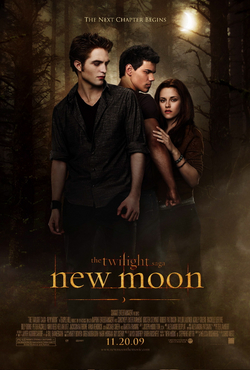
New Moon was the second part of the Twilight Saga. Because people in town are starting to notice that he hasn’t aged in ten years, Carlisle (Peter Facinelli) decides that the Cullens need to move to a new location. Edward explains to Bella that the worst thing a vampire can do is allow humans to discover that they exist. Edward also says that Bella can’t come with the Cullens because it would raise suspicion and it would also put Bella in danger, since even the members of his family are tempted to drink her blood. Bella says, “Change me!” and Edward says not unless they’re married.
The Cullens leave and Bella has a breakdown, and even her father wants to send her back to Florida to live with her mother. Finally, Bella starts hanging out with Jacob (Taylor Lautner), a member of the Quileute Tribe who is also revealed to be a werewolf. Werewolves and vampires hate each other, but the Forks werewolves had arranged a truce with the Cullens where they wouldn’t attack them as long as the Cullens didn’t bite any humans. If Edward had changed Bella, the truce would have been canceled and the werewolves would have had to attack Bella.
When Alice (Ashley Greene) misinterprets a vision of the future and thinks that Bella is dead, Edward leaves wherever it is he’s living and goes to Italy to ask the ruling vampire council to destroy him. Even though Jacob’s in love with her, Bella goes to Italy to try to save Edward’s life.
I remember really liking New Moon when I saw it because I was in a long-distance relationship and I could relate to what Bella was going through. When we rewatched it, I had forgotten how long the movie was and how little actually happens until Bella goes to Italy, which doesn’t even happen until the movie’s nearly over. The other thing I forgot about this one was that they really overdid the vampire makeup on Robert Pattinson at the start of the movie. He was so pale and wearing so much lipstick that everyone should have been able to figure out that he was a vampire just by looking at him.
When this movie came out, everyone was either Team Jacob or Team Edward. I was Team Edward because, again, I was in a long-distance relationship. But rewatching it, I realized that I should have been Team Jacob because he really was nicer to Bella and he wasn’t constantly sulking about everything like Edward. Jacob came with a lot less baggage and he was part of that tribe where you’re apparently not allowed to wear a shirt. No one in the tribe wore a shirt and they all looked like models. They probably all were models. This movie knew what we wanted to see.
I still enjoyed rewatching the movie. The men were all sexy and brooding. Anna Kendrick was funny. Dakota Fanning had red eyes and sent psychic pain waves. Bella said, “Change me,” and Edward looked tortured. It wasn’t as good as I remembered and it probably could have been cut down to 30 minutes without really losing much of the plot but it’s Twilight. If you know, you know.
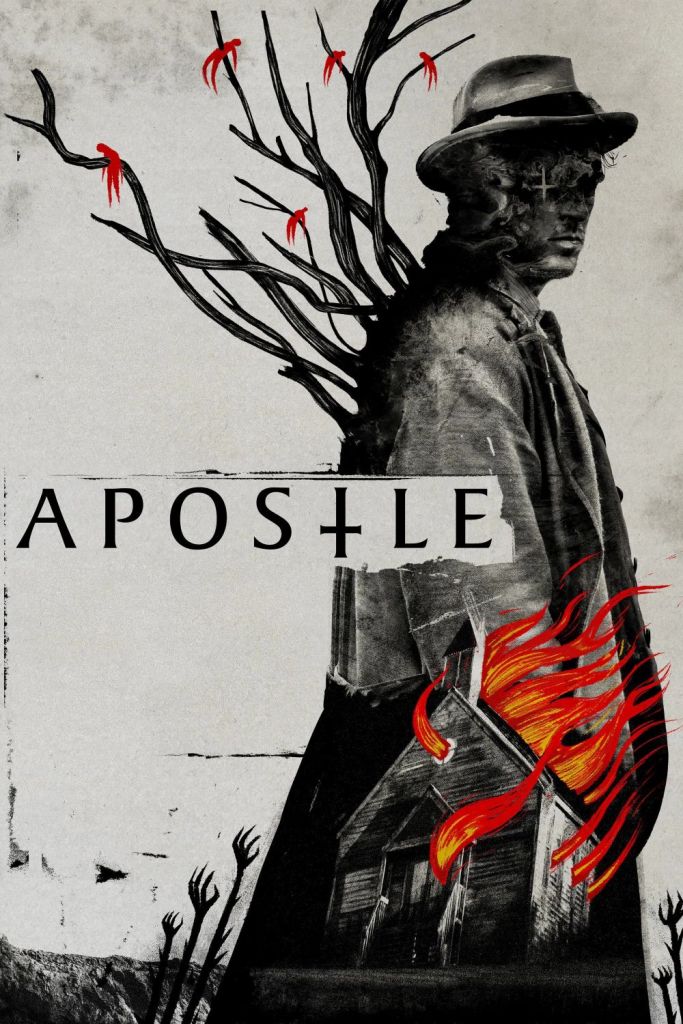
Apostle is one of those films that feels like Gareth Evans deliberately swerved away from the kinetic precision of The Raid and The Raid 2, as if to test whether he could still dominate the screen without back‑to‑back martial‑arts set pieces. The result is not a clean crowd‑pleaser, but a grim, blood‑soaked folk‑horror descent that trades velocity for dread, atmosphere, and the slow peeling away of civilized surfaces until what’s left is pure cruelty. It’s ambitious, dense, and at times unwieldy, but it is never the kind of hollow, algorithm‑friendly Netflix original that feels assembled by committee. The film leans into a slow‑burn approach, letting its cult setting and religious unease simmer before it erupts into something truly grotesque.
Set in 1905, Apostle follows Thomas Richardson, played by Dan Stevens with the exact right mix of haunted intensity and bruised arrogance, as he infiltrates a remote island cult to rescue his kidnapped sister. That setup sounds straightforward enough, but Evans uses it as a trapdoor into a much uglier story about faith, coercion, exploitation, and the grotesque systems people build when belief curdles into power. The cult is not merely spooky window dressing; it’s a functioning social organism with labor, hierarchy, punishment, and ritual, which gives the film a more grounded menace than a simple haunted‑house scenario. The island’s wrongness is not just in its rituals, but in the way ordinary domestic life has been turned into a kind of ongoing penance.
What makes Apostle compelling is how patiently Evans allows the island to breathe before he starts tearing it apart. The first half is almost methodical in the way it maps the place: the political tension within the cult, the uneasy alliances, the daily routines, the controlled scarcity, and the sense that every face hides some compromise. That slow construction is crucial, because once the film starts revealing what the island is actually built on, the horror lands with more force. It does not chase jump scares; it lets the audience sit inside the wrongness until the wrongness starts to feel inevitable. The film’s real horror is in the way it treats belief as a system of control rather than a source of comfort.
Michael Sheen is the other major pillar here, and he gives the film a wickedly slippery center as Malcolm, the island’s charismatic prophet. Sheen plays him as part messiah, part salesman, part exhausted tyrant, which is exactly the right tone for a character whose authority depends on performance. He isn’t merely loud or theatrical; he’s persuasive, and that is much scarier. The film understands that the most dangerous religious figures are often not the ones who snarl the loudest, but the ones who can make oppression sound like purpose. Dan Stevens plays beautifully against that energy, keeping Thomas in a state of wary observation until desperation forces him into action. The two actors give the movie a dramatic spine sturdy enough to support all the blood and theology around them.
Evans’ direction is, unsurprisingly, the film’s great technical asset. Even when Apostle feels overloaded, it never feels careless. He stages the island as an environment of mud, wood, fog, and decay, and his eye for spatial clarity keeps the film legible even when the narrative starts layering on secrets and hidden machinery. If The Raid was about velocity and geometry, Apostle is about pressure and contamination. The violence, when it arrives, still carries the director’s unmistakable talent for framing brutality on screen: every blow lands with a clarity and weight that makes the gore feel integral rather than gratuitous. But in Apostle he deftly dips his filmmaking talents into the world of gothic folk horror, slotting his sensibility alongside classics like The Wicker Man, Witchfinder General, and The Witch. The island’s rituals, its mix of agrarian dread and religious paranoia, and its sense of a sealed community preparing for a bloody reckoning all echo those earlier works, while Evans colors them in his own grimy palette.
There’s also something interesting about how the film handles world‑building. It is overstuffed, yes, but it is overstuffed in a way that feels earned rather than random. The island has systems, factions, and ugly little bureaucracies of suffering, and the film keeps revealing new layers of control and corruption until the whole place feels like a machine designed to consume bodies and faith at the same time. Some viewers will see that density as a flaw, and they’re not entirely wrong; Apostle can feel a little overextended, as if Evans has too many ideas he wants to wring out of the same pressure cooker. But it could also be argued that the excess is part of the film’s personality. It’s not elegant horror. It’s horrified by its own abundance.
Thematically, Apostle works best when it treats religion not as a decorative taboo, but as a field of contesting desires. The film isn’t interested in simple anti‑faith provocation. Instead, it examines what happens when belief becomes a resource to be managed, weaponized, and monetized. The cult claims to reject corruption from the outside world, but its inner life is every bit as predatory, which makes the island feel less like an isolated aberration and more like a compressed version of the larger world Thomas came from. That’s one of the movie’s smartest ideas: the mainland and the island are different expressions of the same rot. The difference is only one of scale and visibility.
As a horror film, Apostle is strongest when it is patient and weakest when it has to juggle too many moving parts at once. The final stretch escalates into an effectively feral confrontation, but the movie occasionally risks losing the eerie precision of its setup in favor of sheer attritional chaos. Still, even that chaos has a purpose. Evans is not just trying to shock; he’s trying to show what happens when systems of belief collapse under the weight of their own lies. The result is messy, unpleasant, and often very good. It is also one of the more distinctive Netflix originals of its era, precisely because it refuses to be easy or tidy.
Apostle feels like a filmmaker known for kinetic precision making a movie about spiritual and social collapse, and the contradiction works in its favor. Even as he steps into the domain of gothic folk horror, Evans never loses his gift for filming violence or his sense of where the camera should sit in relation to pain. It has the rough edges of an ambitious film reaching for too much, but those edges are part of what makes it memorable. Part of the reason the film is underappreciated as quietly as it is may be that it arrived with a reputation attached: if Evans did not already have a name as a master of action filmmaking, Apostle might be celebrated more openly as a standalone horror achievement. Sometimes moving out of one’s comfort zone and still succeeding is exactly what gets held back by one’s reputation for what they’re “supposed” to be good at.
Between the bleak atmosphere, the commanding performances, the grim folk‑horror imagery, and Evans’ refusal to soften the ugliness of his subject, Apostle stands as a smart, vicious, and unusually committed piece of genre filmmaking. It may not be the Gareth Evans movie action fans expected, but it is very much the one horror fans deserved.
“Sometimes I wonder… will God ever forgive us for what we’ve done to each other? Then I look around and I realize, God left this place a long time ago.” — Danny Archer
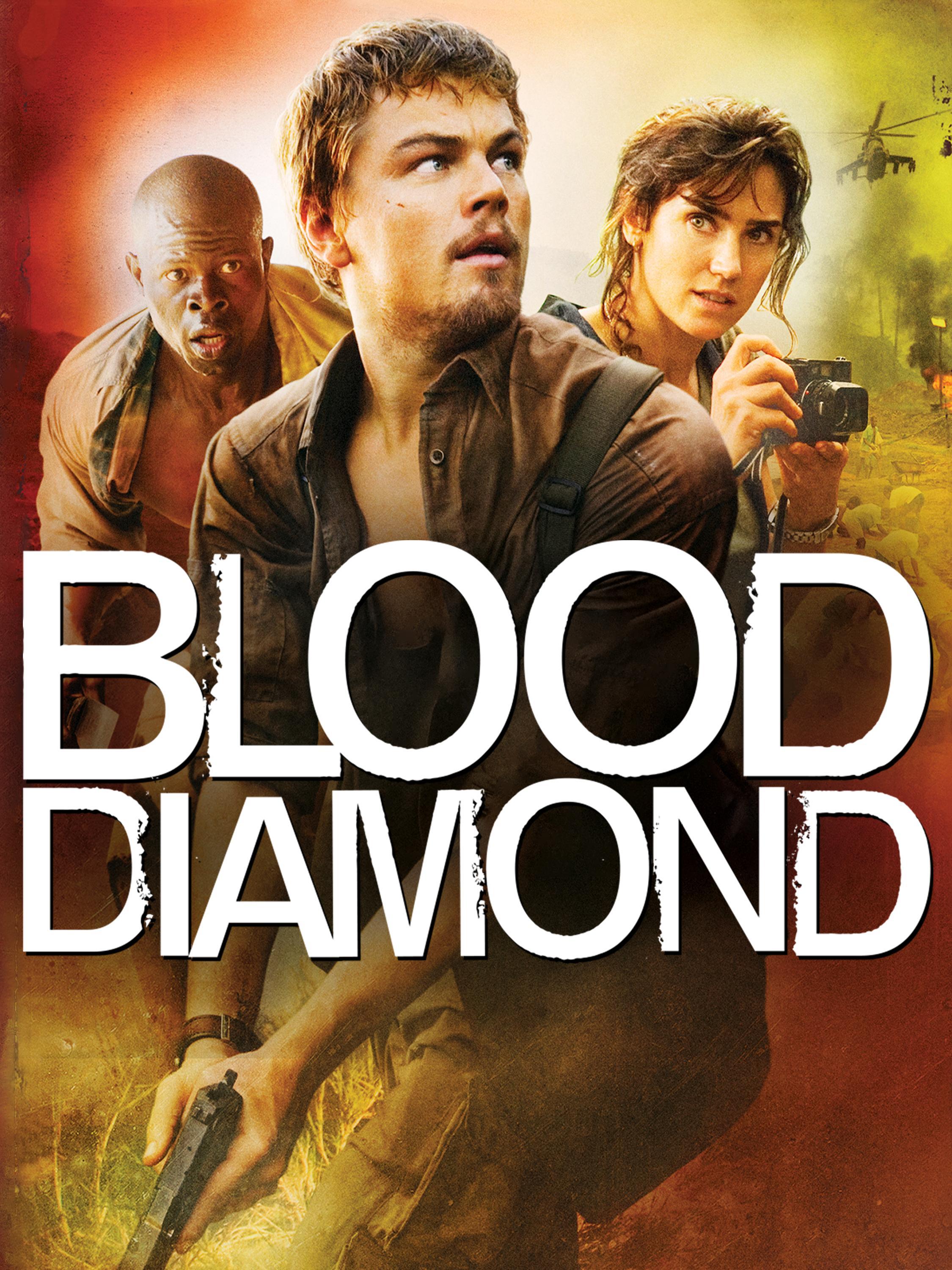
Edward Zwick’s 2006 film Blood Diamond is one of those big Hollywood productions that tries to be both a gritty, globe-trotting thriller and a politically conscious indictment of the diamond trade’s role in African civil wars. Set in Sierra Leone during the 1990s, it stars Leonardo DiCaprio as Danny Archer, a Rhodesian mercenary and diamond smuggler, and Djimon Hounsou as Solomon Vandy, a fisherman torn from his family by rebels and forced into brutal diamond mining. Rounding out the leads is Jennifer Connelly as Maddy Bowen, a tenacious reporter determined to expose the atrocities fueling the global supply of conflict diamonds. The film is ambitious, harrowing, and, at times, as slickly entertaining as it is bluntly didactic. But like many socially minded blockbusters, it walks a tightrope between genuine drama and Hollywood sensationalism.
The story kicks off with a bang—literally—as Solomon’s village is raided by Revolutionary United Front militants, a moment that quickly plunges the viewer into Sierra Leone’s chaotic civil war. Solomon’s family is fragmented: he ends up a slave at a rebel-run mining camp, his son is eventually brainwashed into a child soldier, and his wife flees for safety. Meanwhile, DiCaprio’s Archer lands in jail after a failed smuggling run—which sets the two men on a collision course. Archer learns of Solomon’s discovery of an enormous, rare pink diamond—a stone that could mean escape or redemption for both men but is a magnet for greed, violence, and compromise. Their uneasy partnership with Maddy Bowen, who’s chasing a story, adds layers as their individual motives collide and evolve.
The movie doesn’t shy away from illustrating the devastating effects of the diamond trade—child soldiers, forced labor, mass displacement, and political corruption. While most of the on-screen violence is handled to maximize emotional punch, it never lets the viewer forget the real-world stakes of the Blood Diamond narrative. The film ultimately points viewers toward the establishment of the Kimberley Process—a set of international regulations designed to combat the illicit diamond trade.
A lot of the film’s emotional weight lands on DiCaprio and Hounsou, and for good reason. Leonardo DiCaprio nabs the complex role of Danny Archer with a layered performance and goes the extra mile by working hard on the Zimbabwean (Rhodesian) accent. While accents in film can be divisive, DiCaprio immersed himself deeply, working with dialect coaches and spending time with people from the region to best capture the regional nuances. Although some viewers and critics felt the accent was uneven or shifted at points, many others praised him for nailing this challenging and rare dialect. For an American actor to convincingly embody a mercenary with roots in that part of the world is no small feat. DiCaprio’s commitment brings credibility to Archer’s character, who is morally ambiguous but immensely human.
Djimon Hounsou, playing Solomon Vandy, serves as the emotional core and grounding presence of the film. His portrayal of a man torn apart by civil war, who fights desperately to reclaim his family, is heartbreaking and physically compelling. Their scenes together create genuine tension, as trust is both scarce and necessary for survival. Jennifer Connelly’s Maddy Bowen, while less fleshed out, brings determination and serves as the moral compass driving the film’s exposé of conflict diamonds.
Director Edward Zwick has a way of blending spectacle with raw storytelling. The action sequences, especially the firefights and escapes, feel intense and immersive. The cinematography captures the lush, dangerous landscape of Sierra Leone vividly, contrasting beauty with brutality. Some technical aspects do show their age—like certain digital effects that can feel artificial—but these don’t significantly dampen the overall experience. The soundtrack by James Newton Howard underscores the drama without veering into heavy-handed territory.
Blood Diamond scores high on several fronts. The performances by DiCaprio and Hounsou are standout elements, their evolving relationship carrying the film’s emotional heft. The pulse-pounding action sequences inject thrills while highlighting the chaos of civil war. Perhaps most importantly, the movie exposes the grim realities behind the glittering allure of diamonds, educating audiences about child soldiers, forced labor, and the complicity of international markets in perpetuating violence. Though it sometimes leans into melodrama and moralizing dialogue, the film’s commitment to its message is fairly unambiguous and impactful.
That said, the film sometimes succumbs to the trappings of big-budget Hollywood storytelling. The plot can feel overly convenient, with coincidences and resolutions that stretch credibility. Supporting characters, aside from the leads, are underdeveloped, mainly functioning as plot devices. Dialogue can at times be heavy-handed, particularly in the final act where scenes verge on preachy. Some narrative contrivances—like the recovery and passing of the pink diamond—can feel forced even in a tense, action-driven context. On the technical side, a few CGI moments fail to hold up under scrutiny, but these are minor irritants in an otherwise immersive film.
An important and unavoidable observation about Blood Diamond is how, like many of Edward Zwick’s previous action-dramas, it leans heavily into the “white savior” trope, if not outright embodying it. This trope centers a white protagonist—in this case, Danny Archer—who becomes the crucial figure in the salvation or redemption of non-white characters and communities. While the film sheds light on the horrors and complexity of Sierra Leone’s civil war and the conflict diamond trade, the narrative perspective and moral center overwhelmingly revolve around Archer’s personal journey from cynical mercenary to reluctant hero. The African characters, though vital and powerful especially through Hounsou’s Solomon, are often cast in more reactive roles, with Archer positioned as the key agent for change. The film also features a white journalist, Maddy Bowen, reinforcing this pattern.
Zwick’s leanings toward this trope are not new or isolated. His earlier films Glory (1989) and The Last Samurai (2003) also engage with the white savior narrative. Glory, a Civil War epic about the 54th Massachusetts Infantry Regiment, tells a historically significant story but largely centers on Colonel Robert Gould Shaw, a white officer played by Matthew Broderick, as the story’s main emotional and narrative anchor. The film has been noted for respectfully addressing racism and heroism but still revolves around Shaw’s perspective and sacrifice as a key redemptive figure for the African American soldiers. The Last Samurai similarly places Tom Cruise’s character, an American military advisor, at the heart of a narrative about Japanese samurai culture and resistance, blending cultural appreciation with the problematic trope of the white outsider who becomes indispensable to a non-white community’s fate.
This approach, familiar in Hollywood, walks the line between broad audience engagement and ethical storytelling. Zwick’s films often balance studio and audience expectations with a desire to tell compelling stories about marginalized communities. Yet inevitably, this framing simplifies complex histories and contributes to critiques that such films center whiteness and diminish the agency of non-white characters.
Casually speaking, Blood Diamond is not subtle, but that directness is part of its appeal. For viewers looking for a gripping action drama with strong performances and an ethical core, it delivers. It entertains while providing a sobering look at the high cost of luxury goods. DiCaprio’s portrayal of Danny Archer, complete with an authentically worked-on accent from the region, puts to rest doubts about his action lead capabilities. Hounsou’s performance lingers emotionally, especially in scenes grappling with the trauma of child soldiering. The violence depicted is raw and unvarnished, contributing to a visceral sense of the film’s urgent themes.
Running for about two hours and 23 minutes, the film has plenty of time to develop its complex story and deliver tense action sequences without feeling rushed or padded. Ultimately, Blood Diamond is an effective historical thriller that balances high stakes and moral urgency. While it’s not nuanced in every aspect and occasionally tips into cliché and convenience, it makes a strong case for itself beyond mere entertainment. Whether you’re interested in history, action, or the human stories behind the diamond trade, this film offers a thought-provoking, emotionally resonant experience. Leonardo DiCaprio’s dedication to portraying a Rhodesian mercenary authentically, especially through his accent work, is a highlight that complements the film’s broader narrative ambitions.
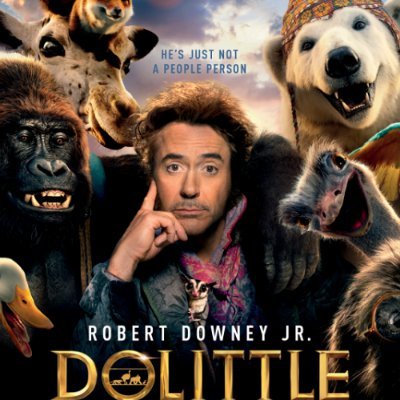
Dolittle tells the story of Dr. Dolittle (Robert Downey, Jr.), the eccentric doctor who can talk to the animals and who hasn’t had much use for humans ever since the tragic death of his wife, Lily (Kasia Smutniak). Dolittle would be happy to just spend his entire life locked away in his estate, talking to Poly the Parrot (voice of Emma Thompson) and Chee-Chee the Gorilla (voice of Rami Malek) and all of the other animals but Dolitle has to eventually leave his home because otherwise, there wouldn’t be a movie.
When Queen Victoria (Jessie Buckley) is mysteriously taken ill, only Dolittle can save her. Dolittle quickly realizes that the Queen has been poisoned and that the only cure for the poison is to be found on a tree that’s located on an island that no one has ever seen before. Soon, Dolittle and the animals are sailing in search of the island. Accompanying them is Tommy Stubbins (Harry Collett), a sensitive teen who hates to hunt and who hopes to become Dolittle’s apprentice. Pursuing Dolittle is the evil Dr. Blair Mudfly (Michael Sheen), who went to college with Dolittle and who is in cahoots with the conspirators who are trying to do away with Queen Victoria.
Got all of that? I hope so because we haven’t even gotten to the dragon with a set of bagpipes crammed up her ass. Yes, you read that correctly.
Last year, Dolittle was one of the few major studio productions to actually get a wide release before COVID-19 closed down all the theaters. It was released in January, which is traditionally the time when studios release the films that they hope everyone will have forgotten about by the time April rolls around. January is traditionally the month when studios release the films that they know aren’t any good. And, indeed, the reviews of Dolittle were overwhelmingly negative. Not only did the critics hate Dolittle but audiences were also rather unenthusiastic and the film bombed at the box office. Indeed, under normal circumstances, the reaction to Dolittle and its subsequent box office failure would be considered one of the year’s biggest disasters. However, 2020 was a year of disasters. Compared to everything else that ended up happening over the past 12 months, Dolittle’s lukewarm reception seems almost quaint now.
Earlier today, I finally watched Dolittle on HBOMax. I was expecting the film to be terrible but it’s actually not quite as bad as I had been led to believe. I mean, don’t get me wrong. Dolittle has a ton of problems. The tone is all over the place as the film tries to mix cartoonish humor with thrilling adventure in a style that owes more to the Pirates of the Caribbean franchise than it does to Dr. Dolittle. Despite a few self-consciously manic moments, Robert Downey, Jr. seems remarkably bored in the lead role. Many of the jokes fall flat and the awkward attempts to shoehorn the usual message of “be true to yourself” into the film just felt awkward. That said, the CGI animals were cute enough to hold my interest and that’s really the most important thing when it comes to a film like Dolittle. Cute animals — even computer generated ones — help to make up for a lot of flaws.
Dolittle’s final scene hints at a sequel or even a franchise. Considering the reaction to the first film, I doubt we’ll get a second. I do think Dr. Dolittle could make for an enjoyable PIXAR film but it might be time to give the live action adaptations a rest.
I saw Underworld when it was first released in theaters, way back in 2003. And I’ve rewatched more than a handful of times since then, mostly because of my huge girl crush on Kate Beckinsale. And every time that I watch this movie, I find myself wondering what the Hell’s going on.
I mean, I get it. There’s a centuries-old war between vampires and Lycans and the Lycans are basically werewolves but they’re called “Lycan” because Lycan sounds better than werewolf. The Death Dealers are vampires who go around and shoot Lycans on dark rainy nights. And apparently, the vampires think that the Lycan threat has been neutralized because the leader of the Lycans, Lucian, is dead but maybe he’s not because Lucian’s body was never found. And meanwhile, there’s three vampire rulers and two of the rulers get to sleep while the other one reigns and they switch out every few centuries.
Oh! And the vampires and the Lycans are not really supernatural creatures. Instead, they’re people who have been infected by a virus that causes them to live a really long time and have a craving for blood or something like that. So, that explains why none of the vampires turn into a bat or anything like that during the movie. Instead, everyone just runs around and does parkour and shoots guns at one another.
Also, the vampires don’t have to prey on human beings because they’ve learned how to clone blood because cloning is the solution for everything.
And also, everything happens at night while it’s raining because the vampires and the Lycans are secretly living in the same world with humans, they’re just living underground. They’re living in an underworld, if you will.
Also ….
Well, listen, there’s a lot of plot in this movie. Underworld lasts for 121 minutes and there’s really not a slow spot in the entire film. In fact, that’s probably one of the film’s greatest strengths. The nonstop action keeps you from thinking about how the plot of the film just seems to be something that the filmmakers made up as they went along. Instead of wondering how everything fits together, you’re too busy watching as the movie flies from violent set piece to another.
Underworld‘s other great strength is that it stars Kate Beckinsale. Nowadays, the action girl who kicks ass and defeats evil while looking good has become such a cliche that it’s easy to forget just how exciting it was when we first saw Kate Beckinsale, clad in leather and effortlessly dodging bullets and ruthlessly killing Lycans. Though its impact may have subsequently been diluted by too many sequels and imitations, watching Underworld for the first time was a very empowering experience. Watching Underworld for the first time, I wanted to be Kate Beckinsale. If Kate could defeat both vampires and Lycans without breaking a sweat then I knew that I could defeat my own insecurities. Of course, unlike Kate, I didn’t have the advantage of movie magic to help me down a backflip off of a wall and I ended up spraining my ankle but still, Kate Beckinsale in Underworld was the perfect antidote to years of previously watching women in horror and action films be treated like either disposable victims or damsels in need of rescue.
In Underworld, Kate Beckinsale played Selene, a Death Dealer who tries to figure out why the Lycans are all after a human named Michael (Scott Speedman). Selene also falls in love with Michael, which leads to some complications after Michael gets bitten by Lucian (Michael Sheen), the Lycan leader who wasn’t really dead after all. Meanwhile, Kraven (Shane Brolly) wants to take over the vampires and a vampire elder named Viktor (Bill Nighy) is woken up early and then ages backwards through the film, which is actually a pretty clever idea.
And, as I said before, it never really makes much sense. But, as incoherent as Underworld may be, it’s still an undeniably addictive viewing experience. The movie is pure style. It takes place in a world where it’s always night and it’s always raining and where everyone is beautiful and deadly at the same time. Whether they’re a vampire or a Lycan, People in Underworld movies don’t merely enter a room. Instead, they throw the doors open and allows blue light to flood in as they make a grand entrance. At times, the film’s style is so kinetic and overwhelming that it threatened to get a little bit silly but, again, that’s a part of the film’s appeal. While Kate Beckinsale thrills you with her empowering performance, the visuals grab you and say, “We’re going on a trip and don’t worry about whether it makes any sense!”
That’s why I’ve watched Underworld several times. It doesn’t have to make sense. It just has to kick ass.
Gareth Evans is pretty much the director who helped usher in the latest renaissance in action films. His films show that action can be done without reling on quick cuts and fast edits. Gone are the days of Christopher Nolan staged fight scenes that shows no life whatsoever and the nausea-inducing edits by Paul Green grass in his Bourne franchise.
Well-known for his work in Indonesia, especially with the Raid franchise, Gareth Evans is now trying his hand in something a bit different, but still looks to be in his wheelhouse. This time around it’s through the largesse of Netflix that he will be making his next project titled Apostle.
The film has been under the radar throughout much of its production and post-production, but with less than a month remaining til it’s October release, Apostle may have just become one of my most anticipated films of the year.
With a cast headlined by Dan Stevens and Michael Sheen, Apostle looks to combine Evans’ stylistic action with period horror. Will the combination be a balanced mix or will it be too much of a good thing and the whole thing falls apart? We’ll find out on October 12, 2018.
Here are six mini-reviews of six films that I saw in 2016!
Alice Through The Looking Glass (dir by James Bobin)
In a word — BORING!
Personally, I’ve always thought that, as a work of literature, Through The Looking Glass is actually superior to Alice’s Adventures in Wonderland. That’s largely because Through The Looking Glass is a lot darker than Wonderland and the satire is a lot more fierce. You wouldn’t know that from watching the latest film adaptation, though. Alice Through The Looking Glass doesn’t really seem to care much about the source material. Instead, it’s all about making money and if that means ignoring everything that made the story a classic and instead turning it into a rip-off of every other recent blockbuster, so be it. At times, I wondered if I was watching a film based on Lewis Carroll or a film based on Suicide Squad. Well, regardless, the whole enterprise is way too cynical to really enjoy.
(On the plus side, the CGI is fairly well-done. If you listen, you’ll hear the voice of Alan Rickman.)
Gods of Egypt (dir by Alex Proyas)
I don’t even know where to begin when it comes to describing the plot of Gods of Egypt. This was one of the most confusing films that I’ve ever seen but then again, I’m also not exactly an expert when it comes to Egyptian mythology. As far as I could tell, it was about Egyptian Gods fighting some sort of war with each other but I was never quite sure who was who or why they were fighting or anything else. My ADHD went crazy while I was watching Gods of Egypt. There were so much plot and so many superfluous distractions that I couldn’t really concentrate on what the Hell was actually going on.
But you know what? With all that in mind, Gods of Egypt is still not as bad as you’ve heard. It’s a big and ludicrous film but ultimately, it’s so big and so ludicrous that it becomes oddly charming. Director Alex Proyas had a definite vision in mind when he made this film and that alone makes Gods of Egypt better than some of the other films that I’m reviewing in this post.
Is Gods of Egypt so bad that its good? I wouldn’t necessarily say that. Instead, I would say that it’s so ludicrous that it’s unexpectedly watchable.
The Huntsman: Winter’s War (dir by Cedric Nicolas-Troyan)
Bleh. Who cares? I mean, I hate to put it like that but The Huntsman: Winter’s War felt pretty much like every other wannabe blockbuster that was released in April of last year. Big battles, big cast, big visuals, big production but the movie itself was way too predictable to be interesting.
Did we really need a follow-up to Snow White and The Huntsman? Judging by this film, we did not.
Me Before You (dir by Thea Sharrock)
Me Before You was assisted suicide propaganda, disguised as a Nicolas Sparks-style love story. Emilia Clarke is hired to serve as a caregiver to a paralyzed and bitter former banker played by Sam Claflin. At first they hate each other but then they love each other but it may be too late because Claflin is determined to end his life in Switzerland. Trying to change his mind, Clarke tries to prove to him that it’s a big beautiful world out there. Claflin appreciates the effort but it turns out that he really, really wants to die. It helps, of course, that Switzerland is a really beautiful and romantic country. I mean, if you’re going to end your life, Switzerland is the place to do it. Take that, Sea of Trees.
Anyway, Me Before You makes its points with all the subtlety and nuance of a sledge-hammer that’s been borrowed from the Final Exit Network. It doesn’t help that Clarke and Claflin have next to no chemistry. Even without all the propaganda, Me Before You would have been forgettable. The propaganda just pushes the movie over the line that separates mediocre from terrible.
Mother’s Day (dir by Garry Marshall)
Y’know, the only reason that I’ve put off writing about how much I hated this film is because Garry Marshall died shortly after it was released and I read so many tweets and interviews from people talking about what a nice and sincere guy he was that I actually started to feel guilty for hating his final movie.
But seriously, Mother’s Day was really bad. This was the third of Marshall’s holiday films. All three of them were ensemble pieces that ascribed a ludicrous amount of importance to one particular holiday. None of them were any good, largely because they all felt like cynical cash-ins. If you didn’t see Valentine’s Day, you hated love. If you didn’t see New Year’s Eve, you didn’t care about the future of the world. And if you didn’t see Mother’s Day … well, let’s just not go there, okay?
Mother’s Day takes place in Atlanta and it deals with a group of people who are all either mothers or dealing with a mother. The ensemble is made up of familiar faces — Jennifer Aniston, Julia Roberts, Kate Hudson, and others! — but nobody really seems to be making much of an effort to act. Instead, they simple show up, recite a few lines in whatever their trademark style may be, and then cash their paycheck. The whole thing feels so incredibly manipulative and shallow and fake that it leaves you wondering if maybe all future holidays should be canceled.
I know Garry Marshall was a great guy but seriously, Mother’s Day is just the worst.
As far as recent Biblical films go, Risen is not that bad. It takes place shortly after the Crucifixion and stars Joseph Fiennes as a Roman centurion who is assigned to discover why the body of Jesus has disappeared from its tomb. You can probably guess what happens next. The film may be a little bit heavy-handed but the Roman Empire is convincingly recreated, Joseph Fiennes gives a pretty good performance, and Kevin Reynolds keeps the action moving quickly. As a faith-based film that never becomes preachy, Risen is far superior to something like God’s Not Dead 2.
What’s an Insomnia File? You know how some times you just can’t get any sleep and, at about three in the morning, you’ll find yourself watching whatever you can find on cable? This feature is all about those insomnia-inspired discoveries!
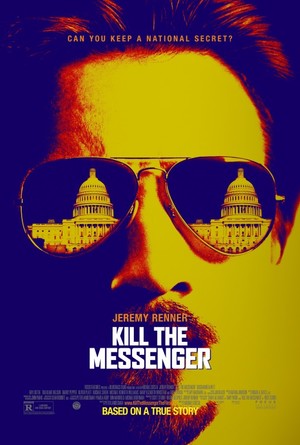
Last night, if you were awake and unable to get any sleep at 1:45 in the morning, you could have turned over to Cinemax and watched the 2014 conspiracy thriller, Kill The Messenger.
Kill The Messenger opens with one of those title cards that assures us that the movie we’re about to see is based on a true story. We are then introduced to Gary Webb (Jeremy Renner), a California-based reporter who we know is a rebel because he has a precisely trimmed goatee. Gary is interviewing a suspected drug smuggler (Robert Patrick) at the smuggler’s luxurious mansion. Suddenly, the DEA storms the house, shouting insults and roughly throwing everyone to the ground, including Gary. It’s actually exciting and promising opening, one that perfectly establishes both Gary as a truth seeker and the U.S. government as an invading army that’s fighting a war that’s full of collateral damage.
Gary, of course, has nothing to do with smuggling drugs. He was just in the wrong place at the wrong time. If he was treated unfairly by the DEA, it’s just because the government is serious about winning the war on drugs!
Or is it?
Following up on a tip, Gary comes across evidence that, in order to raise money for pro-Amercian rebels in Central America, the CIA not only helped to smuggle drugs into the U.S. but also arranged for the drugs to largely be sold in poor, minority neighbors where, in theory, no one would notice or care.
When the story is finally published, Gary is briefly a celebrity. Not surprisingly, the government denies his accusations and start tying to discredit him. However, Gary also finds himself being targeted by his fellow journalists. Angry over being outscooped by a relatively unknown reporter, The Los Angeles Times and The Washington Post both launch their own investigations. Instead of investigating Gary’s allegations, they jealously and viciously investigate Gary himself.
Soon, both Gary’s career and his family are falling apart and Gary finds himself growing more and more paranoid…
Remember when everyone was expecting Kill The Messenger to be a really big deal? It was due to come out towards the end of 2014, right in the middle of Oscar season. Jeremy Renner was being talked up as a contender for best actor. Then the film came out, it played in a handful of theaters for a week or two, and then it sunk into obscurity. Some commentators even complained that Focus Features buried the release of Kill The Messenger and that the film was ignored because of its leftist politics…
Of course, it’s just as probable that Focus Features realized that The Theory of Everything was more likely to charm audiences than a movie that suggested the U.S. government was behind the drug epidemic.
Or it could have just been that, despite telling a potentially intriguing story, Kill The Messenger was an oddly bland film. Other than one scene in which he admits to cheating on his wife, Gary Webb is portrayed as being such a saint that it actually causes the film to lose credibility. (Don’t get me wrong. For all I know, he was a saint. But, from a cinematic point of view, sainthood is never compelling.) This is one of those earnest films that gets so heavy-handed that, even if you agree with what the movie is saying, you still resent being manipulated. (Of course, some of us have grown so cynical about the media that we automatically doubt the veracity any movie that opens with those dreaded words: “Based on a true story.”) Watching Kill The Messenger, one gets the feeling that a documentary about Gary Webb would probably be more compelling (and convincing) than a fictionalized dramatization.
(Unfortunately, if you think it’s difficult to get an audience to watch a movie that suggested the U.S. government was behind the drug epidemic, just try to get them to watch a documentary about … well, anything. I know most of our readers would probably happily watch a documentary but that’s because y’all are the best and a thousand times better than the average person. Love you!)
Here’s what did work about Kill The Messenger: the performances. Jeremy Renner, who also produced this film, gives an excellent performance as Gary, especially in the scenes where he realizes that both the government and the press are now conspiring about him. Rosemarie DeWitt has the traditionally thankless role of being the supportive wife but she still does a good job. And finally, Ray Liotta shows up for one scene and is absolutely chilling in that way that only Ray Liotta can be.
Kill The Messenger doesn’t quite work but, thanks to the cast, it is, at the very least, a watchable misfire.