“G.I. Joe is the code name for America’s daring, highly trained special mission force. Its purpose: to defend human freedom against Cobra, a ruthless terrorist organization determined to rule the world!”
Actually, you only thought that Cobra was a ruthless terrorist organization. In G.I. Joe: The Movie, it is revealed that Cobra is actually the brainchild of Golobulus (voiced by Burgess Meredith), a human/serpent hybrid who is the ruler of Cobra-La, an ancient civilization hidden away in the Himalayas. Golobulus not only recruited Cobra Commander, but his servant Pythona implanted the dream that led to Dr. Mindbender creating the Cobra Emperor. Despite having the power to do all that, Golobulus still has to steal G.I. Joe’s latest weapon so that he can launch and open a bunch of space spores that will turn all of humanity into snakes. It’s up to G.I. Joe to stop them. Everyone thinks that new recruit Falcon (Don Johnson) is just Duke’s irresponsible kid brother, so, of course, it will be up to him to save the day.
G.I. Joe: The Movie is actually not bad as far as 1980s animation is concerned. Cobra-La may have a silly name, but it’s a memorable location, and the scenes involving Cobra Commander being put on trial while trapped in a giant Venus flytrap are actually pretty impressive. Cobra Commander was turned into a snake in this movie, and his hissing “I was a man” is a hundred times more effective than it should have been. Since the original G.I. Joe animated series was canceled around the same time this was released, G.I. Joe: The Movie actually does wrap up the show. After fighting an ancient civilization of flying monsters and talking serpents, what was really left for G.I. Joe to do?
There are a lot of battle scenes and, again, no one dies. Originally, that wasn’t the plan. When G.I. Joe: The Movie was animated, Duke was killed while saving his brother’s life. However, when Transformers: The Movie underperformed at the box office, it was decided to release G.I. Joe: The Movie straight to video and not to kill off anyone in the cast. Dialogue was added to indicate that Duke was actually just severely injured, despite the fact that he obviously died in battle. In the movie, Duke passes out and everyone looks away with tears in their eyes. Falcon defeats Cobra-La and then says, “That was for you, brother,” while looking up at the star-filled sky. It was just a flesh wound!
No matter what else might be said, the animated G.I. Joe: The Movie was better than any of the live-action films that came out thirty years later.
Welcome to Retro Television Reviews, a feature where we review some of our favorite and least favorite shows of the past! On Mondays, I will be reviewing Miami Vice, which ran on NBC from 1984 to 1989. The entire show can be purchased on Prime!
This week, Miami Vice comes to a close.
Episode 5.21 “Too Much, Too Late”
(Dir by Richard Compton, originally aired on January 25th, 1990)
Tough NYPD detective Valerie Gordon (Pam Grier) returns to Miami after she learns that her friend Yvonne (CCH Pounder) has become addicted to crack cocaine and has been using her teenage daughter, Lynette (Malinda Williams), to pay her dealer, Swayne (John Toles-Bey). Returning to Miami also allows Valerie to meet up with her former lover, Tubbs. Tubbs is happy to see her again and even starts to think about marriage. When Yvonne turns up dead, Valerie insists that Swayne killed her. However, Crockett isn’t so sure. Eventually, it turns out that Lynette murdered her own mother and that Valerie has been trying to frame Swayne for the crime. Both Swayne and Lynette are arrested. Valerie returns to New York where, she tells Tubbs, she is going to turn in her badge and retire from the police force.
Meanwhile, Switek tries to resist the temptation to start gambling again. He even goes to meetings of Gamblers Anonymous but, when he’s stuck alone in his apartment and dealing with the guilt that he still feels over Zito’s death, Switek finds himself overwhelmed. Soon, he is again placing bets.
This was not intended to be the final episode of Miami Vice. Switek giving into his gambling addiction and Tubbs growing increasingly burned out were all plot points that were obviously designed to lead straight into Freefall. Even Tubbs’s decision to return to New York makes a lot more sense once we know that Valerie is there. However, NBC did not air this episode during the show’s original run because of its subject matter. Yvonne selling her daughter for crack was considered to be too controversial. As such, it didn’t air until the show went into syndication. That’s a shame. This was a strong episode, one that featured the melancholy atmosphere that made Miami Vice so memorable in the first place.
Well, that’s it for Miami Vice. It’s a show that started out strong. The first two seasons were consistently outstanding. The third season was entertaining, even if it was obvious that the show was starting to run on autopilot. The fourth season is where the show lost itself. As for the fifth season, it had its flaws but it was a definite improvement over the fourth season. While it was obvious that Don Johnson was eager to move on, the fifth season still provided enough good episodes that the show managed to redeem itself before it finally ended.
I’m going to miss Miami Vice. Even at its worse, it had style to burn.
(I should mention that the whole reason I started reviewing Miami Vice back in 2023 was because I assumed Ron DeSantis would be elected President in 2024 and that people would naturally be curious about a show set in Florida. Whoops.)
Next week, something new will premiere in this time slot. What will it be? I’ll let you know as soon as I know. For now, let’s just take a moment to remember Crockett, Tubbs, and Elvis.
“What are you going to do when a dog goes bad on you… bites somebody or hurts somebody? There’s only two things you can do, right? You either chain him up… or put him down. But which do you think is more cruel?” — Ben Russell
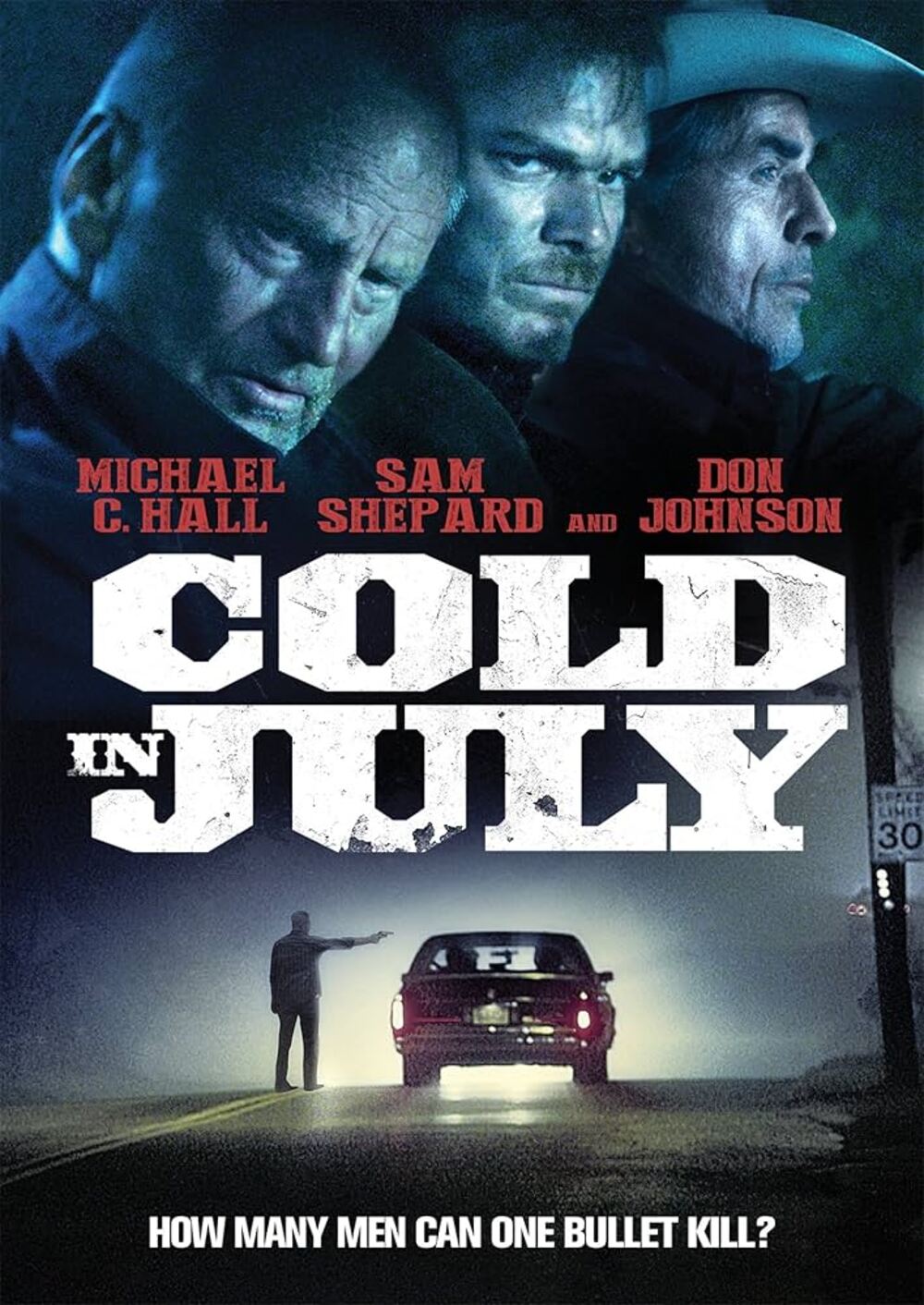
Cold in July opens with a jolt of primal terror, the kind that shatters the fragile illusion of safety in one’s own home. It’s the sticky summer of 1989 in small-town East Texas, where Richard Dane, a soft-spoken picture framer embodied with exquisite restraint by Michael C. Hall, stirs from sleep to the creak of floorboards under an intruder’s weight. No time for second thoughts; his hand finds the .38 revolver under the pillow, and in the inky darkness of his living room, he fires. The body hits the carpet with a thud, blood pooling like spilled ink. The local law rolls up, commends him under Castle Doctrine—self-defense sanctified by statute—and hauls the corpse away. But Richard can’t wash away the echo of that shot. Hall captures the everyman’s unraveling with microscopic precision: the thousand-yard stare at family photos, the hesitant touch of his wife Ann’s shoulder, the way he now checks locks twice before bed. He’s no vigilante archetype; he’s a man whose moral compass, once pointed true north, now spins wildly in the aftermath, haunted by the ghost of a kid he never knew.
Into this fragile peace stalks Ben Russell, the dead boy’s father, a parolee fresh from Huntsville’s iron grip, played by Sam Shepard as a specter of weathered fury. Shepard infuses Ben with that laconic Texan menace, eyes like weathered shale, voice gravel ground under boot heels. He doesn’t roar threats; he etches them into Richard’s walls—”YOU TOOK MY BOY”—and reduces Richard’s beloved Cadillac to a smoldering husk in the driveway. Ben’s grief manifests as a slow siege: parked across the street, watching Richard’s young son Jordan pedal his bike, a predator’s patience masking paternal devastation. The sheriff dismisses it; Ben’s alibis are airtight, greased by unseen hands. Richard’s domestic idyll fractures—nights fractured by paranoia, meals choked down in silence, a marriage straining under unspoken blame. Here, director Jim Mickle, adapting Joe R. Lansdale’s novel with co-writer Nick Damici, pivots from chamber-piece tension to a labyrinthine noir, peeling back layers of small-town complacency to expose the rot beneath. The film’s ’80s patina is immersive: wood-paneled walls sweating humidity, CRT screens buzzing with local news, Jeff Grace’s synth pulses throbbing like a migraine.
Enter Jim Bob Luke, Don Johnson’s hurricane in cowboy boots—a private investigator with a cherry-red Cadillac horned like a longhorn bull, Stetson cocked at a defiant angle, and patter slick as spilled bourbon. Johnson channels pure Miami Vice charisma, but earthier, a good-ol’-boy philosopher packing heat and homilies in equal measure. Hired by Richard to shadow Ben, Jim Bob unearths the seismic twist: the corpse in Richard’s living room wasn’t Freddy Russell, Ben’s son. The real Freddy lurks alive, ensnared in a subterranean web of illicit recordings peddled to depraved collectors, tentacles reaching into Dixie Mafia coffers. Those grainy tapes—clandestine glimpses of human extremity, captured in derelict husks of industry—form the film’s shadowy core, a vortex pulling the trio into moral freefall. Mickle evokes the era’s snuff hysteria without exploitation: no money shots of viscera, just the implication of captured agony, faces contorted in private hells, traded like contraband smokes. Freddy’s not victim but architect, his boyish features warped in the flicker of self-made damnation, a progeny turned parasite on society’s underbelly.
This revelation refracts the narrative through fractured prisms of identity and inheritance. Ben’s vendetta, born of purest paternal fire, curdles into horror as he beholds his bloodline’s perversion—proof that nurture’s failures can birth monsters no paternal love can redeem. Shepard’s performance peaks in silent devastation, a father unmade by the reel spinning his failure. Richard, the reluctant catalyst, crosses his own Rubicon; the man who fired in panic now shoulders a rifle into the fray, his arc tracing the corrosion of innocence by complicity. Jim Bob, ever the fulcrum, tempers the descent with levity—quips about hog-tying demons, a portable TV blasting The Three Stooges amid stakeouts—yet his bravado masks a code, a line drawn against the abyss. Their alliance, uneasy as oil and water, embodies the film’s thesis on makeshift brotherhood: strangers forged in crisis, bound by shared outrage against systemic blindness.
Deeper still, the forbidden footage interrogates voyeurism’s seductive poison. Richard’s first encounter with the tapes mirrors our own—initial revulsion yielding to morbid pull, the screen a portal to unfiltered id. Mickle frames it as cultural id, echoing ’70s/’80s panics over bootleg horrors like Faces of Death, where myth blurred into reality, VHS democratizing depravity. The mansion raid—a decaying palace of vice, corridors echoing with muffled cries—confronts not just Freddy but the machinery of consumption: projectors whirring, stacks of cassettes labeled in code, a clientele shielded by badges and bribes. Ben’s Oedipal climax shatters illusions; he doesn’t save his son but euthanizes the illusion, a mercy killing of legacy. Richard emerges scarred, paternal instincts twisted—he shields Jordan not from burglars now, but from the world’s hidden reels. Jim Bob’s fate underscores sacrifice’s cost, his flair extinguished in gunfire’s roar.
Thematically, Cold in July wrestles with manhood’s brittle myths in Reagan-era Americana. Richard starts as domesticated archetype—provider, protector by proxy—only to reclaim agency through blood, a Darwinian baptism. Ben embodies failed patriarchy, his prison-hardened shell cracking to reveal vulnerability’s raw nerve. Jim Bob, the id unbound, revels in machismo yet weeps for the fallen, humanizing the trope. Violence accrues gravity: each trigger pull exacts tolls—Richard’s queasy recoil post-kill, Ben’s hollow victory, the collateral innocents. Mickle’s visual lexicon amplifies this: desaturated palettes chilling the Texas swelter, shadows swallowing faces in interrogation rooms, slow-motion casings arcing like fallen stars. Lansdale’s source infuses pulp authenticity—dialogue taut as barbed wire, twists coiled like rattlers—elevated by Mickle’s restraint, never mistaking style for substance.
Flaws surface in the third act’s escalation: a shootout inferno, bodies stacking amid explosions, tips into excess after the scalpel-precision buildup. Threads like the sheriff’s graft fray loose, accents occasionally drift Yankee-ward, and stylistic nods to Coens or Tarantino flirt with homage overload. Yet these blemishes fade against strengths: a triumvirate of leads in career-best synergy, Grace’s score evoking Carpenterian dread laced with twang, production design nailing ’89 grit from payphone booths to mullet mustaches. Mickle’s sophomore leap post-Stake Land proves mastery of genre alchemy—thriller mechanics serving thematic depth.
Ultimately, Cold in July haunts as meditation on unseen currents: the darkness we film, consume, ignore. It indicts voyeurism’s complicity—Richard’s gaze on the tape mirroring ours—while affirming redemption’s flicker amid ruin. Ben buries not just Freddy but paternal ghosts; Richard fortifies his home anew, vigilant against shadows within. Jim Bob’s ghost lingers in punchlines and principles. In VOD glut, this neo-noir endures, twisty as kudzu vines, resonant as a revolver’s echo. It clings like summer sweat, whispering that some July colds seep bone-deep, thawing never.
Welcome to Retro Television Reviews, a feature where we review some of our favorite and least favorite shows of the past! On Mondays, I will be reviewing Miami Vice, which ran on NBC from 1984 to 1989. The entire show can be purchased on Prime!
When is Miami Vice not Miami Vice?
Episode 5.20 “Leap of Faith”
(Dir by Robert Iscove, originally aired on June 28th, 1989)
A crazed college professor named Terry Baines (Keith Gordon) is making his own designer drugs and selling them to the cult-like college students who worship his every move. Terry thinks that the drugs will help people move into a dream state. However, Terry also doesn’t care how many people die as a result of entering that dream state. Terry is obviously crazy but he’s got tenure.
Fortunately, the youthful cops of the Young Victims Unit are able to go undercover as college students and infiltrate Terry’s organization. Joey Harden (Justin Lazard) is the newest member of the squad. He’s a cop who does things his way! Zach (Cameron Dye) is the wild man. He’s from Arkansas! And Ray Mundy (Adam Storke), he’s a surfer from California! Their boss is Lt. Paul Cutter (Kiel Martin). Tania Louis (Laura San Giacomo) is their computer expert. Together, they’re….
….not Crockett and Tubbs!
Crockett and Tubbs appear at the start of the episode and then Crockett appears in another scene, in which it’s established that he and Cutter have a contentious relationship. Otherwise, this really isn’t an episode of Miami Vice. Instead, it’s a pilot for a show about the Young Victims Unit. The pilot never became a series and, watching this episode, one can see why. The three undercover cops are all way too similar. They seem like three different versions of the same guy. Kiel Martin and Laura San Giacomo at least manage to bring some life to their characters but the rest of the cast is just bland. The best performance comes from Keith Gordon and he’s dead by the end of the episode.
Next week …. Miami Vice comes to an end as Tubbs falls in love and Crockett refuses to get a haircut.
Welcome to Retro Television Reviews, a feature where we review some of our favorite and least favorite shows of the past! On Mondays, I will be reviewing Miami Vice, which ran on NBC from 1984 to 1989. The entire show can be purchased on Prime!
This week, the Miracle Man arrives in Miami!
Episode 5.19 “Miracle Man”
(Dir by Alan Myerson, originally aired on June 21st, 1989)
Who is the Miracle Man?
The Miracle Man (played by Jose Perez) is an overweight, middle-aged man who sometimes wears an eye mask and a t-shirt with a big M on it. He rallies the good people of Miami to take back their neighborhoods from the drug dealers. He thwarts drug deals, even the ones that are actually a part of an undercover operation. He’s something of a pest. The cops wants to stop him. The criminals want to kill him. A news reporter (Zach Grenier) wants to make him a star.
In real life, he’s actually Gregory Esteban and he is Izzy’s cousin. A former junkie, he blames himself for the overdose death of his daughter and he’s now determined to launch a one-man war against crime. He’s also bipolar and running low on his meds, which makes him unpredictable. Switek and Tubbs eventually catch the Miracle Man but he still manages to escape from the safehouse. His actions lead to the death of this week’s drug dealers but they also lead to him getting killed as well. That’s not really a surprise. Guest stars almost always died on Miami Vice.
This episode didn’t work for me. The Miracle Man character was too over-the-top to be taken seriously and, as a result, his story and his death didn’t have the emotional impact that it should have. As well, the villains were forgettable and generic. Considering how surreal Miami Vice could be, one would be justified in expecting this episode to be much more stylized than it was. Unfortunately, it was just dull. The Miracle Man could not save it.
Don Johnson is only in this episode for the first two minutes. Edward James Olmos isn’t in it at all. (Crockett and Castillo are described as being absent to prepare for a trial.) The whole episode feels like filler. I can kind of understand why it wasn’t aired during season 5’s original run.
Welcome to Retro Television Reviews, a feature where we review some of our favorite and least favorite shows of the past! On Mondays, I will be reviewing Miami Vice, which ran on NBC from 1984 to 1989. The entire show can be purchased on Prime!
This week, Al Lombard retuns.
Episode 5.18 “World of Trouble”
(Dir by Alan Myerson, originally aired on Jun 14th, 1989)
Way back in the first season, Dennis Farina appeared as an honorable gangster named Al Lombard who did not want his son, Sal, to follow him into the family business. During his first appearance, Lombard considered ratting out his associates in return for an immunity deal but, in the end, he refused. Al Lombard was old school. He was not a rat. That didn’t make much difference to his associates. The episode ended with an ambiguous freeze frame and gunshot that suggested they had executed him.
In this episode, it is revealed that Al Lombard faked his death and has spent the last few years in Europe. When a judge dismisses the years-old indictment against him, Al returns to Miami so he can visit his son, Sal (Timothy Patrick Quill). Despite the fact that Lombard went back on his promise to testify against his associates, Crockett and Tubbs are still happy to see him. Al is a likable guy!
Unfortunately, the whole thing is a set-up. Rival gangster Federico Librizzi (Ned Eisenberg) arranged for the indictment to be dismissed in order to lure Al back to Miami. Once in Miami, Al is upset to discover that Sal is now involved in the family business and that a gang war is about to break out over a new superweapon that Sal stole from the DEA. When Librizzi’s hitmen try to take out Al, they hit Sal instead.
Sal is dead and Al wants revenge. Al is smart enough to show up at a meeting between Librizzi and Burnett and Cooper (*sigh* the undercover thing again). Librizzi shoots Al, forcing Crockett and Tubbs to shoot Librizzi.
This was one of the fifth season episodes that did not originally air during the show’s network run. It was included in syndication as a “lost episode.” Dennis Farina gives a charismatic performance as Al Lombard but that’s about all this episode really has going for it. The other performances are nowhere close to being as good as Farina’s and the whole plot to bring Lombard back to Miami is ludicrously convoluted. Seriously, there aren’t mob hitmen in Europe?
Welcome to Retro Television Reviews, a feature where we review some of our favorite and least favorite shows of the past! On Mondays, I will be reviewing Miami Vice, which ran on NBC from 1984 to 1989. The entire show can be purchased on Prime!
This week, Crockett and Tubbs are burned out.
Episode 17 “Freefall”
(Dir by Russ Mayberry, originally aired on May 12th, 1989)
As this episode begins, we find Crockett and Tubbs at their most cynical. After five years as partners, they’ve seen a lot of bad guys go down. They’ve seen a lot of innocent people die. Larry Zito was killed by drug dealers. Switek has developed a gambling addiction. Gina has shot numerous men in cold blood. Trudy was kidnapped by aliens. Castillo has never once smiled. None of it seems to make any difference.
When the government approaches them and orders Crockett and Tubbs to go into a war-torn island country and smuggle out dictator General Manuel Borbon (Ian McShane), Crockett is not happy about the assignment. Tubbs, however, believes that the government is telling the truth about Borbon having information that could take down the world’s biggest drug cartel. The government, for their part, think that Crockett and Tubbs have the undercover experience to pull off the operation. Has the government not noticed that Crockett and Tubbs have had their covers blown in nearly every episode?
Of course, it turns out that the government is lying. They just wanted Borbon out of the country so he wouldn’t reveal what he knows about American intelligence’s activities in Central America. Crockett and Tubbs manage to get Borbon to Miami but they then find themselves under constant attack from the drug gangs that want Borbon dead. Borbon proves to be untrustworthy. Because of his gambling addiction, Castillo suspects that Switek may have sold out his partners. Switek responds by tracking down three hitmen and gunning them down. Did Switek sell out Crockett and Tubbs? The answer isn’t clear but it does seem like his time as a detective is coming to an end.
Finally, Tubbs and Crocket do what they have to do. They go on a “suicide” mission that involves them firing their weapons at Borbon’s sea plane until it explodes. Borbon is killed and so are several of his American associates. When the CIA man in charge of the operation threatens to have their badges, Crockett and Tubbs toss their badges on the ground. Castillo offers to back them up if they chose to stay on the force. Tubbs says thanks but no thanks. Tubbs is going back to New York. Crockett is heading further south, presumably to live in the Florida everglades.
And so, Miami Vice ends.
Except it doesn’t! There were four so-called “lost episodes” that aired in syndication. We’ll take a look at them over the next four weeks.
As for Freefall, it’s not a terrible conclusion to the story of Crockett and Tubbs. It stays true to the cynicism that ran though the entire series. Crockett and Tubbs finally admit that the War on Drugs is a sham and they quit. It’s a shame that Gina and Trudy didn’t get to do much in the finale. I wasn’t happy with the idea of Switek being a traitor but it actually did work for his character. Switek had been spiraling ever since Zito was killed. This episode has a lot of surprisingly violent action, the show’s trademark political subtext, and Johnson and Thomas bringing their characters to life one last time.
Apparently, this episode was originally envisioned as ending with both Crockett and Tubbs dying. That actually would have been a totally appropriate ending as both characters have often seemed as if they had a death wish. However, the network turned down that idea because they were hoping to do a spin-off series. Crockett and Tubbs were spared by the higher-ups. The series ends — or it would end if not for the four extra episodes — with Crockett and Tubbs speeding through the streets of Miami and it’s had not to feel that’s the way it should be.
Welcome to Retro Television Reviews, a feature where we review some of our favorite and least favorite shows of the past! On Mondays, I will be reviewing Miami Vice, which ran on NBC from 1984 to 1989. The entire show can be purchased on Prime!
This week, Crockett goes undercover as a Neo-Nazi.
Episode 5.16 “Victim of Circumstances”
(Dir by Colin Bucksey, originally aired on May 5th, 1989)
When a Miami coffeeshop is the scene of a violent shooting that leaves several dealers and the coffeeshop’s owner dead, Crockett and Tubbs assume that it’s just another part of an ongoing drug war. However, when it’s discovered that the owner of the coffeeshop was a Holocaust survivor who was scheduled to testify against a former guard named Hans Kozak (William Hickey), Crockett comes to suspect that the hit was ordered by a Neo-Nazi group. Crockett and Switek go undercover to infiltrate the group but it turns out that the killer was actually Helen Jackson (Karen Black), a reporter who is the daughter of Hans Kozak and who is trying to kill everyone who can testify against her father. Crockett and Tubbs manage to capture Helen but Helen is subsequently gunned down by Angelo Alvarez (John Leguizamo), the brother of one the dealers who was killed at the coffeeshop.
This was an interesting episode. On the one hand, it was based in reality. In the days following World War II, several concentration camp commandants were put on trial and executed for war crimes but the Allies were so busy going after the people in charge that there were several guards, doctors, and other personnel who were able to escape justice and who immigrated elsewhere. Quite a few went to South America. Several turned up in the Middle East. And there were many who ended up in America. It wasn’t until decades after the war that people started to get serious about tracking down and putting on trial the camp personnel who were often as brutal as the people giving the orders. By the time many of them started going on trial, they were elderly and often frail, like Hans Kozak. And, just as in this episode, there were many Neo-Nazi groups who protested the trials and sometimes tried to help the accused escape justice.
On the other hand, this episode played out in such a surreal manner that it often felt rather dream-like, with Hans Kozak being haunted by nightmares and the Neo-Nazis themselves meeting in ceremonies that felt as if they could have been lifted from one of Fritz Lang’s Dr. Mabuse films. Karen Black plays her role with such wild-eyed intensity that the revelation that she was the killer isn’t really that much of a surprise. As for William Hickey, he doesn’t so much chew the scenery as he treats it like a buffet. This was one of those episodes that felt like it could spin off into space at any given moment. If James Brown had returned as the alien who abducted Trudy, I would not have been surprised.
This episode was definitely watchable and Stefan Gierasch gave a strong performance as the Nazi hunter who was determined to track down Hans Kozak. There was nothing subtle about it but it’s still one of the more memorable episodes of the show’s final season.
Speaking of final season, next week will feature Crockett and Tubbs in their final adventure. And then, we’ll look at the four “lost” episodes, which aired in syndication after the show’s network run ended. And then, we’ll done with Miami …. for now.
Welcome to Retro Television Reviews, a feature where we review some of our favorite and least favorite shows of the past! On Mondays, I will be reviewing Miami Vice, which ran on NBC from 1984 to 1989. The entire show can be purchased on Prime!
This week, the Vice Squad learns that a man has to know his limitations.
Episode 5.15 “Over The Line”
(Dir by Russ Mayberry, originally aired on April 28th, 1989)
“All of our heroes are dead.”
That line was delivered in 1973’s Magnum Force, by a motorcycle cop-turned-vigilante who justified his murderous actions by claiming that he was a part of the first generation without heroes. That line could have just as easily been delivered by the cops in this episode of Miami Vice.
Crockett and Tubbs are recruited by Walter Stevens (Thomas Arana), a cop-turned-vigilante who explains to them that, once they join his organization, they can never leave. Of course, Crockett and Tubbs are only pretending to be vigilantes so that they can take down both the drug dealers and Walter’s organization. They do this despite the fact that, in many ways, Crockett agrees with Walter. But when Walter’s methods lead to three good cops getting killed, Crockett realizes that Walter has to be stopped. Even worse, he discovers that Walter is funding his operation by selling the cocaine that he confiscates from the dealers.
When Crockett pulls his gun on Walter and tells him to surrender, Walter appears to be doing so. Walter warns Crockett that there’s a lot more to the organization than Crockett realizes. Suddenly, a police captain named Robert Highsmith (Robert Fields) pops up and shoots Walter. Crockett says that Walter was surrendering. Highsmith insists that he saved Crockett’s life.
With the drug dealers and the bad cops taken down, Highsmith takes all the credit. Highsmith is not only a police captain but he’s also a candidate for Dade County Supervisor. At a televised “meet-the-candidate” forum, Highsmith brags about how he personally is helping to clean up the city. Crockett watches and says, “Whatever it takes, right?”
Agck!
Seriously, this episode is cynical even by the standards of Miami Vice. Legitimate cops like Crockett and Tubbs can’t do their job because of budget cuts. The vigilante cops are taking down the drug dealers but they’re also stealing and selling cocaine so they’re not actually doing anything to stop the flow of drugs into Miami. Walter becomes the first Miami Vice bad guy to both show remorse and to willingly surrender but he’s still gunned down by Captain Highsmith who, at the end of the episode, appears poised to be elected to political office. Miami Vice was often critical of the War on Drugs. This episode showed why the war couldn’t be won, despite the best efforts of soldiers like Crockett, Tubbs, and Castillo. Men like Highsmith had to appear to be winning the war so that they could accumulate more power but if they actually did win the war, they would no longer be given carte blanche to do whatever they wanted.
This was a dark but effective episode. Crockett’s hair has never been longer and he’s never appeared more defeated.
Welcome to Retro Television Reviews, a feature where we review some of our favorite and least favorite shows of the past! On Mondays, I will be reviewing Miami Vice, which ran on NBC from 1984 to 1989. The entire show can be purchased on Prime!
This week, Crockett and Tubbs — or is it Burnett and Cooper? — enter the art world.
Episode 5.14 “The Lost Madonna”
(Dir by Chip Chalmers, originally aired on March 17th, 1989)
When Crockett and Tubbs take down what they think is a drug deal, they’re shocked to discover that Stanley Costa (Stephen G. Anthony) was actually smuggling two paintings! They could always ask Stanley what’s going on but — whoops! They killed him during the show’s precredit sequence.
Detective Whitehead (Michael Chiklis) comes down from New York City and explains that the two paintings are the side pieces for a triptych called The Last Madonna. It was recently stolen from a Paris museum and Whitehead is convinced that theft was masterminded by Joey Scianti (Peter Dobson).
It’s time for Tubbs and Crockett to — *sigh* — go undercover. Why they’re still always going undercover, I have never really understood. Every time they go undercover, their cover gets blown. Do the members of the Miami underworld just not communicate with each other? Shouldn’t everyone know, by this point, that Tubbs and Crockett are cops? In this case, Tubbs goes undercover as someone who appreciates art. Crockett goes undercover as the crude Sonny Burnett….
Yes, Crockett is still using the Burnett cover. He’s doing this despite the fact that he just recently had a mental breakdown that led to him not only thinking that he actually was Burnett but also becoming Miami’s biggest drug lord. Even if the Scianti family was dumb enough to not know that Crockett was a cop, surely they would have heard enough about drug lord Sonny Burnett to wonder why he would be hanging out with a connoisseur of fine art.
(Indeed, it’s hard not to notice that everyone has apparently moved on rather quickly from Sonny’s mental breakdown and his time as a drug lord. For that matter, Sonny certainly doesn’t seem to ever give much thought to his dead second wife. Remember her? The world-famous singer who was literally gunned down in front of him? She appears to have been forgotten.)
This episode was dull, largely because the Scianti family was never really a credible threat. They came across as being a bunch of buffoons and, as such, it was hard to really get that concerned about whether or not they would figure out that Crockett and Tubbs were actually cops. This is another episode that features a twist that you’ll see coming from miles away. From the minute Michael Chiklis first showed up, I knew that he was eventually going to try to steal the The Lost Madonna for himself.
Considering that there was a lot of humor in this episode (Crockett, not surprisingly, struggled with understanding modern art), there’s also some surprisingly graphic violence. Crockett and Tubbs gun down Stanley Costa and blood splatters all over the wall. Whitehead shoots Joey Scianti and the shocked Joey looks down at his wound and says that it’s “real blood.” Tonally, this episode is all over the place.
Everyone seemed kind of bored with this episode. This was definitely a final season entry.
 “G.I. Joe is the code name for America’s daring, highly trained special mission force. Its purpose: to defend human freedom against Cobra, a ruthless terrorist organization determined to rule the world!”