Review: Deadwood (by David Milch)


“Be in my joint in two hours—we’re forming a fuckin’ government.” — Al Swearengen

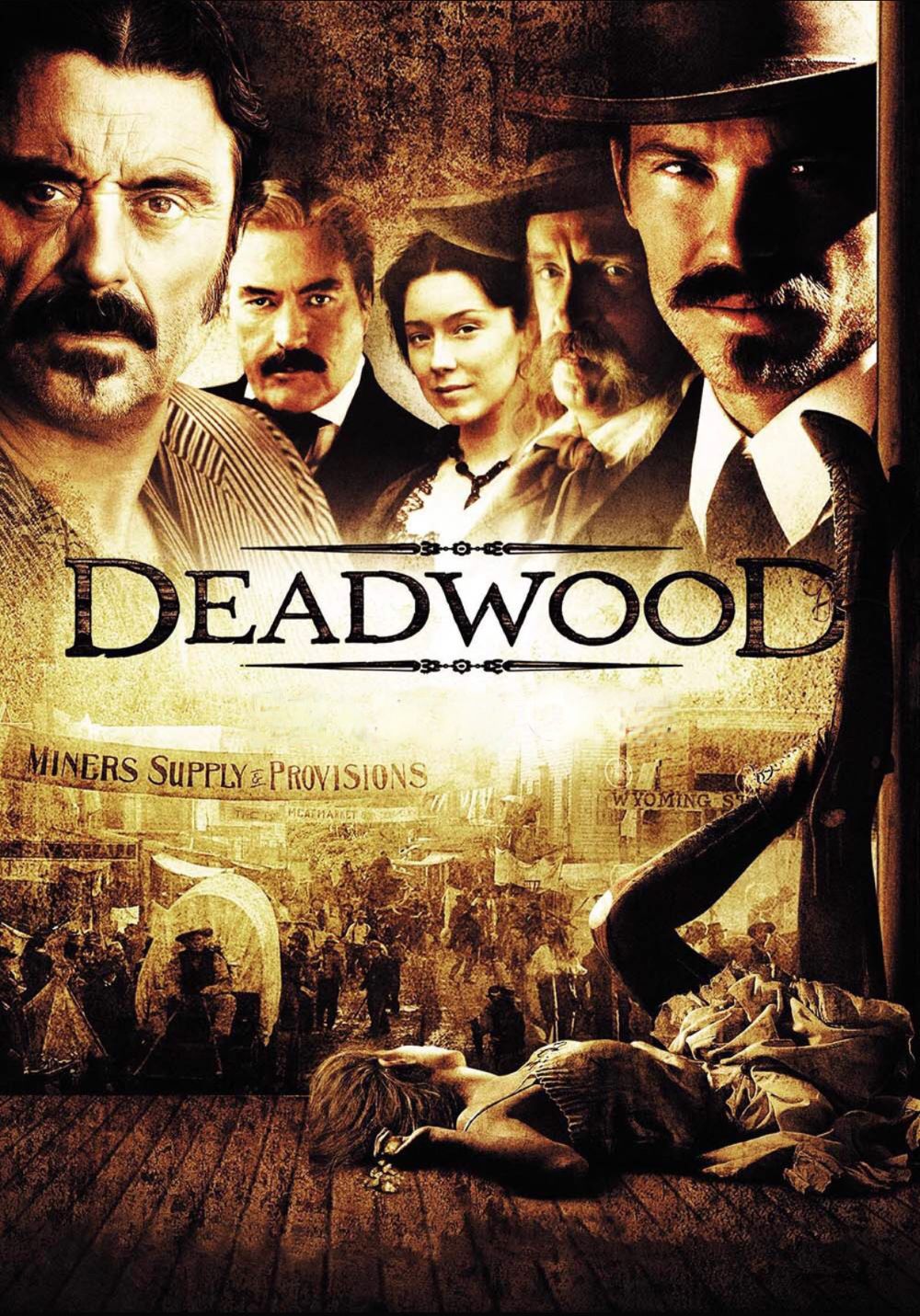
David Milch’s Deadwood is one of those rare television series that feels less like a conventional prestige drama and more like being dropped into a living, breathing, filthy historical world. Set in the rough gold-rush settlement of Deadwood, South Dakota, during the 1870s, the HBO series takes the familiar pieces of the Western—lawmen, gunfighters, prospectors, saloons, prostitutes, corrupt businessmen, and murder—and turns them into something far richer than a genre exercise. It is a Western, but it is also a story about the difficult, often ugly process of creating a society in the middle of chaos. Civilization in Deadwood is not built by noble speeches or clean acts of heroism. It is assembled through greed, fear, business deals, compromise, bloodshed, exploitation, loyalty, and the occasional act of real compassion.

The show’s biggest strength is its ability to make Deadwood itself feel like one of television’s great settings. At the beginning, the camp exists outside the reach of formal American law, which means everyone who arrives sees an opportunity. Some people come looking for gold. Others come looking to escape old lives, make money, gain power, or take advantage of people too desperate to protect themselves. Every character has a different idea of what Deadwood should become, and the series finds drama in the collision between those competing visions. A claim dispute, a murder, a business arrangement, an illness, a newspaper article, or even a random rumor can become part of the larger struggle over who gets to shape the town’s future.

At the center of that struggle is Seth Bullock, played by Timothy Olyphant with an intensity that makes him seem like he is always one bad conversation away from throwing somebody through a window. Bullock arrives in Deadwood with his friend and business partner Sol Star, hoping to start a hardware business and leave behind his past as a lawman. He wants a calmer, more stable existence, but the town almost immediately drags him back toward violence and public responsibility. Bullock has a powerful sense of justice, but he is not a smooth, patient hero. He is rigid, angry, stubborn, and frequently driven by instinct before reflection. Olyphant gives him a clenched physicality—the hard stare, the tense posture, the barely restrained frustration—that makes it clear Bullock is always fighting to keep the more destructive side of himself under control.

That is what makes Bullock such a compelling protagonist. Deadwood never treats him as a simple white-hat sheriff who comes to tame the frontier. He is more decent than many of the people around him, but he is not uncomplicatedly good. His moral certainty can become self-righteousness, and his willingness to defend the vulnerable can slide into an urge to control a situation through force. At times, Bullock’s anger is justified; at other times, it is frightening. Olyphant’s performance works because he does not try to make Bullock effortlessly likable. Instead, he makes him believable as a man who wants order, justice, and dignity in a place that seems designed to expose every violent impulse he is trying to bury.

If Bullock represents Deadwood’s rough version of moral order, Ian McShane’s Al Swearengen represents its ruthless understanding of power. As the owner of the Gem Saloon, Swearengen initially appears to be the obvious villain: a man who profits from vice, manipulation, intimidation, and murder. McShane gives him such enormous control over the role that every scene becomes more charged when Swearengen walks into it. His speech has a strange, unforgettable rhythm, moving between elaborate insults, sly observations, sudden bursts of rage, and dry comedy. He is part Shakespearean king, part criminal entrepreneur, and part exhausted manager trying to hold together a business and a town full of people who are constantly making life harder for him.

What makes Swearengen one of television’s greatest characters is that the series refuses to flatten him into a conventional bad guy. He is undeniably brutal, often monstrous, and capable of treating human beings as disposable pieces in a larger game. The show never asks the audience to forget that. But as Deadwood faces pressure from outside business interests, political maneuvering, and wealthy figures who see the camp as a resource to be absorbed, Swearengen’s investment in the town becomes clearer. He does not become a hero, but he develops into something more complicated: a man whose selfish ambition is inseparable from a practical, almost territorial loyalty to Deadwood. He understands that the camp can only survive if its people occasionally work together, even if he usually has to manipulate them into doing so.

The relationship between Bullock and Swearengen gives the series much of its electricity. They are rivals, reluctant allies, ideological opposites, and men who recognize certain necessary qualities in each other. Bullock sees Swearengen as a moral disease at the center of the camp. Swearengen sees Bullock as an unpredictable nuisance, but also as someone with the strength and authority to be useful. Their confrontations work because neither man can completely dominate the other. Olyphant and McShane create a tension that goes beyond physical threat. Their conflict reflects the show’s larger question: can Deadwood become a place governed by something closer to law and principle, or will it always belong to the people with the most money, violence, and influence?

Still, Deadwood would not be nearly as great if it were only the Bullock and Swearengen show. Its ensemble is one of HBO’s best, filled with actors who make the camp feel populated by people with histories, grudges, private fears, ambitions, and complicated ties to one another. John Hawkes is excellent as Sol Star, Bullock’s business partner and closest friend. Sol is quieter and more patient than Bullock, but Hawkes never lets that quietness fade into the background. He gives Sol an intelligence and decency that make him a crucial moral and emotional counterweight to Bullock’s volatility. His friendship with Bullock is one of the show’s most believable relationships because Sol understands the good in Bullock without ignoring the damage Bullock’s anger can cause.

Molly Parker is equally strong as Alma Garret, a wealthy widow who gradually becomes much more than an outsider caught in Deadwood’s orbit. Alma could have been written as a standard symbol of refinement in a crude frontier town, but Parker gives her tremendous resolve, intelligence, and emotional restraint. Her story is about survival in a different but no less dangerous form. She is forced to navigate grief, addiction, business interests, motherhood, and the expectations placed on a woman in a violently male world. Her relationship with Bullock is complicated in the best way because it is built from longing, frustration, guilt, repression, and circumstance rather than easy romance.

Anna Gunn brings similar depth to Martha Bullock, who becomes increasingly essential as the series develops. Martha could have been pushed aside as merely the protagonist’s wife, but Gunn makes her one of the clearest-eyed people in the camp. She understands the weight of family, grief, responsibility, and compromise, and she gives the character an emotional firmness that Bullock himself often lacks. Martha does not need grand speeches to establish her strength. Her endurance and intelligence gradually make her one of the show’s most quietly powerful figures.

Robin Weigert’s Calamity Jane is another unforgettable character, and one of the series’ most heartbreaking. Jane is loud, drunk, funny, self-destructive, and seemingly incapable of admitting how deeply she cares about people without covering it in profanity or sarcasm. Weigert finds the sadness beneath every messy outburst. Her love for Wild Bill Hickok, her loyalty to those who treat her with kindness, and her profound discomfort with herself make Jane much more than a colorful Western side character. She can be hilarious one minute and devastating the next, which is exactly the emotional balance Deadwood handles so well.

The supporting cast is so strong that the show continually finds new ways to make minor characters feel essential. Gerald McRaney brings a cold, weathered authority to George Hearst, the wealthy mining magnate whose arrival makes Deadwood’s conflicts larger and more dangerous. Hearst is not simply another local schemer. He represents the corporate and political forces that can crush a place like Deadwood from the outside, turning its chaos into something colder and more organized. McRaney plays him with a calm menace that is often more unsettling than open rage. He does not need to shout to make it clear how much power he has.

Brian Cox is terrific as Jack Langrishe, the theatrical and charismatic impresario whose arrival adds another kind of intelligence to the camp. Langrishe can be charming, funny, and seemingly generous, but Cox always lets the audience see the calculation behind the performance. He understands how to survive around men like Swearengen and Bullock because he knows that people are always playing roles, especially when power is on the line. Garrett Dillahunt also does remarkable work in two very different roles. He first appears as Jack McCall, the disturbed and dangerous killer whose actions leave a permanent mark on the camp. Later, he returns as Francis Wolcott, a polished, educated, deeply unsettling man whose manners barely conceal something vicious underneath. Dillahunt’s ability to make those roles feel so distinct is one of the more impressive acting achievements in the series.

Keith Carradine gives Wild Bill Hickok a tired, melancholy gravitas that makes the legendary lawman feel human rather than mythical. He is aware of his reputation, perhaps exhausted by it, and Carradine captures the loneliness beneath the public image. Jeffrey Jones is wonderfully eccentric as A. W. Merrick, Deadwood’s nervous but idealistic newspaper editor. Merrick’s love of language and belief in the importance of a free press make him both funny and unexpectedly vital. In a town shaped by violence and backroom deals, the act of recording events and trying to tell the truth becomes its own form of resistance.

Kim Dickens is excellent as Joanie Stubbs, a woman carrying deep emotional scars while trying to carve out independence in a world that treats vulnerability as an invitation to exploit someone. Her performance brings tenderness and pain to a character who could have easily been reduced to a plot device. Brad Dourif is another major presence as Doc Cochran, the camp’s exhausted, haunted physician. Dourif makes him funny, strange, compassionate, and spiritually worn down by everything he has seen. Jim Beaver is equally memorable as Whitney Ellsworth, the gruff prospector who gradually reveals himself to be one of the show’s warmest and most honorable people. Powers Boothe’s Cy Tolliver, meanwhile, offers a sharp contrast to Swearengen. He is just as ambitious and cruel, but he lacks Swearengen’s strange capacity for loyalty and for understanding that a town, however dirty and violent, is still an ecosystem that must be maintained.

Milch’s writing is famous for its dense, ornate, profanity-heavy dialogue, and it can take a little time to adjust to the show’s rhythm. These characters do not speak in the clean, direct language of a standard television Western. They circle around their meanings, launch into bizarrely poetic insults, turn routine negotiations into verbal duels, and sometimes say more through implication than through plain statements. But once the language clicks, it becomes one of Deadwood’s greatest pleasures. The dialogue gives the show its own identity. It makes the town sound as alive and unpredictable as it looks.

That stylized language also supports what Deadwood is really about. The series is not interested in selling a clean myth of American rugged individualism. It shows the frontier as a collision between people who need one another and often cannot stand one another. Deadwood grows through compromise, manipulation, sacrifice, corruption, and a slow recognition that nobody can survive entirely alone. Even the most vicious people become tied to a larger network of obligations. The show understands that communities are not built by saints. They are built by flawed, wounded, selfish people who occasionally discover that cooperating is better than destroying each other.

The original series ended after three seasons, which leaves it with an undeniably unfinished quality, but that does not lessen its accomplishments. If anything, the lack of a neat conclusion suits the show’s view of history. Deadwood is always changing, always threatened, and never fully settled. The later film provides a welcome return to the characters and offers some emotional closure, but the series remains the core achievement.

Deadwood is demanding television, but it is never hollow television. Its violence has consequences, its humor is vicious and surprisingly warm, and its characters become richer the more time the audience spends with them. Timothy Olyphant gives Seth Bullock the rage of a man trying to force order onto a world that resists it. Ian McShane turns Al Swearengen into a full, contradictory human being rather than a one-note villain. Around them, Milch assembled an extraordinary ensemble that makes every saloon, storefront, street, and muddy patch of ground feel inhabited. People may start the show for the gunfights, the outlaw mythology, and the famously inventive profanity, but the reason Deadwood endures is its people. It understands that civilization is not born cleanly. It is dragged into existence, often unwillingly, by damaged people trying to make a home in a place that barely resembles one.

Retro Television Review: Miami Vice 5.19 “Miracle Man”


Welcome to Retro Television Reviews, a feature where we review some of our favorite and least favorite shows of the past!  On Mondays, I will be reviewing Miami Vice, which ran on NBC from 1984 to 1989.  The entire show can be purchased on Prime!

This week, the Miracle Man arrives in Miami!

Episode 5.19 “Miracle Man”

(Dir by Alan Myerson, originally aired on June 21st, 1989)

Who is the Miracle Man?

The Miracle Man (played by Jose Perez) is an overweight, middle-aged man who sometimes wears an eye mask and a t-shirt with a big M on it.  He rallies the good people of Miami to take back their neighborhoods from the drug dealers.  He thwarts drug deals, even the ones that are actually a part of an undercover operation.  He’s something of a pest.  The cops wants to stop him.  The criminals want to kill him.  A news reporter (Zach Grenier) wants to make him a star.

In real life, he’s actually Gregory Esteban and he is Izzy’s cousin.  A former junkie, he blames himself for the overdose death of his daughter and he’s now determined to launch a one-man war against crime.  He’s also bipolar and running low on his meds, which makes him unpredictable.  Switek and Tubbs eventually catch the Miracle Man but he still manages to escape from the safehouse.  His actions lead to the death of this week’s drug dealers but they also lead to him getting killed as well.  That’s not really a surprise.  Guest stars almost always died on Miami Vice.

This episode didn’t work for me.  The Miracle Man character was too over-the-top to be taken seriously and, as a result, his story and his death didn’t have the emotional impact that it should have.  As well, the villains were forgettable and generic.  Considering how surreal Miami Vice could be, one would be justified in expecting this episode to be much more stylized than it was.  Unfortunately, it was just dull.  The Miracle Man could not save it.

Don Johnson is only in this episode for the first two minutes.  Edward James Olmos isn’t in it at all.  (Crockett and Castillo are described as being absent to prepare for a trial.)  The whole episode feels like filler.  I can kind of understand why it wasn’t aired during season 5’s original run.

Sorry, Miracle Man.

Retro Television Review: Miami Vice 3.16 “Theresa”


Welcome to Retro Television Reviews, a feature where we review some of our favorite and least favorite shows of the past!  On Mondays, I will be reviewing Miami Vice, which ran on NBC from 1984 to 1989.  The entire show can be purchased on Prime!

This week, a guest star breaks Sonny’s heart.

Episode 3.16 “Theresa”

(Dir by Virgil W. Vogel, originally aired on February 13th, 1987)

Sonny is planning on asking his girlfriend, Dr. Theresa Lyons (Helena Bonham-Carter), to marry him.  What Sonny doesn’t know is that Theresa is a junkie.  Back surgery caused her to develop a dependence on painkillers and, after she got in trouble for writing her own prescriptions, Theresa started dealing with drug dealers.  Theresa’s addiction has left her vulnerable to a long-haired drug lord named Wyatt (Brad Dourif).  Sonny recently arrested Wyatt but Wyatt has one of his dealers tell Theresa that he’ll only give her a fix if she steals the four evidence tapes from Sonny’s houseboat.  Theresa steals one tape.  The other tapes are destroyed when Wyatt bombs a police evidence warehouse!  Seriously, Wyatt doesn’t mess around and, when that warehouse goes up in flames, we’re reminded that Miami is not a place for the weak.  The police are in a war and they have no possible path to victory.  The bad guys are always willing to do what the police can not.

Most of this episode centers around Theresa and Sonny attempting to deal with her addiction and Sonny coming to realize that Theresa will have to return to the UK if she’s ever going to recover.  Even after Sonny gets suspended from the force while Internal Affairs investigates the theft of the tape, Theresa remains Sonny’s main concern.  It was actually kind of nice to see Sonny caring about someone again.  Don Johnson has been a bit inconsistent this season.  (There are several episodes were its obvious he was getting a bit bored with the part.)  But he does a good job in this episode.

As for the guest stars, Brad Dourif is charismatically evil as the smug and New Age-y Wyatt.  Helena Bonham Cater was only 20 when she appeared in this episode and she looked even younger.  That doesn’t exactly make her the most believable trauma doctor in the world.  Because of her youth, she’s miscast and there are a few times when she looks more like Crockett’s daughter than his girlfriend.  That said, Bonham Carter really sells the scene where she reveals her addiction to Crockett and she definitely captures the desperation of someone in need of another fix.

“Life’s not easy when you’re a lover,” Tubbs says at one point, “….or a primary investigator.”  With Sonny sidelined with his suspension and his personal drama, Tubbs got to play the role of concerned best friend and it’s one that Philip Michael Thomas always played well on the show.  If nothing else, you believe that Tubbs would take a bullet for his partner.  The show may end with Theresa returning to the UK and Sonny sadly looking down at the engagement ring that he’ll never give her but, fortunately, he’ll always have Tubbs.

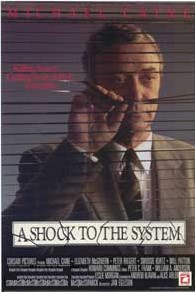
A Shock To The System (1990, directed by Jan Egleson)


Graham Marshall (Michael Caine) has spent years toiling away as an executive at an advertising firm and being nagged by his wife (Swoosie Kurtz), who claims that Graham doesn’t have enough of a killer instinct to get ahead.  When Graham is passed over for a promotion that he felt was promised to him, Graham starts to reconsider everything that he once believed.  While Graham is waiting for the train to take him home, he is approached by an obnoxious panhandler who always asks him for money.  That night, instead of ignoring the panhandler, Graham shoves him in front of the train.  When no one notices that Graham has murdered the panhandler, Graham decides to get revenge on everyone who he blames for the sorry state of his life.

With each murder, Graham rises higher in the company and he feels better about his life.  But each murder brings to Graham a new set of complications that he has to clean up.  Lt. Laker (Will Patton) thinks that Graham is responsible for all of the deaths that have recently occurred but he doesn’t have the evidence to charge him.  His murder spree brings him a chance of romantic redemption with Stella (Elizabeth McGovern) but soon, even she suspects that Graham might actually be a killer.  Luckily for him, Graham learns that he can get away with his crimes because the system is set up to protect men like him.

A Shock To The System is a pitch-black comedy that benefits from the casting of Michael Caine in the lead role.  Caine is one of the few actors who can make a resentful and bitter sociopath likable and he does that in A Shock To The System.  Graham starts out beaten down by the world and being passed over for younger executives like Bob Benham (Peter Reigert) but, by the end of the film, he’s become as ruthless a killer as Jack Carter.  Just as in Get Carter, A Shock To The System features Michael Caine making evil very compelling.

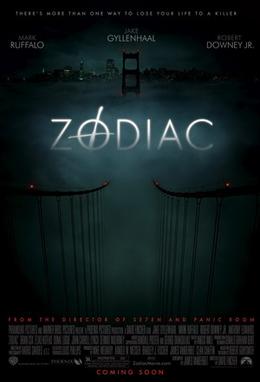
October True Crime: Zodiac (dir by David Fincher)


Who was the Zodiac Killer?

That is a question that has haunted journalists, cops, and true crime fans since the late 60s.  It is known that the Zodiac Killer murdered at least five people in Northern California in 1968 and 1969.  He targeted young couples, though he is also thought to have murdered on taxi driver as well.  What set Zodiac apart from other killers is that he was a prolific letter writer, who sent cards and ciphers to the police and the journalists who were reporting on his crimes.  In one of his ciphers, Zodiac claimed that he had killed 37 people.  Cartoonist Robert Graysmith later wrote two books about his personal obsession with the case.  He estimated that the Zodiac may have been responsible for hundred of murders, up through the 80s.  Of course, reading Graysmith’s first Zodiac book, it’s also easy to suspect that Graysmith reached a point where he saw the Zodiac’s hand in every unsolved murder in the San Francisco area.  Of all the unidentified serial killers in American history, Zodiac is one that most haunts us.  Zodiac was a serial killer who operated in an era when such things were still considered to be uncommon.  Much as Jack the Ripper did during the Victorian Age, Zodiac announced the arrival of a new age of evil.

Zodiac wrote about being a film fan and he was probably happy about the fact that he inspired quite a few films.  1971’s The Zodiac Killer came out while Zodiac was still sending letters to the police and cops actually staked out the theaters showing the film just to see if he  would show up.  Dirty Harry‘s Scorpio Killer was also based on Zodiac, right down to the taunting letters that he sent the mayor and again, one has to wonder if Zodiac ever showed up to watch Clint Eastwood take him down.

And, if Zodiac survived into the 21st Century, one has to wonder if he showed up in the theaters for 2007’s Zodiac.

One of the best true crime films ever made, Zodiac not only recreates the crimes of the Zodiac but it also examines the mental price of obsessing over the one unknown force of evil.  Mark Ruffalo plays Dave Toschi, the celebrity cop who nearly sacrificed his professional reputation in his search for the identity of the killer.  Jake Gyllenhaal plays cartoonist Robert Graysmith, who spends over a decade searching for the Zodiac’s identity and who loses his wife (Chloe Sevigny) in the process.  And Robert Downey, Jr. plays Paul Avery, the crime reporter to whom the Zodiac wrote and who sunk into paranoia and addiction as a result.  This is a film that is less about the Zodiac’s crime and more about how this unknown killer seemed to unleash a darkness that would come to envelope first a city and eventually an entire nation.

As one might expect from a film directed by David Fincher, Zodiac plays out like a filmed nightmare with the starkly portrayed murders being all the more disturbing because they often take place outside, where people would think they would be safe.  (The second murder is especially terrifying, as it plays out without even the sound of background music to allow us the escape of remembering that it’s only a movie.)  Fincher heightens our paranoia but having a different actor play the killer in each scene, reminding us that the Zodiac could literally be anyone.  Indeed, one of the scarier things about Zodiac is that, in the course of his investigation, Graysmith meets so many different people who seem like they could be the killer.  Even if they aren’t the Zodiac, the viewer is left with the feeling that the world is full of people who are capable of committing the same crimes.  The film becomes a journey into the heart of darkness, with the Zodiac becoming both a malevolent force and potentially your next door neighbor.  And with the film’s detailed recreation of the 60s and the 70s, the film becomes a portrait of a country on the verge of changing forever with the Zodaic and his crimes representing all the fear waiting in the future.

Again, as one might expect from a Fincher film, it’s a well-acted film, especially by Robert Downey, Jr.  Zodiac came out a year before Iron Man, when Downey was still better known for his personal troubles than for his talent.  Downey perfect captures his character’s descent into self-destruction, as he goes from being cocky and self-assured to being so paranoid that he’s carrying a gun.  (Paul Avery’s actual colleagues have disputed the film’s portrayal of Avery being mentally destroyed by the Zodiac.)  Ruffalo and Gyllenhaal also do a good job of portraying Toschi and Graysmith’s growing obsession with the case while Charles Fleischer and John Carroll Lynch both make strong (and creepy) impressions as two men who might (or might not) be the killer.

Though the film was not a success at the box office and it was totally ignored by the Academy, Zodiac has built up a strong reputation in the years since its released.  It’s inspired a whole new generation of web sleuths to search for the killer’s identity.  Personally, my favored suspect is Robert Ivan Nichols, an enigmatic engineer who abandoned his former life and changed his name to Joseph Newton Chandler III in the 70s and who committed suicide in 2002.  I think much like Jack the Ripper, the Zodiac’s identity will never be definitely known.  There have been many compelling suspects but most of the evidence seems to be circumstantial.  (That’s certainly the case when it comes to Nichols.)  The Zodiac was thought to be in his 30s or even his early 40s in 1969 so it’s doubtful that he’s still alive today.  In all probability, his identity and his motive will forever remain an unsolvable mystery.

Catching Up With The Films of 2022: She Said (dir by Maria Schrader)


To put it lightly, I had mixed feelings about She Said.

On the one hand, the downfall of Harvey Weinstein is an important story and it’s one that should never be forgotten.  It wasn’t that long ago that Weinstein was one of the most powerful people in Hollywood.  Many of the people who now regularly talk about how much they hated him had no problem working for him, taking his money, and thanking him whenever they won an award.  She Said focuses on the work of the two New York Times reporters, Jodi Kantor (Zoe Kazan) and Megan Twohey (Carey Mulligan), who wrote the initial article that detailed the allegations against Weinstein.  (Ronan Farrow’s New Yorker piece was published shortly afterwards.)  The film is not only about the article but it’s also about women working together and supporting each other.  Kazan and Mulligan both do a good job of portraying Jodi and Megan, bringing some nuance to a script that is full of dialogue that is occasionally a bit too on-the-nose.

On the other hand, it’s hard not to feel that She Said lets a lot of people off the hook.  While Jodi does originally pitch her story as dealing with systemic sexism, there’s actually very little examination of how the system enabled a monster like Harvey Weinstein.  Mention is made of Weinstein having powerful friends but few of those friends are called out by name and there’s very little discussion about how Weinstein used his money to become a player in Washington as well as Hollywood.  It leads to some odd narrative choices.  For instance, both Jodi and Megan are shocked to discover that Harvey is being represented by prominent feminist attorney Lisa Bloom, the daughter of Gloria Allred.  Jodi later talks about an off-screen conversation that she had with Bloom, in which Bloom tried to use a number of personal, political, and professional appeals to convince Jodi to drop the story.  It sounds like an interesting conversation but why don’t we get to see it?  Would it have cast Bloom in too negative of a light?  The film’s approach leaves it open to such accusations.  Indeed, it’s hard not to be reminded of the way that Rose McGowan was shunned when she (correctly) pointed out that a lot of the people celebrating Weinstein’s downfall were the same people who spent years ignoring what was an open secret in Hollywood.  The film tells us that Harvey Weinstein is a monster but we already know that.  What the film does not tell us is how he came to power and why he was protected for decades.

Thematically, She Said attempts to be a celebration of journalism, in the style of recent films like The Post, Truth, and Spotlight.  Like those films, it shares the same flat visual style.  There’s nothing particularly cinematic about it which is unfortunate as, with everyone already knowing how the story ends, She Said could have used some stylistic flair.  To a certain extent, I can understand the logic.  The emphasis is supposed to be on the reporters doing the hard work of getting the story and all of the recent films about journalism take a straight-ahead, by-the-numbers approach.  The problem with using this approach for She Said is that it leads to a lot of static, poorly framed shots of people talking on the phone, sitting at their desks, and staring at computer screens.  It may be a realistic depiction of modern journalism but it’s not particularly compelling to watch.  If anything, the film’s depiction of clean offices, supportive co-workers, and fair-minded editors makes the film feel like a testimonial about how The New York Times is the best workplace in America.  As opposed to the reporters in Spotlight, one never feels that Jodi and Megan are in danger of losing their jobs.  Unlike The Post or Shattered Glass, there’s no conversations about how the media establishment is often guilty of initially enabling the same behavior that it later condemns.  The New York Times never feels alive in the way that The New Republic did in Shattered Glass.  There’s not even a moment that’s as ludicrously over-the-top as the scene in Truth where Cate Blanchett argues that she shouldn’t be criticized for producing an obviously false story because it could have, in theory, been true.  Instead, She Said is very respectable and very dignified and a little too safe.  There’s not much going on beneath the surface. 

The film drops a lot of famous names.  Ashley Judd plays herself while Gwyneth Paltrow provides her voice for a scene in which she calls Jodi and says that Harvey has shown up at her house.  (Again, this is a scene that would probably have been more effective if we had seen it happen as opposed to just hearing about it.)  Lena Dunham is given a shout-out as someone who (off-screen) called and offered to help.  Someone casually mentions that Martin Scorsese hates Harvey Weinstein.  And yet, the film’s most powerful moments come when Jodi and Megan talk to the women who weren’t famous but who were still traumatized and victimized by Harvey Weinstein.  Samantha Morton and Jennifer Ehle play two former Miramax employees, both of whom eventually tell their stories to Jodi and Megan.  Morton and Ehle both give heart-felt performances and, during their scenes, She Said finds its reason for existing.  The performances of Samantha Morton and Jennifer Ehle both capture the real-life damage caused by men like Harvey Weinstein and the systems that enable them.

In the end, She Said is a film that I wanted to like more than I did.  It tells a compelling story in the least compelling way possible and, unlike Kitty Green’s The Assistant, it lets far too many people off the hook.


Film Review: Rescue Dawn (dir by Werner Herzog)


Dieter Dengler (Christian Bale) has been obsessed with flying ever since he was a child in Germany.  Towards the end of World War II, while his native country burned around him, Dieter would stare up at the skies and watch the American planes fly overhead and he knew that was not only what he wanted to do someday but also who he wanted to do it for.  Jump forward two decades, to 1966.  Dengler is now a lieutenant in the U.S. Air Force, an always smiling optimist who is considered to be something of a wild man.  When Dengler is reported as having been shot down over Loas, his fellow pilots are not only convinced that Dengler survived but that he’ll also eventually escape captivity.  Why?  Because they now Dieter Dengler is not the type to give up.

And they’re right.  Dengler not only survives the crash but he also survives in the wild.  After growing up in the rubble of Germany, Dengler is confident that he can survive anything.  Even when he’s finally captured by communist rebels, Dengler remains optimistic that he’ll make it back home.  When he’s told that he can go free if he signs a statement denouncing the United States, he refuses.  Dengler’s not going to turn on the country that allows him to fly.  Dengler soon finds himself being held in a POW camp with four other men, including two other Americans (played by Jeremy Davies and Steve Zahn).  The guards are determined to break Dengler but he’s just as determined to escape.  Hearing that it’s impossible to do so only makes Dengler more determined.

The story of Dieter Dengler and his eventual escape from captivity was originally told, by Dengler himself, in Werner Herzog’s 1997 documentary, Little Dieter Needs To Fly.  That Herzog saw Dengler as a kindred spirit is evident in the fact that, 9 years after the documentary, Herzog again told Dengler’s story in the 2006 film, Rescue Dawn.

On the face of it, a story about a group of Americans escaping from a POW camp might sound like an unlikely topic for a Werner Herzog film but it doesn’t take long for Herzog to put his own distinctive stamp on the project.  As played by Bale, Dengler is another one of Herzog’s obessessive heroes.  Dengler’s obsession is not just with flying but also with being free.  For Dengler, that’s what being an American means and that’s why he would rather be tortured than sign a simple piece of paper denying the existence of that freedom.  Much as how Grizzly Man portrayed Timothy Treadwell as being a man who would rather be eaten by a bear than live a life that’s been dictated by others, Dengler would rather suffer than betray his adopted country.

Rescue Dawn also centers around another common Herzog theme, the pitilessness of nature.  Watching Dengler trying to make his way through the jungle, we’re reminded that nature will always win in the end.  In Herzog’s world, neither nature nor the universe as a whole has any ideology.  Long after every warrior has died, the film tells us, nature will still be there.  The one thing that the POWs and their captors have in common is that they’re all at the mercy of the chaos of nature.  Just as the jungle threatens to swallow up Dengler and the other prisoners, their captors are slowly starving to death due to a drought.  As filmed by Herzog, the jungle is both beautiful and overwhelming.  Even at the film’s triumphant conclusion, it’s hard not to feel that, for all the planning, Dengler’s escape and survival was due to the random chaos of the universe.  How much can we control and how much must we simply leave up to the whim of nature?

Bale, Davies, and Zahn all give excellent performances and Herzog keeps the story moving quickly.  It’s probably one of his most emotionally accessible films and it’s impossible not to shed a tear at that final scene.  That said, I’d be remiss if I didn’t acknowledge that there’s a good deal of controversy about the way that Rescue Dawn portrays Gene DeBruin, the POW played by Jeremy Davies.  The film often contrasts Dengler with DeBruin.  If Dengler is always hopeful and determined, DeBruin is portrayed as being unstable and unreliable.  However, by most accounts — including the one given by another one of the prisoners — DeBruin was actually the exact opposite of how he was portrayed in the film.  Instead of being selfish, he was a source of strength for the POWs and he actually refused to take advantage of a previous chance to escape because it would have meant abandoning the rest of the prisoners.  Herzog has said that he wasn’t aware of DeBruin’s heroism when he wrote and directed the film and that he now regrets the way that DeBruin was portrayed.  (DeBruin’s brother has said that Herzog refused to talk to the family while the film was in poduction.)  Rescue Dawn is a well-made and wonderfully acted film and it’s one that always brings tears to my mismatched eyes but, while watching it, it’s impossible not to regret the injustice that was done to Gene DeBruin.

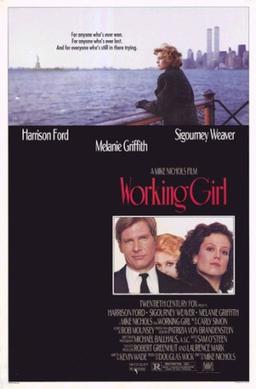
Lisa Reviews An Oscar Nominee: Working Girl (dir by Mike Nichols)


(With the Oscars scheduled to be awarded on March 4th, I have decided to review at least one Oscar-nominated film a day.  These films could be nominees or they could be winners.  They could be from this year’s Oscars or they could be a previous year’s nominee!  We’ll see how things play out.  Today, I take a look at the 1988 best picture nominee, Working Girl!)

Welcome to the 80s!

Yes, Working Girl is definitely a film of its time.  It’s a film that’s obsessed with big things: big dreams, big offices, big money, and big hair.  It’s a movie where the heroes talk about hostile takeovers and where everyone’s dream is to eventually to be an executive on Wall Street.  You know all of those people who claim that The Big Short is the greatest movie ever made?  I can guarantee that the majority of them would totally hate every character in Working Girl.  Working Girl is such a film of the past that it even features Alec Baldwin doing something other than bellowing at people.  In fact, Baldwin’s actually sexy in Working Girl.  It was strange to see him in this film and realize that he was the same actor who currently spends all of his time picking fights on twitter and defending James Toback.

Of course, Alec Baldwin has a relatively small role in Working Girl.  He plays Mick Dugan, the type of blue-collar guy who gives his girlfriend lingerie for her birthday (“I just wish you would get me something that I could wear outside,” she says as she tries it on) and who then proceeds to cheat on her while she’s off at work.  From the minute we first meet Tess McGill (Melanie Griffith), we know that she deserves better than Mick.

Tess is a professional administrative assistant.  She’s just turned 30 but she’s not ready to give up her dreams and settle for a life of fighting off coke-snorting executives and coming home to some guy like Mick.  (Speaking of early performances from infamous actors, one of the coke-snorting executives is played by Kevin Spacey.)  Tess has got a bachelor’s degree in Business.  As she puts it, she has a “mind for business and a bod for sin.”

She’s also got a new boss, an up-and-coming executive named Katharine Parker (Sigourney Weaver).  It turns out that Katherine is 29 years old.  (“I’ve never worked for someone younger than me before,” Tess says as Katherine gives her a condescending smile.)  Katharine encourages Tess to think of her as being a mentor.  If Tess has any ideas for investments, she should feel free to bring them to Katharine.  Of course, when Tess does so, Katharine claims that her bosses shot the idea down.  It’s only after Katharine breaks her leg in a skiing accident and is laid up in Europe that Tess discovers that Katharine has actually been stealing her ideas and not giving her any credit for them.

What is Tess to do?  Well, she does what any of us would do.  She passes herself off as an executive and presents her idea to Jack Trainer (Harrison Ford) herself.  Jack is impressed with the idea but he’s even more impressed with Tess.  Of course, complicating things is that Jack was once in a relationship with Katharine and Katharine still thinks that she’s going to eventually marry Jack.  And, of course, there’s the fact that Tess is lying about actually being an executive…

Working Girl is a frequently amusing film, elevated by performances of Melanie Griffith and, in the role of Tess’s best friend, Joan Cusack.  Add to that, Harrison Ford is remarkable non-grouchy as Jack Trainer and Sigourney Weaver appears to be having the time of her life playing a villain.  Even as I laughed at some of the lines, here was a part of me that wished that the film had a bit more bite.  At times, Working Girl tries too hard to have it both ways, both satirizing and celebrating Wall Street culture.  In the end, the film works best as a piece of wish-fulfillment.  It’s a film that says that not only can you win success and Harrison Ford but you can get your bitchy boss fired too.

Despite being a rather slight (if likable) film, Working Girl was nominated for Best Picture of 1988.  However, it lost to Rain Man.

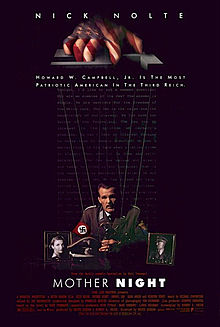
A Movie A Day #113: Mother Night (1996, directed by Keith Gordon)


Four years after she played the mysterious (and dead) Laura Palmer in Twin Peaks, Sheryl Lee starred as another mysterious (and possibly dead) woman in Mother Night.

Lee is cast as Helga Noth, the German wife of American expatriate Harold W. Campbell (Nick Nolte).  Harold is a playwright, living in Berlin and doing propaganda broadcasts for the Nazis.  Working with Frank Wirtanen (John Goodman), a military intelligence officer, Campbell has developed a series of verbal tics that are meant to secretly deliver information to the Allied Forces.  It is never clear whether Harold’s information serves any real purpose just as it is left ambiguous as to whether Harold believes any of the anti-Semitic propaganda that he broadcasts over the airwaves.  Working as both a propagandist and a double agent, Harold serves both the Allies and the Axis.

In the final days of the war, Helga is reportedly killed on the Eastern Front and Harold is captured by the Americans.  Frank arranges for Harold to be quietly sent to New York City but tells him that the government will never admit that they used him as a double agent.

Harold spends the next fifteen years living an isolated life in New York.  His only friend is an elderly painter, Kraft (Alan Arkin), with whom he plays chess.  Eventually, Harold opens up to the painter and talks about his past.  Kraft, for his own shady reasons, reveals Harold’s identity to a group of neo-Nazis.  Though Harold initially wants nothing to do with them, this changes when they reveal that they have Helga.

Or do they?  Almost no one in Mother Night is who they claim or what they seem to be, especially not Harold.

Based on a novel by Kurt Vonnegut, Mother Night suffers from the same uneven quality that seems to afflict most films based on Vonnegut’s work.  It is easy to go overboard when it comes to bringing Vonnegut’s unique mix of drama and satire to the screen and Mother Night does that in a few scenes, especially once Harold reaches New York.  It is still an intriguing and thought-provoking film, though.  Nick Nolte gives one of his best performances as Harold and Sheryl Lee does a good job in a difficult role.

The pinnacle of Vonnegut films remains George Roy Hill’s version of Slaughterhouse-Five but Mother Night is still superior to something like Alan Rudolph’s adaptation of Breakfast of Champions.