Review: War of the Worlds (dir. by Steven Spielberg)


“This is not a war any more than there’s a war between men and maggots… This is an extermination.” — Harlan Ogilvy

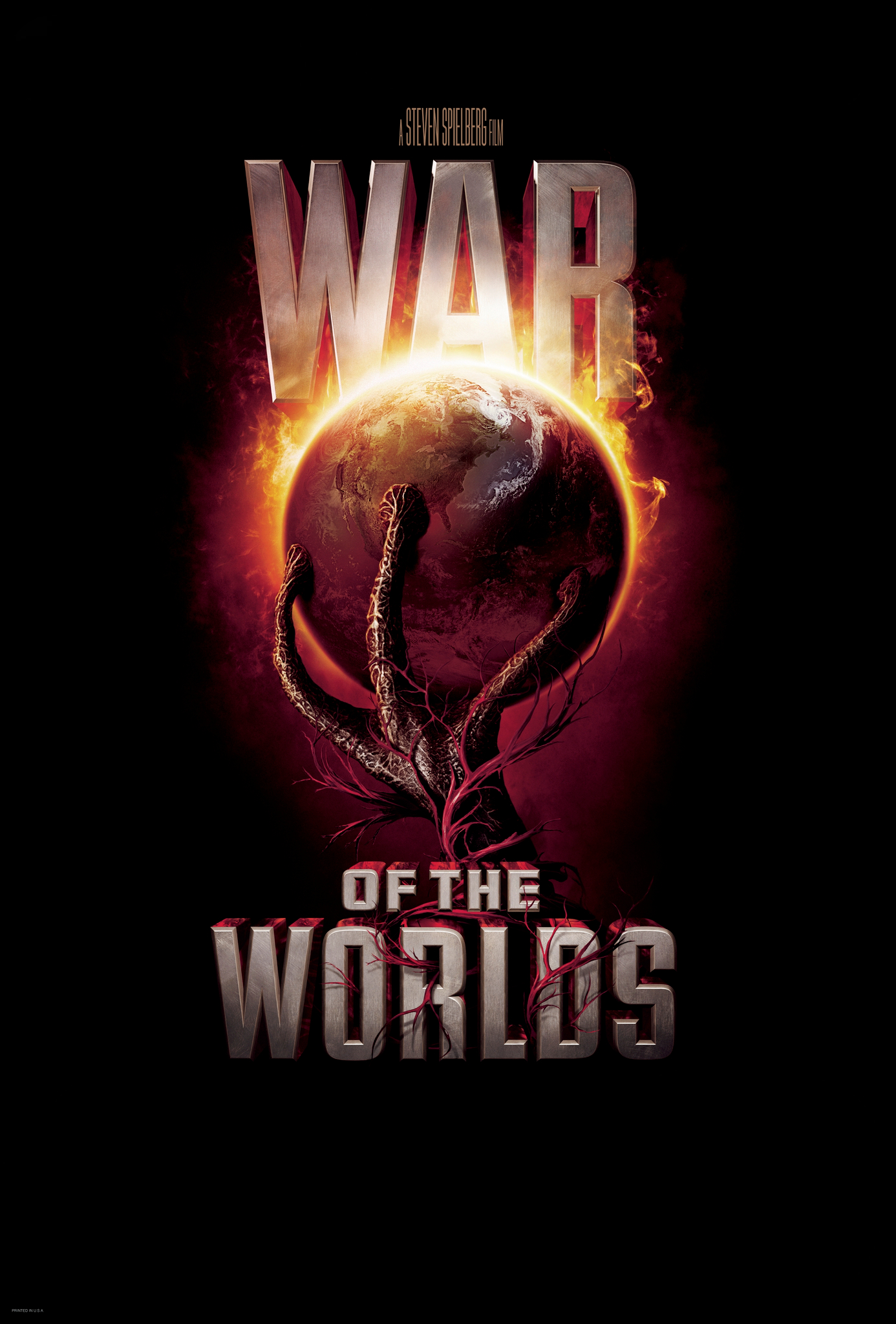
When looking back at the vast filmography of Steven Spielberg, science fiction usually evokes a sense of sweeping wonder, starry-eyed optimism, or at the very least, a deeply felt humanism. Films like Close Encounters of the Third Kindand E.T. the Extra-Terrestrial taught generations to look at the stars with hope rather than dread. Even when things took a darker turn in Jurassic Park or the neon-drenched corridors of Minority Report, there remained a foundational thrill—a cinematic ride that ultimately leaves the audience exhilarated. However, his 2005 adaptation of H.G. Wells’ classic novel, War of the Worlds, stands as a radically different beast altogether. It is arguably the bleakest, most claustrophobic blockbuster Spielberg ever directed, operating less as an adventurous alien invasion epic and more as a raw, nerve-shredding analog for collective trauma. Emerging a mere four years after the collapse of the Twin Towers, the film strips away the romanticism of cosmic exploration and replaces it with a visceral, ground-level nightmare of sudden, inexplicable annihilation.

The brilliance of Spielberg’s approach, working alongside screenwriter David Koepp, lies in how intensely localized the narrative remains. Rather than tracking the invasion from the traditional perspective of military command centers, global leaders, or brilliant scientists, the audience is trapped inside the chaotic, deeply flawed perspective of Ray Ferrier, played with a brilliant, unheroic franticness by Tom Cruise. Ray is not a savior; he is a deadbeat, blue-collar crane operator living in a graying New Jersey suburb. He is the kind of father who doesn’t know his son’s school schedule and has an empty refrigerator when his ex-wife drops off their two children, Robbie and Rachel. By centering the apocalypse around a fractured, working-class American family, Spielberg roots the cosmic terror in a painful reality. The impending destruction of the planet mirrors the collapse of Ray’s domestic stability, forcing a man who can barely manage basic parental accountability to suddenly navigate the literal end of the world.

From a purely technical standpoint, the first act of War of the Worlds features some of the most masterful suspense and terror ever committed to celluloid, heavily leaning on a barrage of explicit 9/11 visual imagery. The sequence where the first Martian Tripod emerges from beneath a New Jersey intersection is a masterclass in modern cinematic dread, directly weaponizing the fresh, collective trauma of the post-9/11 American public. Spielberg eschews the clean, omniscient visual language of standard disaster cinema for an organic, chaotic documentary style, mirroring the sudden, disorienting informational and electronic blackout experienced by millions during the real-world attacks. The camera lingers on heavy, ominous storm clouds moving against the wind, the eerie crackle of localized lightning strikes, and the unsettling silence of a neighborhood stripped of electronic life. When the asphalt fractures and the colossal, three-legged war machine rises from the earth, the sound design hits the audience like a physical blow. The Tripod’s horn—a terrifying, mechanical foghorn groan—instantly triggers an ancient, mammalian fight-or-flight response. As the machine opens fire with its disintegration beams, turning nearby pedestrians into literal puffs of ash, the camera tracks Ray running for his life through a massive, rolling cloud of dust and debris. When Ray finally makes it back to his house, the ash of his vaporized neighbors covers his clothes and face, an unmistakable and deeply unsettling visual that explicitly echoes the horrific reality of the streets of Manhattan on September 11, 2001.

This deliberate invocation of post-9/11 anxiety is the thematic engine that drives the entire film. Spielberg does not hide these parallels; he highlights them with a devastating accuracy that makes the film difficult to watch even decades later. When the invasion begins, a terrified, screaming Rachel asks her father if it is “the terrorists,” a line that perfectly encapsulates the collective, reactionary psyche of the mid-2000s American consciousness, where any sudden, catastrophic violence was instantly filtered through the lens of domestic terrorism. The imagery of walls plastered with photocopied missing-persons flyers, crowds of refugees trudging down desolate highways with whatever belongings they can carry, and a derailed, blazing passenger train hurtling past an abandoned station all tap into a very specific, historical vulnerability. In Independence Day, an alien invasion was an opportunity for global unity and triumphant, cigar-chomping counter-offensives. In Spielberg’s hands, the invasion is an overwhelming, asymmetric slaughter that reduces the world’s most powerful military to a collection of burning tanks rolling over a ridge into an invisible abyss.

However, while the film masterfully handles the grand-scale terror of the invasion, it stumbles significantly when navigating its internal family dynamics, particularly regarding Ray’s son, Robbie, played by Justin Chatwin. I completely agree with the widespread criticism that Robbie is an intensely annoying, deeply self-destructive presence whose actions and decisions repeatedly defy basic human survival instincts. Throughout the crisis, his behavior goes beyond typical teenage rebellion and crosses into pure narrative absurdity. Instead of helping protect his traumatized, screaming younger sister, Robbie consistently sabotages his family’s safety to aggressively gawk at a hopeless war zone. His sudden, obsessive urge to join a military force that is clearly being pulverized by an unearthly power feels entirely unearned and maddening to watch. His character arc reaches a peak of irritation when he blindly runs over a burning ridge directly into a mechanical meat grinder, abandoning his family for a bizarre, suicidal patriotic impulse. This makes his miraculous survival at the end of the film a massive narrative misstep; having him casually show up at his grandparents’ pristine Boston home after witnessing a literal military massacre completely undermines the high-stakes realism Spielberg spent two hours building, turning what should have been a tragic consequence of his own foolishness into a cheap, unearned happy ending.

As the narrative progresses past the family friction, the film shifts its focus from external spectacle to the internal breakdown of human morality under the weight of existential terror. This transition is embodied by the mid-movie introduction of Harlan Ogilvy, played with an unsettling, unhinged intensity by Tim Robbins. Trapped in a dark basement while the Martians harvest the surrounding countryside, Ray and Ogilvy represent two radically different, yet entirely believable, reactions to trauma. Ogilvy is consumed by a vengeful, nihilistic madness, obsessed with digging tunnels and launching a futile, suicidal guerrilla war against an enemy that operates on a completely different evolutionary plane. Ray, conversely, is driven solely by a desperate, animalistic urge to protect his daughter. The sequence culminating in Ray’s decision to kill Ogilvy behind closed doors to keep him from alerting the aliens is one of the darkest thematic beats in Spielberg’s career. It forces the audience to confront a disturbing truth: the true horror of the apocalypse is not just what the monsters do to us, but what we are willing to do to each other to survive another hour.

The film’s visual palette, masterfully crafted by cinematographer Janusz Kamiński, reinforces this pervasive sense of rot and despair. Kamiński utilizes a heavily bleached, high-contrast aesthetic that drains the world of vibrant color, leaving behind a cold, metallic landscape dominated by sickly slates, deep shadows, and stark whites. This visual harshness reaches its zenith during the infamous “Red Weed” sequence. As the Tripods begin carpet-bombing the landscape with human blood to fertilize an invasive, crimson alien flora, the film transforms into a surrealist, gothic horror show. The Earth itself is literally being terraformed by the bodily fluids of the slaughtered, creating a grotesque, bleeding ecosystem that visually mirrors the internal rot of the surviving human populations. It is a sequence that feels closer to the cinematic nightmares of H.R. Giger than the traditional whimsy of a Spielbergian adventure.

Despite its immense strengths, War of the Worlds is frequently criticized for its final act, a critique that deserves a nuanced evaluation. The abrupt resolution—wherein the seemingly invincible Martians suddenly succumb to Earth’s microscopic bacteria—is lifted directly from H.G. Wells’ original 1898 text. While narratively faithful, its execution in a modern Hollywood blockbuster can feel jarring, functioning as a biological deus ex machina that robs the human protagonists of a traditional, heroic victory. Furthermore, Robbie’s unearned survival represents a sudden, almost desperate pivot back toward Spielberg’s traditional family-first sentimentality. This neat resolution feels somewhat unearned given the preceding two hours of unrelenting, uncompromising nihilism, momentarily fracturing the film’s gritty, documentary-like reality.

Yet, looking past these structural stumbles, the final voiceover adaptation of Wells’ text offers a profound philosophical punctuation mark to the nightmare. The realization that humanity has earned its right to survive on this planet not through military might or moral superiority, but through millions of years of evolutionary struggle alongside the tiniest microbes, recontextualizes the entire ordeal. It reminds the audience of our inherent fragility and the hubris of believing ourselves to be permanently secure in our modern, technological fortresses. Spielberg’s War of the Worlds remains an incredibly potent piece of mainstream filmmaking precisely because it refuses to comfort its audience for the majority of its runtime. It stands as a brilliant, terrifying time capsule of an era defined by sudden vulnerability, demonstrating that even the master of cinematic wonder could look into the abyss of the cosmos and see nothing but our own reflections looking back in sheer terror.
Lisa Reviews An Oscar Nominee: Captain Phillips (dir by Paul Greengrass)


tom-hanks-barkhad-abdi-captain-phillips

Here’s an interesting and often overlooked fact:

It has been 17 years since Tom Hanks was last nominated for Best Actor.

When I discovered this fact, I was shocked because Tom Hanks is one of those actors who has a reputation for always getting nominated.  We tend to think of him as almost being a male Meryl Streep, an actor who will be nominated simply for showing up.  But, actually, the Academy last nominated Tom Hanks, for his performance in Cast Away, in the year 2000.

Hanks has given plenty of strong performances since then and he’s continued to appear in acclaimed and Oscar-nominated films.  And you would think, considering his apparent popularity in Hollywood, Tom Hanks would have been nominated for everything from Charlie Wilson’s War to Bridge of Spies.  But no.

Personally, I think Hanks should have been nominated this year for Sully.  But you know what Hanks performance truly deserved some Oscar recognition?

Captain Phillips.

Playing the title role in this 2013 Best Picture nominee, Hanks gave perhaps the best performance of his career.  That he was snubbed by the Academy is not only shocking but it’s actually a bit unforgivable.  Perhaps Hanks was so good that the Academy took him for granted.  Perhaps they thought that since both Hanks and Richard Phillips are decent, down-to-Earth guys, that Hanks was just playing himself.  For whatever reason, Tom Hanks deserved, at the very least, a nomination.

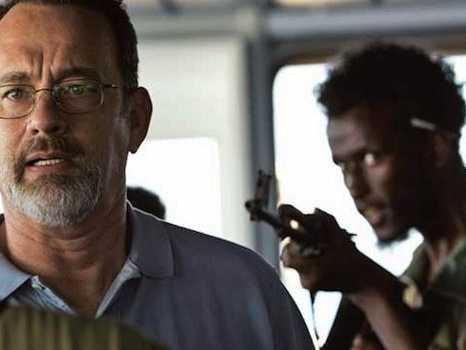
Captain Phillips was based on a true story.  This is another docudrama from director Paul Greengrass, filmed in his signature (and potentially nausea-inducing) handheld style.  (Actually, if any aspiring director wants to understand how to effectively use the handheld style, Greengrass is the filmmaker to study.)  In 2009, a four Somali pirates hijacked the Maersk Alabama and took its captain, Richard Phillips, hostage.  Captain Phillips was eventually rescued by a group of Navy SEALS.  Three of the pirates were killed while their leader, Muse (Barkhad Abdi), was captured and is currently serving a 33 year sentence in a federal penitentiary.

This was a huge news story in 2009 with the rescue being described as being the first major foreign policy victory for the new presidential administration.  When Phillips was rescued, people took to the streets and the “USA!  USA!” chant was heard.  “That’s right,” the media and the government and the chanters seemed to be exclaiming in unison, “America’s back!  We were abused and it’s never going to happen again!”

A lot of that jubilation was because, at the time, the term “Somali pirates” conjured up visions of cinematic villains who would be more at home in Mad Max: Fury Road than in the real world.  The reality of the situation, of course, was that the “pirates,” whose deaths were celebrated as some sort of political victory for the government, were actually poverty-stricken Somali teenagers, the majority of which worked for warlords who remained (and still remain) safely hidden away.

One of the more interesting things about Captain Phillips is that it devotes almost as much time to the Somali pirates as it does to Phillips and his crew.  Rather than presenting them as a nameless and personalityless threat, the film allows Muse and his men to emerge as individuals.  Much as Phillips spends the movie trying to keep both himself and his crew safe, Muse spends much of the movie trying to keep an increasingly out-of-control situation stable.  Both Phillips and Muse are in over their heads.  Barkhad Abdi gives a smart and intimidating performance as Muse.  The film never makes the mistake of excusing the actions of Muse or the other pirates but, at the same time, it does provide a more nuanced view of them than one would normally expect.

But really, this film totally belongs to Tom Hanks.  Captain Phillips works because of Tom Hanks.  It earned its best picture nomination on the strength of Hanks’s performance.  As an actor, Hanks could have easily coasted on the good will that the audience would have already had for him but instead, he fully commits himself to playing not Tom Hanks but instead Captain Richard Phillips.  The film’s final scene — in which Phillips goes into a state of shock and can’t stop talking — is a masterclass in great acting.  How the Academy ignored it, I will never understand.

Captain Phillips was nominated for best picture of 2013.  However, it lost to 12 Years a Slave.


Insomina File No. 16: Kill The Messenger (dir by Michael Cuesta)


What’s an Insomnia File? You know how some times you just can’t get any sleep and, at about three in the morning, you’ll find yourself watching whatever you can find on cable? This feature is all about those insomnia-inspired discoveries!

Kill_the_Messenger_poster

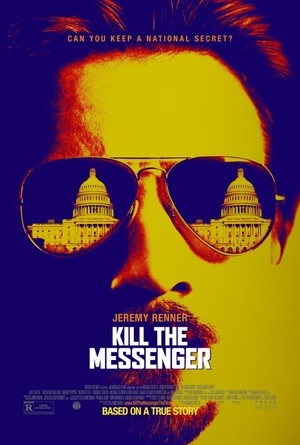
Last night, if you were awake and unable to get any sleep at 1:45 in the morning, you could have turned over to Cinemax and watched the 2014 conspiracy thriller, Kill The Messenger.

Kill The Messenger opens with one of those title cards that assures us that the movie we’re about to see is based on a true story.  We are then introduced to Gary Webb (Jeremy Renner), a California-based reporter who we know is a rebel because he has a precisely trimmed goatee.  Gary is interviewing a suspected drug smuggler (Robert Patrick) at the smuggler’s luxurious mansion.  Suddenly, the DEA storms the house, shouting insults and roughly throwing everyone to the ground, including Gary.  It’s actually exciting and promising opening, one that perfectly establishes both Gary as a truth seeker and the U.S. government as an invading army that’s fighting a war that’s full of collateral damage.

Gary, of course, has nothing to do with smuggling drugs.  He was just in the wrong place at the wrong time.  If he was treated unfairly by the DEA, it’s just because the government is serious about winning the war on drugs!

Or is it?

Following up on a tip, Gary comes across evidence that, in order to raise money for pro-Amercian rebels in Central America, the CIA not only helped to smuggle drugs into the U.S. but also arranged for the drugs to largely be sold in poor, minority neighbors where, in theory, no one would notice or care.

When the story is finally published, Gary is briefly a celebrity.  Not surprisingly, the government denies his accusations and start tying to discredit him.  However, Gary also finds himself being targeted by his fellow journalists.  Angry over being outscooped by a relatively unknown reporter, The Los Angeles Times and The Washington Post both launch their own investigations.  Instead of investigating Gary’s allegations, they jealously and viciously investigate Gary himself.

Soon, both Gary’s career and his family are falling apart and Gary finds himself growing more and more paranoid…

Remember when everyone was expecting Kill The Messenger to be a really big deal?  It was due to come out towards the end of 2014, right in the middle of Oscar season.  Jeremy Renner was being talked up as a contender for best actor.  Then the film came out, it played in a handful of theaters for a week or two, and then it sunk into obscurity.  Some commentators even complained that Focus Features buried the release of Kill The Messenger and that the film was ignored because of its leftist politics…

Of course, it’s just as probable that Focus Features realized that The Theory of Everything was more likely to charm audiences than a movie that suggested the U.S. government was behind the drug epidemic.

Or it could have just been that, despite telling a potentially intriguing story, Kill The Messenger was an oddly bland film.  Other than one scene in which he admits to cheating on his wife, Gary Webb is portrayed as being such a saint that it actually causes the film to lose credibility.  (Don’t get me wrong.  For all I know, he was a saint.  But, from a cinematic point of view, sainthood is never compelling.)  This is one of those earnest films that gets so heavy-handed that, even if you agree with what the movie is saying, you still resent being manipulated.  (Of course, some of us have grown so cynical about the media that we automatically doubt the veracity any movie that opens with those dreaded words: “Based on a true story.”)  Watching Kill The Messenger, one gets the feeling that a documentary about Gary Webb would probably be more compelling (and convincing) than a fictionalized dramatization.

(Unfortunately, if you think it’s difficult to get an audience to watch a movie that suggested the U.S. government was behind the drug epidemic, just try to get them to watch a documentary about … well, anything.  I know most of our readers would probably happily watch a documentary but that’s because y’all are the best and a thousand times better than the average person.  Love you!)

Here’s what did work about Kill The Messenger: the performances.  Jeremy Renner, who also produced this film, gives an excellent performance as Gary, especially in the scenes where he realizes that both the government and the press are now conspiring about him.  Rosemarie DeWitt has the traditionally thankless role of being the supportive wife but she still does a good job.  And finally, Ray Liotta shows up for one scene and is absolutely chilling in that way that only Ray Liotta can be.

Kill The Messenger doesn’t quite work but, thanks to the cast, it is, at the very least, a watchable misfire.

Previous Insomnia Files:

  1. Story of Mankind
  2. Stag
  3. Love Is A Gun
  4. Nina Takes A Lover
  5. Black Ice
  6. Frogs For Snakes
  7. Fair Game
  8. From The Hip
  9. Born Killers
  10. Eye For An Eye
  11. Summer Catch
  12. Beyond the Law
  13. Spring Broke
  14. Promise
  15. George Wallace

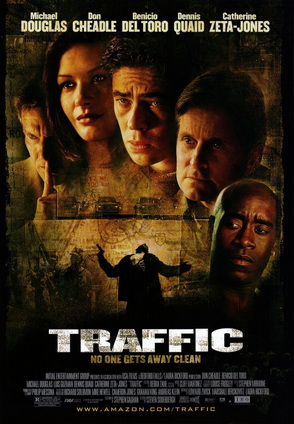
Shattered Politics #69: Traffic (dir by Steven Soderbergh)


Traffic2000Poster

I have mixed feelings about Steven Soderbergh.  On the one hand, his talent cannot be denied and you have to respect the fact that he’s willing to take chances and make films like The Girlfriend Experience and The Informant.  On the other hand, he’s also the director who has been responsible for overrated messes like Contagion and utter pretentious disasters like Haywire.  And it doesn’t help that Soderbergh’s fanbase seems to be largely made up of the type of hipsters who end up leaving comments under the articles at The A.V. Club.  Some people mourned Soderbergh’s retirement.  Personally, I think he made the right decision.  He retired before his misfires ended up outnumbering all of his masterpieces.

The thing about Soderbergh is that his good films are so good that it makes it all the more frustrating to watch his failures.  If Soderbergh was just your typical bad director than a film like Contagion wouldn’t be as annoying.  But this is the man who also gave us Traffic!

And Traffic is a very good film.

First released in 2000, Traffic attempted to deal with the American war on drugs, a war that the film suggests might not even be worth fighting.  (Full disclosure: I support the legalization of drugs and, for that matter, just about everything else.  And yes, I am biased towards films that agree with me.  So is every other film critic out there.  The difference is that I’m willing to admit it.)  Traffic won four Oscars, including Best Director and Best Supporting Actor for Benicio Del Toro.  It was also nominated for best picture but lost to Gladiator.

Traffic tells three, barely connected stories.  Each story is given its own distinct look, feel, and color scheme.  And while it takes a few minutes to get used to film’s visual scheme, it ultimately works quite well.  Though all of the film’s characters share the same general existence, they live in different worlds.  The only thing linking them together is drugs.

Judge Andrew Wakefield (Michael Douglas) is a judge on the Ohio Supreme Court who has recently been named as the new drug czar.  However, while Judge Wakefield is going around the country and talking to politicians (Harry Reid shows up playing himself and is just as creepy as always), his daughter Caroline (Erika Christensen) is dating Seth (Topher Grace) and getting addicted to cocaine and heroin.  When Caroline run away, Judge Wakefield recruits Seth and, using him as a guide, searches the ghetto for his daughter.

The Wakefield scenes are bathed in cold and somber blues.  They’re beautiful to look at but, in some ways, they’re also some of the weakest in the film.  The whole plotline of Caroline going from being an innocent honor’s student to being a prostitute who sells her body for heroin feels a lot like the notorious anti-drug film Go Ask Alice.  At the same time, it’s interesting and a little fun to see Topher Grace playing such a little jerk.  Grace gets some of the best lines in the film, especially when he attacks Wakefield’s feelings of smug superiority.

In the film’s second storyline, two DEA Agents (Don Cheadle and Luis Guzman) arrest drug trafficker Eddie Ruiz (Miguel Ferrer).  Eddie works for the Ayala syndicate and, once he’s arrested, he turns informant.  Drug lord Carlos Ayala (Steven Bauer) is arrested.  While Carlos sits on trial, his pregnant wife (Catherine Zeta-Jones) and his sleazy business associate (Dennis Quaid) struggle to hold together the business and find a way to kill Ruiz before he can testify.

This storyline is filmed in bright and vibrant colors and why not?  The Ayalas are rich and, unlike the Wakefields, they don’t feel the need to hide their material wealth.  This is actually probably my favorite storyline, largely because it’s the best acted and the most entertaining.  Miguel Ferrer, in particular, steals every scene that he’s in.  The scene where he explains the economics of being a drug trafficker is fascinating to watch.

The Ayala storyline may be my favorite but the film’s most thought-provoking storyline is the third one.  Taking place in Mexico, it stars Benicio Del Toro as Javier Rodriguez, a casually corrupt police officer who gets recruited to work for General Salazar (Tomas Milian), who is heading up Mexico’s war on the cartels.  Following the orders of Salazar, Javier captures assassin Frankie Flowers (Clifton Collins, Jr.) who is then savagely tortured by Salazar until he turns informer.  Javier comes to realize that Salazar is actually working for one of Mexico’s cartels.  When he decides to inform on Salazar, he puts his own life at risk.

The Mexico storyline is also the harshest and visually, it reflects that fact.  The heat literally seems to be rising up from the desert and the streets of Tijuana.  It takes a few minutes to adjust to the look of the Mexico scenes but, once you do, they become enthralling.

And Traffic, as a film, is undeniably enthralling as well.  Soderbergh deftly juggles the multiple storylines and brings them together to create a portrait of a society that’s being destroyed by the efforts to save it.  Hopefully, if Soderbergh ever does come out of retirement, he’ll give us more films like Traffic and less films like Contagion.