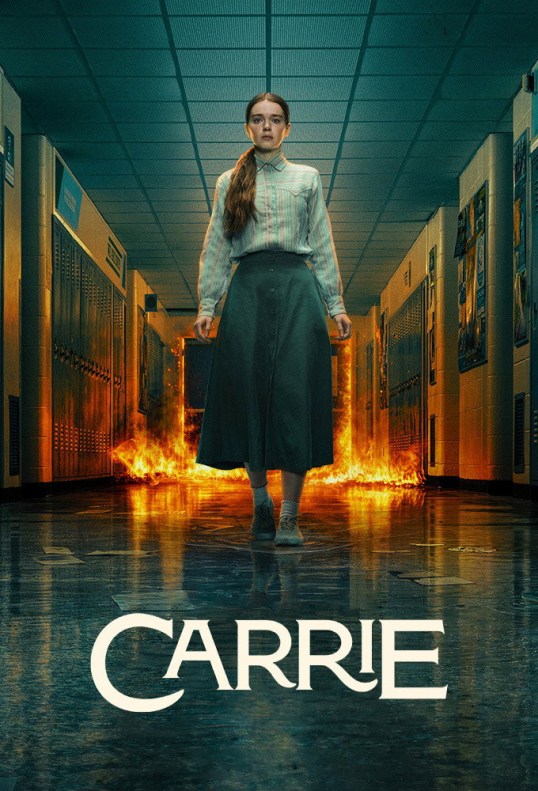
Icarus File No. 34: Carrie (dir by Mike Flanagan, Kate Siegel, Axelle Carolyn, Kyra Sedgwick, Hiromi Katana)


If I had to choose two words to describe Mike Flanagan’s “reimagining” of Carrie, they would probably be “fan fiction.”

In fact, it’s sometimes humorous just how obviously this miniseries is a work of fan fiction. Carrie White (blandly played by Summer Howell) may be a bullied and sheltered girl with telekinetic powers, but now she has a best friend, Emaline (an equally bland Thalia Dudek, who looks less like a 2026 teenager and more like the bassist in a 1990s riot grrrl band), who also has a power and always has the best advice and the snarkiest comebacks! What would Carrie do without her best friend Emaline? And while Margaret White (Samantha Sloyan) is still present as an overprotective and paranoid force in Carrie’s life, there’s now another maternal figure named Adelaide (Kate Siegel) who exists to talk about how those with secret powers are always being held down by a society that’s just not capable of accepting how important they are. Adelaide opens each episode with a monologue that feels like it was written by a 2017 college freshman who has just watched Linda Sarsour on YouTube. Watching the miniseries, one gets the feeling that Flanagan and his writers really wanted to make a show called Emaline and Adelaide and decided to graft them onto Carrie.

Ever since this miniseries was announced, there’s been a lot of talk about how Flanagan has updated the story. In this case, that means there’s an emphasis on phones and social media, as if teenagers couldn’t find a way to hurt each other even before technology caught up with them. In fact, social media is pretty much to blame for everything that happened. The audience is meant to violently roll their eyes at Margaret White for believing in conspiracy theories and religion while, at the same time, accepting a portrayal of the dangers of social media that makes Aaron Sorkin look even-handed and calm. One gets the feeling that if this show had been made just a few years earlier, it would have found a way to blame Margaret White and Chris Hargensen for the January 6th riots. There is a riot in the sixth episode, but it just involves all of the students doing a massive walkout to protest Chris Hargensen’s secret Instagram account. “Death to Hargensen!” the students chant, and it briefly seems like maybe Flanagan is going to make a bigger point about how the bullies can become the bullied, but ultimately, this is too much of a work of fan fiction to delve too deeply into anything that complex. It’s also too much of a work of the streaming era to introduce an idea that can’t be neatly summed up in 15 seconds.

Yes, this is a new version of Carrie. If King’s novel and De Palma’s film gave us a Carrie White who was never happy until that one prom night and who lashed out after that happiness was stolen from her, the Mike Flanagan miniseries gives us a Carrie who becomes the most popular girl in school even before prom night. No longer does Tommy (Joel Oulette) ask Carrie to prom as a favor to his guilt-ridden girlfriend, Sue Snell (Siena Agudong). Instead, he asks Carrie as a friend. Carrie’s no longer sheltered and shy. Instead, she’s somewhat smug and annoying. She sneaks out of the house many times before prom night. She goes to a party. She goes to the junkyard and curses like a sailor while showing off her powers. Her best friend Emaline is impressed. What would Carrie do without her best friend, Emaline? Of course, by changing all of this, Flanagan robs the story of all of its emotional power. This is probably the first version of Carrie where I’ve actually found myself getting annoyed with Carrie as a character. Towards the end of the miniseries, she just becomes so smug and self-righteous, like the girl at school who used to sweetly pull you aside to tell you that your skirt was too short. This is a version of the story that lets Carrie off the hook. Emaline is the one who suggests that she use her powers to get revenge. Adelaide and her dumbass cult are the ones who accidentally set fire to the school. Carrie dances in the street with Emaline and, for a few seconds, you actually find yourself wishing for the calming hand of Ryan Murphy.

Yes, I know that Stephen King has endorsed Mike Flanagan’s changes. That doesn’t mean that I have to. The fact of the matter is that Stephen King has consistently shown that he will endorse just about anything, and it’s also been a while since King has written anything that can match the power of his earlier work. There’s a world of difference between the youngish and struggling writer who originally wrote Carrie and the wealthy boomer who is now probably better known for his angry tweets than his more recent literary output. As well, it’s obvious that King likes Flanagan. Flanagan is the ultimate fan. And yet, considering that Flanagan’s best film, Hush, was also his simplest, one can’t help but feel that Flanagan would do well to stop adapting his heroes and maybe just try to focus on creating unapologetic suspense.

It’s the curse of elevated horror. Right now, the critics who hate entertaining horror love slow-moving elevated horror. They go on and on about the subtext, as if there wasn’t subtext to be found in the horror movies that were made in the past. The truth of the matter is that the subtext is usually the least interesting thing about these films and series. Making a film or a show that is critical of capitalism and religion is hardly the radical act that the critics seem to think it is. There’s nothing particularly interesting or special to be found between the lines when it comes to this version of Carrie. Indeed, for all the time and effort that the series puts into villainizing Margaret White and Chris Hargensen, they’re ultimately the most interesting characters because Samantha Sloyan and Alison Thornton are the only two performers who are allowed to break free from the show’s rigid ideological structure. (Samantha Sloyan especially deserves a lot of credit for finding a hint of reality in her portrayal of Margaret.) Chris and Margaret are compelling because they’re the only characters who don’t just parrot the accepted lines and the accepted thinking. They’re the only characters who seem to have a life and an outlook that was formed by something other than the demands of the show. We’re meant to shake our heads when Margaret becomes an online celebrity with a podcast, but instead, we’re interested and almost happy for her because Margaret is actually doing something unexpected and making an effort to take actual control of her life. It’s hard not to feel that this version of Margaret White deserved a better ending than what the show gave her. In the end, Margaret feels less like a villain and more like a victim of the show’s writers and their own feelings about religion and politics. (One wonders if the writers realize that their show ultimately makes the case that all of the tragedy could have been avoided if the government had simply stayed out of it and just allowed Margaret to continue to homeschool her daughter.) If previous versions of Carrie seemed to be designed to appeal to shy outsiders, this version of Carrie is designed to compliment self-styled victims who don’t have the self-awareness necessary to realize that they are now the bullies.

In the end, Carrie feels like a forgotten Showtime series from 2018 and, if it had been made by anyone other than Mike Flanagan, no one would care.

Previous Icarus Files:

  1. Cloud Atlas
  2. Maximum Overdrive
  3. Glass
  4. Captive State
  5. Mother!
  6. The Man Who Killed Don Quixote
  7. Last Days
  8. Plan 9 From Outer Space
  9. The Last Movie
  10. 88
  11. The Bonfire of the Vanities
  12. Birdemic
  13. Birdemic 2: The Resurrection 
  14. Last Exit To Brooklyn
  15. Glen or Glenda
  16. The Assassination of Trotsky
  17. Che!
  18. Brewster McCloud
  19. American Traitor: The Trial of Axis Sally
  20. Tough Guys Don’t Dance
  21. Reach Me
  22. Revolution
  23. The Last Tycoon
  24. Express to Terror 
  25. 1941
  26. The Teheran Incident
  27. Con Man
  28. Looker
  29. 1776
  30. Here
  31. The Adventures of Brisco County, Jr.
  32. The Cable Guy
  33. A Chorus Line


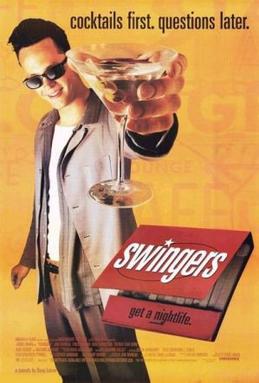
Film Review: Swingers (dir by Doug Liman)


“Vegas, baby, Vegas!”

1996‘s Swingers is a very quotable movie.  “You’re so money and you don’t even know it,” is one of the more famous lines.  Whenever I watch the movie, I always laugh when Mike (Jon Favreau) reacts to Sue (Patrick Von Horn) pulling a gun during an argument in a parking lot by saying, “Haven’t you seen Boyz N Da Hood?  Now, one of us is going to get shot!”  But for me, my favorite line will always be Trent yelling “Vegas, baby, Vegas!” as he drives Mike to Nevada’s best-known city.

There’s a sincerity to the way Trent yells it, one that you might miss on your first viewing.  Trent is the aspiring actor who is confident and who always seems to know the right thing to say and who manages to keep his cool no matter how potentially embarrassing the situation.  He’s a bit immature and a little bit loud but he’s the type of friend that every group needs.  Mike is a comedian who moved from New York to Los Angeles.  He hosts a night at a comedy club.  He also asks for an application when he goes to Starbucks.  He’s just been dumped by his girlfriend and he’s struggling to get over her.  He’s still in that stage where all he can talk about is his former relationship.  He’s the sweet guy who makes you go “Awww!” and little else.

Trent is convinced that a trip to Vegas is what Mike needs.  Mike is trying convince himself that Trent is right.  It’s a long and a hot drive.  When Trent suddenly yells, “Vegas, baby, Vegas!,” it’s not just his way of keeping Mike awake.  It’s his way of promising Mike that things are going to get better.  To Trent, Vegas is the solution to all of Mike’s L.A. woes.  Once they arrive in Vegas, Trent neve stops believing.  It doesn’t matter that he and Mike get exiled from the high rollers table at a casino and end up gambling with a bunch of elderly tourists.  It doesn’t matter that the waitress (Deena Martin) that Trent picks up lives in a rundown mobile home.  And, in the end, it even doesn’t matter that Mike ends up spending the entire night telling the waitress’s roommate about his ex-girlfriend.  What matters is that Trent believes that he has the solutions to everyone’s problems.  For Mike, that solution is Vegas.  For Sue, it’s playing hockey.  Everyone has their own personal Vegas.

Swingers is a classic example of American independent film.  Jon Favreau wrote the script and based it on his own experiences as a struggling actor.  The cast was largely made up by Favreau’s friends.  Vince Vaughn has said that Trent was largely based on himself, which is why he asked that there be at least one scene that revealed that Trent really did care about his friends.  The story is deliberately loose.  Mike tries to get over his ex-girlfriend while receiving largely useless advice from his friends.  Rob (Ron Livington) moves to Los Angeles and provides somewhat gentler advice than Trent.  Sue pulls a gun on some wannabe white gangstas and talks about how he grew up on the tough streets of Los Angeles.  (He actually grew up in Anaheim.)  The effortlessly cool Charles (Alex Desert) declares every party that the group goes to to be “dead.”  As a group they spend a lot of time talking about movies.  They complain about Tarantino stealing from other directors before an extended sequence of them walking in slow motion down a Los Angeles street while the Average White Band plays on the soundtrack.

The heart of Swingers together is the very real friendship between the characters. with Trent holding it all together.  Mike and Sue tolerate each other because they both want to hang out with Trent.  Even the momentary crisis caused by Sue pulling his gun on the guys in the parking lot is solved by the fact that the guys all want to hang out with Trent as well.  Problems in Swingers are not solved by guns or high-speed chases.  They’re solved by video games, beer, dancing, and maybe a trip to Vegas.  They’re solved by doing your own thing and not worrying about “the rules.”  They’re solved by just being in the right place at the right time.   They’re solved by Mike dancing with Heather Graham and then hanging up on his ex right when she’s saying, “I love–”

Today, of course, Swingers is very much a period piece.  It’s a film from a time when you actually had to get in a car and drive to Vegas if you wanted to gamble.  It’s a film from a period where Mike has to ask permission to use someone else’s phone to call his ex and when there was a grace period between leaving a bad message on a machine and having to worry about anyone having heard it.  For me, it’s always interesting to see Vince Vaughn, Jon Favreau, and Ron Livingston back when they were all still so young and, in the case of Vaughn and Favreau, thin.  It’s a film that celebrate friendship, love, and being young enough to still feel like anything can happen.

It’s a film that celebrates everyone’s personal Las Vegas.

Brad reviews THE HANGOVER PART III (2013), directed by Todd Phillips!


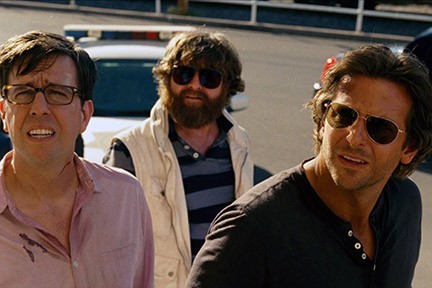
In THE HANGOVER PART III, Phil (Bradley Cooper), Stu (Ed Helms), and Doug (Justin Bartha) get back together so they can help Alan (Zach Galifianakis), whose gone off his meds and seems incapable of handling his dad’s sudden death. After a family intervention, the guys are driving him to a rehabilitation facility when their car is forced off the road and out steps the gangster Marshall (John Goodman), assisted by Black Doug (Mike Epps). Marshall kidnaps (white) Doug as leverage to force the guys to bring him their old friend Leslie Chow (Ken Jeong) within three days, or they won’t see Doug alive again. It seems that Chow, who recently escaped from a Thai prison, had stolen $21 million in gold from Marshall, and he’s pissed. The Wolfpack head back to Vegas, and with the help of a few old friends, they do whatever they have to do to save Doug one more time! 

Released in the summer of 2013, THE HANGOVER PART III pulled in around $362 million in worldwide box office against a $103 million budget. While definitely a box office hit, these numbers are a big step down from the prior film’s $586 million, so up to this point, Part III has remained the Wolfpack’s last adventure. While THE HANGOVER PART II was practically a remake of the first film, PART III seems to be going the opposite way and actively tries not to repeat itself. The “what the hell happened last night” plot lines are abandoned for something different, and honestly, that’s probably about the smartest decision the filmmakers could have made for this installment. The film plays more like a darker, R-rated crime comedy, leaning into the action, heist, and confrontation sequences. While the change isn’t entirely successful, I definitely appreciate the attempt to come up with something different.

Even though THE HANGOVER PART III isn’t as funny as the prior films, I still enjoy the chemistry between Bradley Cooper, Ed Helms, and Zach Galifianakis as the primary members of the Wolfpack. I also thought it was funny that Justin Bartha’s pack member Doug is once again relegated to the guy who’s not really involved, as he’s the one who’s kidnapped. Ken Jeong’s Mr. Chow, as cartoonish and unhinged as he is, is probably my favorite character in the series at this point. He pretty much steals every scene he’s in. John Goodman is a welcome addition as the intimidating bad guy, and he’s good in the film, but it’s the kind of role he could do in his sleep. I also really liked the fact that PART III returned to the initial setting of Las Vegas, which provides a nice sense of closure to the series, while also allowing for the participation of former characters like Heather Graham’s Jade and her son Tyler! It was nice to check in with them again. 

Ultimately, THE HANGOVER PART III is a pretty good conclusion to the series. It’s certainly not as funny or outrageous as the prior films, but it does deserve some credit for trying something new instead of simply repeating the formula for a third time. And I also thought the final scenes were emotionally effective as they took us for a quick trip down memory lane with the Wolfpack. It felt like the end, and I felt good watching it.

Brad reviews THE HANGOVER (2009), directed by Todd Phillips!


It seems kind of strange in today’s world of non-stop streaming, but there was a time when you would purchase a blu-ray of a movie, and they’d give you a free “digital” copy of the movie. In 2009, I purchased the blu-ray for THE HANGOVER and added the digital copy of the movie to my laptop that I kept at my tax and accounting office. Every night during the 2010 tax season, I would go home around 5:00 for dinner, and then I’d go back to the office at 7:00 to continue my work. When I’d get back to the office, I would always play two copies of digital movies on my laptop… first, I’d play THE HANGOVER and next, I’d play ZOMBIELAND. When those two movies would end, usually by around 11:00, I’d head home. Needless to say, I got to know each of these movies very well and love them both.  

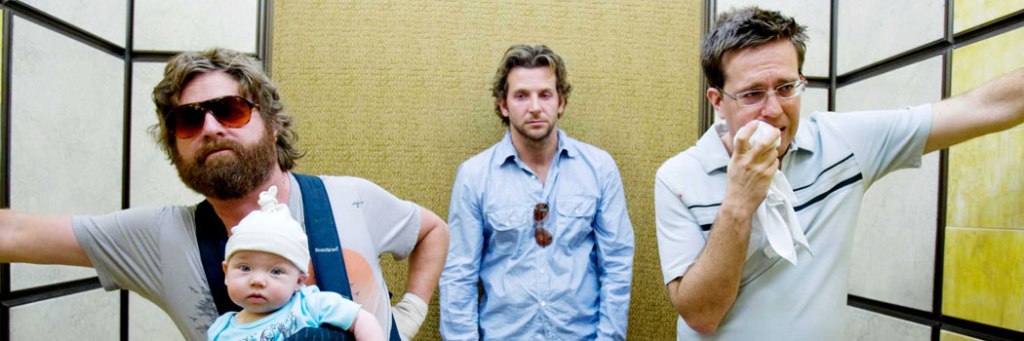
In director Todd Phillips’ THE HANGOVER, the night before his wedding, groom-to-be Doug (Justin Bartha), his two best friends, Phil and Stu (Bradley Cooper and Ed Helms), and his soon-to-be brother-in-law Alan (Zach Galifianakis), head to Las Vegas for a wild and exciting bachelor party. After taking some Jagermeister shots on the roof of Caesar’s Palace, the movie screen goes black, and soon we see Phil, Stu and Alan wake up in their hotel room with absolutely no memory of what happened the previous night. The room is trashed, there’s a tiger in the bathroom, a baby in the closet, Alan doesn’t have on any pants, Stu is missing his lateral incisor, and Doug is nowhere to be found! With the wedding just hours away, the three friends follow any clues they can find in a frantic search for Doug. The search leads to the surprise discovery of a new stripper wife for Stu, the naked and dangerous Asian gangster Chow (Ken Jeong), who jumps out of the trunk of their car and attacks Phil with a crowbar, and Alan being tasered in the face by a kid visiting the Vegas police station. Hell, at one point Alan even gets punched out by Mike Tyson! More importantly, though, will they find Doug alive and have time to get him back to Los Angeles for his wedding?!!

A massive box office hit in the summer of 2009, THE HANGOVER became the highest grossing R-rated comedy up to that time, with a worldwide gross of $469 million against a budget of $35 million. One of the keys to the film’s success is its clever and unique premise, comprised of a mystery-driven plot line where we follow the detective-like adventures of Phil, Stu, and Alan and discover what the hell happened the night before at the same times that they do. This allows for a series of outrageous, raunchy, surprising, and hilarious comedic moments that escalate in absurdity over the course of the film’s 100-minute running time, culminating with an almost unbelievable roll of pictures on Stu’s camera that fill in the crazy events from their wild night in Vegas. Most movies, even comedies, don’t result in me laughing out loud. I laughed out loud frequently that first time I watched THE HANGOVER back in 2009, and I still do. It’s also a movie that, since that 2010 tax season, I have quoted endlessly in my personal life, whether it be “Classic,” to “Thanks a lot, Bin Laden,” and even “It’s not a purse, it’s called a satchel. Indiana Jones wears one.” I never know exactly when something will happen in my personal life that reminds me of THE HANGOVER, but if the time is right for an “in the face,” I’m always ready!  

Of course, the comedy in THE HANGOVER would not work without the great direction from Todd Phillips, as well as the exceptional performances and chemistry between Bradley Cooper, Ed Helms, and Zach Galifianakis. Phillips moves things along at a perfect pace, allowing for tons of laughs, while propelling the story forward to its conclusion. He also seems to capture the chaos and “what happens in” feeling of an out-of-control night in Vegas. And when I watched the film, I was reminded of people in my own life who share certain traits with some of the characters, especially those played by Cooper and Helms. As such, the interactions between the characters seems natural and familiar to me, which makes it even funnier. Luckily, I can’t think of any friends like Galifianakis’ eccentric character, but that’s probably a good thing for my real life. In the context of the movie, however, he steals the film with his deadpan delivery.   

Ultimately, THE HANGOVER became a cultural phenomenon that launched a series of three films that grossed over $1.4 billion worldwide. It’s blend of clever writing, great casting and performances, and most importantly, great comedic moments, makes it one of my favorite comedies of the 21st century.

Brad reviews DIGGSTOWN (1992), starring James Woods, Lou Gossett Jr. and Bruce Dern!


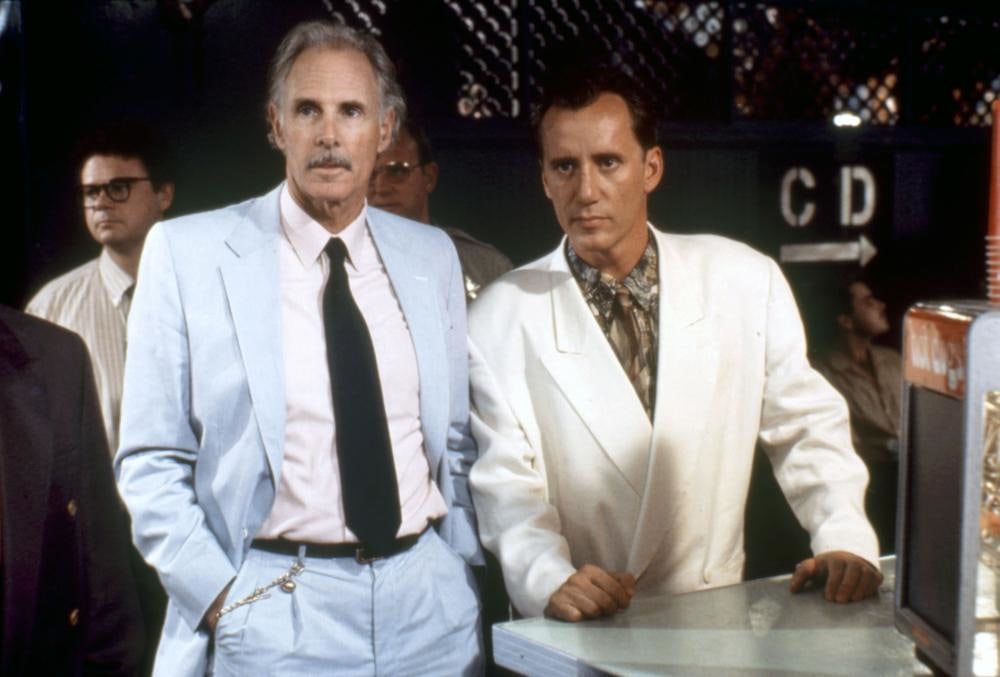
Gabriel Caine (James Woods) is a fast-talking con man fresh out of prison who’s already set up his next big scam. Along with his partner Fitz (Oliver Platt), Caine is targeting Diggstown, a small, boxing-obsessed community ruled over by the corrupt John Gillon (Bruce Dern). Gillon controls the town because he rigged a fight that left local boxing legend Charles Macum Diggs (Wilhelm von Homburg) completely brain-damaged. The scam involves getting Gillon to take a $100,000 bet that 48 year old “Honey” Roy Palmer (Louis Gossett Jr.) can defeat any ten Diggstown fighters in one 24-hour period. Once the fights start, you can bet that both sides will have lots of surprises up their sleeves, but the question is who will be standing when the final bell rings?!! 

Since today is Bruce Dern’s 89th birthday, I decided to watch DIGGSTOWN, one of my favorite movies featuring the birthday boy. A box office flop when it was released in 1992, making less than $5 million at the box office, the reputation for the film seems to have gotten stronger over the years. The film has an excellent cast! James Woods exudes cockiness and intelligence as conman, Gabriel Caine. He somehow pulls off the feat of being both sleazy and very likable, which is a testament to Woods’ skills as an actor. Louis Gossett Jr. is great as “Honey” Roy Palmer. I remember when I first saw the trailer for DIGGSTOWN, I thought he was too old for the role. After watching it though, he’s able to make the boxing scenes work, especially when you consider some of the help he’s given as part of the con. With the huge personalities of Woods and Bruce Dern surrounding him, Gossett’s more grounded performance anchors the film. Bruce Dern is perfectly cast as the villainous scuzzbucket, Gillon. He’s the type of guy you really want to see get his comeuppance at the end. Now that I think about it, Gillon is such an A-hole, Caine can’t help but seem likable in comparison! Finally, I did want to give a shout out to Oliver Platt, who’s extremely funny in his role as Caine’s partner in con. It’s one of the first movies I remember seeing Platt in, and he’s great!

For DIGGSTOWN to really work though, the boxing scenes need to work and the con needs to be smart. Director Michael Ritchie (THE BAD NEWS BEARS) does a good job setting up both. The boxing sequences are well choreographed by Benny “The Jet” Urquidez, and you can’t help but root for the old guy as his opponents keep on coming. Of the 10 fights, some are funny, some are quick, and some are very intense depending on the situation. Ritchie is able to keep the stakes high enough during the boxing scenes to make sure we remain invested in the story. It’s a nice balancing act as the con plays out in the background of each fight. And what a con it is! I won’t spoil it for you, but it’s a stroke of genius that resulted in a massive amount of satisfaction for this audience member! 

Overall, DIGGSTOWN is one of those movies I’m sure to watch every few years. With its great cast, punchy sense of humor, and genius triple-twist of an ending, I can’t imagine anyone leaving disappointed. I highly recommend it! 

The trailer is included below:

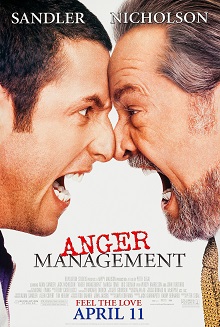
Anger Management (2003, directed by Peter Segal)


Dave (Adam Sandler), a timid man who has never gotten over being humiliated when he was a teenager, is sentenced to anger management after a slight argument on a plane is blown out of proportion by a taser-wielding shy marshal.  His therapist is Dr. Buddy Rydell (Jack Nicholson), whose techniques only seem to exacerbate Dave’s growing anger.  Among Dr. Rydell’s methods are giving Dave an unstable “anger buddy” named Chuck (John Turturro), ordering Dave to get revenge on the guy (John C. Reilly) who humiliated on his as a teenager, and also encouraging Dave to cheat on his girlfriend Linda (Maria Tomei) with a woman (Heather Graham) that they meet at bar.  Dave goes from timid to angry, Dr. Rydell starts dating Linda, and the whole thing is wrapped up with a totally implausible ending.

The idea of the star of Chinatown and Five Easy Pieces co-starring in an Adam Sandler comedy sounds like it should be exhibit #1 when it comes to talking about the decline of American cinema but I’ve always liked Anger Management.  Casting Jack Nicholson as the seemingly insane Dr. Rydell was an inspired choice and Nicholson gives a real performance in the film as opposed to just coasting on his already-established persona.  Anger Management came out a year after Adam Sandler’s first dramatic film, Punch-Drunk Love, and, even though Anger Management is a raunchy comedy from the start to finish, Sandler’s performance actually finds the reality in Dave’s situation.  Sandler plays Dave as being someone who is sincerely trying his best to get through his court-mandated anger management without losing control.  Nicholson and Sandler make for a surprisingly good team.

Of course, it’s an Adam Sandler comedy so it’s not for everyone.  The humor is often crude and the film’s final twist is so ridiculous that it can actually leave you feeling like you might need anger management.  But Anger Management does show how Jack Nicholson improves anything that he’s involved with and it also shows that Adam Sandler can act when he feels like it.  Anger Management also gave us the meme of Jack Nicholson nodding his approval, meaning the film and the performance will live forever.

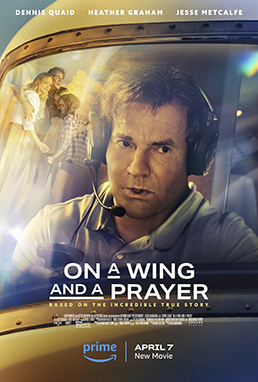
Film Review: On a Wing and a Prayer (dir by Sean McNamara)


Having just attended the funeral of his brother, Doug White (Dennis Quaid) and his family — wife Terri (Heather Graham) and daughters Bailey (Abigail Rhine) and Maggie (Jessi Case) — are flying back to their home in Louisiana.  Unfortunately, shortly after takeoff, their pilot suffers a heart attack and dies.  Now Doug, who’s had only one flight lesson in his entire life, has to not only fly the plane but also land safely.

Doug has people on the ground, trying to talk him through the landing even though they don’t know what is actually happening in the cockpit.  Hard-drinking Dan Favio (Rocky Myers) calls his friend, Kari Sorenson (Jesse Metcalfe).  Kari has never gotten over the death of his family in a similar plane crash so, for him, helping Doug land is about more than just saving Doug and his family.  It’s also about achieving his own personal redemption and hopefully finding the strength to forgive himself.

While this is going on, two kids — Donna (Raina Grey) and Buggy (Trayce Malachi) — follow the flight online and then head down to the airport so that they can watch it try to land.  To be honest, I’m really not sure why either one of them is in the movie.  When Donna first showed up, talking about how she wanted to be a pilot because “Mr. Jones” told her that girls can’t fly planes, I found myself dreading the inevitable moment when the kids would take it upon themselves to help Doug land the plane.  I dreaded Donna calling the cockpit and Doug going, “Wait a minute …. you’re just a kid!”  Fortunately, that moment didn’t happen but I was still left wondering why Donna and Buggy were in the film to begin with.

It feels almost churlish to be overly critical of a film like On a Wing and a Prayer because it is based on a true story.  Doug White really did have to land an airplane after the pilot died mid-flight and he really was instructed on what to do by a group of air traffic controllers and Kari Sorenson.  It’s a good story and the film ends with some undeniably touching shots of the real people involved in the landing.  That said, this is ultimately a film that many filmgoers will want to like more than they actually do.  Thanks to some dodgy special effects, the viewer never forgets that Dennis Quaid and his family aren’t really tapped up in the sky.  Instead, one is always aware that they’re just watching a movie and a rather cheap-looking one at that.  As well, the script is full of awkward dialogue and heavy-handed moments.  As soon as I saw that one of the daughters wouldn’t stop looking at her phone, I knew that she would be the one who would be forced to grow up in a hurry.  As soon as the other daughter ate something with nuts in it, I knew that there was going to be a desperate search for an epi-pen.

On the plus side, Dennis Quaid was as likable as ever and Heather Graham managed to wring some genuine feeling out of even the most sentimental of dialogue.  On A Wing and a Prayer was directed by Sean McNamara, who also directed one of my favorite films of 2011, Soul Surfer.  (Later this year, McNamara and Quaid have another project that is scheduled to be released, a biopic of President Ronald Reagan.)  On A Wing and A Prayer doesn’t really work as a film but, as a story, it at least reminds us of what people are capable of doing when they all work together.

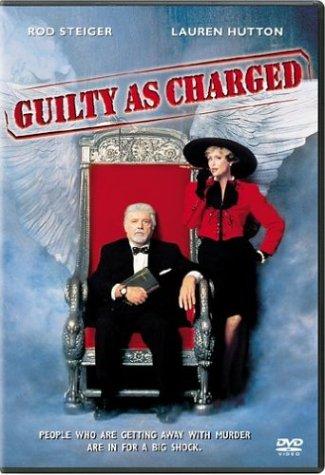
Guilty As Charged (1991, directed by Sam Irvin)


Stop me if you’ve heard this one before.

Kalin (Rod Steiger) is a crazy old religious fanatic who is rich enough to own a meatpacking plant and hire goons to work for him.  Underneath the meatpacking plant, he has a secret prison and an electric chair that he uses to electrocute people who he feels have escaped justice.  Helping out Kalin is a crazy preacher, played by Isaac Hayes (!), who waxes philosophically about how much he loves the smell of burning flesh.

While Kalin and the gang are executing people below ground, parole officer Kimberly (Heather Graham) is above ground and wondering why so many ex-cons are mysteriously vanishing.  Kimberly is worried that someone may be executing them but then she gets distracted by a politician named Stanford (Lyman Ward).  Stanford wants Kimberly to work on his campaign because she looks like Heather Graham and he’s a sleazy politico.

Meanwhile, a man named Hamilton (Michael Beach) has escaped from prison.  Hamilton claims that he was framed for a murder that he didn’t commit but no one is willing to believe him.  However, Hamilton is telling the truth and the murder was actually committed by Stanford!  The only people who know that Stanford is the murderer are Stanford, his wife (Lauren Hutton!!), and his maid (Zelda Rubinstein!!!).

It all leads to one question: How did all of these talented people all end up in this crappy film!?

The strange thing about Guilty As Charged is that, even though the film is centered around the death penalty, the film itself doesn’t seem to have any opinion on the issue.  Kalin and his followers are crazy religious fanatics who claim that they’re doing God’s work by executing people and Hamilton is an innocent man who has been marked for death so you would think that the movie is against the death penalty.  But then, in a twist that makes no sense, Kalin reveals that he knows that Hamilton is innocent and he’s only using him to get to Stanford and suddenly, the film is for the death penalty.  Kimberly is worried that someone is targeting ex-cons but, by the end of the movie, she’s targeting ex-cons herself even though nothing’s happened that should have made her change her mind.

Guilty as Charged is technically a comedy, though most of the jokes are too thuddingly obvious to provoke even the slightest of a smile.  Hayes wins some laughs, just because he seems like he’s having fun.  Rod Steiger bellows as if he’s getting paid by the decibel and doesn’t seem to be having any fun at all.  Guilty as Charged isn’t funny and it’s not thought-provoking but at least it’s got Isaac Hayes.

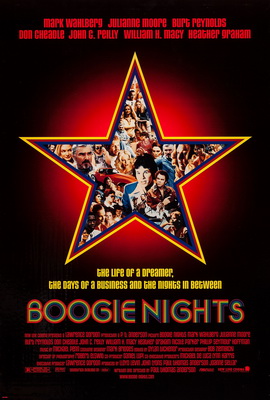
Scenes That I Love: The Awards Ceremony From Boogie Nights


I would like to think that when the Palme d’Or is awards in Cannes, it’ll be half as exciting as when Dirk Diggler (Mark Wahlberg) picked up his second Best Actor trophy in Paul Thomas Anderson’s Boogie Nights.

Now, the scene below is actually the extended version of the scene that actually appeared in the movie.  In the movie, you just see Jack Horner (Burt Reynolds) watching his latest film and then cut to Dirk picking up his award.  In the extended version, we get to see everyone’s reaction to Dirk winning.  They’re all there — Burt Reynolds, William H. Macy, Nina Hartley, John C. Reilly, Melora Waters, Luis Guzman, Julianne Moore, Heather Graham, Don Cheadle, Robert Ridgely (as the memorably corrupt Colonel), and, of course, the dearly missed Philip Seymour Hoffman.

I can understand why Anderson chose to go with a shortened version of this scene.  Boogie Nights is a long film and obviously, it wasn’t totally necessary to see how everyone reacted to Diggler’s victory.  (By that point, in the film, we already knew how everyone felt about him.)  That said, I do prefer the extended version.  If nothing else, it’s a reminder that Boogie Nights was more than just the story of Dirk Diggler.  Instead, it was the story of a group of outcasts who became a family.

Anyway, let’s hope that whoever wins the Palme d’Or will be a bit more enthusiastic about it than Dirk.