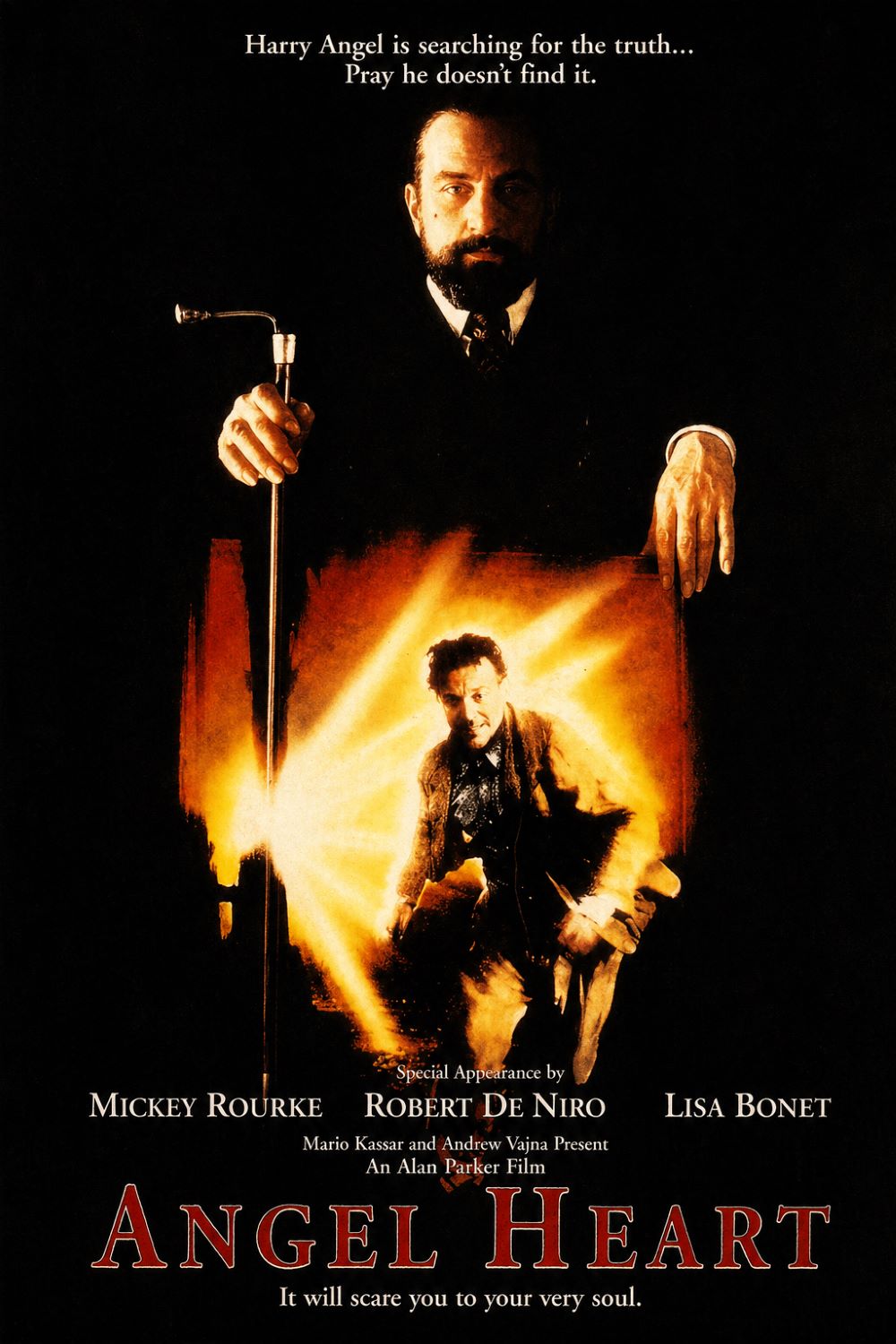
Review: Angel Heart (dir. by Alan Parker)


“They say there’s just enough religion in the world to make men hate one another, but not enough to make them love.” — Louis Cyphre

Angel Heart is one of those ’80s movies that sneaks up on you, starting like a gritty detective yarn before plunging into supernatural muck that leaves you questioning everything. Alan Parker’s 1987 neo-noir gem, adapted from William Hjortsberg’s Falling Angel, stars Mickey Rourke as Harry Angel, a down-and-out private eye in 1955 New York who gets pulled into a case that reeks of bad karma from the jump. It’s casual viewing at first—rain-slicked streets, fedoras, the whole bit—but Parker’s got a critical eye for blending hardboiled noir with occult horror, making it stick like gum on your shoe long after the credits roll.

Harry’s your classic hard luck of a gumshoe, hustling divorce cases in a dingy office when this slick mystery man named Louis Cypher (Robert De Niro, chewing scenery with devilish glee—get the name pun?) hires him to track down Johnny Favorite, a crooner who vanished after World War II. Cypher’s got cash to burn and an unsettling vibe that hints at deeper darkness, pulling Harry into a web of lies from the start. Harry follows the trail from NYC’s jazz dives to the steamy underbelly of New Orleans, where voodoo rituals, bloody murders, and hallucinatory nightmares start piling up like bodies in a back alley. Parker does a solid job adapting the source material’s clash of noir cynicism with Southern gothic rot, but his direction leans too heavily on the style of what he thinks a Southern gothic noir is supposed to look like—overripe with misty bayous and candlelit rituals—instead of letting the narrative drive the supernatural melding with the hardboiled detective beats.

What hooks you early is Rourke’s performance—he’s at his pre-meltdown peak here, all brooding intensity and rumpled charm, nailing the everyman unraveling under cosmic pressure. De Niro’s Cypher is a masterclass in minimalism; he lounges in that art deco office peeling a hard-boiled egg with surgical precision, dropping biblical barbs that land like gut punches. It’s not showy, but every word drips menace, elevating the whole film from B-movie territory to something almost operatic. Then there’s Lisa Bonet, fresh off The Cosby Show, diving headfirst into an X-rated role as Epiphany Proudfoot, Johnny’s daughter with a voodoo twist. Her steamy, sweat-drenched sex scene with Harry is erotic nightmare fuel—raw, uncomfortable, and unforgettable, pushing boundaries in a way that got the film slapped with an X rating before settling on R. Parker’s not afraid to get gory either; decapitations and ritual killings hit with visceral thud, but it’s the psychological slow burn that really twists the knife.

The film’s neo-noir DNA shines through in its voiceover narration, shadowy cinematography by Michael Seresin (those rain-lashed rooftops and fog-shrouded bayous are poetry), and a Trevor Jones score laced with eerie blues that pulses like a heartbeat from hell. Parker shifts gears from straight detective procedural to full-on supernatural dread, introducing occult hints gradually—a creepy voodoo ceremony here, a phantom vision there—until the genre flip feels inevitable yet shocking. New Orleans becomes a character itself, all humid decay and ritual undercurrents, contrasting sharp with New York’s cold urban grind. It’s Parker’s only stab at horror (he’s more Mississippi Burning or The Commitments guy), but while he nails the glossy nightmare aesthetic, the heavy stylistic hand sometimes overshadows the organic fusion of noir fatalism and otherworldly dread that the story begs for.

Critically, though, Angel Heart isn’t flawless. The late-game turns pack a wallop but drag a bit in laying out their logic, making you question the elaborate cat-and-mouse when a quicker path might’ve sufficed. Some dated effects in the dream sequences feel cheesy now, a minor blemish on an otherwise polished gem. Pacing sags slightly in the middle as Harry chases red herrings, and while the cast is gold, supporting players like Brownie McGhee as Toots Sweet add flavor without always deepening the mystery. Still, these are nitpicks; Parker’s atmospheric command and thematic depth—exploring guilt, denial, and the inescapability of one’s darker impulses—elevate it above pulp, even if the visuals occasionally feel more like a mood board than narrative propulsion.

Thematically, it’s a devil’s playground. Angel Heart riffs on classic Faustian tropes, but Parker’s critical lens probes deeper into fractured identity and moral rot. Harry’s journey mirrors the novel’s hardboiled cynicism, but the film amps the supernatural, turning noir fatalism into outright damnation. Mirrors recur obsessively—shattered glass, reflections warped by blood—symbolizing a crumbling self-image as buried truths bubble up. Voodoo isn’t just window dressing; it’s woven into the fabric, blending African diaspora mysticism with Catholic guilt for a uniquely American horror. Parker’s post-war setting adds layers, nodding to shell-shocked vets and racial undercurrents without preaching, letting the era’s shadows do the talking, though one wishes the story’s momentum had guided the gothic flourishes rather than the other way around.

Visually, it’s a feast. Seresin’s camera glides through rain-swept nights and candlelit rituals with painterly flair, while Parker’s British outsider gaze infuses Americana with alien menace—think Midnight in the Garden of Good and Evil but grimier. The egg-peeling scene alone is iconic, De Niro’s Cypher dissecting morality with yolk-stained fingers. And those final confrontations? Subtle, actor-driven tension that relies on faces, not effects, delivering chills through implication rather than revelation. Jones’ score weaves jazz horns with dissonant strings, amplifying the bluesy fatalism; it’s the perfect auditory companion to Harry’s descent, grounding the style in emotional truth.

For fans of the genre mashup, Angel Heart is essential—think Chinatown meets The Exorcist, with Parker’s glossy sheen making it pop. Rourke’s turn here is arguably his career best, raw and vulnerable before the tabloid implosion; De Niro proves he’s the king of charismatic evil. Bonet’s bold pivot shocked audiences, earning a career-defining role that proved her chops beyond sitcom smiles.

Rewatch value is sky-high; the slow build rewards patience, and clues hidden in plain sight make it a puzzle box. It’s not subtle—Cypher’s name screams spoilers—but that’s part of the fun, a winking nod to infernal cleverness. Parker’s eye for detail shines in production design: peeling wallpaper in tenements, incense-heavy apartments, gator-infested swamps. It’s immersive, oppressive, and oddly seductive, with every frame dripping atmosphere that pulls you deeper into the haze, even if the narrative sometimes plays catch-up to the visuals.

In a sea of jump-scare slop, Angel Heart stands tall as thoughtful horror-noir that lingers because it forces you to confront the monster in the mirror. If you’re digging into ’80s cult classics or just crave a detective tale with teeth, fire it up. It’s flawed, yeah—style occasionally eclipsing story—but those flaws make it human, much like Harry himself.
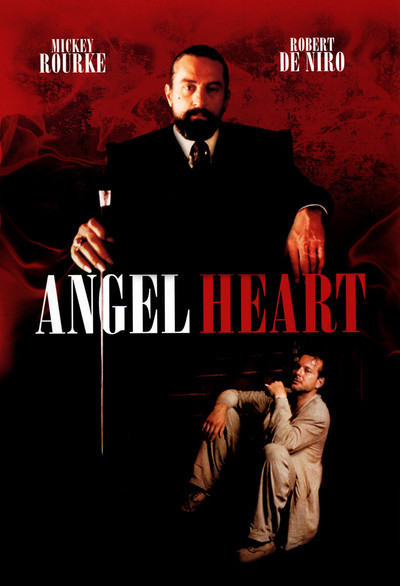
Horror Film Review: Angel Heart (dir by Alan Parker)


First released in 1987 and set in 1955, Angel Heart tells the story of Harry Angel (Mickey Rourke).

With a name like Harry Angel, it’s perhaps not surprising that Harry is a private investigator.  Harry operates out of New York.  He’s got a shabby apartment.  He wears wrinkled clothes.  He rarely shaves.  He smokes almost constantly.  (In a rare moment of comedy, the camera catches Harry blithely emptying a full ashtray in the middle of the street.)  Harry looks like he reeks of tobacco, beer, sweat, and lost dreams.  And yet, it’s difficult not to like Harry.  He’s got a charming smile, even if his face is often bruised from his latest beating.  He speaks in a low whisper and it’s hard not to get the feeling that Harry is actually kind of shy.  He’s incredibly sleazy but there’s something about him that just makes the viewer want to take care of him.

Harry is hired by a mysterious man named Louis Cyphere (Robert De Niro, cheerfully overacting).  Louis wants Harry to track down a singer named Johnny Favor.  As Cyphere explains it, he did a favor for Johnny and Johnny has yet to pay Cyphere what he owes.  Johnny has been suffering from PTSD ever since he served in World War II.  When last seen, Johnny was receiving electroshock treatment in an upstate hospital.

Harry’s search for Johnny leads him into an increasingly complex and disturbing conspiracy.  He meets a doctor who is addicted to morphine and, when the doctor turns up dead, Harry coolly uses the dead man’s shoe to light his match.  Eventually, Harry’s investigation leads him to New Orleans, where he meets both Johnny’s wife (Charlotte Rampling) and Johnny’s unacknowledged daughter, Epiphany (Lisa Bonet).  As Harry searches for Johnny, he deals with strange visions of his own mysterious past.  He sees himself wandering around Times Square shortly after the attack on Pearl Harbor.  Harry also finds himself having to deal with the fact that almost everyone that he talks to ends up being brutally murdered.  Every time that Harry tries to quit the case, Cyphere offers him more money.  (Cyphere tends to show up whenever Harry finds himself on the verge of abandoning his search.)

Angel Heart moves at its own deliberate pace.  In fact, the first hour can feel a bit slow but that first hour definitely pays off during the second half of the film.  By the time that Harry starts to truly uncover what has happened to Johnny, the audience actually cares about Harry and is actually worried about what’s going to happen to him when he reaches the end of the case.  Mickey Rourke was (and is) an eccentric actor but he’s at his most effective in Angel Heart.  A lesser actor would have just played Harry as being a typical hardboiled detective.  Rourke plays Harry as being a lost soul, a vulnerable man who is often as confused and scared as the people that he’s looking for.  By the end of the film, Harry realizes that the answer to the mystery was right in front of them and his look of despair is surprisingly powerful.  If De Niro gives a good performance that is almost totally on the surface, Rourke gives the type of performance that allows the audience to explore what’s going on beneath the surface of a character who many would initially view as being a cliché.  Mickey Rourke’s Harry Angel is right up there with Bogart’s Sam Spade and Jack Nicholson’s Jake Gittes.  He’s a familiar character who also seems to be a human being.

Full of sex, violence, and increasingly disturbing imagery, Angel Heart is not for everyone.  Alan Parker’s direction emphasizes the darkness of Harry’s world and the bleakness of his situation.  The film ends with a twist that may not be totally unexpected but which is still undeniably disturbing.  The more you think about it, the most disturbing it gets.  Angel Heart is an atmospheric and intelligent chiller.  It’s existential horror at its most nightmarish.

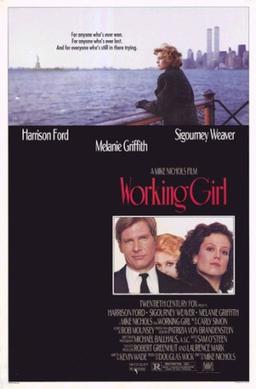
Lisa Reviews An Oscar Nominee: Working Girl (dir by Mike Nichols)


(With the Oscars scheduled to be awarded on March 4th, I have decided to review at least one Oscar-nominated film a day.  These films could be nominees or they could be winners.  They could be from this year’s Oscars or they could be a previous year’s nominee!  We’ll see how things play out.  Today, I take a look at the 1988 best picture nominee, Working Girl!)

Welcome to the 80s!

Yes, Working Girl is definitely a film of its time.  It’s a film that’s obsessed with big things: big dreams, big offices, big money, and big hair.  It’s a movie where the heroes talk about hostile takeovers and where everyone’s dream is to eventually to be an executive on Wall Street.  You know all of those people who claim that The Big Short is the greatest movie ever made?  I can guarantee that the majority of them would totally hate every character in Working Girl.  Working Girl is such a film of the past that it even features Alec Baldwin doing something other than bellowing at people.  In fact, Baldwin’s actually sexy in Working Girl.  It was strange to see him in this film and realize that he was the same actor who currently spends all of his time picking fights on twitter and defending James Toback.

Of course, Alec Baldwin has a relatively small role in Working Girl.  He plays Mick Dugan, the type of blue-collar guy who gives his girlfriend lingerie for her birthday (“I just wish you would get me something that I could wear outside,” she says as she tries it on) and who then proceeds to cheat on her while she’s off at work.  From the minute we first meet Tess McGill (Melanie Griffith), we know that she deserves better than Mick.

Tess is a professional administrative assistant.  She’s just turned 30 but she’s not ready to give up her dreams and settle for a life of fighting off coke-snorting executives and coming home to some guy like Mick.  (Speaking of early performances from infamous actors, one of the coke-snorting executives is played by Kevin Spacey.)  Tess has got a bachelor’s degree in Business.  As she puts it, she has a “mind for business and a bod for sin.”

She’s also got a new boss, an up-and-coming executive named Katharine Parker (Sigourney Weaver).  It turns out that Katherine is 29 years old.  (“I’ve never worked for someone younger than me before,” Tess says as Katherine gives her a condescending smile.)  Katharine encourages Tess to think of her as being a mentor.  If Tess has any ideas for investments, she should feel free to bring them to Katharine.  Of course, when Tess does so, Katharine claims that her bosses shot the idea down.  It’s only after Katharine breaks her leg in a skiing accident and is laid up in Europe that Tess discovers that Katharine has actually been stealing her ideas and not giving her any credit for them.

What is Tess to do?  Well, she does what any of us would do.  She passes herself off as an executive and presents her idea to Jack Trainer (Harrison Ford) herself.  Jack is impressed with the idea but he’s even more impressed with Tess.  Of course, complicating things is that Jack was once in a relationship with Katharine and Katharine still thinks that she’s going to eventually marry Jack.  And, of course, there’s the fact that Tess is lying about actually being an executive…

Working Girl is a frequently amusing film, elevated by performances of Melanie Griffith and, in the role of Tess’s best friend, Joan Cusack.  Add to that, Harrison Ford is remarkable non-grouchy as Jack Trainer and Sigourney Weaver appears to be having the time of her life playing a villain.  Even as I laughed at some of the lines, here was a part of me that wished that the film had a bit more bite.  At times, Working Girl tries too hard to have it both ways, both satirizing and celebrating Wall Street culture.  In the end, the film works best as a piece of wish-fulfillment.  It’s a film that says that not only can you win success and Harrison Ford but you can get your bitchy boss fired too.

Despite being a rather slight (if likable) film, Working Girl was nominated for Best Picture of 1988.  However, it lost to Rain Man.