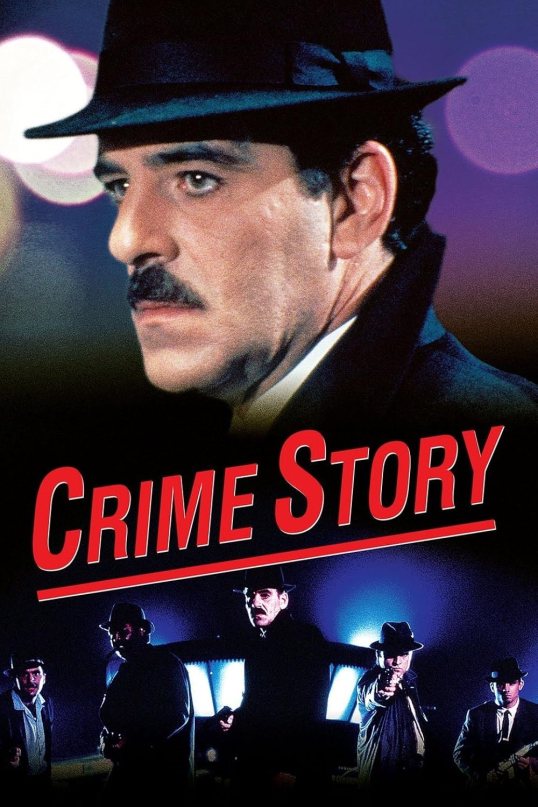
Welcome to Retro Television Reviews, a feature where we review some of our favorite and least favorite shows of the past! On Mondays, I will be reviewing Crime Story, which ran on NBC from 1986 to 1988. The entire show can be found on Tubi!
Today, we start the second season of Crime Story!
Episode 2.1 “The Senator, The Movie Star, and the Mob”
(Dir by John Nicolella, originally aired on September 22nd, 1987)
The second season of Crime Story opens with Torello, Abrams, and the Task Force still in Las Vegas. With Luca and Pauli apparently dead as a result of that nuclear blast at the end of the first season, various gangsters are trying to position themselves as Manny Weisbord’s new man in Vegas. Carlo Mastrangelo (Stephen McHattie) is the latest contender.
(And yet, it’s hard not to notice that, during the opening credits, both Tony Denison and John Santucci are listed. Neither appears in this episode other than in the pictures displayed at their funeral. But the credits don’t seem quite convinced that Luca and Pauli are dead.)
Crusading Senator Rourke (Kevin Spacey, in his first major television role) comes to Vegas. Rourke—the son of a former bootlegger and a presidential contender who speaks with a slightly abrasive Boston accent—is holding hearings on the Mob. Also arriving in Vegas is Pamela Palmer (Jenny Wright), a platinum-blonde movie star known for her glamorous sex appeal but who spends almost the entire episode hiding a black eye behind her sunglasses. As Torello discovers, Pamela is Mastrangelo’s occasional girlfriend, but she’s also having an affair with Senator Rourke.
Anyone who has studied history or who has an interest in conspiracy theories will be able to see the obvious real-world parallels. Rourke, with his bootlegger father and his less-than-ideal private life, is an obvious stand-in for both John and Robert F. Kennedy. (Of course, when seen today, the casting of Kevin Spacey in the role brings a whole other dimension to it. Now we instinctively distrust Rourke as soon as we see him, despite the fact that the show portrays him as sincere in his crusade against the Mob.) Pamela is Marilyn Monroe. Mastrangelo and his second-in-command Bobby Meeker (Michael Wincott) bring to mind Sam Giancana and Johnny Roselli, two of the mobsters whose names regularly turn up in JFK assassination lore.
In real life, a heartbroken Marilyn Monroe overdosed and both Kennedy brothers were assassinated. On Crime Story, Torello is able to prevent Mastrangelo from assassinating Rourke, and an emotionally strengthened Pamela is able to leave Las Vegas for what will hopefully be a brighter future than the one that awaited Marilyn. This episode feels like a work of alternative history, one in which the Kennedys lived up to their promise and one determined man like Mike Torello could prevent a nation from being traumatized.
For a history nerd like me, this episode was enjoyable. It held my interest. I liked seeing how the show reimagined history. At the same time, Luca and Pauli were definitely missed. A format in which Torello deals with a villain-a-week doesn’t carry the same emotional punch as watching Torello obsess, episode after episode, on just one particularly nasty villain. Because Luca and Torello were opposite sides of the same driven coin, not having Luca around makes it feel as if Torello is incomplete as well.
That said, this episode ended with a shot of a bandaged man sitting on a beach in Mexico. Could that man be Luca? Hopefully, we’ll find out soon!
“If the people we love are stolen from us, the way to have them live on is to never stop loving them. Buildings burn, people die, but real love is forever.” — Sarah Mohr
The Crow is one of those films whose reputation has become inseparable from the tragedy surrounding it, yet reducing it to that tragedy misses why it has endured so powerfully. Alex Proyas’s 1994 adaptation of James O’Barr’s graphic novel is a revenge story, a gothic romance, a comic-book nightmare, and an MTV-era industrial-rock mood piece fused into something singular. It is not flawless, and its storytelling is often more archetypal than psychologically deep, but that directness helps its emotional force. The movie does not ask viewers to untangle a complicated moral puzzle. It asks them to feel the enormity of a love violently interrupted, and then to watch that grief return from the grave with black feathers, white face paint, and a very personal sense of justice.
The premise is almost mythically simple. On the night before their wedding, musician Eric Draven and his fiancée Shelly Webster are murdered by a gang of thugs who break into their Detroit apartment. A year later, on Devil’s Night—the annual pre-Halloween ritual of fires and chaos that hangs over the film’s ruined cityscape—Eric rises from his grave, guided by a crow, to hunt down every person responsible. The classic revenge-movie structure is there: identify the killers, stalk them, punish them, move closer to the figure at the top. But The Crow distinguishes itself by making revenge feel less like triumphant macho fantasy and more like an extension of mourning. Eric does not become a cool killer because pain has made him stronger. He becomes an avenging specter because he cannot accept a world in which Shelly’s final moments are left unanswered.
Proyas directs the film like a fever dream built from wet asphalt, broken glass, empty tenements, and perpetual night. The Detroit of The Crow barely operates as a realistic city, but realism is not the point. It is an expressionist landscape, a metropolis that seems permanently trapped between a crime scene and a graveyard. The production design gives the movie its extraordinary visual identity: towering shadows, alleyways lit by flame, apartments that look like mausoleums, and a skyline that appears to have been abandoned by daylight itself. This is Gothic cinema filtered through comic-book panels, German Expressionism, punk fashion, and the darkly romantic visual language of early-1990s alternative music videos. It has been imitated constantly, sometimes lovingly and sometimes clumsily, but the original still feels unusually tactile. The grime, rain, fire, and shattered architecture have physical weight.
That sense of atmosphere is helped enormously by the soundtrack, which operates as more than a collection of era-specific needle drops. Songs by The Cure, Nine Inch Nails, Stone Temple Pilots, Pantera, and others create a sonic environment around Eric’s grief. The music gives the movie a pulse that is melancholy, furious, and seductive all at once. For many viewers, The Crow became a gateway text for a specific kind of 1990s gothic-alt identity: black clothing, industrial textures, romantic despair, and the conviction that heartbreak could be transformed into style without becoming trivial. Its aesthetic influence is obvious, but it worked because it was attached to an actual emotional core rather than simply a pile of cool images.
Brandon Lee is the center of that emotional core. His Eric Draven is handsome and charismatic, obviously, but the performance’s real strength lies in its shifts of tone. Lee can play Eric as tender and playful in the brief memories of his life with Shelly, then turn him into a creature of eerie stillness and explosive violence. He delivers some of the film’s most famous lines with a theatrical flair that could have become silly in another actor’s hands, but he never entirely loses the sense that Eric is broken underneath the black leather and corpse-like makeup. When he says, “It can’t rain all the time,” it does not land merely as a quotable gothic slogan. It is a declaration of faith from someone trying to recover one small piece of warmth from an overwhelmingly cruel world.
Lee’s death during production makes that performance almost unbearably charged. He was accidentally shot on set during the filming of a scene involving a prop firearm and died at age 28. The production had to regroup, rewrite and restructure parts of the film, and use a combination of body doubles, careful editing, visual effects, and previously filmed material to complete Eric’s story. That practical disruption is visible only in limited ways in the finished product; remarkably, The Crow generally feels cohesive rather than patched together. Still, the tragedy affected more than the logistics of production. It fundamentally changed the public’s relationship to the film. Eric’s resurrection, his grief over a stolen future, and the repeated imagery of a dead young man returning to finish unfinished business all acquired a terrible real-world resonance.
That connection could easily have overwhelmed the movie, turning it into a morbid curiosity. Instead, it made the film feel elegiac. Audiences did not merely see a fictional tragic hero; they saw Lee’s final completed role, an image of an actor whose life had ended before the public had a chance to see where his career might go. The contrast is particularly painful because Lee’s work here suggests enormous range and movie-star potential. He is not just doing martial-arts action or inheriting the legacy of his father, Bruce Lee. He is creating an icon of romantic anguish and dark humor. The public reception of The Crow therefore carried an unusual mixture of admiration, grief, and protectiveness. Its cult status was built partly on its style, soundtrack, and comic-book mythology, but also on the feeling that viewers were witnessing a final gift from an artist taken much too soon.
The supporting cast gives the film much of its flavor, especially because Proyas treats its villains as grotesque figures in a corrupted fairy tale. David Patrick Kelly’s T-Bird is nervy and cruel, Michael Massee’s Funboy has a sleazy unpredictability, and Angel David’s Skank brings a wild, cartoonish energy to the gang. Rochelle Davis, playing Sarah, provides something vital in the opposite direction. She is not merely a child sidekick; she represents the lingering human connection between Eric’s former life and his revenant existence. Her scenes with Eric remind us that he is not simply a supernatural executioner. He is still someone capable of care, humor, and memory.
But Michael Wincott’s Top Dollar is the film’s true villainous masterstroke. Wincott has one of cinema’s most instantly recognizable voices: smoky, velvety, sardonic, and faintly predatory. As Top Dollar, he makes every line sound like it has been exhaled through cigarette smoke in a cathedral. He is not a conventional crime boss in the realistic, procedural sense. He is a decadent king of the city’s underworld, a man who appears to have converted criminal power into a private religion of violence, ritual, and spectacle. His lair, his manner, and his relationship with his half-sister Myca all push him beyond ordinary gangster territory into something operatic and mythic.
What makes Wincott mesmerizing is that he does not overplay Top Dollar’s eccentricities. The character has plenty of theatrical material to work with—occult touches, ominous speeches, a penthouse filled with weaponry and strange décor—but Wincott approaches him with a serene confidence. He rarely seems rushed or rattled, even as Eric systematically destroys his organization. That calm makes him more intimidating. Top Dollar understands the city as a machine of corruption, and he sees himself as the person with his hands on the controls. Wincott’s performance gives the villain intelligence, sensuality, and a distinctly sinister elegance. He is evil, certainly, but he is never bland. In a movie full of striking images, his voice alone becomes part of the visual texture.
The action in The Crow is effective precisely because it avoids pretending that Eric’s vengeance is a balanced fight. For much of the movie, he is invulnerable, and the violence plays like supernatural punishment. The standout set pieces—Eric’s assault on the gang’s hideout, his confrontation with T-Bird, and the final tower sequence—have the heightened, almost ritualistic quality of comic-book action rather than the grounded impact of a crime thriller. That can make some of the antagonists feel less like people than targets, but again, the film is working in the language of myth. Eric is a ghost walking through the consequences of someone else’s cruelty.
If The Crow has a weakness, it is that the love story depends heavily on fragments. Shelly is more an emotional presence than a fully developed character, preserved in Eric’s memories as warmth, laughter, music, and suffering. Yet the film understands that grief often works that way. We do not always remember a person as a complete biography when they are gone; sometimes we cling to specific gestures, rooms, jokes, songs, and images. The flashes of Eric and Shelly together are deliberately idealized because they are being recalled by a man who has lost everything. The movie’s romanticism may be blunt, but it is sincere.
More than three decades later, The Crow still works because it is a film of conviction. It believes in the visual poetry of rain and ruins, in the melodrama of eternal love, in the power of a memorable face framed in black-and-white makeup, and in the possibility that a soundtrack can become part of a movie’s mythology. Brandon Lee’s death will always remain a heartbreaking part of its history, and it is impossible to watch the film without feeling that absence hovering around it. But The Crow is not remembered simply because of what happened behind the scenes. It is remembered because Proyas, Lee, Wincott, and the rest of the cast made a pulpy revenge tale feel like a dark romantic elegy—one that still takes flight every time the crow returns to the skyline.
“Memories are meant to fade, Lenny. They’re designed that way for a reason.” — Lornette “Mace” Mason
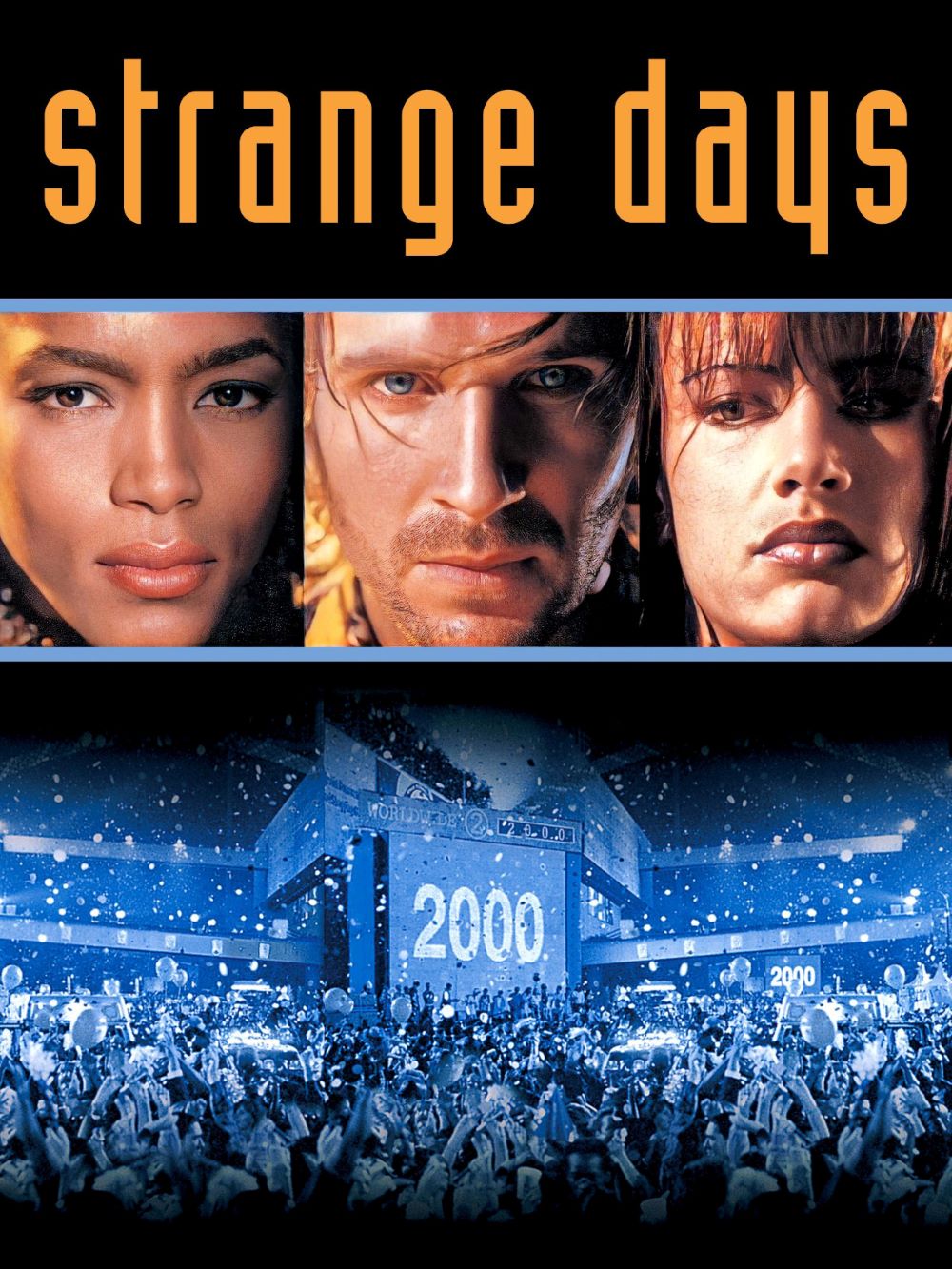
Kathryn Bigelow’s Strange Days plunges into a gritty, near-future Los Angeles teetering on the edge of the millennium, where illegal “SQUID” technology lets people hijack others’ sensory experiences, fueling a black-market addiction to raw thrills. Released in 1995 with a screenplay by James Cameron and Jay Cocks, the film stars Ralph Fiennes as Lenny Nero, a shady ex-cop dealing these clips amid escalating racial tensions and urban chaos. At over two hours, it mixes cyberpunk visuals with thriller tension, crafting an immersive world that pulses with sensory overload and moral ambiguity.
The story opens with a heart-pounding sequence—a robber’s point-of-view heist captured in one seamless, breathless shot that drops you right into the adrenaline-fueled action, setting a template for the film’s signature subjective dives into chaos. Lenny navigates this underworld, peddling clips of highs and dangers to escape his own regrets, especially over a past love, singer Faith Justin, brought to life by Juliette Lewis with vulnerable intensity that captures the pull of faded dreams. He pulls in his loyal bodyguard Mace, Angela Bassett delivering a fierce, grounded performance, as a mysterious clip hints at deeper corruption involving cops and power players in the city, drawing them into a web of intrigue that tests loyalties amid the neon haze. Bigelow leans into the tech’s seductive pull, where users feel every rush or rush of emotion, blurring lines between observer and participant in uncomfortably real ways that linger long after the credits roll.
Visually, the film explodes off the screen, with cinematographer Matthew Leonetti’s dynamic camera and Bigelow’s high-octane style painting L.A. as a neon-drenched maze of helicopters, crowds, and holographic distractions that feel alive and oppressive. That kinetic opening blends POV chaos with slick editing that amps the disorientation, making every frame pulse with urgency. The world feels authentically grimy and multicultural, alive with New Year’s Eve energy in clubs and streets, evoking millennial anxiety through thumping sound design and distorted audio bleeds that heighten the sensory assault. Bigelow channels her action roots into visceral set pieces that turn the future into something tangible and tense, rewarding close attention to the details that build immersion, from flickering holograms to rain-slicked streets buzzing with tension.
Fiennes captures Lenny’s sleazy charisma perfectly—a sweaty, chain-smoking hustler whose charm masks desperation, keeping him oddly relatable even as his flaws pile up in moments of quiet vulnerability. Bassett dominates as Mace, a tough wheelwoman with unshakeable integrity, her presence anchoring the frenzy and elevating every exchange with quiet strength that cuts through the chaos like a blade. Lewis adds raw edge to Faith, trapped in a web of influence and ambition, her scenes crackling with desperation and fire. Tom Sizemore brings twitchy noir flavor as Max, Lenny’s private investigator buddy who adds layers of unreliable grit to their partnership, his manic energy bouncing off Fiennes in tense, believable banter. The cast meshes well in the overload, though some peripheral figures lean into cyberpunk stereotypes like street dealers and digital oddities, occasionally stretching the vibe thin without fully fleshing out their roles amid the relentless pace.
At its core, Strange Days digs into tech’s grip on empathy in a numb world, where SQUID clips turn voyeurism into full-body complicity, raising tough questions about detachment, consent, and the thrill of borrowed lives. Lenny’s habit of replaying personal moments underscores the addictive pull of reliving the past, turning memory into a dangerous escape that erodes real connections. Bigelow threads in sharp commentary on racism and authority, drawing from real ’90s unrest, with Mace pushing for truth amid systemic shadows in ways that feel urgent and unflinching, her moral compass a steady force against the moral rot. The infamous rape scene stands out as a gut-wrenching pinnacle of this approach, forcing viewers into the perpetrator’s twisted perspective via SQUID playback, amplifying the victim’s terror and the assailant’s depravity to confront voyeuristic horror and power imbalances head-on without pulling punches or easy outs—its raw intensity is jarring, deliberately so, to expose the ethical rot at the tech’s heart. The female-led perspective highlights abuses thoughtfully, adding layers to the spectacle and giving the film a distinctive edge that balances exploitation with unflinching critique.
That said, the film isn’t without bumps, as the plot weaves a tangled web of alliances and betrayals that can feel convoluted under the sensory barrage, occasionally losing focus amid the noise and demanding sharper clarity to match its ambition. Its 145-minute runtime sags midway with Lenny’s brooding and repetitive demos, testing patience before ramping up to its feverish peaks, where the editing could trim some fat for tighter momentum. The climax aims for catharsis amid riots and revelations but lands unevenly, with a hopeful turn that feels rushed or tidy in spots, underplaying certain social threads post-buildup and diluting their harder-hitting potential just when they build to a roar. Some effects show their age, like glitchy clip transitions that disrupt rather than enhance the immersion at times.
Still, these rough edges can’t overshadow the film’s bold highs. Bigelow’s direction thrives on discomfort, using the SQUID concept to mirror how media desensitizes us, making every clip a window into ethical quicksand. The sound design deserves special mention—bass-heavy tracks and visceral screams that bleed from headsets create a claustrophobic intensity, amplifying the tech’s invasive allure. Action beats, from high-speed chases to brutal confrontations, showcase Bigelow’s knack for kinetic choreography, with Bassett’s physicality in the driver’s seat stealing the show. Lenny’s arc, flawed as it is, lands with pathos, his hustler’s denial cracking under pressure to reveal flickers of redemption tied to loyalty and loss.
Strange Days delivers highs that exhilarate and lows that challenge, mirroring its own addictive clips—a raw, uneven ride pulsing with Bigelow’s bold vision that thrives on discomfort and connection. Mace’s decency offers human spark amid the dystopia, balancing provocation with heart in a way that elevates the whole, her bond with Lenny grounding the spectacle in something real. It’s provocative cyberpunk for those craving immersion with bite, a film that doesn’t just show a future but makes you live it, flaws and all, leaving you wired and wary. Fire it up if you’re ready to jack in and feel the rush—just brace for the crash.
Welcome to Retro Television Reviews, a feature where we review some of our favorite and least favorite shows of the past! On Mondays, I will be reviewing Miami Vice, which ran on NBC from 1984 to 1989. The entire show can be purchased on Prime!
This week, Gina’s in trouble again!
Episode 4.19 “Blood & Roses”
(Dir by George Mendeluk, originally aired on April 1st, 1988)
Frank Mosca (Stanley Tucci) is back!
In case you’ve forgotten, Mosca was the villain from the fourth season premiere, Contempt of Court. That episode ended with Mosca getting away with everything. This episode finds him killing a rival drug lord (Michael Wincott) and trying to kill Crockett. Because Mosca knows who Crockett and Tubbs are, it falls on Gina to go undercover. This becomes yet another episode where Gina starts to fall for the bad guy and ends up having sex with the target of a Vice investigation. As often happens with these type of episodes, Gina ends up shooting Mosca to keep him from shooting Sonny. Mosca’s body plummets down an air shaft and it’s hard not to notice that Stanley Tucci has suddenly become a mannequin with painted hair.
Stanley Tucci gave a magnetic performance as the charismatic but evil Frank Mosca. Watching Tucci, it’s easy to see why the show brought him but Mosca was such a memorable character that it’s shame that he was given a standard Miami Vice death scene. Mosca deserved to go out with a bit more style. Saundra Santiago gave a good performance as Gina but it’s hard not to notice that every time she’s at the center of an episode, it’s pretty much the same basic plot. As a character, Gina deserved better than to constantly be used as a sex toy by every bad guy she went undercover to investigate.
Watching this episode, I found myself wondering if the show’s writers remembered that Crockett was supposed to be married. Between his jealousy over Gina getting close to Mosco and a scene where he and Gina shared a brief but intense kiss, it was hard not to notice that Crockett didn’t seem to be thinking about his wife. Perhaps this episode was originally meant to air earlier in the season, before Crockett’s somewhat improbable wedding. Who knows? It’s been a while since anyone asked Crockett about Caitlin. Maybe they got a quickie divorce offscreen.
This episode was typical of season 4. It was well-made but everything just felt a bit too familiar. to be effective.
That can be a dangerous thing to admit, about both the band and Oliver Stone’s 1991 film. Yes, both the band and the film could be a bit pretentious. They both tended to go on for a bit longer than necessary. They were both centered around a guy who wrote the type of poetry that I used to love back in my emo days. It’s all true.
But, with The Doors as a band, I find that I can’t stop listening to them once I start. Even if I might roll my eyes at some of the lyrics or if I might privately question whether any blues song really needs an organ solo, I can’t help but love the band. They had a sound that was uniquely their own, a psychedelic carnival that brought to mind images of people dancing joyfully while the world burned around them. And say what you will about Jim Morrison as a poet or even a thinker, he had a good voice. He had the perfect voice for The Doors and their rather portentous style. From the clips that I’ve seen of him performing, Morrison definitely had a stage presence. Morrison died young. He was only 27 and, in the popular imagination, he will always look like he’s 27. Unlike his contemporaries who managed to survive the 60s, Morrison will always eternally be long-haired and full of life.
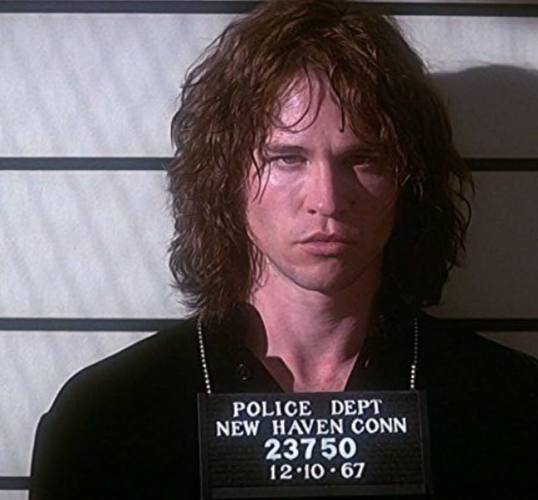
As for The Doors as a movie, it’s definitely an Oliver Stone film. It’s big. It’s colorful. It’s deliberately messy. Moments of genuinely clever filmmaking and breath-taking visuals are mixed with scenes that are so heavy-handed that you’ll be inspired to roll your eyes as dramatically as you’ve ever rolled them. Stone loved the music and that love comes through in every performance scene. Stone also loves using Native Americans as symbols and that can feel a bit cringey at times. Why would Jim Morrison, whose was of Scottish and Irish ancestry, even have a Native American spirit guide? At its best The Doors captures the chaos of a world that it’s the middle of being rebuilt. The 60s were a turbulent time and The Doors is a turbulent movie. I’ve read many reviews that criticized The Doors for the scene in which Morrison gets involved in a black magic ceremony with a journalist played by Kathleen Quinlan. I have no idea whether or not that scene happened in real life but the movie is so full of energy and wild imagery that the scene feels like it belongs, regardless of whether it’s true or not. Stone turns Jim Morrison into the warrior-artist-priest that Morrison apparently believed himself to be and the fact that the film actually succeeds has far more to do with Oliver Stone’s enthusiastic, no-holds-barred direction and Val Kilmer’s charismatic lead performance than it does with Jim Morrison himself.
The Doors spent several years in development and there were several actors who, at one time or another, wanted to play Morrison. Everyone from Tom Cruise to John Travolta to Richard Gere to Bono was considered for the role. (Bono as Jim Morrison, what fresh Hell would that have been?) Ultimately, Oliver Stone went with Val Kilmer for the role and Kilmer gives a larger-than-life performance as Morrison, capturing the charisma of a rock star but also the troubled and self-destructive soul of someone convinced that he was destined to die young. Kilmer has so much charisma that you’re willing to put up with all the talk about opening the doors of perception and achieving a higher consciousness. Kilmer was also smart enough to find the little moments to let the viewer know that Morrison, for all of his flamboyance, was ultimately a human being. When Kilmer-as-Morrison winks while singing one particularly portentous lyric, it’s a moment of self-awareness that the film very much needs.
(When the news of Kilmer’s death was announced last night, many people online immediately started talking about Tombstone, Top Gun, and Top Secret. For his part, Kilmer often said he was proudest of his performance as Jim Morrison.)
In the end, The Doors is less about the reality of the 60s and Jim Morrison and more about the way that we like to imagine the 60s and Jim Morrison as being. It’s a nonstop carnival, full of familiar faces like Kyle MacLachlan, Michael Madsen, Crispin Glover (as Andy Warhol), Frank Whaley, Kevin Dillon, and a seriously miscast Meg Ryan. It’s a big and sprawling film, one that is sometimes a bit too big for its own good but which is held together by both Stone’s shameless visuals and Val Kilmer’s charisma. If you didn’t like the band before you watched this movie, you probably still won’t like them. But, much like the band itself, The Doors is hard to ignore.
In 1989, having already won an Oscar for recreating his Vietnam experiences in Platoon, director Oliver Stone returned to the war with Born On The Fourth Of July.
Based on the memoir of anti-war activist Ron Kovic, Born on the Fourth of July stars Tom Cruise as Kovic. When we first meet Kovic, he’s growing up on Long Island in the 50s and 60s. He’s a clean-cut kid from a nice family. He’s on the school wrestling team and he’s got a lot of friends. When he was just 15, he heard John F. Kennedy telling people to ask what they can do for their country and he was inspired. He decided he wanted to join the Marines, despite the fact that his father (Raymond J. Barry) was still haunted by the combat that he saw in World War II. (In one of the film’s better scenes, a young Kovic notices that the elderly veterans marching in the Independence Day parade still flinch whenever they hear a firecracker.) He enlists in the Marines after listening to a patriotic speech from a recruiter (played by Tom Berenger). Ron runs through the rain to attend his prom and has one dance with Donna (Kyra Sedgwick), on whom he’s always had a crush. There’s nothing subtle about the way that Stone portrays Kovic’s childhood. In fact, one might argue that it’s a bit too idealized. But Stone knows what he’s doing. The wholesomenss of Kovic’s childhood leaves neither him nor the viewer prepared for what’s going to happen in Vietnam.
Vietnam turns out not to be the grand and patriotic adventure that Kovic thought it would be. After Sgt. Kovic accidentally shoots one of his own men in a firefight, he is ordered to keep quiet about the incident. After he is wounded and paralyzed in another firefight, Kovic ends up in a Hellish VA hospital, surrounded by men who will never fully recover from their mental and physical wounds. Kovic is eventually returns home in wheelchair. The film then follows Kovic as he goes from defending the war in Vietnam to eventually turning against both the war and the government. At one point, he ends up with a group of disabled vets in Mexico and there’s a memorable scene where he and another paraplegic (Willem Dafoe) attempt to fight despite having fallen out of their chairs. Eventually, Kovic returns to America and turns his anger into activism.
There’s nothing subtle about Born On The Fourth Of July. It’s a loud and angry film and Oliver Stone directs with a heavy-hand. Like a lot of Stone’s films, it overwhelms the viewer on a first viewing and it’s only during subsequent viewings that one becomes aware of just how manipulative the film is. Tom Cruise gives a good performance as Ron Kovic but his transformation into a long-haired, profane drunk still feels as if it happens a bit too abruptly. A good deal of the film centers on Kovic’s guilt about accidentally killing one of his men but the scene where he goes to the soldier’s family and asks them for forgiveness didn’t quite work for me. If anything, Kovic came across as being rather self-centered as he robs the man’s mother and father of the belief that their son had at least died heroically in combat as opposed to having been shot by his own sergeant. Did Kovic’s need to absolve himself really give him the right to cause this family more pain? Born on the Fourth Of July is an effective work of agitprop. On the first viewing, you’ll want to join Kovic in denouncing the military and demanding peace. On the second viewing, you’ll still sympathize with Kovic while also realizing that he really owes both his mother and father an apology for taking out his anger on them. By the third viewing, you’ll be kind of like, “Wow, I feel bad for this guy but he’s still kind of a jerk.” That said, when it comes to making an effective political film, Adam McKay could definitely take some lessons from Oliver Stone. Born On The Fourth of July is at its best when it simply captures the feeling of living in turmoil and discovering that the world is not as simple a place as you once believed. As idealized as the film’s presentation of Kovic’s childhood may be, anyone who has ever felt nostalgia for an earlier and simpler world will be able to relate.
Oliver Stone won his second Best Director Oscar for Born On The Fourth Of July. The film itself lost Best Picture to far more genteel version of the past, Driving Miss Daisy.
Burned-out writer Jake Bridges (William L. Petersen, a year or two before CSI) comes home one day to discover his wife in bed with another man. Jake, who is already suffering from an epic case of writer’s block, goes to Atlantic City and tries to drink his troubles away. When the bitter Jake gets into a bar fight, he’s saved by Frankie (Michael Wincott). Frankie takes Jake back to his house, where Jake meets Frankie’s girlfriend, Melissa (Diane Lane). Jake also discovers that Frankie works as a debt collector for a local mob boss, Lange (Michael Byrne).
Frankie and Jake strike up an unexpected friendship. Jake wants to experience what it’s like to be a real tough guy. Frankie wants to improve his vocabulary. Frankie agrees to take Jake with him when he makes his collections on the condition that Jake recommend a book to him. Soon, Jake is pretending to be a gangster and Frankie is reading Moby Dick. Frankie shows Jake how to be intimidating. Jake explains the symbolism of Ahab’s quest to Frankie. They become good friends, with the only possible complication being that Jake is falling in love with Melissa.
For a low-budget neonoir that, as far as I know, never even got a theatrical release before being released to video, Gunshy is surprisingly good. The plot may sometimes be predictable but Petersen and especially Wincott give good performances and they both play off of each other well. Diane Lane is undeniably sexy but also bring a fierce intelligence and a sense of wounded dignity to the role of Melissa. This is a love triangle where you want things to work out for all three of the people involved. The rest of the cast is full of familiar faces. Keep an eye out for everyone from R. Lee Ermey to Meat Loaf. Director Jeff Celantano keeps the story moving and proves himself to be adept at balancing scenes of violence with scenes where Frankie and Jake simply discuss their differing views of the world.
An unjustly obscure film, Gunshy is a 90s film that deserves to be rediscovered.
I Shot Andy Warhol was not the only 1996 film to feature Andy Warhol as a character. He was also a prominent supporting character in Basquiat. In this film, he’s played by David Bowie and Bowie gives a far different performance than Jared Harris did in I Shot Andy Warhol. Whereas Harris played Andy as a detached voyeur, Bowie’s performance is far more sympathetic. (Of course, it should be noted that Harris and Bowie were playing Andy Warhol at very different points in the artist’s life. Harris played the younger, pre-shooting Warhol. Bowie played the older, post-shooting Warhol.)
Then again, it’s not just Andy Warhol who is portrayed more positively in Basquiat than in I Shot Andy Warhol. The entire New York art scene is portrayed far more positively in Basquiat. Whereas I Shot Andy Warhol was a film about an outsider who was destined to forever remain an outsider, Basquiat is a film about an outsider who becomes an insider. On top of that, Basquiat was directed by a fellow insider, painter Julian Schnabel.
The film itself is a biopic of Jean-Michel Basquiat (very well played by Jeffrey Wright), the graffiti artist who, in the 1980s, briefly became one of the superstars of the New York art scene. However, it’s less of a conventional biopic and more of a meditation on what it means to be an artist. Throughout the film, Basquiat looks up to the New York skyline and sees a surfer riding a wave across the sky. The image itself is never explicitly explained. We never learn why, specifically, Basquiat visualizes a surfer. But then again, that’s what makes the surfer a perfect symbol of Basquiat’s artistic sensibility and talent. It’s a reminder that, while we can appreciate an artist’s work, only the artist can truly understand what that work is saying. All attempts to try to explain or categorize art are as pointless as trying to understand why that surfer is in the sky. Ultimately, the why is not as important as the simple fact that the surfer is there.
The film follows Basquiat as he goes from living on the streets to being a protegé of Andy Warhol’s and, until he overdosed on heroin, one of the shining lights of the New York art scene. Along the way, Basquiat struggles to maintain a balance between art and the business. In one of the key scenes of the film, an empty-headed suburbanite (Tatum O’Neal) looks at Basquiat’s work and whines that there’s too much green. She just can’t handle all of that green.
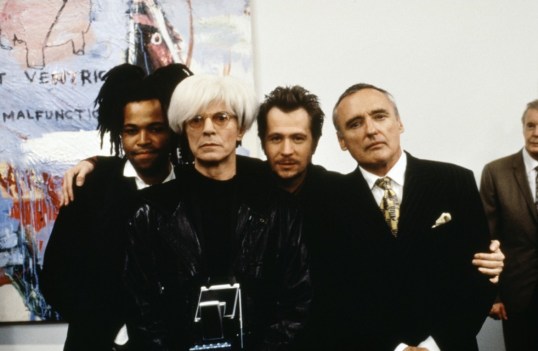
Basquiat’s friendship with Andy Warhol provides this film with a heart. When Bowie first appears — having lunch with a German art dealer played by Dennis Hopper — one’s natural instinct is to assume that Bowie as Warhol is stunt casting. However, Bowie quickly proves that instinct to be wrong. As opposed to many of the actors who have played Andy Warhol over the years, Bowie gives an actual performance. Instead of resorting to caricature, Bowie plays Warhol as being mildly bemused by both his fame and the world in general.
Basquiat also develops a close friendship with another artist. Gary Oldman may be playing a character named Albert Milo but it’s obvious from the moment that he first appears that he’s playing the film’s director, Julian Schnabel. If there was any doubt, Schnabel’s studio stands in for Milo’s studio. When Milo shows off his work, he’s showing off Schnabel’s work. When Albert Milo introduced Basquiat to his parents, the nice old couple is played by Julian Schnabel’s actual parents. It’s perhaps not surprising that Albert Milo is presented as being one of the most important and popular artists in New York City. In a film full of bitchy characters, Albert Milo is unique in that literally everyone likes and respects him. And yet Gary Oldman gives such a good and heartfelt performance that you can’t hold it against the character that he happens to be perfect. There’s a small but touching scene in which Albert Milo and his daughter share a dance in front of one of Schnabel’s gigantic canvases. Of course, Milo’s daughter is played by Julian Schnabel’s daughter.
The entire cast is full of familiar actors. Willem DaFoe appears as a sculptor. Christopher Walken plays a hilariously vapid interviewer. Courtney Love plays a groupie. Benicio Del Toro plays Basquiat’s best friend. Parker Posey shows up as gallery owner Mary Boone. Michael Wincott plays Rene Ricard, the somewhat infamous art critic who was among the first to celebrate the work of both Basquiat and Schnabel. For once, the use of familiar actors does not sabotage the effectiveness of the film. If anything, it helps to explain why Basquiat was so determined to make it. There’s a magical scene where a then-unknown Basquiat peeks through a gallery window and sees Andy Warhol, Albert Milo, and Bruno Bischofberger. However, the film’s audience sees David Bowie, Gary Oldman, and Dennis Hopper. What both Basquiat and the audience have in common is that they’re both seeing bigger-than-life stars.
Basquiat is an often magical and poignant film and I absolutely love it.
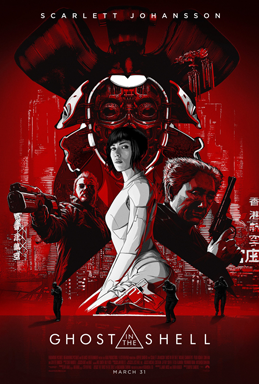
Now, before I start in on this review, I should admit that I’m hardly an expert on the manga on which Ghost in the Shell was based. (In fact, as soon as I wrote that previous sentence, I called my boyfriend over and had him read it, just to make sure that I was using the term manga correctly.) A few years ago, I did watch Mamoru Oshii’s 1995 film version. And while I don’t remember a whole lot about the animated Ghost in the Shell, I do remember that I was never bored while watching it. I wish I could say the same about the live action Ghost in the Shell.
Don’t get me wrong. The live action, Westernized Ghost In The Shell is truly a visually impressive film. It takes place in the near future, in the fictional Japanese city of New Port City. New Port City basically looks like the city from Blade Runner, just with a somewhat more colorful visual scheme. Everywhere you look, there are gigantic holographic advertisements and sleek, neon buildings. But, as advanced as New Port City may look at first sight, it’s also full of dark allies, cramped apartments, and gray cemeteries. Visually, it’s a perfect mix of outlandish science fiction and brooding film noir.
Or, at least, it is the first time that you see it. Unfortunately, director Rupert Sanders has a habit of using the visuals as a crutch. It seemed as if, every time a new plot point was clumsily introduced, we would suddenly cut to another shot of New Port City at night, as if the film was saying, “Don’t worry about narrative coherence! Look at the city!”
After about 15 minutes, I decided to take the film up on its suggestion. I stopped paying attention to the slow-moving story and I focused almost exclusively on the visuals. That’s a shame really because, from what I understand, both the manga and the original film are deeply philosophical works that balance style with thematic depth. Unfortunately, since there’s no real depth to the live action Ghost in the Shell, you really have no choice but to focus almost exclusively on the style.
Ghost in the Shell takes place in a world where the line between human and machine has become blurred. Everyone is getting cybernetic upgrades done. One character, Batou (Pilou Asbæk), even gets new eyes halfway through the film. Major (Scarlett Johansson) is unique because, while her brain is human, her body is totally cybernetic. She is a member of Section 9, an anti-terrorism task force. Major has only vague flashes of memory of who she used to be. She’s been told that her parents were killed by terrorists but she doesn’t know if that’s true or if that’s just more manipulation from Cutter (Peter Ferdinando). (It’s no spoiler to say that Cutter turns out to be a not nice guy. He’s the CEO of a Hanka Robotics and when was the last time you saw a movie where a robotics CEO didn’t turn out to be a not nice guy?) After Section 9 thwarts a cyberterrorist attack against Hanka Robotics, Major starts to wonder who she is and who she can trust. Everyone tells her that, because she has a human brain, she’s also a human. But Major still feels lost and without an identity. When she starts to get too close to discovering her past, Cutter sets out to not only destroy her but all of Section 9 as well…
There’s a really good movie in which Scarlett Johansson plays a lost soul looking for her identity in Japan. It’s called Lost in Translation. Or, if you just want to see Scarlett playing someone who is learning more and more about herself and what she’s capable of, you could go watch Lucy. (I don’t care much for that movie but some people seemed to like it.) Or, if you want to see Scarlett play an enigmatic being who explores the world while hiding her true form in a human shell, you can always go watch Under the Skin.
(I highly recommend Under the Skin, which is as thought-provoking as Ghost in the Shell is shallow.)
This is what’s frustrating. Scarlett Johansson gives a really good performance in Ghost in the Shell but she’s continually let down by a script that refuses to take the time to really explore anything. We get a scene or two of Major wondering what it means to be truly human but the movie is always more interested in getting to the next action scene. There’s a lot of talk about what it means to be human but there’s no real exploration. Ghost in the Shell has all the depth of one of those old sci-fi shows where aliens (and, occasionally, androids) approach bemused humans and ask, “What is this thing that you call laughter?”
Ghost in the Shell ends with the hint of more films to come. Personally, I’d rather see Scarlett Johansson in a Black Widow solo film. When is that going to happen, Marvel Studios!? Let’s get to it! As for the live action Ghost in the Shell, it’s just frustrating and forgettable.
The second part of THQ and Vigil Games’ short-film trailer to introduce the character of Death for their sequel to 2010’s Darksidershas now come out and it shows the Pale Horseman of the Apocalypse taking on even more demons and an enormous angelic engine of destruction. We don’t hear Death speak (his voice will be veteran genre actor Michael Wincott), but we do see him in action taking on demons and then finally transforming into his more recognizable Grim Reaper aspect to take on the battle engine.
If there was a game I’m really waiting to get my hands on this summer it will be this game and hopefully the delay of releasing the game on June 26, 2012 to a later date of August 14, 2012 means more polishing and tweaking of the final product before it comes out to the public. Here’s to hoping that when it finally comes out it will not be buggy and be as good or better than the game that preceded it.