Welcome to Retro Television Reviews, a feature where we review some of our favorite and least favorite shows of the past! On Mondays, I will be reviewing Crime Story, which ran on NBC from 1986 to 1988. The entire show can be found on Tubi!
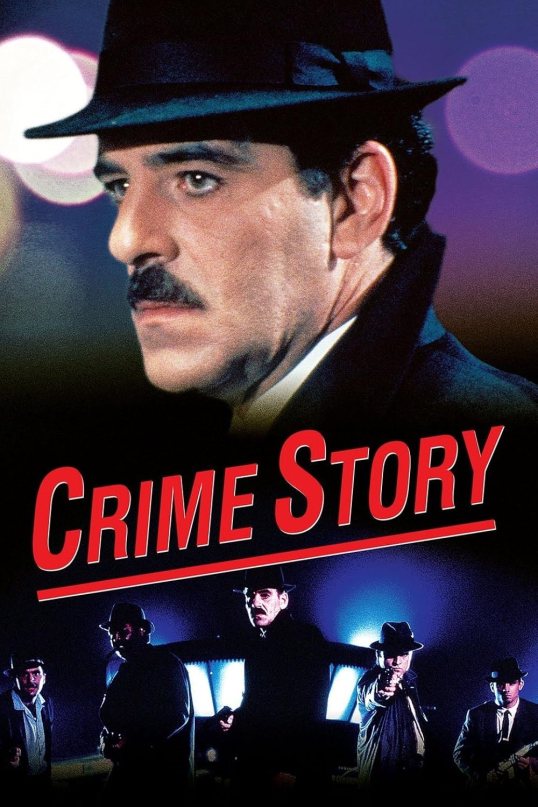
This week, Luca has to prove himself.
Episode 1.5 “The War”
(Dir by Leon Ichaso, originally aired on October 7th, 1986)
Luca is in trouble.
Last week’s episode ended with Max Goldman on the receiving end of a beating from Noah Ganz’s goons. Goldman survives and returns with a message. Ganz is not happy that Luca tried to steal his book. Bartoli, Weisbord, and Fosse all inform Luca will have to resolve the Ganz situation on his own.
Luca tries to get public defender David Abrams (Stephen Lang) to act as a negotiator for him but David doesn’t want to get involved in the mobster lifestyle that made his father rich. David just wants to defend the poor and play sax in a jazz club. When Luca is attacked while driving in Chicago, he realizes that negotiating with Ganz is a dead end.
Instead, he just kills Ganz. In a bravura sequence, Luca shows up at a hotel and, with the help of sniper, takes down Ganz’s bodyguards. Then he uses a bomb to take out Ganz while the latter is holding court in an elevator. A plume of white smoke puffs out of the hotel’s exhaust vent.
Having taken care of the issue, Luca is welcomed back into the family. Weisbord says, “Call me Mac.” Fosse (played by Michael Madsen) nods and slowly smokes a cigarette.
Meanwhile, Torello’s wife miscarries. This is the episode that features the clip of Torello walking down a lonely Chicago street on a rainy night. (The clip is prominently featured during the show’s opening credits.) In fact, both Torello and Luca end up spending a good deal of time walking around at night while David Abrams plays his saxophone. It’s a scene that is so overstylized that it shouldn’t work but somehow, it does. If nothing else, it reminds us that Crime Story of two dangerously obsessed men on a collision course.
This was a good episode, if just because it showed that Luca can be a clever criminal when he needs to be. Before this episode, Luca seemed to be clearly outmatched by Torello. With this episode, Luca proved himself to be Torello’s equal.
Welcome to Retro Television Reviews, a feature where we review some of our favorite and least favorite shows of the past! On Mondays, I will be reviewing Crime Story, which ran on NBC from 1986 to 1988. The entire show can be found on Tubi!
This week, everyone’s going to Missouri. Can you blame them?
Episode 1,4 “St. Louis Book of Blues”
(Dir by Leon Ichaso, originally aired on September 30th, 1986)
After Ray Luca discovers that his henchman, Frank Holman (Ted Levine), has been compromised by Torello, he decides to deal with the situation by sending Holman down to St. Louis. A gangster named Ganz (Raymond Serra) has a home in St. Louis and, according to Ganz’s associate Johnny Fosse (Michael Madsen, doing his slow-talking, cigarette-smoking Madsen thing), there is a book in Ganz’s shelf that contains the name of every bookie, coach, and sports-fixer in America. Ray, who is hoping to start up his own nationwide gambling syndicate, wants that book.
Far be it for me to question Ray Luca’s strategy but it does seem strange that his response to one of his people screwing up is to give that person an even more important job to do. I get that Ray is trying to be a manager now and, as a result, he no longer personally robs anyone but Frank really does seem like the last person he should trust to pull this off.
And, to no one’s surprise, Frank doesn’t pull it off. Torello and his men follow him all the way to St. Louis. They not only arrest him but they also get their hands on Ganz’s book. They do this despite the operation nearly being ruined by an ambitious and publicity-hungry sheriff named Hartman (Allen Swfit).
Unfortunately, when Frank offers to inform on the entire “St. Louis mob,” Hartman releases him from jail. Frank promptly flees town. When he calls Ray, Ray orders him to stay out of Chicago and instead to go to Cleveland. Frank replies that if he has to choose between Hell or Cleveland …. he’ll go to Cleveland. Good thinking, Frank!
(Actually, I’ve never been to Cleveland so I don’t know if it’s really good thinking. Wasn’t Dennis Kucinich from Cleveland?)
As this episode ends, Ganz is ready to declare war on Luca and it appears that Max Goldman might be the first victim. The funny thing about Max is that he’s played by a young Andrew Dice Clay and, in every scene in which he appears, Clay’s facial expressions are totally and completely over-the-top, as if Clay was determined to make sure that no one forgot he was in the scene. I hope that Max survives, just for the sake of entertainment,
This episode returned to the idea of Torelllo being dangerously and tightly wound. Before he followed Frank to St. Louis, he nearly firebombed a furniture store because the owner hadn’t delivered the table that he had ordered. Torello was talked out of doing so by his fellow cops but the store owner still got the message. The table arrived at Torello’s apartment. Of course, it was the wrong table. That made me laugh. People have no idea how close Torello is to snapping and killing everyone around him.
This was a good episode. It was interesting to see a young Ted Levine, not to mention a young Michael Madsen as well. The corrupt and incompetent sheriff was identified as being a Democrat. I appreciated that. I’m looking forward to seeing where this show is going.
Welcome to Retro Television Reviews, a feature where we review some of our favorite and least favorite shows of the past! On Mondays, I will be reviewing Crime Story, which ran on NBC from 1986 to 1988. The entire show can be found on Tubi!
This week, Torello and company search Chicago for a serial killer.
Episode 1.2 “Final Transmission”
(Dir by Leon Ichaso, originally aired on September 19th, 1986)
Mike Torello and the members of the MCU would really like to go after Luca and his crew but, unfortunately, there’s a serial killer on the loose in Chicago. Realizing that the MCU is going to be tied up trying to track down Ray Pernell (John Snyder) before he kills again, Luca orders his crew to commit even more robberies. Luca explains to a crestfallen Paulie that Luca will no longer be taking part in the robberies. Luca is the boss and the boss doesn’t get his hands dirty. Instead, Luca spends most of this episode meeting with Murray Weisbord’s man in Chicago, Max Goldman (Andrew Dice Clay).
This was an odd episode. On the one hand, the show went out of its way to recreate Chicago in the early 60s. The soundtrack was early rock and roll. The cars all had tailfins. The suits, the cigarettes, Luca’s haircut, all of the details screamed 1960s. But then the episode revolved around a serial killer who thought his mother was addressing him through the television and who looked and dressed like a late 70s punk rocker. I assume that Ray Pernell was based on Richard Speck, the notorious Chicago serial killer who, in 1966, murdered 8 student nurses. Like Speck, Pernell had an identifying tattoo and both men were traced through the National Maritime Union. That said, Pernell just seemed so out-of-place, with his sleeveless shirt and his punkish haircut that he just didn’t seem to belong in the world of Crime Story.
That said, I will give this episode some credit. In the pilot, Luca often seemed like a clueless punk. In this episode, he quickly realized that the MCU would be too busy hunting for Pernell to devote much time to him and he took advantage of that fact. Luca’s not quite as dumb as he sometimes seems. This episode also showed that he was capable of thinking ahead. When he suspects that someone is listening in on his conversation with Goldman, he resists the temptation to burst into the room next door with his gun drawn. (If he had, he would have run straight into Torello and Danny.) This episode shows that Luca is learning and growing. He not the buffoonish hothead that Torello originally assumed him to be. In fact, he’s even more dangerous.
This episode ends with Pernell somehow (it’s not really clear how) taking an entire television news broadcast hostage. Torello takes him down as the cameras roll and the entire city of Chicago watches. It’s not a bad ending but it just doesn’t feel right for the show. It’s a Miami Vice ending. This is Crime Story!
Welcome to Retro Television Reviews, a feature where we review some of our favorite and least favorite shows of the past! On Mondays, I will be reviewing Crime Story, which ran on NBC from 1986 to 1988. The entire show can be found on Tubi!
In 1986, riding high on the success of Miami Vice, Michael Mann signed on as executive producer of Crime Story, a cop show that Mann imagined would run for five seasons and which would follow a group of cops and gangsters from 1960s Chicago to 1980s Las Vegas. The show was co-created by former Chicago cop Chuck Adamson and it starred another former Chicago cop, Dennis Farina.
Though generally well-received by critics, Crime Story struggled in the ratings. The show’s highly serialized-nature made it difficult for audiences to follow. (This was in the pre-streaming age, when viewers couldn’t just get online and catch up with what they may have missed.) Crime Story only lasted for two seasons but it has since developed a strong cult following and is now regularly listed as one of the best cop shows ever made.
(Dir by Abel Ferrara, originally aired on September 18th, 1986)
In Chicago, on a rainy night in the early 1960s, a group of masked robbers hold up a fancy restaurant and then try to escape with a group of terrified hostages. On the scene is the Major Crimes Unit, led by the grim Lt. Torello (Dennis Farina, a former real-life cop). The end result is that all of the robbers end up dead, the hostages end up traumatized, and one of Torello’s men, the obviously doomed Wes Connelly (William Russ), appears to be losing his mind over the violence that he has to deal with every day.
The plot of the pilot is actually pretty simple. A gang of thieves is holding up restaurants, banks, and stores in Chicago. Torello believes that an ambitious gangster named Ray Luca (Tony Denison) is behind the robberies and Torello is correct. The cool and sociopathic Ray is working with Johnny O’Donnel (David Caruso). O’Donnel may be a childhood friend of Luca’s but his parents are friends with Torello. When gangster Phil Bartoli (Jon Polito) orders Luca to kill O’Donnel after the latter robs one of Bartoli’s jewelry stores, it’s personal all-around.
Plot-wise, it’s pure Michael Mann. The cops and the gangsters are both obsessive. Luca will kill anyone to get ahead in the underworld. Oddly, his only real loyalty seems to be to his dumbest henchman, Pauli Taglia (John Santucci, a real-life former jewel thief who was once arrested by Dennis Farina). Torello may be fighting on the side of the law but he’s often just as quick to resort to violence as Luca. Director Abel Ferrara’s style can be seen in a scene where Torello is visited by the ghost of the recently murdered Wes Connelly. Torello is burned out and paranoid, flying into a rage when he sees his wife, Julie (Darlanne Fluegel), dancing with another man at a wedding. (The man in question turns out to be Torello’s cousin, whom Torello didn’t even recognize because he apparently doesn’t have much of a connection to anyone outside of the police force.) Towards the end of the episode, there’s a shoot-out in a department store and it’s hard not to notice that neither the crooks nor the cops seem to be all that concerned with the innocent bystanders trying to not get caught in the crossfire.
The pilot is dark, gritty, and, in its way, as stylized as any episode of Miami Vice. It never seems to stop raining and, even during the day, the skies are permanently gray and dark. The early 60s are recreated like a fever dream of pop culture, with rock and roll on the soundtrack, cars with tail fins screeching down the street, and Bartoli living in a house that looks more like a tacky diner then a true home. Torello and his men wear their dark suits and trenchcoats the way that soldiers wear their uniforms.
It’s an effective pilot, though we don’t really get to know much about the men working with Torello at the Major Crimes Unit. Bill Smitrovich, in the role Detective Danny Krycheck, establishes himself as being Torello’s second-in-command but that’s about it. Stephen Lang appears in a handful of scenes as David Abrams, a liberal public defender who is the son of a prominent gangster. Both Luca and Torello seem to want to make David into an alley and the episode hints that he will eventually have to make a choice. The episode ends with Luca in sunny Florida, meeting with veteran gangster Manny Weisbord (Joseph Wiseman). Torello, meanwhile, remains in dark Chicago.
The Crime Story pilot was deemed good enough to be released as a feature film in Europe. It also led to a series on NBC, which I will be reviewing here, every Monday! On the basis of the pilot, I’m looking forward to it.
After high school basketball coach Schmidt (Andrew Dice Clay) has a heart attack, one of his former players, Bilal Irving (Jordan Johnson-Hines), returns to Ontario to replace him. Bilal, a pro player who has developed a reputation for being a diva, thinks that it will mean some good publicity for him. Instead, he discovers that coaching a group of scrappy underdogs to the province championship is far more satisfying than being a member of the Timberwolves.
There’s not a sports cliche that goes unused in Warrior Strong. At first, no one gives the team a chance but then the team shows what they can do when they are properly motivated. Bilal stop being selfish but then gets a chance to return to the NBA right before the championship game. The team’s best player quits in disgust and the rest of the players have to prove themselves. Since this is a Canadian film, there’s a lot of political and cultural content stuffed into the plot. A local indigenous woman give the team permission to use the Warriors name. One the team’s stars, Bettina (Macaulee Cassaday), worries about fitting in as a nonbinary person. Some of it feels awkwardly forced into the story. Some of it works. I’ve never been a believer in the idea that “going work” automatically makes a film good or bad. But there are times that the movie feels as if it was written by someone who was given a checklist of issues to include.
Most people who watch this film will probably be watching for Andrew Dice Clay, cast here as a plainspoken coach. Clay is believable in the role, even if he doesn’t really do that much. He plays a decent person who doesn’t curse or recite dirty limericks. Watching films like this, you have to wonder what his career would be like now if he had never been the Diceman.
After two blissfully Rand-free episodes of Pam & Tommy, Rand Gauthier (Seth Rogen) returned to dominate this week’s episode. As soon as things opened with a close-up of Rand looking like someone had just run over his favorite pet, I groaned very loudly. Rand is such an unlikable character and the show insists on trying to make us feel sorry for this loser. Even if Seth Rogen wasn’t both miscast and intent on giving the worst performance of his career in the role, Rand would make Pam & Tommy difficult to watch.
Rand (or Reed or whatever his name is supposed to be) was basically upset because he wasn’t making any money off of the Pam and Tommy sex tape. Instead, the bootleggers were making all the money. Rand/Reed also got upset because cocaine addict Uncle Miltie (Nick Offerman) turned out to be a bad business partner. Meanwhile, Butchie (Andrew “Dice” Clay, acting up a storm with little to show for it) wanted his money and demanded that Reed/Rand turn into a debt collector. “I AM THE DESTROYER OF WORLDS!” a frustrated Rand declared as he collected a debt and seriously, what the heck? (Folks, I gave up cursing for Lent. Just go with me here.) The episode’s best moment was when Rand tried to blackmail Tommy and Tommy reacted by setting the money on fire while Randy Reed watched. What made this scene so great was that Tommy called Reedy Rand a loser. Again, I got the feeling that we were supposed to feel bad for Rand but …. eh. Who cares? Rand is a loser and the mullet isn’t making him look any better.
If the highlight of the episode was Tommy setting that money on fire while taunting Rand, the show’s second best moment was Pam appearing on The Tonight Show and having to deal with a series of disrespectful and infuriatingly sexist questions from Jay Leno. The actor playing Leno essentially played him as being the devil, which was kind of amusing. Watching the scenes with Leno acting like a member of the Spanish Inquisition, I found myself thinking about how Ken Russell probably could have done something amazing with this material. The scene ended with Pam having to talk Tommy out of beating up Jay Leno, which again was kind of amusing. Just imagine if Tommy had stormed onto the Tonight Show set and thrown a punch while Jay was introducing Hugh Grant. That would have been classic television.
As the Tonight Show debacle indicated, the release of Barb Wire was overshadowed by Pam and Tommy’s court case against Penthouse. The judge ruled that the 1st Amendment gave Penthouse the right to publish still from the tape. Tommy was too stupid to realize that the judge had ruled against him. Pam responded with a monologue about how the judge was actually saying that it was okay to exploit her because she wore a swimsuit on Baywatch and she also previously appeared in Playboy. Pam had a point but, as so often happens on this show, that point was somewhat negated by the fact that the real-life Pamela Anderson never signed off on having her life dramatized in Pam & Tommy and, as a result, the show is itself a bit exploitive.
The show also continues to feel a bit pointless, despite Lily James’s frequently excellent performance as Pam. Again, it’s hard not to wonder why exactly this story demands the limited series treatment as opposed to the 90-minute movie treatment. Indeed, by stretching thing out over 8 hours, Pam & Tommy just reminds us of how superficial this story really is.
One final note: early on in the episode, Butchie is shocked to discover that there’s a new coffee company in Seattle that’s called Starbucks. I’ve noticed this is a joke that’s popped up in a lot of movies about the 90s and it feels rather lazy. They should have made an AOL joke instead.
Currently (and, presumably, forever) available on Hulu, Pam & Tommy is a miniseries about …. well, it’s about many things.
It’s about the mid-90s, a time when people still used terms like “World Wide Web” and where no one thought twice about having to wait two or three minutes for one lousy web site to finish loading. It’s about a time when dial-up internet was still considered to be something of an exotic luxury. It’s about a time when the number one show in the entire world was the critically derided Baywatch and the show’s star, Pamela Anderson, was trying to make the jump from television to film.
It’s also about the early days of online porn and how it was first discovered that people would pay money to watch celebrity sex tapes. It may seem strange to consider that this was something that needed to be discovered but, if you believe Pam & Tommy, apparently no one thought there was an audience for celebrity sex tapes before 1996. Today, of course, celebrity sex tapes are so common place that they’re often leaked by the celebrity themselves. Where would the Kardashians be if not for the celebrity sex tape industry? Could it be that Kim owes as much of her success to Pamela Anderson and Tommy Lee as she does to O.J. Simpson? Perhaps, which is a polite way of saying yes.
Pam & Tommy is also about the brief marriage of Pamela Anderson (Lily James) and Tommy Lee (Sebastian Stan). When Pam & Tommy begins, Pam, as mentioned above, is the star of the number one show in the world. Despite being a star, she’s not respected as an actress. Instead, she’s usually treated as just being a body. The show’s producers and directors have no trouble cutting her big monologue on a whim but they spend several minutes discussing just how tight her red swimsuit should be. (After cutting her monologue, they condescendingly thank her for being a team player.) Pam has a very earnest and somewhat heart-breaking desire to be taken seriously as an actress. She describes Jane Fonda as being her role model. Meanwhile, Tommy Lee is, for lack of a better term, an idiot. He’s also a drummer for a band that used to be big. He travels with an entourage. His body is covered with tattoos, the majority of which have no meaning to him beyond, “I just thought it looked cool.” Tommy is usually an arrogant bully, the epitome of the spoiled rock star. Occasionally, with Pam, he’s sweet but if this miniseries stays true to what actually happened during Pam and Tommy’s marriage, that sweetness is not going to last.
Finally, Pam & Tommy is the story of Rand Gautheir (Seth Rogen). Much like Tommy, Rand is a moron. However, Rand has neither Tommy’s looks nor his swagger. Instead, he’s just a schlub who works as a carpenter and tries way too hard to present himself as being an intellectual. After Tommy humiliates Rand by firing him from a remodeling job, Rand retaliates by stealing a safe from Tommy’s garage. (Tommy doesn’t even notice that it’s missing.) Inside the safe, Rand finds a sex tape that Tommy and Pam made on their honeymoon. With the help of gangster Butchie Periano (Andrew Dice Clay) and adult film veteran “Uncle” Miltie (Nick Offerman), Rand puts the video on the internet and plans to make a fortune. Rand tells himself that he’s doing it because Tommy didn’t pay him for his work but it’s clear that Rand’s main motivation is jealousy. Why should Tommy get a huge house and a beautiful wife while Rand is stuck in his little apartment? Rand is at least as smart as Tommy. Of course, the same could probably be said of the dog that Pam purchases when she and Tommy return from their honeymoon.
In other words, Pam & Tommy is about a very specific cultural moment. So far, the series is taking a stylized approach to the material, mixing occasionally broad comedy with more dramatic moments. Needless to say, it’s a bit uneven. During the second episode, Tommy actually has a conversation with his penis about whether or not he should marry Pam. It’s a funny idea but the scene itself goes on forever and, ultimately, the whole thing says more about the importance of generating twitter buzz than it does about why Tommy and Pam ended up getting married after knowing each other for only a handful of days. The first three episodes were directed by Craig Gillipsie, who also directed I, Tonya. Much like that film, Pam & Tommy is occasionally insightful but it also sometimes seems to get bogged down in its own condescending attitude towards the people who are at the center of its story.
And yet, there are also enough moments that work in Pam & Tommy that I’ll definitely watch the rest of the show. So far, this is a series that is largely saved by its cast. Seth Rogen has recently been so intent on presenting himself as being the only man in Hollywood with integrity that it’s easy to forget that he’s always been at his most entertaining (and sympathetic) whenever he’s been cast as a complete loser and it’s hard to think of anyone who could be a bigger loser than the character he plays in Pam & Tommy. Sebastian Stan plays Tommy as being a destructive manchild and, for the first two episodes, he’s pretty obnoxious. By the third episode, though, Stan is given a few quieter scenes and he manages to suggest that there’s something more to Tommy than just rock star bravado. And finally, Lily James gives a wonderfully empathetic performance as Pamela Anderson, capturing her earnest desire to be something more than just a sex symbol.
The first three episodes of Pam & Tommy dropped on Hulu this week. The remaining five episodes will be released on a weekly basis. I don’t really know how you get 8 episodes out of this particular story but I guess I’ll find out soon. Hopefully, the show will continue to focus on the best thing that it has going for it, its cast.
Bradley Cooper is 45 years old today. With all the recent talk about how people’s lives have changed over the past decade, let’s take a minute to appreciate just how spectacularly things have gone for Bradley Cooper, career-wise. Ten years ago, Bradley Cooper was probably best-known for playing the smarmiest member of The Hangover‘s quartet of friends. Now, Cooper is known for not only being one of the best actors working today but also for making an acclaimed directorial debut with the 2018 Best Picture nominee, A Star Is Born.
Cooper not only directed A Star is Born but he also starred in it. He played Jackson Maine, a country musician who has been drinking for as long as he can remember. He used to drink with his father and when his father died, Jackson continued to drink alone. (At one point, Jackson says that he was a teenager when his father died.) Managed by his older brother, Bobby (Sam Elliott), Jackson became a star but his career has been in decline for a while. For all of his talent and for all of his belief that he has something worth saying, Jackson is drinking his life away. He stumbles from show to show and is often dependent upon Bobby to tell him what he missed while he was blacked out.
When Jackson stumbles into a drag bar and sees Ally (Lady Gaga, making her film debut) singing a song by Edith Piaf, he is immediately captivated by her talent. Ally, whose father (Andrew Dice Clay) is a limo driver who once aspired to be bigger than Sinatra, is at first weary of Jackson but he wins her over. After she punches a drunk and he takes her to a grocery store to construct a makeshift cast for her hand, she sings a song that she wrote and Jackson decides to take her on tour. Soon, they’re in love and, before you know it, they’re married!
Unfortunately, Jackson’s alcoholism threatens both their happiness and their future. While Ally’s star rises, his continues to dim. Will Ally sacrifice her career for Jackson or will Jackson sacrifice his life for Ally?
It’s a familiar story, one that’s been told many times. The first version was 1932’s What Price Hollywood, which featured aspiring actress Constance Bennett falling in love with an alcoholic director played by Lowell Sherman. In 1937, What Price Hollywood? was unofficially remade as A Star Is Born, with Janet Gaynor as Esther, the actress who falls in love with faded matinee idol, Norman Maine (Fredric March). The next version came out in 1954 and featured Judy Garland as Esther and James Mason as Norman. Significantly, the 1954 version added music to the plot, with Judy Garland singing The Man That Got Away.
In 1976, the story was told a third time. This version of A Star is Born starred Barbra Streisand as singer Esther Hoffman and Kris Kristofferson as a self-destructive rock star named John Norman Howard. The 1976 version was terrible, largely because there was zero chemistry between Streisand and Kristofferson. And yet, one gets the feeling that the 1976 version is the one that had the most influence on the 2018 version. Not only does Bradley Cooper’s version of A Star Is Born make the story about aspiring singers but one gets the feeling that Cooper watched the 1976 version, saw the lack of chemistry between Kristofferson and Streisand, and said, “There’s no way that’s going to happen in my movie!”
Indeed, it’s the chemistry between Bradley Cooper and Lady Gaga that makes the latest version of A Star Is Born so compulsively watchable. I mean, we already know the story. From the minute that Jackson and Ally meet for the first time, we know what’s going to happen. But Cooper and Lady Gaga have got such an amazing chemistry, that it almost doesn’t matter whether the movie surprises us or not. There’s a scene where Ally says that she’s always been told that her nose is too big and Jackson responds by nonchalantly touching her nose and, with that one simple and very naturalistic gesture, the film convinces us that Jackson and Ally are meant to be together, even if just for a while. It also makes it all the more upsetting when a drunk and jealous Jackson later uses Ally’s insecurities against her.
(Of course, I should admit that I’ve always been insecure about my own nose so, at that moment, I totally understood what Ally was feeling.)
It’s an unabashedly romantic and sentimental film but it works because, as a director, Cooper brings just enough of an edge to the story. Cooper, who has been sober since 2004, has been open about his past struggle with alcoholism and, as both an actor and director, he’s smart enough not to romanticize Jackson’s addictions. In many ways, Jackson Maine is a pain in the ass to be around. We watch as he goes from being a fun drunk to a sad drunk to a mean drunk, all the while lashing out at anyone who gets too close to him. At the same time, Cooper also captures the spark of genius and the hints of inner goodness that would explain why he is never totally rejected by those that he’s hurt. Cooper offers up hints of who Jackson could have been if he hadn’t surrendered to pain and addiction. We understand why Ally and Bobby stick with him, even if we wouldn’t blame either one of them if they refused to have anything more to do with him.
Lady Gaga, meanwhile, gives a performance is that is down-to-Earth and instantly relatable. Anyone who has ever been insecure or who has ever felt as if she was being punished for being independent or thinking for herself will understand what Ally’s going through. At some point, we’ve all been Ally and we’ve all had a Jackson Maine in our lives. Sadly, these stories rarely have happy endings.
For most of 2018, it was assumed that A Star Is Born would be the film to beat at the Oscars. While it was eventually nominated for 8 Oscars, Bradley Cooper did not receive a nomination for Best Director. (Cooper, Lady Gaga, and Sam Elliott were all nominated in the acting categories.) In the end, Green Book won Best Picture while A Star Is Born only won one award, for Best Original Song.
Of course, Bradley Cooper and Lady Gaga’s performance of that song was perhaps the highlight of the entire Oscar ceremony.
Under the direction of their leaders, Oz (Andrew “Dice” Cay) and his second-in-command, Ice (Roddy Piper), a diverse group of terrorists have taken the Miss Galaxy contest hostage. If they don’t receive a ransom of diamonds, they will kill the Miss Galaxy contestants, including the daughter of a powerful senator. What the terrorists didn’t count on was that the show would be hosted by actress and kick boxer Sharon Bell (Shannon Tweed). Now, it’s up to Sharon to sneak through a locked-down hotel, killing the terrorists one-by-one. Her only help comes from a battle-scarred but supportive security officer (Robert Davi) locked outside of the hotel.
No Contest is so much of a rip-off of Die Hard that it almost qualifies as a remake. (It is probably not a coincidence that Robert Davi appears in both movies.) Despite being such a blatant rip-off, No Contest is redeemed by the combination of Andrew “Dice” Clay’s Broolyn-accented villainy and a surprisingly convincing performance from Shannon Tweed. Toss in Roddy Piper and Robert Davi and the end result is one entertaining direct-to-video thriller.
Shannon Tweed’s best film? No contest. It’s No Contest.
What’s an Insomnia File? You know how some times you just can’t get any sleep and, at about three in the morning, you’ll find yourself watching whatever you can find on cable? This feature is all about those insomnia-inspired discoveries!
If you had insomnia at one in the morning, you could have turned over to Starz Comedy and watched the 1988 comedy, Casual Sex? That’s what I just did!
I have to admit that I’m a little bit surprised that this is the first insomnia file that I’ve written since last July. It’s not like I haven’t had insomnia between then and now. However, I guess I’ve been busy either going on vacation, writing about horror movies, writing about the Oscars, or, of course, writing about reality TV over at the Big Brother Blog and Reality TV Chat Blog. That said, I’ve always enjoyed writing these insomnia files and I’m happy to finally have the chance to do a new one.
I’m also happy to have the chance to write about a film called Casual Sex?, if just because I know that it will lead to the site getting a lot of hits from people doing google searches. They probably won’t actually be looking for a movie review but a hit is a hit!
Anyway, Casual Sex? is an 80s film. In fact, it’s such an 80s film that it probably spent the 90s recovering from an expensive coke habit. It’s a film about two best friends who have decided that they’re tired of being single. Stacy (Lea Thompson) is the promiscuous one, the one who has had many partners, has gotten involved in way too many needy relationships, and who is now freaking out over the spread of AIDS. Melissa (Victoria Jackson) is the sweet but ditzy one. Melissa has had boyfriends but she’s never had an orgasm. When Stacy tells her about an article she read about AIDS, Melissa replies that at least now she’s “not the only one who is afraid of sex.” Hoping to each find a permanent mate, Stacy and Melissa go to a health spa. Stacy immediately falls madly in love with Nick (Stephen Shellen), an aspiring musician. Melissa, meanwhile, meets the sensitive and sweet-natured Jamie (Jerry Levine), who works at the spa and gives a killer massage. Meanwhile, an annoying guy named Vinny (Andrew Dice Clay) pursues both of them and everyone else as well.
(Vinny leers at every woman that he sees and prefers to be known as the Vin Man. I know, I know. It’s hard to believe that he’s still single.)
Casual Sex? actually get off to a really good start. It opened with both Stacy and Melissa standing on an empty stage and discussing their sexual histories. Usually, I cringe whenever a movie opens with a character standing on a blank stage and talking directly to the audience. It usually feels like a lazy storytelling technique to me. (Can’t figure out a natural way to let the audience know a character’s backstory? Have them talk to directly to the audience! It’s easy and lazy!) But in Casual Sex?, this technique actually works. Lea Thompson and Victoria Jackson both give very natural and believable performances and the flashbacks to their previous experiences are all well-done and sometimes painfully relatable. Despite the fact that the film was made 30 years ago, their experiences and emotions felt timeless.
After that strong opening, the rest of the film was much more uneven. I have to admit that I had trouble telling how much of the film was meant to be satirical and how much of it was just a reflection of the time in which it was made. For instance, I wasn’t sure if I was supposed to be rolling my eyes at Nick, with his feathered hair and his overdramatic style of singing, or if that was just what was considered to be hot in the 80s. It was very confusing but, regardless of whether it was intentional or not, it was hard to take Nick seriously as anything more than a plot device. As a result, it was difficult to care about his relationship with Stacy. Melissa’s relationship with Jamie was far more interesting, largely because Jerry Levine was so likable in the role.
(Just in case anyone was wondering, Casual Sex? does feature a lot of sex but very little of it feels casual. Perhaps that’s why the title ends with a question mark. “Casual sex?” the film asks before answering, “No.”)
The film was ultimately too uneven to really be considered to be a success but I actually enjoyed it more than I thought I would. That was largely because of the performances of Lea Thompson, Victoria Jackson, and Jerry Levine. There’s a few scenes where Vinny drops his bluster and reveals a sensitive side and Andrew Dice Clay does well with these scenes but, ultimately, it’s hard to like anyone known as The Vin Man. I mean, he even has “Vin Man” written on the back of his jacket. Strangely, Clay’s performance here felt like an early version of his performance in Blue Jasmine, almost as if the Vin Man eventually changed his name to Augie and ended up marrying the sister-in-law of a Ponzi scheme manager.
Casual Sex? may not be great but it’s good enough for when you’re awake at one in the morning.