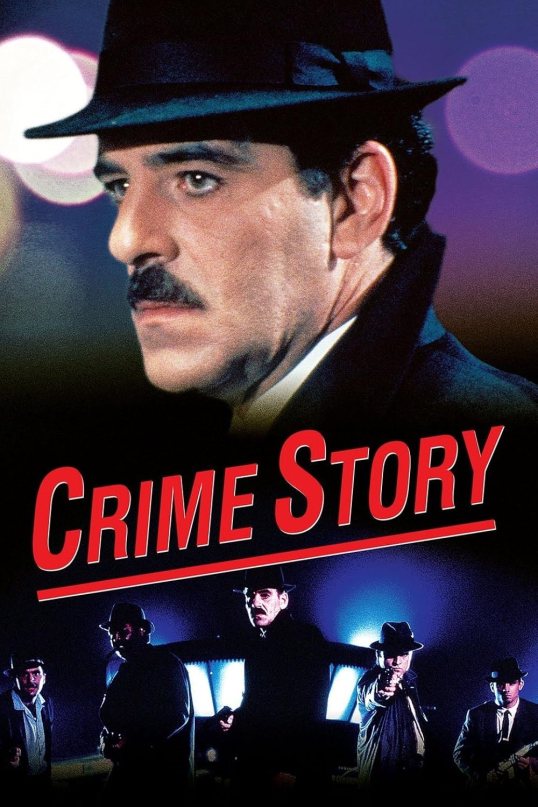
Retro Television Review: Crime Story 1.3 “Shadow Dancer”


Welcome to Retro Television Reviews, a feature where we review some of our favorite and least favorite shows of the past!  On Mondays, I will be reviewing Crime Story, which ran on NBC from 1986 to 1988.  The entire show can be found on Tubi!

This week, Torello’s war on Luca continues!

Episode 1.3 “Shadow Dancer”

(Dir by Leon Ichaso, originally aired on September 26th, 1986)

With the frequency killer now dead, Torello and his men are once again free to focus on trying to bust Ray Luca. The sooner they do it, the better. For one thing, Torello is becoming so obsessed that, even though his wife is pregnant, Torello’s dreams are still dominated by Luca taunting him. Also, Luca’s latest robbery has resulted in a death. Vincent Noonan (Michael Kemmerling), a former cellmate of Frank Holman’s (Ted Levine,) lost it during their latest home invasion and beat to death Mrs. Novak (Nancy Sheeber).

(Noonan, it turns out, has a history of losing control. It probably wasn’t a good idea to hire him in the first place but, with Luca no refusing to personally take part in robberies, the crew had to find a third man and quickly. Holman recommended Noonan because of how loyal Noonan was to him in prison)

Eager to solve the case and take down Luca, the Major Case Unit starts to put pressure on Luca’s boss, Phil Bartoli (Jon Polito). After his weekly craps game is broken up by Danny Krychek, Bartoli tells Luca that he has to do something to get the police to back off. Bartoli orders him to turn Noonan over to the police. Luca, who no longer handles dirty work himself, tells Holman to take care of it. Holman sends Noonan on a job and then tips off Torello. Despite Danny telling him that Noonan would die before turning into a rat, Torello is convinced that, if he takes Noonan alive, he’ll be able to get Noonan to give up Luca. (What Torello doesn’t realize is that Noonan has never actually met Luca. To quote Willy Cicci, “The family had lots of buffers.”)

It’s all for naught, though. Torello and the cops chase Noonan all over the streets of Chicago and, in the end, Noonan dies while trying to escape. Much like Homicide’s Luther Mahoney, Luca appears to be untouchable …. for now.

This episode worked best as a character study. After last week’s somewhat over-the-top villain, this episode reminded us that Luca and Torello are two tightly-wound men who struggle with emotion. Beyond his own self-absorption, Luca lacks the emotions necessary to truly understand his fellow humans. Torello, meanwhile, gets too emotional. Whether he’s pursuing Ray Luca or snapping at a condescending salesman, Torello is a self-styled crusader who appears to be going slowly but surely insane. This wasn’t a particularly complex episode but it felt important. It was a reminder of what this show is all about.

Retro Television Review: Crime Story 1.2 “Final Transmission”


Welcome to Retro Television Reviews, a feature where we review some of our favorite and least favorite shows of the past!  On Mondays, I will be reviewing Crime Story, which ran on NBC from 1986 to 1988.  The entire show can be found on Tubi!

This week, Torello and company search Chicago for a serial killer.

Episode 1.2 “Final Transmission”

(Dir by Leon Ichaso, originally aired on September 19th, 1986)

Mike Torello and the members of the MCU would really like to go after Luca and his crew but, unfortunately, there’s a serial killer on the loose in Chicago.  Realizing that the MCU is going to be tied up trying to track down Ray Pernell (John Snyder) before he kills again, Luca orders his crew to commit even more robberies.  Luca explains to a crestfallen Paulie that Luca will no longer be taking part in the robberies.  Luca is the boss and the boss doesn’t get his hands dirty.  Instead, Luca spends most of this episode meeting with Murray Weisbord’s man in Chicago, Max Goldman (Andrew Dice Clay).

This was an odd episode.  On the one hand, the show went out of its way to recreate Chicago in the early 60s.  The soundtrack was early rock and roll.  The cars all had tailfins.  The suits, the cigarettes, Luca’s haircut, all of the details screamed 1960s.  But then the episode revolved around a serial killer who thought his mother was addressing him through the television and who looked and dressed like a late 70s punk rocker.  I assume that Ray Pernell was based on Richard Speck, the notorious Chicago serial killer who, in 1966, murdered 8 student nurses.  Like Speck, Pernell had an identifying tattoo and both men were traced through the National Maritime Union.  That said, Pernell just seemed so out-of-place, with his sleeveless shirt and his punkish haircut that he just didn’t seem to belong in the world of Crime Story.

That said, I will give this episode some credit.  In the pilot, Luca often seemed like a clueless punk.  In this episode, he quickly realized that the MCU would be too busy hunting for Pernell to devote much time to him and he took advantage of that fact.  Luca’s not quite as dumb as he sometimes seems.  This episode also showed that he was capable of thinking ahead.  When he suspects that someone is listening in on his conversation with Goldman, he resists the temptation to burst into the room next door with his gun drawn.  (If he had, he would have run straight into Torello and Danny.)  This episode shows that Luca is learning and growing.  He not the buffoonish hothead that Torello originally assumed him to be.  In fact, he’s even more dangerous.

This episode ends with Pernell somehow (it’s not really clear how) taking an entire television news broadcast hostage.  Torello takes him down as the cameras roll and the entire city of Chicago watches.  It’s not a bad ending but it just doesn’t feel right for the show.  It’s a Miami Vice ending.  This is Crime Story!

Retro Television Review: Crime Story 1.1 “Pilot”


Welcome to Retro Television Reviews, a feature where we review some of our favorite and least favorite shows of the past!  On Mondays, I will be reviewing Crime Story, which ran on NBC from 1986 to 1988.  The entire show can be found on Tubi!

In 1986, riding high on the success of Miami Vice, Michael Mann signed on as executive producer of Crime Story, a cop show that Mann imagined would run for five seasons and which would follow a group of cops and gangsters from 1960s Chicago to 1980s Las Vegas.  The show was co-created by former Chicago cop Chuck Adamson and it starred another former Chicago cop, Dennis Farina.

Though generally well-received by critics, Crime Story struggled in the ratings.  The show’s highly serialized-nature made it difficult for audiences to follow.  (This was in the pre-streaming age, when viewers couldn’t just get online and catch up with what they may have missed.)  Crime Story only lasted for two seasons but it has since developed a strong cult following and is now regularly listed as one of the best cop shows ever made.

I’m going to find out if that’s true over the next few months.  Two weeks ago, I finished up Miami Vice.  Now, it’s time for Crime Story.

Episode 1.1 “Pilot”

(Dir by Abel Ferrara, originally aired on September 18th, 1986)

In Chicago, on a rainy night in the early 1960s, a group of masked robbers hold up a fancy restaurant and then try to escape with a group of terrified hostages.  On the scene is the Major Crimes Unit, led by the grim Lt. Torello (Dennis Farina, a former real-life cop).  The end result is that all of the robbers end up dead, the hostages end up traumatized, and one of Torello’s men, the obviously doomed Wes Connelly (William Russ), appears to be losing his mind over the violence that he has to deal with every day.

The plot of the pilot is actually pretty simple.  A gang of thieves is holding up restaurants, banks, and stores in Chicago.  Torello believes that an ambitious gangster named Ray Luca (Tony Denison) is behind the robberies and Torello is correct.  The cool and sociopathic Ray is working with Johnny O’Donnel (David Caruso).  O’Donnel may be a childhood friend of Luca’s but his parents are friends with Torello.  When gangster Phil Bartoli (Jon Polito) orders Luca to kill O’Donnel after the latter robs one of Bartoli’s jewelry stores, it’s personal all-around.

Plot-wise, it’s pure Michael Mann.  The cops and the gangsters are both obsessive.  Luca will kill anyone to get ahead in the underworld.  Oddly, his only real loyalty seems to be to his dumbest henchman, Pauli Taglia (John Santucci, a real-life former jewel thief who was once arrested by Dennis Farina).  Torello may be fighting on the side of the law but he’s often just as quick to resort to violence as Luca.  Director Abel Ferrara’s style can be seen in a scene where Torello is visited by the ghost of the recently murdered Wes Connelly.  Torello is burned out and paranoid, flying into a rage when he sees his wife, Julie (Darlanne Fluegel), dancing with another man at a wedding.  (The man in question turns out to be Torello’s cousin, whom Torello didn’t even recognize because he apparently doesn’t have much of a connection to anyone outside of the police force.)  Towards the end of the episode, there’s a shoot-out in a department store and it’s hard not to notice that neither the crooks nor the cops seem to be all that concerned with the innocent bystanders trying to not get caught in the crossfire.

The pilot is dark, gritty, and, in its way, as stylized as any episode of Miami Vice.  It never seems to stop raining and, even during the day, the skies are permanently gray and dark.  The early 60s are recreated like a fever dream of pop culture, with rock and roll on the soundtrack, cars with tail fins screeching down the street, and Bartoli living in a house that looks more like a tacky diner then a true home.  Torello and his men wear their dark suits and trenchcoats the way that soldiers wear their uniforms.

It’s an effective pilot, though we don’t really get to know much about the men working with Torello at the Major Crimes Unit.  Bill Smitrovich, in the role Detective Danny Krycheck, establishes himself as being Torello’s second-in-command but that’s about it.  Stephen Lang appears in a handful of scenes as David Abrams, a liberal public defender who is the son of a prominent gangster.  Both Luca and Torello seem to want to make David into an alley and the episode hints that he will eventually have to make a choice.  The episode ends with Luca in sunny Florida, meeting with veteran gangster Manny Weisbord (Joseph Wiseman).  Torello, meanwhile, remains in dark Chicago.

The Crime Story pilot was deemed good enough to be released as a feature film in Europe.  It also led to a series on NBC, which I will be reviewing here, every Monday!  On the basis of the pilot, I’m looking forward to it.

Alone In The Neon Jungle (1988, directed by Georg Stanford Brown)


Alone In The Neon Jungle takes place in a Pittsburgh police precinct that is supposedly so crime-ridden that it is called The Sewer.  After two cops are arrested while committing a burglary, the Chief of Police (Danny Aiello) sends tough Captain Jane Hamilton (Suzanne Pleshette) to take over the precinct.  Her mission?  To enforce discipline and root out police corruption!

There’s a lot of corruption to root out.  Crime boss Nahid (Tony Shalhoub) has half the precinct on his payroll and corrupt cops like Brad Stafowski (Jon Polito) are quick to to drag new transfers, like Todd Hansen (Jon Tennery), into the rackets.  Along with enforcing the dress code and cleaning up the streets, Jane also has to figure out who is responsible for the murder of one of her sergeants.

This made for TV movie was probably meant to be a pilot for a weekly television series.  It just has the sort of feel to it.  It features just about every cop cliche imaginable, from the weary detective who comes to respect the new boss to the crime lord who claims to be a respectable businessman.  The main problem is that the precinct never seems as bad as its described.  For a place called The Sewer, the streets are surprisingly clean.  The majority of the crimes committed seem to be burglary and prostitution.  If you’re a cop and that’s all you have to deal with in a big city like Pittsburgh, count yourself lucky.  The precinct never lives up to the title “Neon Jungle” and no one’s ever alone in it.

Suzanne Pleshette does a good enough job in the lead role.  By this point in her career, Pleshette’s voice was as deep as the voice of the toughest patrolman around.  It worked for her.

Retro Television Review: Miami Vice 5.2 “Redemption In Blood”


Welcome to Retro Television Reviews, a feature where we review some of our favorite and least favorite shows of the past!  On Mondays, I will be reviewing Miami Vice, which ran on NBC from 1984 to 1989.  The entire show can be purchased on Prime!

This week, Sonny Burnett continues his reign of terror!

Episode 5.2 “Redemption in Blood”

(DIr by Paul Krasny, originally aired on November 11th, 1988)

When last we checked in with Miami Vice, Sonny thought he was a drug lord named Sonny Burnett and he was firing his gun at Tubbs, who he had just recognized as a cop.  This episode reveals that Sonny didn’t shoot Tubbs.  Instead, he aimed at a wall, firing while Tubbs made his escape.

Working with the psychotic Cliff King (Matt Frewer), Sonny takes over his late boss’s drug empire and continue to fight a war against El Gato (Jon Polito).  El Gato is meant to be a “flamboyant” drug dealer, which is a polite way of saying that Polito overacts through the entire episode.

The show hedges its bets by having Cliff commit all of the murders while Sonny rises to power.  In fact, when Sonny catches Cliff torturing two of El Gato’s men, Sonny orders Cliff to stop and then offers them jobs in the Burnett operation.  Amazingly, over the course of the entire three-episode Burnett arc, Sonny manages to get through the whole thing only killing people in self-defense.  Even the cop that he killed at the end of the previous season was a dirty cop who had been sent to kill him.  I get that the show couldn’t take Sonny totally over to the dark side but it’s still hard to believe that Burnett took over the Miami underworld without getting his hands a bit more dirty than he did.

A car bomb (courtesy of El Gato) knocks Sonny unconscious and, when he wakes up, he suddenly starts to remember who he actually is.  Finally realizing that his name is Crockett, Sonny turns himself into the Vice Squad and is promptly arrested while Kate Bush sings, “Don’t give up.”  Sonny tells Castillo, Switek, and Tubbs that he’s ready to acccept the consequences of whatever he did during his previous bout of amnesia.  But then Sonny escapes custody and sets up both Cliff and El Gato for a great fall so I guess he wasn’t totally ready to turn himself in and head off to prison.

Tubbs, who now trusts Sonny, helps him take out Cliff King and the Burnett organization.  Sonny shoots Cliff to save Tubbs.  With Tubbs dangling off of a walkway, Sonny pulls him back up to safety.  Sonny then goes back to his mansion where he and his girlfriend (Debra Feuer) are taking hostage by a gun-wielding El Gato.  “Where is the safe?” El Gato demands.  Sonny tricks El Gato into thinking the safe is in the room where he keeps his pet panther.  (Apparently, all drug lords were given either a tiger, a panther, a cheetah, or a leopard.)  El Gato gets mauled to death as the episode ends.

This episode suggests that Sonny is going to be let off the hook because he finally remembered he was.  I don’t really think that it would really work like that.  Sonny has multiple warrants out and he also killed a cop, albeit a corrupt one.  If Sonny isn’t on trial in next week’s episode, I’m going to be a little annoyed.

This episode ended the Burnett trilogy about as well as it could be ended.  The idea that all Sonny needed was to survive a second near-fatal explosion made me smile.  What if El Gato hadn’t tried to blow him up?  I guess it’s a good thing that he did!  While Polito went overboard, Matt Frewer gave a very good performance as the villainous Cliff King.  It’s a bit of a shame that he died so dramatically because Cliff would have made a good recurring villain.

This episode was definitely better than anything from season 4.  It’ll be interesting to see how the rest of season 5 plays out.

Horror Film Review: C.H.U.D. (dir by Douglas Cheek)


There’s something living under the streets of New York City.

That’s the basic idea behind 1984’s C.H.U.D., a film that opens with an upper class woman and her little dog being dragged into the sewers by a creature the reaches out of a manhole.  People are disappearing all over the city but the authorities obviously aren’t revealing everything that they know.  Even after the wife of NYPD Captain Bosch (Christopher Curry) disappears, the city government doesn’t seem to be too eager to dig into what exactly is happening.

Instead, it falls to two activists.  Photographer George Cooper (John Heard) specializes in taking picture of the homeless, especially the one who live underground in the New York subways.  He’s like a well-groomed version of Larry Clark, I guess.  Social activist A.J. “The Reverend” Shepherd (Daniel Stern) runs a homeless shelter and is convinced that something is preying on the most vulnerable citizens of New York.  When the police won’t do their job, George and the Reverend step up!

So, what’s living in the sewers?  Could it be that there actually are cannibalistic humanoid underground dwellers out there?  Everyone in New York City has heard the legends but, much like stories of the alligators in the Chicago sewers, most people chose not to believe them.  Or could the disappearance have something to do with the cannisters labeled Contamination Hazard Urban Disposal that are being left in the sewers by the Nuclear Regulatory Commission?  Wilson (George Martin) of the NRC says that they would never purposefully mutate the people living underground but Wilson works for the government so who in their right mind is going to trust him?

C.H.U.D. is a horror film with a social conscience.  It’s very much an 80s films because, while you have Shepherd running around and attacking everyone for not taking care of the most vulnerable members of society, the true villain is ultimately revealed to be the members of a regulatory agency.  Instead of finding a safe way to get rid of their nuclear waste, they just found a sneaky way to abandon it all in New York and obviously, they assumed no one would care because …. well, it’s New York.  Everyone in the country knows that New York City isn’t safe so who is going to notice a few underground monsters, right?

The idea behind C.H.U.D. has a lot of potential but the execution is a bit lackluster.  For every good C.H.U.D. kill, there’s long passages where the story drags.  Considering that Heard spent most of his career typecast as the type of authority figure who would dump nuclear waste under New York City, it’s actually kind of interesting to see him playing a sympathetic role here.  Daniel Stern, on the other hand, is miscast and rather hyperactive as Shepherd.  You really do want someone to tell him to calm down for a few minutes.  Watching C.H.U.D., one gets the feeling that it’s a film with an identity crisis.  Is it a horror film, an action flick, a work of social commentary, or a dark comedy?  There’s no reason why it can’t be all four but C.H.U.D. just never really comes together.  It ultimately feels more like a mix of several different films instead of being a film made with one clear and coherent vision.

In the end, Death Line remains the film to see about underground cannibals.

Retro Television Review: Miami Vice 5.1 “Hostile Takeover”


Welcome to Retro Television Reviews, a feature where we review some of our favorite and least favorite shows of the past!  On Mondays, I will be reviewing Miami Vice, which ran on NBC from 1984 to 1989.  The entire show can be purchased on Prime!

This week, we start the fifth and final season of Miami Vice.

Episode 5.1 “Hostile Takeover”

(Dir by Don Johnson, originally aired on November 4th, 1988)

The fifth and final season of Miami Vice gets off to a good start with this episode.  After opening with some appropriately glitzy scenes of the drug-fueled Miami nightlife, the episode then shows us that Sonny Crockett is still convinced that he’s Sonny Burnett.  He has now returned to Miami and, along with Cliff King (Matt Frewer), he is one of the key advisors to drug lord Oscar Carrera (Joe Santos).

Carrera is at war with El Gato (Jon Polito), the brother of Sonny Burnett’s former employer, Miguel Manolo.  El Gato, who wears gold lamé, cries over the body of one of his henchmen, and flinches when forced to deal with direct sunlight, is a flamboyant figure.  In fact, he’s so flamboyant that it’s initially easy to overlook how determined he is to get revenge for the death of his brother.  That means taking down the Carreras family and Sonny Burnett as well.

The Vice Squad knows that Sonny is moving up in the drug underworld but Castillo is firm when asked what they should do about it.  Sonny has an active warrant out for murdering a corrupt cop.  “Sonny’s not Sonny anymore,” Tubbs says at one point and Castillo seems to agree.

Tubbs goes undercover, making contact with the Carreras cartel.  When Sonny meets Tubbs, Tubbs introduces himself as “Ricardo Cooper” and starts speaking in his terribly unconvincing Jamaican accent and that was when I said, “Miami Vice is back!”  Sonny doesn’t trust Cooper from the start.  “Maybe you’re a cop,” Sonny says.  “Not I, mon,” Tubbs replies.

People are dying and, while Sonny doesn’t have a problem with that, the show is also careful to show that Sonny only shoots in self-defense.  (It appears the most of the cold-blooded murders are farmed out to Cliff King.)  When Oscar Carreras dies, it’s because his poofy-haired son (Anthony Crivello) accidentally shot him when Oscar discovered him with his stepmother.  When the son dies, it’s because he was about to shoot Sonny after he caught Sonny with …. his stepmother, again.  The Carreras family is so dysfunctional that it shouldn’t come as a surprise that Sonny steps up to take it over.

After promising Castillo that he’ll take out Sonny if necessary, Tubbs meets up with Sonny at beach-side tower.  Tubbs looks at Sonny and suddenly says, “Sonny, it’s me, Rico.”  Sonny stare at Tubbs.  “Do you remember me?” Tubbs asks.

“Sure,” Sonny suddenly says, “You’re Tubbs.”

Three gunshots ring out as the episode ends.

OH MY GOD, DID SONNY KILLS TUBBS!?

We’ll find out next week.  For now, I’ll say that — after a disappointing fourth season — this was exactly how Miami Vice needed to start things off for Season 5.  Seriously, if you’re going to have Sonny get hit with amnesia, you might as well just go for it and take things to their logical extreme.

Next week …. is Tubbs dead?  I hope not, mon.


Retro Television Review: Homicide: Life On The Street 2.4 “A Many Splendored Thing”


Welcome to Retro Television Reviews, a feature where we review some of our favorite and least favorite shows of the past!  On Sundays, I will be reviewing Homicide: Life On The Street, which aired from 1993 to 1999, on NBC!  It  can be viewed on Peacock.

This week, season 2 of Homicide comes to a close with an episode directed by John McNaughton, of Henry: Portrait of A Serial Killer fame.

Episode 2.4 “A Many Splendored Thing”

(Dir by John McNaughton, originally aired on January 27th, 1994)

The second season finale of Homicide opens with Bolander in a good mood and Munch feeling that life is pretty much pointless.  It’s a reversal from what we’ve seen over the last few episodes of Homicide and, as annoyed as I got with all the storylines about Bolander’s private life, I was still happy to see Bolander happy in this episode.  As an actor, Ned Beatty’s performance is a lot interesting when Bolander is looking forward to the future.  By that same token, Richard Belzer always seemed to be trying to hard whenever it came to playing Munch’s happiness.  Belzer was born to play a cynic and, in this episode, he delivers his lines with a bitterness that is both funny and authentic.

Bolander is dating Linda and I have to admit that, despite my initial weariness, I really like Ned Beatty and Julianna Margulies as a couple.  Bolander and Linda go on a double date with Kay and Danvers.  Awwww, two couples in love and having dinner together!  How sweet!  Uh-oh, here comes Munch….

While Munch is ruining Bolander’s date, Bayliss is getting in touch with his own dark side.  An investigation into the S&M-related death of a young woman leads to Bayliss and Pembleton arresting a man who killed her during rough (but consensual) sex.  Bayliss and Pembleton spend their investigation in Baltimore’s red light district.  Bayliss claims to be disgusted by the whole scene, leading to Pembleton calling him out for being judgmental.  Pembleton tells Bayliss that he can’t be a good detective unless he’s really in touch with every aspect of his existence.  After the murder is solved, the woman’s co-worker, Tanya, gives Bayliss the gift of a leather jacket.  Tanya is played, in a very good performance, by the actress Adrienne Shelley.  Tragically, Shelley herself would, 12 years later, be murdered in her New York apartment.  And while it’s tempting to write about the irony of Shelley appearing on a show like Homicide, I’d rather recommend that everyone see Waitress instead.  It was the second feature film that Shelley directed and it is very good.

Finally, Lewis investigates a man who committed murder because he felt someone had taken his favorite pen.  Lewis searches for a deeper motive but in the end, it really was all about a pen.  Lewis, I’ve noticed, always seems to get the cases that show just how random life and death can truly be.

The second season of Homicide ends with Lewis giving Felton a pen, Bayliss putting on his new leather jacket and walking the streets of Baltimore, and Munch, Bolander, and Linda watching fireworks explode over the harbor.  It’s a good way to end a season.  As dark as the show was (and as dark as this particular episode was), the season ends on a note of hope.  There is happiness out there for those willing to look for it.


Retro Television Review: Homicide: Life on the Street 2.3 “Black and Blue”


Welcome to Retro Television Reviews, a feature where we review some of our favorite and least favorite shows of the past!  On Sundays, I will be reviewing Homicide: Life On The Street, which aired from 1993 to 1999, on NBC!  It  can be viewed on Peacock.

This week, Pembleton gets a confession.

Episode 2.3 “Black and Blue”

(Dir by Chris Menaul, originally aired on January 20th, 1994)

In this week’s episode, Pembleton manipulates a man into confessing to a murder that he didn’t commit.  Pembleton does it with the full knowledge that the man is innocent and that, if the man is indicted and goes to trial, he will undoubtedly be found guilty as a result of that coerced confession.  Pembleton does it to prove a point to Giardello.

The man is Lane Staley (Isaiah Washington), who has been identified (by his grandmother, who was just trying to be helpful) as an eyewitness to the shooting of Charles Courtland Cox.  Pembleton is convinced that Cox was shot by a policeman and he only wants to interrogate Staley as a witness.  Giardello, who feels that Pembleton is to obsessed with his cop theory and who, as a proud member of the police force, does not want Pembleton to be right, insists that Pembleton treat Staley as a suspect.  Pembleton responds by going into the Box and pretending to be sympathetic to Staley’s situation.  He and Staley talk about how they’re both expected to always be polite and careful about what they say around white detectives.  Pembleton jokes that he always has to be extra polite when he comes to work.

Staley starts to open up to Pembleton and eventually admits that he was present when Cox was shot.  That’s when Pembleton starts shouting at Staley, accusing him of being responsible and basically browbeating Staley until Staley is in tears.  Pembleton makes Staley feel guilty for not doing more to protect Cox and continues to yell at him until, eventually, Staley feels that Cox’s murder was his fault.  Staley finally signs a confession, even though it’s obvious that the sobbing man is not a murderer.  Pembleton hands Giardello the confession and reminds him that’s the way that the police have been getting confessions out of young black suspects for years.

It’s a powerful moment and one that took me totally by surprise.  Andre Braugher and Yaphet Kotto both gave excellent performances in this episode.  The dynamic between Pembleton and Giardello has always been one of the more interesting parts of the show.  The fact that both of them are black and both of them are portrayed as being fully aware of the racism surrounding them brings an extra edge to their debate as to whether or not the black Cox was shot by a white policeman. (At one point, Giardello snaps at Pembleton to speak to him as respectfully as he speaks to the white lieutenants and it’s the exact type of moment that most shows would never have the courage or insight to portray.)  Pembleton is a great detective because he’s laser-focused on getting a confession, to the exclusion of worrying about anything else.  Giardello is a great lieutenant because he’s enough of a pragmatist to understand that some battles are not worth the price of victory.  In the end, Giardello comes to realize that Pembleton is right about the shooting but one still has to wonder what would have happened in Giardello hadn’t torn up Staley’s confession.  The murder of Cox would have disappeared from the headlines but the innocent Staley would have disappeared into the system.

The scenes with Pembleton and Staley were so electrifying that it made up for the fact that this is yet another episode that features Bolander feeling sorry for himself after his divorce.  Fortunately, for Bolander, he meets and befriends a young waitress named Linda (Julianne Margulies) who mentions that she plays the violin.  Bolander reveals that he plays the cello — WHAT!?  Since when has Bolander, someone who has expressed no interest in art or creativity or even music during his entire time of the show, become a cello player?  The episode ends with Bolander and Linda playing their instruments together and it’s a sweet scene but it’s still a bit hard to buy that apparently every woman in Baltimore is instantly attracted to a middle-aged, balding cop who spends all of his time talking about his divorce.  Ned Beatty was one of the great character actors but it sometimes feels like Homicide wasn’t sure what to do with his character.

But, hey, maybe Bolander will finally stop being so whiny.  That’s my hope.  This episode found Munch breaking up with his girlfriend after he accidentally gave her a carnivorous fish that ate all of her other fish.  At one point, Munch says that he can’t accept the idea of Bolander being happier than him.  Seriously, Munch, don’t jinx this.  I’ve been listening to Bolander complain nonstop for 15 episodes.  If he’s happy now, let him have it!

Next week …. life on the street continues!

Retro Television Review: Homicide: Life on The Street 2.2 “See No Evil”


Welcome to Retro Television Reviews, a feature where we review some of our favorite and least favorite shows of the past!  On Sundays, I will be reviewing Homicide: Life On The Street, which aired from 1993 to 1999, on NBC!  It  can be viewed on Peacock.

This week, no one’s innocent.

Episode 2.2 “See No Evil”

(Dir by Christopher Menual, originally aired on January 13th, 1994)

Watch out!  Stanley Bolander’s whining about his divorce again!

Ned Beatty was one of the great character actors and he is certainly convincing in the role of Stanley Bolander, the veteran Baltimore homicide detective who has seen the worst that humanity has to offer and who spends most of his time annoyed with his partner, John Munch.  But, as good as Beatty is, I still groan whenever Bolander starts to talk about his ex-wife and his divorce.  His bitterness was a recurring theme during the first season.  It was annoying but it was understandable because the divorce was still recent.

But now, we’ve started the second season.  It’s time move on, Big Man!

This episode finds Bolander very reluctantly taking part in sensitivity training.  He avoids meeting with Dr. Carrie Weston (Jennifer Mendenhall) until Giardello threatens to suspend him without pay.  Bolander is stunned when Dr. Weston turns out to be sympathetic to his anger over his divorce.  Bolander ever tries to ask Dr. Weston out, just for Weston to inform him that she’s just gotten out of a bad relationship and that she believes “birds of a feather should flock together” and, speaking of birds, did you know that there are lesbian seagulls?  Bolander gets the hint.  Myself, I would probably lie about being a lesbian just to get out of having to spend any more time listening to him cry about his divorce.

Far more interesting than Bolander’s angst were the two cases at the center of this week’s episode.  Chuckie Prentice (Michael Chaban) shoots his dying father (played, in a powerful and intimidating performance, by Wilford Brimley) in the head.  Though Chuckie claims that his father committed suicide, Lewis has his doubts and takes Chuckie to the station for interrogation.  Detective Beau Felton just happens to be Chuckie’s best friend and, after Chuckie tells him that his father specifically asked to be put out of his misery, Felton tries to convince Lewis to say that the shooting actually was a suicide.  At first, Lewis refuses but eventually, he agrees to look the other way while Felton takes Chuckie to wash his hands and destroy any evidence of gunpowder residue on his skin.  Without any definite evidence proving the he fired the gun, Chuckie is free to go and his father’s death is ruled a suicide.

This was a powerful story and it was all the more effective because it refused to come down on one side or the other.  Both Felton and Lewis presented their positions well and the episode ended not on a note of triumph but on a note of weary resignation.  Chuckie is free to go on with his life and his father is no longer in pain but Lewis is going to be haunted by his decision to allow evidence to be destroyed.  Personally, I’m against assisted suicide and I felt it was selfish for Chuckie’s father to ask Chuckie to pull the trigger.  But, having spent the previous few months trying to come to terms with my own father’s passing, I could understand what Chuckie was feeling.  There really are no easy answers.

As for the other case, it involved the shooting of a drug dealer.  The dealer was shot in the back.  A patrolman claimed that he slipped and his gun accidentally fired during the pursuit of the dealer.  Pembleton had his doubts about whether the shooting was really an accident or a case of police brutality.  Even after Giardello warned him that pursuing the case would turn “brother against brother” in the police force, Pembleton insisted on asking every police officer on the scene to turn in their guns for testing.  “You son of a bitch, Pembleton,” Giardello muttered.

And again, this was a storyline that worked because it refused to present an easy solution.  The dead man was a criminal and he was shot while fleeing the cops.  Even though the cop that slipped was eventually cleared of having fired the shot that killed the dealer, it was obvious that the shot did come from a cop.  Pembleton, with his black-and-white view of his job, was determined to find the truth, regardless of the professional consequences.  Giardello, with years more experience than Pembleton, spoke from the heart when he told Pembleton that investigating the case would bring harm not just to the cop who shot the dealer but to every cop working the streets, regardless of whether they were involved or not.  Felton could convince Lewis to look the other way.  Pembleton was not willing to do the same thing.

It was a strong episode, even with all of Bolander’s nonsense.  Perfectly acted, morally ambiguous, and fiercely intelligent, this is an episode that I’ll be thinking about for a while.