Retro Television Review: Crime Story 1.5 “The War”


Welcome to Retro Television Reviews, a feature where we review some of our favorite and least favorite shows of the past!  On Mondays, I will be reviewing Crime Story, which ran on NBC from 1986 to 1988.  The entire show can be found on Tubi!
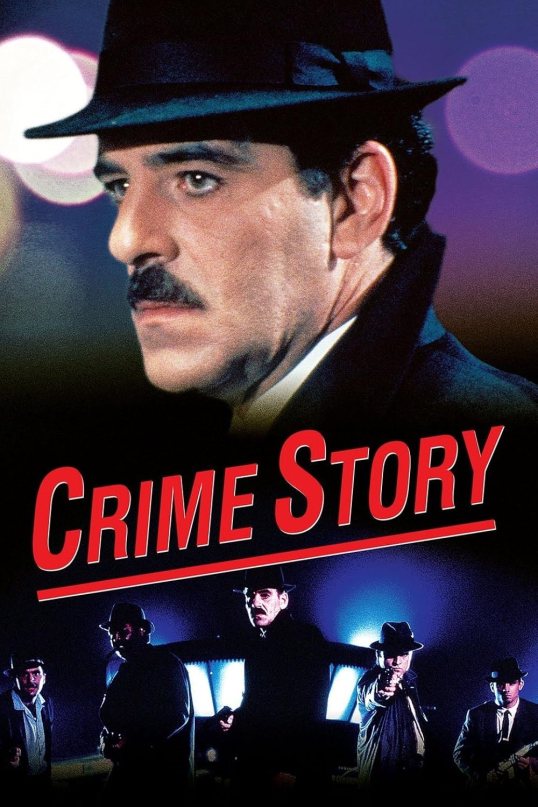
This week, Luca has to prove himself.

Episode 1.5 “The War”

(Dir by Leon Ichaso, originally aired on October 7th, 1986)

Luca is in trouble.

Last week’s episode ended with Max Goldman on the receiving end of a beating from Noah Ganz’s goons.  Goldman survives and returns with a message.  Ganz is not happy that Luca tried to steal his book.  Bartoli, Weisbord, and Fosse all inform Luca will have to resolve the Ganz situation on his own.

Luca tries to get public defender David Abrams (Stephen Lang) to act as a negotiator for him but David doesn’t want to get involved in the mobster lifestyle that made his father rich.  David just wants to defend the poor and play sax in a jazz club.  When Luca is attacked while driving in Chicago, he realizes that negotiating with Ganz is a dead end.

Instead, he just kills Ganz.  In a bravura sequence, Luca shows up at a hotel and, with the help of sniper, takes down Ganz’s bodyguards.  Then he uses a bomb to take out Ganz while the latter is holding court in an elevator.  A plume of white smoke puffs out of the hotel’s exhaust vent.

Having taken care of the issue, Luca is welcomed back into the family.  Weisbord says, “Call me Mac.”  Fosse (played by Michael Madsen) nods and slowly smokes a cigarette.

Meanwhile, Torello’s wife miscarries.  This is the episode that features the clip of Torello walking down a lonely Chicago street on a rainy night.  (The clip is prominently featured during the show’s opening credits.)  In fact, both Torello and Luca end up spending a good deal of time walking around at night while David Abrams plays his saxophone.  It’s a scene that is so overstylized that it shouldn’t work but somehow, it does.  If nothing else, it reminds us that Crime Story of two dangerously obsessed men on a collision course.

This was a good episode, if just because it showed that Luca can be a clever criminal when he needs to be.  Before this episode, Luca seemed to be clearly outmatched by Torello.  With this episode, Luca proved himself to be Torello’s equal.

Retro Television Review: Crime Story 1.4 “St. Louis Book of Blues”


Welcome to Retro Television Reviews, a feature where we review some of our favorite and least favorite shows of the past!  On Mondays, I will be reviewing Crime Story, which ran on NBC from 1986 to 1988.  The entire show can be found on Tubi!

This week, everyone’s going to Missouri.  Can you blame them?

Episode 1,4 “St. Louis Book of Blues”

(Dir by Leon Ichaso, originally aired on September 30th, 1986)

After Ray Luca discovers that his henchman, Frank Holman (Ted Levine), has been compromised by Torello, he decides to deal with the situation by sending Holman down to St. Louis.  A gangster named Ganz (Raymond Serra) has a home in St. Louis and, according to Ganz’s associate Johnny Fosse (Michael Madsen, doing his slow-talking, cigarette-smoking Madsen thing), there is a book in Ganz’s shelf that contains the name of every bookie, coach, and sports-fixer in America.  Ray, who is hoping to start up his own nationwide gambling syndicate, wants that book.

Far be it for me to question Ray Luca’s strategy but it does seem strange that his response to one of his people screwing up is to give that person an even more important job to do.  I get that Ray is trying to be a manager now and, as a result, he no longer personally robs anyone but Frank really does seem like the last person he should trust to pull this off.

And, to no one’s surprise, Frank doesn’t pull it off.  Torello and his men follow him all the way to St. Louis.  They not only arrest him but they also get their hands on Ganz’s book.  They do this despite the operation nearly being ruined by an ambitious and publicity-hungry sheriff named Hartman (Allen Swfit).

Unfortunately, when Frank offers to inform on the entire “St. Louis mob,” Hartman releases him from jail.  Frank promptly flees town.  When he calls Ray, Ray orders him to stay out of Chicago and instead to go to Cleveland.  Frank replies that if he has to choose between Hell or Cleveland …. he’ll go to Cleveland.  Good thinking, Frank!

(Actually, I’ve never been to Cleveland so I don’t know if it’s really good thinking.  Wasn’t Dennis Kucinich from Cleveland?)

As this episode ends, Ganz is ready to declare war on Luca and it appears that Max Goldman might be the first victim.  The funny thing about Max is that he’s played by a young Andrew Dice Clay and, in every scene in which he appears, Clay’s facial expressions are totally and completely over-the-top, as if Clay was determined to make sure that no one forgot he was in the scene.  I hope that Max survives, just for the sake of entertainment,

This episode returned to the idea of Torelllo being dangerously and tightly wound.  Before he followed Frank to St. Louis, he nearly firebombed a furniture store because the owner hadn’t delivered the table that he had ordered.  Torello was talked out of doing so by his fellow cops but the store owner still got the message.  The table arrived at Torello’s apartment.  Of course, it was the wrong table.  That made me laugh.  People have no idea how close Torello is to snapping and killing everyone around him.

This was a good episode.  It was interesting to see a young Ted Levine, not to mention a young Michael Madsen as well.  The corrupt and incompetent sheriff was identified as being a Democrat. I appreciated that.  I’m looking forward to seeing where this show is going.


Retro Television Review: Crime Story 1.1 “Pilot”


Welcome to Retro Television Reviews, a feature where we review some of our favorite and least favorite shows of the past!  On Mondays, I will be reviewing Crime Story, which ran on NBC from 1986 to 1988.  The entire show can be found on Tubi!

In 1986, riding high on the success of Miami Vice, Michael Mann signed on as executive producer of Crime Story, a cop show that Mann imagined would run for five seasons and which would follow a group of cops and gangsters from 1960s Chicago to 1980s Las Vegas.  The show was co-created by former Chicago cop Chuck Adamson and it starred another former Chicago cop, Dennis Farina.

Though generally well-received by critics, Crime Story struggled in the ratings.  The show’s highly serialized-nature made it difficult for audiences to follow.  (This was in the pre-streaming age, when viewers couldn’t just get online and catch up with what they may have missed.)  Crime Story only lasted for two seasons but it has since developed a strong cult following and is now regularly listed as one of the best cop shows ever made.

I’m going to find out if that’s true over the next few months.  Two weeks ago, I finished up Miami Vice.  Now, it’s time for Crime Story.

Episode 1.1 “Pilot”

(Dir by Abel Ferrara, originally aired on September 18th, 1986)

In Chicago, on a rainy night in the early 1960s, a group of masked robbers hold up a fancy restaurant and then try to escape with a group of terrified hostages.  On the scene is the Major Crimes Unit, led by the grim Lt. Torello (Dennis Farina, a former real-life cop).  The end result is that all of the robbers end up dead, the hostages end up traumatized, and one of Torello’s men, the obviously doomed Wes Connelly (William Russ), appears to be losing his mind over the violence that he has to deal with every day.

The plot of the pilot is actually pretty simple.  A gang of thieves is holding up restaurants, banks, and stores in Chicago.  Torello believes that an ambitious gangster named Ray Luca (Tony Denison) is behind the robberies and Torello is correct.  The cool and sociopathic Ray is working with Johnny O’Donnel (David Caruso).  O’Donnel may be a childhood friend of Luca’s but his parents are friends with Torello.  When gangster Phil Bartoli (Jon Polito) orders Luca to kill O’Donnel after the latter robs one of Bartoli’s jewelry stores, it’s personal all-around.

Plot-wise, it’s pure Michael Mann.  The cops and the gangsters are both obsessive.  Luca will kill anyone to get ahead in the underworld.  Oddly, his only real loyalty seems to be to his dumbest henchman, Pauli Taglia (John Santucci, a real-life former jewel thief who was once arrested by Dennis Farina).  Torello may be fighting on the side of the law but he’s often just as quick to resort to violence as Luca.  Director Abel Ferrara’s style can be seen in a scene where Torello is visited by the ghost of the recently murdered Wes Connelly.  Torello is burned out and paranoid, flying into a rage when he sees his wife, Julie (Darlanne Fluegel), dancing with another man at a wedding.  (The man in question turns out to be Torello’s cousin, whom Torello didn’t even recognize because he apparently doesn’t have much of a connection to anyone outside of the police force.)  Towards the end of the episode, there’s a shoot-out in a department store and it’s hard not to notice that neither the crooks nor the cops seem to be all that concerned with the innocent bystanders trying to not get caught in the crossfire.

The pilot is dark, gritty, and, in its way, as stylized as any episode of Miami Vice.  It never seems to stop raining and, even during the day, the skies are permanently gray and dark.  The early 60s are recreated like a fever dream of pop culture, with rock and roll on the soundtrack, cars with tail fins screeching down the street, and Bartoli living in a house that looks more like a tacky diner then a true home.  Torello and his men wear their dark suits and trenchcoats the way that soldiers wear their uniforms.

It’s an effective pilot, though we don’t really get to know much about the men working with Torello at the Major Crimes Unit.  Bill Smitrovich, in the role Detective Danny Krycheck, establishes himself as being Torello’s second-in-command but that’s about it.  Stephen Lang appears in a handful of scenes as David Abrams, a liberal public defender who is the son of a prominent gangster.  Both Luca and Torello seem to want to make David into an alley and the episode hints that he will eventually have to make a choice.  The episode ends with Luca in sunny Florida, meeting with veteran gangster Manny Weisbord (Joseph Wiseman).  Torello, meanwhile, remains in dark Chicago.

The Crime Story pilot was deemed good enough to be released as a feature film in Europe.  It also led to a series on NBC, which I will be reviewing here, every Monday!  On the basis of the pilot, I’m looking forward to it.

TV Review: Night Gallery 1.2 “Room With A View/The Little Black Bag/The Nature of the Enemy”


The second episode of Night Gallery originally aired on December 23rd, 1970 and it featured three stories, two of which were written by Rod Serling.  Serling, himself, introduced all three of the stories by inviting us to look at the paintings that may or may not have been inspired from them.

Room With A View (dir by Jerrold Freedman, written by Hal Dresner)

When a cranky, bed-bound man (Joseph Wiseman) discovers this his wife (Angel Tompkins) is cheating on him, he comes up with an elaborate scheme to get revenge.  It all hinges on his somewhat nervous nurse (Diane Keaton), who has no idea that she’s being manipulated.

This short segment is well-done but it doesn’t really feel like it belongs on an episode of Night Gallery.  There’s no elements of horror or science fiction to be found in this story.  Instead, it’s just about a manipulative man seeking revenge on his wife.  It’s actually easy to imagine this segment as being a flashback on a Monk-style detective show.  You just need a detective saying, “I finally figured out how you did it!”

For most viewers, probably the most interesting thing about this segment will be the presence of a young Diane Keaton, playing the nurse and laughing nervously at her patient’s rather intrusive questions.

The Little Black Bag (dir by Jeannot Szwarc, written by Rod Serling)

In the 30th Century, a careless accident at a time travel station sends a black medical bag into the past.  It arrives in 1971, where it’s discovered by two homeless gentlemen.  One of the men is a disgraced former doctor named William Fall (Burgess Meredith).  The other, Hepplewhite (Chill Wills), has no medical experience but he does have a greedy spirit.  Fall wants to use the bag to do good,  Hepplewhite wants to use the bag to make money.  Meanwhile, in the future, poor put-upon Gillings (George Furth) is just trying to figure out what to do about the missing bag.

The Little Black Bag is this episode’s high point, featuring good performances from Meredith, Wills, and Furth and also ending with properly macabre twist.  This is another Rod Serling story about how terrible, at heart, most people are but Jeannot Szwarc’s direction is fast-paced and he never allows things to get too heavy-handed.

The Nature of the Enemy (dir by Allen Reisner, written by Rod Serling)

NASA’s latest expedition to the Moon has run into trouble.  The astronauts have discovered that there is something living on the lunar surface.  On Earth, the director of NASA (Joseph Campanella) tries to keep everyone calm while also figuring out the nature of the enemy.

This segment has an intriguing premise but it’s let down by a so-so execution.  Like a lot of less-than-effective Night Gallery segments, this one features a story that doesn’t so much conclude as it just stops after a somewhat weak punchline.

So, the second episode of Night Gallery was not an improvement on the first and it was nowhere close to matching the pilot.  Watching this episode, it was hard not to feel that the show had a few growing pains.  Did it want to be a horror anthology or a collection of short skits?  The 2nd episode reveals a show that was still trying to find it’s voice.

Previous Night Gallery Reviews:

  1. The Pilot
  2. The Dead Man/The Housekeeper


James Bond Begins!: Sean Connery as 007 in DR. NO (United Artists 1962)


gary loggins's avatarcracked rear viewer

Ian Fleming’s secret agent 007, James Bond, was introduced in the 1953 novel Casino Royale, and was a smashing success, leading to a long-running series of books starring MI-6’s “licensed to kill” super spy. No less than President John F. Kennedy was a huge fan of Fleming’s books, and since the early 60’s were all about “Camelot”, producers Albert Broccoli and Harry Saltzman decided to cash in and bring James Bond to the big screen (the character had appeared in the person of Barry Nelson in an adaptation of CASINO ROYALE for a 1954 episode of TV’s CLIMAX!, with Peter Lorre as the villain Le Chiffre).

DR. NO was the first Bond movie, and the producers wanted Patrick McGoohan, star of the British TV series SECRET AGENT, to play the suave, ruthless Bond. McGoohan declined, and Richard Johnson was considered. He also turned them down, leading Broccoli and Saltzman…

View original post 534 more words

Embracing The Melodrama Part III #6: The Betsy (dir by Daniel Petrie)


“Wheeeeeeee!”

— Loren Hardeman Sr. (Sir Laurence Olivier) in The Betsy (1978)

Here’s a little thought experiment:

Imagine if The Godfather had starred Laurence Olivier and Tommy Lee Jones.

That may sound strange but it actually could have happened.  When Francis Ford Coppola first started his search for the perfect actor to play Don Vito Corleone, he announced that he could only imagine two actors pulling off the role.  One was Marlon Brando and the other was Laurence Olivier.

As for Tommy Lee Jones, he was among the many actors who auditioned for the role of Michael Corleone.  At the time, Jones was 26 years old and had only recently made his film debut in Love Story.  As odd as it may be to imagine the quintessentially Texan Tommy Lee Jones in the role, Coppola always said that he was looking for a brooder as Michael and that’s definitely a good description of Jones.

Of course, as we all know, neither Olivier nor Jones were ever cast in The Godfather.  Marlon Brando played Don Vito and Al Pacino was cast as Michael.  However, a few years later, Olivier and Jones would co-star in another family saga that combined history, organized crime, and melodrama.  That film was 1978’s The Betsy and, interestingly enough, it even co-starred an actor who actually did appear in The Godfather, Robert Duvall.

Of course, now would probably be a good time to point out that The Godfather is perhaps the greatest American film of all time.  And The Betsy … well, The Betsy most definitely is not.

The film’s German poster even gives off a Godfather vibe

Based on a novel by Harold Robbins, The Betsy exposes the secrets of Detroit.  Decades ago, Loren Hardeman founded Hardeman Motors and started to build his considerable fortune.  Sure, Loren had to break a few rules.  He cut corners.  He acted unethically.  He had an affair with his daughter-in-law and then drove his gay son to suicide.  Loren never said that he was perfect.  Now in his 80s, Loren has a vision of the future and that vision is a new car.  This car will be called the Betsy (named after his great-granddaughter) and it will be the most fuel-efficient car ever made.

Since the film appropriates the flashback structure used in The Godfather Part II, we get to see Loren Hardeman as both an elderly man and a middle-aged titan of industry.  Elderly Loren is played by Laurence Olivier.  Elderly Loren spends most of the film in a wheelchair and he speaks with a bizarre accent, one that I think was meant to be Southern despite the fact that the film takes place in Michigan.  Elderly Loren gets really excited about building his new car and, at one point, shouts out “Wheeeeeee!”

Middle-aged Loren is played by … Laurence Olivier!  That’s right.  Olivier, who was 71 years old at the time, also plays Loren as a younger man.  This means that Olivier wears a hairpiece and so much makeup that he looks a bit like a wax figure come to life.  Strangely, Middle-aged Loren doesn’t have a strange accent and never says “wheeeee.”

To build his car, Loren recruits race car driver Angelo Perino (Tommy Lee Jones).  Angelo’s father was an old friend of Loren’s.  When Angelo agrees, he discovers that the Hardeman family is full of drama and secrets.  Not only is great-granddaughter Betsy (Kathleen Beller) in love with him but so is Lady Bobby Ayers (Lesley-Anne Down), who is the mistress of Loren’s grandson, Loren the 3rd (Robert Duvall).

Because he blames his grandfather for the death of his father, Loren the 3rd has no intention of building Loren the 1st’s car.  Loren the 3rd wants to continue to make cars that pollute the environment.  “Over my dead boy!” Loren the 1st replies.  “As you wish, grandfather,” Loren the 3rd replies with a smile.

But we’re not done yet!  I haven’t even talked about the Mafia and the union organizers and the automotive journalist who ends up getting murdered.  From the minute the movie starts, it’s nonstop drama.  That said, most of the drama is so overdone that it’s actually more humorous than anything else.  As soon as Laurence Olivier shouts out, “Wheeeee!,” The Betsy falls into the trap of self-parody and it never quite escapes.  There’s a lot going on in the movie and one could imagine a more imaginative director turning the trashy script into a critique of capitalism and technology.  However, Daniel Petrie directs in a style that basically seems to be saying, “Let’s just get this over with.”

The cast is full of interesting people, all of whom are let down by a superficial script.  Nothing brings out the eccentricity in talented performers quicker than a line of shallow dialogue.  Jane Alexander, who plays Duvall’s wife, delivers all of her lines in an arch, upper class accent.  Edward Herrmann, playing a lawyer, smirks every time the camera is pointed at him.  Katharine Ross, as Olivier’s mistress and Duvall’s mother, stares at Olivier like she’s trying to make his head explode.  Tommy Lee Jones is even more laconic than usual while Duvall always seems to be struggling not to start laughing.

And then there’s Olivier.  For better or worse, Olivier is the most entertaining thing about The Betsy.  He doesn’t give a good performance but he does give a memorably weird one.  Everything, from the incomprehensible accent to a few scenes where he literally seems to bounce up and down, suggests a great actor who is desperately trying to bring a spark of life to an otherwise doomed project.  It’s a performance so strange that it simply has to be seen to be believed.

Tomorrow, we take a look at another melodrama featuring Robert Duvall, True Confessions!


A Movie A Day #238: Lawman (1971, directed by Michael Winner)


In the 1880s, Jared Maddox (Burt Lancaster) is the marshal of the town of Bannock.  After a night of drinking and carousing leads to the accidental shooting of an old man, warrants are issued for the arrest of six ranch hands.  Maddox is determined to execute the arrest warrants but the problem is that the six men live in Sabbath, another town.  They all work for a wealthy rancher (Lee J. Cobb) and the marshal of Sabbath, Cotton Ryan (Robert Ryan), does not see the point in causing trouble when all of the men are likely to be acquitted anyway.  Maddox doesn’t care.  The law is the law and he does not intend to leave Sabbath until he has the six men.

Lawman starts out like a standard western, with a stranger riding into town, but then it quickly turns the western traditions on their head by portraying Marshal Maddox as being a rigid fanatic and the wealthy rancher as a morally conflicted man who does not want to resort to violence and who continually tries and fails to convince Maddox to leave.  In the tradition of Sergio Leone and Sam Peckinpah, there are no real heroes to be found in Lawman and, even when Maddox starts to reconsider his strict adherence to the law and refusal to compromise, it is too late to prevent the movie from ending in a bloody massacre.  Since Lawman was made in 1971, I initially assumed it was meant to be an allegory about the Vietnam War but then I saw that it was directed by Michael Winner, a director who specialized in tricking audiences into believing that his violent movie were deeper than they actually were.

Even if Lawman never reaches the heights of a revisionist western classic like Pat Garrett and Billy the Kid, it is still pretty good, with old pros Lancaster, Ryan, Cobb, and Albert Salmi all giving excellent performances.  The cast is full of familiar faces, with everyone from Robert Duvall to Richard Jordan to Ralph Waite to Joseph Wiseman to John Beck showing up in small roles.  In America, Winner is best remembered for his frequent collaborations with Charles Bronson.  Chuck is not in Lawman, though it seems like he should have been and Lee J. Cobb’s rancher is named Vincent Bronson.  Winner would not make his first film with Charles Bronson until a year later, when he directed him in Chato’s Land.

Lisa Cleans Out Her DVR: The Silver Chalice (dir by Victor Saville)


If you ever needed proof that everyone has to start somewhere, look no further than the 1954 biblical epic, The Silver Chalice.

The Silver Chalice features the film debut of Paul Newman, who later proved himself to be a legitimately great actor.  It’s true that, unlike a lot of actors, Newman made his debut in a starring role.  He never had to humiliate himself with any one-line roles or walk-on bits.  No, Paul got to humiliate himself with a starring role.

Paul Newman was 29 years old when he played Basil, a former slave turned sculptor.  Not only did Newman bear a disconcerting resemblance to Ben Savage (of Boy Meets World fame) but he gave a performance that was so bad that it’s kind of a shock that he ever worked again.  Basil is a passionate artist, one who survived being betrayed by his adopted family and slavery.  Newman comes across like a nice, young man from Iowa.  Usually, Newman looks miserable but occasionally, he flashes a somewhat weak smile.  When Basil gets mad, Newman speaks in a squeaky voice.  When Basil is feeling reverent, Newman furrows his brow like a hungover Russell Brand staring straight into the sun.

“But me and Topanga are soul mates…”

Then again, I’m not sure that any actor could have given a good performance as Basil.  The Silver Chalice has a terrible script, one that was written by Lesser Samuels.  (I’ll avoid the obvious joke about whether or not The Silver Chalice would have been better if written by Greater Samuels.)  Apparently, before Newman was cast, the producers pursued James Dean for the role.  I’m sure we all would have enjoyed seeing Dean slouch his way through the film but I doubt that even he could have done much with The Silver Chalice.

The Silver Chalice is based on a novel, which perhaps explains why there’s so many characters and so many unnecessary subplots.  Basil follows a path that will be familiar to anyone who has seen a 1950s biblical epic.  He’s a young Greek who is adopted into a noble Roman family.  When his kindly stepfather dies, Basil’s stepsiblings sell him into slavery.  It’s not an easy life but Basil is a talented sculptor so Joseph of Arimathea commissions him to make a silver chalice for the Holy Grail.  Basil goes from poor to rich to poor again to rich again to ultimately saved by grace.  He even gets to do the same walking towards Heaven thing that Richard Burton did at the end of The Robe.

Meanwhile, Simon Magus (Jack Palance) is wowing the citizenry with his magic tricks and claiming to be the risen Messiah.  Simon’s assistant just happens to be Helena, who knew Basil when he was younger.  Young Helena is played by dark-haired Natalie Wood.  Grown-up Helena is played by blonde Virgina Mayo.  They were both good actresses but there’s seriously no way that Natalie Wood would have ever grown up to be Virginia Mayo.

Jack Palance pretty much steals the movie, mostly because he gets to wear the silliest costumes:

Poor Paul Newman has to settle for a tunic and a miniskirt, while Jack Palance gets to wear this:

Personally, I’ve always enjoyed the story of Simon Magus.  He tried to show off by flying over the Roman Forum so St. Peter said a prayer and Simon promptly plunged to his death.  Take that, you Gnostic!

Another interesting thing about The Silver Chalice is that the sets are very deliberately fake.  I don’t mean that they look cheap.  I mean, much as in the style of German Expressionism, the sets are specifically designed to remind you that you’re watching a movie.

For instance, look at the wall behind Palance:

Look at this pleasure palace:

Look at Rome at night:

The sets are extremely dream-like and yet everything else about the film is extremely slow and conventional.  One wonders if director Victor Saville was trying to make an art film, though there’s nothing else in his long filmography that would suggest that Saville was anything other than a workmanlike director.  In fact, most biblical epics of the time took a lot of pride in looking as expensive and “accurate” as possible.  Major studios in the 1950s were not known for artistic experimentation, especially when it came to Biblical epics.  It’s hard to know what to make of The Silver Chalice‘s artistic flourishes, which is why it’s easier to just focus on what a terrible performance Paul Newman gives.

That’s certainly what Paul did!  In 1966, when The Silver Chalice finally premiered on TV, Newman took out a newspaper ad in which he apologized for his performance and then asked people not watch.  Apparently, he also used to show the movie during parties on the condition that his guests mock the film while watching it.

I don’t really blame him.  It’s an amazingly dull film and Newman looks absolutely miserable in nearly every other scene.  However, because it did star Paul Newman, The Silver Chalice will always have a life on TCM.

Speaking of TCM, they last broadcast this film on February 24th as part of their 31 Days of Oscar.  (It was nominated for both its sets and its score.)  That is when I recorded it.  And, after watching it yesterday, I was more than happy to erase it.

A Movie A Day #23: The Valachi Papers (1972, directed by Terrence Young)


The best thing about The Valachi Papers is this:

valachi-0

That is Charles Bronson, playing real-life mob informant Joe Valachi and making a gesture that expresses the way many people feel about the world right now.  Valachi, in both the film and real life, was a bit player in the Cosa Nostra, a driver and an occasional hitman who was lucky enough to marry the daughter (played by Bronson’s real-life wife, Jill Ireland) of one of the bosses.  In prison for smuggling heroin, Valachi runs into one of those bosses, Vito Genovese (Lino Ventura).  Genovese, convinced that Valachi has broken the code of omerta, gives Valachi the kiss of death.  Valachi kisses him right back and then becomes a rat.

Valachi’s 1963 testimony to the U.S. Senate was the public’s first glimpse into life in the Mafia.  Many of the cliches that have since appeared in every mob movie or television show were the result of Valachi’s testimony and Peter Maas’s subsequent book, The Valachi Papers.  (In the “Test Dream” episode of The Sopranos, Tony can be seen holding a copy of The Valachi Papers.)

Over the years, doubts have been raised about both the validity of Valachi’s testimony and his claim that he only turned rat because Genovese put a contract on his life.  The film version of The Valachi Papers takes Valachi’s claims at face value, telling Valachi’s story in a series of flashbacks.

The Valachi Papers is often compared to another mob movie that came out in 1972, The Godfather, though there’s really not much of a comparison to be made.  Whereas The Godfather was a family saga, The Valachi Papers is much more concerned with the day-to-day operations of the Mafia.  It never comes close to matching The Godfather‘s epic feel and the cheap production values don’t help.  (Keep an eye out for the twin towers of the World Trade Center, anachronistically towering over depression-era New York City.)

Storywise, The Valachi Papers actually has more in common with Goodfellas than with The Godfather.  Like Henry Hill, Joe Valachi is not a major player.  He’s just a working man whose employer happens to be the Mafia.  Stylistically, of course, The Valachi Papers has nothing in common with Goodfellas.  If not for the violence and some the language, it would be easy to mistake The Valachi Papers for an old made-for-TV movie.

The best thing about The Valachi Papers is Charles Bronson as Joe Valachi.  When The Valachi Papers was made, Bronson was a huge draw in Europe but was still largely unknown in the United States.  It was not until Death Wish came out, two years later, that Bronson became a star.  He does a good job as Joe Valachi.  In a way, it’s the perfect role for Bronson, who was a genuine tough guy who, like Valachi, spent decades working in the trenches before eventually becoming a household name.

I don’t think Charles Bronson ever would have turned informant, though.

Not our Chuck.

the_valachi_papers_still

Horror on TV: Twilight Zone 3.17 “One More Pallbearer”


TheTwilightZoneLogo

In this episode of The Twilight Zone, bitter millionaire Paul (Joseph Wiseman, who also played the title character in Dr. No around the same time that this episode as shot) offers three people safety from a nuclear war on one condition. They must apologize to him for insults that are both real and imagined.

This episode originally aired on January 12th, 1962.