One of my favorite video game titles from 2010 was also one of it’s earliest releases with THQ and Vigil Games’ post-apocalyptic action-adventure, hack and slash Darksiders. It was the game which allowed the player to play as War of the Four Horsemen of the Apocalypse. It was a game that was received positively by both critics and the general public though the title was not without it’s flaws.
Darksiderssold quite enough units for both the Xbox 360 and the PS3 that THQ was quick to greenlit a sequel to the title. This was good news since the first game ended in what one could only assume was a cliffhanger. I mean this was a game that was epic in its art design, epic in it’s story (it is set after the world ends in the game’s prologue) and finally it just sounded epic. The ending itself wasn’t just a cliffhanger but gave a clue as to how the game would continue on as a franchise. War a player was already able to play in the first game and the game end’s with three other flaming meteor’s streaking down to Earth. Hmmm, I wonder just who or what exactly are those three mysterious meteors.
[spoilers in video below for those who haven’t played the first game]
With the sequel only months away from release we get the first CG cinematic trailer for it released and show’s the Death as the newest Horseman of the Apocalypse the player gets to play this time around. Yes, you heard that correctly. You as a player gets to play as Death itself. From the look of how Death move and fights in the trailer he’s more lithe and agile than the more brutish and “crush rocks with each step” brother War.
With both Skyrimand Mass Effect 3now out and played this title now goes up my list for 2012 as one of my most-anticipated titles to get a hold of a play. Also, one thing which should make playing Death epic: Michael Wincott will voice the character.
Darksidersis set for a June 26, 2012 release date for the Xbox 360, PS3, Wii U and Windows PC.
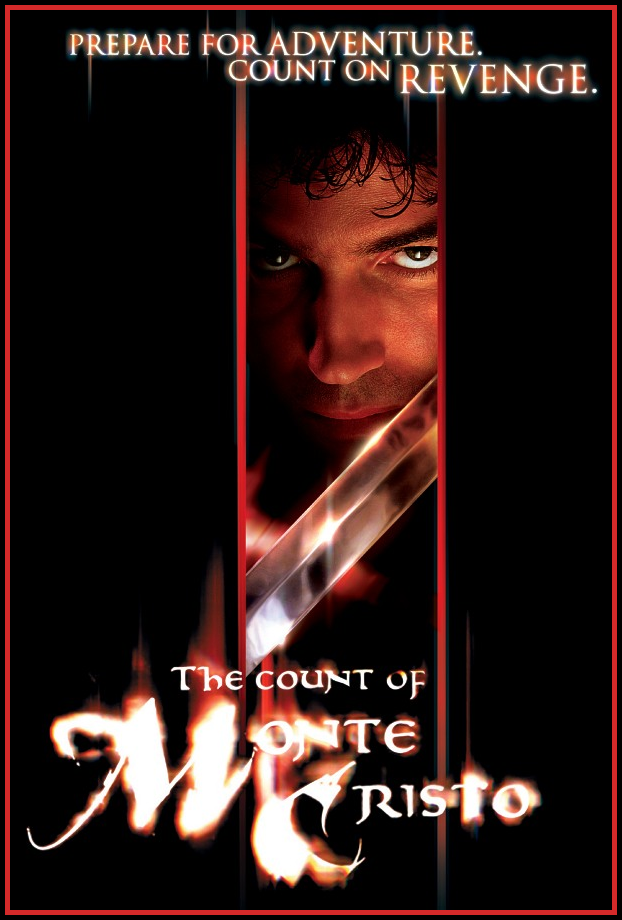
In what has become an unofficial ritual for myself whenever my birthday rolls around I always end up watching a film from 2002 that flew under the radar of most people. While it made modest box-office returns it wasn’t the head-turning blockbuster that some of its producers hoped it would turn out to be. It’s a romantic adventure piece by Kevin Reynolds and for readers of classic literature they’d recognize the title of the film, The Count of Monte Cristo. A film loosely based on the classic novel of adventure, revenge and redemption by French author Alexandre Dumas. The film ends up being a fun, thrilling throwback to films of an era which had marquee stars such as Errol Flynn and Basil Rathbone.
The story is one known well enough. It’s a tale of a man, Edmond Dantès wrongly accussed of a capital crime and imprisoned in the Alcatraz-like prison Chateau d’If through the machinations of three individuals: his best friend Fernand Mondego, first mate Danglars and the ambitious deputy prosecutor Villefort. Dantès spends the next several years in Chateau d’If under the cruel and sadistic eyes of it’s warden, Armand Dorleac (played by Michael Wincott with his usual flair for sadism). It’s while Dantès has started to contemplate suicide after rejecting God for the pain and suffering he has had to endure that he has a fortuitious meeting with another guest of Chateau d’If. It’s this relationship between Dantès and Abbé Faria (Richard Harris in the mentor role he had begun to play in his later years) which take up the bulk of the first third of the film.
Dantès tells him of the circumstances which led to his imprison in Chateau d’If and the thoughts of vengeance on those responsible for his predicament. Faria tries to turn him from his dark path, but seeing how determined his young friend seems on journeying down its twisted path he agrees to teach him how to become adept at being a noble, finances and in swordcraft in exchange for help in digging themselves out of their prison. Taking several more years to complete the education Dantès needs to exact his revenge it ends at the death of Faria and his mentor’s final gift to his student. The location of a treasure so vast that Dantès could retire to a life of peace and contemplation or fund his plans of vengeance.
The middle section of the film shows Dantès finding the treasure and remaking himself through his newfound wealth as the Count of Monte Cristo to better insinuate himself amongst the wealthy and noble-born his targets mingle in. With the help of a bandit whose life spares after a duel in Jacopo (Luis Guzman) the plans Dantès has worked on for years begin to bear fruit as he manipulates and fools Fernand, Villefort and Danglars into his confidence to better see to their downfall. It’s during this time he meets his former fiancee Mercedes (played by the ridiculously beautiful Dagmara Dominczyk), now Countess Mondego after being told of Edmond’s execution earlier in the film, and Fernand’s son Albert. The circumstances of how his former love having had a child and married to one of the men who had conspired against him brings a new complication to Dantès plans.
The last third of the film shows the culmination of Dantès and his elaborate plans to bring about the downfall of all those who had wronged him. While the plans, at times, strain the bonds of disbelief at actually having fooled and worked against his enemies the way the film makes the audience root for Dantès to succeed helps. This is a Dantès who comes off as noble despite being of commoner origins who we stand behind and support in his plans of vengeance. With the amount of wealth at his disposal it’s not too difficult to put oneself in the same shoes and not think of vengeance as well to strike a balance.
It’s a testament to the direction of filmmaker Kevin Reynolds that the film and it’s story never bogs down despite a story with many elaborate plots and secondary characters introduced midway. The fact that the film only borrows some of its complexity from an even more labyrinthine novel shows how the filmmakers actually had to simplify the story as to not make it so complex that it loses the bulk of its audience.
The Count of Monte Cristo also benefit from a strong cast led by Jim Caviezel in the titular role with Guy Pearce playing his former friend and betrayer Fernand Mondego and James Frain as the prosecutor Villefort. Caviezel plays his role as Dantès and as the Count of Monte Cristo as two different people with distinct personalities. There’s Dantès the earnest sailor who just wanted to get back to his love, Mercedes and then there’s the sophisticated and ruthless Count whose machinations would lead to the destruction of lives and reputations. It’s a mystery why Caviezel hasn’t become the star he surely was in the making and this film showed that he had the talent to become one of the industry’s new leading men. I blame Mel Gibson in casting him as Jesus in The Passion of the Christ for having put a curse on Caviezel.
Guy Pierce in the role of Fernand plays the conniving and remoreless villain role to the hilt. With an overbearing and effete noble bearing to his performance it was a character written to inspire hatred not just in its main protagonist but in the audience as well. Pearce knows what his roles represent and has fun playing up the role as main heavy.
Richard Harris as the priest Faria did his usual great work as the elder mentor to a younger man. It was a role he began to be known for starting with Ridley Scott’s Gladiator right up to his final mentor role as the wizard Dumbledore in the Harry Potter film franchise. It’s hard to explain to people that Harris was not always this wise and mentoring father figure, but one who played roles where he’d play womanizers, charming cads and roguish rebel.
The Count of Monte Cristo ended up being more fun than it should be with enough complexities in its storytelling that the film doesn’t dumb down too much the story it was adapted from. To be honest the only way one could truly adapt Dumas’ novel of revenge and redemption is through a long-form tv series. It is just that complex with so many characters that a film adaptation would just be too long or just unnecessarily crowded with characters the audience would care to know. It’s a good thing that the film by Kevin Reynolds was still able to keep to the spirit of the original source while whiling away the story down to its basic core.
It’s a film that plays like a throwback to the swashbuckling films from Hollywood of the 30’s and 40’s and it wouldn’t be too difficult to see Caviezel in the roles Errol Flynn once inhabited. There’s very little special effects in the film which adds more to this sense with swordfight scenes as expertly choreographed as any of the past. The Count of Monte Cristo, for some reason still unknown to me, continues to be the one thing that keeps airing on my birthday and the fact that it’s such a fun and thrilling film that I continue to watch it everytime my day of days roll around. Can’t wait for next year.
At the start of 1980’s Ticket To Heaven, we’re introduced to David (Nick Mancuso), a normal young man from an upper middle class background. David is likable enough but, when we first meet him, is still feeling depressed after breaking up with his longtime girlfriend. He handles his loneliness by meeting up with Karl, a friend from college. Karl, who is accompanied by an almost unbelievably positive young woman (played by a very young Kim Cattrall), invites David to come spend the weekend at a religious “retreat.” For reasons that have more to do with Cattrall than with any interest in religion, David agrees.
The retreat turn out to be a camp where everyone is extremely friendly and extremely positive. From the minute David arrives, everyone is smiling at him and telling him how thrilled they are to meet him. It’s such a positive experience that David doesn’t even complain when he’s given little to eat, allowed very little sleep, and forced to endure hours of talk about the great spiritual leader who set up the camp. When David does eventually decide that he’d like to leave, all of his friendly campmates are so wounded by his rejection that he changes his mind. Who wouldn’t? After all, they’re so nice and idealistic and positive.
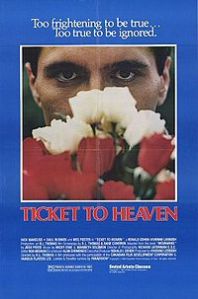
Needless to say, David never leaves the camp. When his best friend (played by Saul Rubinek) happens to run into David on the street, he’s shocked to discover that David has become a blank-eyed zombie whose life now revolves around selling flowers in the street and making money for his new friends. However, David’s old friends aren’t quite ready to give him up and the rest of the film details the battle between the two groups for David’s mind and soul.
Ticket to Heaven is a genuinely unsettling film. As directed by Ralph Thomas, the entire film seem to ooze a very real creepiness that stays with you even after the end credits have rolled. The film is at its best when it shows, in painfully believable detail, just how easy it is for someone to become brainwashed and to set aside everything that makes them unique in the name of a “greater good.”
The film’s cast is made up of a talented group of mostly Canadian character actors and, down to the smallest role, they’re all disturbingly believable. Kim Cattrall is probably the most recognizable face in the cast, though Michael Wincott (he of the sexy, gravelly voice) also shows up in a tiny role. Nick Mancuso and Saul Rubinek are believable as best friends and Mancuso is such a likeable presence that it makes his transformation into soulless zombie all the more disturbing. Meg Foster — who looks like a thin, somewhat stable version of Kirstie Alley — gives an excellent and chilling performance as one of the cult’s leaders.
However, for me, the film’s best performance was given by an actor named R.H. Thomson. Playing a cult deprogrammer named Linc Strunc (what a great name), Thomson is only in a handful of scenes but he dominates every one of them. Speaking through clenched teeth and giving off an attitude of weary cynicism, Thomson takes a role that could have been a stereotype and makes it instead very compelling. If I choose to believe Wikipedia, Thomson is still active as an actor and, after seeing his work in Ticket to Heaven, I may have to track down his other films.
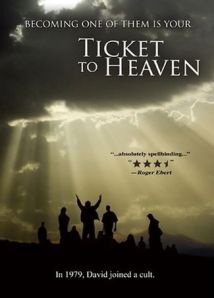
Despite having won a Genie (the Canadian version of the Oscar), Ticket to Heaven is something of an obscure film. I have to admit that I bought the DVD on something of a whim and that was mostly because I was intrigued by the words “In 1979, David joined a cult…” on the DVD’s cover. I’ve long been fascinated by cults and just how easily some people can surrender everything the makes them a unique and individual human being.
During my first semester away at college, there used to be a small handful of students who, every night, would gather together outside the student union. Since I’ve always been a night person, I’d often find myself walking by their little group and I always felt a little bit anxious whenever I saw them. They all looked perfectly normal but there was still something off about them. As my roommate Kim put it, they all looked like they had wandered out of a toothpaste commercial. There was also the fact that they obviously considered themselves to be a part of an exclusive club that the rest of us had not been invited to join.
One night, Kim and I went down to the student union to check our mail. As we were heading back to our dorm, we passed this little group and I noticed that one of them appeared to be holding a microphone. I guess he saw me looking because he held the microphone up to his lips and said, his voice booming, “HEY YOU, DO YOU KNOW THE LORD!?” At the time, Kim and I both considered ourselves to be decadent Pagans so we answered by sharing a long kiss in front of them and then laughing at the dead glares that greeted our response before we then ran, hand-in-hand, back to the dorms. In retrospect, I guess that was my invitation to join the club and I’m glad I was too busy trying to be worldly to accept it.
A few nights later, I found myself suffering from the insomnia that’s plagued me for as long as I can remember. Around 3:00 a.m., I was sitting down in the dorm’s lobby, trying to write angsty poetry. On the other side of the lobby was this guy that we’ll call “Rich.” You’ve probably known someone like Rich. He’s one of those guys who was always smiling a little bit too much, who was always almost desperately friendly. Rich was someone who, for whatever reason, was obviously lost and looking at him, you got the sense that he’d never been truly happy a day in his life. I always felt sorry for Rich but I was also a little scared of him.
That night, I was happy that he wasn’t trying to talk to me. Instead, he was just quietly sitting in a corner with a blank stare. Suddenly, he was approached by three men who greeted him by name and, visibly shaking, Rich stood up to greet them. It took me a few minutes but then I recognized that two of the guys were from that same group that always gathered outside the union. Standing in between them was a balding, bearded man who I’d never seen before or since.
The four of them sat down and they were soon leaning forward in huddled conversation. I found myself straining to hear what they were saying but I could only pick up a few words. I could see that Rich was still shaking and that he had started to cry.
Suddenly, the bearded man spoke in a voice that snapped through the entire lobby. “You little shit,” he said, “You pathetic motherfucker!”
As the two others sat there impassively, the bearded man leaned forward until his face was inches in front of Rich’s. From where I was sitting, it looked almost as if Rich’s face was being eclipsed by the back of the man’s head. The man continued to speak but now his voice was low and I couldn’t make out the exact words. But I could tell from his body language and his gestures that he was giving Rich more of the same.
After about an hour of this, Rich started nodding and, tears flowing down his face, he started to say, “Praise God! Praise God! Thank you! Praise God!”
The four of them stood up and, as I watched in disbelief, they stood there hugging each other as Rich continued with his “Praise God!” The three guys then headed out and Rich, smiling even though his face was still slick with tears, skipped out of the lobby.
Rich graduated at the end of that semester. A few years later, when I was about to graduate, I heard someone say that Rich had recently committed suicide. I don’t know if that’s true and it’s almost too obvious an ending to his story.
I thought a good deal about Rich and that night after I finished watching Ticket to Heaven.
Admittedly, Ticket to Heaven is not a “perfect film.” Strong as Mancuso’s performance is, David is still something of a sketchy character. The film does a good job showing the techniques that the cult uses to brainwash David but it’s never quite clear why David was so susceptible to those techniques to begin with. There are hints, of course. David is shown to be upset over breaking up with his girlfriend and there are hints that his safely middle class existence has left with him with little sense of having an individual existence of his own. That doesn’t change the fact that David ultimately comes across as less of a real person and more as a way for the film to preach its anti-cult message.
Indeed, the film’s biggest flaw is that it is essentially a message film. As well-acted and intelligently scripted as it often is, the movie exists to deliver a message. Fortunately, it’s a good message but that doesn’t stop the film from sometimes rather heavy-handed. This is most obvious in the movie’s final scene in which things are tied up just a little bit too neatly.
Still, flaws aside and despite having been made 30 years ago, Ticket to Heaven remains a relevent film. We live in a world that, for the most part, is made up of brainwashed people and, watching the movie, I had to wonder how much difference there really was between the overbearingly positive cultist played by Kim Cattrall and the grim-faced jihadists that currently haunt our nightmares. When you consider just how much evil is justified, on a daily basis, in the name of the greater good, its becomes obvious that the movie’s warning against becoming a living zombie is just as important today as when the film was made.
The film’s cult is based on an actual, real-life group that was apparently very active in the late 70s and who are still around today, the Unification Church. I vaguely remember them being in the news back in 2004 when the head of the church was declared to be “the prince of peace” at a ceremony that was attended by a few congressmen. Type “Unification Church” into google and you’ll end up with links to a lot of stories that would seem to suggest that the real cult is even more creepy than the fictionalized version in Ticket to Heaven.