Welcome to Retro Television Reviews, a feature where we review some of our favorite and least favorite shows of the past! On Mondays, I will be reviewing Crime Story, which ran on NBC from 1986 to 1988. The entire show can be found on Tubi!
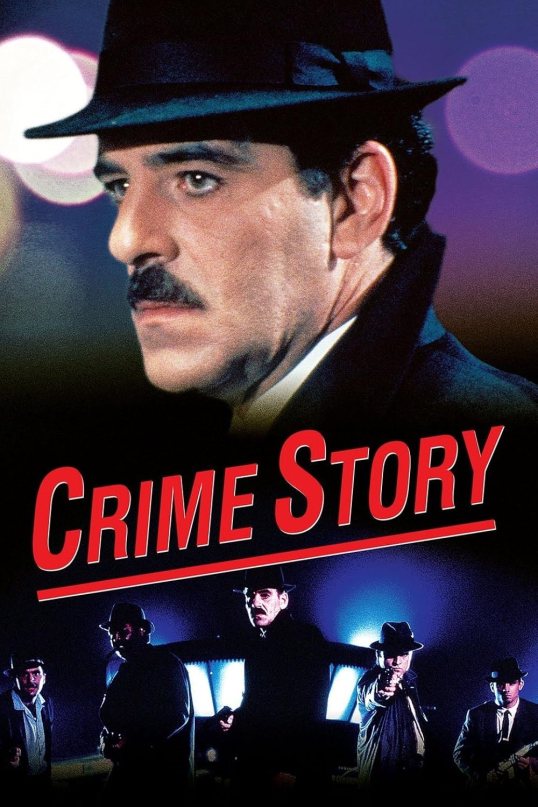
Today, we start the second season of Crime Story!
Episode 2.1 “The Senator, The Movie Star, and the Mob”
(Dir by John Nicolella, originally aired on September 22nd, 1987)
The second season of Crime Story opens with Torello, Abrams, and the Task Force still in Las Vegas. With Luca and Pauli apparently dead as a result of that nuclear blast at the end of the first season, various gangsters are trying to position themselves as Manny Weisbord’s new man in Vegas. Carlo Mastrangelo (Stephen McHattie) is the latest contender.
(And yet, it’s hard not to notice that, during the opening credits, both Tony Denison and John Santucci are listed. Neither appears in this episode other than in the pictures displayed at their funeral. But the credits don’t seem quite convinced that Luca and Pauli are dead.)
Crusading Senator Rourke (Kevin Spacey, in his first major television role) comes to Vegas. Rourke—the son of a former bootlegger and a presidential contender who speaks with a slightly abrasive Boston accent—is holding hearings on the Mob. Also arriving in Vegas is Pamela Palmer (Jenny Wright), a platinum-blonde movie star known for her glamorous sex appeal but who spends almost the entire episode hiding a black eye behind her sunglasses. As Torello discovers, Pamela is Mastrangelo’s occasional girlfriend, but she’s also having an affair with Senator Rourke.
Anyone who has studied history or who has an interest in conspiracy theories will be able to see the obvious real-world parallels. Rourke, with his bootlegger father and his less-than-ideal private life, is an obvious stand-in for both John and Robert F. Kennedy. (Of course, when seen today, the casting of Kevin Spacey in the role brings a whole other dimension to it. Now we instinctively distrust Rourke as soon as we see him, despite the fact that the show portrays him as sincere in his crusade against the Mob.) Pamela is Marilyn Monroe. Mastrangelo and his second-in-command Bobby Meeker (Michael Wincott) bring to mind Sam Giancana and Johnny Roselli, two of the mobsters whose names regularly turn up in JFK assassination lore.
In real life, a heartbroken Marilyn Monroe overdosed and both Kennedy brothers were assassinated. On Crime Story, Torello is able to prevent Mastrangelo from assassinating Rourke, and an emotionally strengthened Pamela is able to leave Las Vegas for what will hopefully be a brighter future than the one that awaited Marilyn. This episode feels like a work of alternative history, one in which the Kennedys lived up to their promise and one determined man like Mike Torello could prevent a nation from being traumatized.
For a history nerd like me, this episode was enjoyable. It held my interest. I liked seeing how the show reimagined history. At the same time, Luca and Pauli were definitely missed. A format in which Torello deals with a villain-a-week doesn’t carry the same emotional punch as watching Torello obsess, episode after episode, on just one particularly nasty villain. Because Luca and Torello were opposite sides of the same driven coin, not having Luca around makes it feel as if Torello is incomplete as well.
That said, this episode ended with a shot of a bandaged man sitting on a beach in Mexico. Could that man be Luca? Hopefully, we’ll find out soon!

