Retro Television Review: Crime Story 1.3 “Shadow Dancer”


Welcome to Retro Television Reviews, a feature where we review some of our favorite and least favorite shows of the past!  On Mondays, I will be reviewing Crime Story, which ran on NBC from 1986 to 1988.  The entire show can be found on Tubi!
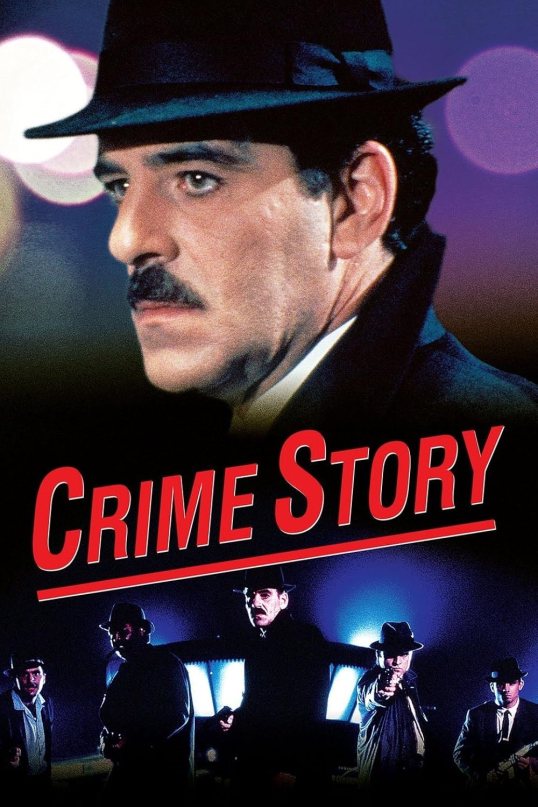
This week, Torello’s war on Luca continues!

Episode 1.3 “Shadow Dancer”

(Dir by Leon Ichaso, originally aired on September 26th, 1986)

With the frequency killer now dead, Torello and his men are once again free to focus on trying to bust Ray Luca. The sooner they do it, the better. For one thing, Torello is becoming so obsessed that, even though his wife is pregnant, Torello’s dreams are still dominated by Luca taunting him. Also, Luca’s latest robbery has resulted in a death. Vincent Noonan (Michael Kemmerling), a former cellmate of Frank Holman’s (Ted Levine,) lost it during their latest home invasion and beat to death Mrs. Novak (Nancy Sheeber).

(Noonan, it turns out, has a history of losing control. It probably wasn’t a good idea to hire him in the first place but, with Luca no refusing to personally take part in robberies, the crew had to find a third man and quickly. Holman recommended Noonan because of how loyal Noonan was to him in prison)

Eager to solve the case and take down Luca, the Major Case Unit starts to put pressure on Luca’s boss, Phil Bartoli (Jon Polito). After his weekly craps game is broken up by Danny Krychek, Bartoli tells Luca that he has to do something to get the police to back off. Bartoli orders him to turn Noonan over to the police. Luca, who no longer handles dirty work himself, tells Holman to take care of it. Holman sends Noonan on a job and then tips off Torello. Despite Danny telling him that Noonan would die before turning into a rat, Torello is convinced that, if he takes Noonan alive, he’ll be able to get Noonan to give up Luca. (What Torello doesn’t realize is that Noonan has never actually met Luca. To quote Willy Cicci, “The family had lots of buffers.”)

It’s all for naught, though. Torello and the cops chase Noonan all over the streets of Chicago and, in the end, Noonan dies while trying to escape. Much like Homicide’s Luther Mahoney, Luca appears to be untouchable …. for now.

This episode worked best as a character study. After last week’s somewhat over-the-top villain, this episode reminded us that Luca and Torello are two tightly-wound men who struggle with emotion. Beyond his own self-absorption, Luca lacks the emotions necessary to truly understand his fellow humans. Torello, meanwhile, gets too emotional. Whether he’s pursuing Ray Luca or snapping at a condescending salesman, Torello is a self-styled crusader who appears to be going slowly but surely insane. This wasn’t a particularly complex episode but it felt important. It was a reminder of what this show is all about.

Retro Television Review: Crime Story 1.2 “Final Transmission”


Welcome to Retro Television Reviews, a feature where we review some of our favorite and least favorite shows of the past!  On Mondays, I will be reviewing Crime Story, which ran on NBC from 1986 to 1988.  The entire show can be found on Tubi!

This week, Torello and company search Chicago for a serial killer.

Episode 1.2 “Final Transmission”

(Dir by Leon Ichaso, originally aired on September 19th, 1986)

Mike Torello and the members of the MCU would really like to go after Luca and his crew but, unfortunately, there’s a serial killer on the loose in Chicago.  Realizing that the MCU is going to be tied up trying to track down Ray Pernell (John Snyder) before he kills again, Luca orders his crew to commit even more robberies.  Luca explains to a crestfallen Paulie that Luca will no longer be taking part in the robberies.  Luca is the boss and the boss doesn’t get his hands dirty.  Instead, Luca spends most of this episode meeting with Murray Weisbord’s man in Chicago, Max Goldman (Andrew Dice Clay).

This was an odd episode.  On the one hand, the show went out of its way to recreate Chicago in the early 60s.  The soundtrack was early rock and roll.  The cars all had tailfins.  The suits, the cigarettes, Luca’s haircut, all of the details screamed 1960s.  But then the episode revolved around a serial killer who thought his mother was addressing him through the television and who looked and dressed like a late 70s punk rocker.  I assume that Ray Pernell was based on Richard Speck, the notorious Chicago serial killer who, in 1966, murdered 8 student nurses.  Like Speck, Pernell had an identifying tattoo and both men were traced through the National Maritime Union.  That said, Pernell just seemed so out-of-place, with his sleeveless shirt and his punkish haircut that he just didn’t seem to belong in the world of Crime Story.

That said, I will give this episode some credit.  In the pilot, Luca often seemed like a clueless punk.  In this episode, he quickly realized that the MCU would be too busy hunting for Pernell to devote much time to him and he took advantage of that fact.  Luca’s not quite as dumb as he sometimes seems.  This episode also showed that he was capable of thinking ahead.  When he suspects that someone is listening in on his conversation with Goldman, he resists the temptation to burst into the room next door with his gun drawn.  (If he had, he would have run straight into Torello and Danny.)  This episode shows that Luca is learning and growing.  He not the buffoonish hothead that Torello originally assumed him to be.  In fact, he’s even more dangerous.

This episode ends with Pernell somehow (it’s not really clear how) taking an entire television news broadcast hostage.  Torello takes him down as the cameras roll and the entire city of Chicago watches.  It’s not a bad ending but it just doesn’t feel right for the show.  It’s a Miami Vice ending.  This is Crime Story!

Retro Television Review: Crime Story 1.1 “Pilot”


Welcome to Retro Television Reviews, a feature where we review some of our favorite and least favorite shows of the past!  On Mondays, I will be reviewing Crime Story, which ran on NBC from 1986 to 1988.  The entire show can be found on Tubi!

In 1986, riding high on the success of Miami Vice, Michael Mann signed on as executive producer of Crime Story, a cop show that Mann imagined would run for five seasons and which would follow a group of cops and gangsters from 1960s Chicago to 1980s Las Vegas.  The show was co-created by former Chicago cop Chuck Adamson and it starred another former Chicago cop, Dennis Farina.

Though generally well-received by critics, Crime Story struggled in the ratings.  The show’s highly serialized-nature made it difficult for audiences to follow.  (This was in the pre-streaming age, when viewers couldn’t just get online and catch up with what they may have missed.)  Crime Story only lasted for two seasons but it has since developed a strong cult following and is now regularly listed as one of the best cop shows ever made.

I’m going to find out if that’s true over the next few months.  Two weeks ago, I finished up Miami Vice.  Now, it’s time for Crime Story.

Episode 1.1 “Pilot”

(Dir by Abel Ferrara, originally aired on September 18th, 1986)

In Chicago, on a rainy night in the early 1960s, a group of masked robbers hold up a fancy restaurant and then try to escape with a group of terrified hostages.  On the scene is the Major Crimes Unit, led by the grim Lt. Torello (Dennis Farina, a former real-life cop).  The end result is that all of the robbers end up dead, the hostages end up traumatized, and one of Torello’s men, the obviously doomed Wes Connelly (William Russ), appears to be losing his mind over the violence that he has to deal with every day.

The plot of the pilot is actually pretty simple.  A gang of thieves is holding up restaurants, banks, and stores in Chicago.  Torello believes that an ambitious gangster named Ray Luca (Tony Denison) is behind the robberies and Torello is correct.  The cool and sociopathic Ray is working with Johnny O’Donnel (David Caruso).  O’Donnel may be a childhood friend of Luca’s but his parents are friends with Torello.  When gangster Phil Bartoli (Jon Polito) orders Luca to kill O’Donnel after the latter robs one of Bartoli’s jewelry stores, it’s personal all-around.

Plot-wise, it’s pure Michael Mann.  The cops and the gangsters are both obsessive.  Luca will kill anyone to get ahead in the underworld.  Oddly, his only real loyalty seems to be to his dumbest henchman, Pauli Taglia (John Santucci, a real-life former jewel thief who was once arrested by Dennis Farina).  Torello may be fighting on the side of the law but he’s often just as quick to resort to violence as Luca.  Director Abel Ferrara’s style can be seen in a scene where Torello is visited by the ghost of the recently murdered Wes Connelly.  Torello is burned out and paranoid, flying into a rage when he sees his wife, Julie (Darlanne Fluegel), dancing with another man at a wedding.  (The man in question turns out to be Torello’s cousin, whom Torello didn’t even recognize because he apparently doesn’t have much of a connection to anyone outside of the police force.)  Towards the end of the episode, there’s a shoot-out in a department store and it’s hard not to notice that neither the crooks nor the cops seem to be all that concerned with the innocent bystanders trying to not get caught in the crossfire.

The pilot is dark, gritty, and, in its way, as stylized as any episode of Miami Vice.  It never seems to stop raining and, even during the day, the skies are permanently gray and dark.  The early 60s are recreated like a fever dream of pop culture, with rock and roll on the soundtrack, cars with tail fins screeching down the street, and Bartoli living in a house that looks more like a tacky diner then a true home.  Torello and his men wear their dark suits and trenchcoats the way that soldiers wear their uniforms.

It’s an effective pilot, though we don’t really get to know much about the men working with Torello at the Major Crimes Unit.  Bill Smitrovich, in the role Detective Danny Krycheck, establishes himself as being Torello’s second-in-command but that’s about it.  Stephen Lang appears in a handful of scenes as David Abrams, a liberal public defender who is the son of a prominent gangster.  Both Luca and Torello seem to want to make David into an alley and the episode hints that he will eventually have to make a choice.  The episode ends with Luca in sunny Florida, meeting with veteran gangster Manny Weisbord (Joseph Wiseman).  Torello, meanwhile, remains in dark Chicago.

The Crime Story pilot was deemed good enough to be released as a feature film in Europe.  It also led to a series on NBC, which I will be reviewing here, every Monday!  On the basis of the pilot, I’m looking forward to it.

Retro Television Review: Miami Vice 5.7 “Asian Cut”


Welcome to Retro Television Reviews, a feature where we review some of our favorite and least favorite shows of the past!  On Mondays, I will be reviewing Miami Vice, which ran on NBC from 1984 to 1989.  The entire show can be purchased on Prime!

There’s another serial killer haunting the streets of Miami.  We all know what that means.  It’s time to put either Trudy or Gina in harm’s way again.

Episode 5.7 “Asian Cut”

(Dir by James Contner, originally aired on January 13th, 1989)

Someone is murdering prostitutes and carving symbols into their skin.  The seemingly friendly Prof. Halliwell (David Schramm) confirms that the symbols are Asian in origin.  Crockett and Castillo suspect that the murderer might be a knife-obsessed Japanese gangster named Tegoro (Cary-Hiroyui Tagawa) but it turns out that they’re wrong.  Gina and Trudy work undercover as escort and Trudy meets Carlos (Alfredo Alvarez Calderon), a man with a kink for being beaten.  Carlos wants to introduce Trudy to a friend of his, someone who is something of an expert on torture and who learned the majority of his techniques while he was serving in the CIA during the Vietnam War….

Yep, the murderer is Prof. Halliwell!

This episode was thoroughly unpleasant.  That’s not necessarily a bad thing when it comes to episodes about serial killers and David Schramm did a good job of switching from being goofy to deadly.  However, in this case, it was hard not to think about the fact that, in five seasons, Gina and Trudy haven’t really gotten to do much other than pretend to be escorts and get threatened by serial killers.  For once, Gina was the one providing support while Trudy was the one put in jeopardy but it still otherwise felt very, very familiar.  Even the twist that the killer was a former CIA agent who specialized in torturing enemy combatants felt just a bit too predictable.  (On Miami Vice, anyone who is former CIA and not named Castillo always turns out to be a murderer.)  The torture scenes were so drawn out that they ultimately felt a bit gratuitous.

This episode ultimately just felt icky,