Though the Academy of Motion Picture Arts and Sciences claim that the Oscars honor the best of the year, we all know that there are always worthy films and performances that end up getting overlooked. Sometimes, it’s because the competition too fierce. Sometimes, it’s because the film itself was too controversial. Often, it’s just a case of a film’s quality not being fully recognized until years after its initial released. This series of reviews takes a look at the films and performances that should have been nominated but were, for whatever reason, overlooked. These are the Unnominated.
Why am I talking about 1979’s The Warriors in October?
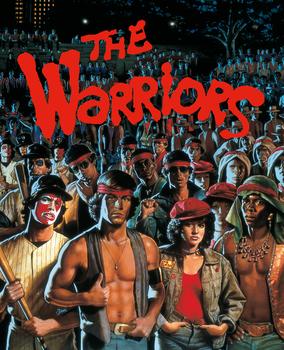
No, it’s not a traditional horror movie, even though the film does have some creepy moments and it features David Patrick Kelly playing one of the most memorable psychos in film history. At heart, it’s a film about a group of youngish gang members trying to survive the night and reach safety. (The characters are all meant to be teenagers, though that can be hard to remember when two of the film’s main characters are played by Michael Beck and James Remar, both of whom were close to 30 when the film was made.) The other gangs that the Warriors mostly either battle or escape from often feel as if they’ve stepped out of a nightmare. Everyone remembers the Baseball Furies because, as a gang, they were both intimidating and ludicrous at the same time. Myself, I was freaked out by the skinheads who drove around New York in a bus. The gang led by the guy on roller skates was pretty frightening as well. One thing about the rival gang members is that, with the exception of Luther, few of them speak. Instead, they simply show up and attack.

The Warriors (1979, directed by Walter Hill, DP: Andrew Laszlo)
The Warriors is a surreal film, which is not surprising when you consider that it was written by Walter Hill. The film takes place almost entirely at night and the streets of New York are eerily empty. Watching the film, I was reminded of the dying Paris from Jean Rollin’s Night of the Hunted and Dario Argento’s claim that Tenebrae was meant to take place in a future where there were far fewer people on the planet. At the same time, there are hints of the real world littered throughout the film. Four teenagers who are obviously heading home from prom find themselves on a train, sitting across from a bruised Swan (Michael Beck) and Mercy (Deborah Van Valkenburgh). Occasionally, we see people in bars or just trying to get back to their own homes. The subway stations are crawling with cops, one of whom throws Fox (Thomas G. Waites) in front of a moving train. Throughout the film, the members of the Warriors keep count of who is still with them on their journey to Coney Island, but no one mentions Fox after his sudden death. One could argue that they don’t want to think about how easily things could go wrong for them. They’re in a fantasy world where there are no consequences. Of course, a more likely reason is because Fox’s death was a last-minute development that was a result of actor Waites proving to be difficult to work with.
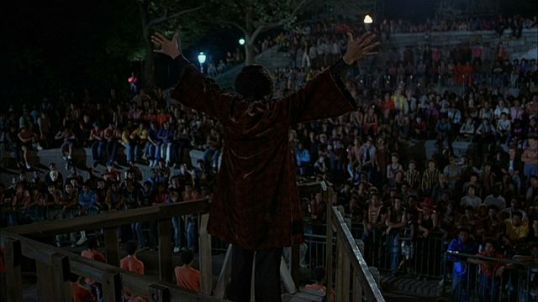
The Warriors (1979, dir by Walter Hill, DP: Andrew Laszlo)
Ultimately, The Warriors is a film for Halloween because it’s a film about costumes. The members of each gang are defined by what they wear. Some of them dress up. Some of them dress like they’re doing some sort of Bruce Springsteen-style working-class cosplay. There’s even a group of mimes who wear top hats. I feel bad for any neighborhood that is weak enough to be taken over by mimes. The film’s first great set piece—the meeting in the park—is rightly remembered for Roger Hill’s charismatic performance as Cyrus. (“Can you dig it!?”) But it also deserves to be remembered for the hundreds of extras, all of whom are wearing their costumes and mixing together. That’s the respect that Cyrus commands. The mimes and the pimps and the skinheads and the roller skaters are all willing to come together for Cyrus. And when Luther assassinates Cyrus and then blames the Warriors, the gangs of the city are prepared to destroy the gang of Coney Island.
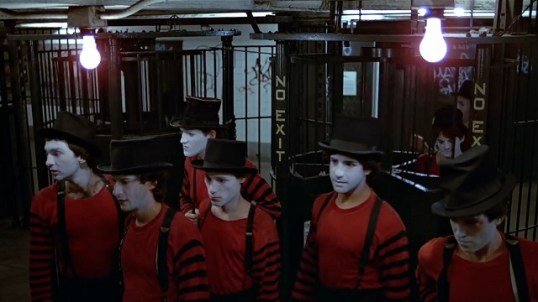
The Warriors (1979, dir by Walter Hill, DP: Andrew Laszlo)
It’s a great and exciting film that has stood the test of time. It’s not a surprise that it wasn’t Oscar-nominated. The film was controversial when it was released, with some claiming that it glorified gang life and that it promoted violence. Beyond that, the film is unapologetically pulpy. Walter Hill was and is a brilliant genre filmmaker and he’s never apologized for that fact. His films were never obvious award bait. That said, it does seem a shame that The Warriors didn’t even get a nomination for its propulsive score. The film’s cinematography turned a familiar city into an alien landscape and the editing kept viewers on the edge of their seats. It’s rare to see a film that captures the feeling of the world closing in on a group of people as well as The Warriors does. As far as the acting goes, the majority of the cast was inexperienced and there were more than a few times when that inexperience came through. It’s a film that’s more about visual style than deep performances. That said, Michael Beck was likable and had the right look to be a leader and Hill was very smart in how he framed him on screen. James Remar also did a good job as Ajax, playing him as being strong-willed and obnoxious and a bit too obsessed with proving his masculinity but also fiercely loyal to his gang. (As played by Remar, Ajax was the only Warrior who truly seemed like he could handle himself in a fight.) Deborah Van Valkenburgh was effective in an underwritten role. If anyone from the cast deserved a nomination, it was probably David Patrick Kelly. “Warriors, come out to play!” Kelly was a force of pure chaos. In the end, the big Oscar winner of 1979 was Kramer vs. Kramer, a film that might as well have taken place on a different planet from The Warriors.
If I may close on a personal note, I was feeling pretty sick last Thursday. I hadn’t gotten much sleep. I was stressed about getting my Horrorthon reviews written. I had given myself a headache. But then, I watched The Warriors and I got so sucked into its world (despite the fact that I had already watched the film more than a few times) that I forgot that I wasn’t feeling well. My headache went away. By the time the film ended, I was feeling a hundred times better.
Nominated or not, that’s the power of a good movie.
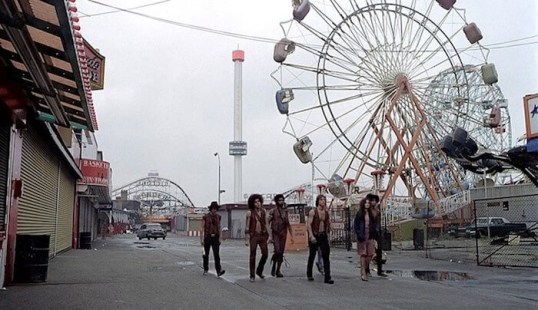
The Warriors (1979, dir by Walter Hill, DP: Andrew Laszlo)
Previous Entries In The Unnominated:
- Auto Focus
- Star 80
- Monty Python and The Holy Grail
- Johnny Got His Gun
- Saint Jack
- Office Space
- Play Misty For Me
- The Long Riders
- Mean Streets
- The Long Goodbye
- The General
- Tombstone
- Heat
- Kansas City Bomber
- Touch of Evil
- The Mortal Storm
- Honky Tonk Man
- Two-Lane Blacktop
- The Terminator
- The Ninth Configuration
- Southern Comfort