Retro Television Review: Crime Story 1.1 “Pilot”


Welcome to Retro Television Reviews, a feature where we review some of our favorite and least favorite shows of the past!  On Mondays, I will be reviewing Crime Story, which ran on NBC from 1986 to 1988.  The entire show can be found on Tubi!
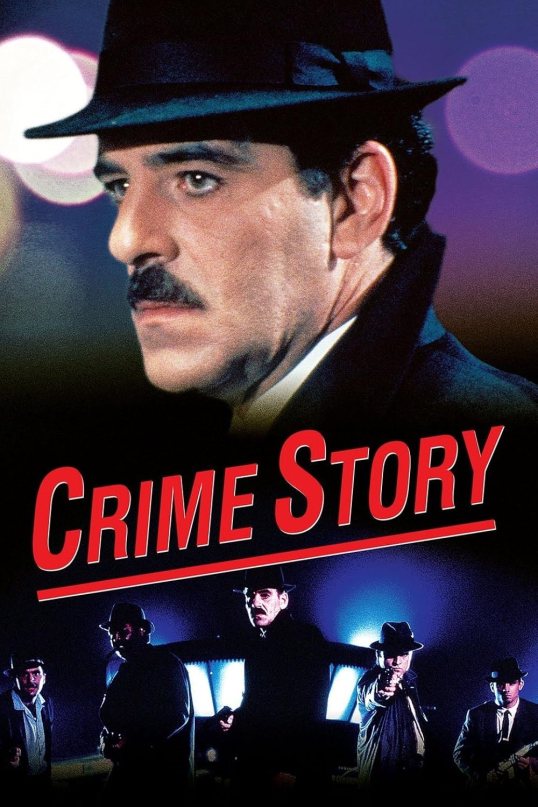
In 1986, riding high on the success of Miami Vice, Michael Mann signed on as executive producer of Crime Story, a cop show that Mann imagined would run for five seasons and which would follow a group of cops and gangsters from 1960s Chicago to 1980s Las Vegas.  The show was co-created by former Chicago cop Chuck Adamson and it starred another former Chicago cop, Dennis Farina.

Though generally well-received by critics, Crime Story struggled in the ratings.  The show’s highly serialized-nature made it difficult for audiences to follow.  (This was in the pre-streaming age, when viewers couldn’t just get online and catch up with what they may have missed.)  Crime Story only lasted for two seasons but it has since developed a strong cult following and is now regularly listed as one of the best cop shows ever made.

I’m going to find out if that’s true over the next few months.  Two weeks ago, I finished up Miami Vice.  Now, it’s time for Crime Story.

Episode 1.1 “Pilot”

(Dir by Abel Ferrara, originally aired on September 18th, 1986)

In Chicago, on a rainy night in the early 1960s, a group of masked robbers hold up a fancy restaurant and then try to escape with a group of terrified hostages.  On the scene is the Major Crimes Unit, led by the grim Lt. Torello (Dennis Farina, a former real-life cop).  The end result is that all of the robbers end up dead, the hostages end up traumatized, and one of Torello’s men, the obviously doomed Wes Connelly (William Russ), appears to be losing his mind over the violence that he has to deal with every day.

The plot of the pilot is actually pretty simple.  A gang of thieves is holding up restaurants, banks, and stores in Chicago.  Torello believes that an ambitious gangster named Ray Luca (Tony Denison) is behind the robberies and Torello is correct.  The cool and sociopathic Ray is working with Johnny O’Donnel (David Caruso).  O’Donnel may be a childhood friend of Luca’s but his parents are friends with Torello.  When gangster Phil Bartoli (Jon Polito) orders Luca to kill O’Donnel after the latter robs one of Bartoli’s jewelry stores, it’s personal all-around.

Plot-wise, it’s pure Michael Mann.  The cops and the gangsters are both obsessive.  Luca will kill anyone to get ahead in the underworld.  Oddly, his only real loyalty seems to be to his dumbest henchman, Pauli Taglia (John Santucci, a real-life former jewel thief who was once arrested by Dennis Farina).  Torello may be fighting on the side of the law but he’s often just as quick to resort to violence as Luca.  Director Abel Ferrara’s style can be seen in a scene where Torello is visited by the ghost of the recently murdered Wes Connelly.  Torello is burned out and paranoid, flying into a rage when he sees his wife, Julie (Darlanne Fluegel), dancing with another man at a wedding.  (The man in question turns out to be Torello’s cousin, whom Torello didn’t even recognize because he apparently doesn’t have much of a connection to anyone outside of the police force.)  Towards the end of the episode, there’s a shoot-out in a department store and it’s hard not to notice that neither the crooks nor the cops seem to be all that concerned with the innocent bystanders trying to not get caught in the crossfire.

The pilot is dark, gritty, and, in its way, as stylized as any episode of Miami Vice.  It never seems to stop raining and, even during the day, the skies are permanently gray and dark.  The early 60s are recreated like a fever dream of pop culture, with rock and roll on the soundtrack, cars with tail fins screeching down the street, and Bartoli living in a house that looks more like a tacky diner then a true home.  Torello and his men wear their dark suits and trenchcoats the way that soldiers wear their uniforms.

It’s an effective pilot, though we don’t really get to know much about the men working with Torello at the Major Crimes Unit.  Bill Smitrovich, in the role Detective Danny Krycheck, establishes himself as being Torello’s second-in-command but that’s about it.  Stephen Lang appears in a handful of scenes as David Abrams, a liberal public defender who is the son of a prominent gangster.  Both Luca and Torello seem to want to make David into an alley and the episode hints that he will eventually have to make a choice.  The episode ends with Luca in sunny Florida, meeting with veteran gangster Manny Weisbord (Joseph Wiseman).  Torello, meanwhile, remains in dark Chicago.

The Crime Story pilot was deemed good enough to be released as a feature film in Europe.  It also led to a series on NBC, which I will be reviewing here, every Monday!  On the basis of the pilot, I’m looking forward to it.

The TSL Grindhouse: The Spook Who Sat By The Door (dir by Ivan Dixon)


1973’s The Spook Who Sat By The Door opens with Senator Hennington (Joseph Mascolo) in a panic.

The Senator is running for reelection and is struggling to appeal to white voters and minority voters at the same time.  White voters are happy that the Senator recently gave a speech in favor of “law and order” but now, he’s polling weakly with black voters.  His wife (Elaine Aiken) suggests that the Senator win back black voters by demanding that the CIA hire more black agents.

The CIA responds to the political pressure by hiring Dan Freeman (Lawrence Cook) to be their first black agent.  Freeman is given the standard CIA training and taught how to start revolutions in other countries.  However, after he completes his training, Freeman is assigned no real responsibilities.  He is given a desk job and spends most of his day making copies.  Whenever a senator or a reporter visits CIA Headquarters, Freeman is trotted out so that the CIA can claim to be diverse.  Freeman understands that he’s a token.  He knows that his job is to basically sit by the door and be seen.  But Freeman actually has bigger plans.

After spending a few years at the CIA, Freeman resigns and heads back to Chicago to work as a social worker.  Using what he learned at the agency, he starts to recruit young black men as freedom fighters.  He and the Cobras (as they’re called) launch their own guerilla war against the establishment in Chicago.  Some of their tactics are violent and some of them are not.  Freeman understands the importance of winning both hearts and minds and he recruits Willy (David Lemieux) to serve as his lead propagandist.  Because Willy is light-skinned, he is also assigned to rob a bank because Freeman knows that both the witnesses and the police will mistake him for being white and will be less likely to fire on him.  (The other members of the Cobras wear whiteface during the robbery.)

Freeman hopes that he will be able to recruit his childhood friend, Dawson (J.A. Preston), to the cause.  Dawson, however, now works as a detective for the Chicago PD and has been assigned to beak up the Cobras.  Will Freeman be able to bring over Dawson and what will happen if Dawson resists?

Based on a novel by Sam Greenlee (who was one of the first black men to be recruited to work with the United States Information Agency and who based many of Freeman’s CIA experiences on his own), The Spook Who Sat By The Door has achieved legendary status as a film that the FBI reportedly tried to keep out of theaters.  Theater owners were pressured to either not book the film or to only book it for a week before replacing it with a less incendiary film.  As a result, The Spook Who Sat By The Door became a difficult film to see.  As often happens, the efforts to censor the film only added to its revolutionary mystique.

Of course, in 2024, one can go on YouTube and watch the film for oneself.  It’s definitely uneven film, one that has pacing issues (especially at the beginning) and also one that suffers due to its low budget.  Depicting the overthrow of the government on a budget will always be a challenge.  Some of the acting is a bit amateurish but Lawrence Cook broods convincingly as Freeman and he’s well-matched by J.A. Preston’s portrayal of the more down-to-Earth Dawson.  At its best, there’s a raw authenticity and anger to the film that immediately captures the viewer’s attention.  It’s the rare political film to actually feature conversations about actual politics and it’s a film that asks how far people would be willing to go to accomplish change.  The Spook Who Sat By The Door suggests that the true villains are the members of the establishment who cynically embraced the civil rights struggle in their words but not in their actions.  In the end, Dan Freeman becomes a bit of a fanatic but the film suggests that perhaps a fanatic was what the times demanded.