Welcome to Retro Television Reviews, a feature where we review some of our favorite and least favorite shows of the past! On Mondays, I will be reviewing Crime Story, which ran on NBC from 1986 to 1988. The entire show can be found on Tubi!
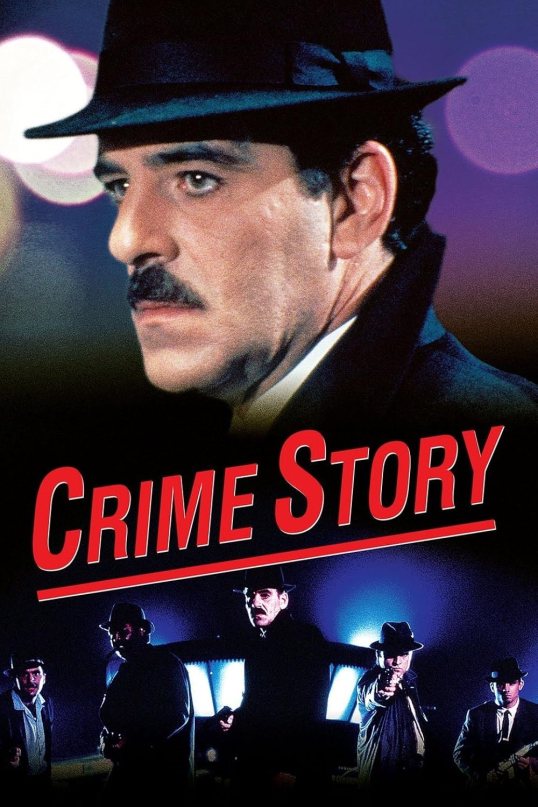
This week, Torello’s war on Luca continues!
Episode 1.3 “Shadow Dancer”
(Dir by Leon Ichaso, originally aired on September 26th, 1986)
With the frequency killer now dead, Torello and his men are once again free to focus on trying to bust Ray Luca. The sooner they do it, the better. For one thing, Torello is becoming so obsessed that, even though his wife is pregnant, Torello’s dreams are still dominated by Luca taunting him. Also, Luca’s latest robbery has resulted in a death. Vincent Noonan (Michael Kemmerling), a former cellmate of Frank Holman’s (Ted Levine,) lost it during their latest home invasion and beat to death Mrs. Novak (Nancy Sheeber).
(Noonan, it turns out, has a history of losing control. It probably wasn’t a good idea to hire him in the first place but, with Luca no refusing to personally take part in robberies, the crew had to find a third man and quickly. Holman recommended Noonan because of how loyal Noonan was to him in prison)
Eager to solve the case and take down Luca, the Major Case Unit starts to put pressure on Luca’s boss, Phil Bartoli (Jon Polito). After his weekly craps game is broken up by Danny Krychek, Bartoli tells Luca that he has to do something to get the police to back off. Bartoli orders him to turn Noonan over to the police. Luca, who no longer handles dirty work himself, tells Holman to take care of it. Holman sends Noonan on a job and then tips off Torello. Despite Danny telling him that Noonan would die before turning into a rat, Torello is convinced that, if he takes Noonan alive, he’ll be able to get Noonan to give up Luca. (What Torello doesn’t realize is that Noonan has never actually met Luca. To quote Willy Cicci, “The family had lots of buffers.”)
It’s all for naught, though. Torello and the cops chase Noonan all over the streets of Chicago and, in the end, Noonan dies while trying to escape. Much like Homicide’s Luther Mahoney, Luca appears to be untouchable …. for now.
This episode worked best as a character study. After last week’s somewhat over-the-top villain, this episode reminded us that Luca and Torello are two tightly-wound men who struggle with emotion. Beyond his own self-absorption, Luca lacks the emotions necessary to truly understand his fellow humans. Torello, meanwhile, gets too emotional. Whether he’s pursuing Ray Luca or snapping at a condescending salesman, Torello is a self-styled crusader who appears to be going slowly but surely insane. This wasn’t a particularly complex episode but it felt important. It was a reminder of what this show is all about.
Welcome to Retro Television Reviews, a feature where we review some of our favorite and least favorite shows of the past! On Mondays, I will be reviewing Crime Story, which ran on NBC from 1986 to 1988. The entire show can be found on Tubi!
This week, Torello and company search Chicago for a serial killer.
Episode 1.2 “Final Transmission”
(Dir by Leon Ichaso, originally aired on September 19th, 1986)
Mike Torello and the members of the MCU would really like to go after Luca and his crew but, unfortunately, there’s a serial killer on the loose in Chicago. Realizing that the MCU is going to be tied up trying to track down Ray Pernell (John Snyder) before he kills again, Luca orders his crew to commit even more robberies. Luca explains to a crestfallen Paulie that Luca will no longer be taking part in the robberies. Luca is the boss and the boss doesn’t get his hands dirty. Instead, Luca spends most of this episode meeting with Murray Weisbord’s man in Chicago, Max Goldman (Andrew Dice Clay).
This was an odd episode. On the one hand, the show went out of its way to recreate Chicago in the early 60s. The soundtrack was early rock and roll. The cars all had tailfins. The suits, the cigarettes, Luca’s haircut, all of the details screamed 1960s. But then the episode revolved around a serial killer who thought his mother was addressing him through the television and who looked and dressed like a late 70s punk rocker. I assume that Ray Pernell was based on Richard Speck, the notorious Chicago serial killer who, in 1966, murdered 8 student nurses. Like Speck, Pernell had an identifying tattoo and both men were traced through the National Maritime Union. That said, Pernell just seemed so out-of-place, with his sleeveless shirt and his punkish haircut that he just didn’t seem to belong in the world of Crime Story.
That said, I will give this episode some credit. In the pilot, Luca often seemed like a clueless punk. In this episode, he quickly realized that the MCU would be too busy hunting for Pernell to devote much time to him and he took advantage of that fact. Luca’s not quite as dumb as he sometimes seems. This episode also showed that he was capable of thinking ahead. When he suspects that someone is listening in on his conversation with Goldman, he resists the temptation to burst into the room next door with his gun drawn. (If he had, he would have run straight into Torello and Danny.) This episode shows that Luca is learning and growing. He not the buffoonish hothead that Torello originally assumed him to be. In fact, he’s even more dangerous.
This episode ends with Pernell somehow (it’s not really clear how) taking an entire television news broadcast hostage. Torello takes him down as the cameras roll and the entire city of Chicago watches. It’s not a bad ending but it just doesn’t feel right for the show. It’s a Miami Vice ending. This is Crime Story!
Welcome to Retro Television Reviews, a feature where we review some of our favorite and least favorite shows of the past! On Mondays, I will be reviewing Crime Story, which ran on NBC from 1986 to 1988. The entire show can be found on Tubi!
In 1986, riding high on the success of Miami Vice, Michael Mann signed on as executive producer of Crime Story, a cop show that Mann imagined would run for five seasons and which would follow a group of cops and gangsters from 1960s Chicago to 1980s Las Vegas. The show was co-created by former Chicago cop Chuck Adamson and it starred another former Chicago cop, Dennis Farina.
Though generally well-received by critics, Crime Story struggled in the ratings. The show’s highly serialized-nature made it difficult for audiences to follow. (This was in the pre-streaming age, when viewers couldn’t just get online and catch up with what they may have missed.) Crime Story only lasted for two seasons but it has since developed a strong cult following and is now regularly listed as one of the best cop shows ever made.
(Dir by Abel Ferrara, originally aired on September 18th, 1986)
In Chicago, on a rainy night in the early 1960s, a group of masked robbers hold up a fancy restaurant and then try to escape with a group of terrified hostages. On the scene is the Major Crimes Unit, led by the grim Lt. Torello (Dennis Farina, a former real-life cop). The end result is that all of the robbers end up dead, the hostages end up traumatized, and one of Torello’s men, the obviously doomed Wes Connelly (William Russ), appears to be losing his mind over the violence that he has to deal with every day.
The plot of the pilot is actually pretty simple. A gang of thieves is holding up restaurants, banks, and stores in Chicago. Torello believes that an ambitious gangster named Ray Luca (Tony Denison) is behind the robberies and Torello is correct. The cool and sociopathic Ray is working with Johnny O’Donnel (David Caruso). O’Donnel may be a childhood friend of Luca’s but his parents are friends with Torello. When gangster Phil Bartoli (Jon Polito) orders Luca to kill O’Donnel after the latter robs one of Bartoli’s jewelry stores, it’s personal all-around.
Plot-wise, it’s pure Michael Mann. The cops and the gangsters are both obsessive. Luca will kill anyone to get ahead in the underworld. Oddly, his only real loyalty seems to be to his dumbest henchman, Pauli Taglia (John Santucci, a real-life former jewel thief who was once arrested by Dennis Farina). Torello may be fighting on the side of the law but he’s often just as quick to resort to violence as Luca. Director Abel Ferrara’s style can be seen in a scene where Torello is visited by the ghost of the recently murdered Wes Connelly. Torello is burned out and paranoid, flying into a rage when he sees his wife, Julie (Darlanne Fluegel), dancing with another man at a wedding. (The man in question turns out to be Torello’s cousin, whom Torello didn’t even recognize because he apparently doesn’t have much of a connection to anyone outside of the police force.) Towards the end of the episode, there’s a shoot-out in a department store and it’s hard not to notice that neither the crooks nor the cops seem to be all that concerned with the innocent bystanders trying to not get caught in the crossfire.
The pilot is dark, gritty, and, in its way, as stylized as any episode of Miami Vice. It never seems to stop raining and, even during the day, the skies are permanently gray and dark. The early 60s are recreated like a fever dream of pop culture, with rock and roll on the soundtrack, cars with tail fins screeching down the street, and Bartoli living in a house that looks more like a tacky diner then a true home. Torello and his men wear their dark suits and trenchcoats the way that soldiers wear their uniforms.
It’s an effective pilot, though we don’t really get to know much about the men working with Torello at the Major Crimes Unit. Bill Smitrovich, in the role Detective Danny Krycheck, establishes himself as being Torello’s second-in-command but that’s about it. Stephen Lang appears in a handful of scenes as David Abrams, a liberal public defender who is the son of a prominent gangster. Both Luca and Torello seem to want to make David into an alley and the episode hints that he will eventually have to make a choice. The episode ends with Luca in sunny Florida, meeting with veteran gangster Manny Weisbord (Joseph Wiseman). Torello, meanwhile, remains in dark Chicago.
The Crime Story pilot was deemed good enough to be released as a feature film in Europe. It also led to a series on NBC, which I will be reviewing here, every Monday! On the basis of the pilot, I’m looking forward to it.
Bruise Brubaker (Mr. T) spends his nights as a bouncer at a club owned by his best friend (Dennis Dugan) and his days running a center for at-risk youth. Bruise is a former Marine drill sergeant who is now determined to make Chicago a better place. He’s so cool that his name is Bruise and he even has his own theme song, which plays whenever he patrols the streets and alleys of Chicago. But when it looks like the youth center is going to get closed down unless it can quickly raise some money, Bruise faces the challenge of a lifetime when he enters a competition to prove that he’s the toughest man in the world!
Is Mr. T the toughest man in the world? I pity the fool who even has to ask.
This made-for-TV movie is exactly what you think it is. Mr. T barks out his dialogue with his signature growl but he still seems utterly sincere when he orders the kids to say in school and stop trying to mug old men in the alleys. At first, it seems like Bruise should be able to easily win the Toughest Man competition but it turns out to be tougher than he thought. There’s an extended sequences in which Bruise tries to learn how to box and it turns out that he’s no Clubber Lang. There’s also an extended subplot about some broadly-played mobsters who are hoping that can drug Bruise so he’ll lose the contest.
Probably the funniest thing about the movie is the idea that everyone in Chicago would stop what they were doing so that they could gather around the television and watch the Toughest Man contest. The second funniest thing is Dennis Farina showing up in a small role and reminding us that it takes all types of actors to make a movie.
Mr. T was never a good actor but he was a great personality and that personality is on full display here. The Toughest Man In The World will make you nostalgic for a more innocent time.
Welcome to Retro Television Reviews, a feature where we review some of our favorite and least favorite shows of the past! On Mondays, I will be reviewing Miami Vice, which ran on NBC from 1984 to 1989. The entire show can be purchased on Prime!
This week, Al Lombard retuns.
Episode 5.18 “World of Trouble”
(Dir by Alan Myerson, originally aired on Jun 14th, 1989)
Way back in the first season, Dennis Farina appeared as an honorable gangster named Al Lombard who did not want his son, Sal, to follow him into the family business. During his first appearance, Lombard considered ratting out his associates in return for an immunity deal but, in the end, he refused. Al Lombard was old school. He was not a rat. That didn’t make much difference to his associates. The episode ended with an ambiguous freeze frame and gunshot that suggested they had executed him.
In this episode, it is revealed that Al Lombard faked his death and has spent the last few years in Europe. When a judge dismisses the years-old indictment against him, Al returns to Miami so he can visit his son, Sal (Timothy Patrick Quill). Despite the fact that Lombard went back on his promise to testify against his associates, Crockett and Tubbs are still happy to see him. Al is a likable guy!
Unfortunately, the whole thing is a set-up. Rival gangster Federico Librizzi (Ned Eisenberg) arranged for the indictment to be dismissed in order to lure Al back to Miami. Once in Miami, Al is upset to discover that Sal is now involved in the family business and that a gang war is about to break out over a new superweapon that Sal stole from the DEA. When Librizzi’s hitmen try to take out Al, they hit Sal instead.
Sal is dead and Al wants revenge. Al is smart enough to show up at a meeting between Librizzi and Burnett and Cooper (*sigh* the undercover thing again). Librizzi shoots Al, forcing Crockett and Tubbs to shoot Librizzi.
This was one of the fifth season episodes that did not originally air during the show’s network run. It was included in syndication as a “lost episode.” Dennis Farina gives a charismatic performance as Al Lombard but that’s about all this episode really has going for it. The other performances are nowhere close to being as good as Farina’s and the whole plot to bring Lombard back to Miami is ludicrously convoluted. Seriously, there aren’t mob hitmen in Europe?
“Someday we might look back on this and decide that Saving Private Ryan was the one decent thing we were able to pull out of this whole godawful, shitty mess.” — Sergeant Horvath
Saving Private Ryan stands as a landmark achievement in war cinema, intricately weaving immersive battle scenes, rich character dynamics, and profound moral themes into a nearly three-hour exploration of World War II’s human cost. One of its most remarkable features is the opening Omaha Beach landing sequence, a meticulously crafted, over 24-minute depiction of warfare’s brutal reality. Spielberg deploys a cinema verité style with handheld cameras capturing disorientation and chaos through the soldiers’ eyes. The sound design envelops the viewer in a sensory onslaught—gunfire, shouting, explosions—creating a visceral experience that immerses audiences directly in the terror and confusion of D-Day.
The filming process drew heavily on historical accuracy, with the production shot on the coast of County Wexford, Ireland, employing amputee actors and practical effects over computer graphics to simulate violent injuries and battlefield horrors. Muted tones evoke wartime photographs, and rapid, shaky editing conveys the disorganized, frantic environment soldiers endured. Consulting WWII veterans and historians, Spielberg created a sequence that reshaped cinematic portrayals of war, influencing how future films would approach the genre’s raw immediacy and emotional weight.
The film’s narrative follows a squad led by Captain Miller on a mission to locate and bring home Private James Ryan, whose three brothers have been killed in combat. The mission is steeped in the real-life tragedy of the five Sullivan brothers who died together aboard the USS Juneau in the Pacific, prompting military policies to prevent similar familial devastation. This historical context frames the story’s ethical heart: risking several men’s lives to save one, raising enduring questions about the value of individual sacrifice within the broader war.
In Saving Private Ryan, sacrifice is portrayed ambiguously—not as the sacrifice of a single hero but as the collective cost borne by the men tasked with rescuing one individual under perilous conditions. As the squad journeys through the war-torn French countryside, the deaths, injuries, and tensions they face underscore war’s randomness and the difficulty of weighing one life against many. The narrative refuses to romanticize or simplify, instead confronting the audience with the tragic truth that countless soldiers lose their lives without recognition or purpose, while some survive against staggering odds.
Duty and camaraderie thread throughout the film, portrayed through the soldiers’ evolving relationships and personal struggles. Each grapples with loyalty not only to their mission but to their fellow men and their own moral codes.
Integral to the film’s power is Tom Hanks’s layered performance as Captain John Miller. Hanks breathes life and emotional depth into Miller, portraying him as a man shaped by civilian life—revealed poignantly when he discloses his pre-war profession as a schoolteacher—now transformed by the relentless demands of war. He embodies an officer who is both composed and vulnerable, carrying the heavy burden of leadership with quiet dignity. Hanks’s portrayal reveals the internal struggles beneath Miller’s stoic exterior: moments of doubt, moral conflict, and fatigue subtly expressed through a trembling hand or a weary gaze. This humanity makes Miller relatable, as a man trying to maintain order and purpose amid chaos.
Hanks skillfully balances Miller’s authoritative presence with warmth and empathy, particularly evident in his paternal interactions with younger soldiers, reinforcing Miller’s role as both a leader and protector. His nuanced acting delivers the complexity of a man constantly negotiating duty and compassion. In scenes of high tension or moral quandaries, Hanks conveys the weight of command while allowing glimpses into Miller’s psychological strain, deepening the film’s emotional resonance.
Following Hanks’s Miller, a standout amongst the supporting cast is Tom Sizemore’s portrayal of Technical Sergeant Mike Horvath, Miller’s steady second-in-command. Sizemore embodies the pragmatic, battle-hardened soldier whose loyalty and experience provide emotional grounding for the squad. Sizemore portrays Horvath’s weariness and quiet commitment, adding layers of realism that deepen the exploration of how war reshapes individuals. The chemistry and shared history between Miller and Horvath are palpable, illustrating the bonds that sustain soldiers through hardship and lending emotional weight to the narrative.
The film wrestles with intense moral ambiguity throughout. The mission’s premise—to risk many lives to save one—compels both characters and viewers to confront complex questions about justice, value, and the cost of war. Scenes presenting difficult choices, such as the decision to spare or execute prisoners, dramatize these ethical dilemmas and highlight the emotional burdens borne by soldiers.
Technically, the film excels, with Janusz Kaminski’s dynamic cinematography capturing both the chaos of battle and intimate moments with evocative clarity. The immersive sound design reinforces the brutal reality, stripping warfare of glamor and confronting audiences with its daunting human costs.
Despite the overwhelming destruction and loss, Saving Private Ryan offers moments of humanity and hope. The rescue mission serves as a fragile symbol of compassion in the midst of devastation, while the film’s closing reflections on memory and legacy emphasize the lasting significance of sacrifice and survival.
Saving Private Ryan stands as a monumental achievement in the war genre, combining visceral combat realism, compelling characters, and moral complexity. Through Hanks’s deeply human Captain Miller and the nuanced supporting performances, especially Sizemore’s grounded Horvath, the film explores themes of sacrifice, duty, and brotherhood with unflinching honesty. Its enduring legacy lies in its unvarnished yet empathetic portrayal of war’s cost and the profound sacrifices made by those who lived it.
Hi, everyone! Brad and his wife Sierra are on vacation so guess is who is guest hosting the #MondayMuggers live tweet tonight? That’s right …. me!
Tonight’s movie will be MANHUNTER (1986), the classic Michael Mann-directed thriller that introduced the world to the characters of Will Graham, Jack Crawford, Francis Dollarhyde, and Hannibal Lecter! (Though it’s spelled Lektor in this film.) Check out the trailer!
You can find the movie on Prime and then you can join us on twitter at 9 pm central time! (That’s 10 pm for you folks on the East Coast.) See you then!
In 1995’s Get Shorty, John Travolta stars as Chili Palmer.
Chili is a loan shark for the mob, an effortlessly cool guy who lives in Miami and who loves to watch old movies. Chili may work for the Mafia and he may make his living by intimidating people but he doesn’t seem like such a bad guy, especially when compared to someone like Ray “Bones” Barboni (Dennis Farina). Bones is an uncouth and rather stupid gangster who steals Chili’s leather jacket from a restaurant. Chili reacts by breaking Bones’s nose with just one punch. Bones reacts by trying to shoot Chili but instead, he gets shot by Chili himself. (The bullet only grazes his forehead.) Chili can do all this because he’s protected by Momo (Ron Karasbatsos) but, after Momo drops dead after having to walk up several flights of stairs just to then be given a surprise birthday party, Chili suddenly finds himself working for Bones. (This all happens in the first few minutes of this perfectly paced film.)
Bones, eager to humiliate Chili, sends him to Vegas to collect on a debt owed by a dry cleaner named Leo (David Paymer). Leo is thought to be dead but Bones wants to collect the money from Leo’s widow. It’s not the sort of thing that Chili likes to do so instead, he ends up going to Hollywood to collect a debt from B-movie director Harry Zimm (Gene Hackman). Chili happens to like Harry’s movies. He also likes Harry’s current girlfriend and frequent co-star, actress Karen Flores (Rene Russo).
Chili ends up in Hollywood, a town where everyone has some sort of hustle going. Chili finds himself dealing with drug dealers (Delroy Lindo), egocentric film stars (Danny DeVito), stuntmen-turned-criminals (James Gandolfini), and the widow (Bette Midler) of a screenwriter. Chili also finds himself looking to escape from the debt collection business by becoming a film producer. Harry has a script that he wants to make. Chili proposes a film based on the story of Leo the dry cleaner. Danny DeVito’s Martin Weir wants to be a “shylock” in a movie just so he can show off his intimidating stare. (“Is this where I do the look?” he asks while listening to the pitch.) Get Shorty is a whip-smart satire of Hollywood, one in which the gangsters want to be film people and all of the film people want to be gangsters. It features wonderful performances from the entire cast, with Travolta epitomizing cool confidence as Chili Palmer. Hackman, Russo, DeVito, Gandolfini, and Lindo are all excellent in their supporting roles but I have to admit my favorite performance in the film is probably given by Dennis Farina, who turns Bones Barnobi into a very believable (and a believably dangerous) buffoon.
GetShorty is based on a book by Elmore Leonard. First published in 1990, the book is a quick and entertaining read, one that reminds us that Leonard was one of the best “genre” writers of his time. When I read that book, I was surprised to see how closely the movie stuck to the book’s plot. Much of the film’s dialogue is right there in the book. It’s a book that practically shouts, “Turn me into a movie!” and fortunately, director Barry Sonnenfeld did just that.
1981’s Thief tells the story of Frank (James Caan).
Frank is a professional diamond thief, one of the best in the business. He’s so cool that he even has his own Tangerine Dream soundtrack. After doing a stint in prison, Frank lives his life very carefully and with discipline. He’s determined not to return to prison. His mentor (played by Willie Nelson) is still behind bars and will probably die there. In fact, Frank has even found himself thinking about abandoning his criminal lifestyle. He’s got two front businesses, both of which are doing well. (Frank’s used car lot looks like some sort of alien world.) He’s fallen in love with a cashier named Jessie (Tuesday Weld) and it’s starting to seem like now would be a good time to settle down and become a family man. The only problem is that Frank is working for Leo (Robert Prosky) and Leo has absolutely no intention of allowing Frank to walk away. As Leo puts it, Frank belongs to him. That’s not a smart thing to say to someone like Frank.
Frank’s an interesting character. He’s the film’s hero, not because he’s a good guy but because he’s a smidgen better than most of the other bad guys. He’s a professional, one who goes out of his way avoid unnecessary complications. When we see him on the job, it’s impossible not to admire just how good he is at stealing stuff. When he uses a blowtorch to break into a store or a safe, the screen is full of sparks and, for a few minutes, Frank looks like some sort of cosmic super hero brought to life. We admire Frank but we discover early on that he’s willing to get violent. He’s willing to pull a gun and threaten his way out of a situation. Frank is loyal. He visits his mentor in prison. He takes care of his partner-in-crime, Barry (Jim Belushi, making his film debut). He truly loves Jessie. But, at heart, he’s a criminal who doesn’t hesitate to pull the trigger when he has to. The question the film asks is whether one can just go straight, after years of breaking the law and living in the shadows. Can Frank abandon the lifestyle, even for love? Or is he destined to always be a thief?
Thief was Michael Mann’s feature film debut. (The Jericho Mile was Mann’s directorial debut but it was made for television.) Thief is full of the usual Mann themes and also Mann’s signature style, showing that Mann knew exactly what type of films he wanted to make from the start of his career. The nights are full of shadows. The days are deceptively calm. The neon of Frank’s car lot glows like another dimension. The final bloody shoot out takes place at night, in the type of suburban neighborhood in which most people would probably love to live. And holding the film together is James Caan, giving a coolly centered performance as a man who has learned to hold back his emotions and who won’t be controlled by anyone. Halfway through the film, Caan delivers a seven-minute monologue about life in prison and it’s an amazing moment, one in which Caan shows just how good of an actor he truly was. Thief is an effective and stylish neo-noir, one that sticks with you as the end credits roll.
The 1980’s saw the what film enthusiasts saw as the death of the grindhouse experience. Major cities had begun to clean up their skid rows and the $1 all-day matinee theaters were closing down left and right. By the late 80’s gone were the buckets of stale popcorn, watered down sodas, carpets so sticky that one didn’t even want to think was made them that way and, of course, the sketchy individuals who always seemed to in every showing no matter the time.
Yet, the grindhouse never truly left the cinema, but became a bit more “mainstream” under the many independent studios that came about during the early 80’s. You had Cannon, Carolco, United Film and Orion to name a few. It was with Orion that we get the latest guilty pleasure of mine and that was the one really good film that Chuck Norris ever made: Code of Silence.
Chuck Norris was the Jason Statham and Scott Adkins of the 1980’s action scene. He was cranking out action flicks almost on a yearly basis trying to cash in on not just the Bruce Lee martial arts phase, but also the action hero phase that was beginning to be dominated by Schwarzenneger and Stallone. While Norris never reached the heights of those two action stars, his list of action films from the 80’s and into the early 90’s were decent and, dare I say, very workmanlike.
Code of Silence was the one film that had a decent story of the lone good cop that has to fight not just the criminals but also the corrupt cops and system that allows crime to run rampart. Norris as Sgt. Eddie Cusack of the Chicago PD has become the template for the loner hero cop who ends up not just fighting the mob (of differently nationalities) but also a corrupt partner and, they always have one or two, a couple of retired cops who help him but also die in the process.
Norris doesn’t lean heavily on the martials arts of his previous action films. Code of Silence was the film that helped transition him to the gunplay of the action flicks that the public couldn’t get enough of. While the film could and never truly escape it’s grindhouse influence it was very good enough both in characters, plot and direction (director Andrew Davis would later film later classics with The Fugitive and Under Siege).
The film really gets its grindhouse bonafides with the addition of Henry Silva as the main antagonist. Silva would make a career out of being the villain in many 80’s action flicks and in Code of Silence he steals the limelight with his over the top performance as Colombian drug trafficker Luis Camacho. Where Jack Palance got more praise for being the preeminent villain and tough guy of from the 70’s and 80’s, I do believe that Silva was the more sinister of the pair when it came to their performance.
Code of Silence shows that Chuck Norris can carry a film with minimal dialogue and on the power of his silent, seething stares. He was never one for quippy one-liners and Code of Silence is all the better because of it.