Music Film Review: The Punk Rock Movie (dir by Don Letts)


The year was 1977 and Don Letts had a video camera.

Letts was the DJ at The Roxy, a nightclub in London that gained some notoriety by hosting Punk acts like Sex Pistols, The Clash, The Slits, Siouxsie and the Banshees, Generation X, and several others.  In his role as DJ, Letts is often credited with introducing British punks to Jamaican reggae.  (I’ve occasionally seen it misreported that Letts himself was from Jamaica.  Letts commented in an interview that, until he visited the country with Johnny Lydon, the closest he had come to Jamaica was watching The Harder They Come.)  As an amateur filmmaker, Letts was responsible for making one of the key documentaries about the early days of Punk Rock, 1978’s The Punk Rock Movie.

Shot largely at the Roxy, The Punk Rock Movie features raw but candid footage of some of the key Punk bands.  Sex Pistols are there, of course.  The Clash get a lot of footage and it’s interesting to see the young members of the band doing something other than screeching about imperialism.  Billy Idol appears and shows off the rough charisma that would make him a star.  We watch as The Slits argue in rehearsal.  Siouxsie Sioux both performs and appears backstage, playing the enigmatic Punk diva.  We also see quite a few Punks acts who are no longer as well-remembered as The Clash or Sex Pistols.  Even with the DIY, anti-star ethos of the Punk Rock era, stage presence counted for a lot.  Some bands just naturally had it and some bands did not.

I watched The Punk Rock Movie on Tubi and the most frequent caption was one informing me that the lyrics were unintelligible due to the music.  It was a caption that I saw so frequently that I found myself both predicting when it would pop up and laughing when it did so.  The Punk Rock Movie is a raw film.  Don Letts shot the footage with a Super 8 Camera and, as a result, there’s nothing slick about the film.  The images are sometimes blurry.  It can be hard to make out what everyone is saying.  It’s a far cry from the type of carefully choreographed and meticulously shot concert footage that we’re used to seeing.  Needless to say, that’s a good deal of the film’s appeal.  It’s often said, perhaps incorrectly, that Punk was started as a reaction to the commercialization of rock.  At a time when soulless hitmakers and aging millionaires were dominating music, Punk came along with a burst of anger and vitality.  The Punk Rock Movie captures that youthful anger.  It captures the feeling of people refusing to accept that only a certain few were allowed to make music or express themselves.  Scenes of the police raiding a Punk store add a political element of the film while the backstage and tour bus footage serve to remind us of just how English the original Punks were.

It’s no surprise that Sex Pistols dominate the film.  We don’t see them backstage but we don’t have to.  All we have to do is see Johnny Rotten (as he was known then) staring out at the audience.  One of the more interesting thing about Punk is that the Sex Pistols were sold as being a band that didn’t know how to play their instruments or sing.  This film reveals that, for whatever they lacked in formal training, they were naturals on stage.  Regardless of what Malcolm McLaren and the press may have insisted, they were born to be stars.
 

Billy Idol Should Be Dead (2025, directed by Jonas Akerlund)


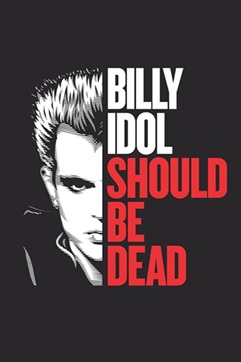
Billy Idol Should Be Dead is the title of a new documentary about Billy Idol and, watching the movie, it’s hard not to agree.

Billy Idol Should Be Dead covers Billy Idol’s storied career, from being a member of the Bromley Contingent to his time as lead singer of Generation X to his solo career and his current status as an unlikely elder statesman of rock and roll.  The film features interviews with Miley Cyrus and Billie Joe Armstrong and, despite the age differences, you only have to listen to them and then listen to the 70-something Billy Idol to see the difference between a true rocker and a pretender.  Even in his 70s and speaking in a gravelly voice, Billy Idol still has the charisma and the confidence that made him a star.  He still has the genuine punk rock attitude that bands like Green Day have made a lot of money imitating but which they have never matched.

The documentary is as open about Billy Idol’s history of drug abuse as Idol himself has been.  Idol became a heroin addict at an early age and doesn’t really start to think about cleaning himself up until his father comes over to America and scolds him.  Throughout the film, we hear about overdoses and lost weekends and all the times that Billy Idol came close to dying.  We also hear about the motorcycle accident that nearly lost him his leg and which ultimately inspired his most controversial album, Cyberpunk.  Why did Billy Idol survive while so many of his contemporaries did not?  Why was Billy Idol able to survive heroin while so many of the original punk rockers succumbed to it?  Who knows?  Luck of the draw, perhaps.

The theme of family runs through Billy Idol Should Be Dead.  Though Billy’s father is no longer around to offer up his perspective, Billy’s mother is and she’s the epitome of the perfect English mum, amused by her son’s antics even when she doesn’t quite understand them.  Billy Idol’s relationship with his father is one of the running themes of the film.  It was a difficult relationship but one built on familial love.  The relationship is reflected by Idol’s relationship with his own children, all of whom seem to be remarkably stable for someone who grew up with a rock star for a father.

The film alternates between archival footage of the young and cocky Billy Idol and black-and-white scenes of the contemporary Billy Idol.  The older Idol still has his swagger but he also has a hard-fought wisdom that younger Idol lacked.  The younger Idol thought he was indestructible while the older Idol is happy to be alive and be a grandfather.  The older Idol also reveals himself to be far more thoughtful than I think anyone gave the young Idol credit for being.  This documentary shows not only how Billy Idol survived a lifestyle that should have killed him but also how and why he’s earned his place as one of rock’s elder statesmen.

Billy Idol probably should be dead but this documentary will make you happy that he’s not.

Music Video of the Day: Adam in Chains by Billy Idol (1993, directed by Julien Temple)


Adam In Chains was the third single to be released from Billy Idol’s controversial Cyberpunk album.  Billy Idol predicted the future with Cyberpunk, though no one appreciated it at the time.  In interviews, Idol said he was inspired by the work of William Gibson while also admitting he had never read anything written by Gibson.

The video was directed by Julien Temple, who is best-known for his work with the Sex Pistols.

Film Review: The Doors (dir by Oliver Stone)


I like The Doors.

That can be a dangerous thing to admit, about both the band and Oliver Stone’s 1991 film.  Yes, both the band and the film could be a bit pretentious.  They both tended to go on for a bit longer than necessary.  They were both centered around a guy who wrote the type of poetry that I used to love back in my emo days.  It’s all true.

But, with The Doors as a band, I find that I can’t stop listening to them once I start.  Even if I might roll my eyes at some of the lyrics or if I might privately question whether any blues song really needs an organ solo, I can’t help but love the band.  They had a sound that was uniquely their own, a psychedelic carnival that brought to mind images of people dancing joyfully while the world burned around them.  And say what you will about Jim Morrison as a poet or even a thinker, he had a good voice.  He had the perfect voice for The Doors and their rather portentous style.  From the clips that I’ve seen of him performing, Morrison definitely had a stage presence.  Morrison died young.  He was only 27 and, in the popular imagination, he will always look like he’s 27.  Unlike his contemporaries who managed to survive the 60s, Morrison will always eternally be long-haired and full of life.

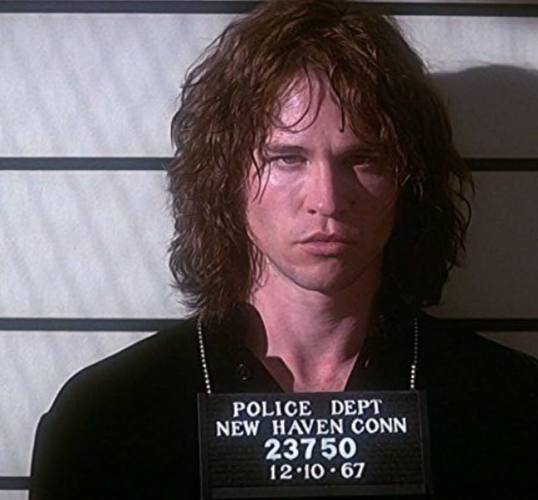
As for The Doors as a movie, it’s definitely an Oliver Stone film.  It’s big.  It’s colorful.  It’s deliberately messy.  Moments of genuinely clever filmmaking and breath-taking visuals are mixed with scenes that are so heavy-handed that you’ll be inspired to roll your eyes as dramatically as you’ve ever rolled them.  Stone loved the music and that love comes through in every performance scene.  Stone also loves using Native Americans as symbols and that can feel a bit cringey at times.  Why would Jim Morrison, whose was of Scottish and Irish ancestry, even have a Native American spirit guide?  At its best The Doors captures the chaos of a world that it’s the middle of being rebuilt.  The 60s were a turbulent time and The Doors is a turbulent movie.  I’ve read many reviews that criticized The Doors for the scene in which Morrison gets involved in a black magic ceremony with a journalist played by Kathleen Quinlan.  I have no idea whether or not that scene happened in real life but the movie is so full of energy and wild imagery that the scene feels like it belongs, regardless of whether it’s true or not.  Stone turns Jim Morrison into the warrior-artist-priest that Morrison apparently believed himself to be and the fact that the film actually succeeds has far more to do with Oliver Stone’s  enthusiastic, no-holds-barred direction and Val Kilmer’s charismatic lead performance than it does with Jim Morrison himself.

The Doors spent several years in development and there were several actors who, at one time or another, wanted to play Morrison.  Everyone from Tom Cruise to John Travolta to Richard Gere to Bono was considered for the role.  (Bono as Jim Morrison, what fresh Hell would that have been?)  Ultimately, Oliver Stone went with Val Kilmer for the role and Kilmer gives a larger-than-life performance as Morrison, capturing the charisma of a rock star but also the troubled and self-destructive soul of someone convinced that he was destined to die young.  Kilmer has so much charisma that you’re willing to put up with all the talk about opening the doors of perception and achieving a higher consciousness.  Kilmer was also smart enough to find the little moments to let the viewer know that Morrison, for all of his flamboyance, was ultimately a human being.  When Kilmer-as-Morrison winks while singing one particularly portentous lyric, it’s a moment of self-awareness that the film very much needs.

(When the news of Kilmer’s death was announced last night, many people online immediately started talking about Tombstone, Top Gun, and Top Secret.  For his part, Kilmer often said he was proudest of his performance as Jim Morrison.)

In the end, The Doors is less about the reality of the 60s and Jim Morrison and more about the way that we like to imagine the 60s and Jim Morrison as being.  It’s a nonstop carnival, full of familiar faces like Kyle MacLachlan, Michael Madsen, Crispin Glover (as Andy Warhol), Frank Whaley, Kevin Dillon, and a seriously miscast Meg Ryan.  It’s a big and sprawling film, one that is sometimes a bit too big for its own good but which is held together by both Stone’s shameless visuals and Val Kilmer’s charisma.  If you didn’t like the band before you watched this movie, you probably still won’t like them.  But, much like the band itself, The Doors is hard to ignore.

Music Video of the Day: Cage by Billy Idol (2022, directed by SRS)


After all this time, Billy Idol is still out there, making music and making videos.  Cage is his latest and it features Billy singing about dealing with his own demons while breaking free of a straight-jacket.  Harry Houdini has nothing on Billy!

The video was directed by SRS, which I assume is a pseudonym.  Remember when music videos used to be directed by guys with names like Nigel and Spike?  Now every music video appears to have been directed by a computer program.

Right now, this video only has 419,000 views on YouTube.  Times are forever changing and musical tastes change with them but that’s still no way to treat Billy Idol!

Enjoy!

Music Video of the Day: Mony Mony, covered by Billy Idol (1987, directed by Larry Jordan)


The cover of a song by Tommy James & The Shondells would be Billy Idol’s only number one hit in the United States.  As hard as it may be to believe, other Idol songs like White Wedding, Rebel Yell, and Dancing With Myself failed to even crack the top 30.  Interestingly enough, when Mony Mony hit number one, the song that it replaced was another song that was originally recorded by Tommy James, Tiffany’s cover of I Think We’re Alone Now. 

A good deal of the success of Billy Idol’s Mony Mony can probably be linked back to this music video, which features Billy Idol at his most energetic.  During performances of Mony Mony, audience members would regularly shout, “Hey Motherfucker … Get Laid!  Get fucked!” in between the lines.  How this became a tradition is not known but it did lead to this otherwise innocuous song getting banned from several high school dances.

This video was directed by Larry Jordan, who has also done videos for Shania Twain and Mariah Carey.

Enjoy!

Music Video of the Day: Dancing With Myself by Billy Idol (1983, dir by Tobe Hooper)


Hi!  Lisa here, filling in for Val, with today’s music video of the day!

On Saturday night, fans of both film and horror were saddened to learn of the death of Tobe Hooper.  Tobe Hooper was a Texas original, a fiercely iconoclastic director who totally changed the face of horror when he directed a low-budget shocker called The Texas Chainsaw Massacre.

When it came time to pick today’s music video of the day, I decided to see if Tobe Hooper had ever directed a music video.  It turned out that he directed exactly one and here it is:

According to almost everyone online, Dancing With Myself is a song about masturbation.  However, Idol himself says that the song’s lyrics are actually meant to be quite literal.  The song actually is about dancing with yourself.  Here’s how it’s explained over on Songfacts:

“This song is commonly thought to be about masturbation, but it’s really more about dancing by yourself. Billy got the idea after watching Japanese kids at a Tokyo disco “dancing with themselves” in a nightclub. The kids would dance in a pogo style up and down, and there were mirrors in the club so they could watch themselves doing it… This song is about more than just dancing. Idol told Rolling Stone: “The song really is about people being in a disenfranchised world where they’re left bereft, dancing with their own reflections.”

As for how Tobe Hooper came to direct the video … well, I have no idea.  I imagine he was hired because of his fame as the director of The Texas Chainsaw Massacre.  This video came out a year after the original Poltergeist, a film that Hooper is credited with directing but which many people believed was actually directed by producer Steven Spielberg.  (Poltergeist was a huge hit but the rumors of Hooper being a director-in-name-only permanently and unfairly damaged Hooper’s reputation.)  As far as I know, this is the only music video that Tobe Hooper directed.

As for the video, it features neither masturbation nor Japanese nightclubs.  Instead, it appears to be taking place in a post-apocalyptic setting.  The beginning of the video reminds me a bit of Hooper’s underrated slasher film, The Funhouse.

Anyway, enjoy!


Music Video of the Day: Eyes Without A Face by Billy Idol (1984, dir. David Mallet)


But behind the scenes, it was more like Face Without Eyes. I’m not abridging this story. Thank you Rob Tannenbaum and Craig Marks for writing the book I Want My MTV. Also, thank you John Diaz and Billy Idol for sharing this story.

John Diaz: On “Eyes Without a Face,” I brought in Tony Mitchell as DP–that was one of the first videos he shot. David Mallet directed, and David always shot in 16mm. I said, “I don’t care what else you do, but we have to shoot this in 35mm and Billy has to look like a beauty queen.”

Billy Idol: The video was super-important because we had large hopes for “Eyes Without a Face.” We poured into it not only ideas, but also money and time. For three days, I didn’t see anything but dry ice, smoke, fire, and naked bodies. We hardly slept.

John Diaz: Bill Aucoin brought some new contact lenses for Billy. I said, “You can’t give them to Billy, they might redden his eyes during the shoot.” Well, he gave them to Billy. David Mallet liked to use lots of dry ice in videos. So Billy was laying in dry ice for quite some time, and he was really tired, and his eyes dried out. The contact lenses fused to his eyeballs.

Billy Idol: We’d been up all night finishing the video and got straight on a plane to do a gig in Arizona. It was boiling hot so I laid down on the grass outside the venue, and when I woke up, a sheriff was standing with his gun drawn. I’d never really had a gun barrel in my face.

I almost couldn’t think because of the pain in my eyes. I’d fallen asleep with my contact lenses in, and they were dried from being on set, then on an airplane. I said, “I’m with the band that’s sound-checking inside that building.” My eyes were tearing, pouring water. So we go inside and the sheriff made my road crew line up. He said, “Who is this?” And they said, in unison, “The boss.” So he left me alone. Then they had to take me the hospital because I’d scraped the cornea so badly. I had my eyes bandaged for three days, until the cornea grew back. It was stupid, really. But I wasn’t thinking too much, I was just trying to get the video done.

According to the authors of I Want My MTV, during this period, “the average budget had been $30,000 to $40,000, but videos now became more sleek and elaborate–and so grueling that three different people went temporarily blind.” This wasn’t even the only time somebody went temporarily blind on a Billy Idol video.

Stories like this are something to keep in mind the next time you see a music video you love that isn’t in IMDb. People temporarily lost the ability to see in order to get these made. So, submit.

Enjoy!

30 Days Of Surrealism:

  1. Street Of Dreams by Rainbow (1983, dir. Storm Thorgerson)
  2. Rock ‘n’ Roll Children by Dio (1985, dir. Daniel Kleinman)
  3. The Thin Wall by Ultravox (1981, dir. Russell Mulcahy)
  4. Take Me Away by Blue Öyster Cult (1983, dir. Richard Casey)
  5. Here She Comes by Bonnie Tyler (1984, dir. ???)
  6. Do It Again by Wall Of Voodoo (1987, dir. ???)
  7. The Look Of Love by ABC (1982, dir. Brian Grant)

Music Video of the Day: Rebel Yell by Billy Idol (1984, dir. Jeff Stein)


I have to admit that there was some strong competition for the music video to feature today. There was the CGI fun of Money For Nothing by Dire Straits, the Michael Bay directed song about masturbation, Ice Ice Baby, and Shania Twain’s remake of a Robert Palmer video staring at me in the same list. However, I decided to just go with something that is pure fun.

I remember when MTV oddly decided to celebrate their 20th anniversary in 2001 rather than their 25th 5 years later. They invited back a bunch of musicians who had been big on the network. It seemed that all of them had lost it. I remember TLC sounding awful. Then Billy Idol came onstage. He was amazing, and so was his guitarist Steve Stevens. They played the living hell out of this song. They didn’t need to, but they did anyways. I remember them sounding as good as in this music video except they did it live.

I have nothing to say except that director Jeff Stein certainly captured Billy and his crew perfectly. A well-filmed concert video is one done by someone who knows the musician’s style. Jeff Stein obviously did. The music video was produced by Kathy Doherty who doesn’t appear to have done anything else. Jeff Stein on the other hand is another director we’ll see again.

ENJOY!!!