The Rev. Fred Sultan (Samuel L. Jackson) has a problem. He is the richest and the best known fight promoter in America but the current (and undefeated) heavyweight champion is just too good. No one is paying to watch James “The Grim Reaper” Roper (Damon Wayans) fight because Roper always wins. Sultan has a plan, though. Before Roper turned professional, he lost a fight to Terry Conklin (Peter Berg). Conklin has long since retired from boxing and is now a heavy metal, progressive musician. Sultan convinces Conklin to come out of retirement and face Roper in a rematch. Since Conklin is white and Roper is black, Sultan stands to make a killing as white boxing fans get swept up in all the hype about Conklin being the latest “great white hope.”
In the days leading up to the fight, crusading journalist Mitchell Kane (Jeff Goldblum) attempts to expose the crooked Sultan before getting seduced into his inner circle. Meanwhile, boxer Marvin Shabazz (Michael Jace) and his manager, Hassan El Rukk’n (Jamie Foxx), unsuccessfully pursue a match with Roper. Conklin gets back into shape while Roper eats ice cream and watches Dolemite.
In its attempt to satirize boxing, The Great White Hype runs into a huge problem. The fight game is already so shady that it is beyond satire. This was especially true in the 90s, when the The Great White Hype was first released. (Even more than the famous Larry Holmes/Gerry Cooney title fight, The Great White Hype’s obvious inspiration was the heavily promoted, two-minute fight between Mike Tyson and Peter McNeeley.) The Great White Hype is a very busy film but nothing in it can match Oliver McCall’s mental breakdown in the middle of his fight with Lennox Lewis, Andrew Golota twice fighting Riddick Bowe and twice getting disqualified for low blows, or Mike Tyson biting off Evander Holyfield’s ear.
The Great White Hype has an only in the 90s supporting cast, featuring everyone from Jon Lovitz to Cheech Marin to, for some reason, Corbin Bernsen. Damon Wayans is the least convincing heavyweight champion since Tommy Morrison essentially played himself in Rocky V. The Rev. Sultan was meant to be a take on Don King and Samuel L. Jackson was a good pick for the role but the real Don King is so openly corrupt and flamboyant that he’s almost immune to parody.
When it comes to trying to take down Don King, I think Duke puts it best.
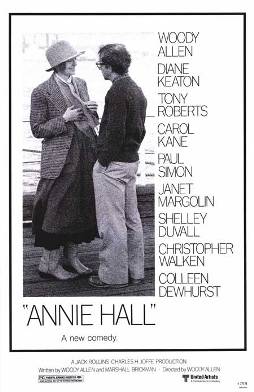
You take a risk when you review a Woody Allen film, even an acknowledged, Best Picture-winning classic like 1977’s Annie Hall. Do you address the accusations that have been made about him? Do you ignore them and hope that they won’t be the Elephant in the Room, stomping through your review? Do you try to justify reviewing (or, in some cases, even watching) Allen’s film? Or do you just let the work speak for itself?
I love Annie Hall. Quite frankly, I like a lot of Woody Allen’s films, even though I understand why his work is an acquired taste for quite a few other people. I’ll address the elephant in the room in a paragraph or two but you know what? I watched Annie Hall last night and I want to mention a few reasons why I enjoy this film.
First off, Annie Hall features one of Christopher Walken’s first (and best) performances. He only has a few lines but he makes quite an impression. He plays Duane, the brother of Annie Hall (Diane Keaton). When Annie’s boyfriend, Alvy Singer (Woody Allen), is visiting the Hall family, Duane invites Alvy into his bedroom and tells him that, whenever he’s driving, he fantasizes about intentionally swerving into incoming traffoc. In the very next scene, Duane is driving an oblivious Annie and a terrified Alvy to the airport. It’s a wonderfully funny moment. (If you keep your eyes open, you’ll notice that Annie’s apartment is full of pictures of Duane and his thousand yard stare.)
Secondly, this film also features an early role for Jeff Goldblum. He only has one line — “I forgot my mantra” but my God, he does amazing things with that line.
Third, when Alvy and his agent, Rob (Tony Roberts), are driving through Los Angeles, they pass a theater. According to the marquee, the theater is showing House of Exorcism, a Mario Bava film. That’s right: Italian horror in a Woody Allen film. How glorious is that?
Fourth, Annie Hall is an extremely dated film. It was made in 1977 and, as to be expected about a film directed and written by a stand up comedian, it’s full of references that were probably hilariously on target then but rather obscure now. As well, like almost all Woody Allen films, it’s a very New York film. Alvy is an intellectual, left-wing Jew who suspects that everyone he sees is an anti-Semite and who is dating an aspiring actress and singer who hails from middle America. (During the scene where Alvy meets her family, he immediately pegs Grammy Hall as a “classic Jew hater.”) The film is very much told from Alvy’s point of view, which means jokes about New York periodicals and a flashback to an Adlai Stevenson rally. That being said, I’m a Texas girl who was born long after Annie Hall was first released and I still enjoy the film because it’s a film that captures some universal truths about human relationships.
The first time I watched Annie Hall, I was 17 and I saw a lot of myself in Annie. While I wouldn’t be caught dead wearing some of her outfits, I knew what it was like to be insecure. I knew what it was like to be nervous. I know what it was like to worry about being smart enough. And, like Annie, I eventually learned that independence was the key to happiness. Annie Hall has stood the test of time because both Annie and Alvy are relatable while still remaining wonderfully unique and neurotic individuals.
(If ever a film has been a ode to the joy of being neurotic, it’s Annie Hall.)
Fifth, I love the scene where Alvy asks a random couple of the street how they make their relationship work. “I’m totally shallow and have no original thoughts,” the woman replies. “And I’m the exact same way,” her husband cheerfully adds.
Sixth, I’m going to assume that Paul Simon was primarily playing himself.
Seventh, there are just so many great scenes. Like when Alvy deals with a rude cop by ripping up his license. And then, there’s that lobster scene. And that moment when Alvy comes over to Annie’s apartment to kill a “spider the size of a buick.” (Judging by the number of times Alvy has to hit the spider with that tennis racket, I assume buick’s are pretty big.) There’s the two scenes of Annie singing, one when she’s still insecure and can’t compete with the sound of plates smashing around here and the other when she’s developed the confidence to dominate and control both the stage and the audience. There’s the scenes where Alvy breaks the fourth wall and get advise from random people on the streets of New York. And what about when Annie starts laughing while telling the horrible story of how her uncle died at the post office? Or what about when Alvy tries to avoid having sex with his first wife by discussing the JFK assassination? Or when we literally see Annie mentally check out of making love to Alvy? Or how about the split-screen therapy sessions? Or the sudden moment when Annie and Alvy become cartoon characters? Or the scene with the pretentious blowhard at the movies?
(As a Southern girl, I have to admit that it’s always strange to me to hear Alvy and Annie talking about “waiting on line” at the movies. Down here, we say “in line,” which makes a lot more sense. Since a line is just a crowd of people standing in a certain order, saying that you’re “on line,” is the same as saying your standing on someone’s head. You get in a crowd, not on them. Whenever I hear someone from up north talking about “waiting on line,” I assume they must be bidding for something on Ebay.)
I like Annie Hall and I always will. As for the accusations against Woody Allen, they don’t keep me from enjoying his better films because:
I’ve always been a big believer that art can and should be judged separately from the artist.
Having read what both sides have said about Woody Allen and the accusations that have been made against him, I don’t think he did it.
Obviously, some are going to disagree with me on both those points. So be it. Everyone has to make their own choice. For me, though, what’s important is that Annie Hall is a film that I’ve loved since the first time I saw it and I’ll continue to love it.
The Alliance of Women Film Journalists (of which I am not a member and what’s up with that!?) announced their picks for the best of 2016 earlier this week.
And here they are:
AWFJ BEST OF AWARDS
These awards are presented to women and/or men without gender consideration. Best Film
Arrival Hell or High Water La La Land
Manchester by the Sea Moonlight
Best Screenplay, Adapted
Arrival – Eric Heisserer
Lion – Luke Davies
Love & Friendship – Whit Stillman Moonlight – Barry Jenkins
Nocturnal Animals –Tom Ford
Best Documentary 13th – Ava DuVernay
Gleason – Clay Tweel
I Am Not Your Negro – Raoul Peck
OJ Made in America – Ezra Edelman Weiner – Elyse Steinberg and Josh Kriegma
Best Actress
Amy Adams – Arrival
Isabelle Huppert – Elle Ruth Negga – Loving
Natalie Portman – Jackie Emma Stone – La La Land
Best Actress in a Supporting Role Viola Davis – Fences
Greta Gerwig – 20th Century Women
Naomie Harris – Moonlight
Octavia Spencer – Hidden Figures
Michelle Williams – Manchester by the Sea
Best Non-English-Language Film
Elle – Paul Verhoeven, France
Fire At Sea – Gianfranco Rossi, Italy The Handmaiden – Chan-Wook Park, South Korea
Julieta – Pedro Almodovar. Spain
Toni Erdmann – Maren Ede, Germany
EDA FEMALE FOCUS AWARDS
These awards honor WOMEN only
Best Woman Director Andrea Arnold – American Honey Ava DuVernay -13TH
Rebecca Miller – Maggie’s Plan
Mira Nair – Queen of Katwe
Kelly Reichardt – Certain Women
Best Woman Screenwriter Andrea Arnold – American Honey
Rebecca Miller – Maggie’s Plan Kelly Reichardt – Certain Women
Lorene Scafaria – The Meddler
Laura Terruso – Hello, My Name is Doris
Best Breakthrough Performance Sasha Lane – American Honey
Janelle Monáe – Moonlight and Hidden Figures
Madina Nalwanga – Queen of Katwe Ruth Negga – Loving
Outstanding Achievement by A Woman in The Film Industry Ava DuVernay – For 13TH and raising awareness about the need for diversity and gender equality in Hollywood
Anne Hubbell and Amy Hobby for establishing Tangerine Entertainment’s Juice Fund to support female filmmakers
Mynette Louie, President of Gamechanger Films, which finances narrative films directed by women
April Reign for creating and mobilizing the #OscarsSoWhite campaign
EDA SPECIAL MENTION AWARDS
Actress Defying Age and Ageism Annette Bening – 20th Century Women
Viola Davis – Fences
Sally Field – Hello, My Name is Doris Isabelle Huppert – Elle and Things to Come
Helen Mirren – Eye in the Sky
Actress Most in Need Of A New Agent Jennifer Aniston – Mother’s Day and Office Christmas Party
Melissa McCarthy – The Boss and Ghostbusters
Margot Robbie – Suicide Squad and Tarzan
Julia Roberts – Mother’s Day
Shailene Woodley – Divergent Series
AWFJ Hall of Shame Award Sharon Maguire and Renee Zellweger for Bridget Jones’s Baby
Nicholas Winding Refn and Elle Fanning for The Neon Demon
David Ayer and Margot Robbie for Suicide Squad
David E. Talbert and Mo’Nique for Almost Christmas
So, I just finished watching Thank God, It’s Friday, a movie from 1978. It’s an episodic comedy, one that follows a group of genuinely unlikable characters as they all gather in one genuinely unlikable location and proceed to have some fairly generic experiences.
For example, there’s the married couple and the husband needs to loosen up. There’s the DJ who is going to lose his job if he can’t deliver the big stars that he’s promised. There’s the short, violent guy who is upset because he’s been set up on a date with a tall woman. There’s the dental hygienist who comes across like she’s desperately trying to convince everyone that she’s eccentric when she’s really just boring. (We all know the type.) There’s the teenager girls who try to sneak into the club, despite being underage. There’s the two dorky guys who are looking for love. There’s the two dorky girls who are looking for love.
In fact, everyone in the movie is looking for love! Except for Jeff Goldblum! He just wants to get laid. He manages the club where everyone has gathered on this particular Friday. He’s a womanizer. We can tell because he wears a red jacket and his shirt is half-buttoned. Goldblum decides that he wants to break up the married couple. Boo! Hiss! But wait a minute — neither the husband nor the wife are likable or interesting. Go, Jeff, go! BREAK UP THAT BORINGASS MARRIAGE!
Oh! And Nicole (Donna Summer) is wandering around the club too. She wants a chance to perform but the DJ refuses to let her. So, eventually, she just grabs a microphone and she starts to sing. Luckily, the song she sings is Last Dance and, by singing it, she gives everyone an excuse to go home. If you’ve ever been to a karaoke night, you know that, as soon as a drunk sings Last Dance, it’s time to pay the bill and get the Hell out of there.
Last Dance was apparently written specifically for Thank God, It’s Friday. Or maybe Thank God, It’s Friday was written specifically for Last Dance, who knows? What we do know is that Last Dance won the Oscar for Best Original Song. That’s right — Thank God, It’s Friday is an Oscar winner and therefore, will always be enshrined with fellow Oscar winners like Crash, Titanic, and SPECTRE.
(Which songs did Thank God, It’s Friday beat? It defeated a song from Grease, which is a good thing because Grease is even more annoying than Thank God, It’s Friday. That’s right, I said it. And you know it’s true.)
Anyway, Thank God, It’s Friday is a really bad movie, one that is full of bad writing, bad jokes, bad performances, and indifferent direction. It’s tempting to say that the music was really good but actually, we don’t hear much of the music. The movie is often more concerned about what’s happening in the club’s parking lot than in what is happening (and being heard) on the inside. We may not hear much music but we do get to see some pretty icky racial stereotyping and who would guess that a movie about disco would be so homophobic?
(We don’t see any cocaine, though I’m sure you could probably hear the key grip and the gaffer snorting a line off-camera if you listened closely enough. A lot of the cast looked pretty wired.)
ANYWAY — here’s the important thing about Thank God, It’s Friday. Occasionally, I’ll watch a movie like Dazed and Confused or Boogie Nights or Saturday Night Fever and I’ll get jealous because I know that I’ll never get a chance to experience the 70s first hand. Fortunately, something like Thank God, It’s Friday will always be around to reassure me, “No, Lisa. The 70s sucked!”
Thank God, it’s Friday?
No, thank God the movie’s over.
“Is it Friday yet!?”
Actually, you know what? I can’t end this review without sharing this film’s trailer:
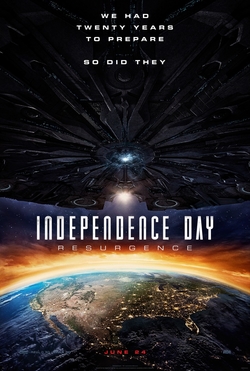
Sorry, I know that’s like an ultra unprofessional way to open a review but Independence Day: Resurgence is one of the least inspiring films that I’ve ever seen. Jeff and I saw it the day that it opened and, at the time, I was planning on reviewing it the next day. But when I sat down to actually write about the movie … well, I discovered that I could hardly care less. This is one of those films that I could have easily waited until December to review. However, seeing as today is Independence Day, this seemed to be the right time to say something about it.
Memorable movies inspire. Good movies inspire love. Bad movies inspire hate. A movie like Independence Day: Resurgence inspires apathy.
Actually, what’s really frustrating about Independence Day: Resurgence is that it starts out with such promise. The first few scenes suggest that maybe the film is trying to be something more than just another “let’s blow shit up while stars get quippy” action film. Independence Day: Resurgence imagines an alternative history for post-alien invasion Earth and it’s actually pretty clever. Earthlings have taken advantage of the alien technology but society has also become heavily militaristic. The main characters of the first film are all revered as heroes but, when we first meet former President Whitmore (Bill Pullman, with a wise old man beard), he’s having nightmares about the invasion.
And seriously, for the first 30 minutes or so, I really thought that Independence Day: Resurgence might turn out to be surprisingly clever, that maybe it would satirize the excesses of the original while subtly critiquing everything that’s fucked up about our real world.
Well, that was a mistake on my part. There is no satire. There is no critique. Instead, it’s just another alien invasion film and it’s all terribly predictable. It may be a sequel to the first Independence Day but it feels more like a rip-off of Battle: Los Angeles. Considering what the film could have been, it’s impossible not to be disappointed by how familiar and uninspired it all is.
What I failed to take into account is that this film was directed by Roland Emmerich. Emmerich is a director who is best distinguished by his total lack of self-awareness. After all, this is the director who, in Anonymous, seriously suggested that William Shakespeare personally murdered Christopher Marlowe. Watching Independence Day: Resurgence and listening to the generic dialogue and witnessing the generic mayhem, I started to get the sinking feeling that the film was a joke and that Emmerich was the only person on the planet who was not in on it. He doesn’t realize how predictable his movies are or that his characters are cardboard cut-outs or that the film’s inspiring moments are so overdone that they instead become groan-inducing. One of the stars of the first film sacrifices himself in Resurgence and you know who it’s going to be from the minute he shows up onscreen. Emmerich is not a good enough director to make his sacrifice touching. The fact that the film ends with the promise of a sequel is not surprising and yet, it still somehow manages to be annoyingly presumptive. The film’s ending seems to be taunting us. “Of course, you’re going to want to sit through this shit for a third time…what other choice do you have?”
In the film’s defense, the cast is big and it includes a lot of good actors. Unfortunately, the characters are so undeveloped that you again find yourself regretting what a waste it all is. Jeff Goldblum and Judd Hirsch are both likable but Bill Pullman seems to be incredibly bored with the whole thing. Liam Hemsworth, Jessie Usher, and Maika Monroe are all stuck playing typical Emmerich ciphers.
I should mention that, despite how negative this review may sound, I did not hate Independence Day: Resurgence, at least not in the way that I’ve hated other films, like Anonymous or the remake of Straw Dogs. My problem with Resurgence isn’t that I hated it or even that I disliked it. It’s that I didn’t feel much about it, one way or the other. It’s one of those film that is best described as “just kinda being there.” Apathy is the worst thing that a film can inspire.
Perhaps the best thing about Independence Day: Resurgence is that Roland Emmerich has protected the holiday from being co-opted by Garry Marshall.
Remember how, in the 1990s, every aspiring indie director tried to rip off Quentin Tarantino by making a gangster film that mixed graphic violence with quirky dialogue, dark comedy, and obscure pop cultural references? That led to a lot of terrible movies but not a single one (not even Amongst Friends) was as terrible as Mad Dog Time.
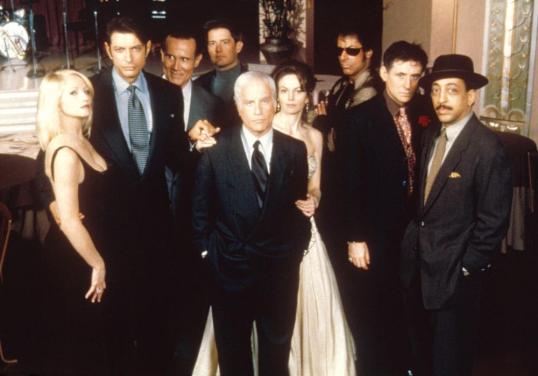
That Mad Dog Time was terrible should come as no surprise. Most directorial debuts are. What made Mad Dog Time unique was the sheer amount of talent that was assembled and wasted in the effort to bring this sorry movie to life. As the son of Joey Bishop, director Larry Bishop was Hollywood royalty and was able to convince several ridiculously overqualified actors to play the thinly drawn gangsters and rouges who populated Mad Dog Time. Much like the Rat Pack movies that his father once starred in, Larry Bishop’s debut film was full of familiar faces. Some of them only appeared for a few seconds while others had larger roles but they were all wasted in the end. Hopefully, everyone was served a good lunch in between filming their scenes because it is hard to see what else anyone could have gotten out of appearing in Mad Dog Time.
Mob boss Vic (Richard Dreyfuss) has just been released from a mental hospital. With the help of his main enforcer, Mick (Jeff Goldblum), and a legendary hitman named Nick (Larry Bishop, giving not only the worst performance in the film but also the worst performance of the 1990s), Vic is going to reassert his control over the rackets. Vic also wants to find his former mistress, Grace Everly (Diane Lane) but he doesn’t know that Grace is now with Mick and that Mick is also having an affair with Grace’s sister, Rita (Ellen Barkin).
(Grace and Rita are the Everly Sisters! Ha ha, between that and all the rhyming names, are you laughing yet?)
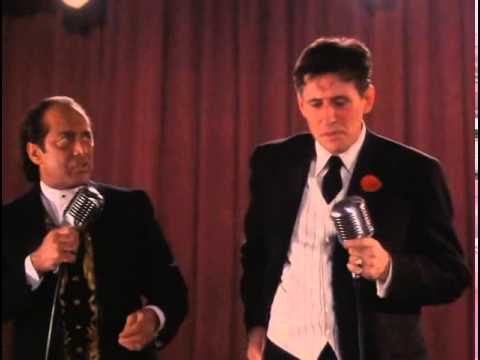
Ben London (Gabriel Byrne) has taken over Vic’s nightclub and, while singing My Way with Paul Anka, tells Vic that he should take an early retirement because he’s a paranoid schizophrenic. Before he can deal with Ben, Vic has to kill all of his other rivals, all of whom are played by actors like Michael J. Pollard, Billy Idol, Kyle MacLachlan, Gregory Hines, and Burt Reynolds. The bodies start to pile up but Jimmy the Undertaker (Richard Pryor, looking extremely frail in one of his final roles) is always around to make sure that everyone gets a proper burial.
And there are other cameos as well. Joey Bishop is the owner of a mortuary. Henry Silva is wasted as one the few gangsters to stay loyal to Vic. Christopher Jones, who previously co-starred with Larry Bishop and Richard Pryor in Wild In The Streets before dropping out of a society, plays a hitman who pretends to be Nick Falco. Even Rob Reiner shows up a limo driver who talks too much.
Almost every poorly paced scene in Mad Dog Time plays out the same way. Three or more men confront each other in a room. Hard-boiled dialogue is exchanged for an interminable length of time until someone finally gets shot. You would think, at the very least, it would be watchable because of all the different people in the cast but none of the actors really seem to be into it. Richard Dreyfuss and Jeff Goldblum resort to smirking through their scenes while Gabriel Byrne often appears to be drunk. Whenever he’s in a scene, Burt Reynolds seems to be trying to hide his face and it is hard to blame him. There were many terrible movies released in the 90s but none were as bad as Mad Dog Time.
For decades fans of Robotech (Macross everywhere else in the world) have been hoping for a live-action film adaptation of this very iconic anime series from Japan. Many Westerners had their first introduction to anime after watching the localized version of the original Japanese series Macross. There have been some traction to get the live-action film up and running but rarely past pre-production stage.
With special effects advancing to the point that we can almost recreate dead people back to life via digital trickery, entire worlds astronomers could only dream of and fantastical lands and creatures it’s high time we got a live-action Robotech film. We fans deserve such a gift.
For now, let’s settle for Independence Day: Resurgence which seems to lift certain elements from the anime series spoken of above to make up the plot of the sequel to 1996’s blockbuster hit, Independence Day.
Independence Day: Resurgence is set for a June 24, 2016 release date.
There are certain films that truly are “You just had to be there” films. These are the movies that were apparently loved by contemporary audiences but, when viewed today, it’s difficult to see just what exactly everyone was getting so excited about. Sometimes, this is because the film itself was so influential and has been copied by so many other films that the original has had its power diluted. And then, sometimes, it’s just a case that the film was never that good to begin with.
I’m guessing that The Big Chill must be one of those “you just had to be there” type of films. First released in 1983, The Big Chill was nominated for best picture. If you look the film up over at the imdb, you’ll find lots of comments from people who absolutely adore this film. However, when I watched the film as a part of TCM’s 31 Days of Oscar, I have to admit that my reaction can be best summed in one word.
Meh.
Now, don’t get me wrong. I’m not saying that The Big Chill was a bad film. To be honest, it was neither memorably bad nor remarkably good. Instead, it just was. Overall, the performances were good, the direction was shallow, and the screenplay was occasionally good and occasionally shallow but mostly, it was the epitome of serviceable.
At the start of The Big Chill, Alex is dead. With the exception of a scene where his corpse is being prepared for burial, Alex never actually appears on screen. (Originally, Kevin Costner was cast to play the role in a flashback but director Lawrence Kasdan cut the scene.) What little we learn about Alex, we learn from listening to the other characters in the film talk about him. For instance, Alex was apparently brilliant but troubled. He attended the University of Michigan in the 1960s and was close to 7 other politically radical students. While everyone else was busy selling out their ideals, Alex stayed true to his and, as a result, he ended up spending his life depressed and poor. Alex ultimately ended up committing suicide, an act that leads to his 7 friends reuniting for his funeral.
Opening with Alex’s funeral and taking place over one long weekend, The Big Chill follows Alex’s friends as they try to figure out why Alex committed suicide and debate whether or not they’ve sold out their college ideals. They also spend a lot of time listening to the music of the youth, getting high, watching a football game, and washing dishes.
(Interestingly enough, they spend the weekend in the exact same house where Alex committed suicide. Which, to be honest, I would think would be kind of creepy.)
There’s Harold (Kevin Kline) and Sarah (Glenn Close), who are the unofficial grown ups of the group. It was at their vacation home that Alex committed suicide and, over the course of the film, we find out that Alex and Sarah had a brief affair. Harold owns a company that makes running shoes and, to at least one friend’s horror, is now good friends with the local police. Sarah, meanwhile, splits her time between crying in the shower and smiling beatifically at her friends.
(Incidentally, throughout the film, Kevin Kline speaks in one of the least convincing southern accents that I’ve ever heard…)
Meg (Mary Kay Place) is a former public defender who, after deciding that all of her poverty-stricken clients really were scum, has now become a real estate attorney. Meg wants a baby and is hoping that one of the men at the funeral might be willing to impregnate her. Meg is a chain smoker so good luck, unborn child. Before Alex killed himself, she had an argument with him. (“That’s probably why he killed himself,” someone suggests.)
I liked Karen (JoBeth Williams) because she’s prettier than Meg and less condescending than Sarah. She’s unhappily married to an advertising executive named Richard (Dan Galloway). As they drive to the cemetery, Richard tells Karen that he can’t believe her famous friends all turned out to be so boring. Karen is unhappy in her marriage and, after Richard returns home and leaves her in South Carolina for the weekend, decides that she wants a divorce.
That’s good news for Sam (Tom Berenger), an actor who is best known for playing private detective J.T. Lancer on television. Sam is upset that nobody takes him or his career seriously. Meg was hoping that Sam would be the father of her baby but, instead, Sam is more interested in Karen.
And then there’s Nick (William Hurt), who is a former radio psychologist-turned-drug dealer. Nick was wounded in Vietnam and is impotent as a result. In case you somehow forget that fact, don’t worry. Nick brings it up every few minutes.
Michael (Jeff Goldblum) was my favorite among the men because he’s at least willing to admit that he’s a self-centered jerk. Michael is a former underground journalist who now works for People Magazine. Nobody seems to like Michael and yet, he’s still invited to stay over the weekend. Personally, I like to think that he does so just to get on everyone’s nerves. Good for him.
And finally, there’s Chloe (Meg Tillis), who was Alex’s much younger girlfriend and who doesn’t seem to be impressed with any of Alex’s friends (with the exception, of course, of impotent old Nick).
I have to admit that I probably would have responded more to The Big Chill if it was actually about my generation, as opposed to being about my grandparents. Someday, someone my age will make a movie about a bunch of college friends reunited for a funeral and it will be filled with my music and my cultural references and I’ll think it’s brilliant. And then, a 30 years later, some snotty little film reviewer will watch and probably say, “Meh. Old people.”
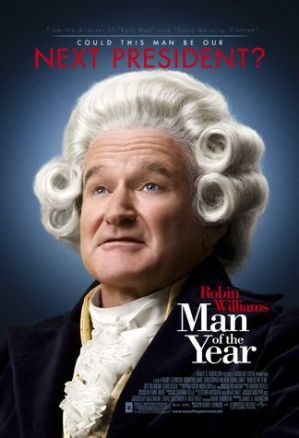
The 2006 comedy Man of the Year is a difficult film to review. Some of that is because it’s not that interesting of a film. It’s simplistic and predictable. In fact, the only reason that I’m reviewing this film for Shattered Politics is because I needed an example of a bad, mainstream political film.
However, that’s not the only reason why it’s difficult to write about Man of the Year. The bigger reason is that Man Of The Year stars Robin Williams and, in many ways, it’s typical of one of his later lesser films. After his tragic death, it’s even harder to watch Robin Williams waste his talents in a bad film.
And, make no mistake about it, Man of the Year is a bad film.
Robin Williams plays Tom Dobbs. Dobbs, we are told, is the most famous political commentator in America. Watching the film, it’s obvious that Dobbs is meant to be the film’s equivalent of Jon Stewart and Stephen Colbert. However, the difference is that Stewart and Colbert are both obviously liberal whereas, from what little we see of Tom Dobbs show, Dobbs doesn’t appear to have any positions beyond the few vague platitudes that pass for political thinking in most mainstream films. Dobbs is against special interests. He’s against career politicians. He’s against … well, he’s against everything that most people are against and for everything that most people are for. About the closest that Tom Dobbs come to being edgy is when he makes a stupid joke about Pope Benedict being German.
Anyway, Dobbs is recruited to run for President and he manages to get on the ballot in 13 states! And he’s even doing well because, apparently in this film’s version of reality, Catholic voters have no problem supporting someone who makes fun of Pope Benedict for being German. And he’s even invited to take part in a presidential debate. When asked his first question in the debate, Dobbs starts talking and, because he’s being played by Robin Williams, he doesn’t stop. The debate spirals out-of-control. Dobbs goes on and on about the state of America, all the while assuming weird accents and slipping in and out of different personalities.
“Oh my God,” I thought, “he’s had a nervous breakdown.”
Except, of course, he hasn’t. And, since this is a movie, everyone in America loves his performance. On election night, Tom Dobbs apparently wins all 13 of his states and he’s elected President!
Except, of course, he hasn’t been. It turns out there was an error with the voting machines. Eleanor Green (Laura Linney), who works at the company that built the machines, figures out what happened. In order to keep her from revealing the truth, the company drugs her and attempts to destroy her credibility and…
Wait, this is a Robin Williams comedy, isn’t it? Well, it is and it isn’t. Half of the film is devoted to Tom Dobbs saying things that are supposed to be funny but the other half deals with Eleanor trying to expose a giant cover-up without getting killed. Director Barry Levinson can’t seem to figure out whether his film is supposed to be an unfunny comedy or a boring drama. So, he tries to do both and … well, taken by that criteria, the film actually works. If Levinson set out to be unfunny and boring, he succeeded.
One of the biggest dangers of making a film about a comedian is that, for the film to work, you have to believe that people would actually find the comedian to be funny. When the jokes aren’t funny, it doesn’t matter how many reaction shots of people laughing that you stuff into the film. Man of the Year is full of reaction shots. During the debate, we continually see Eleanor’s teenage son laughing. (How many teenagers, other than the weird ones and the ones assigned to do so for homework, actually watch a presidential debate?) During one particularly painful moment, Tom starts rambling while traveling on the campaign bus and we are subjected to countless reaction shots of Christopher Walken and Lewis Black laughing so hard that they look like they might faint from exhaustion.
The problem is that it’s rare that a few hundred people will all start laughing and stop laughing at the exact same time. Whenever you listen to a truly good comedian, you always hear a few giggles that indicate that at least a few audience members are still thinking about the last joke or else that they’re anticipating the next joke. Often times, when a comedian says something especially funny or unexpected, you don’t even hear laughter. You might hear a gasp of shock. You might hear tittering. You might hear applause. You might hear someone shouting like they’re at a sporting event.
What I’m saying is that everyone reacts to humor in their own individual way. Everyone has a laugh of their very own. Uniform laughter, like the laughter in Man of the Year, sounds fake because it is fake.
Add to that, nothing that Tom Dobbs says is particularly funny.
“Oh we must be doin’ somethin right to last 200 years…”
— Haven Hamilton (Henry Gibson) in Nashville (1975)
The 1975 Best Picture nominee Nashville is the epitome of an ensemble film. It follows 24 characters as they spend five days wandering around Nashville, Tennessee. Some of them are country music superstars, some of them are groupies, some of them are singers looking for a first break, and at least one of them is an assassin. The one thing that they all have in common is that they’re lost in America. Released barely a year after the resignation of Richard Nixon and at a time when Americans were still struggling to come to terms with the turmoil of the 60s, Nashville is a film that asks whether or not America’s best days are behind it and seems to be saying that they may very well be. (That’s a question that’s still being asked today in 2015.) It’s appropriate, therefore, that Nashville both takes place in and is named after a city that everyone associates with perhaps the most stereotypically American genre of music that there is.
Nashville follows 24 characters, some of whom are more interesting than others. For five days, these characters wander around town, occasionally noticing each other but far more often failing to make any sort of connection.
Haven Hamilton (Henry Gibson) is a veteran star, a somewhat comical character who sings vapid songs about home and family and who smiles for the public while privately revealing himself to be petty and vain. His son, Bud (Dave Peel), is a Harvard graduate who acts as his father’s business manager. Oddly enough, Haven is an unlikable character until the end of the film when he suddenly reveals himself to be one of the few characters strong enough to keep Nashville for descending into chaos. Meanwhile, Bud seems to be a nice and modest guy until he takes part in humiliating another character.
Haven’s lover is Lady Pearl (Barbara Baxley), who owns a nightclub and spends most of the film drinking. Much like Haven, she starts out as a vaguely comical character until she finally gets a chance to reveal her true self. In Pearl’s case, it comes when she delivers a bitter monologue about volunteering for Bobby Kennedy’s presidential campaign.
Haven’s lawyer is Delbert Reece (Ned Beatty), an obsequies good old boy who is married to gospel singer Linnea (Lily Tomlin). They have two deaf children. Linnea has learned sign language. Delbert has not. Over the course of the film, both Delbert and Linnea will be tempted to cheat. Only one of them actually will.
And then there’s Barbara Jean (Ronee Blakley), a mentally unstable singer who has come to Nashville with her manipulative husband/manager, Barnett (Allen Garfield). Almost every character in the film wants something from Barbara Jean. A mostly silent Vietnam veteran named Kelly (Scott Glenn) claims that his mother knows Barbara Jean. A nerdy guy named Kenny (David Hayward) comes to Nashville just to see her perform.
Both Kelly and Kenny end up getting to know Mr. Green (Keenan Wynn), a rare Nashville resident who doesn’t seem to care about music. However, Mr. Green’s spacey niece, L.A. Joan (Shelly Duvall), is obsessed with having sex with as many musicians as possible.
Among those being targeted by L.A. Joan is Tom Frank (Keith Carradine), one-third of the folk trio Bill, Mary, and Tom. Unknown to Bill (Allan F. Nicholls), Tom is sleeping with Bill’s wife, Mary (Cristina Raines). Unknown to Mary, Tom is sleeping with almost every other woman in Nashville as well. When Tom takes to the stage at Pearl’s nightclub and sings a song called I’m Easy, the audience is full of women who think that he’s specifically singing to them.
Another one of Tom’s songs, the appropriately titled “It Don’t Worry Me,” is frequently sung by Albuquerque (Barbara Harris), who spend the entire film trying to get discovered while hiding out from her much older husband, Star (Bert Remsen).
Another aspiring star is Sulleen Grey (Gwen Welles), who is a tone deaf waitress who suffers the film’s greatest humiliation when she agrees to perform at a political fund raiser without understanding that she’s expected to strip while singing. Trying to look after Sulleen is Wade (Robert DoQui), who has just been released from prison.
And then there’s the loners, the characters who tend to pop up almost randomly. Norman (David Arkin) is a limo driver who, like everyone else in Nashville, wants to be a star. The hilariously bitchy Connie White (Karen Black) and the bland Tommy Brown (Timothy Brown) already are stars. (The character of Tommy Brown is one of Nashville’s oddities. He’s listed, in the credits, as being a major character but he only appears in a few scenes and never really gets a storyline of his own.) There’s the Tricycle Man (Jeff Goldblum), a silent magician who mysteriously appears and disappears throughout the film.
And, finally, there’s Opal (Geraldine Chaplin), an apparently crazed woman who is wandering around Nashville and pretending to be a reporter for the BBC. (It’s never specifically stated that Opal is a fake but it’s fairly obvious that she is.) How you feel about the character of Opal will probably determine how you feel about Nashville as a whole. If you find Opal to be a heavy-handed caricature, you’ll probably feel the same way about the rest of the film. If you find the character of Opal to be genuinely amusing with her increasingly pretentious musings, you’ll probably enjoy Nashville.
There is one more very important character in Nashville. He’s the character who literally holds the film together. He’s also the reason why I’m including Nashville in this series of reviews about political films. That character is named Hal Phillip Walker and, though he’s never actually seen in the film, he’s still the driving force behind most of what happens. Walker is a third-party presidential candidate, a man who seems to be universally admired despite the fact that his campaign appears to just be a collection of vapid platitudes. Walker’s campaign manager, John Triplette (Michael Murphy), comes to Nashville and sets up the Walker For President rally. That’s where Nashville reaches its violent and not-all-together optimistic climax.
Reportedly, Nashville is a favorite film of Paul Thomas Anderson’s and you can see the influence of Nashville in many of Anderson’s films, from the large ensemble to the moments of bizarre humor to the refusal to pass judgement on any of the characters to the inevitable violence that ends the film. Also, much like Anderson’s films, Nashville seems to be a film that was specifically made to divide audiences. You’re either going to think that Nashville is a brilliantly satirical piece of Americana or you’re going to think it’s a self-indulgent and self-important mess.
As for me, I think it’s great and I think that, after you watch it, you should track down and read Jan Stuart’s The Nashville Chronicles: The Making of Robert Altman’s Masterpiece. It’s the perfect companion for a great film.
 The Rev. Fred Sultan (Samuel L. Jackson) has a problem. He is the richest and the best known fight promoter in America but the current (and undefeated) heavyweight champion is just too good. No one is paying to watch James “The Grim Reaper” Roper (Damon Wayans) fight because Roper always wins. Sultan has a plan, though. Before Roper turned professional, he lost a fight to Terry Conklin (Peter Berg). Conklin has long since retired from boxing and is now a heavy metal, progressive musician. Sultan convinces Conklin to come out of retirement and face Roper in a rematch. Since Conklin is white and Roper is black, Sultan stands to make a killing as white boxing fans get swept up in all the hype about Conklin being the latest “great white hope.”


 Remember how, in the 1990s, every aspiring indie director tried to rip off Quentin Tarantino by making a gangster film that mixed graphic violence with quirky dialogue, dark comedy, and obscure pop cultural references? That led to a lot of terrible movies but not a single one (not even Amongst Friends) was as terrible as Mad Dog Time.