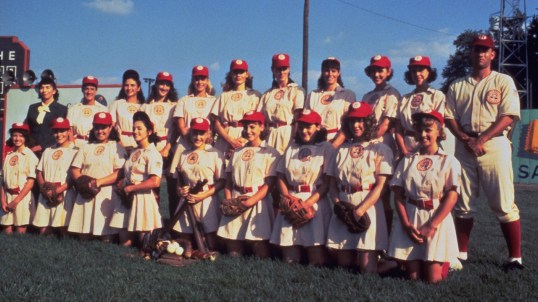
Last night, I saw that A League of Their Own was on Netflix. I tried to get my sister to watch it with me, but she just told me that she liked the high ones and called me a nag. (It makes sense if you’ve seen the movie.) So I rewatched it by myself and cried all over again.
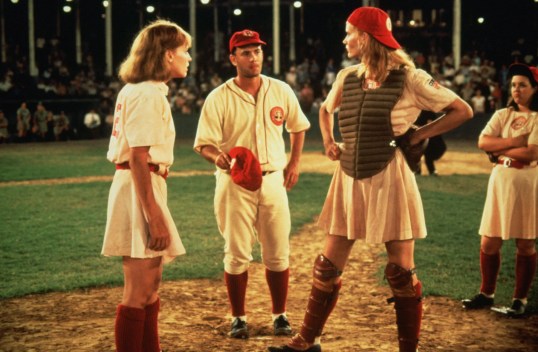
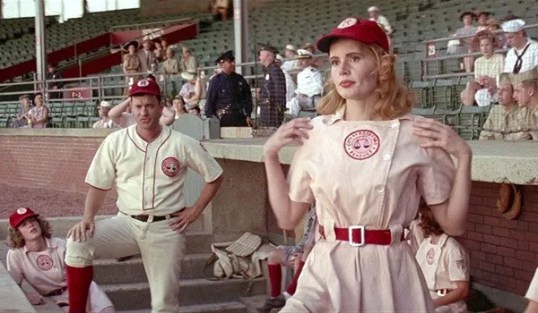
In case you’re one of the two people who haven’t heard of this movie, A League of Their Own takes place during World War II. With professional baseball players either enlisting or getting drafted, people worry there might not be another season of baseball until the war ends. Candy-bar manufacturer Walter Harvey (played by director Penny Marshall’s brother, Garry) creates the All-American Girls Professional Baseball League, with the requirement that the players not only know how to handle a bat but also look good in the impractical short skirts he expects them to wear while sliding into home. The movie follows the first season of the Rockford Peaches. Geena Davis plays Dottie, the catcher whose husband is serving overseas. Lori Petty plays Kit, the pitcher who struggles to hit high fastballs and who is also Dottie’s sister. Rosie O’Donnell and Madonna play two players from New York. Tom Hanks is Jimmy, the alcoholic former player turned manager who says, “There’s no crying in baseball!”
It may be heresy to admit it, but A League of Their Own is not my favorite baseball movie. (That would be Major League.) Most of the actresses, especially Geena Davis, are convincing as baseball players, and I love that the movie shone a light on the real-life AAGPBL. (Sixty former AAGPBL players appear in the movie.) But as a baseball fan, it’s always bothered me that the movie doesn’t really examine any of their games in depth. We know that Dottie is a good catcher, that Kit is a good pitcher, that Madonna can catch a baseball in her hat, and that Evelyn (Bitty Schram) cries when she gets yelled at, but we don’t learn much about the other players on the team and what they’re good at. The Peaches win games, but I would have liked to see more of how they won.
I still love A League of Their Own, though. The bonding between the players gets to me. They’re all from different parts of the country. Some of them are married and some of them are definitely single. But from the minute they’re selected to play in the AAGPBL, they form a family of their own. When one of them reveals that she’s never learned how to read, the players teach her. When Evelyn needs to bring her bratty problem child on the road, the team looks after him. When Jimmy makes Evelyn cry, the team rallies around Evelyn. Everyone remembers Jimmy saying there’s no crying in baseball, but they forget he got kicked out of the game afterward. (Jimmy eventually becomes a better coach.) When one player gets the telegram that her husband has been killed in the war, everyone cries. In the film’s epilogue, Evelyn’s son says that she was never happier than when she was playing for the Peaches, and I can understand why. The heart of the film is the relationship between Dottie and Kit. Even though you can guess from the start that Kit and Dottie are eventually going to end up on different teams and face each other in the big game, it’s still an emotional moment when they find themselves on opposite sides of the plate.
A League of Their Own is on Netflix, so watch it if you haven’t seen it before. Or, if you’re like me, rewatch it and try not to cry all over again when the former players reunite at the Baseball Hall of Fame. Hurry up, though. It’s leaving on September 30th.
“When you pray for rain, you gotta deal with the mud too.” — Robert McCall
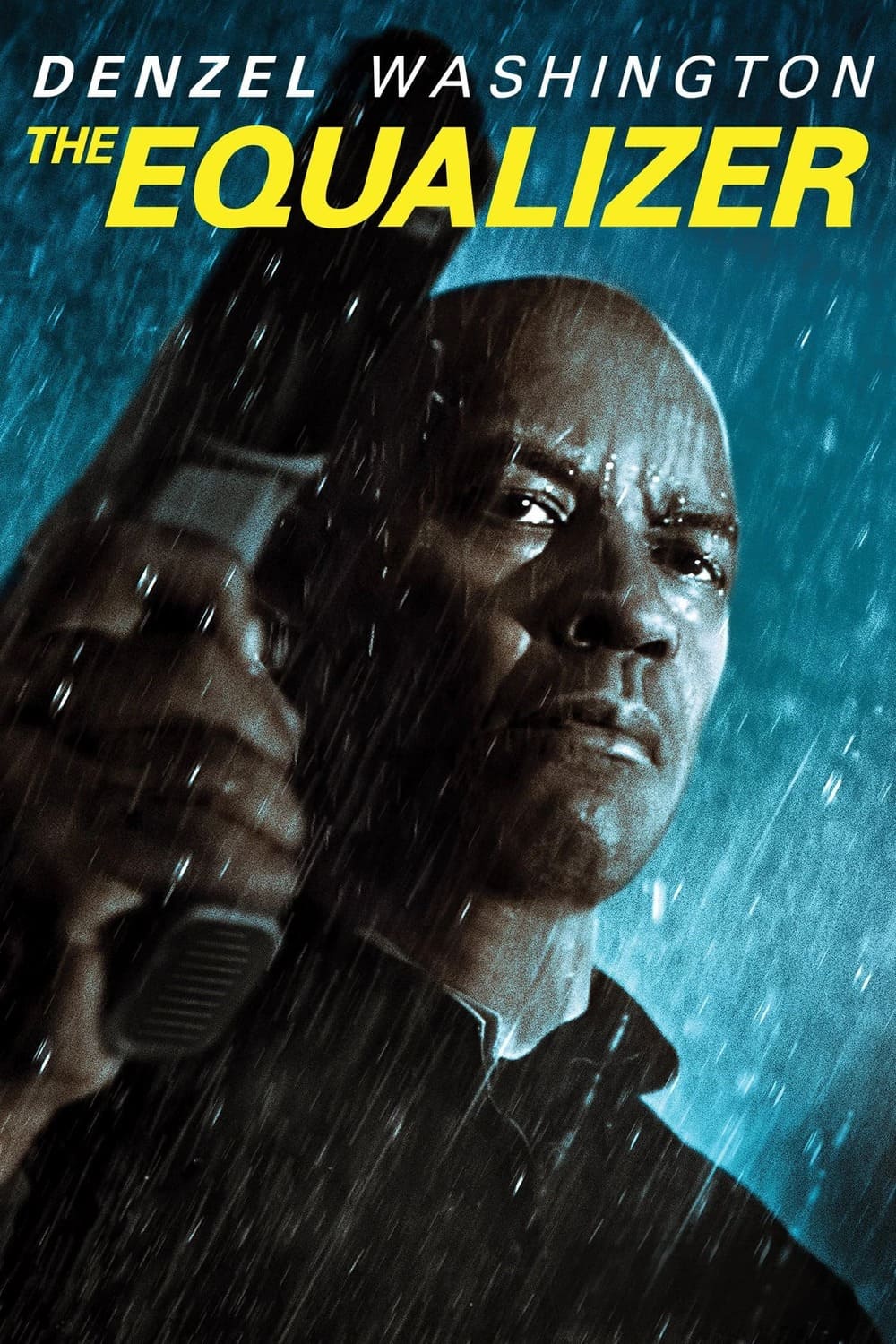
Antoine Fuqua’s The Equalizer is a film remake of the original 1980s TV series that starred Edward Woodward in the title role, and it feels like a throwback to the gritty, no-nonsense action thrillers of that era, but with a modern polish that only a director like Fuqua can deliver. From the opening frame, you know you’re in for something that’s equal parts stylish and brutal, a film that doesn’t waste time with unnecessary fluff and instead gets straight to the point: justice, served cold and calculated. Denzel Washington plays Robert McCall, a man who looks like your average big-box store employee by day but transforms into a methodical, almost surgical force of retribution by night. The premise is simple—McCall can’t stand to see good people get hurt, and when the Russian mob pushes him too far, he snaps into action—but the execution is anything but.
Where Woodward’s McCall was a more cerebral, world-weary ex-intelligence officer who relied on wit and strategy as much as physical force, Denzel’s version is a man of few words who lets his actions do the talking. Woodward brought a melancholic, almost philosophical edge to the role, giving the original series a more introspective, morally ambiguous tone. Denzel, though, brings a quiet intensity that’s all about controlled fury, shifting the film’s tone toward something more visceral and immediate. It’s less about the internal struggle and more about the sheer efficiency of justice being delivered, which makes Fuqua’s version feel like a high-octane action thriller rather than a brooding character study. This difference in approach is key to why the movie works so well as a modern reboot—it keeps the spirit of the original while amping up the energy to match today’s action standards.
This version of The Equalizer stands out in how it balances its quiet, character-driven moments with explosive bursts of violence. Fuqua has always had a knack for action, but here he takes his time building tension, letting scenes breathe in a way that makes the eventual payoff feel earned. There’s a sequence early on where McCall takes apart a room full of Russian gangsters, and it’s not just the choreography that impresses—it’s the precision. Every movement has purpose, every strike is efficient, and the whole thing unfolds with a kind of balletic brutality. Washington sells it all with that signature calm intensity of his, the kind of performance where you’re never quite sure if he’s about to offer you a cup of tea or put you in the ground. His McCall is a man of discipline, a guy who’s clearly spent a lifetime honing his skills, and it shows in the way he carries himself, whether he’s reading a book in a diner or turning a hardware store into an improvised armory.
The story itself isn’t reinventing the wheel. It’s a classic revenge tale with a heavy dose of vigilante justice, but the devil’s in the details. McCall isn’t some invincible super-soldier; he’s a guy who’s smart, resourceful, and, above all, patient. He doesn’t rush into things. He plans, he observes, and when he finally makes his move, it’s with the kind of cold efficiency that makes you wince and cheer at the same time. The film’s villain, Teddy Rensen, played by Marton Csokas, is a solid antagonist—a slick, ruthless mob fixer who’s used to getting his way. Csokas brings a quiet menace to the role, and his dynamic with Washington crackles with tension, especially in their final confrontation, which is as much a battle of wits as it is a physical showdown.
Fuqua’s direction is a masterclass in pacing and atmosphere. He knows how to make even the simplest scenes feel charged with meaning. Take, for example, the way he frames McCall in his apartment, surrounded by mementos of a past life we only get glimpses of. There’s a sense of history there, a depth to the character that’s never explicitly spelled out but is always felt. And then there’s the action, which is shot with a clarity that’s refreshing in an era where so many directors rely on shaky cam and rapid cuts to hide their lack of choreography. Fuqua lets you see everything, and it makes the violence hit harder because of it. The climactic battle in the hardware store is a perfect example—it’s a long, unbroken take (or at least feels like one) that puts you right in the middle of the chaos, and it’s thrilling precisely because you can follow every punch, every improvised weapon, every desperate move.
The supporting cast does a great job of fleshing out the world around McCall. Chloe Grace Moretz plays Teri, the young prostitute who becomes the catalyst for McCall’s crusade, and she brings a vulnerability to the role that makes her more than just a damsel in distress. She’s tough, but she’s also broken, and Moretz nails that balance. Then there’s Harold, McCall’s coworker and only real friend, played by Bill Pullman. Their scenes together provide some much-needed levity, but they also serve as a reminder that McCall isn’t just a machine—he’s a human being with connections, however tenuous, to the world around him.
One of the things I like most about The Equalizer is how it doesn’t glorify violence so much as it treats it as a necessary evil. McCall doesn’t enjoy what he does; he does it because he feels he has to. There’s a fascinating psychological undercurrent to his conversations with Teri about the nature of the people who hurt others, specifically this idea that the cruel and corrupt always find a way to rationalize their monstrous actions. The film really explores this twisted logic where abusers and criminals somehow convince themselves they are actually the good guys, completely blind to their own wickedness. It cuts to the heart of the movie’s theme: that real justice isn’t always pretty, and sometimes the only way to stop a relentless villain is to step into the darkness and meet them on their own brutal terms. It’s a morally complex idea, and the film doesn’t shy away from it. McCall isn’t a hero in the traditional sense. He’s a man with a very particular set of skills, and he uses them to tip the scales in a world that’s heavily weighted toward the cruel and the powerful.
Visually, the film is stunning. Fuqua and his cinematographer, Mauro Fiore, make Boston feel like a character in its own right, all grimy streets and neon-lit alleys. The color palette is dark and moody, with pops of color—like the red of a taillight or the blue of a neon sign—that stand out in a way that feels almost painterly. And the score by Harry Gregson-Williams is the perfect complement, all pulsing synths and deep, ominous basslines that ratchet up the tension without ever feeling overbearing. It’s the kind of soundtrack that you don’t notice until it’s gone, and then you realize how much it was adding to the experience.
If there’s a downside to The Equalizer, it’s that the plot can feel a bit thin at times. The story is straightforward, almost to a fault, and there are moments where you wish it would delve a little deeper into McCall’s backstory or the larger implications of his actions. But then again, that’s not really what the movie is going for. This isn’t a sprawling epic; it’s a tight, focused thriller that’s more concerned with mood and atmosphere than with intricate plotting. And in that regard, it succeeds admirably. The film is lean, mean, and never boring, with a runtime that flies by because it’s so damn entertaining.
Denzel Washington, of course, is the glue that holds it all together. At this point in his career, he could probably read the phone book and make it compelling, but The Equalizer gives him a role that’s tailor-made for his strengths. McCall is a man of few words, but every line Washington delivers carries weight. Whether he’s calmly negotiating with a gangster or unleashing hell on a group of armed thugs, he commands the screen with an effortless charisma that’s hard to look away from. It’s the kind of performance that reminds you why he’s one of the greatest actors of his generation.
In the end, The Equalizer is a movie that knows exactly what it is and doesn’t apologize for it. It’s a violent, stylish, and endlessly watchable action thriller with a lead performance that elevates it above the usual fare. It doesn’t pretend to be anything more than it is, and that’s part of its charm. In a world where so many films try to be everything to everyone, The Equalizer is content to be a well-made, pulse-pounding revenge story—and it’s all the better for it. If you’re a fan of action movies that don’t skimp on the brains or the brawn, this one’s a must-watch. Just don’t be surprised if you find yourself rooting for a guy who’s technically a vigilante. After all, in a world this unfair, sometimes you need an equalizer.
“We will not go quietly into the night! We will not vanish without a fight! We’re going to live on! We’re going to survive! Today, we celebrate our Independence Day!” — President Whitmore
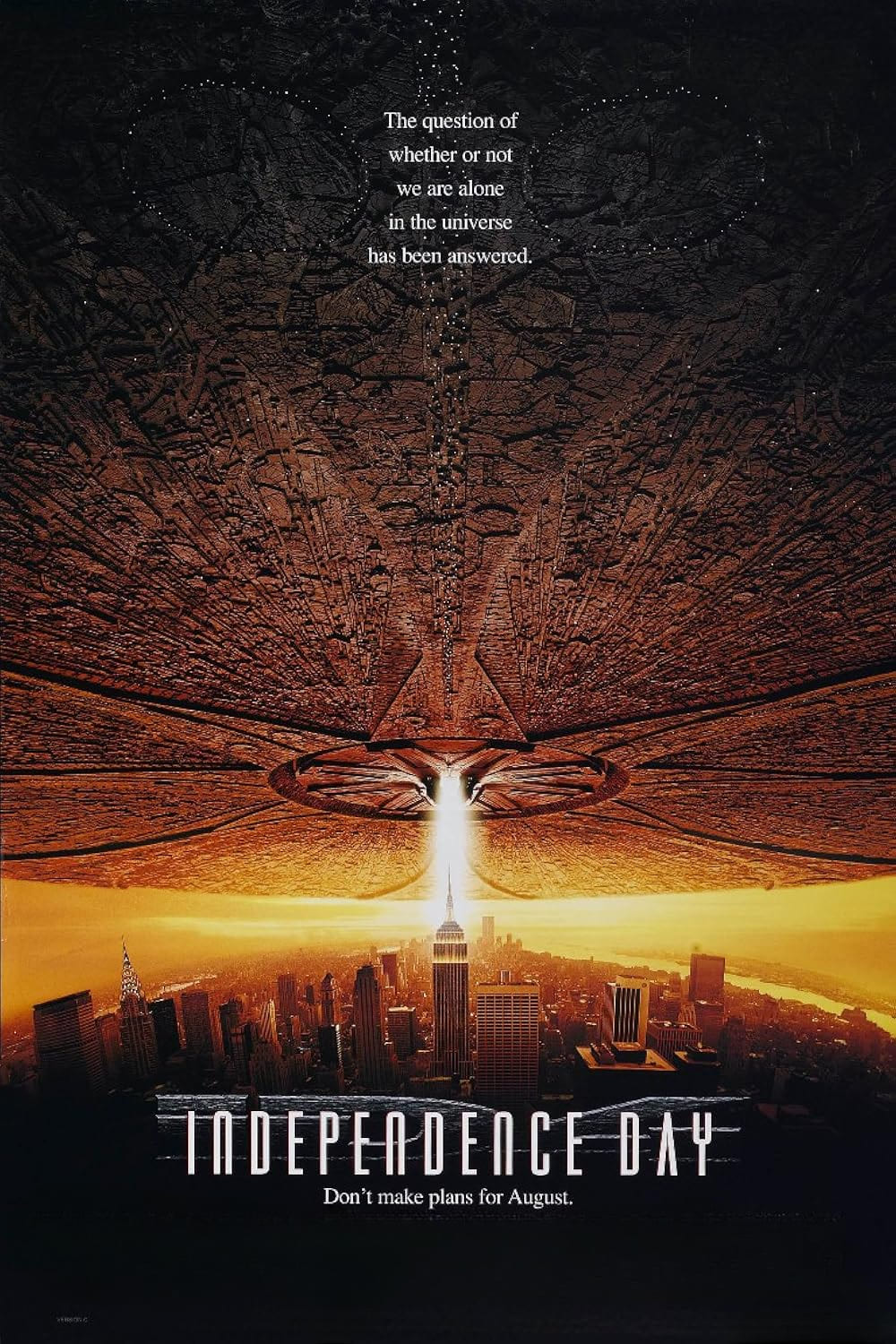
If you were around in the summer of 1996, you already know exactly where you were when you first saw the trailer for Independence Day. There was this massive shadow creeping over the moon, followed by that terrifying, booming sound effect, and then the White House just absolutely getting vaporized by a giant laser beam. It was a cultural moment. Director Roland Emmerich hadn’t really made his mark on Hollywood yet, but with this one movie, he essentially invented the modern summer blockbuster template of destroying famous global landmarks. Looking back at Independence Day almost three decades later, it is honestly wild how well this movie holds up, not as a piece of high art, but as a perfectly calibrated, ridiculously entertaining popcorn machine.
The premise is beautifully simple: massive alien spaceships suddenly appear over Earth’s major cities, they don’t come in peace, and humanity has to figure out how to fight back before we go the way of the dinosaurs. What makes the first act of the movie so effective is the slow build. Emmerich doesn’t just start with explosions; he lets the dread simmer. We see the massive ship hover over New York City, casting a shadow that blocks out the sun, and the sheer scale of the thing is awe-inspiring. Then, when the ships finally initiate their attack sequence, the payoff is spectacular. The practical effects combined with early CGI create these massive, rolling walls of fire that tear through iconic buildings. It is destructive poetry, and as a kid watching it, it was the most incredible thing I had ever seen. Even now, the destruction feels heavy and tactile in a way that modern, entirely computer-generated action sequences often don’t.
But a movie is only as good as its characters, and Independence Day has arguably one of the greatest ensemble casts of the 1990s. You have Will Smith playing Captain Steven Hiller, a fighter pilot who is desperately trying to get promoted while also dealing with his girlfriend, her son, and their dog. Smith is at the absolute peak of his early movie star charm here, delivering some of the most quotable one-liners in action movie history. Punching an alien in the face and yelling “Welcome to Earth!” is the kind of ridiculous machismo that only Smith could pull off without making you cringe. Then you have Jeff Goldblum as David Levinson, an MIT-educated cable repairman and environmentalist who figures out the alien signal is a countdown. Goldblum is basically doing his classic Goldblum thing—stuttering, eccentric, highly caffeinated—but it works perfectly because he serves as the perfect foil to Smith’s brute physicality.
The supporting cast is so deep that it feels like an Ocean’s Eleven of sci-fi tropes. Bill Pullman plays President Thomas J. Whitmore, and he gives the role an earnestness that elevates the material. He’s not an action hero; he’s a former fighter pilot who is clearly in over his head but steps up when his people need him most. You also have Judd Hirsch as Goldblum’s cranky, kvetching father, providing fantastic comic relief. Randy Quaid plays Russell Casse, a traumatized former pilot who was abducted by aliens years ago and is written off as a drunk by his small town, giving the movie an underdog storyline. And you can’t forget Brent Spiner as Dr. Okun, the wildly eccentric Area 51 scientist who gets way too excited about the alien biology. Every single one of these actors is fully committed to the bit, no matter how absurd the situation gets.
Now, if we are being completely honest, we have to talk about the plot, which is essentially held together with scotch tape and sheer willpower. The entire third act revolves around Goldblum and Smith flying a captured alien spacecraft up to the mothership to upload a computer virus using a 1996 Apple PowerBook. Yes, an Earth laptop somehow interfaces perfectly with an advanced extraterrestrial operating system, and yes, the aliens apparently don’t have McAfee, Norton or any kind of firewall to prevent a rudimentary human virus from crippling their entire defense grid. It is monumentally stupid if you think about it for even five seconds. But the secret to Independence Day is that it moves so fast and has so much momentum that you simply do not have time to care. The movie dares you to roll your eyes, but then it immediately distracts you with another massive explosion or a great quip from Will Smith, and you just go along for the ride.
The climax of the movie is a masterclass in cheesy, triumphant blockbuster filmmaking. Before the final aerial assault on the alien ships, President Whitmore gives a speech to the troops that has become completely ingrained in pop culture. “Today we celebrate our Independence Day!” he yells, and it is so incredibly corny, but I challenge you not to get at least a little bit pumped up when the music swells. The dogfight that follows is chaotic and thrilling, culminating in Randy Quaid’s character making the ultimate sacrifice by flying his jet directly into the alien weapon. It is exactly the kind of melodramatic, heroic moment that Emmerich excels at, and it hits the emotional beats it needs to hit, even if you saw it coming from a mile away.
You also have to appreciate how unapologetically intense the movie feels despite skating by with a PG-13 rating. People get vaporized, cities are leveled, and there is a genuine sense of apocalyptic dread that permeates the middle of the film. When the aliens first attack, Emmerich actually takes the time to show the aftermath, including cars blowing up in tunnels and people desperately trying to outrun the fireballs. Harvey Fierstein’s character dramatically dying while just sitting in his car, rolling up the window as if that’s going to stop a giant wall of alien fire, is a weirdly specific, dark comedy beat that you rarely see nowadays. The movie has real stakes, and you genuinely feel like humanity is on the brink of extinction.
It is crazy to think about the legacy of Independence Day and how it changed Hollywood. Before this, disaster movies were mostly relegated to B-movie status or Irwin Allen productions from the 1970s. Emmerich proved that you could blend disaster spectacle with sci-fi action and make an absolute fortune. This movie paved the way for Armageddon, Godzilla, The Day After Tomorrow, and essentially the entire concept of the modern cinematic destruction porn genre. They did eventually make a sequel, Independence Day: Resurgence, in 2016, but it completely missed the point of the original. It was too slick, too reliant on weightless CGI, and it lacked the ragtag, underdog charm that made the first one so special.
At the end of the day, Independence Day is just pure, unadulterated cinema comfort food. It does not demand anything from you as a viewer other than to sit back, suspend your disbelief, and enjoy the fireworks. It captures a very specific mid-90s vibe where movies could be big, dumb, loud, and incredibly fun without taking themselves too seriously. Roland Emmerich has directed a lot of movies since then where he has destroyed the world in various different ways, but he has never quite managed to capture the lightning in a bottle that he did here. Whenever the Fourth of July rolls around, or whenever you just need a reliable, edge-of-your-seat action movie to kill a couple of hours, Independence Day is always there, waiting to welcome you to Earth one more time.
After years of being an underrated actor, Guy Pearce finally got his first Oscar nomination earlier this year for The Brutalist. He didn’t win but at least it reminded people of the fact that he’s a damn good actor. Will Killing Faith also remind people of that? The trailer below features both Pearce and another underrated actor, Bill Pullman.
It made me sad when I saw that writer/director Jim Abrahams had passed away on November 26, 2024 at 80 years of age. Growing up in the 1980’s, Mr. Abrahams is responsible for some of my favorite comedies. AIRPLANE, TOP SECRET, and THE NAKED GUN would not exist without Jim Abrahams. As much as I love all of those movies, my personal favorite film that Jim Abrahams co-directed is RUTHLESS PEOPLE. I remember when our family rented this film and watched it in the ‘80’s. We thought it was so funny. I specifically remember my mom laughing out loud on multiple occasions as the ridiculous scenario played out. That was a fun movie night in the Crain household.
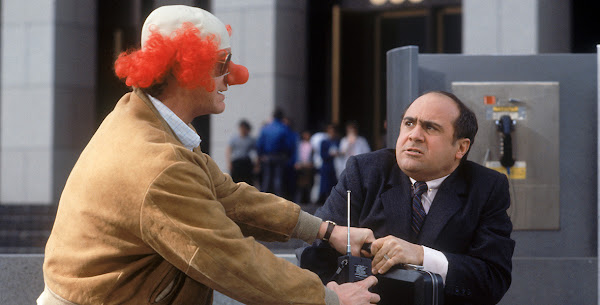
RUTHLESS PEOPLE is about a rich businessman named Sam Stone (Danny DeVito) who truly hates his wife Barbara (Bette Midler), and hatches a plan to kill her so he can inherit her money. Unfortunately he runs into a couple of problems. First, his mistress Carol (Anita Morris) knows about the plan, so she and her dimwitted boy toy Earl (Bill Pullman) want to film Sam dumping his wife’s body so they can blackmail him for millions. Second, before Sam can execute his plan, Barbara is kidnapped and held for a ransom of $500,000 by Ken and Sandy Kressler (Judge Reinhold and Helen Slater). It seems that Sam stole Sandy’s idea for the spandex miniskirt, screwed them out of millions with a handshake deal, and then kept the money for himself. This seems like an answer to prayer at first for Sam because they threaten to kill Barbara if he doesn’t meet their needs or if he calls the police or the media. After saying no to their demands, and then immediately calling the police and the news, Sam realizes that they don’t want to kill her when they keep coming back with lower demands. Sandy tells Barbara that Sam refuses to pay even $10,000 for her safe return. Eventually the kidnappers and Barbara join together to try to take the unfaithful and unethical Sam for everything he’s worth!!
RUTHLESS PEOPLE is one of my favorite comedies of the 1980’s. It has such a great cast. Danny DeVito and Bill Pullman are especially hilarious and have some of the film’s best lines. At the time the movie came out in 1986, DeVito was already established as a master of comedy, so Pullman’s performance as Earl, the dumbass Sonny Crockett wannabe, was the real revelation to me. Pullman made his film debut in RUTHLESS PEOPLE, and I never see him to this day that I don’t think of his character Earl’s excitement over the prospect of his newfound blackmail money:
“And then we’re off, to Haiti!”
“It’s Tahiti, you moron!”
One of the most interesting things about RUTHLESS PEOPLE is just how different it is from the directing trio’s (Zucker / Abrahams / Zucker) other popular films like THE KENTUCKY FRIED MOVIE and AIRPLANE. Those films are based on non-stop visual and verbal gags. I love those films, but this is quite different. The comedy of RUTHLESS PEOPLE is based on the story itself, which is a comedy of confusion, coincidence, and character. I know it’s awesome because I still think of the film often. “Give the bag to bozo” and “a little poke in the whiskers” are phrases I’ll remember up to the point I go to my grave.
Even though the film is almost 40 years old, if you’re looking for a laugh, I don’t think you can do much better than RUTHLESS PEOPLE.
President Skroob (Mel Brooks), the evil and incompetent leader of Planet Spaceball, has squandered all of the air on his planet and is planning on stealing the atmosphere of the planet Druida. To pull this off, he arranges for the idiotic Prince Valium (Jim J. Bullock) to marry Vespa (Daphne Zuniga), the princess of Druida. (All together now: “She doesn’t look Druish.”) Vespa and her droid, Dot Matrix (voice by Joan Rivers), flee Druida with Lord Dark Helmet (Rick Moranis) and Colonel Sandurz (George Wyner) in pursuit.
In debt to the intergalactic gangster, Pizza the Hut (voiced by Dom DeLuise), a mercenary named Lone Star (Bill Pullman) and his associate, the man-dog hypbrid Barf (John Candy), accept a contract from Vespa’s father (Dick Van Patten) to track down his daughter. They take off in their space Winnebago to bring Vespa home. Though they start only interested in money, Lone Star and Barf come to learn about love, freedom, and a mystical power known as the Schwartz. (“No, the Schwartz!”)
Back when I was growing up and just being able to have HBO made you the coolest guy on the block, Spaceballs was one of my favorite movies. I watched it every time that it came on cable. As usual with Mel Brooks, there were a lot of double entendres that went over my young head but there was also enough goofy humor that I could laugh at what was going on. I could quote all the lines. I laughed whenever Rick Moranis showed up in his Darth Vader-costume. I laughed at John Candy’s facial expressions. I laughed when Mel Brooks showed up as Yogurt, the Spaceballs version of Yoda. Pizza the Hut? That’s hilarious when you’re a kid!
I recently rewatched the film. Revisiting it was a lesson in how your memory can trick you. I could still quote most of the lines with reasonable accuracy but nothing was quite the way I remembered it. Rick Moranis and John Candy were still hilarious and, being older, I could better appreciated the frustration felt by George Wyner’s Colonel Sandurz. I also realized what a good performance Bill Pullman gave as Lone Star. While everyone else mugged for the camera, Pullman played his role straight.
I also discovered that a lot of the scenes that I remembered as being hilarious were actually just mildly amusing. Mel Brooks was always hit-and-miss as a director, the type who would toss everything and the kitchen sink into his films. Spaceballs has a lot of hilarious scenes but it’s obvious that Brooks didn’t have the same affection for the source material as he did with Young Frankenstein or Blazing Saddles or even High Anxiety. Brooks is poking fun at Star Wars because it’s popular but he doesn’t seem to have any strong feelings, one way or the other, about George Lucas’s space epic.
I still laughed, though. Even if Spaceballs wasn’t the masterpiece that I remembered it being, I still enjoyed rewatching it. The jokes that hit were funny enough to make up for the ones that missed. Even with his weaker films, Mel Brooks is a national treasure.
What’s an Insomnia File? You know how some times you just can’t get any sleep and, at about three in the morning, you’ll find yourself watching whatever you can find on cable or Netflix? This feature is all about those insomnia-inspired discoveries!
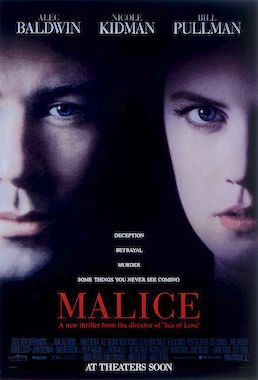
If you were having trouble getting to sleep last night around 12 midnight, you could have turned over to the Cinemax and watched the 1993 thriller, Malice. And then you could have spent the next few hours trying to figure out what you just watched.
Seriously, there’s a lot going on in Malice. The screenplay is credited to Aaron Sorkin and Scott Frank and while it has enough overly arch dialogue and untrustworthy women to plainly identify it as being a product of Sorkin’s imagination, it’s also filled with a mini-series worth of incidents and subplots and random characters. This is also one of those films where no one can simply answer a question with a “yes” or a “no.” Instead, it’s one of those movies where everyone gets a monologue, giving the proceedings a rather theatrical feel. It’s the type of thing that David Mamet could have pulled off. (Check out The Spanish Prisoner for proof.) Harold Becker, however, was a far more conventionally-minded director and he often seems to be at a loss with what to do with all of the film’s Sorkinisms (and, to be fair, Frankisms as well).
The film starts out as a thriller, with a serial rapist stalking a college campus and Prof. Andy Safian (Bill Pullman) becoming an unlikely suspect. Then it turns into a domestic drama as Andy and his wife, Tracy (Nicole Kidman), talk about starting a family. Then Andy meets a brilliant surgeon named Jed Hill (Alec Baldwin) and the film turns into a roommate from Hell story after Jed moves in with them. Then it becomes a medical drama after a mistake by Dr. Hill leaves Tracy unable to have children. Then it returns briefly to the campus rapist story before then turning into a modern-day noir as Andy discovers that Tracy has secrets of her own. (Whenever one watches a film written by Aaron Sorkin, you can practically hear him whispering, “Women are not to be trusted….” in the background.) Even as you try to keep up with the plot, you find yourself distracted by all of the cameos. George C. Scott glowers as Jed’s mentor. Anne Bancroft acts the Hell out of her role as a drunken con artist. Peter Gallagher is the lawyer you distrust because he’s Peter Gallagher. Tobin Bell shows up as a handyman. Gwynneth Paltrow, in one of her first roles, plays dead convincingly
It’s a big and busy and messy film and it too often mistakes being complicated for being clever. Bill Pullman is a likable hero but you have to be willing to overlook that the script requires him to do some truly stupid things. Nicole Kidman is always well-cast as a femme fatale but again, the script often lets her down.
Surprisingly enough, it’s Alec Baldwin who comes out of the film unscathed. Watching Baldwin in this film, it’s hard to believe that he’s the same actor who has since become something of a bloated self-parody. Yes, he’s playing an arrogant character (which is pretty much his trademark) but, in Malice, he actually brings a hint of subtlety and wit to his performance. Baldwin does very little bellowing in the film, despite playing a role that one would think would naturally appeal to all of his bellowing instincts. Malice is a mess but it’s nice to see the type of actor that Alec Baldwin once was.
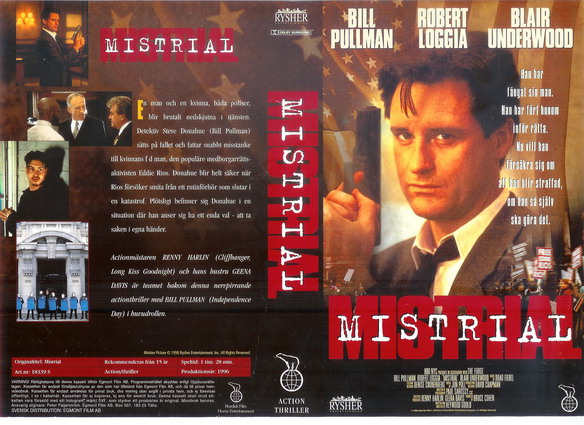
When a NYPD cop and her partner are murdered, overworked and stressed-out Detective Steve Donohue (Bill Pullman) follows a trail of circumstantial evidence that leads him to the door of the cop’s ex-husband, a community activist named Eddie Rios (Jon Seda). Donohue’s attempt to arrest Rios goes terribly wrong and results in a shootout that leaves Rios’s second wife and bother dead before the handcuffs are eventually slapped on his wrists.
Rios may be the one on trial but Donohue is now the one facing judgment. With protesters lined up outside the courthouse and the city’s mayor (James Rebhorn) more interested in his own reelection than in the pursuit of justice, Donohue knows that the only way he’ll be vindicated is if Eddie Rios is convicted. Unfortunately, that’s not what happens. Rios’s sleazy attorney (played by Josef Sommer) gets most of the evidence tossed out of court on a technicality and it appears that Rios is going to walk free. That’s when Donohue decides to take the court itself hostage, pulls out a gun, and demands that Rios immediately be put on trial for a second time, with the jury hearing all of the evidence that was originally thrown out of court.
Mistrial is an example of the good-cop-pushed-over-the-edge genre. Up until a few years ago, this was a very popular genre. Today, of course, it feels tone deaf and it’s a lot more difficult to sympathize with a cop, even a fictional one, complaining about being restricted by the constitution. The main problem with Mistrial is that it’s established early on that Eddie Ramos is guilty so there’s no real tension as to whether Donohue is doing the right thing by demanding a second trial. If there had been some ambiguity about whether or not Ramos was the murderer that Donohue claims he is, it would have made the film much more interesting and less predictable. The other problem is that Bill Pullman is just too naturally earnest and clean-cut to be convincing as an overworked cop who has been pushed into doing something crazy. Remembering back to the 90s, I think someone like Gary Sinise or William L. Petersen could have pulled off the role but Pullman’s just not right for it.
Robert Loggia has a few good moments as Pullman’s sympathetic captain. This was the 2nd time that Pullman and Loggia co-starred together. The first time was in Independence Day. The 3rd time would be in Lost Highway, a film that’s as different from Mistrial as day is from night.
Once upon a time, there were two movies about the legendary Western lawman (or outlaw, depending on who is telling the story) Wyatt Earp. One came out in 1993 and the other came out in 1994.
The 1993 movie was called Tombstone. That is the one that starred Kurt Russell was Wyatt, with Sam Elliott and Bill Paxton in the roles of his brothers and Val Kilmer playing Doc Holliday. Tombstone deals with the circumstances that led to the Gunfight at the O.K. Corral. “I’m your huckleberry,” Doc Holliday says right before his gunfight with Michael Biehn’s Johnny Ringo. Tombstone is the movie that everyone remembers.
The 1994 movies was called Wyatt Earp. This was a big budget extravaganza that was directed by Lawrence Kasdan and starred Kevin Costner as Wyatt. Dennis Quaid played Doc Holliday and supporting roles were played by almost everyone who was an active SAG member in 1994. If they were not in Tombstone, they were probably in Wyatt Earp. Gene Hackman, Michael Madsen, Tom Sizemore, Jeff Fahey, Mark Harmon, Annabeth Gish, Gene Hackman, Bill Pullman, Isabella Rossellini, JoBeth Williams, Mare Winningham, and many others all appeared as supporting characters in the (very) long story of Wyatt Earp’s life.
Of course, Wyatt Earp features the famous Gunfight at the O.K. Corral but it also deals with every other chapter of Earp’s life, including his multiple marriages, his career as a buffalo hunter, and his time as a gold prospector. With a three-hour running time, there is little about Wyatt Earp’s life that is not included. Unfortunately, with the exception of his time in Tomstone, Wyatt Earp’s life was not that interesting. Neither was Kevin Costner’s performance. Costner tried to channel Gary Cooper in his performance but Cooper would have known better than to have starred in a slowly paced, three-hour movie. The film is so centered around Costner and his all-American persona that, with the exception of Dennis Quaid, the impressive cast is wasted in glorified cameos. Wyatt Earp the movie tries to be an elegy for the old west but neither Wyatt Earp as a character nor Kevin Costner’s performance was strong enough to carry such heavy symbolism. A good western should never be boring and that is a rule that Wyatt Earp breaks from the minute that Costner delivers his first line.
Costner was originally cast in Tombstone, just to leave the project so he could produce his own Wyatt Earp film. As a big, Oscar-winnng star, Costner went as far as to try to have production of Tombstone canceled. Ironically, Tombstone turned out to be the film that everyone remember while Wyatt Earp is the film that most people want to forget.
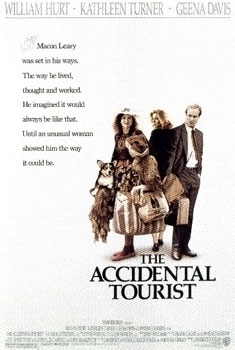
I have to admit that I was tempted to be a little bit snarky in my review of the 1988 Best Picture nominee, The Accidental Tourist. I was going to say that The Accidental Tourist was a perfect example of a genre of film that has always been oddly popular with the Academy, the emotionally stunted man in New England learns to love again genre.
But, then I realized that I was wrong. The Accidental Tourist does not take place in New England. It takes place in Baltimore which may be located up north but which is technically considered to be part of the mid-Atlantic. But, even with that in mind, it was impossible for me to watch The Accidental Tourist without thinking of other New England-set Oscar nominees, such as Mystic River and Manchester By The Sea.
As for the film itself, it’s about a man whose depressing life would be unbearable to watch if not for the fact that everyone around him is so extremely eccentric. Macon Leary (William Hurt) is a travel writer. He’s writes books giving people advice on how best to behave while seeing the world. Throughout the film, we hear snippets of his prose. Macon warns people about overpacking. He warns them about arriving late at the airport. He warns them about not properly planning out their trip. He suggests that travelers bring a book to read but not too many books. And don’t bring magazines because they get wrinkled too easily. Now, to be honest, I liked most of Macon’s advice but then again, I’m OCD and I spend most of my time trying to make sure that everything I own is properly organized and can be equally divided.
A year ago, during a fast food robbery, Macon’s son was shot and killed. Withdrawing from the world, Macon barely reacts when his wife, Sarah (Kathleen Turner), leaves him. After breaking his leg while trying to convince his dog to climb down the stairs into the laundry room, Macon ends up moving in with his three siblings: autocratic Porter (David Ogden Stiers), slightly less autocratic Charles (Ed Begley, Jr.) and sweet but neurotic Rose (Amy Wright).
And so it goes. Even when his agent, Julian (Bill Pullman), starts to date Rose, Macon can’t bring himself to open up emotionally. Fortunately, Macon meets Muriel (Geena Davis), a quirky dog trainer. Though it takes a while, Muriel starts to pull Macon out of his shell. Soon, Macon is spending his nights over at her apartment and bonding with her sickly son.
(Why does every single mother in these type of movies have a sickly son? Just for once, couldn’t a single mother be portrayed as having a child who is well-adjusted, popular, and healthy?)
But, just when everything seems to be perfect, Macon’s phone rings. It’s Sarah and she wants to give their marriage another chance…
Just judging from the tone of this review, you’re probably thinking that I disliked The Accidental Tourist. Actually, nothing could be further from the truth. While the film’s mix of grim reality and relentlessly quirky supporting character can be a bit overwhelming at first, the film works if you stick with it. That’s the thing — you have to stick with it. When William Hurt first stares at the camera with his dead eyes and starts to drone about the importance of not spending too much money while in Paris, it’s tempting to just give up. But, as the film progresses, it improves and so does Hurt’s performance. By the time he finally worked up the strength to hold Muriel’s son’s hand while walking the boy home from school, I had tears in my mismatched eyes.
The Accidental Tourist is low-key but rather sweet film. While the film centers around the performances of Hurt and Geena Davis (who won an Oscar for her work here), my favorite performances came from Bill Pullman and Amy Wright. I honestly would happily watch a film that was just about their characters.
The Accidental Tourist was nominated for Best Picture but lost to Rain Man.

 Once upon a time, there were two movies about the legendary Western lawman (or outlaw, depending on who is telling the story) Wyatt Earp. One came out in 1993 and the other came out in 1994.