Cleaning Out the DVR #16: Keep Calm and Watch Movies!


gary loggins's avatarcracked rear viewer

All last week, I was laid up with sciatic nerve pain, which begins in the back and shoots down my left leg. Anyone who has suffered from this knows how  excruciating it can be! Thanks to inversion therapy, where I hang upside down three times a day on a table like one of Bela Lugosi’s pets in THE DEVIL BAT , I’m feeling much better, though not yet 100%.

Fortunately, I had a ton of movies to watch. My DVR was getting pretty full anyway, so I figured since I could barely move, I’d try to make a dent in the plethora of films I’ve recorded.., going all the way back to last April! However, since I decided to go back to work today, I realize I won’t have time to give them all the full review treatment… and so it’s time for the first Cleaning Out the DVR post…

View original post 1,081 more words

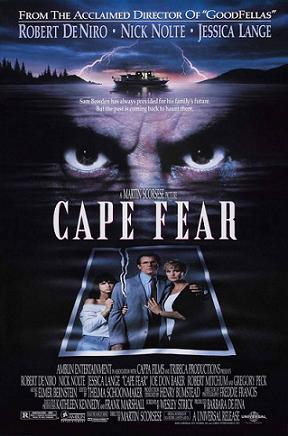
Horror Film Review: Cape Fear (dir by Martin Scorsese)


And I beheld as Scorsese remade a classic movie and, Lo, there was De Niro, decorated in india ink and speaking in tongues…

In 1991, Martin Scorsese remade the 1962 horror thriller, Cape Fear.  Both versions deal with the same basic story but each tells it in a very different way.  If the original Cape Fear was straightforward and to the point, Martin Scorsese’s version is so stylized that occasionally, it’s tempting to suspect that Scorsese might be parodying himself.  Zoom shots, negative shots, sweeping camera movements, Scorsese’s Cape Fear is full of all of them.  When a storm rolls in for the film’s operatic finale, the red clouds look as if their on fire.  Hell is coming to North Carolina, the film appears to be announcing.

While the plot largely remains the same, there are a few significant changes to the characters involved:

In the first Cape Fear, Robert Mitchum’s Max Cady was an arrogant, swaggering brute.  In the remake, Robert De Niro’s Cady is still an arrogant, swaggering brute but he’s now also an evangelical who is tattooed with bible verses and who speaks in tongues.  Cape Fear‘s approach to Cady’s religion is so over-the-top that it almost makes Stephen King’s approach to religious characters seem subtle and nuanced.  De Niro also speaks in a broad Southern accent.  Occasionally, De Niro gets the accent right but most of the time, he sounds like he’s in a Vermont community theater production of Cat On A Hot Tin Roof.

In the first Cape Fear, Gregory Peck’s Sam Bowden was a lawyer who caught Max while Max was attacking a woman and who then testified against Max in court.  That’s not the case with the remake’s version of Sam Bowden.  Despite being played by Nick Nolte, the remake’s Sam Bowden is such a wimp that you can’t help but dislike him.  His wife (Jessica Lange) doesn’t trust him.  His teenage daughter (Juliette Lewis) resents him and his attempts to control her life.  In this version, Sam didn’t testify against Max in court.  Instead, Sam was Max’s lawyer and withheld evidence that could have secured Max’s acquittal.  What Sam didn’t realize is that Max would spend his time in prison studying the law and that Max would eventually figure out what Sam did.

As in the original film, Max shows up in North Carolina and proceeds to stalk the Bowdens.  Unlike Mitchum, who was all quiet menace, De Niro plays Max as being loud and obnoxious, the type who will sit in a theater, light a cigar, and intentionally laugh at the top of his lungs.  Max knows enough about the law that he knows exactly what he can get away with.  He poisons Sam’s dog.  He rapes Sam’s associate, Lori (played, in a heart-breaking performance, by Ileana Douglas).  In one of the film’s most unsettling scenes, he pretends to be the new drama teacher and toys with Sam’s daughter.

With the help of a private eye (Joe Don Baker), Sam tries to get Max out of his life.  Eventually, Sam pretends to be out-of-town, all as part of a ruse to get Max to break into his house so that he can be shot in self-defense.  It’s here that Nolte’s wimpy performance becomes an issue.  It’s impossible not to laugh at the sight of Sam, all hunched down and desperately trying to run from room to room without being spotted through any of the windows.

To a certain extent, I suspect that were meant to see Sam as being a rather pathetic figure.  Scorsese doesn’t really seem to have much sympathy for him or his dysfunctional family.  If anything, the film seems to argue that Sam has been a bad lawyer, a bad husband, and a bad father and Max has been sent as a type of divine retribution.  Only by defeating Max can Sam find forgiveness and hope to have the type of life that Gregory Peck enjoyed in the first movie.

Scorsese’s Cape Fear is an uneasy mishmash of styles.  Is it an art film, a religious allegory, a horror film, or just a generic thriller?  It doesn’t seem to be sure.  Cape Fear‘s a Scorsese film so, of course, it’s always going to be worth watching.  But there are times when the film definitely runs the risk of overdosing on style.  Sometimes, Scorsese seems to be trying too hard to remind everyone that he’s a legitimately great director and ends up getting so invested in the film’s visuals that he runs the risk of losing the story.  De Niro has some scenes in which he is genuinely chilling but then he has other scenes where he is basically just a live action cartoon character.  The same can be said of the film itself.  It’s always watchable.  At times, it’s rather frightening.  But other times, it’s just too cartoonish to be effective.

If anything, this remake proves that sometimes, it’s best to keep things simple.

Here’s What Won At The Emmys Last Night!


Last night, Lisa Marie did not watch the Emmys because she says that, “I’m just not feeling TV this year.”  If Twin Peaks had been eligible to be nominated, I bet it would have been a different story!

Instead, she asked me to watch the ceremony and let everyone know what I thought.  It needed less politics and more cats.

Here’s the list of winners:

COMEDY

BEST COMEDY SERIES
“Atlanta”
“Black-ish”
“Masters of None”
“Modern Family”
“Silicon Valley”
“Unbreakable Kimmy Schmidt”
X — “Veep”

BEST COMEDY ACTRESS
Pamela Adlon, “Better Things”
Jane Fonda, “Grace and Frankie”
Allison Janney, “Mom”
Ellie Kemper, “Unbreakable Kimmy Schmidt”
X — Julia Louis-Dreyfus, “Veep”
Tracee Ellis Ross, “Black-ish”
Lily Tomlin, “Grace and Frankie”

BEST COMEDY ACTOR
Anthony Anderson, “Black-ish”
Aziz Ansari, “Master of None”
Zach Galifianaks, “Baskets”
X — Donald Glover, “Atlanta”
William H. Macy, “Shameless”
Jeffrey Tambor, “Transparent”

BEST COMEDY SUPPORTING ACTRESS
Vanessa Bayer, “Saturday Night Live”
Anna Chlumsky, “Veep”
Kathryn Hahn, “Transparent”
Leslie Jones, “Saturday Night Live”
Judith Light, “Transparent”
X — Kate McKinnon, “Saturday Night Live”

BEST COMEDY SUPPORTING ACTOR
Louie Anderson, “Baskets”
X — Alec Baldwin, “Saturday Night Live”
Tituss Burgess, “Unbreakable Kimmy Schmidt”
Ty Burrell, “Modern Family”
Tony Hale, “Veep”
Matt Walsh, “Veep”

BEST COMEDY DIRECTING
X — “Atlanta” (“B.A.N.”)
“Silicon Valley” (“Intellectual Property”)
“Silicon Valley” (“Server Error”)
“Veep” (“Justice”)
“Veep” (“Blurb”)
“Veep” (“Groundbreaking”)

BEST COMEDY WRITING
“Atlanta” (“B.A.N.”)
“Atlanta” (“Streets on Lock”)
X — “Master of None” (“Thanksgiving”)
“Silicon Valley” (“Success Failure”)
“Veep” (“Groundbreaking”)
“Veep” (“Georgia”)

DRAMA

BEST DRAMA SERIES
“Better Call Saul”
“The Crown”
X — “The Handmaid’s Tale”
“House of Cards”
“Stranger Things”
“This is Us”
“Westworld”

BEST DRAMA ACTRESS
Viola Davis, “How to Get Away with Murder”
Claire Foy, “The Crown”
X — Elisabeth Moss, “The Handmaid’s Tale”
Keri Russell, “The Americans”
Evan Rachel Wood, “Westworld”
Robin Wright, “House of Cards”

BEST DRAMA ACTOR
X — Sterling K. Brown, “This is Us”
Anthony Hopkins, “Westworld”
Bob Odenkirk, “Better Call Saul”
Matthew Rhys, “The Americans”
Liev Schreiber, “Ray Donovan”
Kevin Spacey, “House of Cards”
Milo Ventimiglia, “This is Us”

BEST DRAMA SUPPORTING ACTRESS
Uzo Aduba, “Orange is the New Black”
Millie Bobby Brown, “Stranger Things”
X — Ann Dowd, “The Handmaid’s Tale”
Chrissy Metz, “This is Us”
Thandie Newton, “Westworld”
Samira Wiley, “The Handmaid’s Tale”

BEST DRAMA SUPPORTING ACTOR
Jonathan Banks, “Better Call Saul”
David Harbour, “Stranger Things”
Ron Cephas Jones, “This is Us”
Michael Kelly, “House of Cards”
X — John Lithgow, “The Crown”
Mandy Patinkin, “Homeland”
Jeffrey Wright, “Westworld”

BEST DRAMA DIRECTING
“Better Call Saul” (“Witness”)
“The Crown” (“Hyde Park Corner”)
“The Handmaid’s Tale” (“The Bridge”)
X — “The Handmaid’s Tale” (“Offred”)
“Homeland” (“America First”)
“Stranger Things” (“Chapter One: The Vanishing of Will Byers”)
“Westworld” (“The Bicameral Mind”)

BEST DRAMA WRITING
“The Americans” (“The Soviet Division”)
“Better Call Saul” (“Chicanery”)
“The Crown” (“Assassins”)
X — “The Handmaid’s Tale” (“Offred”)
“Stranger Things” (“Chapter One: The Vanishing of Will Byers”)
“Westworld” (“The Bicameral Mind”)

MOVIE/LIMITED SERIES

BEST LIMITED SERIES
X — “Big Little Lies”
“Fargo”
“Feud: Bette and Joan”
“Genius”
“The Night Of”

BEST TV MOVIE
X — “Black Mirror: San Junipero”
“Christmas of Many Colors”
“The Immortal Life of Henrietta Lacks”
“Sherlock: The Lying Detective”
“The Wizard of Lies”

BEST MOVIE/MINI ACTRESS
Carrie Coon, “Fargo”
Felicity Huffman, “American Crime”
X — Nicole Kidman, “Big Little Lies”
Jessica Lange, “Feud: Bette and Joan”
Susan Sarandon, “Feud: Bette and Joan”
Reese Witherspoon, “Big Little Lies”

BEST MOVIE/MINI ACTOR
X — Riz Ahmed, “The Night Of”
Benedict Cumberbatch, “Sherlock: The Lying Detective”
Robert De Niro, “The Wizard of Lies”
Ewan McGregor, “Fargo”
Geoffrey Rush, “Genius”
John Turturro, “The Night Of”

BEST MOVIE/MINI SUPPORTING ACTRESS
Judy Davis, “Feud: Bette and Joan”
X — Laura Dern, “Big Little Lies”
Jackie Hoffman, “Feud: Bette and Joan”
Regina King, “American Crime”
Michelle Pfeiffer, “The Wizard of Lies”
Shailene Woodley, “Big Little Lies”

BEST MOVIE/MINI SUPPORTING ACTOR
Bill Camp, “The Night Of”
Alfred Molina, “Feud: Bette and Joan”
X — Alexander Skarsgard, “Big Little Lies”
David Thewlis, “Fargo”
Stanley Tucci, “Feud: Bette and Joan”
Michael Kenneth Williams, “The Night Of”

BEST MOVIE/MINI DIRECTING
X — “Big Little Lies”
“Fargo” (“The Law of Vacant Places”)
“Feud: Bette and Joan” (“And the Winner Is”)
“Genius” (“Einstein: Chapter One”)
“The Night Of” (“The Art of War”)
“The Night Of” (“The Beach”)

BEST MOVIE/MINI WRITING
“Big Little Lies”
X — “Black Mirror: San Junipero”
“Fargo” (“The Law of Vacant Places”)
“Feud: Bette and Joan” (“And the Winner Is”)
“Feud: Bette and Joan” (“Pilot”)
“The Night Of” (“Call of the Wild”)

VARIETY/REALITY

BEST REALITY COMPETITION PROGRAM
“The Amazing Race”
“Amercan Ninja Warrior”
“Project Runway”
“RuPaul’s Drag Race”
“Top Chef”
X — “The Voice”

BEST VARIETY TALK SERIES
“Full Frontal with Samantha Bee”
“Jimmy Kimmel Live”
X — “Last Week Tonight with John Oliver”
“Late Late Show with James Corden”
“Late Show with Stephen Colbert”
“Real Time with Bill Maher”

BEST VARIETY SKETCH SERIES
“Billy on the Street”
“Documentary Now”
“Drunk History”
“Portlandia”
X — “Saturday Night Live”
“Tracey Ullman’s Show”

BEST VARIETY SERIES DIRECTING
“Drunk History”
“Jimmy Kimmel Live”
“Last Week Tonight with John Oliver”
“Late Show with Stephen Colbert”
X — “Saturday Night Live”

BEST VARIETY SERIES WRITING
“Full Frontal with Samantha Bee”
X — “Last Week Tonight with John Oliver”
“Late Night with Seth Meyers”
“Late Show with Stephen Colbert

The Alliance of Women Film Journalists Announced Their Picks For The Best of 2016!


american_honey_poster

The Alliance of Women Film Journalists (of which I am not a member and what’s up with that!?) announced their picks for the best of 2016 earlier this week.

And here they are:

AWFJ BEST OF AWARDS
These awards are presented to women and/or men without gender consideration.
Best Film
Arrival
Hell or High Water
La La Land
Manchester by the Sea
Moonlight

Best Director
Damien Chazelle – La La Land
Barry Jenkins – Moonlight
Kenneth Lonergan – Manchester by the Sea
David Mackenzie – Hell or High Water
Denis Villeneuve – Arrival

Best Screenplay, Original
20th Century Women – Mike Mills
Hail Caesar – Joel Coen and Ethan Coen
Hell or High Water – Taylor Sheridan
La La Land – Damien Chazelle
Manchester by the Sea – Kenneth Lonergan

Best Screenplay, Adapted
Arrival – Eric Heisserer
Lion – Luke Davies
Love & Friendship – Whit Stillman
Moonlight – Barry Jenkins
Nocturnal Animals –Tom Ford

Best Documentary
13th – Ava DuVernay
Gleason – Clay Tweel
I Am Not Your Negro – Raoul Peck
OJ Made in America – Ezra Edelman
Weiner – Elyse Steinberg and Josh Kriegma

Best Animated Film
Finding Dory – Andrew Stanton andAngus MacLane
Kubo and the Two Strings- Travis Knight
Moana – Ron Clements, Don Hall, John Musker, Chris Williams
Zootopia – Byron Howard, Rich Moore, Jared Bush

Best Actress
Amy Adams – Arrival
Isabelle Huppert – Elle
Ruth Negga – Loving
Natalie Portman – Jackie
Emma Stone – La La Land

Best Actress in a Supporting Role
Viola Davis – Fences
Greta Gerwig – 20th Century Women
Naomie Harris – Moonlight
Octavia Spencer – Hidden Figures
Michelle Williams – Manchester by the Sea

Best Actor
Casey Affleck – Manchester By The Sea
Joel Edgerton – Loving
Ryan Gosling – La La Land
Tom Hanks – Sully
Denzel Washington – Fences

Best Actor in a Supporting Role
Mahershala Ali – Moonlight
Jeff Bridges – Hell or High Water
Ben Foster – Hell or High Water
Lucas Hedges – Manchester By the Sea
Michael Shannon – Nocturnal Animals

Best Ensemble Cast – Casting Director
20th Century Women – Mark Bennett and Laura Rosenthal
Hail Caesar – Ellen Chenoweth
Hell or High Water – Jo Edna Boldin and Richard Hicks
Manchester by the Sea – Douglas Aibel
Moonlight – Yesi Ramirez

Best Cinematography
Arrival – Bradford Young
Hell or High Water – Giles Nuttgens
La La Land – Linus Sandgren
Manchester by The Sea – Jody Lee Lipes
Moonlight – James Laxton

Best Editing
Arrival – Joe Walker
I Am Not Your Negro — Alexandra Strauss
La La Land – Tom Cross
Manchester By The Sea – Jennifer Lame
Moonlight – Joi McMillon and Nat Sanders

Best Non-English-Language Film
Elle – Paul Verhoeven, France
Fire At Sea – Gianfranco Rossi, Italy
The Handmaiden – Chan-Wook Park, South Korea
Julieta – Pedro Almodovar. Spain
Toni Erdmann – Maren Ede, Germany

EDA FEMALE FOCUS AWARDS
These awards honor WOMEN only

Best Woman Director
Andrea Arnold – American Honey
Ava DuVernay -13TH
Rebecca Miller – Maggie’s Plan
Mira Nair – Queen of Katwe
Kelly Reichardt – Certain Women

Best Woman Screenwriter
Andrea Arnold – American Honey
Rebecca Miller – Maggie’s Plan
Kelly Reichardt – Certain Women
Lorene Scafaria – The Meddler
Laura Terruso – Hello, My Name is Doris

Best Animated Female
Dory in Finding Dory –Ellen DeGeneres
Judy in Zootopia – Ginnifer Goodwin
Moana in Moana – Auli’i Cravalho

Best Breakthrough Performance
Sasha Lane – American Honey
Janelle Monáe – Moonlight and Hidden Figures
Madina Nalwanga – Queen of Katwe
Ruth Negga – Loving

Outstanding Achievement by A Woman in The Film Industry
Ava DuVernay – For 13TH and raising awareness about the need for diversity and gender equality in Hollywood
Anne Hubbell and Amy Hobby for establishing Tangerine Entertainment’s Juice Fund to support female filmmakers
Mynette Louie, President of Gamechanger Films, which finances narrative films directed by women
April Reign for creating and mobilizing the #OscarsSoWhite campaign

EDA SPECIAL MENTION AWARDS

Actress Defying Age and Ageism
Annette Bening – 20th Century Women
Viola Davis – Fences
Sally Field – Hello, My Name is Doris
Isabelle Huppert – Elle and Things to Come
Helen Mirren – Eye in the Sky

Most Egregious Age Difference Between The Lead and The Love Interest Award
Dirty Grandpa – Robert De Niro (b. 1943) and Aubrey Plaza (b. 1984)
Independence Day: Resurgence – Charlotte Gainsbourg (b 1971) and Jeff Goldblum (b 1952)
Mechanic Resurrection – Jason Statham (b. 1967) and Jessica Aba (b. 1981)
Rules Don’t Apply – Warren Beatty (b. 1937) and Lily Collins (b. 1989)

Actress Most in Need Of A New Agent
Jennifer Aniston – Mother’s Day and Office Christmas Party
Melissa McCarthy – The Boss and Ghostbusters
Margot Robbie – Suicide Squad and Tarzan
Julia Roberts – Mother’s Day
Shailene Woodley – Divergent Series

Bravest Performance
Jessica Chastain – Miss Sloane
Naomie Harris – Moonlight
Isabelle Huppert – Elle
Sasha Lane – American Honey
Ruth Negga – Loving

Remake or Sequel That Shouldn’t have been Made
Ben-Hur
Ghostbusters
Independence Day: Resurgence
The Magnificent Seven
My Big Fat Greek Wedding 2

AWFJ Hall of Shame Award
Sharon Maguire and Renee Zellweger for Bridget Jones’s Baby
Nicholas Winding Refn and Elle Fanning for The Neon Demon
David Ayer and Margot Robbie for Suicide Squad
David E. Talbert and Mo’Nique for Almost Christmas

Film Review: Dirty Grandpa (dir by Don Mazer)


dirty_grandpa_teaser_poster

Epix is doing a free preview this weekend so, earlier tonight, I watched Robert De Niro and Zac Efron in Dirty Grandpa.  You may remember Dirty Grandpa as being the film that came out in January and made a ton of movie despite the fact nobody will admit to having seen it.

Myself, I hope that the cast of Dirty Grandpa was paid in cocaine because then, at the very least, I could be assured that they had a better time making the movie than anyone else has had watching it.  The plot, as it is, features De Niro as a widower who is obsessed with getting laid and Efron as his straigher-than-straight grandson who takes him down to Daytona for Spring Break.  Efron is engaged to Meredith (Julianne Hough) who we’re supposed to dislike because of …. reasons, I guess.  The film certainly hates her, even though all she’s trying to do is plan a nice wedding.  De Niro would rather Efron get together with a boring political activist (Zooey Deutch).  Meanwhile, De Niro himself is obsessed with Deutch’s friend, played by Aubrey Plaza.

Anyway, this is one of those films that’s even worse than it sounds.  The pacing is so off that even the scenes that should work fall flat and visually, the film resembles a high quality YouTube video.  The majority of the humor is racist, misogynistic, and homophobic (but, of course, we’re not supposed to notice because the “good” girl is vaguely defined as being a liberal political activist).  Zac Efron, who is really only a credible actor when he’s playing dumb (read into that whatever you want), is miscast as someone who actually has something that’s going on in his life and Aubrey Plaza, one of the most unique comedic performers working today, is almost totally wasted.  Both Zooey Deutch and Julianne Hough struggle within the confines of a script that obsessively hates women.

(By the way, would you believe that the script for this movie was included on the Black List, the annual list of the “best” unproduced scripts in Hollywood?  I would.  Being included on the Black List is perhaps the most overrated honor that Hollywood can provide, seeing as how most Black List films end up sucking.)

As for Robert De Niro, his performance actually isn’t that bad.  But that doesn’t change the fact that he’s Robert freaking De Niro playing a role that could have just as easily been performed by Johnny Knoxville in old age makeup.

Anyway, I watched Dirty Grandpa because I wanted to see if it was as bad as everyone said it was and it was.

Go to Hell, Dirty Grandpa.

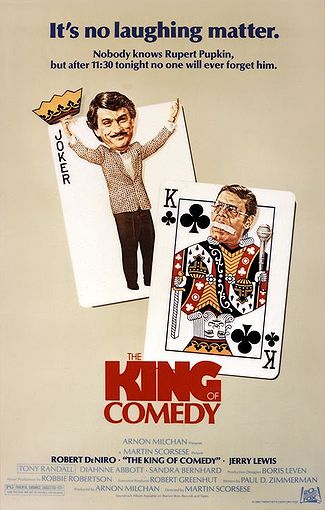
Film Review: The King of Comedy (dir by Martin Scorsese)


Kingofcomedy

Oh my God, do y’all want to see a really great film?

Then you need to do what I did earlier tonight.  You need to sit down and watch Martin Scorsese’s 1983 media satire, The King of Comedy.

Want to know more about The King of Comedy?  Then read on!  But be aware that there are spoilers in the review below!

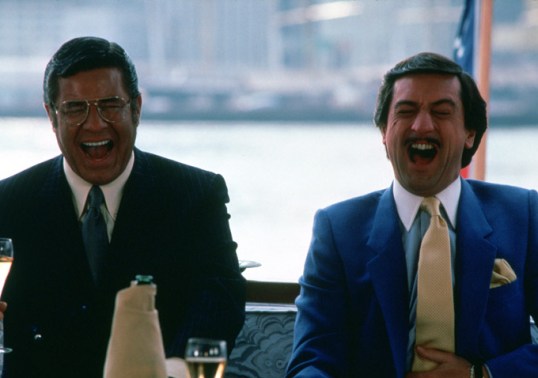
The King of Comedy tells the story of … well, it actually tells the story of several people.  On the one hand, it’s the story of Jerry Langford (played by Jerry Lewis, who gives a performance that is so good that you might even forget that he directed The Day The Clown Cried), a comedian who has his own late night talk show.  Jerry is a celebrity, the type who is mostly famous for being himself.  He makes his living by interviewing people at night but, in his daily life, he struggles to interact with the world at large.  Whenever Jerry steps outside, people start yelling at him.  When he walks away from one elderly fan, she responds by screaming insults at him.  If Jerry seems to be paranoid, it’s because he has good reason to be.

For instance, Masha (a chillingly unhinged performance from Sandra Bernhard) is obsessed with him.  When we first see Masha, she is jumping inside of Jerry’s limousine and refusing to leave.  When she finally gets a chance to be alone with her idol, her manner alternates between desire and hostility.  She may love Jerry but she could just as easily kill him.

And then there’s Rupert Pupkin (Robert De Niro).  Rupert is the character who brings Jerry and Masha together.  He’s a stand-up comedian, the self-described “king of comedy.”  He’s convinced that he can be a star if he can just get on Jerry’s show.  Rupert spends his time imagining the great friendship that he and Jerry could have, if only Jerry would let him on TV.  In his mind, he plays out the scene in which Jerry begs Rupert to take over the show.  Of course, in reality, Rupert lives in his mother’s basement and is surrounded by card-board cutouts of celebs that he will never meet.  When we first see Rupert, his only real skill seems to be the ability to get on everyone’s last nerve.

It’s a little hard to believe now but, when De Niro started his career, he almost exclusively played fuck-ups.  True, he may have won an Oscar for playing Vito Corleone in The Godfather, Part II.  But even while he was playing Vito, he was also playing the erratic and perpetually in debt Johnny Boy in Mean Streets.  In Taxi Driver, he was the delusional Travis Bickle and, in Raging Bull, he was a boxer who managed to alienate just about everyone in the world before finally ending up as an obese self-parody.  But, out of all the fuck-ups that the young(ish) Robert De Niro played, perhaps none was a bigger fuck-up than Rupert Pupkin.

Rupert Pupkin is a character whose sole purpose in life seems to be to make other people cringe with embarrassment.  He is the type of guy who will always come on too strong and say the wrong thing.  Even when Rupert manages to meet Jerry, he is so annoying that Jerry can barely wait to get away from him.  He is the type who asks if you want to see a picture of his “pride and joy” and then shows you a picture of two bottles of dishwashing liquid.  It undoubtedly took some courage to so fully commit to such an off-putting character but that’s exactly what De Niro did.  Rupert is perhaps one of the most annoying characters in cinematic history and yet, perhaps because he’s played by Robert De Niro, you can’t help but feel sorry for him.  You never exactly like him.  But you can’t help but feel a little bit sorry for him.  He is just so clueless!

Of course, what Rupert lacks in common sense, he makes up for in ambition.  He truly believes that he’s destined to be the king of comedy and if he and Masha have to kidnap Jerry Langford for that to happen, so be it.  It is perhaps not surprising that Rupert and Masha would kidnap Jerry and threaten to kill him unless Rupert is invited to appear on the show.  What is surprising is the fact, once we finally see Rupert’s act, we discover that it’s not as bad as we were expecting:

Apparently, when the film was first released, there was some controversy over whether or not Rupert actually appeared on TV and became a star or if it was just another of his delusions.  What’s funny is that there wouldn’t be any controversy today.  In 1983, the idea of someone going to such extremes to be famous may have seemed over-the-top.  In 2016, however, we all know Rupert would eventually end up with his own reality show.  In its way, The King of Comedy is one of the most prophetic films ever made.

The King of Comedy is a great film that, even after all these years, still deserves to be seen.  In fact, it’s probably even more relevant today than when it was first released.

the-king-of-comedy-deniro


Insomnia File No. 19: Great Expectations (dir by Alfonso Cuaron)


What’s an Insomnia File? You know how some times you just can’t get any sleep and, at about three in the morning, you’ll find yourself watching whatever you can find on cable? This feature is all about those insomnia-inspired discoveries!

If you were awake at 2 in the morning last night, you could have turned over to Starz and watched the 1998 film, Great Expectations.

Great Expectations is an adaptation of the famous novel by Charles Dickens, the one about the orphan who helps a fugitive, is mentored by a bitter rich woman who lives in a decaying mansion, falls in love with the beautiful but cold-hearted Estella, and then later is helped out by a mysterious benefactor.  The thing that sets this adaptation apart from other version of the novel is that the 1998 Great Expectations is set in modern-day America, as opposed to Victorian-era Great Britain.

Actually, beyond retaining certain aspects of the plot, it’s interesting how little this version of Great Expectations has to do with the original novel.  That’s not necessarily a bad thing.  While Charles Dickens deserves to be remembered as one of the fathers of modern literature, he could also be a terribly pedantic writer.  This adaptation only touches on the novel’s overriding concerns about class and wealth in the most simplistic of ways.  It also abandons most of the novel’s subplots and instead concentrates on the love story between Estella (Gwynneth Paltrow) and Finn (Ethan Hawke).

Oh yeah, did I mention that?  The hero of this version of Great Expectations is not named Phillip Pirrip and we never have to listen to him explain that, as a child, he was nicknamed Pip because he apparently could not speak.  Instead, Pip has been renamed Finn, short for Finnegan.  If you believe the trivia section of the imdb, Finn was apparently the name of Ethan Hawke’s dog.  And again, that’s not necessarily a bad thing.  One of the main reasons why so many readers automatically dislike the narrator of Great Expectations is that he is named Pip.

Anyway, in this version, Pip Finn grows up in Florida, an orphan who is raised by his blue-collar brother-in-law, Joe Gargery (Chris Cooper, giving a very Chris Cooperish performance).  The escaped convict is played by Robert De Niro and, towards the end of the film, there’s a hilarious scene where Finn and the convict meet for a second time and Finn somehow does not recognize him, despite the fact that he still pretty much looks the same and still acts exactly like Robert De Niro.  The eccentric woman who mentors the young Finn, Mrs. Havisham Dinsmoor, is played by Anne Bancroft and Bancroft, made up to look like Bette Davis in What Ever Happened To Baby Jane?, gives a performance of almost transcendent weirdness.  And, of course, Estella — who has been raised to seduce and then destroy men — is played by Gwynneth Paltrow and, as usual, Paltrow is a lot more believable when Estella is remote and self-centered than when she has to soften up towards the end of the film.

It’s an odd film, to be honest.  This is one of those films that you watch and you try to be cynical but it’s all so lushly shot and deliriously (and manipulatively) romantic that you can’t help but occasionally get wrapped up in its spell.  Hawke and Paltrow, both of whom are incredibly young in this movie, may not have much chemistry but they’re both so achingly beautiful that it almost doesn’t matter.

Great Expectations was the second film to be directed by Alfonso Cuaron and it’s just as visually stylish as his later films.  It’s a frequently shallow and somewhat silly film but oh my God, is it ever pretty to look at.

Great_expectations_poster

Previous Insomnia Files:

  1. Story of Mankind
  2. Stag
  3. Love Is A Gun
  4. Nina Takes A Lover
  5. Black Ice
  6. Frogs For Snakes
  7. Fair Game
  8. From The Hip
  9. Born Killers
  10. Eye For An Eye
  11. Summer Catch
  12. Beyond the Law
  13. Spring Broke
  14. Promise
  15. George Wallace
  16. Kill The Messenger
  17. The Suburbans
  18. Only The Strong

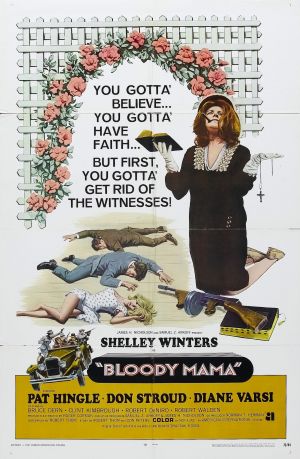
Cleaning Out The DVR, Again #24: Bloody Mama (dir by Roger Corman)


(Lisa is currently in the process of trying to clean out her DVR by watching and reviewing all 40 of the movies that she recorded from the start of March to the end of June.  She’s trying to get it all done by July 11th!  Will she make it!?  Keep visiting the site to find out!)

BloodyMama

The 24th film on my DVR was the 1970 Roger Corman-directed gangster film, Bloody Mama.  I recorded it off of TCM on May 27th.

Bloody Mama opens with a cheerful song that goes, “Maaaaaama…Bloody maaaaama….” and it’s such an unapolegetically over the top song that it perfectly sets the tone for what’s to follow.  Bloody Mama is violent, occasionally perverse, and totally unashamed.  It doesn’t pretend to be anything that it isn’t.  It’s bloody and it’s about a mother and, in the best Corman tradition, it makes no apologies!

The film tells the heavily fictionalized story of the Barkers, a group of brothers who robbed banks and killed people in the 1920s and 30s.  The majority of them were killed in a gunfight with the FBI.  Also killed in the gunfight was their mother, Kate Barker.  Always aware of the danger of bad publicity, the director of the FBI, J. Edgar Hoover, announced that Ma Barker was actually the mastermind of the Barker gang and that she was even more dangerous than her sons.  Ever since, historians have debated whether Ma Barker was the criminal mastermind described by Hoover or if she was just the innocent woman described by … well, by everyone who actually knew her.

Bloody Mama, of course, leaves no doubt.  From the minute that we discover that Shelley Winters will be playing Ma Barker, we know that she’s the most dangerous woman alive.  As played by Winters, Ma Barker is a ruthless bank robber, one who has no fear of gunning down innocent bystanders and who never lets her love for her sons get in the way of ordering them to kill a witness.  As opposed to a lot of gangster films made in the late 60s and early 70s, the film never attempts to portray its title character as being a heroic or particularly sympathetic character.  Instead, what makes the character compelling is just how thoroughly Winters commits to the role.  It doesn’t matter what Ma Barker is doing or saying, Shelley Winters totally sells it.  When the gang is cornered by the police and one associate makes the mistake of yelling that he’s not a Barker, Ma reacts by gunning him down herself and you can’t help but appreciate the lengths that Ma will go to defend her family’s name.

As for her sons, they are an interesting group of perverts and drug addicts and they’re played some of the best character actors of the 1970s.

Herman Barker (Don Stroud) is a sadist but he’s also one of Ma’s favorites.  He travels with a prostitute (played by Diane Varsi), who quickly tires of the Barkers’s violent way of life.

Arthur Barker (Clint Kimbrough) is the most practical of the Barkers and therefore, he’s also the least interesting.

Fred Barker (Robert Walden) is bisexual, which is a fact that the film handles with all the sensitivity that we’ve come to expect from a film made in 1970 (which is to say, not much at all).  Fortunately, Fred’s lover is Kevin and Kevin is played by Bruce Dern and Bruce Dern is always a lot of fun to watch, especially when he’s appearing in a Corman film.

And then there’s Lloyd who sniffs glue and shoots heroin and who is played by an obscure young actor named Robert De Niro and … wait, Robert De Niro!  That’s right!  One of the pleasures of Bloody Mama is getting to see De Niro at the start of his career.  Unfortunately, he doesn’t really get to do much, though he does occasionally flash the same unhinged smile that would later show up in Taxi Driver.

Roger Corman has repeatedly cited Bloody Mama as being one of his favorites of the many movies that he directed over the course of his long career.  I don’t blame him.  It’s a thoroughly shameless and totally entertaining film!

Keep an eye out for Bloody Mama!

Just remember, the real-life Ma Barker was probably innocent.

Film Review: Joy (dir by David O. Russell)


Joyfilmposter

Hi there and welcome to 2016!

Today was the first day of a new year so, of course, I had to go down to the Alamo Drafthouse and see a movie.  What was the title of the first movie that I saw in a theater in 2016?

Joy.

Despite the fact that Joy has gotten some seriously mixed reviews, I had high hopes when I sat down in the Alamo.  After all, Joy represents the third collaboration between director David O. Russell and one of my favorite actresses, Jennifer Lawrence.  (Their previous collaborations — Silver Linings Playbook and American Hustle — happen to be two of my favorite films of the past 5 years.)  Add to that, Joy has been advertised as being a tribute to a real-life, strong-willed woman and I figured that, at the very least, it would provide a nice alternative to the testosterone-crazed movies that I’ve recently sat through.  And finally, Joy had a great trailer!

Sure, there were a few less than positive signs about Joy.  As I mentioned before, the majority of the reviews had been mixed and the word of mouth was even worse.  (My friend, the sportswriter Jason Tarwater, used one word to describe the film to me: “Meh.”)  But what truly worried me was that Sasha Stone of AwardsDaily absolutely raved about the film on her site and that’s usually a bad sign.  Let’s not forget that this is the same Sasha Stone who claimed that Maps To The Stars was one of the best films ever made about Hollywood.

And, to be honest, I had much the same reaction to Joy that I had to Map To The Stars.  I really wanted to love Joy and, occasionally, there would be a clever bit of dialogue or an unexpected directorial choice and I would briefly perk up in my seat and think to myself, “Okay, this is the film that I wanted to see!”  But, for the most part, Joy is a disappointment.  It’s not so much that it’s bad as it’s just not particularly great.  For the most part, it’s just meh.

But let’s talk about what worked.  Overall, this may be one of Jennifer Lawrence’s lesser films but she gives a great performance, one that reminds us that she truly is one of the best actresses working today.  I’ve read some complaints that Lawrence was too young for the title role and, to be absolutely honest, she probably is.  She looks like she could easily go undercover at a high school and help Jonah Hill and Channing Tatum bust drug dealers.  But, at the same time, she projects the inner weariness of a survivor.  For lack of a better term, she has an old soul and it comes across in her films.

In Joy, she plays Joy Mangano, a divorced mother of two who lives in upstate New York.  Her mother (Virginia Madsen) lives with Joy and spends all of her time watching soap operas.  Joy ex-husband, a lounge singer named Tony (Edgar Ramirez), lives in the basement.  Meanwhile, her grandmother (Diane Ladd, who narrates the film) is always hovering in the background, offering Joy encouragement and optimism.  At the start of the film, Joy’s cantankerous father (Robert De Niro) has also moved into the house.  Joy, who was the valedictorian of her high school, has got a demeaning job working as a flight booker at the airport.

(“What’s your name?” one rude customer asks, “Joy?  You don’t seem very joyful to me…”)

How stressful is Joy’s life?  It’s so stressful that she has a reoccurring nightmare in which she’s trapped in her mother’s favorite soap opera and Susan Lucci (cleverly playing herself) tells her that she should just give up.

However, as difficult as life may get, Joy refuses to take Susan Lucci’s advise.  She invents a miraculous mop known as the miracle mop and eventually becomes a highly successful businesswoman.  Along the way, she makes her television debut on QVC and becomes a minor celebrity herself…

The film’s best scenes are the ones that deal with Joy and QVC.  These scenes, in which the inexperienced Joy proves herself to be a natural saleswoman, are the best in the film.  These scenes are filled with the spark that I was hoping would be present throughout the entire film.  Of course, it helps that these scenes also feature Bradley Cooper as a sympathetic television executive.  This is the third time that Bradley Cooper and Jennifer Lawrence have acted opposite each other and there’s an immediate chemistry between them.  In this case, it’s not a romantic chemistry (and one of the things that I did appreciate about Joy was that it didn’t try to force a predictable romance on the title character).  Instead, it’s the type of mutual respect that you rarely see between male and female characters in the movies.  It’s a lot of fun to watch, precisely because it is so real and unexpected.

But sadly, the QVC scenes only make up a relatively small part of Joy.  The rest of the film is something of a mess, with David O. Russell never settling on a consistent tone.  At times, Joy feels like a disorganized collection of themes from his previous films.  Just as in The Fighter and Silver Linings Playbook, we get the quirky and dysfunctional family.  Just as in American Hustle, we get the period detail, the Scorsese-lite soundtrack, and the moments of cynical humor.  There’s a lot going on in Joy and, at time, it doesn’t seem that Russell really knows what to do with all the theme and characters that he’s mixed into the movie.  I found myself wondering if he truly understood the story that he was trying to tell.

Finally, at the end of the film, Joy visits a business rival in Dallas, Texas.  Let’s just say that the film’s version of Dallas looks nothing like the city that I know.  (The minute that the scene cut from her ex-husband discovering that Joy had left to a close-up of a Bar-B-Q sign, I let out an exasperated, “Oh, come on!”)  I suppose I should be happy that Russell didn’t have huge mountains in the background of the Dallas scenes but seriously, would it have killed anyone to do a little research or maybe hop on a plane and spend a day or two filming on location?

(After all, if Richard Linklater or Wes Anderson decided to set a movie in David O. Russell’s home state of Massachusetts, I doubt that they would film the Boston scenes in El Paso….)

Joy features great work from Jennifer Lawrence and Bradley Cooper and it tells a story that has the potential to be very empowering.  But, when it comes to the overall film … meh.

Sorry Jen

Mad Max: Fury Road dominates the 21st Annual Critics Choice Nominations!


MadMaxFuryRoad

It’s been a busy few days as far as the Oscar precursors are concerned.  Let’s see how quickly I can get us caught up.  First off, the 21st Annual Critics Choice nominations were announced yesterday and Mad Max: Fury Road totally dominated them!

And you know what that means — its time to say that the Critics Choice nominations are …. MAD ABOUT MAX!

Anyway, here are the nominations!

BEST PICTURE
The Big Short
Bridge of Spies
Brooklyn

Carol
Mad Max: Fury Road
The Martian
The Revenant
Room
Sicario
Spotlight

BEST ACTOR
Bryan Cranston – Trumbo
Matt Damon – The Martian
Johnny Depp – Black Mass
Leonardo DiCaprio – The Revenant
Michael Fassbender – Steve Jobs
Eddie Redmayne – The Danish Girl

BEST ACTRESS
Cate Blanchett – Carol
Brie Larson – Room
Jennifer Lawrence – Joy
Charlotte Rampling – 45 Years
Saoirse Ronan – Brooklyn
Charlize Theron – Mad Max: Fury Road

BEST SUPPORTING ACTOR
Paul Dano – Love & Mercy
Tom Hardy – The Revenant
Mark Ruffalo – Spotlight

Mark Rylance – Bridge of Spies
Michael Shannon – 99 Homes
Sylvester Stallone – Creed

BEST SUPPORTING ACTRESS
Jennifer Jason Leigh – The Hateful Eight
Rooney Mara – Carol
Rachel McAdams – Spotlight
Helen Mirren – Trumbo
Alicia Vikander – The Danish Girl
Kate Winslet – Steve Jobs

BEST YOUNG ACTOR/ACTRESS
Abraham Attah – Beasts of No Nation
RJ Cyler – Me and Earl and the Dying Girl
Shameik Moore – Dope
Milo Parker – Mr. Holmes
Jacob Tremblay – Room

BEST ACTING ENSEMBLE
The Big Short
The Hateful Eight
Spotlight
Straight Outta Compton
Trumbo

BEST DIRECTOR
Todd Haynes – Carol
Alejandro González Iñárritu – The Revenant
Tom McCarthy – Spotlight
George Miller – Mad Max: Fury Road
Ridley Scott – The Martian
Steven Spielberg – Bridge of Spies

BEST ORIGINAL SCREENPLAY
Matt Charman and Ethan Coen & Joel Coen – Bridge of Spies
Alex Garland – Ex Machina
Quentin Tarantino – The Hateful Eight
Pete Docter, Meg LeFauve, Josh Cooley – Inside Out
Josh Singer and Tom McCarthy – Spotlight

BEST ADAPTED SCREENPLAY
Charles Randolph and Adam McKay – The Big Short
Nick Hornby – Brooklyn
Drew Goddard – The Martian
Emma Donoghue – Room
Aaron Sorkin – Steve Jobs

BEST CINEMATOGRAPHY
Carol – Ed Lachman
The Hateful Eight – Robert Richardson
Mad Max: Fury Road – John Seale
The Martian – Dariusz Wolski
The Revenant – Emmanuel Lubezki
Sicario – Roger Deakins

BEST PRODUCTION DESIGN
Bridge of Spies – Adam Stockhausen, Rena DeAngelo
Brooklyn – François Séguin, Jennifer Oman and Louise Tremblay
Carol – Judy Becker, Heather Loeffler
The Danish Girl – Eve Stewart, Michael Standish
Mad Max: Fury Road – Colin Gibson
The Martian – Arthur Max, Celia Bobak

BEST EDITING
The Big Short – Hank Corwin
Mad Max: Fury Road – Margaret Sixel
The Martian – Pietro Scalia
The Revenant – Stephen Mirrione
Spotlight – Tom McArdle

BEST COSTUME DESIGN
Brooklyn – Odile Dicks-Mireaux
Carol – Sandy Powell
Cinderella – Sandy Powell
The Danish Girl – Paco Delgado
Mad Max: Fury Road – Jenny Beavan

BEST HAIR & MAKEUP
Black Mass
Carol
The Danish Girl
The Hateful Eight
Mad Max: Fury Road
The Revenant

BEST VISUAL EFFECTS
Ex Machina
Jurassic World
Mad Max: Fury Road
The Martian
The Revenant
The Walk

BEST ANIMATED FEATURE
Anomalisa
The Good Dinosaur
Inside Out
The Peanuts Movie
Shaun the Sheep Movie

BEST ACTION MOVIE
Furious 7
Jurassic World
Mad Max: Fury Road
Mission Impossible: Rogue Nation
Sicario

BEST ACTOR IN AN ACTION MOVIE
Daniel Craig – Spectre
Tom Cruise – Mission Impossible: Rogue Nation
Tom Hardy – Mad Max: Fury Road
Chris Pratt – Jurassic World
Paul Rudd – Ant-Man

BEST ACTRESS IN AN ACTION MOVIE
Emily Blunt – Sicario
Rebecca Ferguson – Mission Impossible: Rogue Nation
Bryce Dallas Howard – Jurassic World
Jennifer Lawrence – The Hunger Games: Mockingjay – Part 2
Charlize Theron – Mad Max: Fury Road

BEST COMEDY
The Big Short
Inside Out
Joy
Sisters
Spy
Trainwreck

BEST ACTOR IN A COMEDY
Christian Bale – The Big Short
Steve Carell – The Big Short
Robert De Niro – The Intern
Bill Hader – Trainwreck
Jason Statham – Spy

BEST ACTRESS IN A COMEDY
Tina Fey – Sisters
Jennifer Lawrence – Joy
Melissa McCarthy – Spy
Amy Schumer – Trainwreck
Lily Tomlin – Grandma

BEST SCI-FI/HORROR MOVIE
Ex Machina
It Follows
Jurassic World
Mad Max: Fury Road
The Martian

BEST FOREIGN LANGUAGE FILM
The Assassin
Goodnight Mommy
Mustang
The Second Mother
Son of Saul

BEST DOCUMENTARY FEATURE
Amy
Cartel Land
Going Clear: Scientology and the Prison of Belief
He Named Me Malala
The Look of Silence
Where to Invade Next

BEST SONG
Fifty Shades of Grey – Love Me Like You Do
Furious 7 – See You Again
The Hunting Ground – Til It Happens To You
Love & Mercy – One Kind of Love
Spectre – Writing’s on the Wall
Youth – Simple Song #3

BEST SCORE
Carol – Carter Burwell
The Hateful Eight – Ennio Morricone
The Revenant – Ryuichi Sakamoto and Alva Noto
Sicario – Johann Johannsson
Spotlight – Howard Shore