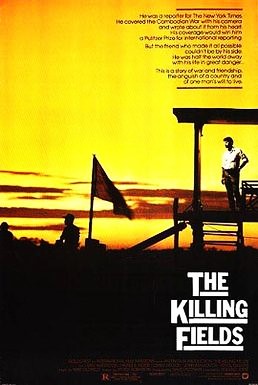
Lisa Marie Reviews An Oscar Nominee: The Killing Fields (dir by Roland Joffe)


1984’s The Killing Fields opens in 1973.  While America is distracted by the growing Watergate scandal and the final battles of the Vietnam War, the nation of Cambodia descends into chaos.  Civil War has broken out between the Cambodian National Army and the Khmer Rouge, a savage communist group led by Pol Pot.  In its desire to return Cambodia to “year zero,” the Khmer Rouge targets anyone who is considered to be too educated or too urban.

Sent to cover the war, journalist Sydney Schanberg (Sam Waterston) meets up with his translator, Dith Pran (played, in an Oscar-winning performance, by Haing S. Ngor).   For two years, Schanberg covers the war in Cambodia, taking pictures of bombed out cities, dead Cambodians, and the bullying teenagers who seem to make up the majority of the Khmer Rouge’s membership.  The Khmer Rouge’s leadership may claim to be creating an equal society but it’s hard not to notice that they act like gangsters, posing with their cigarettes and making a great show over deciding who will live and who will die.  In 1975, when it becomes apparent that the Khmer Rouge have won the war, the press and the diplomats all prepare to evacuate.  Sydney and his colleagues are able to return to their home countries.  Dith Prain’s family escape but Dith Pran himself is left behind in Cambodia where, disguising himself as a disabled beggar, he witnesses the horrors of the Khmer Rouge’s Year Zero.

The Killing Fields is an accidental anti-communist film.  Director Roland Joffe, produced David Puttnam, and screenwriter Bruce Robinson were all men in the left and, in the film, Sydney Schanberg puts the blame for the rise of the Khmer Rouge directly on the American bombing campaign of the early 70s.  The film somehow has the audacity to end with John Lennon’s Imagine, a song that epitomized the worst excesses of the Khmer Rouge’s philosophy, playing over the end credits.

I’ll be the first to admit that the film probably does have a point about the bombing of Cambodia.  The chaos that followed the bombing undoubtedly helped the Khmer Rouge to both organize and to bring in new recruits.  In this film, the Khmer Rouge commanders love to show off their power because, as Cambodians, they had previously been made to feel that they had no control over their destinies.  However, in the scenes with Dith Pran faces the horrors of the reeducation camps and discovers the fields full of skulls and other human remains, the viewer is reminded that it takes more than confusion to lead to this type of concentrated brutality. It takes a group of people brainwashed by a destructive ideology.

(How destructive was the Khmer Rouge’s Maoist philosophy?  The Khmer Rouge’s plan was to return Cambodia to being an agricultural society, one where the State stood in for both family and religion.  To do so, cities were razed.  People who were considered to be intellectuals and free thinkers were tortured and executed.  Doctors were murdered.  Having bad eyesight was considered to be a sign of intelligence and, as such, people who wore glasses were specifically targeted.  As Dith Pran says in the film, the Cambodians who survived were told that they no longer had families, friends, or beliefs.  Now they were to only worry only about serving the organization, the Angkar.)

It’s the scenes of Dith Pran in Cambodia that drive home the powerful anti-communist message that the filmmakers were perhaps not aware that they were delivering.  Haing S. Ngor was not a professional actor when he played Dith Pran.  Instead, he was a gynecologist and an obstetrician who, after the Khmer Rouge came to power, pretended to be dumb to survive.  Like Dith Pran, he was sent to a reeducation camp and he eventually escaped by making his way through the area that Dith Pran called “the Killing Fields.”  Unlike Dith Pran, Ngor’s family did not survive.  (After being sent to work on a rice farm, his wife died in childbirth.)  In the film, when we see Dith Pran discovering the Killing Fields for the first time, we are witnessing Haing Ngor recreating the moment that he discovered them.  The pain and the horror in his eyes is not only Dith Pran’s but also Haing Ngor’s and every other Cambodian who was forced to flee their country to escape the Khmer Rouge.  The film may blame America for the rise of the Khmer Rouge but Ngor’s performance makes it clear that only the Khmer Rouge can be blamed for what happened after they came to power.

It’s a powerful film, though I do think I would be remiss not to mention that Al Rockoff, the photographer played by John Malkovich in the film, has been very critical of the way that the film depicts both Sydney Schanberg and a scene where the journalists attempt to make a phony passport for Dith Pran.  Indeed, the scenes with Schanberg back in New York are considerably less compelling than the scenes of Dith Pran fighting to survive in Cambodia.  When the film’s version of Rockoff accuses Schanberg of using Dith Pran’s tragedy to advance his own career, it’s hard not to agree with him.

The film was nominated for Best Picture of 1984 but lost to Amadeus.  Dr. Ngor did win the Oscar for Best Supporting Actor, becoming the second non-professional (after Harold Russell for The Best Years of Our Lives) to do so.  Ngor went on the appear in a handful of films before being murdered in 1996.  Three members of a street gang were convicted of the murdering Ngor while attempted to rob him.  (Ngor was shot when, after giving them his Rolex, he refused to surrender a locket that contained a picture of his late wife.)  In 2009, Kang Kek lew, a Khmer Rouge official on trial for war crimes, claimed that Ngor’s murder was actually ordered by Pol Pot, the leader of the Khmer Rouge.

The Killing Field was obviously meant to be primarily critical of American foreign policy but, intentionally or not, it has since proven itself to be one of the strongest anti-communist films ever made.


Music Review: Pink Floyd — The Wall (dir by Alan Parker)


1982’s Pink Floyd — The Wall is a film that I have mixed feelings about.

Some of that is due to my feelings about Pink Floyd.  On the one hand, I can’t deny their talent and I do like quite a few of their songs, if they do all tend to be a bit on the portentous side. On the other hand …. Roger Waters!  Bleh, Roger Waters. Waters was one of the founders of Pink Floyd and, for a while, the band’s de facto leader.  He’s also a rabid anti-Semite and a defender of Vladimir Putin’s.  That said, I’ve discovered that I can justify listening to Pink Floyd by remembering that the rest of the band hates Roger Waters as well and that Waters himself eventually left Pink Floyd.  Waters’s bandmate, David Gilmour, has flat-out called Roger Waters an anti-Semite.  Last year, when we had a total eclipse of the sun, I was happy to be able to play the last two tracks of Dark Side of the Moon while enjoying the early and temporary evening.  It just felt appropriate.

Outside of Dark Side of the Moon, The Wall is probably Pink Floyd’s best-known work.  (When I was younger, I can remember my Dad playing it whenever he was driving across the country.)  A concept album about how much it sucks to be a wealthy Englishman, The Wall is one of those albums and films that are beloved by people who consider themselves to be alienated.  Even more so than the average Pink Floyd album, The Wall was the brainchild of Roger Waters and, when the movie version was made in 1982, Waters wrote the screenplay.  That said, I think you can argue that, much as with Tommy, The Wall was ultimately more about the vision of the film’s director than that of the man who wrote the songs.

The Wall is definitely an Alan Parker production.  It’s big.  It embraces the sordid.  It’s stylish almost to the point of parody.  Every image has been carefully constructed by a director who got his start doing commercials and whose main goal was to get an immediate audience reaction.  Much like Parker’s Midnight Express or Evita, it’s a film that grabs your attention while you’re watching it and only afterwards do you stop consider that there really wasn’t much going on underneath the surface.

Pink (Bob Geldof) is a self-loathing rockstar who is haunted by his childhood in post-WWII Britain and whose marriage is failing.  He’s building a wall, brick-by-brick, to keep himself separated from pain but the price of becoming comfortably numb is to be so alienated that you imagine becoming a neo-Nazi who orders his followers to follow the Worm.  The imagery is powerful.  The animated sequences by Gerald Scarfe still make quite an impression, especially the marching hammers.  The score features songs like Another Brick In The Wall, Comfortably Numb, and Run Like Hell.  The film is relentless, full of downbeat imagery that is often excessive but which Parker understood would appeal to the film’s target audience.  Indeed, it’s such an overwhelming film that it’s easy to overlook the fact that, even before he transformed into a fascist, Pink is a drab character and his main problem seems to be that he can’t seem to find anything good to watch on television.

That said, I have to admit that, despite myself, I do like The Wall.  It’s just so shameless that it’s hard not to enjoy the silliness of it all.  Add to that, Comfortably Numb is a great song.  (Another Brick In The Wall is also a great song though perhaps not for the reasons that Waters thought it was.)  The Wall is a monument to the joys of cinematic excess.

Insomnia File No. 19: Great Expectations (dir by Alfonso Cuaron)


What’s an Insomnia File? You know how some times you just can’t get any sleep and, at about three in the morning, you’ll find yourself watching whatever you can find on cable? This feature is all about those insomnia-inspired discoveries!

If you were awake at 2 in the morning last night, you could have turned over to Starz and watched the 1998 film, Great Expectations.

Great Expectations is an adaptation of the famous novel by Charles Dickens, the one about the orphan who helps a fugitive, is mentored by a bitter rich woman who lives in a decaying mansion, falls in love with the beautiful but cold-hearted Estella, and then later is helped out by a mysterious benefactor.  The thing that sets this adaptation apart from other version of the novel is that the 1998 Great Expectations is set in modern-day America, as opposed to Victorian-era Great Britain.

Actually, beyond retaining certain aspects of the plot, it’s interesting how little this version of Great Expectations has to do with the original novel.  That’s not necessarily a bad thing.  While Charles Dickens deserves to be remembered as one of the fathers of modern literature, he could also be a terribly pedantic writer.  This adaptation only touches on the novel’s overriding concerns about class and wealth in the most simplistic of ways.  It also abandons most of the novel’s subplots and instead concentrates on the love story between Estella (Gwynneth Paltrow) and Finn (Ethan Hawke).

Oh yeah, did I mention that?  The hero of this version of Great Expectations is not named Phillip Pirrip and we never have to listen to him explain that, as a child, he was nicknamed Pip because he apparently could not speak.  Instead, Pip has been renamed Finn, short for Finnegan.  If you believe the trivia section of the imdb, Finn was apparently the name of Ethan Hawke’s dog.  And again, that’s not necessarily a bad thing.  One of the main reasons why so many readers automatically dislike the narrator of Great Expectations is that he is named Pip.

Anyway, in this version, Pip Finn grows up in Florida, an orphan who is raised by his blue-collar brother-in-law, Joe Gargery (Chris Cooper, giving a very Chris Cooperish performance).  The escaped convict is played by Robert De Niro and, towards the end of the film, there’s a hilarious scene where Finn and the convict meet for a second time and Finn somehow does not recognize him, despite the fact that he still pretty much looks the same and still acts exactly like Robert De Niro.  The eccentric woman who mentors the young Finn, Mrs. Havisham Dinsmoor, is played by Anne Bancroft and Bancroft, made up to look like Bette Davis in What Ever Happened To Baby Jane?, gives a performance of almost transcendent weirdness.  And, of course, Estella — who has been raised to seduce and then destroy men — is played by Gwynneth Paltrow and, as usual, Paltrow is a lot more believable when Estella is remote and self-centered than when she has to soften up towards the end of the film.

It’s an odd film, to be honest.  This is one of those films that you watch and you try to be cynical but it’s all so lushly shot and deliriously (and manipulatively) romantic that you can’t help but occasionally get wrapped up in its spell.  Hawke and Paltrow, both of whom are incredibly young in this movie, may not have much chemistry but they’re both so achingly beautiful that it almost doesn’t matter.

Great Expectations was the second film to be directed by Alfonso Cuaron and it’s just as visually stylish as his later films.  It’s a frequently shallow and somewhat silly film but oh my God, is it ever pretty to look at.

Great_expectations_poster

Previous Insomnia Files:

  1. Story of Mankind
  2. Stag
  3. Love Is A Gun
  4. Nina Takes A Lover
  5. Black Ice
  6. Frogs For Snakes
  7. Fair Game
  8. From The Hip
  9. Born Killers
  10. Eye For An Eye
  11. Summer Catch
  12. Beyond the Law
  13. Spring Broke
  14. Promise
  15. George Wallace
  16. Kill The Messenger
  17. The Suburbans
  18. Only The Strong