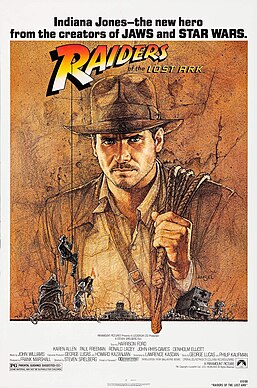
Lisa Marie Review A Best Picture Nominee: Raiders of the Lost Ark (dir by Steven Spielberg)


I can hear you right now.

“Really? You’re reviewing Raiders of the Lost Ark for Horrorthon? That’s not a horror movie!”

Well, you’re right, it’s not. That said, it’s definitely a film that borrows from the genre even if it doesn’t embrace it. If you’ve got a thing about spiders, you’ll cringe when Indiana Jones (Harrison Ford) has to wipe all of those tarantulas off of that guy’s shirt while they’re exploring the Peruvian temple. If you’ve got a thing about snakes, you’ll share Indiana’s reaction when the cobra hisses at him. And don’t even get me started on the justifiably famous finale. “It’s beautiful!” Belloq (Paul Freeman) shouts right before the angels turn into skeletons. A man’s eyes pop out of his head. Another one melts. Another explodes. There are plenty of scary moments in Raiders of the Lost Ark, but it’s such a thrill ride that the fear doesn’t necessarily linger the way that it would need to for Raiders to actually be considered a horror film. We’re too busy cheering on Indy and Marion Ravenwood (Karen Allen) to duck behind the couch. That said, I think Raiders of the Lost Ark is still a perfect film for the Halloween month. Though it was released a little before my time, I imagine that Indiana Jones, with his hat and his bullwhip, was a popular figure when Halloween rolled around in 1981.

I rewatched Raiders of the Lost Ark on Tuesday and, as always, I found myself more than a little amazed at how well it holds up. There’s not a single wasted moment. The action scenes are still exciting. The moments of humor — that poor swordsman! — still make me laugh. There’s not a single weak performance to be found in the film’s large cast. Denholm Elliott is instantly lovable as Prof. Brody and John Rhys-Davies plays Sallah with just the right amount of gusto. Ronald Lacey and Wolf Kahler are thoroughly hissable as the Nazi villains and Paul Freeman brings just enough wit to the role of the duplicitous Belloq that you can understand why he and Indiana were once friends. Of course, the film truly belongs to Karen Allen and Harrison Ford. Karen Allen projects a toughness and an inner strength that keeps Marion from being just another damsel-in-distress. Harrison Ford was the perfect choice for Indiana Jones and he’s equally believable whether he’s running through the jungle, falling into a crypt, or teaching a class. (Indiana is so cute when he puts on his glasses!) My mom always used to say that she liked the way Indiana would smile in a semi-confused way before taking decisive action. For all the arguments about why the last two Indiana Jones movies failed, the answer is pretty simple. They forgot that an Indiana Jones movie is supposed to be about Indiana Jones, not Shia LaBeouf and certainly not some condescending Brit. Harrison Ford is Indiana Jones. He’s the reason we watch.

Raiders of the Lost Ark is a film that is so good that I think there’s a tendency to take it for granted. That’s why, much like with the best of the James Bond films, I think it’s important to rewatch it and re-experience just how good it is. Producer George Lucas and director Steven Spielberg sought to recreate the experience of watching the serials and the adventure films of their youth and they succeeded. Spielberg directs like a man in love with the movies and, as a result, it’s hard not to fall in love with this movie.

Raiders of the Lost Ark was, of course, a huge box office success. It was nominated for several Oscars, including Best Picture and Best Director. Harrison Ford was (unforgivably, in my opinion) not nominated for Best Actor. In the end, the Academy selected Warren Beatty over Steven Spielberg and Chariots of Fire over Raiders of the Lost Ark.
Film Review: Not Without My Daughter (dir by Brian Gilbert)


In 1991’s Not Without My Daughter, Sally Field plays Betty Mahmoody, a Michigan housewife who marriage to Dr. Sayyed “Moody” Mahmoody (Alfred Molina) is perfect until he convinces her to travel with him to his native Iran.  Moody says that the trip will only be for two weeks and that it will give his family a chance to finally meet their five year-old daughter, Mahtob (Sheila Rosenthal).  Once they arrives in Iran, Betty meets Moody’s family and is immediately made to feel unwelcome.  The men glare at her and the women seem to be annoyed that she’s bringing unwanted attention to them.  Betty struggles to fit in, covering her head and trying not to complain.  But then Moody announces that he’s decided that he will not be returning to America and that Betty and Mahtob will be staying in Iran with him.

I’m not really a huge fan of saying that a show or a movie “could not be made today,” because I often feel that’s just code for saying that you’ve reached the age where people younger than you no longer care about your taste in music or have the patience to explain the latest slang to you.  There’s no real shame in reaching that point.  It happens to everyone eventually.  (Even I find myself getting unreasonably worked up over people using “ate” as a way to praise something.)  There’s a lot of movies that would not be made today because cultural changes.  Sometimes that’s a good thing and sometimes that’s a bad thing but it’s mostly just an inescapable fact of life.  The thing to remember is that there is a difference between would and could.

Could Not Without My Daughter be made today?  Of course, it could.  It just wouldn’t be made by a major studio and it probably wouldn’t star an acclaimed actress like Sally Field.  Today, Not Without My Daughter would probably be made by a small studio somewhere in Utah and it would probably star Taryn Manning.  The major studios would be too worried about being accused of being Islamophobic to make a movie in which a seemingly charming man turns into a monster as soon as he returns home to the Middle East.  One imagines that they would probably move the action to a Mennonite community.

And it must be said that Not Without My Daughter does not feature many sympathetic Iranians.  There are a few who help Sally Field escape but they are presented as being the exception to the rule.  Even more importantly, they’re portrayed as not being particularly religious.  While Moody does start to change as soon as he and his wife land in Tehran, the film suggests that Moody’s main problem is that he’s desperate to please his male relatives.  He seems to be desperate to show that he has not allowed himself to become westernized.  For him, that means turning his wife into a virtual prisoner and declaring that she will not be allowed to see their daughter unless she submits to his demands and accepts his abuse.

Here’s the thing, though.  Iran has one of the worst human rights records out there.  Women’s rights are severely restricted in Iran.  Women are legally required to cover their hair and wear modest clothing.  Legally, husband do hold the power in the household.  They can forbid their wives from leaving the country and, as shown in this movie, they are given sole custody of their children.  The Morality Police are a real thing and women have been killed for not covering their hair.  There’s a reason why so many brave Iranian women have risked their lives to protest the Iranian government.  Being opposed to the War with Iran is not a justification for turning a blind eye to Iran’s human rights record.  Yes, one can quite rightly complain that there aren’t many sympathetic Iranians to be found in Not Without My Daughter but let’s not pretend that there isn’t some truth to the scenes where Betty is warned that she has not properly covered her head.

In the end, Not Without My Daughter is a heavy-handed but crudely effective film.  Sally Field is instantly sympathetic as Betty.  Alfred Molina is frightening as Moody.  There’s not a subtle moment to be found but I still cheered when Betty made her escape.

Review: Identity (dir. by James Mangold)


“As I was going up the stairs, I met a man who wasn’t there. He wasn’t there again today. I wish, I wish he’d go away.” — Malcolm Rivers

There’s a certain kind of movie that thrives on a rainy Sunday afternoon or a late-night cable scroll—something pulpy, clever, and self-contained, with a cast that makes you sit up a little straighter. James Mangold’s Identity from 2003 is exactly that breed of thriller. It’s not trying to reinvent the wheel, but it’s having a damn good time spinning it through mud, rain, and a whole lot of psychological fog. On the surface, Identity is a slasher-adjacent whodunit set in a deserted Nevada motel during a biblical storm, and it wears its debt to Agatha Christie’s And Then There Were None like a bloodstained badge of honor. That classic novel—where strangers are lured to an isolated island and picked off one by one according to a nursery rhyme—provides the blueprint. Mangold swaps the island for a rundown motel, the nursery rhyme for room keys, and adds a thick layer of rainy noir atmosphere. But underneath the jump scares and dripping dread, Identity is also a sly, shaggy-dog meditation on identity, trauma, and the stories we tell ourselves to survive. Mangold, who’d go on to direct Walk the Line and Logan, shows his genre dexterity here—he treats the material with just enough seriousness to keep you invested, but not so much that you can’t laugh at the absurdity when the twist finally snaps into place.

The setup is classic Christie with a tar pit of dread. A motley crew of strangers gets stranded at a rundown motel when a flash flood washes out the roads, just as the guests in And Then There Were None find themselves cut off from civilization. There’s a former cop turned limo driver (John Cusack), a has-been actress (Rebecca De Mornay), a newlywed couple, a cop escorting a prisoner, a nervous motel manager, a prostitute with a heart of gold (Amanda Peet), and a few others who might as well have target silhouettes painted on their backs. The storm rages, the power flickers, and one by one, they start turning up dead. The killer leaves behind clues—room keys, specifically—and the survivors realize the bodies are being dropped in the order of the motel’s room numbers. It’s a wonderfully cheap gimmick that works because the film leans into its own artificiality. The rain never stops. The Nevada landscape is featureless and black. The motel feels less like a real place and more like a diorama in a psychiatrist’s office. Which, as it turns out, is almost exactly what it is.

Now, here’s where the review has to carefully step around spoilers, because Identity lives and dies on its midpoint rug-pull. But seeing as the movie is over twenty years old, a gentle acknowledgment is fair: the motel carnage is intercut with scenes of a criminal psychologist (Alfred Molina) arguing with a judge during a late-night hearing about a convicted serial killer’s sanity. That killer, Malcolm Rivers, is awaiting execution, and the defense is presenting new diary evidence. You don’t have to be a detective to start connecting dots. Mangold and screenwriter Michael Cooney aren’t interested in subtlety; they want you to squirm as the two storylines begin to converge. The motel guests, we gradually realize, are not random travelers. They are fractured pieces of a single damaged psyche—personalities inside Rivers’ mind, duking it out for survival as his body faces a real-world lethal injection. The killer in the motel isn’t a man in a mask; it’s the most malevolent alter among them, systematically erasing the others. Where Christie’s novel uses a hidden murderer working through a fixed list, Identity twists that formula by making the setting itself a psychological construct.

On a technical level, Identity is a masterclass in low-budget atmosphere. Phedon Papamichael’s cinematography drenches every frame in gray-blue gloom, and the sound design makes every creak and drip sound like a gunshot. Mangold directs the ensemble with a steady hand, and the cast clearly knows what movie they’re in. Cusack brings his usual blue-collar soulfulness to Ed, the ex-cop with a guilty conscience. Ray Liotta, as the suspicious cop, chews scenery in the best way—he’s all twitchy aggression and bad intentions. But the real standout is Amanda Peet as Paris, a call girl who just wants to start over on a Florida orange farm. She’s smarter and tougher than the archetype usually allows, and her final scene in the motel’s office carries an unexpected tenderness. That’s the trick of Identity: it makes you care about figments. For a good hour, you’re genuinely invested in whether the newlyweds survive or if the motel manager will finally clean that damn room 6.

Where the movie loses some people is in the execution of its twist. When the narrative finally snaps from the motel to the real-world courtroom, there’s a jarring shift that feels almost like a different film. The last fifteen minutes become a race to explain the rules of this shared-mind universe, and here the logic gets wobbly. How exactly does a personality “die” inside a system? Why does the motel order matter? And without giving too much away, the film’s famous final reveal—which involves a third-act twist on the twist—pushes credibility to the breaking point. Some viewers will throw their hands up and groan. Others will grin and applaud the audacity. I land somewhere in the middle. On one hand, the final image is genuinely chilling, a perfect little joke about evil’s persistence. On the other hand, the film spends so much time setting up the motel’s internal rules that it forgets to make the real-world stakes feel as urgent.

Still, Identity works best if you don’t overthink it. Think of it as a B-movie with an A-movie haircut, or as And Then There Were None filtered through a late-night cable dream about multiple personality disorder. Mangold directs the violence with a knowing wink—there are no gratuitous gore shots, just quick, sharp cuts and clever misdirection. One death involving a baseball bat and a laundry machine is as goofy as it is brutal, and that tonal tightrope is hard to walk. The film also has a sneaky thematic resonance beneath the pulp. At its heart, Identity asks whether people can truly change. Every character is trapped not just by the storm, but by their own backstory: the cop who failed a case, the actress past her prime, the prostitute who dreams of orange groves. In the motel of the mind, these backstories are just narratives the personality uses to justify itself. When Paris pleads, “I get to start over,” she’s speaking for anyone who’s ever wished they could delete a bad version of themselves. The film’s bleak final twist suggests that some stories are stronger than we think—the ones we tell ourselves about who we are, and who we’ve always been.

For a thriller that runs just over ninety minutes, Identity has surprising legs. It’s not a masterpiece, but it’s a tight, well-oiled machine of suspense with a gimmick that still feels fresh if you haven’t been spoiled. The dialogue crackles with noir-lite attitude, and the pacing never sags—once the bodies start dropping around the twenty-minute mark, you’re locked in. The biggest flaw is that the movie is so proud of its puzzle-box structure that it forgets to breathe between twists. You never get a quiet moment to sit with the characters as real people because, well, they’re not real people. But that’s also the point. Identity is a movie about a metaphor, and like most metaphors, it works until you poke it too hard. If you’re looking for a rainy-night thrill ride with a cast that commits to the bit and a final shot that’ll stick in your brain like a bad dream, check in. Just maybe avoid room 6.

Retro Television Review: Miami Vice 4.4 “The Big Thaw”


Welcome to Retro Television Reviews, a feature where we review some of our favorite and least favorite shows of the past!  On Mondays, I will be reviewing Miami Vice, which ran on NBC from 1984 to 1989.  The entire show can be purchased on Prime!

I don’t even know how to describe this episode.

Episode 4.4 “The Big Thaw”

(Dir by Richard Compton, originally aired on October 23rd, 1987)

The Vice Squad raids a decrepit building, expecting to find drugs.  Instead, they find a container that holds the frozen body of a dead reggae singer.  Robillard Nevin died after eating a poisoned fish but his body was frozen so it could be thawed out once a cure had been found.  Several different groups of people — including Nevin’s widow and, for some reason, Izzy — all want the body.

Wait …. what?

This is a Miami Vice episode?  Miami Vice, as you may remember, is supposed to be a stylish and cynical show about two detective fighting a losing war against the Miami drug underworld.  Miami Vice is the show that often ends with Crockett and Tubbs looking on in anger as they realize that all of their efforts have been for nothing.  This is the show that often ends with a sympathetic character either getting shot or shooting someone else.  This is the show in which there are no happy endings and every episode — at least in the past — seemed to conclude at the cost of Sonny Crockett’s soul ….

Well, you get my point.

What the Hell is this?

The fourth season of Miami Vice is off to an uneven start.  That’s not a surprise.  After four seasons, not every episode is going to be a winner.  It happens to the best of shows.  But, seriously, how did we go from Crockett and Tubbs driving in the middle of the night while Phil Collins sings In The Air Tonight to Crockett and Tubbs trying to protect a cryogenically frozen corpse?  I guess the show was trying to keep things fresh by trying something new but this episode was just too ridiculous to work.  Not even Tubbs bringing out his fake Caribbean accent could save this episode.

By the way, cryogenics and all that …. it doesn’t work!  It’s waste of money!  But, hey, whatever.  Do what you want.  It’s your life.

Shattered Politics: The Front Runner (dir by Jason Reitman)


Based (loosely, I assume) on a true story, 2018’s The Front Runner tells the story of a politician named Gary Hart (played by Hugh Jackman).

The year is 1987 and former U.S. Sen. Gary Hart is preparing to announce that he will be seeking the Democratic nomination for the Presidency of the greatest nation of all time, the United States!  (YAY!)  Hart is widely seen as the front runner, for both the nomination and the general election.  He’s got the youth vote sewn up.  He’s energetic.  He’s supposed to be intelligent.  We are told that he is handsome and charismatic.  (I say “told” because, in this film, they seem to be informed attributes as Hugh Jackman is given a truly terrible haircut and his performance here is a bit on the dull side.)  Hart announced his candidacy while standing in the Rocky Mountains.  His wife (Vera Farmiga) is behind him, even if she chooses not to join him on the campaign trail.  His campaign manager (J.K. Simmons) is welcoming new and idealistic volunteers to the campaign headquarters and encouraging them to remember that all of the difficulties of the campaign will be worth it after Gary Hart is elected president.  As for the press, they’re investigating long-standing rumors that Hart is a womanizer.  “Follow me around, you’ll get bored,” Hart says.  So, two reporters from the Miami Herald (Bill Burr and Steve Zissis) do just that they catch a young woman named Donna Rice (Sara Paxton) apparently staying over at Gary Hart’s Florida townhouse.

“It’s nobody’s business!” Hart snaps, when asked about his private life and it’s obvious that the film expects us to take Hart’s side.  The problem, as Hart’s campaign manager points out, is that a lot of people are volunteering for Hart’s campaign and have sacrificed a lot to help him out and now, if Hart doesn’t figure out some way to deal with the story, it looks like it was all for nothing.  Even if Hart didn’t cheat with Rice, he still showed remarkably poor judgment in spending time alone with her in Florida while his wife was back in Colorado.  The film argues that the press went overboard pursuing the story and perhaps they did.  The press tends to do that and really, no politician has any excuse not to realize that.  But, even if we accept the argument that the press acted unethically, that doesn’t exactly exonerate Gary Hart, though this film certainly seems to think that it does.  To a certain extent, this film reminded me a bit of James Vanderbilt’s Truth, in which it was assumed we would be so outraged that Cate Blanchett’s Mary Mapes was fired for producing a story about George W. Bush’s time in the National Guard that we would overlook that Mapes and CBS news tried to build a major story around a bunch of obviously forged documents.

(Of course, if Hart had been running today, I doubt the scandal would have ended his campaign.  If anything, Donald Trump’s personal scandals seemed to play to his advantage when he ran in 2016 and 2024.  To a find a 21st Century equivalent to Hart’s scandal, you’d probably have to go all the way back to John Edwards in 2008.  Of course, Edwards was cheating on his wife while she was dying of breast cancer, which makes Edwards a special type of sleaze.)

As for the film itself, director Jason Reitman tries to take a Altmanesque approach, full of overlapping dialogue and deceptively casual camera moments.  There are a few moments when Reitman’s approach work.  The start of the film, in which the camera glided over hundreds of journalists reporting from outside the 1984 Democratic Convention, was so well-handled that I briefly had hope for the rest of the film.  Reitman gets good performances from dependable veterans like J.K. Simmons and Alfred Molina.  But, at the heart of the film, there’s a massive blank as Hugh Jackman gives an oddly listless performance as Hart.  The film expects us to take it for granted that Gary Hart would have been a good President but there’s nothing about Jackman’s performance to back that up.  It’s odd because, typically, Hugh Jackman is one of the most charismatic actors around.  But, as Gary Hart, he comes across as being petulant and a bit whiny.

It’s an interesting story but ultimately, The Front Runner doesn’t do it justice.


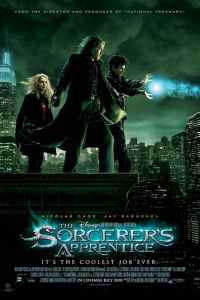
Quick Review: The Sorcerer’s Apprentice (dir. by Jon Turteltaub)


The Sorcerer’s Apprentice may be one of Disney’s better Live Action features. Borrowing from a small segment in Disney’s Fantasia, it builds a pretty cool story and still manages to pay homage to the original in it’s own way. Executive Produced by and starring Nicolas Cage, the film reunites him with his National Treasure director, Jon Turteltaub.

In the Dark Ages, the great wizard Merlin fought a major battle against the evil Morgana (Alice Krige, Star Trek: First Contact). At his side were his three apprentices, Veronica (Monica Bellucci, Beetlejuice Beetlejuice), Horvath (Alfred Molina, Prince of Persia) and Balthazar (Nicolas Cage). When Horvath betrays Merlin, both he and Morgana are defeated, contained in a layer of nesting dolls. Veronica is also part of the doll as she sacrifices herself to keep Morgana at bay. In order for Morgana to be destroyed, however, this can only be done by the Prime Merlinian, a Sorcerer of unimaginable power. To find the Prime Merlinian, Balthazar is given a ring for him to use.

When young Dave Stutler encounters Balthazar in his curio shop, we find that the ring does react to him and he may very well be the Prime Merlinian. Dave accidentally frees Horvath from the nesting doll and is saved by Balthazar before the pair of sorercers are trapped in an urn. 10 Years Pass (to the day), causing an event where both Horvath and Balthazar are freed. Can Balthazar train Dave (Jay Baruchel, Goon) in time to defeat Morgana, especially when Dave’s attentions are more focused on the girl of his dreams, Becky(Teresa Palmer, Netflix’s A Discovery of Witches)?

Thoughout his career, one of Cage’s magical traits is that he fully throws himself into a role. Not so much ‘method’ as maybe a Jeremy Strong (which may be more over the top), but he brings his own style to the mix. There isn’t a Cage character that isn’t enriched by the performances he brings to the table. For The Sorcerer’s Apprentice, he’s slightly subdued, but still carries the moxie he had in fllms like Face/Off, The Rock or even Mandy. He does make for a good father figure in this film.

Of course, the supporting cast is great. Molina makes for a nice villain in Horvath, with Toby Kebbell (Rock-n-Rolla) as an evil apprentice. Baruchel’s performance is pretty similar to what he did for How to Train Your Dragon, which made him perfect for this.

Building off of the National Treasure films, there’s as much humor in The Sorcerer’s Apprentice as there is adventure. After all, we are dealing with a tale of magic and wizards. There’s a cool car chase and a nice final confrontation. The connecting scene to Fantasia is a cute one, with magical brooms and mops trying to clean the workshop was a nice touch. The main theme of the story is just learning to believe in oneself and trust in what you’re capable of.

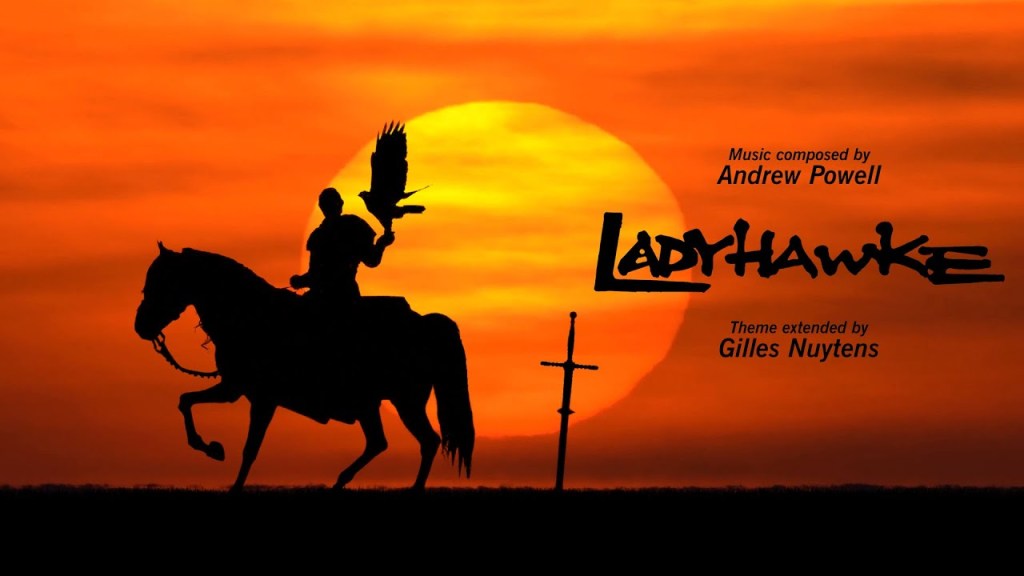
#SundayShorts with LADYHAWKE (1985)


Since Sunday is a day of rest for a lot of people, I present #SundayShorts, a weekly mini review of a movie I’ve recently watched. This week I got carried aways so it’s #SundayNotSoShorts!

We meet petty thief Gaston “The Mouse” Gaston (Matthew Broderick) as he’s finding a way to escape from the horrific dungeons of the medieval city of Aquila. Being the only person to ever escape the prison, the evil Bishop of Aquila (John Wood) orders his soldiers to find Gaston and kill him. When it appears that he’s about to be recaptured and killed, Captain Etienne Navarre (Rutger Hauer) appears and rescues him. Navarre, who’s accompanied by a hawk, forces Gaston to go with him where they seek lodging in the barn of a local farmer. That night while Gaston is out gathering wood, the duplicitous farmer attempts to kill him, but he is saved again, this time by a large black wolf. Freaked out by this seemingly random event, Gaston runs back to the barn and finds a young lady named Isabeau (Michelle Pfeiffer), but no sign of Captain Navarre. Isabeau isn’t surprised about the events that Gaston describes to her. As a matter of fact, he sees the wolf join Isabeau in the yard as she’s taking a leisurely stroll that evening. The next morning, Navarre has returned and tells Gaston that he needs his help to complete his plan to kill the Bishop. Not wanting to get involved, Gaston escapes that night and is immediately captured again by the Bishop’s soldiers. Saving Gaston a second time doesn’t go well for Navarre, when both he and the hawk are shot with arrows by the soldiers prior to dispensing of them. An injured Navarre forces Gaston to take his horse and deliver the injured hawk to a monk named Imperius (Leo McKern) who resides in a ruined castle in the area. At the castle that night, Gaston sees Isabeau with an arrow in her shoulder. Imperius tells him of a satanic curse that has been placed on husband and wife, Navarre and Isabeau, by the evil Bishop because she spurned his advances. The curse dooms them to always being together, yet eternally apart. Thus, by day Isabeau is a hawk, and by night Navarre is a wolf. After learning this, Gaston is now ready to help Navarre in his plan. Is there any way to reverse the curse, or is vengeance against the Bishop the best thing that can be hoped for? You’ll just have to watch and see!

LADYHAWKE is a film that checks quite a few boxes. It has some good action scenes. Rutger Hauer makes for a strong hero who can handle his fists and his swords in numerous fight scenes, and he looks damn awesome astride his beautiful horse! It also has some good comedy, which is mostly provided by Matthew Broderick. His petty thief has a running commentary where he talks to God anytime that he’s alone and needing help. He has this way of making promises, while also hedging his bets, so he doesn’t box himself in with promises that he has no chance to keep. I recognized myself in those conversations. The film has an air of magic and romance. Rutger Hauer and Michelle Pfeiffer are a beautiful couple. The idea that they are lovers caught up in a curse, but who still love and care for each other every day is hard to resist. This desire to see them break that curse is what gives me a real rooting interest in the outcome. The film is a story of redemption for the monk Imperius whose drunken betrayal helped put the two lovers in this position. And it’s a story of good trying to triumph over evil, with evil being vividly portrayed in the character of the Bishop. Leo McKern and John Wood embody the characters of Imperius and the Bishop perfectly. Director Richard Donner handles all of these different facets in a fun and entertaining way. I think LADYHAWKE still holds up well as a nice piece of 80’s entertainment!  

Five Fast Facts:

  1. Spike II, the hawk featured in this movie, worked in the Universal Bird Show until 2000, when she was transfered to the National Audubon society and became an Audubon Ambassador until she died in May 2007.
  2. If you needed proof that celebrities aren’t like the rest of us, three of the castles used for this movie were owned by Italian movie director Luchino Visconti and his family.
  3. Producer and director Richard Donner originally cast Kurt Russell as Navarre. When Russell dropped out a few days before principal photography began, the part was handed to Rutger Hauer.
  4. When Matthew Broderick’s character Gaston is escaping the dungeon at the beginning of the film, you can hear someone say ‘cut’ just before Phillipe says, “It’s not unlike escaping Mother’s womb.”
  5. As enjoyable as the film is, LADYHAWKE was a disappointment at the box office. It grossed a little over $18 million on a budget of $20 million, ranking 48th in the North American box office for 1985.

Spider-Man: No Way Home (dir. by Jon Watts)


This is basically where we are.

If you haven’t seen a film on the Thursday preview night, chances are every online publisher is going to share spoilers by Friday Evening. I get it. It’s the Nature of the Beast. It makes for news, and there are people out there who either don’t mind being spoiled or need to know what they’re seeing going into a film. It’s partially why sites like Movie Pooper, and Does The Dog Die are popular. I usually try not to say anything about a movie on Twitter because of this. Everyone deserves to feel that sense of awe and surprise when the lights come down in their cinema.

These are as spoiler free as I can make them. I may write something else to focus on my thoughts with spoilers down the road.

If you managed to stay off the Internet and avoid any spoilers to Spider-Man: No Way Home (outside of the trailers themselves), then you are in for some grand fun that is almost on the level of Avengers: Endgame. I’ve been to the theatres a few times during the pandemic. Perhaps because it was an After-Midnight showing, but the audience was fantastic. The film comes full circle, with an adventure that celebrates Spider-Man’s guest appearance in the MCU for Disney/Marvel, while still building on the character for Sony’s purposes in the future. As a Trilogy, Jon Watts and the team deserve a round of applause for sticking the landing so very well here. The third film in a series is never easy, and even Sam Raimi found that out with Spider-Man 3. By the time the movie was done, I was soaking up the applause like Colin Robinson in What We Do In the Shadows.

The film picks up right at the last end credit from Spider-Man: Far From Home with Quentin Beck’s Mysterio (Jake Gyllenhaal) proclaiming to the world (through J. Jonah Jameson, played by J.K. Simmons as usual) that Spider-Man was in control of the Stark Drones and that he is really Peter Parker. Normally, my first thought here would be to own it – like Stark did. However, with murders tied in, it’s a bad rap for our webbed hero and anyone associated with him. Peter decides to make things right by visiting Doctor Strange (Benedict Cumberbatch, Power of the Dog) to make everyone forget that Spider-Man is Peter Parker. This gets botched and pulls through some villains that our Peter (Tom Holland) isn’t quite ready for.

As you’ve seen in the posters and trailers, Dr. Otto Octavius (Alfred Molina, Spider-Man 2), and Norman Osborn (Willem Dafoe, Spider-Man) along with a few others are pulled from their universe into Peter’s. When Peter discovers their fates in their own universes, he makes an attempt to save them, which puts him at odds with Doctor Strange. Can Peter find a way to change their futures, and clear his name in the process?

Of course, the gang’s all here. Zendaya, Jacob Batalon, Tony Revolori, Angourie Rice, Marisa Tomei, and Jon Favreau are all on hand for this third one. Everyone has something to offer, with Zendaya, Batalon, and Tomei carrying the most weight. The only awkward character in the whole bunch is Favreau’s Happy Hogan, who is regulated into kind of a silly comic relief here. I don’t know. I just remember Happy being a bit more capable than they way they have him this time around.

From a writing standpoint, it’s somewhat innovative. If we didn’t already have the 2019’s Academy Award winning Spider-Man: Into the Spider Verse, I’d say No Way Home was walking into uncharted territory. The film makes up for this by allowing our Peter to choose differently, compared to what we historically know about Spider-Man and these villains. I honestly enjoyed that angle and thought it helped to drive home the whole “With Great Power, Comes Great Responsibility” motto that defines Spider-Man.

Musically, Michael Giacchino weaves his own form of magic here. Pulling themes both from Doctor Strange and what he’s done with the previous films, there are a number of great sequences. When all is said and done, the score for this film may very well rival Shirley Walker’s Batman: Mask of the Phantasm score for me.

At the time of this writing, it sounds like NYC is headed for another lockdown. I’m hoping that’s not the case. If this is the last movie I get to see in a theatre for a while, I’m thankful for it. Spider-Man: No Way Home completes a great handoff from Disney/Marvel to Sony. The character did what he needed for Disney/Marvel’s MCU, and Sony still holds the movie rights to the character for where they want to take him. I’m hopeful for Spider-Man’s cinematic future.

Our Friendly Neighborhood Spider-Man’s going to be okay.

Here’s The Official Trailer For Spider-Man: No Way Home!


A few days ago, the trailer for Spider-Man: No Way Home supposedly leaked online.  I say “supposedly” because I would honestly be shocked at the idea of anything in the world of entertainment happening without Disney somehow knowing about it beforehand.

Anyway, I held off on sharing the leaked trailer because I have integrity or something.  Or maybe I was just scared I would get sued or the site would be taken down.  I don’t know.  I held off for some reason.  But now that the trailer has been officially released …. well, here it is:

Apparently, Peter’s life has gotten difficult now that the world knows that he’s Spider-Man.  Since Tony Stark is dead and Robert Downey, Jr. would probably demand too much money to play Tony’s hitherto unknown twin brother, Peter decides to get a new bearded mentor but, in typical Peter fashion, he screws up Dr. Strange’s spell by talking too much and soon, universes are literally colliding.

If I sound like I’m being snarky, that’s just the way I always sound.  I love these movies in all of their occasionally silly glory and I’m really looking forward to Spider-Man: No Way Home.  I really enjoyed the previous two movies and this trailer is certainly more entertaining than the one that dropped for The Eternals.  I actually think that Tom Holland and Benedict Cumberbatch have the potential to be a pretty good team.  Plus, I know a lot of our readers are probably really excited about Alfred Molina showing up there at the end.  Will the other Spider-Men make an appearance?  We’ll find out soon.

Here’s What Won At The Emmys Last Night!


Last night, Lisa Marie did not watch the Emmys because she says that, “I’m just not feeling TV this year.”  If Twin Peaks had been eligible to be nominated, I bet it would have been a different story!

Instead, she asked me to watch the ceremony and let everyone know what I thought.  It needed less politics and more cats.

Here’s the list of winners:

COMEDY

BEST COMEDY SERIES
“Atlanta”
“Black-ish”
“Masters of None”
“Modern Family”
“Silicon Valley”
“Unbreakable Kimmy Schmidt”
X — “Veep”

BEST COMEDY ACTRESS
Pamela Adlon, “Better Things”
Jane Fonda, “Grace and Frankie”
Allison Janney, “Mom”
Ellie Kemper, “Unbreakable Kimmy Schmidt”
X — Julia Louis-Dreyfus, “Veep”
Tracee Ellis Ross, “Black-ish”
Lily Tomlin, “Grace and Frankie”

BEST COMEDY ACTOR
Anthony Anderson, “Black-ish”
Aziz Ansari, “Master of None”
Zach Galifianaks, “Baskets”
X — Donald Glover, “Atlanta”
William H. Macy, “Shameless”
Jeffrey Tambor, “Transparent”

BEST COMEDY SUPPORTING ACTRESS
Vanessa Bayer, “Saturday Night Live”
Anna Chlumsky, “Veep”
Kathryn Hahn, “Transparent”
Leslie Jones, “Saturday Night Live”
Judith Light, “Transparent”
X — Kate McKinnon, “Saturday Night Live”

BEST COMEDY SUPPORTING ACTOR
Louie Anderson, “Baskets”
X — Alec Baldwin, “Saturday Night Live”
Tituss Burgess, “Unbreakable Kimmy Schmidt”
Ty Burrell, “Modern Family”
Tony Hale, “Veep”
Matt Walsh, “Veep”

BEST COMEDY DIRECTING
X — “Atlanta” (“B.A.N.”)
“Silicon Valley” (“Intellectual Property”)
“Silicon Valley” (“Server Error”)
“Veep” (“Justice”)
“Veep” (“Blurb”)
“Veep” (“Groundbreaking”)

BEST COMEDY WRITING
“Atlanta” (“B.A.N.”)
“Atlanta” (“Streets on Lock”)
X — “Master of None” (“Thanksgiving”)
“Silicon Valley” (“Success Failure”)
“Veep” (“Groundbreaking”)
“Veep” (“Georgia”)

DRAMA

BEST DRAMA SERIES
“Better Call Saul”
“The Crown”
X — “The Handmaid’s Tale”
“House of Cards”
“Stranger Things”
“This is Us”
“Westworld”

BEST DRAMA ACTRESS
Viola Davis, “How to Get Away with Murder”
Claire Foy, “The Crown”
X — Elisabeth Moss, “The Handmaid’s Tale”
Keri Russell, “The Americans”
Evan Rachel Wood, “Westworld”
Robin Wright, “House of Cards”

BEST DRAMA ACTOR
X — Sterling K. Brown, “This is Us”
Anthony Hopkins, “Westworld”
Bob Odenkirk, “Better Call Saul”
Matthew Rhys, “The Americans”
Liev Schreiber, “Ray Donovan”
Kevin Spacey, “House of Cards”
Milo Ventimiglia, “This is Us”

BEST DRAMA SUPPORTING ACTRESS
Uzo Aduba, “Orange is the New Black”
Millie Bobby Brown, “Stranger Things”
X — Ann Dowd, “The Handmaid’s Tale”
Chrissy Metz, “This is Us”
Thandie Newton, “Westworld”
Samira Wiley, “The Handmaid’s Tale”

BEST DRAMA SUPPORTING ACTOR
Jonathan Banks, “Better Call Saul”
David Harbour, “Stranger Things”
Ron Cephas Jones, “This is Us”
Michael Kelly, “House of Cards”
X — John Lithgow, “The Crown”
Mandy Patinkin, “Homeland”
Jeffrey Wright, “Westworld”

BEST DRAMA DIRECTING
“Better Call Saul” (“Witness”)
“The Crown” (“Hyde Park Corner”)
“The Handmaid’s Tale” (“The Bridge”)
X — “The Handmaid’s Tale” (“Offred”)
“Homeland” (“America First”)
“Stranger Things” (“Chapter One: The Vanishing of Will Byers”)
“Westworld” (“The Bicameral Mind”)

BEST DRAMA WRITING
“The Americans” (“The Soviet Division”)
“Better Call Saul” (“Chicanery”)
“The Crown” (“Assassins”)
X — “The Handmaid’s Tale” (“Offred”)
“Stranger Things” (“Chapter One: The Vanishing of Will Byers”)
“Westworld” (“The Bicameral Mind”)

MOVIE/LIMITED SERIES

BEST LIMITED SERIES
X — “Big Little Lies”
“Fargo”
“Feud: Bette and Joan”
“Genius”
“The Night Of”

BEST TV MOVIE
X — “Black Mirror: San Junipero”
“Christmas of Many Colors”
“The Immortal Life of Henrietta Lacks”
“Sherlock: The Lying Detective”
“The Wizard of Lies”

BEST MOVIE/MINI ACTRESS
Carrie Coon, “Fargo”
Felicity Huffman, “American Crime”
X — Nicole Kidman, “Big Little Lies”
Jessica Lange, “Feud: Bette and Joan”
Susan Sarandon, “Feud: Bette and Joan”
Reese Witherspoon, “Big Little Lies”

BEST MOVIE/MINI ACTOR
X — Riz Ahmed, “The Night Of”
Benedict Cumberbatch, “Sherlock: The Lying Detective”
Robert De Niro, “The Wizard of Lies”
Ewan McGregor, “Fargo”
Geoffrey Rush, “Genius”
John Turturro, “The Night Of”

BEST MOVIE/MINI SUPPORTING ACTRESS
Judy Davis, “Feud: Bette and Joan”
X — Laura Dern, “Big Little Lies”
Jackie Hoffman, “Feud: Bette and Joan”
Regina King, “American Crime”
Michelle Pfeiffer, “The Wizard of Lies”
Shailene Woodley, “Big Little Lies”

BEST MOVIE/MINI SUPPORTING ACTOR
Bill Camp, “The Night Of”
Alfred Molina, “Feud: Bette and Joan”
X — Alexander Skarsgard, “Big Little Lies”
David Thewlis, “Fargo”
Stanley Tucci, “Feud: Bette and Joan”
Michael Kenneth Williams, “The Night Of”

BEST MOVIE/MINI DIRECTING
X — “Big Little Lies”
“Fargo” (“The Law of Vacant Places”)
“Feud: Bette and Joan” (“And the Winner Is”)
“Genius” (“Einstein: Chapter One”)
“The Night Of” (“The Art of War”)
“The Night Of” (“The Beach”)

BEST MOVIE/MINI WRITING
“Big Little Lies”
X — “Black Mirror: San Junipero”
“Fargo” (“The Law of Vacant Places”)
“Feud: Bette and Joan” (“And the Winner Is”)
“Feud: Bette and Joan” (“Pilot”)
“The Night Of” (“Call of the Wild”)

VARIETY/REALITY

BEST REALITY COMPETITION PROGRAM
“The Amazing Race”
“Amercan Ninja Warrior”
“Project Runway”
“RuPaul’s Drag Race”
“Top Chef”
X — “The Voice”

BEST VARIETY TALK SERIES
“Full Frontal with Samantha Bee”
“Jimmy Kimmel Live”
X — “Last Week Tonight with John Oliver”
“Late Late Show with James Corden”
“Late Show with Stephen Colbert”
“Real Time with Bill Maher”

BEST VARIETY SKETCH SERIES
“Billy on the Street”
“Documentary Now”
“Drunk History”
“Portlandia”
X — “Saturday Night Live”
“Tracey Ullman’s Show”

BEST VARIETY SERIES DIRECTING
“Drunk History”
“Jimmy Kimmel Live”
“Last Week Tonight with John Oliver”
“Late Show with Stephen Colbert”
X — “Saturday Night Live”

BEST VARIETY SERIES WRITING
“Full Frontal with Samantha Bee”
X — “Last Week Tonight with John Oliver”
“Late Night with Seth Meyers”
“Late Show with Stephen Colbert