The Detroit Film Critics Society announced their nominees for the best of 2018 today and what can I say other than I absolutely love them?
Seriously, Josh Hamilton and Jesse Plemons for Best Supporting Actor? How can you not love that? That said, the DFCS is not one of the more influential critical groups so I wouldn’t put down any money on either Plemons or Hamilton picking up an Oscar nomination just yet. Still, both of them deserve the consideration and I love the fact that the DFCS is willing to go against the conventional wisdom when it comes to who they nominate. I mean, really, this is what the critics need to be doing during awards season. I mean, we all know that A Star is Born and Green Book are going to pick up nominations regardless. We need the critics to remind the Academy that “hey, some of these guys were pretty good too!”
In fact, if there is a theme that can be found this early in the precursor season, it appears to be that the critics would like to make sure that the Academy doesn’t forget about First Reformed and Eighth Grade.
Here are the DFCS nominees. Winners will be announced on Monday!
The New York Film Critics Circle announced their picks for the best of 2018 earlier today. The victories for Roma, Regina King, and Richard E. Grant are not surprising, as all three of them have been getting awards buzz for months.
Ethan Hawke’s victory for First Reformed is a bit more surprising because, even though his performance was widely acclaimed, I think a lot of people assumed that First Reformed came out too early in the year to be an awards contender. (That’s proving to not be the case, which is a good thing because Hawke’s performance definitely deserves consideration.)
The biggest surprise was Regina Hall’s victory for Support the Girls, a film that I haven’t seen yet, Is this going to lead to Oscar glory or is this going to be one of those fluke awards that occasionally happens during awards season? Time will tell but it’s unexpected awards like this that make me love this time of year.
(And yes, I will be watching Support the Girls as soon as I can. That’s another good thing about awards season. It can inspire you to take a chance on movies that you might otherwise have missed.)
BEST PICTURE: “Roma” (Netflix)
BEST DIRECTOR: Alfonso Cuaron, “Roma” (Netflix)
BEST ACTOR: Ethan Hawke, “First Reformed” (A24)
BEST ACTRESS: Regina Hall, “Support the Girls” (Magnolia Pictures)
BEST SUPPORTING ACTOR: Richard E. Grant, “Can You Ever Forgive Me?” (Fox Searchlight Pictures)
BEST SUPPORTING ACTRESS: Regina King, “If Beale Street Could Talk” (Annapurna Pictures)
BEST SCREENPLAY: “First Reformed” by Paul Schrader (A24)
BEST CINEMATOGRAPHY: Alfonso Cuaron, “Roma” (Netflix)
BEST ANIMATED FILM: “Spider-Man: Into the Spider-Verse” by Bob Persichetti, Peter Ramsey, Rodney Rothman (Sony Pictures Animation)
BEST NON-FICTION AWARD: “Minding the Gap” by Bing Liu (Hulu)
BEST FOREIGN LANGUAGE FILM: “Cold War” by Pawel Pawlikowski – Poland (Amazon Studios)
BEST FIRST FILM: Bo Burnham, “Eighth Grade” (A24)
SPECIAL AWARD: David Schwartz, stepping down as Chief Film Curator at Museum of the Moving Image after 33 years AND Kino Classics Box Set “Pioneers: First Women Filmmakers”
Awards season has just begun, which means that it’s time for the International Press Academy to announce their nominees for the 23rd Satellite Awards. If you’ve never heard of the Satellite Awards, they’re like the Golden Globes, just with even less credibility. For instance, the Satellite people are the one who nominated The Wolf of Wall Street for best picture, despite having not seen the film.
That said, the Satellite nominations are good way to gauge which films are currently getting awards buzz. Let’s put it like this: getting a Satellite nomination is not going to automatically translate into Oscar recognition. But it doesn’t hurt.
Below are the film nominations. (In the interest of space, I’m only posting the film nominations. If you want to see which tv shows picked up nominations, click here.)
Film
Actress in a Motion Picture, Drama Major, Independent or International
Yalitza Aparicio, “Roma”
Glenn Close, “The Wife”
Viola Davis, “Widows”
Nicole Kidman, “Destroyer”
Melissa McCarthy, “Can You Ever Forgive Me?”
Rosamund Pike, “Private War”
Actor in a Motion Picture, Drama Major, Independent or International
Today, the National Board of Review announced their picks for the best of 2018!
Every year, the announcement of the NBR’s picks is considered to be the “official” start of Awards Season. (This despite the fact that the Spirit Nominations were announced a few weeks ago and the Gotham Awards were handed out just last night.) Getting honored by the NBR is considered to be a big boost, when it comes to getting Academy recognition. Of course, nothing’s guaranteed but, since 2010, every NBR best picture winner (with the exception of A Most Violent Year in 2014) has received a corresponding Oscar nomination.
(Interestingly enough, the last time that the NBR winner actually went on to also win the Oscar for Best Picture was way back in 2008. That’s when Slumdog Millionaire won.)
This year, the NBR named, as best picture of the year, Green Book. That’s certainly a boost that Green Book, which has been struggling at the box office, needed. The NBR also gave a big boost to A Star Is Born (Bradley Cooper for Best Director, Lady Gaga for Best Actress, Sam Elliott for Best Supporting Actor), If Beale Street Could Talk (Best Adapted Screenplay, Best Supporting Actress), First Reformed (Best Original Screenplay and Top Ten of the Year) and maybe Black Panther and A Quiet Place (both of which were named as one of the ten best films of 2018).
Not getting a boost from the NBR: Spike Lee’s BlackKklansman and Damien Chazelle’s FirstMan, neither of which received any mention.
Here are the National Board of Review’s picks for the best of 2018:
Best Film: GREEN BOOK
Best Director: Bradley Cooper, A STAR IS BORN
Best Actor: Viggo Mortensen, GREEN BOOK
Best Actress: Lady Gaga, A STAR IS BORN
Best Supporting Actor: Sam Elliott, A STAR IS BORN
Best Supporting Actress: Regina King, IF BEALE STREET COULD TALK
Best Original Screenplay: Paul Schrader, FIRST REFORMED
Best Adapted Screenplay: Barry Jenkins, IF BEALE STREET COULD TALK
Best Animated Feature: INCREDIBLES 2
Breakthrough Performance: Thomasin McKenzie, LEAVE NO TRACE
Dear Readers: (groaning) “There he goes again. Another history lesson!”
CRV: “B-but it’s important to put things in their proper historical context!”
DRs: (sigh) “We guess you’re right. Sorry.”
CRV: (beaming) “No problem! Now, like I was saying…”
Back in the day, every major urban city, and many smaller sized ones, had what was known as a “Red Light District”, where sex workers plied their trade. These streets were loaded with sex shops, peep shows, massage parlors, strip joints, and Triple-X movie palaces, with hookers and drug dealers hawking their wares. New York City had its Times Square/42nd Street area, Boston had The Combat Zone near Chinatown, and Montreal the infamous St. Catherine Street. For Los Angeles, the action was on Sunset Boulevard, and it’s into this seedy milieu that writer/director Paul Schrader plunges George C. Scott in 1979’s HARDCORE, which isn’t about…
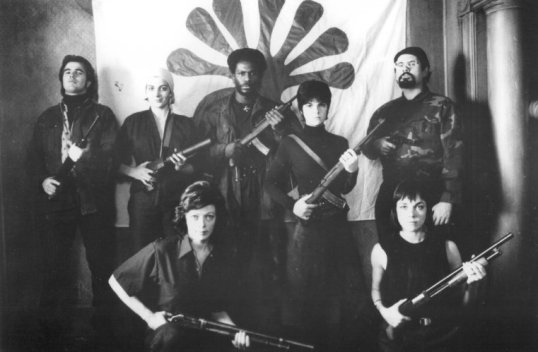
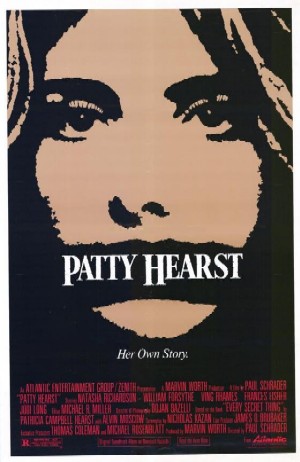
The 1988 film, Patty Hearst, is based on a fascinating true story.
In 1974, newspaper heiress Patty Hearst was a 19 year-old student at Berkeley who was kidnapped from her apartment by a group of self-styled leftist revolutionaries known as the Symbionese Liberation Army (SLA). The SLA was led by a charismatic escaped prisoner who called himself Field Marshal Cinque and who announced — via messages that Hearst read into a tape recorder — that Hearst was being held hostage in the name of social justice. The police and FBI spent several months unsuccessfully searching for Hearst until one day, the SLA released an audio tape in which Hearst announced that she had now joined the SLA and would now be known as Tania. Hearst was soon robbing banks and went from being a hostage to a wanted criminal. When she was arrested in 1975, Hearst claimed to have been brainwashed by the SLA and people still debate whether she was a sincere revolutionary, a calculating criminal, or a victim.
(From what I’ve read about the Hearst kidnapping, I guess the modern day equivalent would be if Kendall Jenner disappeared and then resurfaced in Portland, setting cars on fire with Antifa.)
What can said for sure is that, after being arrested and convicted of bank robbery, Patty Hearst was sentenced to 7 years in prison. Hearst served less than three years before her sentence was commuted by President Jimmy Carter. Twenty years later, another President — Bill Clinton — gave her a full pardon. Needless to say, the rest of the SLA did not receive a pardon or, for that matter, even a commutation. The majority of them, including Field Marshal Cinque, died in a fiery explosion that came at the climax of a gun battle with police. The rest were arrested, convicted, and ended up serving their full sentences. Of course, while the majority of the SLA came from middle and upper middle class backgrounds, only one of them was the heir to a fortune. When she was arrested, Patty may have given her career as being an “urban guerilla,” but ultimately, she was the granddaughter of William Randolph Hearst.
(Regardless of whether you believe Patty Hearst was brainwashed or not, it’s an undeniable fact that it’s easier to be a revolutionary when you know you won’t face any serious consequences if the revolution eventually fails. If the members of the SLA were around today, they could just spend their time on twitter, retweeting John Fugelsang’s thoughts on Jesus. But, in 1974, there was no twitter…)
Based on Every Secret Thing, Hearst’s own account of her kidnapping and subsequent life as a fugitive, Patty Hearst opens with the heiress (played by Natasha Richardson) being kidnapped and held prisoner by the SLA. For the first fourth of the film, we see everything exclusively through Patty’s eyes. She spends her days locked in a dark closet that’s so tiny that she can barely stand. Whenever the door is opened, shafts a bright light flood both the closet and the screen, blinding not only Patty but the audience as well. At first, Patty cannot even see the faces of the people who have kidnapped her. All she knows are their voices. Whenever that door opens, neither Patty nor the viewer knows whether she’s going to fed, berated, comforted, or raped. All four of them happen to her, several times over the course of her time in that closet. It’s harrowing to watch, all the more so because Natasha Richardson gives such an empathetic and bravely vulnerable performance as Patty. When Patty is finally allowed to leave that closet, the audience is almost thankful as she is. And, when Patty gets out of the closet, the look of the film changes as well. It goes from being darkly lit to almost garishly colorful. Patty’s entire world has changed.
The first part of the film is so powerful that it’s not surprising that the rest of Patty Hearst suffers by comparison. Once Patty gets out of the closet and declares her allegiance to the revolution, she becomes a bit of a dead-eyed zombie and the focus naturally shifts to the rest of the SLA. Ving Rhames gives a powerful performance as Cinque, the head of the SLA. Cinque may be a passionate revolutionary but he also has a dangerous messianic streak. Even worse, the film suggests, is Cinque’s lieutenant, Teko (William Forsythe). Teko claims to be a revolutionary but ultimately reveals himself to be as much of a misogynist as those who he claims to oppose. (Today, Teko would probably be one of those guys arguing that it’s okay for him to use the C word because he’s an “ally.”) Whereas Cinque has no doubt about his revolutionary commitment, Teko always seem to be trying to prove something to everyone, especially himself.
Ultimately, Patty becomes almost a bystander to her own story. For a time, she is the most famous bystander in the country. Though the film is sympathetic to Patty, Natasha Richardson plays her with just a hint of ambiguity. Ultimately, Patty comes across as someone desperately searching for an identity. Since she is not sure who she ultimately is, it’s easy for Patty to become an “urban guerilla” and it’s just as easy for to her go back to being an heiress. By the end of the film, it’s obvious that Patty is just as confused by her life as everyone else.
Patty Hearst was directed by Paul Schrader, who is best known for writing the scripts for such films as Taxi Driver and Rolling Thunder. (Among Schrader’s other directorial credits: Blue Collar, Hardcore, American Gigolo,Cat People, and The Canyons. Needless to say, he’s had an interesting career.) In many ways, Patty Hearst is probably more relevant today than it was first released. Considering that our culture is currently dominated by people pretending to be revolutionaries and celebrities famous solely for being famous, Patty Hearst feels rather prophetic.
Watching this film and experiencing Patty’s transformation from vapid heiress to brainwashed political activist to briefly notorious celebrity, I realized that we now live in a world of Patty Hearsts.
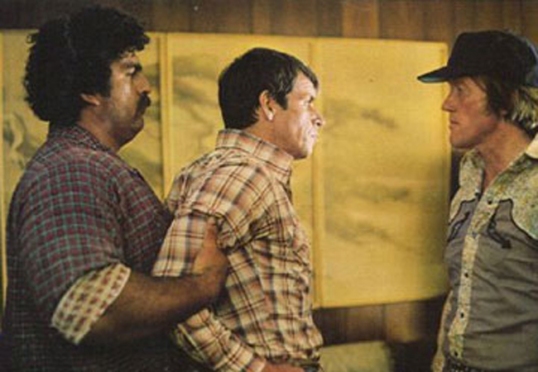
Three Detroit auto workers (played by Harvey Keitel, Yaphet Kotto, and Richard Pryor) are fed up.
It’s not just that management is constantly overworking them and trying to cheat them out of their money. That’s what management does, after all. What really upsets them is that their union is not doing anything to help. While the head of the union is getting rich off of their dues and spending time at the White House, Keitel is struggling to pay for his daughter’s braces, Kotto is in debt to a loan shark, and Pryor is lying to the IRS about the number of children that he has. (When a social worker shows up unexpectedly, Pryor’s wife recruits neighborhood children to pretend to be their’s.) Kotto, Pryor, and Keitel plot to rob the union but instead, they just discover evidence of the union’s ties to the mob. The union bosses will do anything to keep that information from being revealed, from trying to turn the friends against one another to committing murder.
Blue Collar was the directorial debut of screenwriter Paul Schrader. Schrader has said that the three main cast members did not get along during the filming, with Richard Pryor apparently bringing a gun to the set and announcing that there was no way he was going to do more than three takes of any scene. The tension between the lead actors is visible in the film, with all three of them giving edgy and angry performances. That anger is appropriate because Blue Collar is one of the few films to try to honestly tackle what it’s like to be a member of the “working class” in America. While management is presented as being a bunch of clowns, Blue Collar reserves its greatest fury for the corrupt union bosses who claim to represent the workers but who, instead, are just exploiting them. The characters in Blue Collar are pissed off because they know that nobody’s got their back. To both management and the union, the workers are worth less than the cars that they spend all day putting together and the money that can be subtracted from all their already meager pay checks.
Since it’s a Paul Schrader film from 1978, the action in Blue Collar does come to a halt, 40 minutes in, for a cocaine-fueled orgy that feels out of place. While Keitel and especially Kotto give believable performances, Pryor sometimes seems to be struggling to keep up. Still, flaws and all, Blue Collar has a raw and authentic feel to it, something that few other movies about the working class have been able to capture. Perhaps because it never sentimentalizes its characters or their situation, Blue Collar was not a box office success but it has stood the test of time better than many of the other films that were released that same year. Sadly overlooked, Blue Collar is a classic American movie.
I’m currently in the process of watching the 36 films that I’ve recorded on my DVR since March. Last night, I was extremely excited as I looked up the 7th film on the DVR and I discovered that I was about to watch the 1977 revenge classic, Rolling Thunder!
Among those of us who love old grindhouse and exploitation film, Rolling Thunder has achieved legendary status. Based on a script by Paul Schrader (though I should point out that Schrader’s script was rewritten by Heywood Gould and Schrader himself has been very critical of the actual film) and directed by John Flynn, Rolling Thunder is quite literally one of the best revenge films ever made. It’s also a great Texas film, taking place and filmed in San Antonio. Quentin Tarantino has frequently cited Rolling Thunder as being one of his favorite films and he even used the name for his short-lived distribution company, Rolling Thunder Pictures.
Rolling Thunder also has one of the greatest trailers of all time. In fact, if not for the trailer, I probably would never have set the DVR to record it off of Retroplex on March 25th. The Rolling Thunder trailer is included in one of the 42nd Street Forever compilation DVDs and, from the minute I first watched it, I knew that Rolling Thunder was a film that I had to see.
Watch the trailer below:
Everything about that trailer — from the somewhat portentous narration at the beginning to the way that Tommy Lee Jones calmly says, “I’ll get my gear,” at the end, is pure genius.
But what about the film itself? Well, having finally seen the film, I can say that Rolling Thunder is indeed a classic. It’s also one of the most brutal films that I’ve ever seen, containing scenes of truly shocking and jarring violence. In fact, the violence is so shocking that it’s also, at times, rather overwhelming. This is one of those films that you will probably remember as being far more violent than it actually is. Because, while Rolling Thunder features its share of shoot-outs and garbage disposal limb manglings, it’s actually a very deliberately paced character study.
When we first meet Maj. Charles Rane (William Devane), he’s sitting on a plane and looking down on San Antonio. He’s in full military dress uniform. Setting across from him, also in uniform, is John Vohden (Tommy Lee Jones). The year is 1973 and Rane and Vohden have both just spent the past seven years as prisoners in a Vietnamese camp. While they were prisoners, they were tortured every day. Now, they’re returning home and neither one of them is quite sure what’s going to be waiting for them.
Over the imdb, you can find a few complaints from people who feel that Rolling Thunder gets off to a slow start. And it’s true that it takes over 30 minutes to get to the pivotal scene where Maj. Rane loses both his hand and his family. But that deliberate pace is what makes Rolling Thunder more than just a revenge flick with a kickass name. That first half-hour may seem to meander but what it’s actually doing is setting both Rane and Vohden up as strangers in their own country.
The film gets a lot of mileage out of comparing Rane to Vohden. Rane is good with words. When he gets off the plane, he gives a perfect (and perfectly empty) speech about how the whole war experience has made a better American out of him. Rane knows how to fool people but it quickly becomes apparent that, on the inside, Rane feels empty.
Vohden, meanwhile, is not an articulate man. He’s not invited to give a speech when the plane lands. Vohden cannot fake the emotions that he does not feel. At first, Rane and Vohden seem to be complete opposites (and the film wisely contrasts Jones’s trademark taciturn style of acting with Devane’s more expressive technique) but eventually, we learn that they’re actually two sides of the same coin. Both of them have been left empty as a result of their wartime experiences and, in the end, Vohden is the only one who can truly understand what’s going on in Rane’s head while Rane is the only one who can understand Vohden. When Rane needs help getting revenge, Vohden is the one that he turns to. It’s not just because Vohden knows how to kill. It’s also because John Vodhen is literally the only man to whom Charles Rane can relate.
Why does Rane need revenge? After the local bank awards him with 2,000 silver dollars (“One silver dollar for every day you spent in the Hell of Hanoi!,” he is told at the presentation), Rane returns home to discover that a group of men have broken into his house. One of them, known as the Texan (an absolutely chilling performance from James Best), demands that Rane tell them where the silver dollars are hidden. When Rane responds by giving only his name, rank, and serial number, Slim (Luke Askew) reacts by forcing Rane’s arm into the kitchen sink and then turning on the garbage disposal. (A scene was apparently shot that literally showed Rane’s hand getting ripped off by the garbage disposal but it was judged to be too graphic even for this grim little movie.) Even as the disposal mangles Rane’s arm, Rane refuses to tell them where the money is. Instead, he just flashes back to being tortured at the camp and we realize that Rane’s experiences have left him immune to pain.
Of course, the Texan doesn’t realize this. Instead, he glares at Rane and mocks him by declaring him to be “one macho motherfucker.”
When Rane’s wife and son walk in on the men, Slim and the Texan murder them and leave Rane for dead. However, Charles Rane isn’t dead. He survives but he claims that he can’t remember anything about the men who attacked him. It’s only after Rane is released from the hospital and starts to practice firing a shotgun with the hook that has replaced his hand that we realize that Rane does remember. Recruiting a local waitress who also happens to be an amateur beauty queen (Linda Haynes, giving the type of great performance that makes me wonder why I’ve never seen her in any move other than Rolling Thunder) to help, Rane sets out to track down “the men who killed my boy.”
Linda Hayes in Rolling Thunder, giving a great performance in a somewhat underdeveloped role
It’s very telling that Rane continually says that he’s after the men who “killed my boy” but he never mentions his wife. When Rane first arrived home, he had one conversation with his wife. He complained that she had changed her hair and that she wasn’t wearing a bra. “Nobody wears them anymore,” She replied before telling him that, during his seven year absence, she had fallen in love with another man, Cliff (Lawrason Driscoll). And, up until she’s murdered by the Texan, that’s the last conversation that we see Rane have with his wife. Rane still lives in the house and he still tries to talk to his son (even though his son seems more comfortable around Cliff than around Rane) but Rane becomes a stranger to his family. While his wife sleeps in the house, Rane insists on staying out in the garage and continuing to go through the daily routine of calisthenics that he used to maintain his sanity while he was a prisoner.
(When Cliff asks Rane what it was like to be tortured, Rane literally forces Cliff to pull back on his arms in the same way that his Vietnamese captors had to. As I watched these scenes, I was reminded that 2008 presidential candidate John McCain cannot lift his arms above his shoulders as a result of the torture he suffered while a POW.)
When Rane goes to El Paso to recruit Vohden for his mission of revenge, we notice that Vohden also appears to be incapable of speaking to his wife. When Vohden leaves, he says goodbye to his father but not his wife. It’s probably not a coincidence that, when Vohden and Rane find Slim and the Texan, they’re at a brothel, a place where men are in charge, women are subservient, and primal needs are satisfied without the risk of emotional attachment. (It’s also probably not a coincidence that Slim is also identified as having recently returned from Vietnam. He complains that, unlike Rane and Vohden, he was never captured by the enemy and, as a result, he didn’t get a parade when he came back home.) Rolling Thunder is a film about emotionally stunted men who are incapable of interacting in any way other than violence. By the end of the film, you’re left wondering whether Rane’s mission was about revenge or about his own need to destroy.
And what an ending! When I say that the violence in Rolling Thunder is overwhelming, I’m talking about two scenes in particular. There’s the scene where Rane loses his hand and watches as The Texan casually executes his wife and son. And then there’s the ending. The final shootout was quick but it was also so brutal that I was literally shaking by the end of it.
(The scenes leading up the final shootout also featured one of the few humorous moments to be found in this otherwise grim film. When Vohden — who is inside the brothel with a prostitute — starts to put his rifle together, the prostitute asks him what he’s doing. “Oh,” Vohden says, in that perfectly weary way that only Tommy Lee Jones can do, “just going to kill a bunch of folks.”)
I mentioned earlier that Paul Schrader is reportedly not a fan of Rolling Thunder. Apparently, in his original script, Charles Rane was portrayed as being a poorly educated racist, a bit of a prototype for the character that Robert De Niro played in Taxi Driver. Ranes’s final rampage was meant to be an example of the war in Vietnam coming home and it was made much clearer that Rane’s violence was as much fueled by his own racism as by a desire for revenge. Schrader has said that his anti-fascist script was turned into a fascist movie.
A scene from Paul Schrader’s original script
With all due respect to Mr. Schrader (who I think is a very underrated filmmaker), Rolling Thunder is anything but a fascist movie. Instead, it’s a brutal and somewhat disturbing character study of a man who will never truly escape the war in which he fought. The fact that Rane is played by super smooth William Devane (as opposed to the redneck that Schrader apparently envisioned) only serves to make the film’s critique of hyper masculinity all the more disturbing. It’s interesting to note that, on their own, Rane and Vohden are never presented as being particularly likable or heroic. Instead, we root for them because the people who have hurt them are even worse.
This was how Schrader envisioned Johnny and Rane.
Though it may be far different from what Paul Schrader originally envisioned, John Flynn’s Rolling Thunder is a film that works on every level. It is both a visceral revenge film and a character study of a disturbed man. It’s a powerful film that will leave you shaken and it’s one that I will probably never erase from my DVR.
There are some movies that you just don’t dare delete.
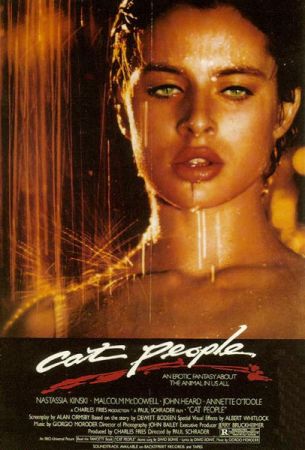
Before I get around to actually reviewing Paul Schrader’s 1982 reimagining of Cat People, I’m going to suggest that you take a few minutes to watch the film’s opening credits. Say what you will about Schrader’s Cat People, it has a great opening, one that perfectly sets up the rest of the film.
In this version of Cat People, Irena (Natassja Kinski) is a naive young woman (and virgin) who, after the death of her parents, has spent most of her previous life in foster care. Irena travels to New Orleans, where she reconnects with her older brother, Paul (Malcolm McDowell). From the minute that Irena meets her brother and his housekeeper (Ruby Dee), it’s obvious that something is off. When Paul looks at her, he does so with an unsettling intensity. At night, while Irena sleeps, Paul wanders the dark streets of New Orleans.
One morning, Irena wakes up to discover that Paul is missing. Having nothing else to do, Irena wanders around New Orleans. When she visits the zoo, she feels an immediate connection to a caged panther who stares at her with a familiar intensity. It turns out that the panther was captured the previous night, after he mysteriously appeared in a sleazy motel and mauled a prostitute.
It’s at the zoo that Irena meets zookeeper Oliver Yates (John Heard). Oliver gets Irena a job working at the zoo gift shop. where Irena is befriended by Oliver’s co-worker, Alice (Annette O’Toole). One day, Irena witnesses the panther kill another zookeeper before it then escapes from its cage.
That night, Paul suddenly shows up in Irena’s bedroom. He explains to her that they are a cursed species. Having sex causes them to turn into panthers and the only way to avoid the curse is through incest. A terrified Irena flees her brother and soon finds herself living with and falling in love with the increasingly obsessive Oliver, all the while knowing that giving herself to him physically will lead to her transformation.
From the very first second of the film. Schrader’s Cat People is an exercise in pure style. If the original Cat People was largely distinguished by its restraint, Schrader’s version is all about excess. Everything that was merely suggested in the original is made explicit in this version. As tempting as it may be to try, it’s somewhat pointless to try to compare these two versions. Though they may both be about a woman who turns into a panther when she has sex, they are two very different films.
Schrader’s Cat People walks a very fine line between moodiness and absurdity, which is perhaps why I enjoyed it. Making great use of both the sultry New Orleans setting and Giorgio Moroder’s atmospheric score, Cat People is compulsively dream-like and enjoyably over-the-top. Cat People is often described as being an example of a movie that could have only been made in the coked up 80s and truly, this is one of those films that’s so excessive that it’s becomes fascinating to watch.
(I think that often we are too quick to assume that excess is necessarily a bad thing. If you can’t be excessive when you’ve got Malcolm McDowell playing an incest-minded cat person in New Orleans, when can you be excessive?)
Schrader’s Cat People may not have much in common with the original version but the film’s best scene is the only one that is a direct recreation of a scene from the original. In fact, in recreating the scene where Alice is menaced while swimming in a public pool, Schrader actually improves on the original. Brilliantly performed by both Annette O’Toole and Natassja Kinski (whose cat-like features made her perfect for the role of Irena), it’s the only scene in the film that can truly be called scary. Starting with a tracking shock that follows Alice as she jogs, the stalking scene is practically a master class in effective horror cinema. If nothing else, you should see Cat People for that one scene.
And you should also see it for the wonderful soundtrack! Let’s end this review with David Bowie’s theme song, which you may also remember from Quentin Tarantino’s Inglourious Basterds.
Well, here we are! A month and two days ago, I announced the start of Embracing the Melodrama Part II, a 126-film series of reviews. At the time, I somewhat foolishly declared that I would manage to review all of these films in just three weeks! Four weeks later and we have finally reached the halfway point.
So yeah…
Anyway! We started this series of reviews with 1927’s Sunrise and we have worked our way through the films of the 30s, the 40s, the 50s, the 60s, and the 70s. And now, as we hit the halfway point, it’s appropriate that we start a new cinematic decade.
In other words, welcome to the 80s!
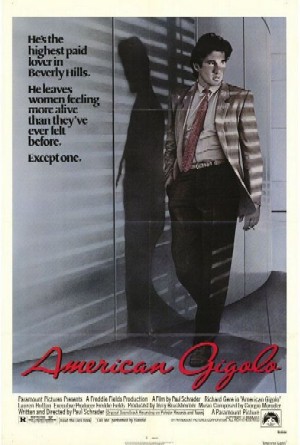
Let’s start the 80s off with the 1980 film, American Gigolo. Directed by Paul Schrader, American Gigolo is — much like Schrader’s Hardcore and The Canyons — a look at the sleazier side of life in California. Julian Kaye (Richard Gere) is the most successful male escort in Los Angeles. He’s handsome, he’s confident, he speaks multiple languages, and he maintains a proper emotional distance from … well, from everyone. He’s got a fast car, expensive clothes, a great apartment, and — because it is the 80s after all — a small mirror that is perpetually coated in cocaine residue.
We don’t really learn much about Julian’s past. We don’t know much about who he was before he became the American Gigolo. (If this movie were made today, American Gigolo would be a part of the MCU and would end up joining The Avengers.) However, the film is littered with clues. For instance, we know that he used to work exclusively for Anne (Nina Van Pallandt) but he’s become so successful that Anne has lost her hold over him. Before Julian worked for Anne, he worked for Leon (Bill Duke), a gay pimp.
Julian’s sexuality is a big question mark throughout the entire film. Though all of his current clients are female and Julian brags about his ability to leave a woman feeling sexually satisifed, the film leaves it ambiguous as to whether or not he actually likes women. (It’s suggested — though never explicitly stated — that Julian slept with men while he was working for Leon.) Ultimately, for someone who has sex for a living, Julian seems oddly asexual. It’s hard not to feel that Julian is only truly capable of desiring his own carefully constructed image.
Is Julian capable of love? That’s the question that Michelle Stratton (Lauren Hutton) has to consider. Michelle is unhappily married to a member of the U.S. Senate but she’s having an affair with Julian.
Michelle’s relationship with Julian is tested when Julian is accused of murdering one of his clients. While Julian begs both his clients and his business associated to provide him with an alibi, he discovers that he’s basically alone. Convinced that someone’s trying to frame him, Julian destroys his apartment and his car searching for clues. As he grows more and more paranoid, his perfect image starts to crack and Michelle has to decide whether or not to sacrifice her marriage to protect him.
American Gigolo is technically a murder mystery but the murder doesn’t really matter. Instead, it’s a character study of a man who is empty inside until, in Job-like fashion, he loses everything. It’s also a very watchable exercise in pure, sleek, and probably cocaine-fueled style. Richard Gere has always been an oddly hollow actor (and that’s not necessarily meant as a criticism) and that suggestion of inner emptiness makes him the perfect choice for the role of Julian Kaye.
American Gigolo is making the premium cable rounds right now. Keep an eye out for it and don’t be surprised if you find yourself singing Call Me afterwards.
 The Detroit Film Critics Society announced their nominees for the best of 2018 today and what can I say other than I absolutely love them?


 Three Detroit auto workers (played by Harvey Keitel, Yaphet Kotto, and Richard Pryor) are fed up.



 Through the Shattered Lens