Film Review: Hamlet (dir by Michael Almereyda)


What if Hamlet was a hipster douchebag?

That appears to be the question at the heart of the 2000 film adaptation of William Shakespeare’s most famous play.  In this adaptation, a young Ethan Hawke plays a Hamlet who is no longer a melancholy prince but who is instead a film student with a petulant attitude.

As you probably already guessed, this is one of those modern day adaptations of Shakespeare.  Denmark is now a Manhattan-based corporation.  Elsinore is a hotel.  Hamlet ponders life while wandering around a Blockbuster and, at one point, the ghost of his father stands in front of a Pepsi machine.  While Shakespeare’s dialogue remains unchanged, everyone delivers their lives while wearing modern clothing.  It’s one of those things that would seem rather brave and experimental if not for the fact that modern day versions of Shakespeare have gone from being daring to being a cliché.

At the film’s start, the former CEO of the Denmark Corporation has mysteriously died and his brother, Claudius (Kyle MacLachlan), has not only taken over the company but he’s also married the widow, Gertrude (Diane Venora).  Hamlet comes home from film school, convinced that there has been a murder and his suspicions are eventually confirmed by the ghost of his father (Sam Shepard).  Meanwhile, poor Ophelia (Julia Stiles) takes pictures of flowers while her brother, Laertes (Liev Schreiber), glowers in the background.  Polonius (Bill Murray) offers up pointless advice while Fortinbras (Casey Affleck) is reimagined as a corporate investor and Rosencrantz (Steve Zahn) wears a hockey jersey.  Hamlet spends a lot of time filming himself talking and the Mousetrap is no longer a player but instead an incredibly over-the-top short film that will probably remind you of the killer video from The Ring.

I guess a huge part of this film’s appeal was meant to be that it featured a lot of people who you wouldn’t necessarily think of as being Shakespearean actors. Some of them did a surprisingly good job.  For instance, Kyle MacLachlan was wonderully villainous as Claudius and Steve Zahn was the perfect Rosencrantz.  Others, like Diane Venora and Liev Schreiber, were adequate without being particularly interesting.  But then you get to Bill Murray as Polonius and you start to realize that quirkiness can only take things so far.  Murray does a pretty good job handling Shakespeare’s dialogue but that doesn’t change the fact that he’s totally miscast as the misguided and foolish Polonius.  One could easily imagine Murray in the role of Osiric.  Though it may initially seem a stretch, one could even imagine him playing Claudius.  But he’s simply not right for the role of Polonius.  Murray’s screen presence is just too naturally snarky for him to be convincing as a character who alternates between being a “tedious, old fool” and an obsequious ass kisser.

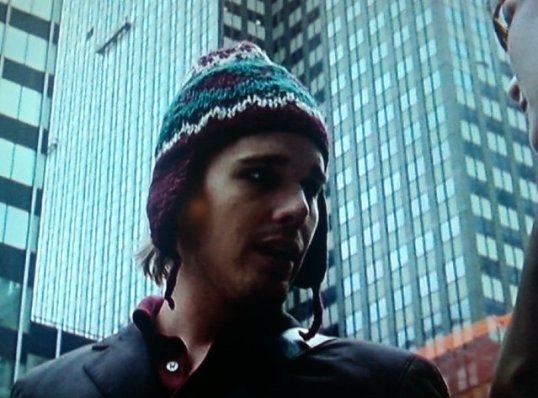
Considering that he spends a large deal of the movie wearing a snow cap while wandering around downtown Manhattan, Ethan Hawke does a surprisingly good job as Hamlet.  Or, I should say, he does a good job as this film’s version of Hamlet.  Here, Hamlet is neither the indecisive avenger nor the Oedipal madman of previous adaptations.  Instead, he’s portrayed as being rather petulant and self-absorbed, which doesn’t necessarily go against anything that one might find within Shakespeare’s original text.  Hawke’s not necessarily a likable Hamlet but his interpretation is still a credible one.

At one point, while Hamlet thinks about revenge, we see that he’s watching Laurence Olivier’s version of Hamlet on television.  There’s Olivier talking to Yorick’s skull while Hawke watches.  It’s a scene that is somehow both annoying and amusing at the same time.  On the one hand, it feels rather cutesy and more than a little pretentious.  At the same time, it’s so over-the-top in its pretension that you can’t help but kind of smile at the sight of it.  To me, that scene epitomizes the film as a whole.  It’s incredibly silly but it’s so unapologetic that it’s easy to forgive.
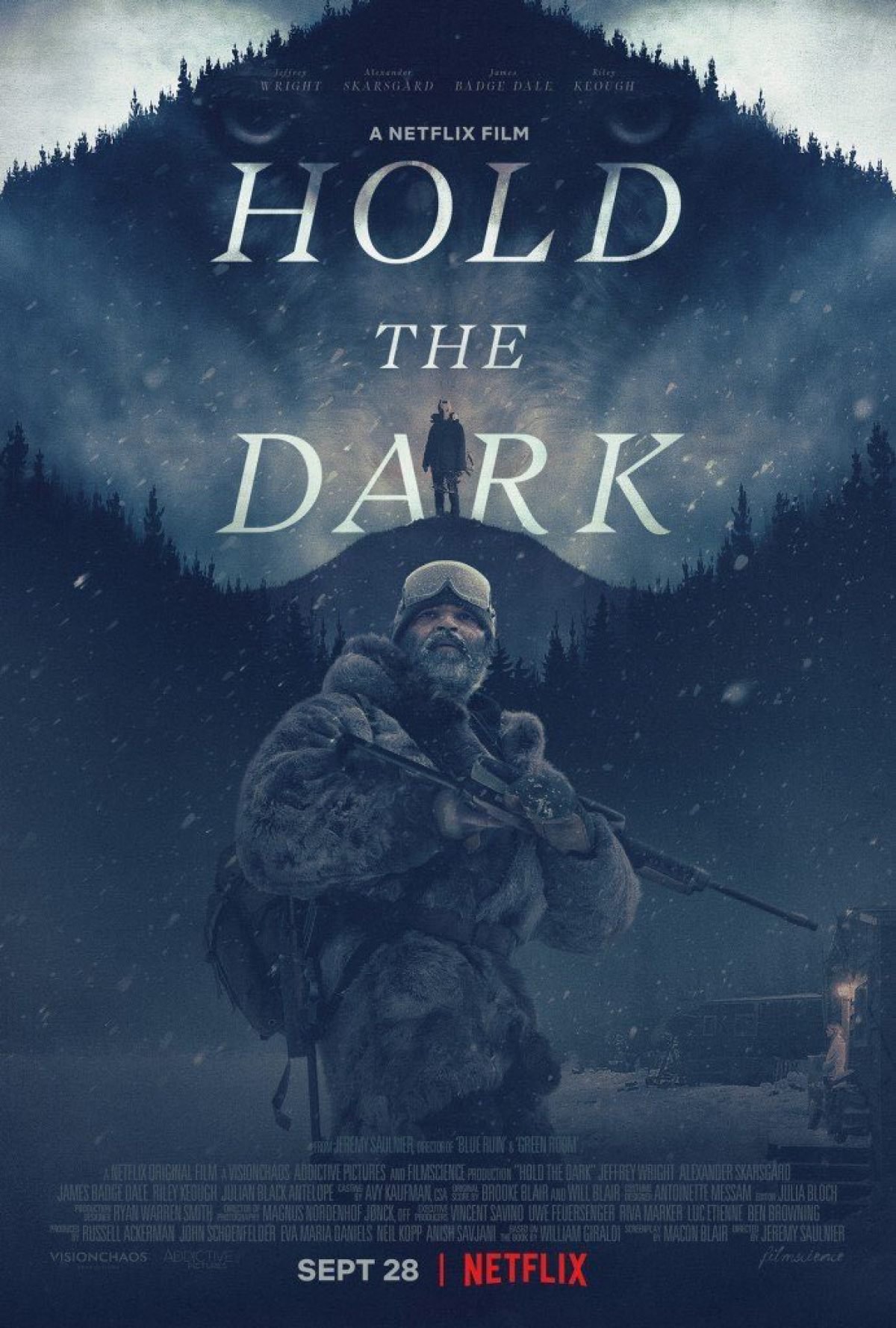
Horror Review: Hold the Dark (dir. by Jeremy Saulnier)


Hold the Dark

“The dead don’t haunt the living. The living haunt themselves.” — Russell Core

Jeremy Saulnier, writer-director of Blue Ruin and Green Room, invites the brave and the curious into his latest creation, steeped in the dark, foreboding Alaskan wilderness and tinged with supernatural folklore.

No one could accuse Saulnier of timidity when it comes to on-screen violence. While many filmmakers stage more elaborate or explosive sequences, Saulnier aligns more with Sam Peckinpah than Michael Bay. His films present violence at its most unglamorous. The brutality he depicts is neither titillating nor exploitative; instead, it’s stark, sudden, and deeply unsettling.

Saulnier views humanity’s capacity for violence as primal—an inherent trait held in check only by the thin veneer of civilization. In his films, man is not truly civilized, but rather a creature pretending to be, always closer to savagery than he’d like to admit. Whether it’s a drifter caught in a blood feud or a punk band fighting for survival against backwoods neo-Nazis, his characters are pushed to rediscover that inner, violent core—even as they try to cling to the fragile rules of civilized behavior.

With Hold the Dark, Saulnier veers away from the straightforward narratives of his previous films and ventures into something more ambiguous—closer to a haunting campfire tale than a conventional thriller. Its deliberately opaque storytelling may frustrate viewers who prefer clear protagonists, antagonists, and linear progression. Yet, like his earlier work, the film continues his fascination with moral ambiguity and the blurred line between good and evil.

The story begins with retired naturalist Russell Core (Jeffrey Wright), who is summoned by Medora Slone, a grieving mother living in the remote Alaskan village of Keelut. She believes wolves have taken her young son, along with two other children before him. Knowing Core’s experience as a wolf expert and hunter, she asks him to track and kill the animals responsible—both for justice and to provide closure for her husband, who is deployed in Iraq.

From the moment Core arrives in Keelut, the film slowly shifts from a man-versus-nature premise into something far more mythic and unsettling—a dark fairytale with no promise of a happy ending. This tonal shift will either draw viewers in, asking them to surrender to its grim, disorienting atmosphere, or leave them detached and confused, searching for concrete answers the film refuses to provide.

Like Saulnier’s previous films, Hold the Dark does not shy away from brutality. Violence erupts suddenly and with horrifying efficiency, emphasizing how fragile the human body—and psyche—really is.

The screenplay, written by frequent collaborator Macon Blair, raises compelling questions: Is violence an inherent darkness within humanity, merely suppressed by the “light” of civilization? Or is it something learned, passed down like a contagion through generations? Is it an inescapable cycle, or something that can be broken? These are questions without easy answers, and the film’s ambiguity—while potentially frustrating—is also what gives it lingering power. It invites viewers to sit with these ideas rather than resolve them.

Where the narrative may divide audiences, the performances are consistently strong. Jeffrey Wright anchors the film as Russell Core, serving as both participant and observer—mirroring the audience’s own confusion and unease. Riley Keough and Alexander Skarsgård, as Medora and Vernon Slone, add further layers of tension. Keough’s eerie stillness contrasts sharply with Skarsgård’s explosive response to his son’s death—a turn that propels the film from mystery into outright horror, complete with imagery that borders on slasher territory.

Hold the Dark may not be a direct evolution of Blue Ruin or Green Room, but it carries forward Saulnier’s thematic obsessions. It allows him to explore more esoteric territory while maintaining his signature style—raw, unflinching, and deeply primal. There’s nothing comforting or hopeful in this dark fairytale, but then again, fairytales were never meant to be. They exist to confront the darkness, to give it shape, and, perhaps, to help us endure it.

What If Lisa Had All The Power: 2018 Emmys Edition


Hi, everyone!

I meant to do this a lot earlier in the month but with the combination of the 4th of July and some other things I had to attend to, I didn’t get the chance until now.  In just a few hours, the 2018 Emmy nominations will be announced.  Hopefully, it’ll be a good morning for Twin Peaks!

Anyway, here’s who and what I would nominate in the major Emmy categories if I had all the power.  Please notice that I just said major categories.  There’s like hundreds of different Emmy categories, the majority of which aren’t ever awarded during the prime time awards show.  As much as I’d love to post every single category, it’s late and I’m not sure that you really care who I think should win Outstanding Art Direction For An Informational Program, 30 Minutes Or Shorter.

Anyway, here are my picks.  Obviously, I’ve only nominated films and TV shows that I actually watched during the 2017-2018 season.  For the most part, I also limited myself to the shows and performers that have actually been submitted for Emmy consideration.  You can see a full list of all the submissions here.

Anyway, here are my nominees.  (Winners are in bold.)

Programming

Best Comedy Series

Atlanta,

Barry,

Brooklyn Nine-Nine,

The End of the Fucking World,

GLOW,

New Girl,

Silicon Valley,

Young Sheldon

Best Drama Series

The Americans,

Game of Thrones,

The Crown

Legion,

Ozark,

Stranger Things,

Trust,

Westworld

Outstanding Limited Series

The Alienist,

American Vandal,

The Assassination of Gianni Versace: American Crime Story,

Genius: Picasso,

Howard’s End,

Picnic at Hanging Rock,

The Terror,

Twin Peaks: The Return

Outstanding Television Movie

(I cheated with this category.  Jesus Christ Superstar was submitted in the category of Outstanding Variety Special.  I felt it belonged here and since it’s my list, I went with it.)

Cocaine Godmother,

I Am Elizabeth Smart,

Jesus Christ Superstar,

Psych: The Movie,

Sharknado 5,

The Tale,

USS Calllister (Black Mirror)

When Love Kills: The Falacia Blakely Story

Outstanding Reality Competition Program

The Amazing Race,

The Bachelorette,

Big Brother: Celebrity Edition,

Dancing With The Stars,

Hell’s Kitchen,

Project Runway,

Survivor,

World of Dance


Performers

Best Actor (Comedy)

Bruce Campbell in Ash Vs. Evil Dead

Donald Glover in Atlanta

Bill Hader in Barry

Pete Holmes in Crashing

Alex Lawther in The End of the Fucking World

Andy Samberg in Brooklyn Nine-Nine

Best Actor (Drama)

Jason Bateman in Ozark

Tom Ellis in Lucifer

James Franco in The Deuce

Ed Harris in Westworld

Donald Sutherland in Trust

Jeffrey Wright in Westworld

Best Actor (Limited Series)

Antonio Banderas in Genius: Picasso

Daniel Bruhl in The Alienist

Darren Criss in The Assassination of Gianni Versace: American Crime Story

Tyler Kitsch in Waco

Kyle MacLachlan in Twin Peaks: The Return

Jimmy Tatro in American Vandal

Best Actor (Movie)

Matthew Broderick in A Christmas Story Live!

Dule Hill in Psych: The Movie

John Legend in Jesus Christ Superstar

Al Pacino in Paterno

Jesse Plemons in USS Callister (Black Mirror)

James Roday in Psych: The Movie

Best Actress (Comedy)

Jessica Barden in The End Of The Fucking World

Melissa Barrera in Vida

Alison Brie in GLOW

Zooey Deschanel in New Girl

Justina Machado in One Day At A Time

Ella Purnell in Sweetbitter

Best Actress (Drama)

Claire Danes in Homeland

Claire Foy in The Crown

Rose McIver in iZombie

Krysten Ritter in Marvel’s Jessica Jones

Keri Russell in The Americans

Evan Rachel Wood in Westworld

Best Actress (Limited Series)

Hayley Atwell in Howard’s End

Natalie Dormer in Picnic at Hanging Rock

Jennifer Ferrin Mosiac

Anna Friel in The Girlfriend Experience

Sarah Gadon in Alias Grace

Louisa Krause in The Girlfriend Experience

Best Actress (Movie)

Alana Boden in I Am Elizabeth Smart

Laura Dern in The Tale

Parisa Fitz-Henley in Harry & Meghan: A Royal Romance

Kelly MacDonald in The Child In Time (Masterpiece Theater)

Maya Rudolph in A Christmas Story Live!

Catherine Zeta-Jones in Cocaine Godmother

Best Supporting Actor (Comedy)

Andre Braugher in Brooklyn Nine Nine

Brian Tyree Henry in Atlanta

Marc Maron in GLOW

Stephen Root in Barry

Henry Winkler in Barry

Zach Woods in Silicon Valley

Best Supporting Actor (Drama)

Peter Dinklage in Game of Thrones

Noah Emmerich in The Americans

Brendan Fraser in Trust

James Marsden in Westworld

Zahn McClarnon in Westworld

Matt Smith in The Crown

Best Supporting Actor (Limited Series)

Tyler Alvarez in American Vandal

Miguel Ferrer in Twin Peaks: The Return

Robert Forster in Twin Peaks: The Return

Michael Horse in Twin Peaks: The Return

David Lynch in Twin Peaks: The Return

Finn Wittrock in The Assassination of Gianni Versace: American Crime Story

Best Supporting Actor (Movie)

Corbin Bernsen in Psych: The Movie

Brandon Victor Dixon in Jesus Christ Superstar

Aldis Hodge in Black Museum (Black Mirror)

Jason Ritter in The Tale

Jimmi Simpson in USS Callister (Black Mirror)

Skeet Ulrich in I Am Elizabeth Smart

Best Supporting Actress (Comedy)

Stephanie Beartriz in Brooklyn Nine-Nine

Suzanne Cryer in Silicon Valley

Sarah Goldberg in Barry

Rita Moreno in One Day At A Time

Zoe Perry in Young Sheldon

Hannah Simone in New Girl

Best Supporting Actress (Drama)

Summer Bishil in The Magicians

Lena Headey in Game of Thrones

Margo Martindale in The Americans

Thandie Newton in Westworld

Aubrey Plaza in Legion

Tessa Thompson in Westworld

Best Supporting Actress (Limited Series)

Penelope Cruz in The Assassination of Gianni Versace: American Crime Story

Laura Dern in Twin Peaks: The Return

Dakota Fanning in The Alienist

Judith Light in The Assassination of Gianni Versace: American Crime Story

Julia Ormond in Howards End

Naomi Watts in Twin Peaks: The Return

Best Supporting Actress (Movie)

Sara Bareilles in Jesus Christ Superstar Live in Concert

Ellen Burstyn in The Tale

Michaela Coel in USS Callister (Black Mirror)

Anna Gasteyer in A Christmas Story Live!

Anjelica Huston in The Watcher In The Woods

Letitia Wright in Black Museum (Black Mirror)

Best Guest Actor (Comedy)

Bill Burr in Crashing

Josh Hamilton in Sweetbitter

Lee Majors in Ash vs. Evil Dead

Wallace Shawn in Young Sheldon

Danny Trejo in Brooklyn Nine-Nine

Gerald Webb in Barry

Best Guest Actor (Drama)

Michael C. Hall in The Crown

C. Thomas Howell in Marvel’s The Punisher

Matthew Modine in Stranger Things

Denis O’Hare in American Masters

Jimmi Simpson in Westworld

Jonathan Tucker in Westworld

Best Guest Actress (Comedy)

Gail Bean in Atlanta

Rashida Jones in Portlandia

Nasim Pedrad in Brooklyn Nine-Nine

Sheridan Piece in One Day At A Time

Elizabeth Perkins in GLOW

Wrenn Schmidt in Sweetbitter

Best Guest Actress (Drama)

Jodi Balfour in The Crown

Donatella Finocchiaro in Trust

Marlee Matlin in The Magicians

Lily Rabe in Legion 

Diana Rigg in Game of Thrones

Mageina Tovah in The Magicians

Cleaning Out The DVR: Crime + Punishment in Suburbia (dir by Rob Schmidt)


(Lisa is once again trying to clean out her DVR!  She’s got about 182 films on her DVR and she needs to get them all watched by the end of this year!  Will she make it?  Not if she’s too busy writing cutesy introductions for her reviews to actually watch the movies!  She recorded Crime + Punishment in Suburbia off of Flix on February 25th!)

Oh, dammit.

I have seen some really pretentious movies before but Crime + Punishment in Suburbia is really something else.  As you might be able to guess from the title, the film is supposedly based on the Dosteyevsky novel but it takes place not only in modern times but in suburbia as well.  Oh, and it actually has next to nothing in common with Doteyevsky novel, beyond a murder and occasional religious symbolism.  And by occasional, I mean that there’s a scene where Vincent Kartheiser wears a Jesus t-shirt.

Kartheiser plays Vincent, a teenager who I think we’re supposed to think is dark and disturbed but instead he just comes across like a weird little poser.  I mean, honestly, it takes more than just wearing black clothes to be weird.  I had a closet full of black clothes when I was eighteen and it still never brought me any closer to enlightenment.  Anyway, Vincent is a classmate of Roseanne (Monica Keena) and Roseanne is dating a handsome but dumb jock named Jimmy (James DeBello).  Roseanne’s mother is named Maggie (Ellen Barkin) and Maggie has recently married an abusive drunk named Fred (Michael Ironside).

Fred is a total jerk so Maggie goes out with her best friend, Bella (Conchata Ferrell), to a bar.  It’s at the bar that she meets Chris (Jeffrey Wright), a handsome and charming bartender.  Soon, Chris and Maggie are having an affair and when Fred finds out, he rapes his stepdaughter.  Roseanne convinces Jimmy to help her murder Fred but, after the deed is done, Roseanne finds herself struggling with her conscience.

Now, of course, in Crime & Punishment, the whole point is that the murder itself was largely random and motiveless.  The rest of the book deals with the protagonist’s attempt to come to terms with not only his crime but also with the meaninglessness of it all.  In Crime + Punishment in Suburbia, Roseanne has a good reason for killing Fred.  Fred is such a monster that there’s no real confusion as to why Roseanne did what she did.  One could argue, quite convincingly, that if she didn’t kill Fred, he would have ended up killing her.  That makes the film’s later attempt at moral ambiguity feel rather hollow and empty.

The other problem with Crime + Punishment in Suburbia is that we don’t see the story through Roseanne’s eyes.  Instead, the entire movie is narrated by Vincent.  Now, Vincent Kartheiser is not a bad actor.  Anyone who has seen Mad Men knows that.  And, in this film, he occasionally gets to flash a cute smile that makes the character a little bit bearable.  But the character he plays, Vincent, is so weird and off-putting that you have no desire to spend 100 minutes listening to him portentously talk about his existence.  Considering that Monica Keena actually gives a pretty good performance as Roseanne, the decision to tell her story through Vincent’s eyes feels all the more mistaken.

The only thing more overwrought than Vincent’s narration is Rob Schmidt’s direction.  This is one of those films that uses every narrative trick in the book to tell its story.  Look at the wild camera angles!  Look at the sudden slow motion!  Look at the freeze frame!  This is one of those movies that you watch and you just want to shout, “Calm down!” at the director.

Crime + Punishment in Suburbia is one to avoid.

Here’s What Won At The Emmys Last Night!


Last night, Lisa Marie did not watch the Emmys because she says that, “I’m just not feeling TV this year.”  If Twin Peaks had been eligible to be nominated, I bet it would have been a different story!

Instead, she asked me to watch the ceremony and let everyone know what I thought.  It needed less politics and more cats.

Here’s the list of winners:

COMEDY

BEST COMEDY SERIES
“Atlanta”
“Black-ish”
“Masters of None”
“Modern Family”
“Silicon Valley”
“Unbreakable Kimmy Schmidt”
X — “Veep”

BEST COMEDY ACTRESS
Pamela Adlon, “Better Things”
Jane Fonda, “Grace and Frankie”
Allison Janney, “Mom”
Ellie Kemper, “Unbreakable Kimmy Schmidt”
X — Julia Louis-Dreyfus, “Veep”
Tracee Ellis Ross, “Black-ish”
Lily Tomlin, “Grace and Frankie”

BEST COMEDY ACTOR
Anthony Anderson, “Black-ish”
Aziz Ansari, “Master of None”
Zach Galifianaks, “Baskets”
X — Donald Glover, “Atlanta”
William H. Macy, “Shameless”
Jeffrey Tambor, “Transparent”

BEST COMEDY SUPPORTING ACTRESS
Vanessa Bayer, “Saturday Night Live”
Anna Chlumsky, “Veep”
Kathryn Hahn, “Transparent”
Leslie Jones, “Saturday Night Live”
Judith Light, “Transparent”
X — Kate McKinnon, “Saturday Night Live”

BEST COMEDY SUPPORTING ACTOR
Louie Anderson, “Baskets”
X — Alec Baldwin, “Saturday Night Live”
Tituss Burgess, “Unbreakable Kimmy Schmidt”
Ty Burrell, “Modern Family”
Tony Hale, “Veep”
Matt Walsh, “Veep”

BEST COMEDY DIRECTING
X — “Atlanta” (“B.A.N.”)
“Silicon Valley” (“Intellectual Property”)
“Silicon Valley” (“Server Error”)
“Veep” (“Justice”)
“Veep” (“Blurb”)
“Veep” (“Groundbreaking”)

BEST COMEDY WRITING
“Atlanta” (“B.A.N.”)
“Atlanta” (“Streets on Lock”)
X — “Master of None” (“Thanksgiving”)
“Silicon Valley” (“Success Failure”)
“Veep” (“Groundbreaking”)
“Veep” (“Georgia”)

DRAMA

BEST DRAMA SERIES
“Better Call Saul”
“The Crown”
X — “The Handmaid’s Tale”
“House of Cards”
“Stranger Things”
“This is Us”
“Westworld”

BEST DRAMA ACTRESS
Viola Davis, “How to Get Away with Murder”
Claire Foy, “The Crown”
X — Elisabeth Moss, “The Handmaid’s Tale”
Keri Russell, “The Americans”
Evan Rachel Wood, “Westworld”
Robin Wright, “House of Cards”

BEST DRAMA ACTOR
X — Sterling K. Brown, “This is Us”
Anthony Hopkins, “Westworld”
Bob Odenkirk, “Better Call Saul”
Matthew Rhys, “The Americans”
Liev Schreiber, “Ray Donovan”
Kevin Spacey, “House of Cards”
Milo Ventimiglia, “This is Us”

BEST DRAMA SUPPORTING ACTRESS
Uzo Aduba, “Orange is the New Black”
Millie Bobby Brown, “Stranger Things”
X — Ann Dowd, “The Handmaid’s Tale”
Chrissy Metz, “This is Us”
Thandie Newton, “Westworld”
Samira Wiley, “The Handmaid’s Tale”

BEST DRAMA SUPPORTING ACTOR
Jonathan Banks, “Better Call Saul”
David Harbour, “Stranger Things”
Ron Cephas Jones, “This is Us”
Michael Kelly, “House of Cards”
X — John Lithgow, “The Crown”
Mandy Patinkin, “Homeland”
Jeffrey Wright, “Westworld”

BEST DRAMA DIRECTING
“Better Call Saul” (“Witness”)
“The Crown” (“Hyde Park Corner”)
“The Handmaid’s Tale” (“The Bridge”)
X — “The Handmaid’s Tale” (“Offred”)
“Homeland” (“America First”)
“Stranger Things” (“Chapter One: The Vanishing of Will Byers”)
“Westworld” (“The Bicameral Mind”)

BEST DRAMA WRITING
“The Americans” (“The Soviet Division”)
“Better Call Saul” (“Chicanery”)
“The Crown” (“Assassins”)
X — “The Handmaid’s Tale” (“Offred”)
“Stranger Things” (“Chapter One: The Vanishing of Will Byers”)
“Westworld” (“The Bicameral Mind”)

MOVIE/LIMITED SERIES

BEST LIMITED SERIES
X — “Big Little Lies”
“Fargo”
“Feud: Bette and Joan”
“Genius”
“The Night Of”

BEST TV MOVIE
X — “Black Mirror: San Junipero”
“Christmas of Many Colors”
“The Immortal Life of Henrietta Lacks”
“Sherlock: The Lying Detective”
“The Wizard of Lies”

BEST MOVIE/MINI ACTRESS
Carrie Coon, “Fargo”
Felicity Huffman, “American Crime”
X — Nicole Kidman, “Big Little Lies”
Jessica Lange, “Feud: Bette and Joan”
Susan Sarandon, “Feud: Bette and Joan”
Reese Witherspoon, “Big Little Lies”

BEST MOVIE/MINI ACTOR
X — Riz Ahmed, “The Night Of”
Benedict Cumberbatch, “Sherlock: The Lying Detective”
Robert De Niro, “The Wizard of Lies”
Ewan McGregor, “Fargo”
Geoffrey Rush, “Genius”
John Turturro, “The Night Of”

BEST MOVIE/MINI SUPPORTING ACTRESS
Judy Davis, “Feud: Bette and Joan”
X — Laura Dern, “Big Little Lies”
Jackie Hoffman, “Feud: Bette and Joan”
Regina King, “American Crime”
Michelle Pfeiffer, “The Wizard of Lies”
Shailene Woodley, “Big Little Lies”

BEST MOVIE/MINI SUPPORTING ACTOR
Bill Camp, “The Night Of”
Alfred Molina, “Feud: Bette and Joan”
X — Alexander Skarsgard, “Big Little Lies”
David Thewlis, “Fargo”
Stanley Tucci, “Feud: Bette and Joan”
Michael Kenneth Williams, “The Night Of”

BEST MOVIE/MINI DIRECTING
X — “Big Little Lies”
“Fargo” (“The Law of Vacant Places”)
“Feud: Bette and Joan” (“And the Winner Is”)
“Genius” (“Einstein: Chapter One”)
“The Night Of” (“The Art of War”)
“The Night Of” (“The Beach”)

BEST MOVIE/MINI WRITING
“Big Little Lies”
X — “Black Mirror: San Junipero”
“Fargo” (“The Law of Vacant Places”)
“Feud: Bette and Joan” (“And the Winner Is”)
“Feud: Bette and Joan” (“Pilot”)
“The Night Of” (“Call of the Wild”)

VARIETY/REALITY

BEST REALITY COMPETITION PROGRAM
“The Amazing Race”
“Amercan Ninja Warrior”
“Project Runway”
“RuPaul’s Drag Race”
“Top Chef”
X — “The Voice”

BEST VARIETY TALK SERIES
“Full Frontal with Samantha Bee”
“Jimmy Kimmel Live”
X — “Last Week Tonight with John Oliver”
“Late Late Show with James Corden”
“Late Show with Stephen Colbert”
“Real Time with Bill Maher”

BEST VARIETY SKETCH SERIES
“Billy on the Street”
“Documentary Now”
“Drunk History”
“Portlandia”
X — “Saturday Night Live”
“Tracey Ullman’s Show”

BEST VARIETY SERIES DIRECTING
“Drunk History”
“Jimmy Kimmel Live”
“Last Week Tonight with John Oliver”
“Late Show with Stephen Colbert”
X — “Saturday Night Live”

BEST VARIETY SERIES WRITING
“Full Frontal with Samantha Bee”
X — “Last Week Tonight with John Oliver”
“Late Night with Seth Meyers”
“Late Show with Stephen Colbert

Film Review: Basquiat (dir by Julian Schnabel)


Basquiat.  I love this movie.

I Shot Andy Warhol was not the only 1996 film to feature Andy Warhol as a character.  He was also a prominent supporting character in Basquiat.  In this film, he’s played by David Bowie and Bowie gives a far different performance than Jared Harris did in I Shot Andy Warhol.  Whereas Harris played Andy as a detached voyeur, Bowie’s performance is far more sympathetic.  (Of course, it should be noted that Harris and Bowie were playing Andy Warhol at very different points in the artist’s life.  Harris played the younger, pre-shooting Warhol.  Bowie played the older, post-shooting Warhol.)

Then again, it’s not just Andy Warhol who is portrayed more positively in Basquiat than in I Shot Andy Warhol.  The entire New York art scene is portrayed far more positively in Basquiat.  Whereas I Shot Andy Warhol was a film about an outsider who was destined to forever remain an outsider, Basquiat is a film about an outsider who becomes an insider.  On top of that, Basquiat was directed by a fellow insider, painter Julian Schnabel.

The film itself is a biopic of Jean-Michel Basquiat (very well played by Jeffrey Wright), the graffiti artist who, in the 1980s, briefly became one of the superstars of the New York art scene.  However, it’s less of a conventional biopic and more of a meditation on what it means to be an artist.  Throughout the film, Basquiat looks up to the New York skyline and sees a surfer riding a wave across the sky.  The image itself is never explicitly explained.  We never learn why, specifically, Basquiat visualizes a surfer.  But then again, that’s what makes the surfer a perfect symbol of Basquiat’s artistic sensibility and talent.  It’s a reminder that, while we can appreciate an artist’s work, only the artist can truly understand what that work is saying.  All attempts to try to explain or categorize art are as pointless as trying to understand why that surfer is in the sky.  Ultimately, the why is not as important as the simple fact that the surfer is there.

The film follows Basquiat as he goes from living on the streets to being a protegé of Andy Warhol’s and, until he overdosed on heroin, one of the shining lights of the New York art scene.  Along the way, Basquiat struggles to maintain a balance between art and the business.  In one of the key scenes of the film, an empty-headed suburbanite (Tatum O’Neal) looks at Basquiat’s work and whines that there’s too much green.  She just can’t handle all of that green.

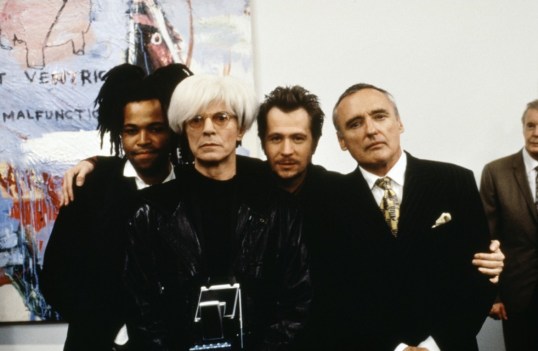
Basquiat’s friendship with Andy Warhol provides this film with a heart.  When Bowie first appears — having lunch with a German art dealer played by Dennis Hopper — one’s natural instinct is to assume that Bowie as Warhol is stunt casting.  However, Bowie quickly proves that instinct to be wrong.  As opposed to many of the actors who have played Andy Warhol over the years, Bowie gives an actual performance.  Instead of resorting to caricature, Bowie plays Warhol as being mildly bemused by both his fame and the world in general.

Basquiat also develops a close friendship with another artist.  Gary Oldman may be playing a character named Albert Milo but it’s obvious from the moment that he first appears that he’s playing the film’s director, Julian Schnabel.  If there was any doubt, Schnabel’s studio stands in for Milo’s studio.  When Milo shows off his work, he’s showing off Schnabel’s work.  When Albert Milo introduced Basquiat to his parents, the nice old couple is played by Julian Schnabel’s actual parents.  It’s perhaps not surprising that Albert Milo is presented as being one of the most important and popular artists in New York City.  In a film full of bitchy characters, Albert Milo is unique in that literally everyone likes and respects him.  And yet Gary Oldman gives such a good and heartfelt performance that you can’t hold it against the character that he happens to be perfect.  There’s a small but touching scene in which Albert Milo and his daughter share a dance in front of one of Schnabel’s gigantic canvases.  Of course, Milo’s daughter is played by Julian Schnabel’s daughter.

The entire cast is full of familiar actors.  Willem DaFoe appears as a sculptor.  Christopher Walken plays a hilariously vapid interviewer.  Courtney Love plays a groupie.  Benicio Del Toro plays Basquiat’s best friend.  Parker Posey shows up as gallery owner Mary Boone.  Michael Wincott plays Rene Ricard, the somewhat infamous art critic who was among the first to celebrate the work of both Basquiat and Schnabel.  For once, the use of familiar actors does not sabotage the effectiveness of the film.  If anything, it helps to explain why Basquiat was so determined to make it.  There’s a magical scene where a then-unknown Basquiat peeks through a gallery window and sees Andy Warhol, Albert Milo, and Bruno Bischofberger.  However, the film’s audience sees David Bowie, Gary Oldman, and Dennis Hopper.  What both Basquiat and the audience have in common is that they’re both seeing bigger-than-life stars.

Basquiat is an often magical and poignant film and I absolutely love it.

A Movie A Day #16: Boycott (2001, directed by Clark Johnson)


boycott

Originally made for HBO, Boycott is one of the best and, unfortunately, least-known films made about the life of Martin Luther King, Jr.  Boycott tells the story of the Montgomery Bus Boycott, starting with the arrest of Rosa Parks for refusing to sit in the back of the bus to the eventual integration of the Montgomery public transportation system.  Clark Johnson directs Boycott in a semi-documentary, handheld style, which adds an immediacy to the oft-told story.

Boycott focuses on the role that 24 year-old Martin Luther King, Jr. (played by Jeffrey Wright) played as the leader of the Montgomery Bus Boycott and how the boycott’s success turned King into a national figure.  Jeffrey Wright does a great job playing the young King and it’s interesting to watch as the initially uncertain King finds both his voice and his strength as a leader.  Boycott works as a good companion piece to Selma, not the least because Carmen Ejogo plays Coretta Scott King in both of them.

Also giving a noteworthy performances are Terrence Howard as King’s second-in-command, Ralph Abernathy and Erik Dellums in the role of Bayard Rustin, who was one of King’s closest confidants but, because he was gay, was often left outside of the movement’s inner circle.  Before they worked together on Boycott, Dellums, the son of former U.S. Rep. Ron Dellums, co-starred with Clark Johnson on Homicide: Life on the Street.

Boycott is a tribute to not just Martin Luther King but also the entire civil rights movement.

Playing Catch Up: The Good Dinosaur and The Peanuts Movie


The Good Dinosaur (dir by Peter Sohn)

It may be hard to remember this now but, at the beginning of 2015, a lot of film bloggers were very excited about an upcoming film from Pixar Studios.  “This,” they said, “is the film that will remind people why they love Pixar in the first place!  In fact, this might be the first animated film to get a best picture nomination since Toy Story 3!”  Of course, there was another movie from Pixar that was due to come out in 2015 but everyone agreed that movie sounded too weird and silly to be a legitimate contender.  One of the movies would be a huge success and the other would probably be forgotten in a year or two.

And, at the time, everyone was sure that The Good Dinosaur would be the triumph while Inside Out would be the also-ran.

Instead, the exact opposite happened.  Inside Out turned out to be one of the most innovative and charming animated films ever.  Meanwhile, The Good Dinosaur — despite being a financial and critical success — has struggled to escape from Inside Out‘s shadow.

But you know what?  Taken on its own terms, The Good Dinosaur is a likable and entertaining movie.  No, it’s not as good as Inside Out but then again, the same can be said for a lot of good movie that were released in 2015.  Inside Out, of course, is a movie for adults that can still be enjoyed by kids.  The Good Dinosaur is definitely a movie for kids but it’s still visually striking enough that adults can get something out of it as well.

Plotwise, The Good Dinosaur imagines a world in which that meteorite did not strike the Earth and dinosaurs and humans developed next to each other.  A teenage dinosaur — eager to prove that he’s worthy despite being clumsy and easily scared — gets separated from his family and tries to get back to them.  Along the way, he deals with villainous pterodactyls and befriends a human child that he names Spot.  Sadly, the film brings about as much depth to the idea of talking dinosaurs as Pixar previously brought to the idea of talking cars but still, it’s an enjoyable and undeniably effective film.  Unlike Inside Out, it may not be great but it’s definitely good enough.

The Peanuts Movie (dir by Steve Martino)

My sister Erin and I saw The Peanuts Movie when it first opened last November.  As we left the theater, we both agreed that the movie was genuinely sweet and cute but that the ending just didn’t feel right.  Ultimately, we agreed that the ending was just too happy.

I don’t claim to be the world’s biggest expert on the life of Charlie Brown but I do know that he’s been around for nearly 70 years and, in that time, I don’t think he’s ever really had a traditionally happy ending.  From what I’ve seen of his holiday specials, it seems that Charlie is usually fated to end up sitting by himself while snow falls all around him.  And really, that always seemed to be the main appeal of Charlie Brown as a character.  Even though nothing ever goes his way, he never stops trying.  Even though he may sometimes get discouraged, he never gives up.  The Peanuts Movie actually rewards Charlie Brown for his patience and that didn’t quite feel right.

But you know what?  Maybe, after 70 years, Charlie Brown has finally earned the right to have at least one unambiguously positive ending.  The Peanuts Movie was a financial success so I imagine there will be a sequel.  If, during that sequel, Charlie wins a game or kicks that football or gets a kite to fly or actually wears a flattering outfit, it’ll be a problem.  But for now, it’s acceptable and perhaps even appropriate that he finally got to feel good about something at the end of The Peanuts Movie.

As for the rest of the film, it’s a cute homage to the original Peanuts specials.  Despite that happy ending, it remains true to the spirit of its source material and it’s obvious that the filmmakers had a lot of affection for Charlie, Linus, Snoopy, and all the rest.

And yes, Snoopy does steal the entire film.

Was there ever any doubt?

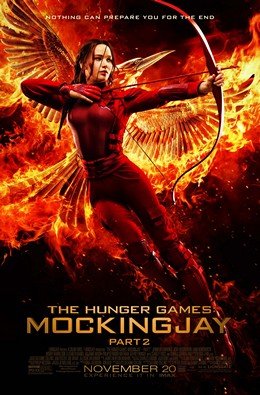
Sci-Fi Film Review: The Hunger Games: Mockingjay — Part 2 (dir by Francis Lawrence)


Mj

It’s finally over!

It probably sounds like I’m really excited that the final Hunger Games adaptation has been released.  It may sound like I’m happy that the saga of Katniss Everdeen and her life in Panem has finally come to an end.  And, to a certain extent, I am.  After everything that Katniss has been through, she deserves some peace and, fortunately, the series has ended before Jennifer Lawrence got bored with playing the role.  (To see what happens when actor gets bored with an iconic role, check out Daniel Craig in Spectre.)  Even though I think it can be argued that Mockingjay Part Two is the weakest of all the Hunger Games films, it still allows both Katniss and the actress who brought her to life to go out on a high note.

There’s a part of me that cringes a little when I think about all of the films that were released as a direct result of the success of The Hunger Games.  The Giver, The Maze Runner, Divergent, Tomorrowland, the list goes on and on.  I’ve reached the point where I can now say that I am officially sick of sitting through adaptations of Young Adult dystopian fiction.  And yet, I was still excited to see The Hunger Games: Mockingjay Part Two (even if that title is way too long and unwieldy).  Regardless of the number of mediocre films that it may have inspired, The Hunger Games franchise has always remained compelling.

So, how was Mockingjay Part Two?  Obviously, it doesn’t work as a stand-alone film.  The pacing is totally off, characters appear and disappear almost at random, and it’s all rather confusing.  If you haven’t seen the film that came before Mockingjay Part Two, I imagine that you would be totally confused by this film.  But, when viewed as the fourth part of one gigantic epic story, the whole thing is rather brilliant.

When the film opens, Katniss is still being used a prop in Alma Coin’s (Julianne Moore) revolution.  The majority of the film deals with her journey into and through the capital.  She wants to track down and assassinate President Snow (the wonderfully evil Donald Sutherland) whereas Coin just wants to use her as a symbol to solidify her authority.  As Katniss quickly realizes, there’s not much difference between Snow and Coin.  However, it takes one great tragedy for Katniss to truly understand the truth about the Alma Coin and her revolution.  If you’ve read the book, you’ll already know about and be prepared for that tragedy but it’s still a heart-breaking moment.

It’s also the most important moment in the franchise, one that reminds us that The Hunger Games has always been far more politically sophisticated (and thematically darker) than all of the films, books, and fan fic that has been inspired by it.  This is a seriously dark and, some would say, cynical movie and, as a student of history, I appreciated that.  I appreciated that Mockingjay didn’t try to force a happy ending on us and I also appreciated the fact that Mockingjay didn’t buy into the simplistic Manichaen worldview that is currently ruining worlds both real and cinematic.  The film’s final scene may be hopeful but it’s never naive.

It’s a bit unfortunate that Mockingjay had to be split into two separate films.  Mockingjay Part Two is full of exciting moments but there’s also a lot of scenes that feel like filler.  You get the feeling they were included to make sure that Mockingjay Part Two’s running team was equal to the other films in the franchise.  This is a film that features a lot of genuinely exciting action and some truly emotional moments.  It’s also a film that features a lot of speeches.  If only both parts of Mockingjay could have been released as one six hour film.  I would have watched it!

The film also features the final performance of Philip Seymour Hoffman, playing the rule of Plutarch.  Hoffman is not in many scenes and reportedly, he died before filming two of his biggest scenes.  Those scenes were rewritten and his dialogue given to other actors.  At one point, Woody Harrelson starts to read a letter that was written by Plutarch and it’s a sad scene because you’re aware that, originally, Hoffman was meant to deliver those lines in his trademark style.  As it is, Hoffman only appears in a few minutes of Mockingjay Part Two and he doesn’t do much.  But, when the film briefly features his bemused smile, you’re reminded of what a great actor the world lost when Philip Seymour Hoffman died.

Of course, the entire Hunger Games franchise has been full of great actors.  Jennifer Lawrence brought Katniss to wonderful and empowering life and one of the joys of Mockingjay Part Two is getting to see her bring the character’s story to a close.  But even beyond Jennifer Lawrence’s rightly acclaimed work, the entire cast of the franchise deserves a lot of credit.  I’ve always loved Donald Sutherland’s interpretation of President Snow and he’s at his best here.

For that matter, if there ever is another Hunger Games film or a Hunger Games spin-off, why not make it about Jena Malone’s Johanna Mason?  The way that Malone delivered her angry and frequently sarcastic dialogue was definitely one of the film’s highlights.

Regardless of whether there are any future films, The Hunger Games: Mockingjay Part Two is a worthy conclusion to a great story.

(By the way, as you may have guessed from the title of this post, December is science fiction month here at the Shattered Lens!  We hope you enjoy it!)

Previous Hunger Games Reviews:

  1. Quick Review: The Hunger Games (dir by Gary Ross)
  2. Review: The Hunger Games
  3. 44 Days of Paranoia: The Hunger Games: Catching Fire
  4. For Your Consideration: Jennifer Lawrence in The Hunger Games Mockingjay Part One

For Your Consideration #6: Jennifer Lawrence in The Hunger Games: Mockingjay Part One


Mockingjay

Of the three The Hunger Games films released so far, Mockingjay Part One is definitely the weakest.  That does not, however, mean that it’s a bad film.  It’s just that it doesn’t quite reach the grandeur of the first film, nor does it have the same political immediacy as the second one.  However, there’s a lot of good things to be said about Mockingjay.  Julianne Moore is perfectly cast as the charismatic but faintly sinister Alma Coin.  Philip Seymour Hoffman’s performance reminds us of what a towering talent we lost earlier this year.  Donald Sutherland continues to transform President Snow into a villain for the ages.  Even though he’s only in the film for a few minutes, Stanley Tucci is perfectly vapid as Caesar Flickerman.

In fact, the only real problem with Mockingjay is that it’s so obviously a prologue to something bigger.  Much as with The Maze Runner, we watch Mockingjay with the knowledge that it’s only part one and that the majority of the issues raised by the film will not be settled until next year.  The film itself knows this as well and, as such, it lacks the immediacy and much of the excitement of the first two Hunger Games films.

But yet, with all those flaws in mind, Mockingjay still works and it’s largely because of Jennifer Lawrence’s performance as Katniss Everdeen.  Whereas the first two Hunger Games films featured a Katniss who was always at the center of the action and always taking charge of any situation that she found herself in, Mockingjay features a Katniss who has far less control over her fate.  (One of the neater ironies of the series is that Katniss was actually more independent as a prisoner of President Snow than as a “guest” of Alma Coin.)  In Mockingjay, Katniss finds herself forced — with more than a little reluctance — to become the figurehead for the entire revolution and the film’s best moments are the ones in which others debate how to best “market” her.  These scenes are all about how Katniss — who is now not only a celebrity but a political icon as well — deals with losing control over her own public image.  Considering that Jennifer Lawrence’s rise to fame and acclaim occurred just as abruptly as Katniss’s, it’s probable that — even more so than in the previous films — the actress brought a lot of herself to the character.

So, yes, I would argue that Jennifer Lawrence does perhaps deserve some awards consideration for her performance in Mockingjay.  However, she truly deserves it for the consistent quality of her performance throughout the entire Hunger Games franchise.  From the very first film, Jennifer Lawrence’s performance has been iconic.  Fiercely independent without giving into the usual cinematic clichés that come with that, Katniss Everdeen has provided an alternative role model for a generation of girls who, otherwise, might have only had the likes of Bella Swan to look up to.

If that’s not worthy of being honored, then I don’t know what is.