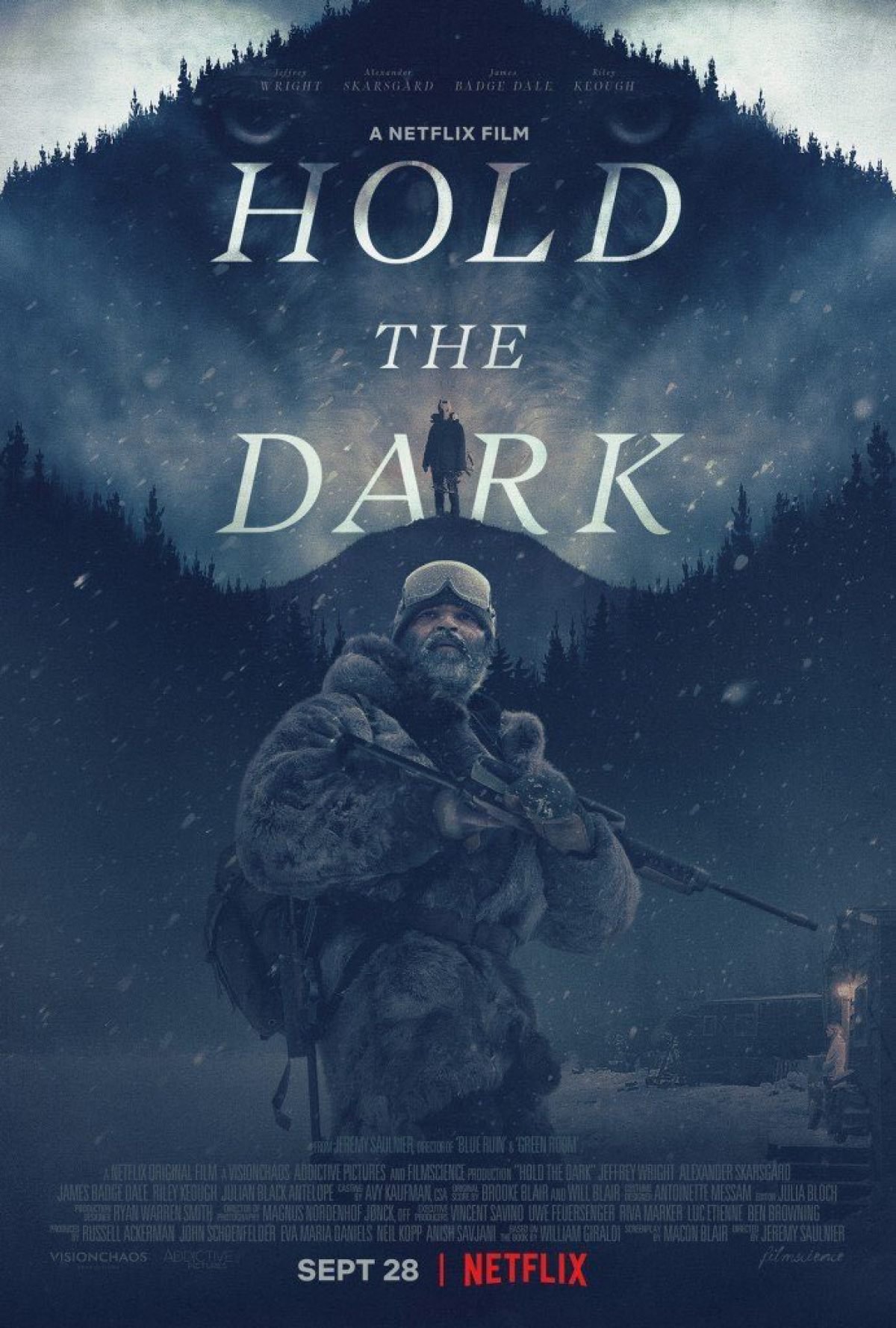
“The dead don’t haunt the living. The living haunt themselves.” — Russell Core
Jeremy Saulnier, writer-director of Blue Ruin and Green Room, invites the brave and the curious into his latest creation, steeped in the dark, foreboding Alaskan wilderness and tinged with supernatural folklore.
No one could accuse Saulnier of timidity when it comes to on-screen violence. While many filmmakers stage more elaborate or explosive sequences, Saulnier aligns more with Sam Peckinpah than Michael Bay. His films present violence at its most unglamorous. The brutality he depicts is neither titillating nor exploitative; instead, it’s stark, sudden, and deeply unsettling.
Saulnier views humanity’s capacity for violence as primal—an inherent trait held in check only by the thin veneer of civilization. In his films, man is not truly civilized, but rather a creature pretending to be, always closer to savagery than he’d like to admit. Whether it’s a drifter caught in a blood feud or a punk band fighting for survival against backwoods neo-Nazis, his characters are pushed to rediscover that inner, violent core—even as they try to cling to the fragile rules of civilized behavior.
With Hold the Dark, Saulnier veers away from the straightforward narratives of his previous films and ventures into something more ambiguous—closer to a haunting campfire tale than a conventional thriller. Its deliberately opaque storytelling may frustrate viewers who prefer clear protagonists, antagonists, and linear progression. Yet, like his earlier work, the film continues his fascination with moral ambiguity and the blurred line between good and evil.
The story begins with retired naturalist Russell Core (Jeffrey Wright), who is summoned by Medora Slone, a grieving mother living in the remote Alaskan village of Keelut. She believes wolves have taken her young son, along with two other children before him. Knowing Core’s experience as a wolf expert and hunter, she asks him to track and kill the animals responsible—both for justice and to provide closure for her husband, who is deployed in Iraq.
From the moment Core arrives in Keelut, the film slowly shifts from a man-versus-nature premise into something far more mythic and unsettling—a dark fairytale with no promise of a happy ending. This tonal shift will either draw viewers in, asking them to surrender to its grim, disorienting atmosphere, or leave them detached and confused, searching for concrete answers the film refuses to provide.
Like Saulnier’s previous films, Hold the Dark does not shy away from brutality. Violence erupts suddenly and with horrifying efficiency, emphasizing how fragile the human body—and psyche—really is.
The screenplay, written by frequent collaborator Macon Blair, raises compelling questions: Is violence an inherent darkness within humanity, merely suppressed by the “light” of civilization? Or is it something learned, passed down like a contagion through generations? Is it an inescapable cycle, or something that can be broken? These are questions without easy answers, and the film’s ambiguity—while potentially frustrating—is also what gives it lingering power. It invites viewers to sit with these ideas rather than resolve them.
Where the narrative may divide audiences, the performances are consistently strong. Jeffrey Wright anchors the film as Russell Core, serving as both participant and observer—mirroring the audience’s own confusion and unease. Riley Keough and Alexander Skarsgård, as Medora and Vernon Slone, add further layers of tension. Keough’s eerie stillness contrasts sharply with Skarsgård’s explosive response to his son’s death—a turn that propels the film from mystery into outright horror, complete with imagery that borders on slasher territory.
Hold the Dark may not be a direct evolution of Blue Ruin or Green Room, but it carries forward Saulnier’s thematic obsessions. It allows him to explore more esoteric territory while maintaining his signature style—raw, unflinching, and deeply primal. There’s nothing comforting or hopeful in this dark fairytale, but then again, fairytales were never meant to be. They exist to confront the darkness, to give it shape, and, perhaps, to help us endure it.

