Well, the Oscar season is finally here and it looks like the competition is going to be fierce! It seems like every day, a new contender is being crowned at yet another festival. Below, you’ll find my predictions for October but, honestly, it’s still difficult to narrow down all of the possible contenders to just 10 films, 5 directors, and 20 actors.
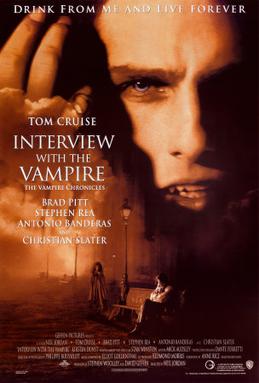
There are a lot of vampires and other cursed beings wandering through the 1994 film adaptation of Interview With A Vampire but Claudia (Kisten Dunst) is the only one for whom I have any sympathy.
Louis (Brad Pitt) may be the main character and the vampire giving the interview but it’s hard to have much sympathy for him. He’s just such a whiny little bitch. The Louisiana aristocrat is transformed into a vampire in 1791 and basically spends the next 200 years complaining about it. You want to have sympathy for him but sometimes, you just have to accept stuff and move on. It doesn’t help that Brad Pitt, who has always given his best performances when cast as men of action, is somewhat miscast as the effete and self-loathing Louis.
Lestat (Tom Cruise) may be the most charismatic of the vampires but he’s never exactly sympathetic. He turns Louis into a vampire and then spends years following him across Louisiana and Europe. Lestat is decadence personified and he never whines and, as a result, he’s far more enjoyable to spend time with than Louis. Cruise is as perfectly cast as Lestat as Pitt was miscat as Louis. Lestat is a star and Tom Cruise has always been one of the few true movie stars around. That said, Lestat is still far too self-indulgent and thoughtlessly self-destructive to really be a sympathetic character. Instead, he’s like Lord Byron, destroying happy families but at least writing a poem about it afterwards.
Armand (Antonio Banderas) runs the Théâtre des Vampires in Paris and he becomes Louis’s companion for a time. Louis is charismatic because he’s played by Antonio Banderas but, ultimately, he proves to be a rather ineffectual leader. Armand puts on a good show but, in the end, that’s all he has to offer. He’s a bit shallow, despite all of the theatrics.
Santiago (Stephen Rea) isn’t sympathetic at all but at least he really seems to get into being evil. Good for him!
And then there’s Daniel Malloy (Christian Slater), the journalist who conducts the interview with Louis. In the film, Malloy starts out as a cynic, the type of writer who theatrically pours himself a glass of whiskey before dramatically turning to his typewriter. All he needs is a fedora with a press pass tucked into the headband. It’s difficult to take him seriously.
But then there’s Claudia. Poor Claudia. In the book, Claudia was only five years old when she was turned into a vampire. In the movie, she’s played by 12 year-old Kirsten Dunst and it’s left ambiguous as to how young Claudia actually was when Lestat turned her into a vampire, though it’s still made clear that was too young to be cursed without her consent. Claudia becomes Lestat and Louis’s companion. Louis treats her like the daughter that he will never have. Lestart treats her like an apprentice, teaching her how to kill. Claudia grows up but is forever trapped in the body of a child. It’s impossible not to feel sorry for Claudia, who never asked to become a vampire, who indeed was just turned so that Lestat could use her as a pawn to keep control of Louis. Claudia spends a good deal of the movie in a rage and who can blame her?
Interview With A Vampire is a messy and uneven film. Brad Pitt is miscast and the whole film is oddly paced, with the New Orleans scenes taking too long and the Paris scenes going by almost too quickly. At the same time, Tom Cruise brings the proper joie de mort to the role of Lestat and Claudia and her fate will simply break your heart. Interview With The Vampire is not the best vampire movie that I’ve ever seen but it definitely has its pleasures.
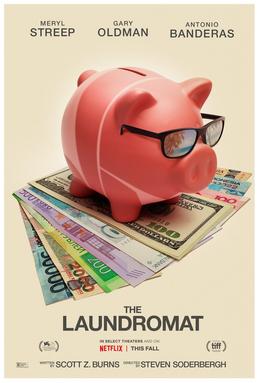
To say that Meryl Streep gives a bad performance in The Laundromat actually does a disservice to your average, run-of-the-mill bad performance.
Meryl Streep instead gives an absolutely terrible performance in The Laundromat, playing not one, not two, but three characters. One of the characters is Ellen Martin, a middle-class widow from Michigan whose attempts to collect a fair settlement after the death of her husband provides a portal in the world of shady con men and corrupt financial institutions. One of the characters is a secret, which means that Meryl wears a lot of make-up and frumpy clothes. That said, from the minute the character appeared on screen, I went, “Oh, there’s Meryl again.” Then, in her third role, Meryl plays herself, demanding campaign finance reform and striking a Statue of Liberty pose while holding a hairbrush instead of a torch.
Really, it’s the type of horrendous performance that could only be delivered by a truly great actress. (If Meryl Streep is the modern Norma Shearer, this is her Romeo and Juliet.) Watching Meryl Streep play the role of Ellen, It occurred to me that Meryl is one of those actresses who is incapable of being authentic but who can certainly act the Hell out of pretending to be authentic. You never forget that Meryl Streep is acting and that’s one reason why her best performances are usually the ones where she’s playing theatrical characters, whether they’re politicians like Margaret Thatcher, celebrities like Julia Child, or the Witch in Into the Woods. But when you cast Meryl as someone who is basically supposed to be a member of the “common people,” it just doesn’t work. Laura Dern, Laurie Metcalf, Allison Janney, even Annette Bening probably could have done a decent job playing Ellen Martin but Meryl is just too Meryl. As for her other two performances in The Laundromat, they don’t work because one is meant to be a joke on the audience and the other is just a retread of her standard “I’m just a middle class woman from New Jersey and I love the little people” awards show speech.
Of course, The Laundromat itself is a remarkably bad film. Again, it takes a lot of talent to make a film this bad. Watching the film, I found myself wondering why, at this point in his celebrated career, Steven Soderbergh would decide to become a second-rate Adam McKay, especially when McKay himself is just a third-rate Jean-Luc Godard? The film is structured so that, while Ellen is obsessing on why she’s getting screwed over by the insurance companies, we’re also treated to scenes of Gary Oldman and Antonio Banderas talking directly to the camera and explaining to use why the poor are always going to get screwed over by the rich. That’s probably true but the film gets so heavy-handed in its execution that the resulting migraine is going to be due less to outrage and more due to the sledgehammer that Soderbergh takes to your head.
Along with Ellen’s story, we also get to see several other stories featuring people and their money. Jeffrey Wright is a crooked accountant who has two families. And then there’s an African businessman who bribes his wife and daughter with shares in a non-existent company and then we take a trip to China, where we learn about cyanide and organ harvesting. And yes, I get it. It shows how a crime committed in China is ultimately felt by a widow living in Michigan. But one can’t help but wish that Soderbergh had just focuses on one story, instead of trying to imitate the worst moments of The Big Short.
Gary Oldman and Antonio Banderas are technically playing the film’s villains but they’re both so charming that The Laundromat at times seems like more of a recruiting film for aspiring money launderers than anything else. (To continue the Adam McKay comparison, it’s a bit like how Vice actually left audiences feeling sympathy for Dick Cheney as opposed to writing petitions to send to The Hague.) It desperately wants to leave us outraged but Soderbegh gets so caught up in his own cutesy storytelling techniques that it just leaves us feeling somewhat annoyed. Watching the film, one gets the feeling that the perfect directors for The Laundromat would have been the Coen Brothers, who are capable of outrage but whose detached style would have kept them from bludgeoning the audience with it. Soderbergh is too angry to be effective.
As I said, there’s a lot of talented people involved in The Laundromat. It’s full of people who have done great work in the past and who will do great work in the future. As for The Laundromat, it’s a legitimate contender for the biggest disappointment of the year.
With the help of the festivals, the Oscar picture became a bit clearer this month. Perhaps the biggest news is that the initial response to Harriet, which many people expected to be this year’s front runner, was decidedly lukewarm. The other big news? The Irishman, according to those who have seen it, may be Scorsese’s best yet.
Below, you’ll find my Oscar predictions for September. If you want to see how my thinking has evolved over the course of this year, be sure to check out my predictions for January, February, March, April, May, June, July, and August!
Now, admittedly, there’s still an element of wishful thinking in some of the predictions below. For instance, it would be an interesting narrative development if Adam Sandler and Eddie Murphy were both nominated for best actor. That doesn’t mean that it’s going to happen but both of them have received a lot of early acclaim for their yet-to-be released films this year. They’re contenders, even if their reputations may make them long shots. What’s the point of making predictions if you can’t have a little fun?
Joker is going to get big Oscar punch. I do think it’s going to probably be a bit too controversial to pick up a Best Picture nomination but I’m still going to go ahead and put down Joaquin Phoenix as a best actor nominee.
Bombshell is the new title of Jay Roach’s Fox News film. To me, it doesn’t sound like it’s going to be that good and, quite frankly, Jay Roach’s films usually prove that just being obsessed with politics doesn’t necessarily mean that you have anything interesting to say about the topic. That said, if Vice (a film that even leftist film critics criticized as being heavy handed and cartoonish) could pick up a best picture nomination last year, then I’m going to assume Bombshell could do the same. With both the presidential election and possible impeachment trial looming, it’s reasonable assume that certain Academy members will be even more obsessed with politics than usual.
Meryl Streep for The Laundromat? Why not? They’ll nominate Meryl for anything, regardless of how bad the movie is.
Here are the predictions for this month!
Best Picture
1917
Bombshell
The Farewell
A Hidden Life
The Irishman
JoJo Rabbit
Marriage Story
Once Upon A Time In Hollywood
Parasite
Waves
Best Director
Bong Joon-ho for Parasite
Terrence Malick for A Hidden Life
Martin Scorsese for The Irishman
Quentin Tarantino for Once Upon A Time In Hollywood
Taika Waititi for JoJo Rabbit
Best Actor
Antonio Banderas in Pain & Glory
Leonardo DiCaprio in Once Upon A Time In Hollywood
It’s time for me to share my early Oscar predictions! With the Telluride and Venice Film Festivals currently underway, the Oscar picture does seem to be a little bit less murky. But then again, we should remember that appearances can be deceiving. Last year, at this time, most people were still expecting a First Man vs. Beale Street vs. A Star is Born Oscar race.
These predictions below take into account the reports that have been coming back from Telluride and Venice. If you want to see how my thinking has evolved over the year, be sure to check out my predictions from January, February, March, April, May, June, and July!
And now, for what their worth, here are my predictions for August:
Best Picture
1917
A Beautiful Day In The Neighborhood
The Farewell
Ford v Ferrari
Harriet
A Hidden Life
The Irishman
Little Women
Once Upon A Time In Hollywood
Waves
Best Director
Kasi Lemmons for Harriet
Terrence Malick for A HIdden Life
Sam Mendes for 1917
Trey Edward Shults for Waves
Martin Scorsese for The Irishman
Best Actor
Antonio Banderas in Pain & Glory
Leonardo DiCaprio in Once Upon A Time In Hollywood
It’s time for me to present my predictions for who and what will be nominated for the Academy Awards next January! Now that we’re nearly done with the summer, the Oscar picture is becoming a bit more clear. For instance, I do think that Once Upon A Time In Hollywood is going to be a player, if just because it’s about actors and the Actors Branch is the biggest voting bloc in the Academy. (How do you think Birdman and Argo managed to win?) And the trailer for The Irishman makes it look like the type of Scorsese film that often gets nominated.
Still, it’s too early to say anything for sure. Last year, for instance, Green Book didn’t really become a player until fairly late in the season. In fact, at this time last year, everyone still thought A Star Is Born was going to win everything.
So, with all that in mind, here are my predictions for July. Be sure to also check out my predictions for January, February, March, April, May, and June!
Best Picture
1917
The Aeronauts
A Beautiful Day In The Neighborhood
Fair and Balanced
Harriet
The Irishman
JoJo Rabbit
Once Upon A Time In Hollywood
Pain & Glory
The Peanut Butter Falcon
Best Director
Pedro Almodovar for Pain & Glory
Kasi Lemmons for Harriet
Sam Mendes for 1917
Martin Scorsese for The Irishman
Quentin Tarantino for Once Upon A Time In Hollywood
Best Actor
Antonio Banderas in Pain & Glory
Leonardo DiCaprio in Once Upon A Time In Hollywood
It’s time for me to offer up my early Oscar predictions!
These will be my first set of predictions since the Cannes Film Festival. It’s always debatable just how much of an influence Cannes will actually have on the Oscar voting. A victory at Cannes pretty much led to Tree of Life receiving an Oscar nomination and it certainly didn’t harm the chances of BlackKklansman last year. While Once Upon A Time In Hollywood and Terrence Malick’s A Hidden Life may not have picked up any major awards at Cannes, the positive critical reception that both of those films received can only help. The same can be said of The Lighthouse, which was shown out of competition. Finally, the Cannes jury gave its best actor award to Antonio Banderas and, for now, that’s enough for me to add him to my list of predicted nominees.
So, without any further ado, here are my predictions for May! If you want to see how my thinking has evolved over the year, be sure to also check out my predictions for January, February, March, and April!
Best Picture
1917
A Beautiful Day In The Neighborhood
Fair and Balanced
The Goldfinch
Harriet
A Hidden Life
The Irishman
Jojo Rabbit
Little Women
Once Upon A Time In Hollywood
Best Director
Kasi Lemmons for Harriet
Terrence Malick for A Hidden Life
Sam Mendes for 1917
Martin Scorsese for The Irishman
Quentin Tarantino for Once Upon A Time In Hollywood
Best Actor
Antonio Banderas in Pain & Glory
Willem DaFoe in The Lighthouse
Leonardo DiCaprio in Once Upon A Time In Hollywood
Watching Life Itself is like getting a Hallmark card from a serial killer. Even if you appreciate the sentiment, you still don’t feel good about it.
Written and directed by This Is Us creator Dan Fogelman, Life Itself attempts to juggle several different themes, so much so that it can sometimes be difficult to understand just what exactly the film is attempting to say. That said, I think the main lesson of the film is that you should always look both ways before stepping out into the middle of the street. It doesn’t matter if you’ve got a horrific backstory, involving a decapitated father, a pervy uncle, and a gun. It doesn’t matter if you love Pulp Fiction or if you think Bob Dylan’s more recent work is underrated. It doesn’t matter if you’ve got a dog and husband who is so in love with you that he’s practically a stalker. It doesn’t even matter that your pregnant and looking forward to naming your firstborn after your favorite musician. If you don’t look both ways before stepping out into the middle of the street, you’re going to get hit by a big damn bus.
That’s the lesson that Abby (Olivia Wilde) does not learn and, as a result, she not only gets run over by a bus but we, the viewers, are subjected to seeing her repeatedly getting run over by that bus. As temtping as it is to feel bad for Abby, my sympathy was limited by the fact that she and her husband (Oscar Isaac) named their dog Fuckface. I mean, seriously, who does that? Not only is it cruel to the dog but it’s also inconsiderate to the people who have to listen to you shouting, “Fuckface!” whenever the dog gets loose. For whatever reason, the movie doesn’t seem to get how annoying this is. That’s because Life Itself is another one of those movies that mistakes quirkiness for humanity.
The other annoying thing about Abby is that she’s an English major who somehow thinks that the use of the unreliable narrator is an understudied literary phenonema. In fact, she’s writing her thesis on unreliable narrators. Her argument is that life itself is the ultimate unreliable narrator because life is tricky and surprising, which doesn’t make one bit of sense.
Speaking of narrators, Life Itself has three, which is three too many. Two of the narrators are unreliable but I get the feeling that the third one is meant to be taken literally, which is a shame because the film would have made a lot more sense if it had ended with a Life of Pi-style revelation that none of what we just watched actually happened.
Anyway, Abby getting hit by a bus has repercussions that reverberate across the globe and across time. Not only does it lead to her husband writing a bad screenplay but it also leads to him committing suicide in a psychiatrist’s office. Abby’s daughter, Dylan (Olivia Cooke), grows up to be what this film believes to be a punk rocker, which means that she angrily covers Bob Dylan songs and stuffs a peanut butter and jelly sandwich down another girl’s throat. Meanwhile, in Spain….
What? Oh yeah, this film jumps from New York to Spain. In fact, it’s almost like another film suddenly starts after an hour of the first one. You go from Olivia Cooke sobbing on a park bench to Antonio Banderas talking about his childhood. Banderas is playing a landowner named Vincent Saccione. Saccione wants to be best friends with his foreman, Javier (Sergio Peris-Mencheta) but Javier suspects that Saccione just wants to steal away his saintly wife, Isabel (Laia Costa) and maybe Javier’s right!
Javier has a son named Rodrigo (who is played by five different actors over the course of the film before eventually growing up to be Alex Monner). When Saccione gives Rodrigo a globe, Javier decides to one-up him by taking his wife and child on a vacation to New York City. Rodrigo has a great time in New York, or at least he does until he distracts a bus driver, which leads to a bus running down a pregnant woman…
…and the movie’s not over yet! It just keeps on going and believe it or not, there’s stuff that I haven’t even mentioned. Life Itself has a running time of only two hours. (For comparison, it’s shorter than almost every comic book film that’s come out over the past few years.) This is one of the rare cases where the film might have been improved with a longer running time because Fogelman crams so much tragedy and melodrama into that running time that it literally leaves you feeling as if you’re being bludgeoned. This is one of those films that gets in your face and screams, “You will cry! You will cry!” Even if you are inclined to cry at movies (and I certainly am), it’s impossible not to resent just how manipulative the film gets. You get the feeling that if you spend too much time wondering about the plot holes or the on-the-nose dialogue, the third narrator might start yelling at you for not getting with the program.
Life Itself is full of twists that are designed to leave you considering how everything in life is connected but, for something like this to work, the twists have to be surprising. They have to catch you off-guard. They have to make you want to see the movie again so that you can look for clues. The twists in Life Itself are not surprising. Anyone who has ever seen a movie before will be able to guess what’s going to happen. For that matter, anyone who has ever sat through an episode of This is Us should be able to figure it all out. Life Itself is not as a clever as it thinks it is.
Also, for a film like this work, you have to actually care about the characters. You have to be invested in who they are. But nobody in the film ever seems to be real and neither do any of their stories. (To the film’s credit, it actually does point out that one narrator is idealizing the past but that’s an intriguing idea that’s abandoned.) Everyone is just a collection of quirks. We know what type of music they like but we never understand why. Background info, like Abby being molested by her uncle or Isabel being the fourth prettiest of six sisters, is randomly dropped and then quickly forgotten about. Almost ever woman has a tragic backstory and, for the most part, a tragic destiny. (Except, of course, for Rodrigo’s first American girlfriend, who is dismissed as being “loud.”) Every man is soulful and passionate. But who are they? The film’s narrators say a lot but they never get around to answering that question. This is a film that insists it has something to say about life itself but it never quite comes alive.
Some critics are saying that Life Itself is the worst film of 2018. Maybe. I don’t know for sure. The Happytime Murders left me feeling so icky that I haven’t even been able to bring myself to review it yet. Life Itself, on the other hand, is such a huge misfire that I couldn’t wait to tell everyone about it. There’s something to be said for that.
What’s an Insomnia File? You know how some times you just can’t get any sleep and, at about three in the morning, you’ll find yourself watching whatever you can find on cable? This feature is all about those insomnia-inspired discoveries!
Last night, if you were in a hotel room in Alabama and you discover that you couldn’t get to sleep despite having a busy day ahead of you, you could have always turned on the TV and watched the 1996 musical extravaganza, Evita.
That’s what I did!
Evita, of course, is based on the award-winning musical by Tim Rice and Andrew Lloyd Webber. Opening in 1952, with Argentina being thrown into mourning and chaos by the death of Eva Peron (Madonna), the film then flashes back to follow Eva as she goes from being a child of poverty to a well-known actress to eventually the wife of Argentina’s president, Juan Peron (Jonathan Pryce). The majority of her story is told to us by Che (Antonio Banderas), a cynical observer who pops up in various disguises and who is always quick to accuse Eva of selling out the poor while, at the same time, professing to be as obsessed with her as everyone else. Much as they did with the story of Jesus in Jesus Christ Superstar, Rice and Lloyd Weber use the story of Eva Peron to explore what it means to be a celebrity in an unstable world.
(If anyone ever decides to produce a musical about the Kardashians, they would be fools not to approach Rice and Lloyd Webber to write it.)
Evita is kind of a strange film. On the one hand, it’s a wonderful spectacle. Director Alan Parker does a wonderful job visually interpreting the music. The sets are huge and ornate. The costumes are to die for. There’s never a moment when you don’t want to look at the screen. Parker keeps the action moving and, regardless of how cynical one may be about politics, it’s hard not to be impressed by the army of extras that march through the film, chanting “Peron.” While both the musical and film undoubtedly took liberties with the actual story (and don’t watch this film expecting to see any acknowledgment of the countless number of Nazi war criminals that Peron welcomed to Argentina after the fall of the Third Reich), it still does a great job of capturing the sweep of change and revolution. You watch the film and you understand why the citizens of an unstable country would put their faith in messianic leaders like the Perons. Jonathan Pryce does a good job playing Peron and Antonio Banderas is absolutely on fire as Che.
(In some stage productions, Che is specifically portrayed as being a young Che Guevara. Guevara, of course, was a racist mass murderer who became an icon because he was photogenic. Fortunately, the film is content to portray Che as simply being a politically active citizen of Argentina.)
And yet, there is an emptiness at the center of this adaptation of Evita and that emptiness is named Madonna. Strangely, for someone who has been a star longer than I’ve been alive, Madonna has absolutely zero screen presence. She looks glamorous enough for the part and she’s got a good enough voice for the songs but, whenever she actually has to act, Madonna’s performance feels awkward and forced. Her performance is too obviously calculated, and, as a result, there’s nothing natural about her or her interpretation of Evita. To put it simply, she tries too hard. She comes across as the type of performer who doesn’t so much smile as she acts the process of smiling. When Madonna performs opposite Pryce and Banderas, they’re both good enough to carry her through their shared scenes. But whenever Madonna has to hold the screen on her own, the film falls strangely flat.
The end result is a strangely uneven film, one that leaves little doubt that Eva Person was loved while, at the same time, never seeming to understand why.
The 33 is an upcoming film about the 2010 Chilean mine accident. For those who may have somehow forgotten, 33 Chilean miners were trapped underground for 69 days. For those 69 days, the entire world was watching Chile and, when the miners were finally rescued, we were all briefly united in our happiness.
(Needless to say, that didn’t last long.)
Personally, I like the trailer for The 33 but I do kind of wish that the film’s producers had just had the guts to have everyone in the film speak Spanish, as opposed to going the heavily accented English route.