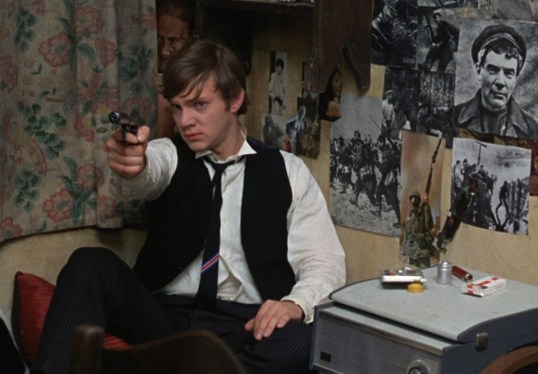
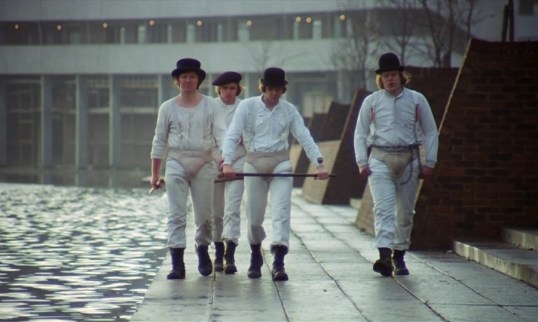
Seeing as how today is Malcolm McDowell’s birthday, it only seems right that today’s song of the day should be one that was used in his best-known film.
The Title Music For A Clockwork Orange was, of course, adapted from Music For The Funeral of Queen Mary, composed by Henry Purcell.
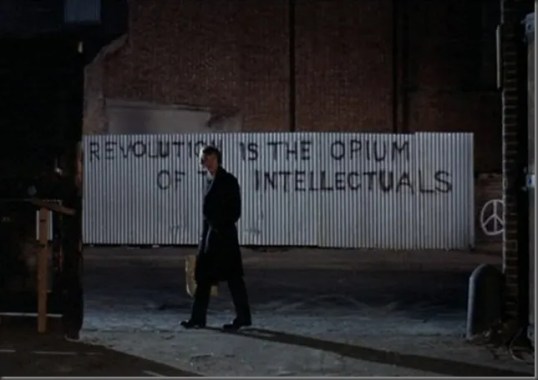
In this scene from 1973’s O Lucky Man, Mick Travis (Malcolm McDowell) comes to the end of his very long journey and finds himself auditioning for a role in a Lindsay Anderson film.
Anderson, of course, was also the director of O Lucky Man! and it’s obvious that the film that Mick is auditioning for is meant to be Anderson’s previous film, If.
McDowell, of course, actually did star in If. In fact, he played a character named Mick Travis.
After all of his surreal adventures, can Mick still smile enough to get the part?
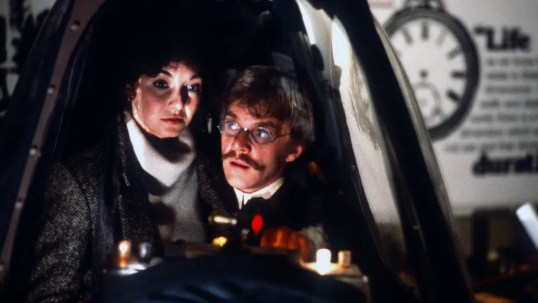
4 Or More Shots From 4 Or More Films is just what it says it is, 4 shots from 4 of our favorite films. As opposed to the reviews and recaps that we usually post, 4 Shots From 4 Films lets the visuals do the talking!
Today, the Shattered Lens wishes a happy birthday to Malcolm McDowell! It’s time for….
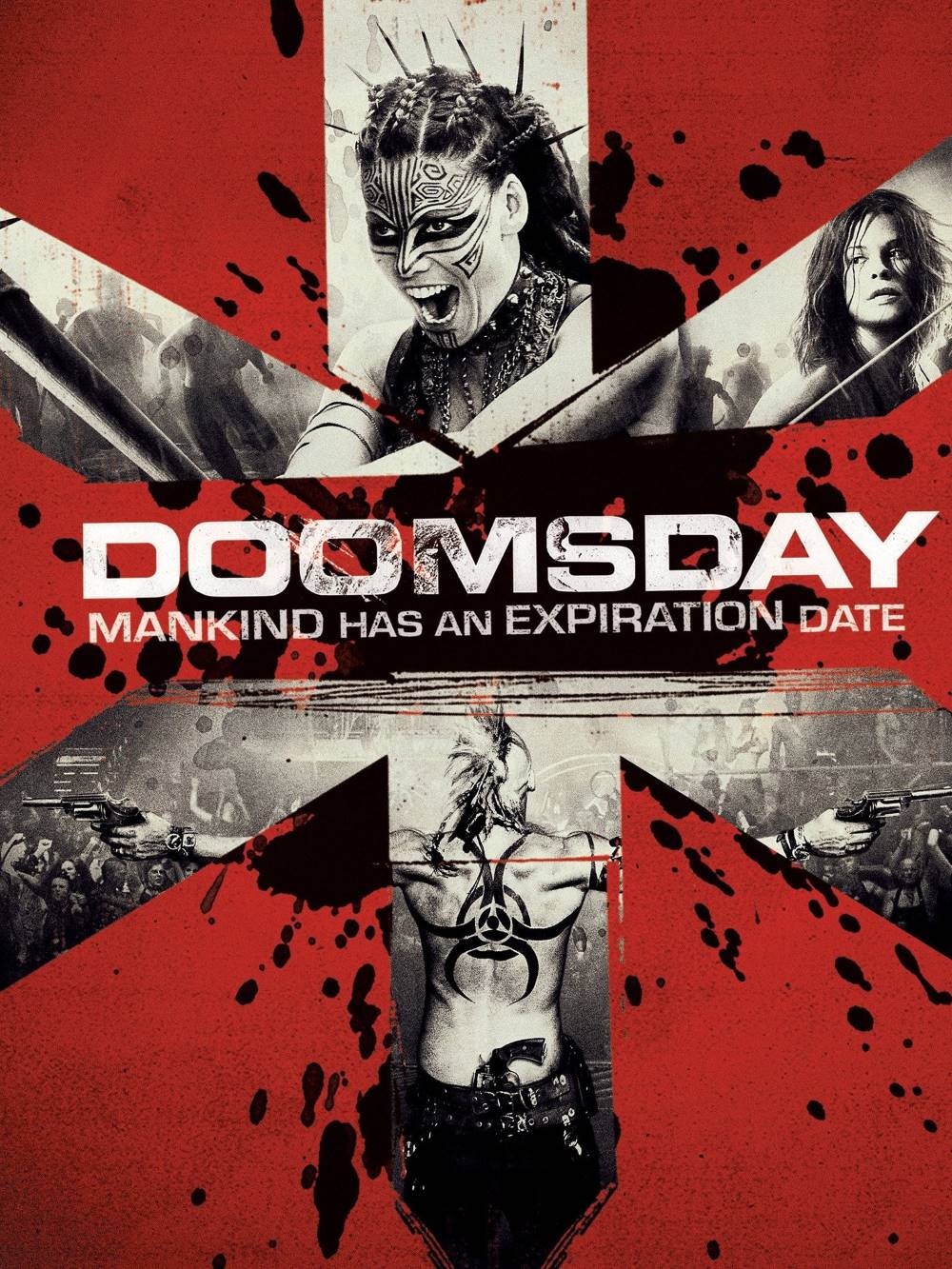
Doomsday tries to be a wild post-apocalyptic romp but ends up as such a profound disappointment, especially coming from Neil Marshall, whose previous two films, Dog Soldiers and The Descent, were much better entries in the horror genre where his attempts to inject new ideas landed the mark with precision and style. Here, Marshall shifts gears into a sprawling, uneven action-horror hybrid that feels like a highlight reel of better movies, bloated and unfocused where his earlier works thrived on tight scripting and fresh twists. While there are flashes of fun in the chaos, the film’s glaring flaws in plotting, tone, and originality outweigh any guilty-pleasure moments, leaving it as more of a curiosity than a recommendation.
The story kicks off with a decent hook: a deadly Reaper virus wipes out much of Scotland, prompting the government to seal it off behind a massive wall and leave the population to fend for itself. Years later, the virus resurfaces in London, and intel suggests survivors—and possibly a cure—lurk inside the quarantine zone. Major Eden Sinclair (Rhona Mitra) leads a ragtag military squad across the wall to hunt down a rogue scientist. It’s a setup that echoes classics like Escape from New York, but Doomsday quickly abandons any tension for a parade of borrowed set pieces that rarely gel, a far cry from the inventive werewolf siege of Dog Soldiers or the claustrophobic crawler terror in The Descent.
Once inside, the movie lurches from one aesthetic to the next without much logic or buildup. First comes a punk-anarchist wasteland with cannibals hosting gladiatorial freak shows amid flames and mohawks, then a sudden pivot to medieval knights in castles complete with jousts and sieges. These shifts feel arbitrary, like Marshall couldn’t decide on a vibe and just threw them all in—a scattershot approach that lacks the confident genre-blending of his prior successes. The worldbuilding is shallow—how did feudalism sprout up so neatly amid the apocalypse?—and the transitions are jarring, undermining any sense of immersion or stakes.
Rhona Mitra holds the center as Sinclair, a one-eyed badass who dispatches foes with grim efficiency, but even she can’t overcome the script’s limitations. Her character is a walking archetype: tough, quippy, and competent, with zero emotional depth or growth. The supporting players, including Malcolm McDowell as a scenery-chewing lord and Bob Hoskins as a gruff boss, are wasted on one-note roles. They’re recognizable enough to highlight how little the film does with its cast, turning potential strengths into reminders of squandered talent.
Visually, Doomsday has some grit thanks to practical effects and location shooting, especially in the grimy urban ruins and over-the-top chases that nod to Mad Max. The gore is plentiful and messy, which might appeal to splatter fans. But the action often devolves into incoherent shaky-cam slogs, and the pacing drags in spots despite the constant escalation. Worse, the film’s self-indulgent excess tips into silliness that undercuts its own grim premise, making it hard to buy the horror of the virus or the desperation of survival.
Tonally, Doomsday is all over the map, swinging from bleak quarantine dread to campy medieval farce without warning. This inconsistency is its biggest sin—serious moments clash with cartoon violence, and the humor lands flat or feels forced. Influences from 28 Days Later, The Road Warrior, and even Excalibur are blatant, but Marshall doesn’t elevate them; he just remixes them into something louder yet less impactful. The result feels like fan fiction for genre nerds rather than a fresh take, missing the spark that made his earlier horrors stand out.
Thematically, there are glimmers of commentary on government abandonment, class divides, and viral panic, but they’re buried under the bombast and never explored. Instead of probing the ethics of walling off a nation, the film prioritizes spectacle, leaving those ideas as window dressing. It’s a missed opportunity that makes the whole endeavor feel hollow, especially when real-world parallels to pandemics could have added bite.
Doomsday struggles to stand on its own amid a crowded genre field, weighed down by narrative sloppiness and tonal whiplash that overshadow its few strengths. The positives—like visceral kills and Mitra’s presence—fail to overcome the disjointed plotting and lack of fresh ideas. Ultimately, it feels like a missed chance for something more cohesive, leaving little reason to revisit beyond a one-off curiosity.
In the end, Doomsday is a swing-and-a-miss for Neil Marshall, ambitious in scope but sloppy in execution, a letdown after the highs of Dog Soldiers and The Descent. The negatives dominate: uneven pacing, logical gaps, borrowed aesthetics without innovation, and a tone that alienates more than it entertains. If you’re in the mood for undemanding B-movie chaos on a slow night, it might scratch a minor itch. Otherwise, skip it for the films it rips off—they deliver the thrills without the frustration. At around 105 minutes, it’s not a huge time sink, but better options abound in the post-apoc genre.
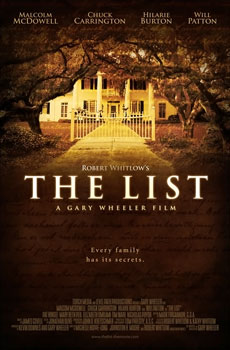
2007’s The List opens during the dying days of the American Civil War.
A group of wealthy plantation owners form a secret society. They pool together their fortunes and they each sign onto a list. Over the years, whenever a member of the Society passes away, their eldest male descendant replaces them on the List and also has access to the fortune that that the Society secretly holds.
In 2007, directionless attorney Renny Jacobsen (Chuck Carrington) is shocked when his father dies and leaves him next to no money. As Renny tells us over and over again, he really could have used some of his father’s fortune. However, his father does leave him a key the leads to Renny uncovering a tape that explains everything that he needs to know about the Society. All Renny has to do is sign his name to the List.
The Society is now run by Desmond Larochette (Malcolm McDowell) and we know that he’s evil because his name is Desmond Larochette and he’s played by Malcolm McDowell. Larochette seems to be more than happy to allow Renny to join the Society but he’s not quite as happy that another member of the group died and only left behind a female heir, Jo Johnston (Hilarie Burton). The members of the Society are faced with quite a quandary. Should they allow a woman to join their society? And, if not, what should they do now that she know about the Society’s existence?
When Jo goes to the mansion for the Society’s meeting, she spots a portrait of a gray-haired gentleman and asks who he is. Gus Eicholtz (Pat Hingle) explains that the painting is of John C. Calhoun, who served as Vice President under Andrew Jackson. “He looks angry,” Jo says and honestly, that was a piece of historical and artistic criticism that was so simple-minded that Jo really should have been disqualified from joining the Society at that very moment.
First off, how are you going to join a Southern secret society if you don’t know how John C. Calhoun is? Secondly, the portrait in question is actually a pretty famous one. George Alexander Haley painted it while Calhoun was Secretary of State. Even if you don’t know who John C. Calhoun is, chances are that you’ve seen the painting. Finally, there’s the claim that “He looks angry.” The painting was completed in 1845. Everyone looked angry in 1840s! Even the noted bon vivant Henry Clay looked angry in his 1848 State Department portrait. (And Clay actually had his picture taken for his official portrait. Imagine how furious he would look if someone had painted him?)
Anyway, Renny joins the society but Jo does not, But then Renny discovers that it’s not as easy to get his hands on the money as he thought and he spends the entire movie complaining about it. That’s pretty much it. There is some suggestion that Desmond might have demonic powers, but it’s not really explored. Another heir dies mysteriously and it seems like Jo is being targeted as well. Again, it’s not really clear why. In the end, Renny puts God before the money but it kind of comes out of nowhere. It’s a muddled story and, by the end of the film, it’s still a struggle to figure out what it all meant. At the very least, Malcolm McDowell seemed to be having fun, playing an evil character and speaking in an almost indecipherable accent.
59 years ago today, the first episode of Star Trek aired in America.
There’s been a lot of different StarTrek shows and crews over the decades. I have to admit that I’ve always preferred the Original Series, with Kirk sleeping with every alien he met, McCoy and Spock bickering about logic, and Scotty warning that the engines can’t take much more. The Next Generation was strong as well, especially in the later seasons. The subsequent series have been hit-and-miss for me.
I was born long after the Original Series went off the air so, like a lot of people, my real introduction to Star Trek came through watching the films. This weekend, I sat down and watched all fourteen of the Star Trek films in order, from The Motion Picture to Section 31. Here are my thoughts.
Star Trek: The Motion Picture (1979, directed by Robert Wise)
In the first Star Trek film, Voyager returns to Earth, now known as V’ger. James T. Kirk (William Shatner) returns to the Enterprise with his old crew and takes command from Decker (Stephen Collins). Spock (Leonard Nimoy) returns from Vulcan is not happy about it.
Directed by Robert Wise, the first Star Trek film feels out-of-place amongst the films that followed it. It’s long and slowly paced and it doesn’t have the sense of humor that runs through the best of the films featuring the original cast. The film favors Kirk and Spock, with the rest of the original cast being largely used as bit players. Even the costumes are different from the uniforms worn in the later films, making Star Trek: The Motion Picture feel like an entry from an alternate universe.
Despite mixed review, Star Trek: The Motion Picture made the most money of any of the pre-reboot films at the box office. Because the film itself was so expensive, it was still judged to be a box office disappointment. The Star Trek films would continue but in a new direction.
Star Trek II: The Wrath of Khan (1982, directed by Nicholas Meyer)
Featuring a character-driven script, exciting action, the best villain in the history of the franchise, and an ending that will bring tears to the eyes of the most cynical viewer, The Wrath of Khan is the film that set the standard for the Star Trek films that would follow.
Ricardo Montalban, recreating a character that he originally played in the television series, is a compelling villain as the vengeance-driven Khan. Montalban and William Shatner make for perfect rivals, two sides of the same coin. At the same time, the other members of the original cast all get their moments to shine, especially Walter Koenig as Chekhov. Kirstie Alley is the sexist Vulcan to ever appear in the franchise and even the revelation that Kirk has a son is handled effectively. Kirstie Alley, Bibi Besch, and Merritt Butrick all fit in with the original crew.
But the thing everyone remembers about The Wrath of Khan is the death of Spock. Even though the movie features plenty of hints that Spock will return (including his command of “Remember” to McCoy), it’s impossible not to get emotional when Spock sacrifices himself for the crew. “I have always been your friend.” To quote George Costanza, that was hell of a thing when Spock died. In that scene, Leonard Nimoy shows that he was the (logical) heart of the franchise. Just as Spock brought out the best in the rest of the crew, Nimoy brought out the best in his co-stars. Shatner was never better than when he was mourning Spock.
Star Trek III: The Search For Spock (1984, directed by Leonard Nimoy)
Spock’s back! It’s not a surprise. I think everyone knew, at the end of Wrath of Khan, that the Genesis Project would bring back Spock. Star Trek III isn’t bad. Christopher Lloyd reminds us of how brutal the Klingons were before their Next Generation makeover. The self-destruction of the Enterprise is a powerful moment. I just wish that a film about Spock being given a new life hadn’t featured so much death. Both the revelation that David Marcus tampered with the Genesis Project and his subsequent death feel like missteps. Robin Curtis takes over the role of Saavik and Kirstie Alley is very much missed. DeForest Kelley playing McCoy possessed by Spock was, for me, the highlight of the film.
Star Trek IV: The Voyage Home (1986, directed by Leonard Nimoy)
Returning home after rescuing Spock from the Genesis Planet, the Enterprise crew is instead sent back into the past so that they can bring two whales into the future. The Voyage Home might not be the best Star Trek film (that honor belongs to Wrath of Khan) but it is the most likable and the most entertaining. Every member of the cast gets something to do in 20th Century San Francisco. The film is full of classic moments, from Chekhov looking for the “nuclear wessels” to Scotty trying to speak to the computer. The moment with the punk on the bus is a crowd-pleaser. I always laugh at Spock’s “One damn minute, Admiral.” After the violence in The Search for Spock, The Voyage Home‘s humor, gentle sincerity, and emphasis on the efforts of the entire ensemble is a welcome development.
Star Trek V: The Final Frontier (1989, directed by William Shatner)
Leonard Nimoy got his chance to shine as the director of the previous two Star Trek films so William Shatner was allowed to direct The Final Frontier. The Enterprise crew is brainwashed by a religious fanatic (Laurence Luckinbill) who is also, improbably, Spock’s brother. Only Kirk is able to resist and confront the entity claiming to be God. “What does God need with a starship!?” Kirk demands. It’s such an obvious question that I can’t believe the entity didn’t already have an answer worked out.
The Final Frontier gets no respect and it was probably doomed as soon as Shatner was announced as director. Shatner also developed the story and it’s probably not surprising that the main theme is that Kirk was the only person on the Enterprise strong enough to not be brainwashed by the film’s fake God. Laurence Luckinbill gave a good performance as Sybok but this film really does feel like an unfortunate episode of the original television series.
Star Trek VI: The Undiscovered Country (1991, directed by Nicholas Meyer)
Star Trek VI featured the final appearance of the Original Series cast as a group and they get a send-off worthy of their legacy. Having been previously established as the Federation’s greatest enemies, the Klingons finally pursue peace. Just as only Nixon could go to China, only Kirk and the original Enterprise crew can go to the Klingons. This movie is what Star Trek was all about, with enough world-building and continuity for the hardcore fans and a story that was interesting enough to hold the attention of the casual viewers. By featuring the start of the era of peace between the Federation and the Klingons, this film also filled in some of the Next Generation‘s backstory. The Final Frontier was meant to be the final Star Trek film featuring any of the original cast and it would have been the perfect entry for Captain Kirk to go out on. Unfortunately, that didn’t happen.
Star Trek Generations (1994, directed by David Cason)
William Shatner meets Patrick Stewart as one Star Trek crew passes the torch to the new Star Trek crew. Malcolm McDowell is the latest villain with an ill-defined plan. Picard and Kirk team up to stop McDowell’s villain. They succeed but at the cost of Kirk’s life. As opposed to Spock’s death in Wrath of Khan, Kirk’s death feels pointless and tacked on for no reason other than to signify the arrival of The Next Generation to the films. Seeing Shatner and Stewart together is interesting. Stewart may have been the better actor but Shatner still dominates their scenes together. Not giving Kirk a better send-off was one of the franchise’s biggest sins.
Star Trek: First Contact (1996, directed by Jonathan Frakes)
After the disappointing Generations, Picard and his crew finally got a film worthy of them with First Contact. Not only do the Borg return but the crew goes back into their past and experience a key date in the history of the Federation. After being outshone by Shatner in Generations, Patrick Stewart takes control in this film, giving a multi-layered and commanding performance that still gives the rest of the cast room to shine. Director Jonathan Frakes not only handles the action well but he also shows that he understands what makes the characters click. This was, without a doubt, the best of the Next Generation films and one the best of the Star Trek films overall.
Star Trek: Insurrection (1998, directed by Jonathan Frakes)
Entertaining but forgettable, Insurrection features Picard pulling a Kirk and defying orders from from a superior officer (played by Anthony Zerbe) and going out of his way to save Data from being decommissioned. Insurrection feels like an extended episodes of the Next Generation television series and lacks the epic scale of First Contact. Under the direction of Jonathan Frakes, the ensemble is strong and watching them interact feels like spending time with a group of old friends. F. Murray Abraham and Anthony Zerbe make for effective villains.
Star Trek: Nemesis (2002, directed by Stuart Baird)
Just as the Original Series crew sought peace with the Klingons in The Undiscovered Country, the final Next Generation film finds Picard, Riker, and the rest seeking peace with the Romulan Empire. Tom Hardy plays a clone of Picard who is now the leader of the Romulans. Data sacrifices himself in a move that tries too hard to duplicate the death of Spock. Picard retires. Director Stuart Baird emphasizes action over the chemistry of the Next Generation cast and the end result is a disappointing finale that left critics and audiences underwhelmed.
Star Trek (2009, directed by J.J. Abrams)
I think people forget about what a big deal this Star Trek reboot was when it first came out. Today, people focus on things like Kirk being a Beastie Boys fan and they forget how exciting it was to see Chris Pine, Zachary Quinto, Karl Urban, Simon Pegg, Anton Yelchin, John Cho, and Zoe Saldana all effortlessly stepping into the roles of the younger versions of the original cast. The storyline is predictable and Eric Bana’s a bland villain but the scenes between Leonard Nimoy and Zachary Quinto were a reminder of how important Spock was and is to Star Trek.
Star Trek wasn’t perfect, of course. In retrospect, I think creating an alternate timeline was a mistake because it created a situation where, even if someone died, it was just an alternate version dying and not the version that audiences knew and cared about. The alternate timeline would also lead to one of the biggest missteps in the history of the franchise.
Star Trek Into The Darkness (2013, directed by J.J. Abrams)
After the surprising success, both critically and commercially, of his Star Trek reboot, J.J. Abrams. Robert Orci, Alex Kurtzman, and Damon Lindelof wasted most of that good will by messing around with one of the franchise’s most memorable characters.
There are some good things to be said about Star Trek Into The Darkness. I like the action sequences and the climatic battle in the film’s futuristic version of San Francisco. But casting Benedict Cumberbatch, of all people, as Khan is a misstep that can’t be overcome. That the movie brought back Khan instead of exploring “strange new worlds” exposed the weakness of Abrams entire reboot. For all the hype, did the Star Trek reboot actually have anything new or original to offer? The answer here seemed to be no.
Star Trek Beyond (2016, directed by Justin Linn)
The final (for now) Star Trek theatrical film featured a memorable villain in the form of Idris Elba and a plot that felt like it could have just as easily been an episode of the original series. In retrospect, the film is mostly memorable for featuring the announcement of the death of Ambassador Spock. (The film was released a year after the death of Leonard Nimoy.) The death of Spock, this time with no Genesis Project around to bring him back, makes this installment feel like right place to end the films. For many of us, Nimoy was Star Trek.
Stark Trek: Section 31 (2025, directed by Olatunde Osunsanmi)
Though there have been many subsequent televisions shows, there hasn’t been a Star Trek theatrical release since 2016. The next installment has been in pre-production limbo for nearly ten years. (Quentin Tarantino was supposedly attached at one time.) Instead of coming to theaters, the latest Star Trek movie came to Paramount Plus.
I debated whether or not to include Section 31 in this list, both because it was a “made-for-TV” movie and also because it was so bad that I think most Star Trek fans would rather forget about it. A mediocre heist film that wastes star Michelle Yeoh and which doesn’t feel like it belongs in the Star Trek universe, Section31 may still represent the way forward for the franchise. With theaters having never recovered from the COVID shut-downs and more and more people preferring to stream their entertainment at home, the future of the Star Trek films could very well be a collection of assembly line Paramount Plus movies.
Finally, Case turned me onto this short film:
765874: Unification (2024, directed by Carlos Baena)
A collaboration between Otoy, a VFX company, and The Roddenberry Archive, with support from Paramount, 765874: Unification is a 10-minute short film that imagines Kirk meeting Spock in the afterlife. Shatner returns as Kirk, de-aged with CGI. Just as Kirk and Spock were friends in the film, the same was true of Shatner and Nimoy in real life. (You only have to compare Nimoy’s comments about Shatner with George Takei’s endlessly bitter takes to see what true class actually is.) This short film gives both characters the finale that they deserved.
It’s possible that we may never see another true Star Trek film. Most of the original cast is gone now. Patrick Stewart will always be Picard but even he is now approaching 90. But whatever the future may hold, I’m happy for the films that Star Trek gave us.
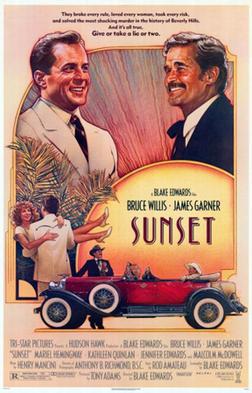
In 1920s Hollywood, famed comedian Alfie Alperin (Malcolm McDowell) has made the transition from screen stardom to working behind the scenes as a producer and studio head. With the coming of the talkies and the death of silent cinema, Alfie plans to make his mark with an epic western starring Tom Mix (Bruce Willis) as Wyatt Earp. The real Wyatt (James Garner) is hired to act as an on-set consultant. Wyatt’s former girlfriend, Christina (Patricia Hodge), is now married to Alfie.
What Mix and Earp discover is that, despite his beloved public image, Alfie is actually a monster who is involved with organized crime and sex trafficking and who has the police on his payroll. While searching for Christina’s missing son (Dermot Mulroney), Mix and Earp get caught up in a murder involving Alife’s sister (Jennifer Edwards) and a gangster named Dutch (Joe Dallesandro). At the first Academy Awards are handed out in Beverly Hills, Tom Mix and Wyatt Earp prepare for the final showdown with their producer.
The idea behind Sunset was promising. Wyatt Earp, a real cowboy who survived the end of the West, teams up with Tom Mix, a movie cowboy who is trying to survive the end of the silent era. (Earp and Mix were friend in real life, as well.) Bruce Willis comes across as being too contemporary in the role of Tom Mix but James Garner plays Wyatt Earp with a weary dignity and Malcolm McDowell does a convincing Charlie Chaplin impersonation. Unfortunately, Blake Edwards’s direction allows the story to meander and the mystery itself is so full of red herrings that it’s impossible to follow. Edwards didn’t seem to know if he wanted this movie to be a buddy comedy, an elegiac tribute to the end of the silent era, or a satire of Hollywood. He tried to include elements of all three but the movie itself just doesn’t come together. Only Garner and McDowell emerge from the film relatively unscathed.
Fortunately, for Bruce Willis, DieHard was released just two months after Sunset.
Seeing as how today is Malcolm McDowell’s birthday, it only seems right that today’s song of the day should be one that was used in his best-known film.
The Title Music For A Clockwork Orange was, of course, adapted from Music For The Funeral of Queen Mary, composed by Henry Purcell.
Today, the Shattered Lens wishes a happy birthday to actor Malcolm McDowell.
Today’s scene that I love comes from 1971’s A Clockwork Orange, featuring McDowell as Alex. This opening scene is famous for its music and its production design but what truly makes it work is the intensity of McDowell’s stare and the seductive menace of his half-smile.
In 1939, an ocean liner named the MS St. Louis set sail from Hamburg. Along with the crew, the ship carried 937 passengers, all of whom were Jewish and leaving Germany to escape Nazi persecution. The ship was meant to go to Havana, where the passengers had been told that they would be given asylum. Many were hoping to reunite with family members who had already taken the voyage.
What neither the passengers nor Captain Gustav Schroeder knew was that the entire voyage was merely a propaganda operation. No sooner had the St. Louis left Hamburg than German agents and Nazi sympathizers started to rile up anti-Semitic feelings in Cuba. The plan was to prevent the passengers from disembarking in Cuba and to force the St. Louis to then return to Germany. The Nazis would be able to claim that they had given the Jews a chance to leave but that the rest of the world would not take them in. Not only would the Jews be cast as pariahs but the Germans would be able to use the world’s actions as a way to defend their own crimes.
Captain Schroeder, however, refused to play along. After he was refused permission to dock in Cuba, he then attempted to take the ship to both America and Canada. When both of those countries refused to allow him to dock, Schroeder turned the St. Louis toward England, where he planned to stage a shipwreck so that the passengers could be rescued at sea. Before that happened, Belgium, France, the Netherlands, and the United Kingdom jointly announced that they would accept the refugees.
Tragically, just a few days after the passengers disembarked, World War II officially began and Belgium, France, and the Netherlands all fell to the Nazi war machine. It is estimated that, of the 937 passengers on the St. Louis, more than 600 of them subsequently died in the Nazi concentration camps.
The journey of the St. Louis was recreated in the 1976 film, Voyage of the Damned, with Max von Sydow as Captain Schroeder and a collection of familiar faces playing not only the ship’s passengers and crew but also the men and women in Cuba who all played a role in the fate of the ship. In fact, one could argue that there’s a few too many familiar faces in Voyage of the Damned. One cannot fault the performances of Max von Sydow, Malcolm McDowell, and Helmut Griem as members of the crew. And, amongst the passengers, Lee Grant, Jonathan Pryce, Paul Koslo, Sam Wanamaker, and Julie Harris all make a good impression. Even the glamorous Faye Dunaway doesn’t seem to be too out-of-place on the ship. But then, in Havana, actors like Orson Welles and James Mason are awkwardly cast as Cubans and the fact that they are very obviously not Cuban serves to take the viewer out of the story. It reminds the viewer that, as heart-breaking as the story of the St. Louis may be, they’re still just watching a movie.
That said, Voyage of the Damned still tells an important true story, one that deserves to be better-known. In its best moments, the film captures the helplessness of having nowhere to go. With Cuba corrupt and the rest of the world more interested in maintaining the illusion of peace than seriously confronting what was happening in Germany, the Jewish passengers of the St. Louis truly find themselves as a people without a home. They also discover that they cannot depend on leaders the other nations of the world to defend them.
Defending the passengers falls to a few people who are willing to defy the leaders of their own country. At the start of the film, Nazi Intelligence Chief Wilhelm Canaris (Denholm Elliott) explains that Captain Schroeder was selected specifically because he wasn’t a member of the Nazi Party and could not be accused of having ulterior motives for ultimately returning the passengers to Germany. Canaris and his fellow Nazis assume that anti-Semitism is so natural that even a non-Nazi will not care what happens to the Jewish passengers. Instead, Schroeder and his crew take it upon themselves to save the lives of the passengers. It is not Franklin Roosevelt who tries to save the passengers of St. Louis. Instead, it’s just a handful of people who, despite unrelenting pressure to do otherwise, step up to do the right thing. Max von Sydow, who was so often cast in villainous roles, gives a strong performance as the captain who is willing to sacrifice his ship to save his passengers.
Flaws and all, Voyage of the Damned is a powerful film about a moment in history that must never be forgotten.