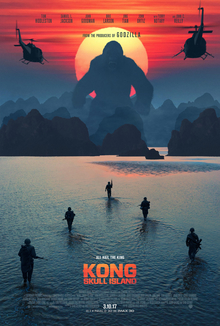
A Halloween Film Review: Kong: Skull Island (dir by Jordan Vogt-Roberts)


You may have noticed that, in the title of this post, I specifically referred to Kong: Skull Island as being a Halloween film but not a horror film.

That was very much intentional on my part.  Kong: Skull Island is really not a horror film.  (I think you could argue that the only King Kong film that can legitimately be considered a horror film would be Peter Jackson’s version and that’s just because he tossed in a few scenes that were obviously inspired by the old Italian cannibal films.)  I watched Kong: Skull Island a few months ago and I really can’t say that there was ever a moment where I was scared or even uneasy.  It’s just not that type of film.

At the same time, it is a fantastically fun and entertaining monster movie, one that has a good sense of humor about its own absurdity.  Halloween is not just a time to get scared.  It’s also a time to have fun and, for that reason, Kong: Skull Island is a perfect movie for October.  In fact, I think that it was actually a mistake for Warner Bros. to release the film in March.  They should have released it during the first weekend of October.  It could have provided a counterbalance to all of the depressing films that have been released this month,

Kong: Skull Island is a throwback to the gleefully absurd monster movies of the past.  Just so we don’t miss that point, the film starts with a 1944 prologue before then jumping forward to 1973.  (Significantly, not a single scene takes place in the 21st Century.)  Samuel L. Jackson plays Lt. Col. Preston Packard, the tough, no-nonsense commander of the Sky Devils helicopter squadron.  The Sky Devils are finally on the verge of leaving Vietnam but they’ve been asked to carry out on more mission.  They’ve been asked to fly an expedition over a newly discovered island.  The official story is that they’re going to be mapping the island but everyone knows better than to trust the government.

Kong: Skull Island is very well-cast, which is a good thing because the majority of the characters are thinly written.  Among the civilians in the helicopters: Tom Hiddleston, Brie Larson, and John Goodman.  Of course, they’re all playing characters but, for the most part, you’ll spend the entire movie thinking of them as being Tom Hiddleston, Brie Larson, and John Goodman.  For that matter, you never think of Samuel L. Jackson as being Preston Packard.  He simply is Samuel L. Jackson.  When they eventually discover a castaway living on the island, it doesn’t matter that the man’s “name” is supposedly Hank Marlow.  He’s played by john C. Reilly and that’s who you’ll always think of him as being.   They’re all charismatic actors so you certainly don’t mind watching them but, at the same time, the film understands that the main reason we’re all here is to see the giant gorilla.

To the film’s credit, it doesn’t take long for King Kong to show up.  This is not one of those films where things are dragged out in an unnecessary attempt to create suspense.  (After all, the audience already knows that King Kong’s on the island.)  Almost as soon as the helicopters breach the airspace over Skull Island, Kong shows up and starts knocking them out of the sky.  The survivors end up stranded on different parts of the island.

Of course, it’s not just Kong that they have to worry about.  In fact, from the start, the audience is smart enough to know that Kong is actually one of the good monsters.  However, Skull Island is also inhabited by bad monsters, like these giant reptiles that Kong keeps having to fight.

Early on, there’s a scene in America where, in regards to the Watergate scandal, John Goodman says that Washington, D.C. is never going to be more screwed up than it is at that moment.  That line pretty much epitomizes Kong: Skull Island.  It’s a lark with a knowing sense of humor and it is not meant to be taken at all seriously.  At it’s best, Kong: Skull Island satirizes some of the most pompous monster movies of the past.  Whenever someone says something portentous, you can be sure that the film will quickly find a way to puncture the somber mood.

And it’s all terrifically entertaining.  Watch, enjoy, and don’t worry too much about whether or not any of it makes sense.  A trip to Skull Island is a trip worth taking.
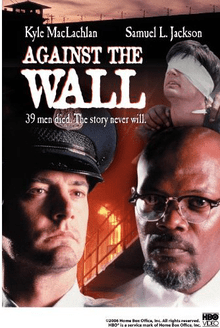
A Movie A Day #108: Against The Wall (1994, directed by John Frankenheimer)


The year is 1971 and Malcolm Smith (Kyle MacLachlan) has just started working as a prison guard at Attica Correctional Facility.  Even though his father (Harry Dean Stanton) was a prison guard, Malcolm does not fit in with the other guards at Attica.  Malcolm is younger than them and is disgusted by the inhumane treatment of the prisoners.  If not for his wife (Anne Heche) and the child that they are expecting, Malcolm would just quit but he needs the money.  He fears that he is going to eventually turn into just another sadistic guard.

When a prison riot breaks out, Malcolm is one of the guards taken hostage.  While the psychotic Chaka (Clarence Williams III) wants to kill all of the guards, Jamaal X (Samuel L. Jackson) realizes that killing the hostages will sacrifice what little leverage that prisoners have.  If the guards are killed, Jamaal X reasons, the state police will have no reason not to storm the prison and violently restore order.  Over the course of the four-day riot, Jamaal and Malcolm become unlikely friends and allies but it turns out that, even with the guards being held hostage, the government has no interest in negotiating with the prisoners.

This moving, thought-provoking, and well-acted docudrama originally aired on HBO and it won John Frankenheimer a well-deserved Emmy.  Samuel L. Jackson is powerful as Jamaal X and this is one of the few times that Kyle MacLachlan got to play a thoroughly normal person with no dark secrets or weird quirks.  Malcolm Smith is just a regular everyman who finds himself in the middle of a history-making event.

For fans of Twin Peaks, Against the Wall features three alumni of the show.  Kyle MacLachlan, of course, starred as Dale Cooper while Clarence Williams III appeared in one episode as Roger Hardy.  Finally, Harry Dean Stanton, a longtime favorite of David Lynch, appeared in Twin Peaks: Fire Walk With Me.

A Movie A Day #81: The Great White Hype (1996, directed by Reginald Hudlin)


The Rev. Fred Sultan (Samuel L. Jackson) has a problem.  He is the richest and the best known fight promoter in America but the current (and undefeated) heavyweight champion is just too good.  No one is paying to watch James “The Grim Reaper” Roper (Damon Wayans) fight because Roper always wins.  Sultan has a plan, though.  Before Roper turned professional, he lost a fight to Terry Conklin (Peter Berg).  Conklin has long since retired from boxing and is now a heavy metal, progressive musician.  Sultan convinces Conklin to come out of retirement and face Roper in a rematch.  Since Conklin is white and Roper is black, Sultan stands to make a killing as white boxing fans get swept up in all the hype about Conklin being the latest “great white hope.”
In the days leading up to the fight, crusading journalist Mitchell Kane (Jeff Goldblum) attempts to expose the crooked Sultan before getting seduced into his inner circle.  Meanwhile, boxer Marvin Shabazz (Michael Jace) and his manager, Hassan El Rukk’n (Jamie Foxx), unsuccessfully pursue a match with Roper.  Conklin gets back into shape while Roper eats ice cream and watches Dolemite.

In its attempt to satirize boxing, The Great White Hype runs into a huge problem.  The fight game is already so shady that it is beyond satire.  This was especially true in the 90s, when the The Great White Hype was first released.  (Even more than the famous Larry Holmes/Gerry Cooney title fight, The Great White Hype’s obvious inspiration was the heavily promoted, two-minute fight between Mike Tyson and Peter McNeeley.)  The Great White Hype is a very busy film but nothing in it can match Oliver McCall’s mental breakdown in the middle of his fight with Lennox Lewis, Andrew Golota twice fighting Riddick Bowe and twice getting disqualified for low blows, or Mike Tyson biting off Evander Holyfield’s ear.

The Great White Hype has an only in the 90s supporting cast, featuring everyone from Jon Lovitz to Cheech Marin to, for some reason, Corbin Bernsen.  Damon Wayans is the least convincing heavyweight champion since Tommy Morrison essentially played himself in Rocky V.  The Rev. Sultan was meant to be a take on Don King and Samuel L. Jackson was a good pick for the role but the real Don King is so openly corrupt and flamboyant that he’s almost immune to parody.

When it comes to trying to take down Don King, I think Duke puts it best.

Playing Catch-Up: The Accountant, Carnage Park, The Choice, The Legend of Tarzan


Continuing my look back at the films of 2016, here are four mini-reviews of some films that really didn’t make enough of an impression to demand a full review.

The Accountant (dir by Gavin O’Connor)

2016 was a mixed year for Ben Affleck.  Batman v. Superman may have been a box office success but it was also such a critical disaster that it may have done more harm to Affleck’s legacy than good.  If nothing else, Affleck will spend the rest of his life being subjected to jokes about Martha.  While Ben’s younger brother has become an Oscar front runner as a result of his performance in Manchester By The Sea, Ben’s latest Oscar effort, Live By Night, has been released to critical scorn and audience indifference.

At the same time, Ben Affleck also gave perhaps his best performance ever in The Accountant.  Affleck plays an autistic accountant who exclusively works for criminals and who has been raised to be an expert in all forms of self-defense.  The film’s plot is overly complicated and director Gavin O’Connor struggles to maintain a consistent tone but Affleck gives a really great performance and Anna Kendrick reminds audiences that she’s capable of more than just starring in the Pitch Perfect franchise.

Carnage Park (dir by Mickey Keating)

I really wanted to like Carnage Park, because it was specifically advertised as being an homage to the grindhouse films of the 1970s and y’all know how much I love those!  Ashley Bell plays a woman who gets kidnapped twice, once by two bank robbers and then by a psycho named Wyatt (Pat Healy).  Healy chases Bell through the desert, hunting her Most Dangerous Game-style.  There are some intense scenes and both Bell and Healy are well-cast but, ultimately, it’s just kind of blah.

The Choice (dir by Ross Katz)

The Choice was last year’s Nicholas Sparks adaptation.  It came out, as all Nichols Sparks adaptations do, just in time for Valentine’s Day and it got reviews that were so negative that a lot of people will never admit that they actually saw it.  Benjamin Walker and Teresa Palmer play two people who meet, fall in love, and marry in North Carolina.  But then Palmer is in a car accident, ends up in a coma, and Walker has to decide whether or not to turn off the life support.

As I said, The Choice got terrible reviews and it’s certainly not subtle movie but it’s actually better than a lot of films adapted from the work of Nicholas Sparks.  Walker and Palmer are a likable couple and, at the very least, The Choice deserves some credit for having the courage not to embrace the currently trendy cause of euthanasia.  That alone makes The Choice better than Me Before You.

The Legend of Tarzan (dir by David Yates)

Alexander Skarsgard looks good without his shirt on and Samuel L. Jackson is always a fun to watch and that’s really all that matters as far as The Legend of Tarzan is concerned.  It’s an enjoyable enough adventure film but you won’t remember much about it afterward.  Christoph Waltz is a good actor but he’s played so many villains that it’s hard to get excited over it anymore.

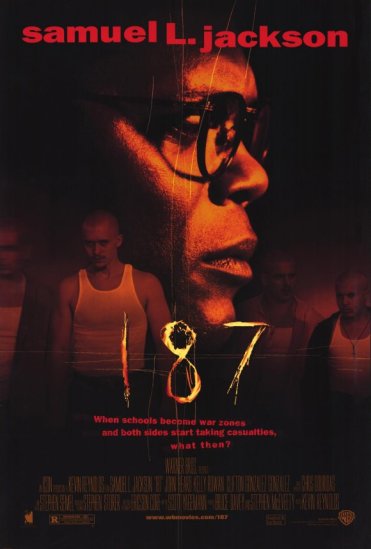
Back to School Part II #35: One Eight Seven (dir by Kevin Reynolds)


one_eight_seven_ver1

I’m writing this review from memory so you’re going to have to bear with me.  187 is one of those films that seems to show up on late night cable constantly, which is how I saw it.  I probably should rewatch it for this review but … no.  I don’t want to have to sit through it again.

See, here’s the thing with 187.  It’s a film where Samuel L. Jackson plays a high school science teacher and, just by definition, that should make it the greatest film ever and yet it isn’t.

Originally, Jackson’s working in New York but then he ends up failing one of his students (played by Method Man).  Method Man ends up giving Jackson a textbook on which he has written 187 on every single page.  Jackson immediately realizes that 187 is the name of the movie that he’s in.  “Always good to meet a fan,” he thinks but then suddenly, it dawns on him that 187 is also police code for homicide!  Jackson asks the school administration for help.  They ignore him (probably because everyone knows that Samuel L. Jackson is too much of a badass to be scared by some numbers in a textbook) and he ends up getting stabbed several times in the back.

Agck!

We jump forward 15 months.  Jackson has recovered from nearly being killed and he’s still determined to teach.  He wants to make a difference!  But he’s decided that New York kids are too homicidal so he transfers to a school in Los Angeles.  Surprise!  It turns out that students in Los Angeles are just as dangerous as the ones in New York.  During his first day as a substitute teacher, Jackson is writing his name on a chalk board.  Someone throws a crumpled ball of paper at him.  Jackson flinches as it hits his back.

FLASHBACK TIME!

Now, here’s the thing: the idea of Samuel L. Jackson teaching in an inner city high school and taking on a bunch of gang members sounds totally kickass.  And you spend this entire two-hour movie waiting for Samuel L. Jackson to have one of those wonderful Samuel L. Jackson moments when he fixes someone with that powerful glare and suddenly speaks in the voice of angry and vengeful God.  You keep waiting but, with the exception of a few moments, it never seems to happen.

I mean, don’t get me wrong.  I wasn’t expecting Jackson to say, “I’m sick of these motherfucking gangstas in this motherfucking classroom!”  It would have been great if he had said that but, after a few minutes of watching the movie, I realized that he probably wouldn’t.  187 is obviously meant to be a serious movie about America’s educational crisis.  Watching it, you get the feeling that 187‘s director, Kevin “I know Kevin Costner” Reynolds, woke up every morning and said, “I am making the most important film ever today!”

But whatever good intentions that the filmmakers may have had, it’s no excuse for totally wasting Samuel L. Jackson.  When you’ve got a powerful actor like Samuel L. Jackson, why do you waste him in such a thinly written role?  When you finally do allow him to do something big and Samuel L. Jackson-like, why do you waste so much dramatic potential by having him do almost all of it off-screen?  Jackson finally does get a great Samuel L. Jackson moment towards the end of the film but that’s just because there’s a big plot twist that doesn’t make any sense.  The end of 187 reminds the viewer that an ironic ending has to be earned.  It just can’t be slapped onto the film.

I mean, I don’t want to toss out any spoilers because, for all I know, 187 is going to be on Cinemax tonight.  If you’re up at 3 in the morning, you might end up watching it and God knows, I don’t want to be accused of giving away the ending.   But let me ask you this — if you’ve finally captured someone who you’ve spent an entire two-hour film trying to kill, would you then suddenly decide to play a game of Russian roulette?

Anyway, 187 should be avoided because it totally wastes Samuel L. Jackson and that’s kind of unforgivable.

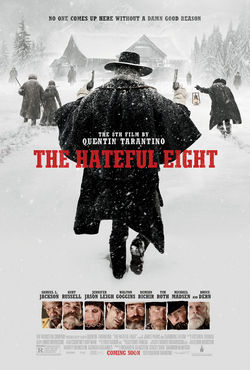
Playing Catch-Up: The Hateful Eight (dir by Quentin Tarantino)


The_Hateful_Eight

Remember how I said that it was intimidating to admit that The Big Short didn’t do much for me as a viewer?  Well, it’s even more intimidating for me to admit that I felt much the same way about The Hateful Eight as well.

Nearly everyone I know loves The Hateful Eight and, going into it, I really wanted to love it as well.  After all, this is — as the opening credits remind us — Quentin Tarantino’s 8th film!  Tarantino is one of my favorite directors.  I thought his last film, Django Unchained, was a masterpiece and one of the most important films ever made about slavery.  Like many of you, I’ve followed all the details of the making of The Hateful Eight, from the initial script leak to the controversy over Tarantino’s comments on the police.  I was excited because the cast looked great and was full of veteran actors — like Kurt Russell, Jennifer Jason Leigh, and Bruce Dern — who all seemed likely to benefit from the Tarantino touch.  (Say what you will about Quentin Tarantino, it cannot be denied that he’s given good roles to talented actors who are rarely given the opportunities that they deserve.)  When I heard that Ennio Morricone was going to be providing the score, I got even more excited.  Morricone and Tarantino; it seemed like the perfect combination for greatness.

Well, Morricone’s score is spectacular.  There’s talk that Morricone might finally win an Oscar for his work on The Hateful Eight and I certainly don’t have a problem with that.  (Hopefully, Morricone will have learned a lesson from the Golden Globes and, if he is nominated, he will either come to the ceremony himself or arrange for someone other than Tarantino to accept for him.)  And Jennifer Jason Leigh takes full advantage of her role, giving a truly ferocious performance.

But otherwise, The Hateful Eight just didn’t do much for me.  It’s not that I disliked the film.  There was a lot that worked but, for whatever reason, The Hateful Eight never enthralled me the way that past Tarantino films have.  The Hateful Eight left me saying, “Is that it?”

A lot of my reaction to The Hateful Eight has to do with the film’s length.  Taking place, for the most part, in only one location and structured more like a play than a film, The Hateful Eight would be a great 90 minute murder mystery.  Instead, it lasts nearly 3 hours and, at times, the film drags interminably.  As usual, Tarantino plays with time and, at one point, stops the action so that we can see what happened earlier in the day.  Unfortunately, as opposed to other Tarantino films, we don’t really learn anything new from this flashback and you get the feeling that it was included most because flaskbacks are a Tarantino trademark and because he wanted to find a way to work a somewhat pointless Zoe Bell cameo into the film.

As for Tarantino’s widely acclaimed script, I have to admit that I got kind of bored with this talky film.  Yes, the actors were all good and it’s always fun to listen to Samuel L. Jackson be a badass but the dialogue itself was largely repetitive and occasionally, the film itself threatened to turn into Tarantino-on-autopilot.

(Interestingly enough, Tarantino’s script features several creative euphemisms for oral sex and the characters come up with a handful of different ways to point out that Jackson is black but, when it comes to Jennifer Jason Leigh’s character, nobody can come up with anything more imaginative than repeatedly calling her a bitch.  While, unlike some critics, I don’t think The Hateful Eight is a misogynistic movie, I do have to admit that I was rolling my eyes around the fifth time that Leigh’s character was called a bitch and kept rolling them for the entire movie.  For a writer well-known for his ability to come up with colorful and memorable insults, Tarantino’s refusal to come up with anything more imaginative than “bitch” just felt lazy.)

What can I say?  The Hateful Eight just didn’t do much for me.  However, I do think that the film looked great and I certainly hope that Morricone and Leigh are at least nominated for their excellent work.  I look forward to Tarantino’s next film but I doubt I’ll be revisiting The Hateful Eight any time soon.

(By the way, with this review, I am now officially caught up on reviewing the films of 2015!)

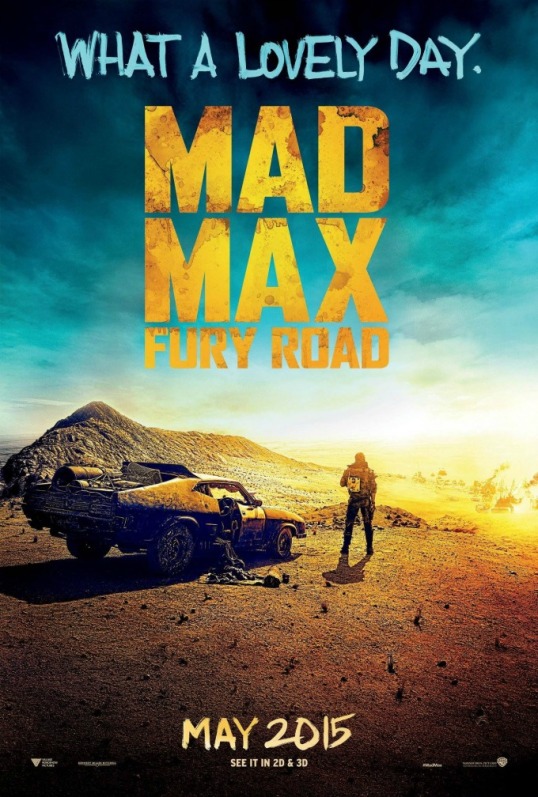
The Seattle Film Critics Survey Is Mad For Max! We Love You, Seattle!


MadMaxFuryRoad

The Seattle Film Critics Survey announced their nominees for the best of 2015 earlier today and I have to say, their nominations are pretty interesting!  (Also interesting to note is that they did not nominate Oscar front runner Spotlight.) Way to go, Seattle!

BEST PICTURE OF THE YEAR:

BEST DIRECTOR:

BEST ACTOR in a LEADING ROLE:

BEST ACTRESS in a LEADING ROLE:

  • Cate Blanchett – CAROL
  • Nina Hoss – PHOENIX
  • Brie Larson – ROOM
  • Rooney Mara – CAROL
  • Saoirse Ronan – BROOKLYN

BEST ACTOR in a SUPPORTING ROLE:

  • Benicio del Toro – SICARIO
  • Tom Hardy – THE REVENANT
  • Oscar Isaac – EX MACHINA
  • Mark Rylance – BRIDGE OF SPIES
  • Sylvester Stallone – CREED

BEST ACTRESS in a SUPPORTING ROLE:

  • Jennifer Jason Leigh – THE HATEFUL EIGHT
  • Kristen Stewart – CLOUDS OF SILS MARIA
  • Mya Taylor – TANGERINE
  • Alicia Vikander – EX MACHINA
  • Kate Winslet – STEVE JOBS

BEST ENSEMBLE CAST:

BEST ORIGINAL SCREENPLAY:

  • EX MACHINA – Alex Garland
  • THE HATEFUL EIGHT – Quentin Tarantino
  • INSIDE OUT – Pete Docter, Meg LeFauve, and Josh Cooley (screenplay); Pete Docter and Ronnie del Carmen (story)
  • SICARIO – Taylor Sheridan
  • SPOTLIGHT – Josh Singer & Tom McCarthy

BEST ADAPTED SCREENPLAY:

BEST ANIMATED FEATURE:

  • ANOMALISA – Charlie Kaufman and Duke Johnson, directors
  • INSIDE OUT – Pete Docter, director
  • THE PEANUTS MOVIE – Steve Martino, director
  • SHAUN THE SHEEP MOVIE – Mark Burton, Richard Starzak, Julie Lockhart and Paul Kewley, directors
  • WHEN MARNIE WAS THERE – Hiromasa Yonebayashi, director

BEST DOCUMENTARY FEATURE:

  • AMY – Asif Kapadia, director
  • CARTEL LAND – Matthew Heineman, director
  • GOING CLEAR: SCIENTOLOGY AND THE POWER OF BELIEF – Alex Gibney, director
  • KURT COBAIN: MONTAGE OF HECK – Brett Morgen, director
  • THE LOOK OF SILENCE – Joshua Oppenheimer, director

BEST FOREIGN LANGUAGE FILM:

  • THE ASSASSIN – Hou Hsiao-Hsien, director
  • MUSTANG – Deniz Gamze Ergüven, director
  • PHOENIX – Christian Petzold, director
  • SON OF SAUL – László Nemes, director
  • WHITE GOD – Kornél Mundruczó, director

BEST CINEMATOGRAPHY:

  • CAROL – Edward Lachman
  • THE HATEFUL EIGHT – Robert Richardson
  • MAD MAX: FURY ROAD – John Seale
  • THE REVENANT – Emmanuel Lubezki
  • SICARIO – Roger Deakins

BEST COSTUME DESIGN:

BEST FILM EDITING:

BEST MAKEUP & HAIRSTYLING:

  • CAROL – Patricia Regan, Jerry DeCarlo
  • MAD MAX: FURY ROAD – Lesley Vanderwalt, Damian Martin, Elka Wardega
  • THE REVENANT – Graham Johnston, Robert Pandini

BEST ORIGINAL SCORE:

BEST ORIGINAL SONG:

  • CREED – “Grip”, Ludwig Göransson, Sam Dew, Tessa Thompson (composers)
  • FIFTY SHADES OF GREY – “Earned It (Fifty Shades of Grey)”, Abel Tesfaye, Stephan Moccio, Jason  Quenneville, Ahmad Balshe (composers)
  • FURIOUS 7 – “See You Again”, Justin Franks, Andrew Cedar, Charlie Puth, Cameron Thomaz (composers)
  • THE HUNTING GROUND – “Til It Happens To You”, Lady Gaga, Diane Warren (composers)
  • SPECTRE – “Writing’s On The Wall”, Sam Smith, James Napier (composers)

BEST PRODUCTION DESIGN:

  • CAROL – Judy Becker (production design); Heather Loeffler (set decorator)
  • CRIMSON PEAK – Tom Sanders (production design); Shane Vieau, Jeffrey A. Melvin (set decorator)
  • MAD MAX: FURY ROAD – Colin Gibson (production design); Lisa Thompson (set decorator)
  • THE REVENANT – Jack Fisk (production design); Hamish Purdy (set decorator)
  • STAR WARS: THE FORCE AWAKENS – Rick Carter and Darren Gilford (production design); Lee Sandales (set decorator)

BEST SOUND DESIGN:

  • MAD MAX: FURY ROAD – Ben Osmo, Chris Jenkins, Gregg Rudloff (sound mixing); Scott Hecker, Mark Mangini, David White (sound editing)
  • THE MARTIAN – Mac Ruth, Paul Massey, Mark Taylor (sound mixing); Oliver Tarney (sound editing)
  • THE REVENANT – Chris Duesterdisk, Jon Taylor, Frank A. Moñtano, Randy Thom (sound mixing); Martin Hernandez, Randy Thom, Lon Bender (sound editing)
  • SICARIO – John Reitz, Tom Ozanich, William Sarokin (sound mixing); Alan Robert Murray (sound editing)
  • STAR WARS: THE FORCE AWAKENS – Andy Nelson, Christopher Scarabosio, Stuart Wilson (sound mixing); Matthew Wood, David Acord (sound editing)

BEST VISUAL EFFECTS:

Playing Catch-Up With 6 Quickie Reviews: The Big Game, The Connection, Graduation Day, McFarland USA, Taken 3, and War Room


Here are 6 more reviews of 6 other films that I watched this year.  Why six?  Because Lisa doesn’t do odd numbers, that’s why.

The Big Game (dir by Jalmari Helander)

In The Big Game, Samuel L. Jackson plays the President of the United States and you would think that fact alone would make this film an instant classic.  Unfortunately, this film never really takes advantage of the inherent coolness of Samuel L. Jackson playing the leader of the free world.  When Air Force One is sabotaged and crashes in the wilderness of Finland, President Jackson has to rely on a young hunter (Onni Tommila) from a group of CIA agents disguised as terrorists.  Tommila does a pretty good job and the scenery looks great but at no point does Samuel L. Jackson says, “Check out this executive action, motherfucker,” and that’s a huge missed opportunity.  As for the rest of the film, it takes itself a bit too seriously and if you can’t figure out the big twist from the minute the movie starts, you obviously haven’t seen enough movies.

The Connection (dir by Cedric Jiminez)

Taking place over the 1970s, the French crime thriller tells the largely true story of the efforts of a French judge (played by Jean Dujardin) to take down a ruthless gangster (Gilles Lellouche) who is the head of one of the biggest drug cartels in the world.  The Connection run for a bit too long but, ultimately, it’s a stylish thriller that does a very good job of creating a world where literally no one can be trusted.  Dujardin, best known here in the States for his Oscar-winning role in The Artist, does a great job playing an honest man who is nearly driven to the point of insanity by the corruption all around him.

Graduation Day (dir by Chris Stokes)

Hey, it’s another found footage horror film!  Bleh!  Now, I should admit that this horror film — which is NOT a remake of that classic 1980s slasher — does have a fairly clever twist towards the end, that goes a long way towards explaining a lot of the inconsistencies that, up until that point, had pretty much dominated the film.  But, even with that in mind and admitting that Unfriended and Devil’s Due worked wonders with the concept, it’s still hard to feel any enthusiasm about yet another found footage horror film.

McFarland USA (dir by Niki Caro)

McFarland USA is an extremely predictable but likable movie.  Kevin Costner plays a former football coach who, while teaching at a mostly Latino high school, organizes a cross country team that goes on to win the state championship.  It’s based on a true story and, at the end of the film, all of the real people appear alongside the actors who played them.  There’s nothing about this film that will surprise you but it’s still fairly well-done.  Even Kevin Costner, who usually gets on my last nerve, gives a good performance.

Taken 3 (dir by Olivier Megaton)

Bryan Mills (Liam Neeson) is back and he’s killing even more people!  Fortunately, they’re all bad people but you really do have to wonder what type of dreams Bryan has whenever he goes to sleep.  In Taken 3, Bryan’s wife (Famke Janssen) has been murdered and Bryan has been framed.  He has to solve the case and kill the bad guys while staying one step ahead of the police (represented by a bored-looking Forest Whitaker).  Neeson does all of his usual Taken stuff — the intense phone conversation, the steely glare, and all the rest — but at this point, it has literally been parodied to death.  If you’re into watching Liam Neeson kill ugly people, Taken 3 will provide you with adequate entertainment but, for the most part, it’s but a shadow of the first Taken.

War Room (dir by Alex Kendrick)

I saw the War Room in Oklahoma.  It was being shown as part of a double feature with The Martian, of all things!  Anyway, this film is about an upper middle class family that hits rock bottom but they’re saved by the power of prayer!  Lots and lots of prayer!  Seriously, this film almost qualifies as “prayer porn.”  Anyway, the film was badly acted, badly written, incredibly heavy-handed, and ran on way too long but, on the plus side, it did eventually end.

Sci-Fi Review: Star Wars Episode III: Revenge of the Sith (2005, directed by George Lucas)


Star_Wars_Episode_III_Revenge_of_the_Sith_posterThe year 2005 was a dark time to be a fan of Star Wars.
The first two parts of the highly anticipated prequel trilogy had been released and had left fans feeling as if millions of voices had cried out in terror and suddenly been silenced.  No sooner had fans started to recover from the trauma of The Phantom Menace then Attack of the Clones was unleashed and they were stunned to learn that a movie could be even more pointless than The Phantom Menace.

The summer of 2005 promised the release of Star Wars Episode III: The Revenge of the Sith.  Fans were excited because they knew that Anakin Skywalker would finally be transformed into Darth Vader but they also knew that he would still be played by Hayden Christensen.  Many of us who went to see the movie on its opening weekend did so with low expectations and mixed feelings.

“WAR!” the opening title crawl of Revenge of the Sith declared, as if it was trying to reassure those of us in the audience that it would not be another boring Star Wars prequel.  There was nothing in the crawl about taxation or trade routes.  Instead, it was all about how the Galactic Republic was at war with separatists and how Chancellor Palpatine was being held prisoner by General Grievous.  After an exciting battle on Grievous’s flagship, Anakin not only rescued Palpatine but also decapitated Christopher Lee’s Count Dooku, despite the fact that Dooku had surrendered and was unarmed.  That’s when those of us watching knew that Revenge of the Sith was not going to be like the other two prequels.  Revenge of the Sith was going to be darker and edgier and not just for kids.  A headless Count Dooku action figure would not be sold at your local toy store.

Looking back, it is easy to forget how relieved many of us were that Revenge of the Sith was not terrible.  After the bitter disappointment of the first two prequels, we were happy that Jar Jar Binks only appeared during one shot towards the end of the film and he did not speak.  We were happy that Ewan McGregor and Natalie Portman both finally got to give performances that justified casting actors of their caliber as Obi-Wan and Amidala.  We were happy that, since Anakin and Amidala were secretly married between Attack of the Clones and Revenge of the Sith, we did not have to sit through any more scenes of them falling in love.  Many of us had found Hayden Christensen’s performance to be petulant in Attack of the Clones and, intentionally or not, Revenge of the Sith seemed to validate our suspicions by having both Yoda and Mace Windu say the same thing about Anakin.  After the embarrassment of Phantom Menace and Attack of the Clones, this was a prequel that we felt we could get behind.

mswr

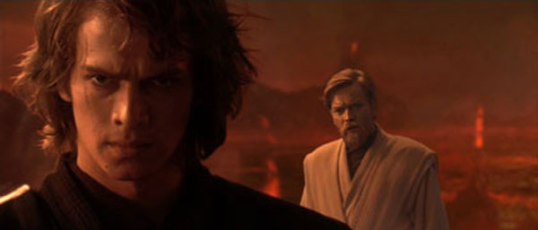
And we were really happy with the climatic battle between Obi-Wan and Anakin.  After Anakin had gone over to the dark side, he and Obi-Wan dueled on a volcanic planet.  “You were supposed to be the chosen one!” Obi-Wan shouted after chopping off Anakin’s legs.  After being left to die by Obi-Wan, Anakin was rescued by Emperor Palpatine.  It was only after being encased in that famous black armor that Palpatine told the new Darth Vader that Amidala had died.  Darth Vader’s “Nooooooooo!” would go down in history.

At the end of the film, Jimmy Smits was seen giving an infant Luke to Owen and Beru Lars and Darth Vader and the Emperor were seen standing on the bridge of an imperial ship and looking out at the skeleton of the Death Star.  For the first time since the prequels were first released, some of us applauded at the end of a Star Wars film.

When, ten years later, I rewatched Revenge of the Sith for the first time in a long while, my immediate impression was that it was nowhere close to being as good as I remembered.  Without a doubt, it was still the best of the prequels but how much was that really saying?  Of all the prequels, it came the closest to capturing the sense of awe and excitement that made the original trilogy (even Return of the Jedi) so entertaining but, at the same time, it still had many of the same flaws that afflicted Phantom Menace and Attack of the Clones.  Hayden Christensen was as stiff and inexpressive as ever, as was George Lucas’s dialogue.  (When Obi-Wan tells Anakin that Palpatine is evil, Anakin actually replies, “From my point of view, the Jedis are evil!”  He shouts this in the middle of a light saber duel.)  Even the movie’s most shocking moment, when Anakin murdered a group of children, was no longer effective because everyone in the movie insisted on calling the children “younglings.”

revenge_of_the_sith600

Throughout the entire prequel ordeal, George Lucas would insist that it was necessary to see all three of the prequels to really understand the story he was trying to tell and how it fit in with the original trilogy.  However, of all the prequels, Revenge of the Sith is the only one that feels as if it adds anything to what we had already learned from watching the original trilogy.  Nor is there anything to be gained from having seen the first two prequels before watching Revenge of the Sith for the first time.  The main accomplishment of Revenge of the Sith was to prove that The Phantom Menace and Attack of the Clones were entirely unnecessary.  (Revenge of the Sith actually works better if you have never seen Phantom Menace because there is no way that the Anakin played by Jake Lloyd could have grown up to be the Anakin played by Hayden Christensen.)

Why, when we originally watched Revenge of the Sith, did so many of us think that it was so much better than it actually was?

In the year 2005, we were just happy to have a Star Wars film that did not totally suck.

Jar

Sci-Fi Review – Star Wars: Episode II – Attack of the Clones (dir. by George Lucas)


Attack of the Clones is, at least in my opinion, the worst Star Wars film ever made. Hands down. That is not to say it’s not mildly entertaining, but it demands a great deal of good will from its viewer to keep him from sneering at the movie constantly, especially if said viewer is a fan.

Christ, where do I even begin.

It’s important to note that Episode II is a transition movie. If that’s not clear enough, what I mean is that it’s a movie that exists to connect both the childish, yet potentially endearing Episode I, and the much darker and edgier Episode III. Episode II is somewhere inbetween these two moods, trying to make the transition smoother, disastrously so. It’s catastrophic in many levels, but mostly because of Hayden Christensen’s Anakin Skywalker. We’ll get there soon.

Episode II starts as a movie about politics. Now, I like fictional world politics as much as the next person. I honestly do. Especially in a space opera setting. But in Star Wars the politics are dull and barely explained. Padmé Amidala’s two terms as democratically elected Queen of Naboo (wait, what?) are now over, and she continues her career as a politician by becoming a senator. The story begins by trying to make it interesting that people are trying to kill Amidala, on what appears to be politically motivated crimes. We don’t get much context, except that she opposes some other senators. Palpatine, being the super trustworthy guy everyone always knew he was, assigns the Jedi Order to protect her, and finds that Obi-Wan is a suitable bodyguard for Padmé, considering their friendship way back in Episode I. Of course, Obi-Wan must take his apprentice, Anakin Skywalker, with him. And hilarity ensues.

Now, you’re probably familiar with whom Anakin is to become, and you probably know whose father he is, so this movie must establish one very important thing; an origin to the affection between future Lord Vader and an unwitting woman, so that we can learn whose womb was it that those guys from the original trilogy came from. Therefore, in addition to being about lackluster politics, this is a movie about love.

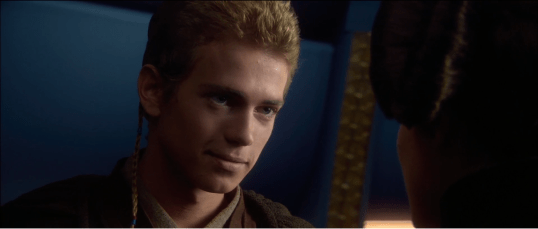
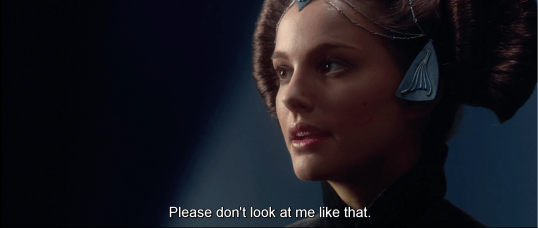
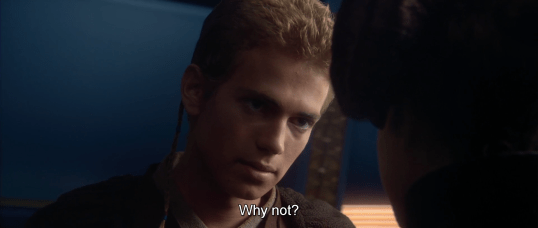
Ani1Ani2Ani3Ani4

DAMN SON.

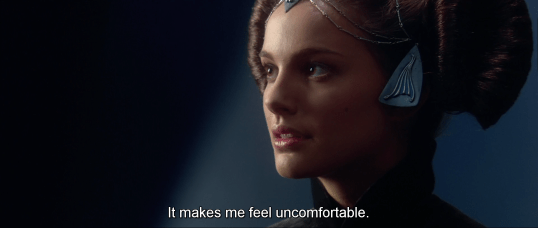
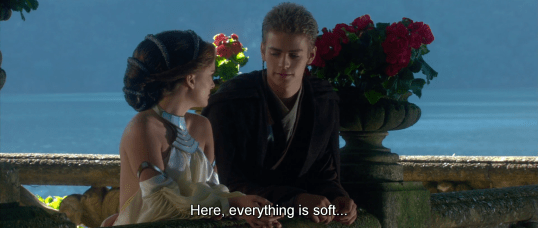
Now, I have to agree with Padmé. You can preach all you want about how you have a massive crush on Hayden Christensen’s mini braid, but that piercing sex offender gaze made me uncomfortable. Throughout the first act, Anakin goes from flirting with the poor woman to actively doing stuff very similar to sexual harassment. I mean, seriously, look at this lecherous, leering asshole.

Ani5.png

Darth Vader has always been regarded as one of the greatest villains of cinema, but I never figured that he was also one of the sleaziest. 

I wish this was the only problem with Anakin. Maybe it’s not Mr. Christensen’s acting, but the poor writing (though I suspect that, considering his absence in major movies this decade, his acting was definitely a factor). Young Skywalker is a very gifted Jedi, being immaculately conceived by midi-chlorians and all (I can’t stop laughing), and he is painfully aware of his skills, which he shows through an overpowering arrogance. Now, arrogance when done right can be charming, and perhaps that was the intention; to make Darth Vader a badass even as a teenager, a daredevil, someone who just barely succeeds, but does it with style. Anakin, however, comes across as impudent, annoying, and exceedingly stupid. It seems Anakin can’t go two scenes without doing something that would displease the Jedi council, and entirely aware of it too. ‘Cause that’s just how he rolls. James Dean from a galaxy far far away.

Second act comes. Anakin grows more and more adolescent and fascist. More politics happen. Then there are some cool action scenes that seem to save the film. Obi-Wan is written as barely having a personality, aside from comments that try to make it evident that he is growing older and grumpier, even though he can’t be much more than 30. Regardless, he is arguably the saving grace in the main cast, at the very least as far as really cool fights go. He pilots fighter ships, he fights with a lightsaber; the man sees some action. It’s almost depressing to see an actor of Ewan McGregor’s caliber being reduced to action hero and grumpy mentor to an angsty teenager.

Grantorino.png

Their dynamic is oddly reminiscent of Gran Torino

Jar Jar also appears. Fan favourite Jar Jar. I feel this is worth mentioning because in an extremely important scene he proposes (as stand-in senator for Amidala) to convey supreme power to Chancellor Palpatine. Yes, that Chancellor Palpatine, and I have to wonder why they couldn’t task this burden to an unnamed senator. Don’t people hate the poor gungan enough? It’s as if George Lucas is just fucking with his public to see how far they can go, at this point.

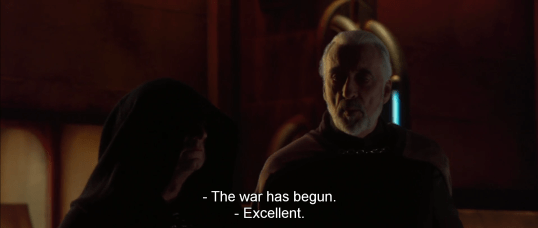
And then, in the third act, we are introduced to the big bad: Count Dooku, played by the late Sir Christopher Lee. You’d think that bringing this legend of acting might infer that this character is the highlight of the cast. Might have been. Dooku is a character full of potential. He’s obviously evil, but with just the right amount of idealism to seem more shades of grey than the cruel, pure black villains the series are accostumed to. But apparently all he does is some exposition, then pave the way for the epic arena fight scene that kind of defines this movie as a Star Wars film (perhaps one of the only things that defines this as a Star Wars film), some more exposition, a lightsaber duel (a really cool one, wrapping up the whole two things that make this a Star Wars film), and then he’s gone, apparently having started a war. The movie is over, without fully explaining why things escalated, and who exactly Count Dooku represents that the Republic is at war with.

Grantorino.png

WAR AGAINST WHOM???

I’m serious when I say this can be an entertaining movie. The fight scenes can be fun and you can laugh at what ridiculous situations the actors are subjected to. But it’s mostly incredibly dull. It’s a film that throws you into an extended torrent of politics you need to understand beforehand to appreciate, and that lead to Clone Wars, a pretty cool spin-off that most people never got to see and that might as well have been properly included as crucial to the continuity since it’s much better than this. As a standalone film, the story is a confusing, rushed mess even at two hours long. As a Star Wars film, Attack of the Clones makes it obvious that the series is not infallible. Horribly, gapingly, obviously not infallible.