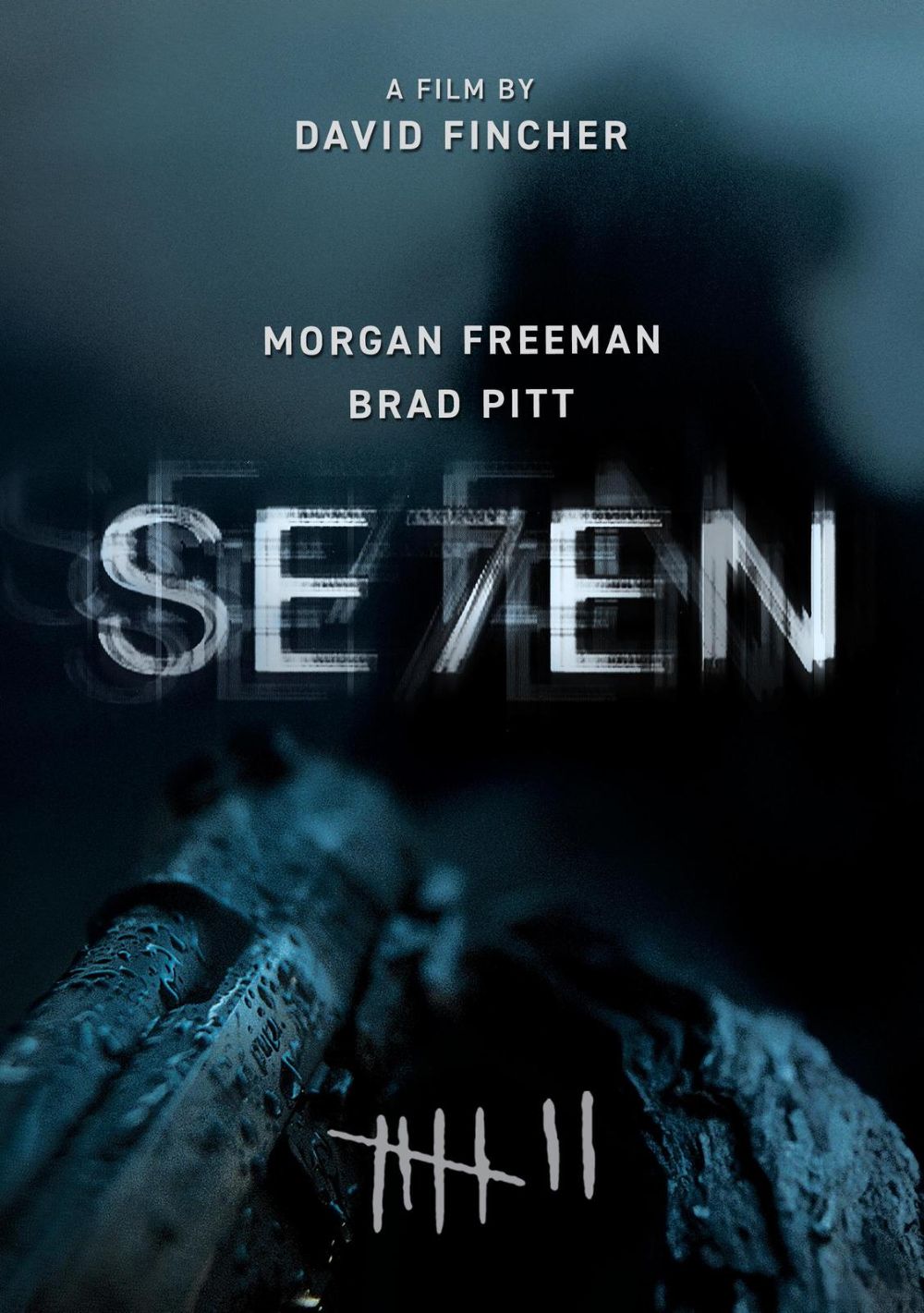
Horror Film Review: Se7en (dir. by David Fincher)


“I just don’t think I can continue to live in a place that embraces and nurtures apathy as if it was virtue.” — William Somerset

The nastiest thing about David Fincher’s Se7en is how quickly its horrors start to feel like part of the landscape. A gruesome murder should bring the world to a halt, but here it’s another room to enter, another report to write, another terrible thing happening while the rain keeps falling. Released in 1995, the film takes a serial-killer investigation and builds an atmosphere so oppressive that simply spending time in its unnamed city becomes uncomfortable. Yet the ugliness never feels entirely like an exercise in shock. Underneath it is a troubling question: what happens when people get used to looking away?

Morgan Freeman’s William Somerset has spent a career fighting that impulse, and he’s tired. Days away from retirement, he gets paired with Brad Pitt’s David Mills, a younger detective whose enthusiasm comes with a generous helping of impatience. Their investigation centers on a murderer arranging killings around the seven deadly sins. It’s a strong hook, but the movie doesn’t coast on the ingenuity of its crimes. Andrew Kevin Walker’s screenplay makes the detectives’ reactions just as important as the evidence. They’re looking at the same awful things while drawing very different conclusions about what their work can accomplish.

Freeman is terrific at suggesting how much effort Somerset’s composure requires. His quietness isn’t an absence of feeling; it’s a way of keeping feeling manageable. He asks questions carefully, studies details other people dismiss, and seems painfully aware of how easily a victim can become an inconvenience to everyone else. The familiar retiring-cop setup could have made him predictable, but Freeman gives his weariness a personal texture. Somerset still cares enough to be hurt by the job. Leaving is less a triumphant escape than an admission that he no longer knows how to keep doing it.

Pitt gives Mills an emotional openness that both challenges Somerset and exposes his own limitations. He’s cocky, easily irritated, and eager to interpret caution as defeatism. Sometimes he’s right to push back; sometimes he clearly needs to stop talking and listen. Pitt lets both sides exist without turning Mills into either a lovable hothead or a complete fool. His belief that police work should make a difference feels genuine. The tension comes from watching that belief encounter situations it can’t easily absorb. Together, the actors make a familiar mismatched partnership feel like an ongoing argument rather than a screenwriting obligation.

Fincher surrounds that argument with a city that seems to encourage surrender. The rain, clutter, cramped rooms, and dirty light create a place where basic comfort feels unavailable. Even spaces that should provide privacy seem invaded by noise or unease. What matters isn’t simply that everything looks miserable. It’s that people move through this misery as though it barely registers anymore. The setting gives Somerset’s exhaustion a believable source while making Mills’s confidence seem increasingly precarious. Neither man is investigating from a position of safety; they’re already living inside the atmosphere the killer exploits.

That’s also why the horror works beyond the immediate disgust of the crime scenes. Se7en often makes us confront what happened after the fact, with the detectives trying to reconstruct suffering from its remains. Fincher understands how disturbing a delayed realization can be. A room initially presents one terrible image, then a detail or explanation makes it worse. The film doesn’t need to show every act of violence because the aftermath supplies enough information for the imagination to take over. The dread comes from knowing that looking more closely will probably reveal something you would rather not understand.

Despite that relentless mood, the investigation stays engaging. There’s satisfaction in watching Somerset and Mills read, argue, follow leads, and gradually assemble a clearer picture. The library sequence is especially effective because it changes the film’s texture without breaking its spell. Somerset finds a measure of calm among books and music, using thought rather than momentum to approach the case. It’s a small reminder that the world contains more than brutality. Those quieter passages also make the shocks hit harder. Fincher knows that an audience needs time to anticipate the next discovery, not just recover from the last one.

Gwyneth Paltrow’s Tracy provides another necessary interruption. As Mills’s wife, she has a different relationship with the city: she isn’t trying to solve it, just work out whether she can live there. Her scenes bring out the personal cost of the detectives’ opposing attitudes. The dinner sequence allows some awkward humor, while her private conversation with Somerset reveals tenderness beneath his guarded manner. Paltrow makes Tracy feel vulnerable without making her helpless. Still, the screenplay gives her less independence than she deserves. She’s emotionally important, but the film is more curious about what she means to its men than about her own life.

John Doe takes that tendency to reduce people to their usefulness and pushes it into monstrous territory. To him, human beings are props in a moral demonstration. His certainty is chilling, but it isn’t the same as wisdom, and the movie works best when that distinction remains clear. There are moments when his elaborate planning feels almost too convenient, as though the screenplay needs him to possess whatever advantage the next development requires. Even so, his vanity keeps him from becoming merely an all-knowing villain. Beneath the preaching is someone desperate to force the world to acknowledge his importance.

Without detailing the final revelations, the closing stretch brings the film’s ideas into brutally personal focus. The shift into daylight feels wrong in a way that’s difficult to shake. After so many shadowy interiors, open space should offer relief, yet there’s nowhere emotionally safe to stand. The suspense becomes less about discovering another clue than watching people recognize what is happening and struggle to respond. That distinction gives the ending its force. Knowledge doesn’t automatically create control, and professional experience doesn’t make anyone immune to being overwhelmed. The case stops being something the detectives can hold at a distance.

What lingers after Se7en isn’t just the memory of its worst images. It’s the uncomfortable distance between noticing suffering and knowing what to do about it. Somerset has experience without much hope; Mills has conviction without enough restraint. Neither can offer a complete answer, but their struggle gives the film something more substantial than stylish despair. Fincher makes looking away seem tempting, even sensible, before leaving us with the cost of that choice. This is a grim, occasionally contrived, remarkably controlled thriller whose deepest horror is also its most recognizable: the fear that the world can wear down our willingness to care.
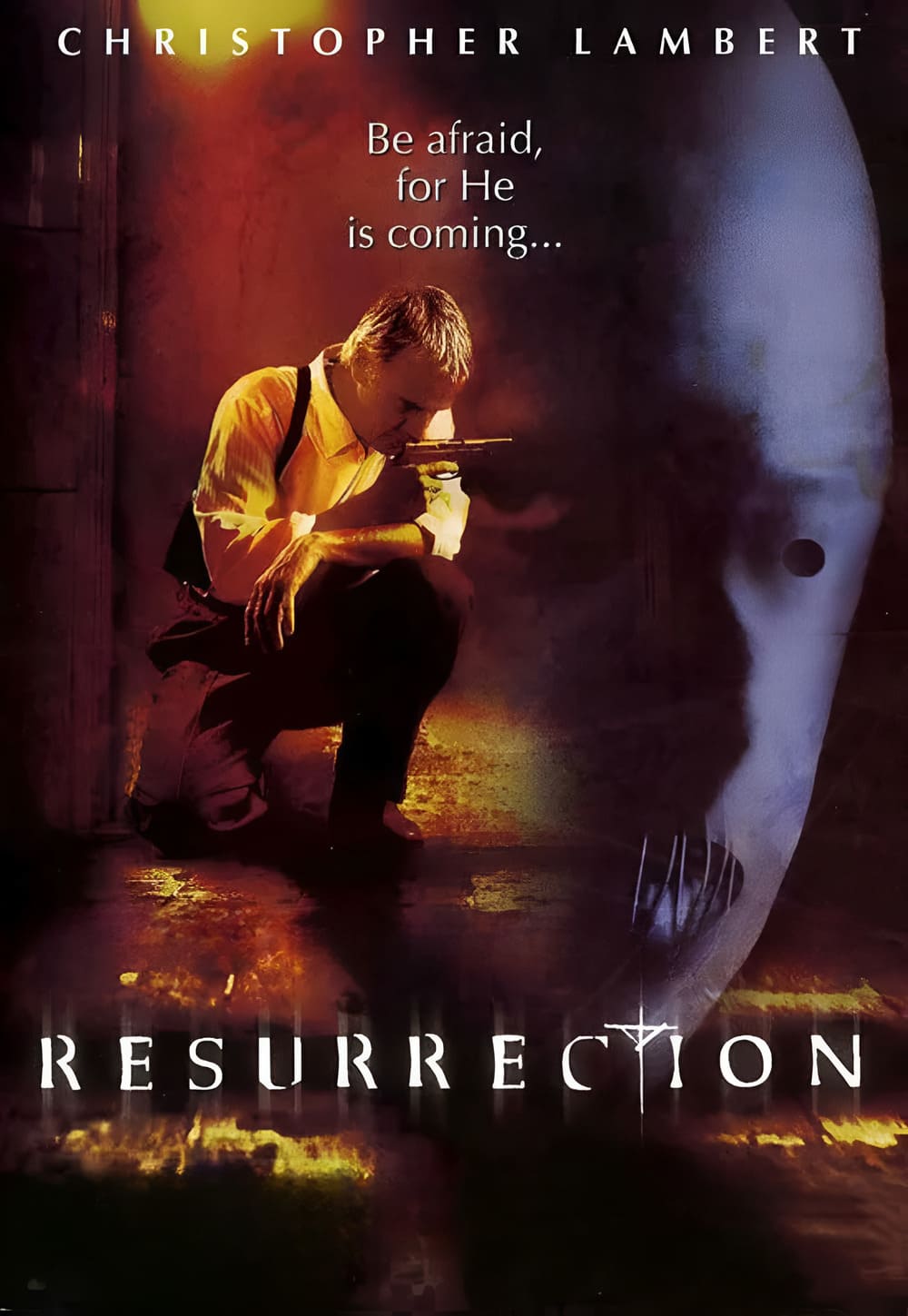
Horror Film Review: Resurrection (dir. by Russell Mulcahy)


“There is an evil which I have seen under the sun, and it is common among men.” — Ecclesiastes 6:1

There is a fine line between a serial-killer thriller that gets under your skin and one that simply throws enough severed limbs at you to make an impression. Resurrection (1999) spends most of its running time somewhere between the two. Russell Mulcahy’s film has the haunted detective, the religiously obsessed murderer, and the crime scenes that look like nobody has paid the electricity bill in years. None of that is particularly original, but originality is not necessarily the deciding factor with a movie like this. What matters is whether the atmosphere, performances, and central mystery make you willing to follow it into another dark room. More often than not, they do.

Christopher Lambert plays John Prudhomme, a Chicago detective still struggling with the accidental death of his young son. His latest assignment involves a series of murders in which the victims have been left with body parts missing. Working alongside his partner, Andrew Hollinsworth, played by Leland Orser, Prudhomme discovers that the mutilations follow a biblical pattern. The killer believes he can reconstruct the body of Christ, with Easter serving as his deadline. It is an outrageous premise, but an effective one for a horror thriller: every murder advances a larger project, and every breakthrough brings the detectives closer to understanding just how far their suspect intends to go.

The obvious comparison is Se7en, and pretending otherwise would be giving Resurrection more credit for individuality than it earns. The oppressive city, elaborate murders, and collision of religious language with human depravity all feel familiar. Where Mulcahy’s film establishes some identity is in its willingness to push the material toward gruesome pulp. It is less interested in carefully cultivating philosophical dread than in making the killer’s obsession physically revolting. That does not make it the better movie, but it gives it something to work with beyond imitation. The mystery is not just about catching a murderer; it is about interrupting a grotesque act of construction.

That distinction makes the crime scenes more effective than their shock value alone would suggest. The missing limbs are not random embellishments designed to make an already unpleasant murder look worse. They are the reason the murders happen. Each victim has been reduced to a useful piece of somebody else’s fantasy, and that cold practicality is genuinely disturbing. The religious angle sometimes becomes heavy-handed, particularly when the screenplay spells out connections that already seem clear. Still, the central idea holds together well enough to give the investigation momentum. Knowing what the killer wants does not immediately tell the detectives how to stop him.

Mulcahy gives that investigation a suitably miserable visual landscape. Rooms feel cramped and contaminated, shadows seem to swallow whatever light reaches them, and the city offers very little relief from the ugliness indoors. At its best, the direction makes an ordinary doorway or hallway feel like the entrance to something nobody should discover. At its worst, the stylization starts competing with the material. Restless camerawork and aggressive visual flourishes occasionally announce the film’s anxiety rather than allowing the viewer to feel it. There are scenes where a steadier approach might have been more unsettling. Even so, the atmosphere remains one of the movie’s strongest selling points.

Lambert helps because he approaches Prudhomme without any apparent embarrassment about the material. His performance has rough edges, and some of the more emotional dialogue does not land with complete ease, but his tired expression and gravelly voice suit a man who is barely keeping himself together. He looks worn down before the investigation really gets moving, which gives the case somewhere to push him. More importantly, he does not treat the grisly premise like an invitation to ham it up. His sincerity gives the film a degree of emotional weight, even when the writing leans on familiar shorthand for a grieving father.

Orser makes a useful partner, bringing a different energy without turning Hollinsworth into comic relief. Their exchanges help establish the practical business of working a case, something the movie needs whenever the religious symbolism threatens to take over. They are more convincing as colleagues trying to make sense of horrible evidence than as pieces in an elaborate thematic puzzle. That distinction matters because the screenplay is not always as persuasive as its actors. Clues sometimes arrive with suspicious convenience, and certain complications feel less like believable obstacles than devices intended to keep the chase going for another stretch.

The same problem affects Prudhomme’s personal story. Connecting his grief to a case built around resurrection gives the film an obvious emotional framework, but it does not always develop that connection with much delicacy. The ideas are there: the desire to reverse death, the damage caused by loss, and the difference between faith and obsession. Too often, though, the movie states those concerns more clearly than it dramatizes them. Once the investigation shifts into its later confrontations, the balance tips further toward thriller mechanics. The tension survives, but some of the unsettling possibilities raised by the premise get left behind.

What ultimately makes Resurrection worth watching is not that it transcends its influences, but that it gets enough of the fundamentals right. The murders are disturbing, the central obsession is memorable, and Lambert gives the ugliness a battered human presence to work against. Mulcahy occasionally pushes too hard, while the screenplay occasionally asks for too much patience, but neither problem completely drains the experience. This is not the serial-killer thriller you recommend for airtight plotting or subtle insights into belief. It is the one you put on when you want something dark, lurid, and committed to making its familiar nightmare unpleasant again.

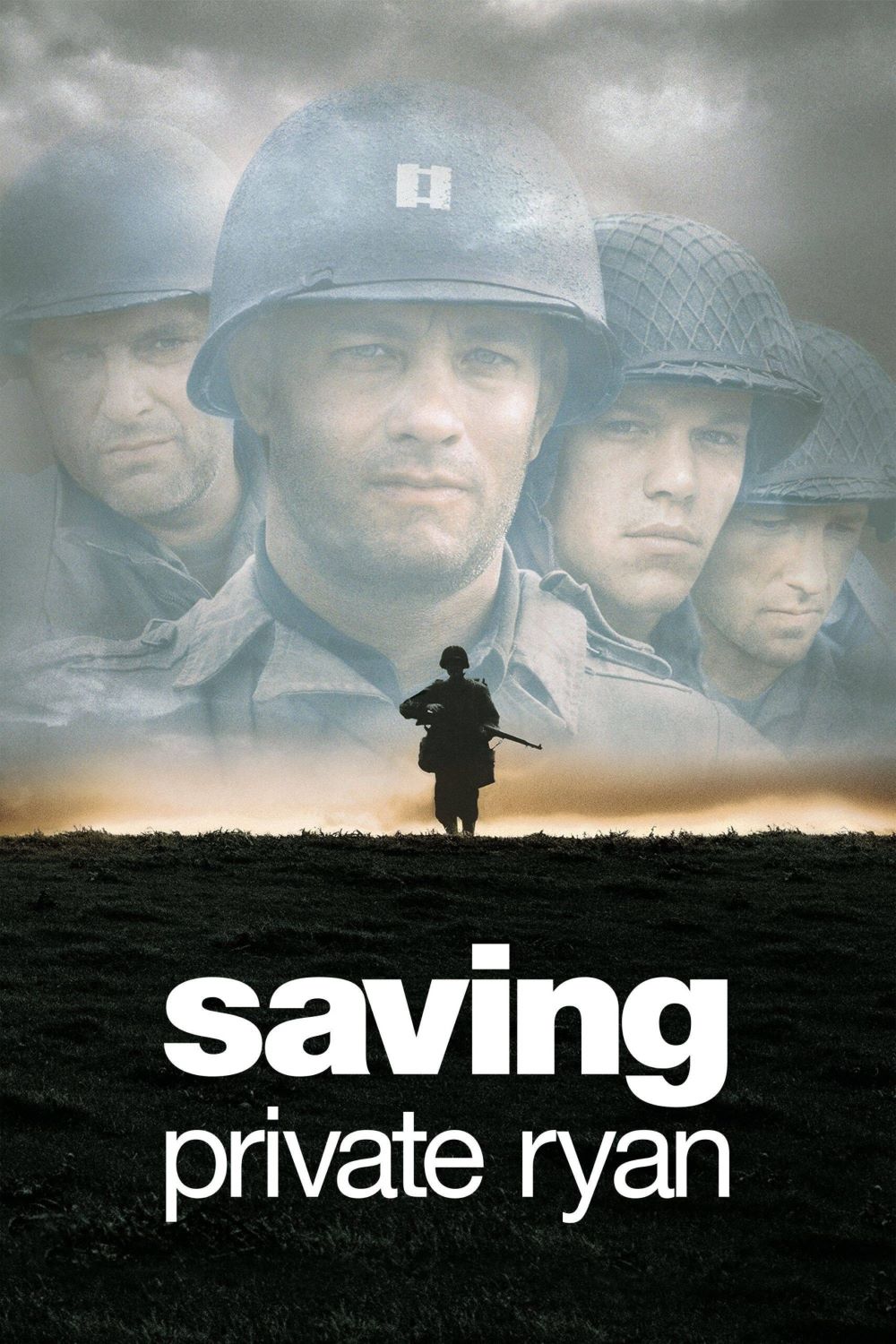
Review: Saving Private Ryan (dir. by Steven Spielberg)


“Someday we might look back on this and decide that Saving Private Ryan was the one decent thing we were able to pull out of this whole godawful, shitty mess.” — Sergeant Horvath

Saving Private Ryan stands as a landmark achievement in war cinema, intricately weaving immersive battle scenes, rich character dynamics, and profound moral themes into a nearly three-hour exploration of World War II’s human cost. One of its most remarkable features is the opening Omaha Beach landing sequence, a meticulously crafted, over 24-minute depiction of warfare’s brutal reality. Spielberg deploys a cinema verité style with handheld cameras capturing disorientation and chaos through the soldiers’ eyes. The sound design envelops the viewer in a sensory onslaught—gunfire, shouting, explosions—creating a visceral experience that immerses audiences directly in the terror and confusion of D-Day.

The filming process drew heavily on historical accuracy, with the production shot on the coast of County Wexford, Ireland, employing amputee actors and practical effects over computer graphics to simulate violent injuries and battlefield horrors. Muted tones evoke wartime photographs, and rapid, shaky editing conveys the disorganized, frantic environment soldiers endured. Consulting WWII veterans and historians, Spielberg created a sequence that reshaped cinematic portrayals of war, influencing how future films would approach the genre’s raw immediacy and emotional weight.

The film’s narrative follows a squad led by Captain Miller on a mission to locate and bring home Private James Ryan, whose three brothers have been killed in combat. The mission is steeped in the real-life tragedy of the five Sullivan brothers who died together aboard the USS Juneau in the Pacific, prompting military policies to prevent similar familial devastation. This historical context frames the story’s ethical heart: risking several men’s lives to save one, raising enduring questions about the value of individual sacrifice within the broader war.

In Saving Private Ryan, sacrifice is portrayed ambiguously—not as the sacrifice of a single hero but as the collective cost borne by the men tasked with rescuing one individual under perilous conditions. As the squad journeys through the war-torn French countryside, the deaths, injuries, and tensions they face underscore war’s randomness and the difficulty of weighing one life against many. The narrative refuses to romanticize or simplify, instead confronting the audience with the tragic truth that countless soldiers lose their lives without recognition or purpose, while some survive against staggering odds.

Duty and camaraderie thread throughout the film, portrayed through the soldiers’ evolving relationships and personal struggles. Each grapples with loyalty not only to their mission but to their fellow men and their own moral codes.

Integral to the film’s power is Tom Hanks’s layered performance as Captain John Miller. Hanks breathes life and emotional depth into Miller, portraying him as a man shaped by civilian life—revealed poignantly when he discloses his pre-war profession as a schoolteacher—now transformed by the relentless demands of war. He embodies an officer who is both composed and vulnerable, carrying the heavy burden of leadership with quiet dignity. Hanks’s portrayal reveals the internal struggles beneath Miller’s stoic exterior: moments of doubt, moral conflict, and fatigue subtly expressed through a trembling hand or a weary gaze. This humanity makes Miller relatable, as a man trying to maintain order and purpose amid chaos.

Hanks skillfully balances Miller’s authoritative presence with warmth and empathy, particularly evident in his paternal interactions with younger soldiers, reinforcing Miller’s role as both a leader and protector. His nuanced acting delivers the complexity of a man constantly negotiating duty and compassion. In scenes of high tension or moral quandaries, Hanks conveys the weight of command while allowing glimpses into Miller’s psychological strain, deepening the film’s emotional resonance.

Following Hanks’s Miller, a standout amongst the supporting cast is Tom Sizemore’s portrayal of Technical Sergeant Mike Horvath, Miller’s steady second-in-command. Sizemore embodies the pragmatic, battle-hardened soldier whose loyalty and experience provide emotional grounding for the squad. Sizemore portrays Horvath’s weariness and quiet commitment, adding layers of realism that deepen the exploration of how war reshapes individuals. The chemistry and shared history between Miller and Horvath are palpable, illustrating the bonds that sustain soldiers through hardship and lending emotional weight to the narrative.

The film wrestles with intense moral ambiguity throughout. The mission’s premise—to risk many lives to save one—compels both characters and viewers to confront complex questions about justice, value, and the cost of war. Scenes presenting difficult choices, such as the decision to spare or execute prisoners, dramatize these ethical dilemmas and highlight the emotional burdens borne by soldiers.

Technically, the film excels, with Janusz Kaminski’s dynamic cinematography capturing both the chaos of battle and intimate moments with evocative clarity. The immersive sound design reinforces the brutal reality, stripping warfare of glamor and confronting audiences with its daunting human costs.

Despite the overwhelming destruction and loss, Saving Private Ryan offers moments of humanity and hope. The rescue mission serves as a fragile symbol of compassion in the midst of devastation, while the film’s closing reflections on memory and legacy emphasize the lasting significance of sacrifice and survival.

Saving Private Ryan stands as a monumental achievement in the war genre, combining visceral combat realism, compelling characters, and moral complexity. Through Hanks’s deeply human Captain Miller and the nuanced supporting performances, especially Sizemore’s grounded Horvath, the film explores themes of sacrifice, duty, and brotherhood with unflinching honesty. Its enduring legacy lies in its unvarnished yet empathetic portrayal of war’s cost and the profound sacrifices made by those who lived it.

Playing Catch-Up With 6 Quickie Reviews: The Big Game, The Connection, Graduation Day, McFarland USA, Taken 3, and War Room


Here are 6 more reviews of 6 other films that I watched this year.  Why six?  Because Lisa doesn’t do odd numbers, that’s why.

The Big Game (dir by Jalmari Helander)

In The Big Game, Samuel L. Jackson plays the President of the United States and you would think that fact alone would make this film an instant classic.  Unfortunately, this film never really takes advantage of the inherent coolness of Samuel L. Jackson playing the leader of the free world.  When Air Force One is sabotaged and crashes in the wilderness of Finland, President Jackson has to rely on a young hunter (Onni Tommila) from a group of CIA agents disguised as terrorists.  Tommila does a pretty good job and the scenery looks great but at no point does Samuel L. Jackson says, “Check out this executive action, motherfucker,” and that’s a huge missed opportunity.  As for the rest of the film, it takes itself a bit too seriously and if you can’t figure out the big twist from the minute the movie starts, you obviously haven’t seen enough movies.

The Connection (dir by Cedric Jiminez)

Taking place over the 1970s, the French crime thriller tells the largely true story of the efforts of a French judge (played by Jean Dujardin) to take down a ruthless gangster (Gilles Lellouche) who is the head of one of the biggest drug cartels in the world.  The Connection run for a bit too long but, ultimately, it’s a stylish thriller that does a very good job of creating a world where literally no one can be trusted.  Dujardin, best known here in the States for his Oscar-winning role in The Artist, does a great job playing an honest man who is nearly driven to the point of insanity by the corruption all around him.

Graduation Day (dir by Chris Stokes)

Hey, it’s another found footage horror film!  Bleh!  Now, I should admit that this horror film — which is NOT a remake of that classic 1980s slasher — does have a fairly clever twist towards the end, that goes a long way towards explaining a lot of the inconsistencies that, up until that point, had pretty much dominated the film.  But, even with that in mind and admitting that Unfriended and Devil’s Due worked wonders with the concept, it’s still hard to feel any enthusiasm about yet another found footage horror film.

McFarland USA (dir by Niki Caro)

McFarland USA is an extremely predictable but likable movie.  Kevin Costner plays a former football coach who, while teaching at a mostly Latino high school, organizes a cross country team that goes on to win the state championship.  It’s based on a true story and, at the end of the film, all of the real people appear alongside the actors who played them.  There’s nothing about this film that will surprise you but it’s still fairly well-done.  Even Kevin Costner, who usually gets on my last nerve, gives a good performance.

Taken 3 (dir by Olivier Megaton)

Bryan Mills (Liam Neeson) is back and he’s killing even more people!  Fortunately, they’re all bad people but you really do have to wonder what type of dreams Bryan has whenever he goes to sleep.  In Taken 3, Bryan’s wife (Famke Janssen) has been murdered and Bryan has been framed.  He has to solve the case and kill the bad guys while staying one step ahead of the police (represented by a bored-looking Forest Whitaker).  Neeson does all of his usual Taken stuff — the intense phone conversation, the steely glare, and all the rest — but at this point, it has literally been parodied to death.  If you’re into watching Liam Neeson kill ugly people, Taken 3 will provide you with adequate entertainment but, for the most part, it’s but a shadow of the first Taken.

War Room (dir by Alex Kendrick)

I saw the War Room in Oklahoma.  It was being shown as part of a double feature with The Martian, of all things!  Anyway, this film is about an upper middle class family that hits rock bottom but they’re saved by the power of prayer!  Lots and lots of prayer!  Seriously, this film almost qualifies as “prayer porn.”  Anyway, the film was badly acted, badly written, incredibly heavy-handed, and ran on way too long but, on the plus side, it did eventually end.

Film Review: Faults (dir by Riley Stearns)


Faults_(film)_POSTER

Faults is many things.

It’s a character study.  It’s a thriller.  It’s a deeply unsettling horror film.  It’s a darker-than-dark comedy that will make you laugh even while you’re glancing over your shoulder to make sure there are no strangers hiding in the shadows.  It’s a look at religion, faith, free will, and guilt.  It’s a declaration that a major talent — writer/director Riley Stearns — has arrived.  It’s an acting showcase for both Mary Elizabeth Winstead and Leland Orser.  It’s a film that found success on the festival circuit and then had an all-too brief theatrical release in March.  It’s also a film that’s currently available on Netflix.  Finally, it’s one of the best films of the year so far.

When we first meet professional cult deprogrammer Ansel Roth (Leland Orser), he is eating dinner in a hotel restaurant and desperately trying to convince his waiter that he has an agreement with management, guaranteeing him free meals while staying at the hotel.  After Ansel is kicked out of the restaurant, he then tries to convince the hotel manager that his room is supposed to be free as well.  The manager gives Ansel an hour to check out.

As quickly becomes apparent, Ansel is nearly broke and he’s living out of his car.  What little money he has, he makes from giving sparsely attended lecture where he literally begs people to pay fifteen dollars to get a copy of his latest book.  After his lectures, Ansel is willing to sign his new book at a cost of five dollars per signature.

(At one point, when someone asks Ansel to sign his previous book, Ansel abruptly explains that he no longer signs that book.  If you want his five dollar autograph, you have to first pay fifteen dollars to get his new book.)

At one point, Ansel was a minor celebrity with his own talk show but, after a girl he deprogrammed subsequently committed suicide, Ansel’s life fell apart.  His latest book is self-published and his former manager, the oddly polite Terry (Jon Gries), claims that Ansel owes him money.  Terry’s enforcer, Mick (the always intimidating Lance Reddick), is stalking Ansel from cheap motel to cheap motel.

However, things start to look up for Ansel when he’s approached by Paul (Chris Ellis) and Evelyn (Beth Grant).  They explain that their daughter, Claire (Mary Elizabeth Winstead), has joined a cult known as Faults and is a follower of a mysterious figure named Ira.  They ask Ansel to deprogram her.  Ansel agrees to do so and charges them $20,000.

After Ansel and two “assistants” literally grab Claire off the street, they take her to a cheap motel where, behind locked doors, Ansel starts to try to deprogram Claire.  However, from the start, Ansel discovers that it’s going to be more difficult than he realized.

For one thing, Claire remains calm throughout the whole kidnapping and, even when locked in the shabby motel room, is confident that she is about to “move on” and achieve a higher level of existence.  When Paul and Evelyn show up and try to talk to Claire, it turns out that they’re not quite the loving parents that they initially presented themselves as being.  Paul, in particular, reveals himself to have a fierce temper and he demands that Claire change into clothes that would be more appropriate for a teenager than for an adult.  When Ansel suggests that the overbearing Paul should back off, Paul replies that he “knows” what Ansel truly wants to do with Claire.

Secondly, even as Ansel tries to deprogram Claire, he still has to deal with Terry and Mick.  Neither one of them is particularly concerned about whether or not Ansel can pull Claire away from Faults.  Instead, Terry just wants his money.

And finally, even as Ansel tries to keep control of the situation, he is personally falling apart.  He finds himself having sudden nosebleeds.  At one point, his suit spontaneously combusts into flame.  (Believe it or not, there is a relatively plausible reason for why this happens but that doesn’t make it even less shocking.)  When Ansel falls asleep in the motel room, he subsequently wakes up in his car and has no memory of how he got there.

And through it all, Claire remains a seductive and manipulative enigma.  Sometimes she’s cold and in control.  Other times, she’s surprisingly vulnerable.  Ansel finds himself both attracted to and frightened of Claire.  Throughout the film, Ansel insists that he has “free will” but Claire forces him to reconsider that assumption.

Faults is a low-key and disturbing film that is distinguished by a very dark and cynical sense of humor.  Mary Elizabeth Winstead is amazing as the mysterious Claire while Leland Orser is wonderfully desperate and surprisingly sympathetic as Ansel.  When Faults first started, I was concerned that, since it largely takes place in one cramped motel room, the film would be too stagey to be effective.  But director Riley Stearns does amazing work with that one location and, as a result, Faults is one of those rare films that actually gets more intriguing the deeper you get into it.

Faults is currently available on Netflix and you should watch it.

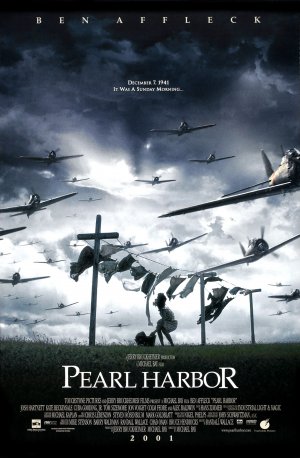
Embracing the Melodrama Part II #100: Pearl Harbor (dir by Michael Bay)


Pearl_harbor_movie_poster

“And then all this happened…”

Nurse Evelyn Johnson (Kate Beckinsale) in Pearl Harbor (2001)

The “this” that Evelyn Johnson is referring to is the Japanese attack on Pearl Harbor.  You know, the date will live in infamy.  The attack that caused the United States to enter World War II and, as a result, eventually led to collapse of the Axis Powers.  The attack that left over 2,000 men died and 1,178 wounded.  That attack.

In the 2001 film Pearl Harbor, that attack is just one of the many complications in the romance between Danny (Ben Affleck), his best friend Rafe (Josh Hartnett), and Evelyn (Kate Beckinsale).  The other complications include Danny briefly being listed as dead, Danny being dyslexic before anyone knew what dyslexia was (and yet, later, he’s still seen reading and writing letters with absolutely no trouble, almost as if the filmmakers forgot they had made such a big deal about him not being able to do so), and the fact that Rafe really, really likes Evelyn.  Of course, the main complication to their romance is that this is a Michael Bay film and he won’t stop moving the camera long enough for anyone to have a genuine emotion.

I imagine that Pearl Harbor was an attempt to duplicate the success of Titanic, by setting an extremely predictable love story against the backdrop of a real-life historical tragedy.  Say what you will about Titanic (and there are certain lines in that film that, when I rehear them today, make me cringe), Leonardo DiCaprio and Kate Winslet had genuine chemistry.  None of that chemistry is present in Pearl Harbor.  You don’t believe, for a second, that Ben Affleck and Josh Hartnett are lifelong friends.  You don’t believe that Kate Beckinsale is torn between the two of them.  Instead, you just feel like you’re watching three actors who are struggling to give a performance when they’re being directed by a director who is more interested in blowing people up than in getting to know them.

Continuing the Titanic comparison, Pearl Harbor‘s script absolutely sucks.  Along with that line about “all this” happening, there’s also a scene where Franklin D. Roosevelt (Jon Voight) reacts to his cabinet’s skepticism by rising to his feet and announcing that if he, a man famously crippled by polio and confined to a wheelchair, can stand up, then America can win a war.

I’ve actually been to Pearl Harbor in Hawaii.  I have gone to the USS Arizona Memorial.  I have stood and stared down at the remains of the ship resting below the surface of the ocean.  It’s an awe-inspiring and humbling site, one that leaves you very aware that over a thousand men lost their lives when the Arizona sank.

I have also seen the wall which lists the name of everyone who was killed during the attack on Pearl Harbor and until you’ve actually been there and you’ve seen it with your own eyes, you really can’t understand just how overwhelming it all is.  The picture below was taken by my sister, Erin.

Pearl Harbor 2003If you want to pay tribute to those who lost their lives at Pearl Harbor, going to the Arizona Memorial is a good start.  But avoid Michael Bay’s Pearl Harbor at all costs.

Trailer: Taken 3 (Official)


taken-3-poster

Why are bad guys still messing with Liam Neeson…I mean Bryan Mills. He literally took on an Albanian gang in Paris (of all places) who were kidnapping young, female tourists to sell to Parisian sex-slave auctioneer who only did business with a very exclusive clientele. Then the hometown relatives of said Albanian gangsters tried to take him out. That didn’t work out so well.

Now, this coming January just when Bryan thought his life as a retired government worker with a unique set of skills can finally enjoy retirement with his lovely daughter and rekindle his relationship with his ex-wife people are out to be quite the killjoy once again.

Taken 3 will see Liam Neeson back as Bryan Mills, Maggie Grace as his daughter Kimmy and joined by Forest Whitaker as an LAPD inspector tasked with taking him down for a murder he didn’t commit. Once again this sequel will be helmed by that French director with the awesome name: Olivier Megaton.

Some people say Taken 3 (will not call it Tak3n) is just a rehash of The Fugitive, but I disagree. Richard Kimble never broke people’s throats and shot many people in their heads to find those responsible. The throat breaking alone puts Bryan Mills heads above Richard Kimble.

Taken 3 is set for January 9, 2015 release date.

Trailer: Taken 2 (Official)


Taken was the surprise hit of 2009 as audiences bought into Liam Neeson as the baddest of badasses. One would rarely think of him as an action-thriller hero. He’s done tough guy, man of action roles in the past but they tended to be of the mentor types. It was the Luc Besson-produced Taken that first made Neeson as a believable action hero.

The film was a simple enough revenge fare. One would thnk that the film’s ending was closure enough that a sequel wasn’t needed, but Hollywood won’t have none of that. It took a year or so, but soon enough 20th Century Fox purchased the rights to the sequel to Taken and quickly greenlit the project.

It’s now 2012 and Neeson’s former CIA black ops character, Bryan Mills, is back to do what he does best and that’s kill, torture and main (not in that particular order every time) every gangster and criminal who gets in his way as he tries to save not just his daughter (again), but his ex-wife as well as they vacation in that hotbed of spying and intrigue,

Istanbul. Luc Leterrier is not helming the sequel but another Besson protege in Olivier Megaton. Now with a name such as Megaton one should expect some explosive action and the trailer hints at such. Here’s to hoping that the film doesn’t go too overboard with the killing and maiming and torturing (again not in that order when they occur each and everytime).

Taken 2 is set for an October 5, 2012 release date.

Review: Taken (dir. by Pierre Morel)


In 2009 a little film coming out of France gained a buzz from on-line film bloggers. The film wasn’t the latest arthouse attempt to relive the glory days of French New Wave. It wasn’t a film that’s become part of the extreme French horror that’s becme all the rage in the horror circles in the past decade or so. This film was an action-thriller starring Irish actor Liam Neeson with an ensemble cast of actors from the US, UK, France and Albania. The film I am talking about is Taken by French filmmaker Pierre Morel (his previous film, District 13 with it’s parkour action scenes would make it a cult hit) and produced by his mentor Luc Besson.

Taken at its most basic core is a film about a father’s love for his daughter who has gotten herself kidnapped by Albanian sex-traffickers while on vacation in Paris, France. Liam Neeson’s character gets introduced as a retired government worker and divorcee whose attempt to reconnect with Kim his teenage daughter (played by Maggie Grace of Lost). His attempts to impress his daughter and make her happy gets upstaged by his ex-wife’s richer husband and stepfather to his daughter. It doesn’t help that Neeson’s character Bryan Mills has skillsets not easily translated to the civilian sector. He’d take an offer of a bodyguard gig from one of his former co-workers and it’s during this security job that we get a clue as to what sort of government employee Bryan Mills was before his decision to retire.

Moving forward we finally get past the introductions of the characters (Famke Janssen as Mills’ ex-wife really comes across as a major harridan who seems intent on punishing Mills for selfish reasons). Mills learns of a trip Kim will be taking with her friend Amanda (Katie Cassidy) to follow U2’s European concert tour. Mills, the clearheaded parent, doesn’t like this plan to have his daughter galavanting across Europe without adult supervision, but his guilt for having neglected Kim while he was working for the government plus his ex-wife’s insistence that Kim take the trip makes him relent, but not without giving her some advice to stay safe.

To say that Kim and Amanda get into a heap of trouble right as soon as they arrive in Paris would be an understatement. The two get kidnapped while staying at the luxury apartment of Amanda’s cousin. Before Kim is taken by the masked intruders (who’ve already taken Amanda) she’s able to make a desperate phone call to her father. Calm, collected and knowing that her daughter’s abduction was an inevitability, Mills instructs his daughter to relay to him as much information as possible about those abducting her. With that information in hand Mills heads to Paris to find his daughter (and to punish those who dare kidnap her).

From then on Taken becomes an action-thriller which barely gives the audience a chance to take a breather. Mills knows his time frame when it comes to finding his daughter gets shorter and shorter thus goes about his job searching for her in a deadly efficient manner. Mills becomes Jack Bauer and Jason Bourne rolled into one. There’s no witty, debonair Bond in this character. Mills goes about his business of interrogating, killing and gathering information with cold, calculating efficiency which leaves no room for Bondesque dialogue. The story moving forward once Mills arrive in Paris becomes almost an extension of Mills’ character. Writers Besson and fellow collaborator Robert Mark Kamen keep the dialogue to the barest minimum. We learn more about Neeson’s character through his actions more than we do during character interactions with other players in the film.

The film hinges on the audience buying Liam Neeson as a deadly, ex-CIA operative who manages to survive every violent encounter throughout the film (some by his own doing and others just trying to survive through it). From how people have reacted to this film and Neeson’s character I would say that it’s a big definitive yes that we buy Neeson as someone akin to Bauer and Bourne. In fact, I would say that Neeson’s Bryan Mills would be the more dangerous of the three. He has no compunction about using torture to gather information and barely breaks a sweat when killing those involved in some way in his daughter’s abduction. He has no bouts of guilt about what he has done in the past (probably killing as a secret agent) , what he’s doing in the present (killing to find his daughter) and what he’ll be doing in the future (probably thinking killing thoughts about anyone who will look at his daughter funny). Neeson’s Bryan Mills is a cold, efficient killing machine who doesn’t use fancy moves to take out his opponents and willing to shoot them in the back if it ends the fight in his favor.

The action sequences in Taken has some parkour influences, but not enough to make it distracting. There were no Michael Bay-style skewed camera angles, slo-mo shots and ADHD-style editing. Morel actually keeps the frenetic editing that made the Jason Bourne fight scenes so dynamic to a minimum. There’s just enough of it to make the fight scenes look brutal and painful, but not enough to make people nauseous. The climactic action sequence on the yacht of a rich buyer of sex-slaves goes by so quickly yet was more entertaining than half the prolonged action scenes from Bay’s Transformers sequel.

The rest of the cast barely keep up with Neeson in the film. They become tertiary characters whose job were to give Neeson’s character the motivations he needs to get the job done. I will say that Maggie Grace as Kim was believable as a teenager even down to the spoiled teen she starts off in the beginning. But again her character was just there to motivate Neeson’s character to go back to doing what he did well and that’s kick ass (he’d probably do it just as well while chewing bubble gum).

In the end, Taken was an action-thriller which more than surprised many people. It cemented Liam Neeson as one badass dude in the same league as Kiefer Sutherland’s Bauer and Matt Damon’s Jason Bourne. The film became a showcase for people to witness Neeson kickass and do it believably while Morel does just enough to keep the film from becoming too ridiculous. While Taken won’t herald the coming of another era of French New Wave, it does succeed in doing what it set out to do and that’s entertain, thrill and just give the audience some kickass escapist fare that some big-budgeted Hollywood studio titles never seem to do.