Film Review: The Ring (dir by Gore Verbinski)


the-ring-2

(SPOILERS BELOW!)

This weekend, I will be seeing Rings, the second sequel to the 2002 film, The Ring.  (Of course, The Ring itself is a remake of the Japanese film, Ringu.)  Since it’s been a while since we’ve had a new installment in the Ring franchise, I decided to rewatch the first film tonight.

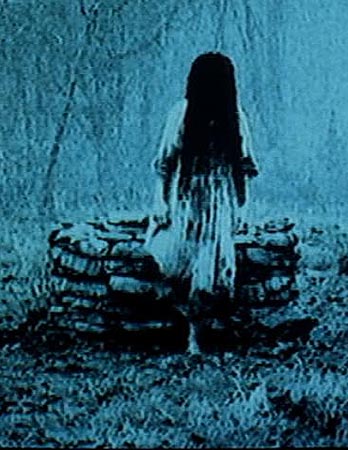
I have to admit that I had a few concerns before I rewatched The Ring.  When I first saw The Ring, it scared me to the extent that I actually had nightmares afterward.  Even after all these years, the image of that little girl emerging from the well and then crawling out of the television still makes me shiver.  But even with that in mind, I still found myself wondering if The Ring would live up to my vivid memories.

After all, it’s been 14 years since The Ring was released and, since that time, it’s been copied and imitated by literally hundreds of other PG-13 rated horror movies.  Would the shocks still be effective, now that I knew they were coming and that I would no longer be surprised to learn that the little girl in the well was actually evil?

Add to that, there was the question of technology.  In 2002, it seemed all too plausible that people could be trading back and forth a cursed VHS tape.  The Ring was made at a time when DVDs were still considered to be exotic.  When The Ring first came out, YouTube didn’t even exist.  But today, both VHS tapes and VCRs are artifacts of another era.  DVDs have been replaced by Blu-rays and Blu-rays are in the process of being replaced by streaming services.  For The Ring to work, you had to be able to relate to people watching a VHS tape.  Today, all of these people would be too busy watching cute cat videos on YouTube to fall into The Ring‘s trap.

In short, would The Ring still work in the age of Netflix?  And would the film still be as scary as it was when it was first released?  These were the question that I found myself wondering as I sat down to rewatch The Ring.

And the answer to both questions is … for the most part, yes.

Here’s the good news.  All the important things still work.  The performances of Martin Henderson, David Dorfman, Amber Tamblyn, and especially Naomi Watts hold up well.  Gore Verbinski’s direction is still effective and, as I rewatched the film, I was surprised to see how many odd and quirky details that Verbinski managed to work into the film.  (I especially enjoyed the magic-obsessed desk clerk.)  The cursed video was still creepy and compulsively watchable and I still felt uneasy while watching Anna Morgan (played by Shannon Cochran) comb her hair in that mirror.  Even more importantly, the little girl in the well, Samara Morgan (Daveigh Chase), was still incredibly frightening.

Admittedly, The Ring is dated and some of its effectiveness has been diluted by imitation.  Unfortunately, that’s something that happens with any financially successful horror film.  Beyond that, as effective as the entire film was, there were parts of The Ring that did feel undeniably silly.  There’s a lengthy scene in which Naomi Watts, while on a ferry, attempts to talk to a horse and the horse reacts by jumping into the ocean.  I understand that the scene was probably meant to establish that, as a result of watching that videotape, Watts was now cursed.  But, still, I kept wondering why Watts was bothering the horse in the first place.  I mean, I love horses too but I know better than to disturb one while on a ferry.  As well, the film’s opening sequence — in which Amber Tamblyn is menaced and ultimately killed by Samara — no longer felt as effective as it did when I first saw it, largely due to the fact that it’s been copied by so many other horror films.  Imitation may be the ultimate compliment but it does tend to dilute the effectiveness of horror.

But, in the end, The Ring held up well enough.  The film’s storyline — characters watch a cursed video tape and then, seven days later, are killed by Samara — was simple but enjoyable.  And, when David Dorfman delivered his classic line: “No.  You weren’t supposed to help her,” I still felt a chill run down my spine.

Will Rings hold up as well as The Ring?

I’ll find out this weekend!
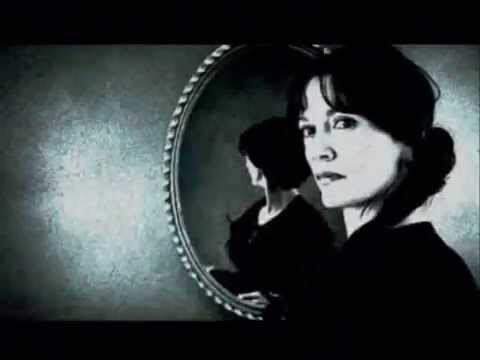
the-ring

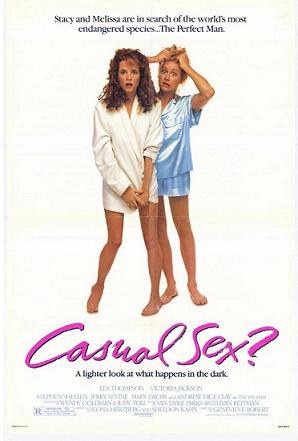
Insomnia File No. 20: Casual Sex? (dir by Geneviève Robert)


What’s an Insomnia File? You know how some times you just can’t get any sleep and, at about three in the morning, you’ll find yourself watching whatever you can find on cable? This feature is all about those insomnia-inspired discoveries!

If you had insomnia at one in the morning, you could have turned over to Starz Comedy and watched the 1988 comedy, Casual Sex?  That’s what I just did!

I have to admit that I’m a little bit surprised that this is the first insomnia file that I’ve written since last July.  It’s not like I haven’t had insomnia between then and now.  However, I guess I’ve been busy either going on vacation, writing about horror movies, writing about the Oscars, or, of course, writing about reality TV over at the Big Brother Blog and Reality TV Chat Blog.  That said, I’ve always enjoyed writing these insomnia files and I’m happy to finally have the chance to do a new one.

I’m also happy to have the chance to write about a film called Casual Sex?, if just because I know that it will lead to the site getting a lot of hits from people doing google searches.  They probably won’t actually be looking for a movie review but a hit is a hit!

Anyway, Casual Sex? is an 80s film.  In fact, it’s such an 80s film that it probably spent the 90s recovering from an expensive coke habit.  It’s a film about two best friends who have decided that they’re tired of being single.  Stacy (Lea Thompson) is the promiscuous one, the one who has had many partners, has gotten involved in way too many needy relationships, and who is now freaking out over the spread of AIDS.  Melissa (Victoria Jackson) is the sweet but ditzy one.  Melissa has had boyfriends but she’s never had an orgasm.  When Stacy tells her about an article she read about AIDS, Melissa replies that at least now she’s “not the only one who is afraid of sex.”  Hoping to each find a permanent mate, Stacy and Melissa go to a health spa.  Stacy immediately falls madly in love with Nick (Stephen Shellen), an aspiring musician.  Melissa, meanwhile, meets the sensitive and sweet-natured Jamie (Jerry Levine), who works at the spa and gives a killer massage.  Meanwhile, an annoying guy named Vinny (Andrew Dice Clay) pursues both of them and everyone else as well.

(Vinny leers at every woman that he sees and prefers to be known as the Vin Man.  I know, I know.  It’s hard to believe that he’s still single.)

Casual Sex? actually get off to a really good start.  It opened with both Stacy and Melissa standing on an empty stage and discussing their sexual histories.  Usually, I cringe whenever a movie opens with a character standing on a blank stage and talking directly to the audience.  It usually feels like a lazy storytelling technique to me.  (Can’t figure out a natural way to let the audience know a character’s backstory?  Have them talk to directly to the audience!  It’s easy and lazy!)  But in Casual Sex?, this technique actually works.  Lea Thompson and Victoria Jackson both give very natural and believable performances and the flashbacks to their previous experiences are all well-done and sometimes painfully relatable.  Despite the fact that the film was made 30 years ago, their experiences and emotions felt timeless.

After that strong opening, the rest of the film was much more uneven.  I have to admit that I had trouble telling how much of the film was meant to be satirical and how much of it was just a reflection of the time in which it was made.  For instance, I wasn’t sure if I was supposed to be rolling my eyes at Nick, with his feathered hair and his overdramatic style of singing, or if that was just what was considered to be hot in the 80s.  It was very confusing but, regardless of whether it was intentional or not, it was hard to take Nick seriously as anything more than a plot device.  As a result, it was difficult to care about his relationship with Stacy.  Melissa’s relationship with Jamie was far more interesting, largely because Jerry Levine was so likable in the role.

(Just in case anyone was wondering, Casual Sex? does feature a lot of sex but very little of it feels casual.  Perhaps that’s why the title ends with a question mark.  “Casual sex?” the film asks before answering, “No.”)

The film was ultimately too uneven to really be considered to be a success but I actually enjoyed it more than I thought I would.  That was largely because of the performances of Lea Thompson, Victoria Jackson, and Jerry Levine.  There’s a few scenes where Vinny drops his bluster and reveals a sensitive side and Andrew Dice Clay does well with these scenes but, ultimately, it’s hard to like anyone known as The Vin Man.  I mean, he even has “Vin Man” written on the back of his jacket.  Strangely, Clay’s performance here felt like an early version of his performance in Blue Jasmine, almost as if the Vin Man eventually changed his name to Augie and ended up marrying the sister-in-law of a Ponzi scheme manager.

Casual Sex? may not be great but it’s good enough for when you’re awake at one in the morning.

casual_sex_poster

Previous Insomnia Files:

  1. Story of Mankind
  2. Stag
  3. Love Is A Gun
  4. Nina Takes A Lover
  5. Black Ice
  6. Frogs For Snakes
  7. Fair Game
  8. From The Hip
  9. Born Killers
  10. Eye For An Eye
  11. Summer Catch
  12. Beyond the Law
  13. Spring Broke
  14. Promise
  15. George Wallace
  16. Kill The Messenger
  17. The Suburbans
  18. Only The Strong
  19. Great Expectations

Playing Catch-Up: The Confessions of Thomas Quick, Holy Hell, Rigged 2016, Witness


I watched several documentaries in 2016.  Here are reviews of 4 of them.

The Confessions of Thomas Quick (dir by Brian Hill)

Like the majority of Americans, I had no idea who Thomas Quick was until I watched this fascinating and rather disturbing documentary.  Thomas Quick was a Swedish serial killer.  Or, at least, he claimed he was.

In the 1990s, a troubled loner and career criminal who went by the name Thomas Quick confessed to committing over 20 murders.  Amazingly, even though his stories were often outlandish and didn’t always make sense, it appears that the authorities took Quick at his word.  Even when Quick told an implausible story about being forced to eat a baby, no one doubted his confessions.

Over the next 20 years, Quick became something of a morbid celebrity.  Whereas we’ve become sadly desensitized to stories of serial killers here in the States, this was still a rare occurrence in Sweden.  Of course, as The Confessions of Thomas Quick makes clear, Quick was never actually a serial killer.  His confessions were all false.  How and why did Thomas Quick fool everyone?  The film suggests that the authorities where more interesting in closing cases than actually investigating Quick’s claims.  Meanwhile, among psychiatric authorities, there was almost a cult-like insistence that Quick was telling the truth.

The Confessions of Thomas Quick is a fascinating and creepy documentary about an incredibly creepy person.

Holy Hell (directed by Will Allen)

Speaking of creepy and fascinating, just check out Holy Hell.  Holy Hell is about a former actor who became a highly successful cult leader.  In many ways, Michel is a silly figure.  With his permanently pursed lips and a face that shows the results of one too many face lifts, Michel looks like almost a parody of a false messiah.  And then when we hear him speak in his reedy voice, we wonder how anyone could have ever followed him.

But, as Holy Hell makes clear, a lot of people did follow Michel and they still do, though Michel has changed his name and has long since abandoned his former Austin compound for Hawaii.  Holy Hell was directed by Will Allen, a former member of Michel’s cult and one of the many young men who were sexually abused by Michel.  (Michel demanded celibacy from his followers but, in private, he felt no need to hold himself to his own standards.)  Will Allen was a film student and, as such, he spent twenty years filming the cult and directing some genuinely odd music videos, all starring Michel.  When Allen finally left the cult, he lost most of his footage.  But what he did mange to escape with is more than enough.

Want to see how a large group of otherwise intelligent people can be brainwashed?  Watch Holy Hell.  Michel may be a ridiculous figure but, by the end of this documentary, he was will have scared the Hell out of you.

Rigged 2016

Do you want to know how America ended up in this current political mess?  Watch Rigged 2016.  Rigged 2016 was originally produced to promote the presidential candidacy of Libertarian Gary Johnson.  And while the film did not accomplish its goal of winning Johnson a spot on the presidential debate stage, it did offer up a portrait of a political system that has been rigged by money, media, and special interests.

Rigged 2016 devotes most of its time to discussing the threat of Donald Trump.  However, it doesn’t let the other side off the hook.  Supporters of Bernie Sanders discuss how his campaign was ultimately sabotaged by the DNC.

Rigged 2016 will make you angry and hopefully, it’ll inspire you to wonder why — year after year — we continue to settle for a rigged system.

The Witness (dir by James D. Solomon)

The Witness is one of the most fascinating and thought-provoking documentaries that I have ever seen.  It’s currently on Netflix and I could not recommend it more.

In 1964, a 29 year-old waitress named Kitty Genovese was brutally stabbed to death on the streets of New York City.  Reportedly, 37 people heard the sound of Kitty screaming for help and none of them called the police.  None of them left their apartment.  For decades after, Kitty Genovese’s case was held up as an example of public apathy.  And yet — even after her murderer was caught and sent to prison — Kitty remained a mystery, a symbol who never quite allowed to be an individual.

Kitty came from a large family.  Her younger brother, Bill, was shaken by the reports of people refusing to help to Kitty as she was being murdered.  And so, he decided that he would always help people.  He enlisted in the army, specifically because he wanted to help his country and help the world.  He was sent to Vietnam, where he lost both of his legs.

The Witness, which opens forty years after Kitty’s murder, is the story of Bill’s attempt to understand who Kitty was and, hopefully, come to terms with his feelings about her death.  As Bill freely admits, he never really knew much about his older sister but the shadow of her death hangs over every day of his life.  Though the film may be about Kitty, it’s just as much Bill’s story.  It’s a story that makes us ask how much anyone can truly know about anyone else.

Bill starts by investigating whether or not Kitty’s screams were actually heard and ignored by 37 people.  The majority of the 37 are now dead but Bill finds a few who are still alive.  He discovers that the legend of the 37 apathetic and/or cowardly witnesses isn’t necessarily true.  He goes on to talk to some of Kitty’s friends.  He tries to talk to his family but most of them seem to be weary of both Kitty and Bill’s obsession.  Bill even gets a chance to talk to Kitty’s girlfriend.  There are suggestions that Kitty and Bill’s father rejected Kitty because Kitty was a lesbian.  We discover that, living in New York and away from her family, Kitty could finally be herself.  It’s interesting to note that, at no point, does The Witness idealize Kitty.  I’m sure the temptation was there.  At one point, Kitty’s girlfriend admits that even she’s not sure she knew who the real Kitty was.

Bill also tries to reach out to the man who murdered Kitty.  The murderer refuses to talk to him.  However, in perhaps the film’s most poignant moment, the murderer’s son agrees to meet with Bill.  It’s a tense meeting.  The son weakly defends his father.  At one point, he says that he’s heard rumors that Bill has Mafia connections.  The son assures Bill that people know where he is, as if he’s concerned that Bill is planning on killing him.

I have to admit that, having spent 90 minutes watching the very engaging and honest Bill deal with his emotions, there was a part of me that really wanted to hate the son.  But, by the end of the scene, it becomes obvious that both Bill and the murderer’s son are suffering because of one man’s senseless act.  They’re both victims of the same evil.

Bill hires an actress to walk down the same streets that Kitty once walked down.  Standing in the same spot that Kitty was standing when she was attacked, the actress lets out a terrifying scream.  Bill flinches.  So do we.

The Witness is a powerful meditation on life, guilt, love, and family.  It’s on Netflix. Watch it.

Playing Catch-Up: The Neon Demon (dir by Nicholas Winding Refn)


the-neon-demon-elle-fanning-900x0-c-default

What to say about The Neon Demon?

See, this is a film that you have to be careful about discussing.  From the moment that it premiered at Cannes last year, The Neon Demon was the love-it-or-hate-it film of 2016.

Those of us that loved The Neon Demon really, really loved it.

And those that hated it — well, let’s just say that they really, really hated it.  They complained that The Neon Demon was exploitive.  They found the subject matter to be sordid.  They accused the movie of being both pretentious and ultimately pointless.  The plot made no sense, they complained.  The film was overlong and featured about a handful of false endings.  It almost seemed as if Nicholas Winding Refn was taunting anyone who expected him to make a typical melodrama about life in Hollywood.

All of that is true but, honestly, what were these people expecting?  As a result of the success of Drive, many people have made the mistake of thinking that Nicholas Winding Refn is a mainstream director.  He’s not.  Refn is a provocateur.  He is a director who often dares his audience to walk away.  In The Neon Demon, each false ending challenges the audience’s assumption about how a story — any story — should end.  Some people, I’m sure, would complain that Refn is all style and no substance.  However, The Neon Demon is about a world where one’s worth is determined by their style.  Style is substance.  The world of The Neon Demon may be empty but the film is not.

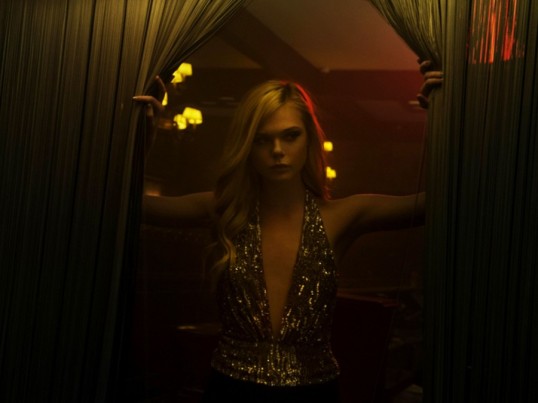
For all the debate about the film’s deeper themes (or lack of them), The Neon Demon‘s story is a fairly simple and deliberately familiar one.  A teenage runaway comes to Hollywood, finds some success as a model, and discovers that the world of show business is not as romantic as she may have initially believed.  When we first see Jesse (Elle Fanning), she’s posing for her boyfriend and she’s pretending to be dead.  Death, beauty, and sex go hand-in-hand in The Neon Demon.

Jesse’s an interesting character, one who constantly challenges our assumptions.  At first, Jesse seems like a typical innocent.  She’s a virgin who is so introverted that she can barely carry on a conversation.  She lives in a cheap apartment, under the menacing gaze of her sleazy landlord (Keanu Reeves, having fun playing his skeezy character).  She has a boyfriend and on their dates, she tells him about how she’s always dreamed of being a star.  It’s only as the film progresses that you start to realize how little you actually know about Jesse.  That she’s a runway is implied early on.  We never learn what led to her running away.  In fact, we learn next to nothing about who she was before she appeared in Los Angeles.

In Los Angeles, Jesse is everything that the fashion industry values.  She’s beautiful and, even more importantly, she’s young.  We watch as Jesse goes to a casting call and we’re struck by the blank-look on her face.  We wonder if there’s anything going on underneath the surface.  Jesse has hallucinations, seeing a shining triangle and kissing her own reflection.  Someone asks her what it’s like to be desired.  She replies, “It’s everything.”

Jesse befriends Ruby (Jena Malone), a makeup artist who lives in a gigantic mansion, overlooking an empty swimming pool.  When Ruby isn’t working in the fashion industry, she works at a morgue, applying makeup to corpses and occasionally engaging in necrophilia.  She makes the dead beautiful so that they can be buried looking their best.  Again, beauty and death are intertwined throughout The Neon Demon.

Ruby has two other friends, Gigi (Bella Heathcote) and Sarah (Abbey Lee).  They’re both models, struggling to maintain their careers even as younger models, like Jesse, continue to flood into Los Angeles.  Gigi has had so much cosmetic surgery that none of her original features remain.  Gigi is neurotic and fearful.  Sarah, on the other hand, is confident and sarcastic.  When asked what she did the last time another model screwed her out of a job, Sarah calmly replies, “I ate her.”

Sarah isn’t necessarily joking either.  Without giving too much away, The Neon Demon features, among other things, a character eating an eyeball that another character has just thrown up.  Not surprisingly for a Refn film, there’s a lot of blood in The Neon Demon.  It’s a film that opens with fake blood and ends with very real blood.

Combining the visual sense of Dario Argento with the thematic concerns of Jean Rollin, The Neon Demon is a triumph of pure style.  The visuals are so strong that it’s impossible to look away, even when the film’s themes are deliberately obscure.  The Neon Demon is a surreal journey into the dark side of Hollywood, a mixture of ennui, alienation, decadence, and sacrifice.  It may not always make sense but it’s always fascinating to watch.

Personally, I think The Neon Demon would make a great double feature with La La Land.  Two triumphs of style, two very different views of Los Angeles.

Playing Catch-Up: Zootopia (dir by Byron Howard and Rich Moore)


zootopia

Speaking of animated films…

I finally got a chance to watch Zootopia last night and oh my God, what a sweet and wonderful little film it turned out to be!

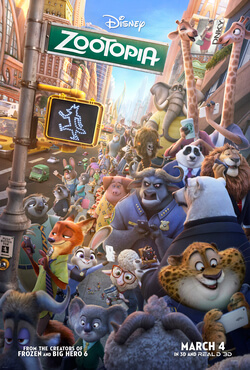
Zootopia is an animated film from Disney and it started out with a premise that sounds very Disney-like.  Zootopia takes place in a world where there are no humans.  Instead, animals walk and talk and scheme and plan and joke and dance and … well, basically, do everything that humans do.  Except they’re a lot cuter when they do it because they’re talking animals.

Judy Hopps (voiced by Gennifer Goodwin) is a rabbit who happens to be an incurable optimist.  (We should all try to be more like Judy.)  Even when she was growing up on the farm, Judy knew that she would someday move to the sprawling metropolis of Zootopia and become the first rabbit on the city’s police force.  When she finally does graduate from the police academy, Judy gets a lot of attention as a trailblazer.  But she quickly discovers that she’s only been hired to be a token, a political tool to help the city’s mayor, a blowhard of a lion named Lionheart (J.K. Simmons, voice the role that he was born to voice), win reelection.

See, Zootopia may look like a wonderful place to live but, as quickly becomes apparent, it’s a city in which the peace is very tenous.  Animals that are traditionally prey — like Judy and her fellow rabbits — may live with the predators but they certainly don’t trust them.  And the predators may not eat the prey but they certainly don’t respect them.  Underneath the cute face of every talking animal, there lies prejudice and resentment.  Lionheart is a predator who needs the votes of prey to remain in office.  What better way to win their trust then to make Judy Hopps a police officer?

Judy may be a member of the police force but that doesn’t mean that she’s going to be allowed to actually do anything.  While every other member of the force gets an exciting assignment, Judy is assigned to traffic duty.

However, an otter has recently vanished.  He’s just the latest of 14 predators to vanish in the city.  With the help of seemingly sympathetic deputy mayor, Judy gets herself assigned to the case.  But there’s a catch.  She has 48 hours to find the otter.  If she doesn’t find that otter, she’ll resign from the force and go back to the farm.

Luckily, Judy is not working alone.  She knows that the last animal known to have seen the otter is a fox named Nick Wilde (Jason Bateman).  Nick’s a bit of a con artist and, as a predator, he wants nothing to do with Judy and she doesn’t quite trust him.  But, events — which I’m not going to spoil here — force them to work together and uncover the darkest secrets of life in Zootopia…

If Zootopia sounds cute, that’s because it is.  It’s perhaps one of the most adorable films that I’ve ever seen, full of wonderful animation and memorable characters.  But, at the same time, there’s a very serious theme running through Zootopia.  Zootopia is about more than just talking animals.  It’s a film about prejudice, racism, sexism, and intolerance.  It’s a film that invites us to not only laugh but also to reconsider the world around us.

Zootopia is currently on Netflix and, if you haven’t seen it yet, I highly recommend it.  It’s great for children and adults.

Playing Catch-Up: Sausage Party (dir by Conrad Vernon and Greg Tiernan)


Sausage Party opens with a scene that could have come straight for a heart-warming Pixar film.  It’s morning and, in a gigantic grocery store called Shopwell’s, all of the grocery items are excited about the start of a new day.  The hot dogs are singing.  The buns are harmonizing.  The produce is bragging about how fresh they are.  Everyone is hoping that this will be the day that they are selected to leave the aisles of Shopwell’s and that they’ll be taken to the Great Beyond.  At Shopwell’s, shoppers are viewed as being Gods and being selected by a God means…

…well, no one is quite sure what it means but everyone’s sure that it has to be something good.  Surely, the Great Beyond couldn’t be something terrible, right?  At least, that’s what everyone assumes until a previously purchased jar of Honey Mustard returns to the store and tells a hot dog named Frank (voiced by Seth Rogen, who also co-wrote the film) that the Great Beyond is a lie.  The Great Beyond is not a paradise.  Instead, it’s something terrible.  Before Honey Mustard can be persuaded to give more details, it leaps off the shelf, choosing suicide over being restocked.

What could it all mean?  Well, there’s not too much time to worry about that because, even as Honey Mustard is committing suicide, a customer is selecting both Frank and Frank’s girlfriend, a bun named Brenda (Kristin Wiig).  They’re going to the Great Beyond together!  Yay!  Except…

…calamity!  A shopping cart collision leads to both Frank and Brenda being thrown to the floor.  While their friends are taken to the Great Beyond, Frank and Brenda are left to wander the store.  It turns out that Shopwell’s really comes alive after the lights go down and the doors are locked.  All of the grocery items leave their shelves and have one big party.  Frank seeks answers about the Great Beyond from a bottle of liquor named Firewater (Bill Hader).  Firewater has all the answers but you need to be stoned to truly understand.  This is a Seth Rogen movie, after all.  Meanwhile…

…Frank’s friends, the ones who survived the earlier cart collision, are discovering that the Great Beyond is not what they thought it was…

I apologize for all the ellipses but Sausage Party is the kind of movie that warrants them.  This is a rambling, occasionally uneven, and often hilariously funny little movie.  (I know that there were allegations that the film’s animators were treated horribly.  That’s sad to hear, not least because they did a truly wonderful job.)  Sausage Party was perhaps the ultimate stoner film of 2016, a comedy with a deeply philosophical bent that plays out with a logic that feels both random and calculated at the same time.

(If you’ve ever had the three-in-the-morning conversation about “What if our entire universe is just a speck of dust in a bigger universe?”, you’ll immediately understand what Sausage Party is trying to say.)

It’s also an amazingly profane little movie but again, that’s a huge reason why it works.  Yes, a lot of the humor is juvenile and hit-and-miss.  (I cringed whenever the film’s nominal villain, a douche voiced by Nick Kroll, showed up.)  But for every joke that misses, there’s a joke that works perfectly.  Interestingly, for all the silliness that’s inherent in the idea of making a film about talking grocery items, there’s a strain a very real melancholy running through Sausage Party.  Sausage Party may be a dumb comedy but that doesn’t mean that it doesn’t have a lot on its mind.

Since it’s a Seth Rogen film, the cast is full of familiar voices.  Yes, James Franco can be heard.  So can Paul Rudd, Danny McBride, Salma Hayek, Edward Norton, Jonah Hill, and Craig Robinson.  They all sound great, bringing vibrant life to the film’s collection of consumables and condiments.

Sausage Party.  After watching it, it’s possible you’ll never eat another hot dog.

Playing Catch-Up: Popstar: Never Stop Never Stopping (dir by Akiva Schaffer and Jorma Taccone)


Have you heard of Conner4Real?

If you haven’t, you’re probably just old or else you don’t keep up with what’s happening in the world of popular music.  His real name is Conner Friel and he used to be a member of the Style Boyz.  Of course, the Style Boyz eventually broke up.  Kid Brain became a farmer.  Kid Contact became a DJ.  And Kid Conner — well, he became Conner4Real and he became a bigger star as a solo artist than he ever was as a Style Boy.  His debut album, Thriller, Also, broke records.

But the follow-up, Connquest … well, Connquest wasn’t quite as acclaimed.  In fact, it was hated by just about everyone.  This is despite featuring classic songs like:

Finest Girl (Bin Laden Song)

Mona Lisa

and Equal Rights (featuring P!nk).

Fortunately, when Conner4Real was facing his greatest existential crisis, a film crew was present to record his struggle.  For those of us who were fascinated by the career of Conner4Real, Popstar: Never Stop Never Stopping is a chance to see how Conner dealt with everything from his terminally ill pet turtle to the elaborate marriage proposal ceremony that led to Seal being attacked by wild wolves.  We would have gotten to see Conner and his manager defeat a swarm of mutant bees but, unfortunately, that happened right after the only time that Conner’s manager asked the film crew to stop filming.

Oh well, these things happen.

So, as you should have guessed from all that, Popstar is not a serious film.  It’s a mockumentary, with the emphasis on mock.  It was also one of the funniest films of 2016, a spot-on parody of the silliness and pretensions of fame.  Conner is a combination of Justin Bieber and Macklemore at their shallowest, a well-meaning but thoroughly empty-headed singer.  In fact, if Conner was played by anyone other than Andy Samberg, he would be so annoying that the film would run the risk of being unwatchable.

But fortunately, Conner is played by Andy Samberg.  It’s hard to think of anyone who plays dumb with quite the same panache as Andy Samberg does.  There are plenty of lines in Popstar that shouldn’t work but they do, specifically because they’re being delivered by Samberg.  He brings just the right amount of sweetly sincere stupidity to the role.  Almost despite yourself, you find yourself hoping that things will work out for Conner and the other Style Boyz.  Conner may not deserve to be as big a star as he is but it was obviously going to happen to some idiot so why not a sincere one?

Samberg is not the only funny person in Popstar.  The movie is full of funny people, from Sarah Silverman to Bill Hader to the always underrated Tim Meadows.  It’s also full of celebrity cameos and I have to admit that I usually tend to cringe when I see too many people playing themselves.  But in Popstar, it works.  One need only rewatch something like Zoolander 2 to see how well Popstar pulls off its celebrity cameos.

Sadly, as funny as Popstar was, it was also one of the biggest bombs of 2016.  (The trailer, it must be said, did not do the film justice.)  However, I expect that it will soon develop a strong cult following.  In a few years, we’ll get a sequel.  It probably won’t be as as good.

Oh well.  These things happen.

Playing Catch-Up: The Accountant, Carnage Park, The Choice, The Legend of Tarzan


Continuing my look back at the films of 2016, here are four mini-reviews of some films that really didn’t make enough of an impression to demand a full review.

The Accountant (dir by Gavin O’Connor)

2016 was a mixed year for Ben Affleck.  Batman v. Superman may have been a box office success but it was also such a critical disaster that it may have done more harm to Affleck’s legacy than good.  If nothing else, Affleck will spend the rest of his life being subjected to jokes about Martha.  While Ben’s younger brother has become an Oscar front runner as a result of his performance in Manchester By The Sea, Ben’s latest Oscar effort, Live By Night, has been released to critical scorn and audience indifference.

At the same time, Ben Affleck also gave perhaps his best performance ever in The Accountant.  Affleck plays an autistic accountant who exclusively works for criminals and who has been raised to be an expert in all forms of self-defense.  The film’s plot is overly complicated and director Gavin O’Connor struggles to maintain a consistent tone but Affleck gives a really great performance and Anna Kendrick reminds audiences that she’s capable of more than just starring in the Pitch Perfect franchise.

Carnage Park (dir by Mickey Keating)

I really wanted to like Carnage Park, because it was specifically advertised as being an homage to the grindhouse films of the 1970s and y’all know how much I love those!  Ashley Bell plays a woman who gets kidnapped twice, once by two bank robbers and then by a psycho named Wyatt (Pat Healy).  Healy chases Bell through the desert, hunting her Most Dangerous Game-style.  There are some intense scenes and both Bell and Healy are well-cast but, ultimately, it’s just kind of blah.

The Choice (dir by Ross Katz)

The Choice was last year’s Nicholas Sparks adaptation.  It came out, as all Nichols Sparks adaptations do, just in time for Valentine’s Day and it got reviews that were so negative that a lot of people will never admit that they actually saw it.  Benjamin Walker and Teresa Palmer play two people who meet, fall in love, and marry in North Carolina.  But then Palmer is in a car accident, ends up in a coma, and Walker has to decide whether or not to turn off the life support.

As I said, The Choice got terrible reviews and it’s certainly not subtle movie but it’s actually better than a lot of films adapted from the work of Nicholas Sparks.  Walker and Palmer are a likable couple and, at the very least, The Choice deserves some credit for having the courage not to embrace the currently trendy cause of euthanasia.  That alone makes The Choice better than Me Before You.

The Legend of Tarzan (dir by David Yates)

Alexander Skarsgard looks good without his shirt on and Samuel L. Jackson is always a fun to watch and that’s really all that matters as far as The Legend of Tarzan is concerned.  It’s an enjoyable enough adventure film but you won’t remember much about it afterward.  Christoph Waltz is a good actor but he’s played so many villains that it’s hard to get excited over it anymore.

Playing Catch-Up: Arrival (dir by Denis Villeneuve)


arrival_movie_poster

I cannot begin to express how happy I was when I learned that the Directors Guild of America had nominated Denis Villeneuve for his work on Arrival.

Arrival was one of the best films of 2016.  In fact, I would argue that it’s one of the best science fiction films that I’ve ever seen.  There were a lot of reasons for that, of course.  There was the brilliant script by Eric Heisserer.  There was the starring performance of Amy Adams, who is one of the best actresses working today.  There was a surprise and thought-provoking twist, one that forced you to reconsider everything that you previously believed.  There were so many reasons why Arrival was a great film but, ultimately, it call came down to Denis Villeneuve.

Working with material that would have led most directors down the road to bombast, Villeneuve instead took a deliberately low-key approach.  Whereas most directors would have encouraged their cast to play up the drama, Villeneuve encourages his actors to take a more inward and cerebral approach to the material.  Arrival is a rarity — a film about smart people in which the people actually seem to be smart.  For once, we don’t need expositionary characters to pop up and tell us that Louise Banks (Amy Adams) and Ian Donnelly (Jeremy Renner) are brilliant.  Instead, we simply believe they are from what we see on the screen.  Much like last year’s Sicario, Arrival proves that Villeneuve is a visionary director.

Arrival is a hard film to describe, not because it’s overly complicated but because there’s a huge twist that I really can’t reveal.  Before the twist, Arrival is simply a well-directed sci-fi film.  After the twist, it is something all together different, an intense meditation on faith, love, language, and destiny.  Since I’m reviewing the film late, chances are that you already know about the twist but I’m still not going to spoil it.

What I can tell you is that Arrival opens with the arrival of twelve spaceships, all of which land at different places across the world.  The Chinese have a spaceship.  The British have a spaceship.  I imagine that the Canadians have a spaceship, because who wouldn’t want to hang out with the Canadians?  And, of course, the Americans have a spaceship.  The aliens are inside the spaceships.  They’re octopus-like creatures, ones that almost look as if they could have come from one of Lovecraft’s Cthulhu stories.  The aliens may appear to be fearsome but they actually seem to be rather benevolent.  No one’s quite sure because the aliens communicate through a complex series of symbols and nobody can understand what those symbols mean.

Louise Banks is a linguist.  Ian Donnelly is a physicist.  The Americans bring both in to help translate the symbols.  Of course, the rest of the world has their own linguists and physicists working to translate the symbols and, humans being humans, it often seems that the Americans and the Chinese are less concerned with translating what the aliens are saying and more concerned with being the first to understand.  While Louise works, she continues to be haunted by dreams and visions of her daughter’s death from cancer.

And that’s really all I can tell you without spoiling the film and potentially making myself cry.  But I will say that if you haven’t seen Arrival, you must go out and see it now.  It’s one of the most thought-provoking and emotionally wrenching films of the past year.

Add to that, it’s probably going to be nominated for best picture.  It’s been overshadowed a bit by all the attention paid to La La Land, Moonlight, and Manchester By The Sea.  But Arrival is just as good a film as any of them.  In fact, in the future, we’ll probably look at Arrival and say that it was better than all of them.


2016 in Review: Lisa Marie’s 20 Favorite Novels of 2016


Right now, I’m in the process of taking a look back at some of my favorite things from the previous year.  Yesterday, I posted a list of my favorite non-fiction books of 2016.  Today, I post my 20 favorite novels!

All of these are worth reading and in fact, I insist that you do.  Let’s enjoy the written word while we can because, sadly, the future holds only illiteracy and propaganda.

hex

  1. Hex by Thomas Olde Heuvelt
  2. All the Ugly and Wonderful Things by Bryn Greenwood
  3. The Wonder by Emma Donoghue
  4. The Butterfly Garden by Dot Hutchison
  5. All the Missing Girls by Megan Miranda
  6. Moonglow by Michael Chabon
  7. Girls on Fire by Robin Wasserman
  8. The Woman in Cabin 10 by Ruth Ware
  9. The Hating Game by Sally Thorne
  10. The Queen of the Night by Alexander Chee
  11. My Name is Lucy Barton by Elizabeth Strout
  12. The Girls by Emma Cline
  13. Ink and Bone by Lisa Unger
  14. The Widow by Fiona Barton
  15. My Best Friend’s Exorcism by Grady Hendrix
  16. The Last Days of Jack Sparks by Jason Arnopp
  17. The Empty Ones by Robert Brockway
  18. The Regional Office is Under Attack! by Manuel Gonzales
  19. Ways to Disappear by Idra Novey
  20. The Gloaming by Melanie Finn

Tomorrow, it’s the list that you have all been waiting for: my picks for the best films of 2016!

the-hating-game

Previous Entries In The Best of 2016:

  1. TFG’s 2016 Comics Year In Review : Top Tens, Worsts, And Everything In Between
  2. Anime of the Year: 2016
  3. 25 Best, Worst, and Gems I Saw In 2016
  4. 2016 in Review: The Best of SyFy
  5. 2016 in Review: The Best of Lifetime
  6. 2016 in Review: Lisa Picks the 16 Worst Films of 2016!
  7. Necromoonyeti’s Top Ten Albums of 2016
  8. 2016 In Review: Lisa Marie’s 14 Favorite Songs of 2016
  9. 2016 In Review: 10 Good Things I Saw On Television in 2016
  10. 2016 in Review: Lisa Marie’s 10 Favorite Non-Fiction Books of 2016