My look back at the previous year continues with 10 of my favorite non-fiction books of 2016! Now, it should be noted that, because this is an entertainment-related website, I’m only listing my favorite entertainment-related books. There was a lot of good nonfiction published last year but the majority of it had nothing to do with either the movies or television so who cares?
Anyway, all of these are wonderful and well-worth the money!
The Godfather Notebook by Francis Ford Coppola
TV: The Book by Matt Zoller Seitz and Alan Sepinwall
The Only Pirate at the Party by Lindsey Stirling
Natalie Wood: Reflections on a Legendary Life by Manoah Bowman
The Purple Diaries: Mary Astor and the Most Sensational Hollywood Scandal of the 1930s by Joseph Egan
In Search of Lost Films by Phil Hall
Down from the Attic: Rare Thrillers of the Silent Era through the 1950s by John T. Soister and Henry Nicolella
Shirley Jackson: A Rather Haunted Life by Ruth Franklin
The Curse of Beauty: The Scandalous & Tragic Life of Audrey Munson, America’s First Supermodel by James Bone
A Thousand Cuts: The Bizarre Underground World of Collectors and Dealers Who Saved the Movies by Dennis Bartok and Jeff Joseph
Finally, I have to give an honorable mention to two books that were published in 2015 but which I didn’t read until 2016. These two books were definitely my favorite non-fiction reads in 2016 and there’s no way that I couldn’t mention them. Troy Howarth’s So Deadly, So Perverse and So Deadly, So Perverse Volume 2 contain everything you could possibly want to know about the giallo genre!
Tomorrow, my look back at 2016 continues with my favorite novels of the year!
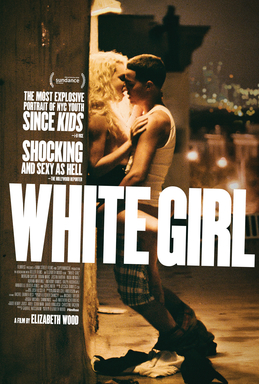
Ever since it premiered at the Sundance Film Festival, I’ve read the White Girl was the most “shocking” film of 2016. You can take a look at the poster above and see that, according to The Hollywood Reporter, White Girl is “SHOCKING … AND SEXY AS HELL!”
Well, I finally got a chance to watch White Girl on Netflix and the only thing shocking about it is that so many (male) critics were apparently convinced that it was the most shocking movie ever made. I certainly wouldn’t call it shocking. (And considering that White Girl features two graphic rapes, I’d love to know why the critic thought “sexy as Hell” would be an appropriate description.) A better description of White Girl would be “honest.” Then again, considering the way that the movies usually present the experience of being young, female, and in the city, perhaps the fact that White Girl is an honest film is the most shocking thing of all.
Morgan Saylor plays Leah, a college student who, along with her friend, Katie (India Meneuz), moves into a New York apartment. The apartment is located in a largely Spanish neighborhood, one that has yet to surrender to gentrification. While Katie and Leah’s hipster friends are immediately suspicious of everyone else in the neighborhood, the Oklahoma-born Leah is far more adventurous (or perhaps reckless). She approaches Blue (Brian Marc) on a street corner and asks him if he has any weed.
Blue has weed and a lot more. He’s the neighborhood drug dealer and soon, he’s also Leah’s boyfriend. When Leah isn’t getting high and having sex with Blue, she’s working as an intern at a magazine where, early on in the film, she’s sexually assaulted by her boss, Kelly (Justin Bartha, playing a predator who, for many, will seem disturbingly familiar). Leah invites Blue to a party given by the magazine and Blue is able to make a lot of money selling cocaine to Leah’s wealthy co-workers.
For Blue, drugs are a business and he refuses to do hard drugs himself. To Leah, it’s an adventure, one that she believes doesn’t have any real consequences. Or, at least, that’s the way she sees it until Blue is arrested. With Blue, a repeat offender, facing a life sentence, Leah manages to find a lawyer (Chris Noth, who will make you skin crawl) but she needs to raise the money to pay him. Fortunately, Leah has a stash of cocaine that Blue was supposed to sell. Blue tells Leah that she needs to return the cocaine to his dealer but instead, Leah decides to sell the cocaine herself. Or, at the very least, she’s going to sell whatever cocaine she doesn’t end up snorting herself…
White Girl has been called shocking because of its open and nonjudgmental portrayal of both drugs and sex but, honestly, there’s nothing shocking about it. It may be a generational thing but, to me, Leah’s story was a familiar one. I’ve known a lot of Leahs and, personally, there were moments in White Girl that left me cringing just because I could relate to one of Leah’s naive notions or I could remember what it was like to feel like, no matter what I did, there would never be any consequences. Leah may not always be a likable character but it’s not because she has sex or experiments with drugs. Instead, it’s because she spends most of the film blissfully unaware of her own privilege. Leah thinks that she understands the realities of Blue’s world but, as she learns by the end of the film, she’s really just a tourist. And, unlike Blue and the rest of her neighbors, Leah can always leave whenever she wants.
So, White Girl was not a shocking film to me. Instead, it was a very honest film. It can currently be viewed on Netflix.
Earlier this week, I named Pride and Prejudice and Zombies as the worst Jane Austen adaptation of 2016. Of course, I understand that Pride and Prejudice and Zombies isn’t really a Jane Austen adaptation. Instead, it’s an adaptation of a jokey novel that took Austen’s characters and combined them with zombies. But you know what? Nobody would have given a damn if the name of that book and that movie didn’t include three words: Pride. And. Prejudice. That’s the power of Jane Austen.
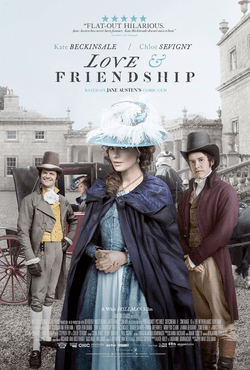
But anyway, my point is that Pride and Prejudice and Zombies was pretty much a low point as far as Jane Austen films are concerned. Fortunately, 2016 also saw the release of a very enjoyable and entertaining Jane Austen film named Love & Friendship and, even better, Love & Friendship was based on something that Austen actually wrote.
Of course, though Austen may have written the novella Lady Susan, it wasn’t published until long after her death and there’s speculation that it was an unfinished (or abandoned) first draft. In fact, it’s debatable whether or not Lady Susan was something that Austen would have ever wanted to see published. While it shares themes in common with Austen’s best known work, it also features a lead character who is far different from the stereotypical Austen heroine. Lady Susan Vernon is vain, selfish, manipulative, and unapologetic about her numerous affairs. She’s also one of the wittiest of Austen’s characters, a woman who is capable of identifying and seeing through the hypocrisies of 18th century society.
In Love & Friendship, Susan is played by Kate Beckinsale, who does a great job in the role. One of the best things about Love & Friendship is that it serves to remind us that Kate Beckinsale is a very good actress, even when she isn’t dealing with vampires and Lycans and all that other Underworld stuff. Lady Susan is a recent widow and has been staying, with her daughter, Frederica (Morfydd Clark), at the estate of Lord and Lady Manwaring (Jenn Murray and Lochlann O’Mearáin) . That’s a good thing because, as a result of the death of her husband, Lady Susan is now virtually penniless and homeless. But, once it becomes obvious that Susan is having an affair with Lord Manwaring, she and Frederica are kicked out of the estate.
They eventually find themselves living with Susan’s brother-in-law, Charles (Justin Edwards) and Charles’s wife, Catherine (Emma Greenwell). Susan, realizing that she needs to find not only a rich husband for Frederica but also one for herself, immediately starts to scheme to win the hand of Catherine’s brother, Reginald DeCourcy (Xavier Samuel). Meanwhile, Susan also tries to arrange for Frederica to marry the hilariously slow-witted Sir James Martin (Tom Bennett). Needless to say, things do not go quite as plan and it’s all rather chaotic and hilarious in its wonderfully refined way.
Director Whit Stillman, who has spent his career making refined and witty movies about morality and manners, is the ideal director for Austen’s material and he’s helped by an extremely witty (and, with the exception of Chloe Sevigny, very British) cast. In the role of Susan, Kate Beckinsale is a force of nature and Tom Bennett is hilariously dense as Sir James, the type of well-meaning dunce who is literally stumped when someone asks him, “How do you do?” Never before has dullness been so hilariously performed and Bennett’s performance really is a minor miracle.
Love & Friendship was a wonderful excursion into Austenland. It didn’t even require zombies to be enjoyable.
Well, in 2016, I watched even less television than I did in 2015. And what I did watch, I usually didn’t care much for. 2016 was dominated by that stupid presidential election and it didn’t take me long to discover that watching too much television would result in me having to sit through hundreds of political commercials. When it came to watching television, I spent a good deal of 2016 clicking on the mute button.
Of course, I watched all of the reality shows, but even that was largely because I was contracted to write about them at the Big Brother Blog and Reality TV Chat.
I also spent a good deal of time watching classic films on TCM. I live tweeted most of the movies that premiered on Lifetime and the Lifetime Movie Network. I did the same during those rare occasions that a new movie showed up on SyFy.
But, beyond that, I found myself with less reason than usual to watch television. Maybe I’m maturing. Maybe my tastes are changing. Maybe I’ve just grown bored with TV in general. Or, perhaps, 2016 was just a really bad year.
Who knows?
Still, with all that in mind, here are a few good things that I saw on television in 2016!
1) American Crime Story: The People v. OJ Simpson
The television event of the year! I watched every episode and I was absolutely enthralled. This brilliantly acted show is probably destined to be remembered as the only worthwhile project that Ryan Murphy was ever involved with.
(“But Lisa, what about American Horror Story…” American Horror Story sucks. Don’t even get me started on Scream Queens…)
2) Veep continued to be the most brilliant comedy on HBO.
I know that some people felt that Veep wasn’t as strong this season as it had been in previous seasons. Well, those people can go to Hell. Veep is not only a brilliant comedy but it’s also probably the most realistic political show on TV. Considering the cult-like adoration that voters have for their candidates and towards the government in general, the unrepentant cynicism of Veep provided a much-needed wake up call to the brainwashed masses.
3) Speaking of Veep…
Without a doubt, this was the best campaign commercial of 2016:
4) Stranger Things
Thank you, Netflix!
5) Agent Carter
The 2nd season of Agent Carter was just as wonderful, stylish, and empowering as the first. Of course, the show as promptly canceled, leaving us with just a grand total of 18 episodes.
6) Speaking of cancellations…
American Idol finally came to an end! Don’t get me wrong. Like a lot of people, I used to be enthralled by American Idol. For the first few seasons, I watched every episode. I voted nearly every week. I got really emotionally involved. But, especially over the last few seasons, American Idol was becoming more and more irrelevant. It soon came to represent everything that people like me hate about cultural conformity. Vote For The Worst ceased operations, leaving me without a safe place to talk about how annoying it was whenever anyone would use that Hallelujah song for an audition. A steady stream of boring judges didn’t help either. American Idol finally came to an end last season. I watched the final episode. I can’t remember who won.
7) Bates Motel Continued To Take Brave Risks
Occasionally frustrating, sometimes infuriating, and often quite brilliant, Bates Motel remained one of the most consistently fascinating shows on television.
8) Vinyl crashed and burned
It may seem petty to describe a dramatic failure as being something good that I saw on television. But, seriously, Vinyl was such a hubris-fueled trainwreck that it was impossible not to feel a little Schadenfreude as it fell apart.
9) Westworld
The anti-Vinyl.
10) The unicorn was saved.
According to Case, the life of a unicorn was saved when People of Earth was renewed for another season. Yay!
Tomorrow, I’ll continue my look back at 2015 with my ten favorite non-fiction books of the year!
As our regular readers are undoubtedly aware, I was born in Texas and I grew up all over the Southwest. I don’t believe in trigger warning and quite frankly, I lose respect for anyone who I hear whining about having to have one. That’s the way we are down here. If you can’t handle potentially being upset by something or someone, that’s you’re own damn problem.
That being said, I do feel like I should give everyone a heads up about A Monster Calls. Don’t consider this to be a warning because a warning suggests that something bad is going to happen and A Monster Calls is actually a very good movie and one that I highly recommend. But I do think I should say that I sobbed almost all the way through A Monster Calls and I wasn’t alone. When I saw this movie on Sunday, there wasn’t a dry eye in the Alamo Drafthouse.
That’s just the type of film it is. It’s a movie that deals very sincerely and very forthrightly with what it means to lose someone who you love. It’s a coming-of-age story that deals with fear, loss, guilt, and those moments when — even while dealing with unbelievable pain and sadness — we can still find happiness in the moments that we have and in the imagination that all people — especially young people — possess.
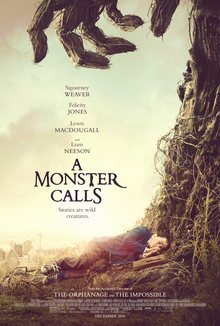
Technically, A Monster Calls is a fantasy though it actually deals with very real emotions and events. Conor O’Malley (Lewis McDougall) is a shy and introverted 13 year-old who is haunted by nightmares, one in particular. His parents are divorced. His father (Toby Kebbell) lives in America and is barely a presence in Conor’s life. His mother, Lizzie (Felicity Jones, giving an amazing performance), gave up her own artistic ambitions when she became pregnant. Now, she’s sick and every day, Conor is told that his mother is starting yet another new treatment because she’s “not responding as expected” to the previous treatment.
With Lizzie growing more and more ill, Conor finds himself living with his grandmother (Sigourney Weaver). To Conor, his grandmother appears to be overly strict and unemotional but, as the film makes clear, she’s not. If she seems strict, it’s because she knows that she will soon have to take over as Conor’s guardian. If she seems unemotional, it’s because she’s trying to stay strong for both her daughter and her grandson.
Meanwhile, at school, Conor finds himself targeted by a strange bully named Harry (James Melville). The scenes with Harry are some of the oddest in the film. At times, Harry seems to look at the perpetually miserable-looking Conor with almost an expression of empathy and you wonder if he feels some sort of guilt over what he’s doing. But whenever Harry approaches Conor, a viscous sadism emerges. Though Harry always seems to be the one who is staring, he continually demands to know why Conor is always looking at him. When another student tries to hit Conor, Harry announces that only Harry is allowed to hit Conor.
And then there’s the Monster. At night, the Monster visits Conor. A gigantic, humanoid tree, the Monster speaks in the voice of Liam Neeson and he alternates between being threatening and being almost paternalistic. When Conor gets angry, the Monster encourages him to destroy things. When Conor gets sad, the Monster taunts him for thinking that his sadness is somehow different from everyone else’s sadness. The Monster is frightening but, at the same time, he seems to be the only thing in Conor’s life that he can depend on. The Monster’s words may be harsh but there’s also something oddly comforting in their harshness. It helps that he sounds like Liam Neeson.
The Monster tells Conor three stories, all of which are full of ambiguity and end with uncertain lessons. The Monster tells Conor that, after he finishes the third story, Conor will be required to tell him about his greatest nightmare. Conor finds himself both frightened and fascinated by the Monster but, as quickly becomes clear, his main fear is talking about his nightmare.
A Monster Calls is a beautifully done story about dealing with loss, one that will make you cry but, at the same time, will leave you feeling almost grateful for those tears. The Monster is a truly spectacular creation and Liam Neeson does a perfect job voicing him. What makes A Monster Calls so special is the way that director J. A. Bayona deftly balances Conor’s apocalyptic encounters with the Monster with the small, every day details of real life.
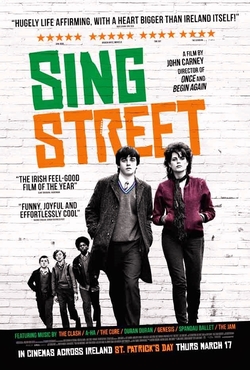
The Irish musical comedy drama romance (that’s a lot of genres to take in, I know) Sing Street was one of the great and most sadly overlooked films of the previous year. Fortunately, it’s on Netflix now and I seriously recommend that you watch it. I watched it last night and I absolutely loved it.
Well, actually, it took me a while to realize that I loved it. When the movie first started, I was kinda like, “Well, that’s cute and sweet but it’s not exactly blowing me away…” It tells the story of a 15 year-old boy named Conor (Ferdia Walsh-Peelo) who is growing up in Dublin in the early 80s. His father (Aidan Gillen) and his mother (Maria Doyle Kennedy) are constantly fighting and Conor suspects that they’re on the verge of separating. His older brother, the charismatic but bitter Brendan (Jack Reynor), has dropped out of college and moved back home. Brendan spends his days stoned and talking about music.
Because the family is short on money, Conor has been transferred to a free school, Synge Street. It’s a far rougher school than what Conor is used to. Bullies target him as soon as he arrives. Meanwhile, the principal, Brother Baxter (Don Wycherly), has taken a somewhat disturbing interest in his newest student. When Conor can’t afford to buy the black shoes that he’s required to wear to school, Baxter forces him to spend the school day in his socks.
Perhaps the only positive in Conor’s life is Raphina (Lucy Boynton), a 16 year-old who lives across the street from the school. Raphina is an aspiring model with an older boyfriend and plans to move to London. Conor tells Raphina that he’s in a band and that he wants her to star in a music video. To Conor’s surprise, Raphina agrees.
Now, Conor just has to get a band together…
Sing Street was directed by John Carney, the same man who previously gave us the wonderful Once and the somewhat-less-wonderful-but-still-good Begin Again. Much like those previous two films, Sing Street is a deliriously romantic and rather bittersweet little film, one in which love and emotion are expressed through song. As a director, Carney has a real skill for capturing the excitement of creation. The scenes in which Conor and his friend Eamon (Mark McKenna) work on their songs are just as enthralling as the scenes of Raphina and Conor falling in love.
And the music itself is wonderful. While the soundtrack never quite reaches the heights of Once, it is a definite improvement over Begin Again. The songs are all catchy and enjoyable but, even more importantly, they sound like the songs that actually would have been written by a talented but confused 15 year-old who has just started his own band. There’s an aching sincerity to Sing Street‘s songs and they stay with you. They remind you of how wonderful it is to know that you have your entire future ahead of you.
As I said, I didn’t realize how good Sing Street was until I had nearly reached the end of the movie. Sing Street is one of those low-key films that kind of sneaks up on you. At first, you think that you’re just watching another well-made coming of age film and then suddenly, you’re in tears. You’re hoping that Raphina will make it to London and that Conor will find some sort of happiness. The film ends on a somewhat ambiguous note but, in the end, you realize you really don’t need to know the exact details of what happened to Raphina and Conor in the future. Instead, what’s important is that they had this wonderful experience when they were young. Regardless of what happens to them in the future, you’re happy that they had the experience.
The whole film is undeniably well-acted but I want to make special mention of Jack Reynor, who brings a wounded dignity and rueful humor to the role of Brendan. He dominates his few scenes and you find yourself happy that, regardless of how messed up the rest of his family may be, Conor has a brother like Brendan.
As I said at the start of this review, Sing Street is on Netflix. And you should definitely watch it.
Every January, I list my fourteen favorite songs of the previous year and, every January, I include the same disclaimer. My fourteen favorite songs are not necessarily the fourteen favorite songs of any of the other writers here at the Shattered Lens. We are a large and diverse group of people and, as such, we all have our own individual tastes.
If you ever visited the TSL Bunker, you would be shocked by the different music coming out of each office. You would hear everything from opera to death metal to the best of Frank Sinatra and Dean Martin. And then, of course, you would reach my office and you would discover that my taste in music pretty much runs the gamut from EDM to More EDM.
Now, usually, I do try to listen to a variety of music. You can go to my Song of the Day site — Lisa Marie’s Song of the Day — and see that I do occasionally listen to other types of music. But, I have to be honest. 2016 was not a year that inspired me to really leave me comfort zone. If anything, music provided me with some much needed consistency in an otherwise chaotic year. 2016 was a year that made me want to dance until it was all over and, for the most part, my favorite songs of the year reflect that fact.
Before I list my 14 songs, I should make something else very clear. These are my 14 favorite songs of 2016. I’m not saying that they’re necessarily the best songs of 2016. I’ll leave that debate for others. Instead, there are the songs that I found myself listening to over and over again. These are the songs made me dance. These are the songs that made me sing. A few of these songs relaxed me when I needed to be relaxed. One of the songs made me cry but I’m not going to say which one.
It might make you cry too.
Or it might not.
That’s the beautiful thing about art. Everyone experiences it in their own individual way.
Here are my 14 favorite songs of 2016:
14) David Bowie — Lazarus
13) Afrojack & Hardwell — Hollywood
12) Cedric Gervais (ft. Juanes) — Este Amor
11) Matoma (ft. Becky Hall) — False Alarm
10) Radiohead — Burn the Witch
9) Gorgon City (feat Vaults) — All Four Walls
8) Penthox — Give It Away
7) Britney Spears — Clumsy
6) Martin Garrix (feat Mesto) — WIEE
5) Tiesto, Oliver Heldens (feat Natalie LaRose) — The Right Song
I have to admit that the main reason I watched Yoga Hosers is because I’m currently in the process of making out my “worst of 2016” list and everyone that I’ve talked to has insisted that Yoga Hosers happens to belong on that list.
Well, for once, I actually happen to agree with other people. At the risk of losing my contrarian reputation, Yoga Hosers definitely belongs on any list of the worst films of 2016.
I mean … Look, I get it.
I know that making crappy-looking films with juvenile humor has, in the past, worked out very well for Kevin Smith. It’s made him an icon. It’s won him legions of fans. Some of my best friends love Kevin Smith and his movies. I, personally, appreciate that he’s a fan of Degrassi.
And I know that there are literally thousands of interviews with Kevin Smith where he talks about the fact that he’s not the world’s greatest visual stylist. He always pokes fun at the fact that he rarely moves the camera. He’s open about the fact that he’s better at writing dialogue than filming it. And I also know that he has regularly encouraged people not to take anything that he does too seriously.
I get all of that.
But here’s the thing … Yoga Hosers is really, really bad. And Kevin Smith openly admitting that he’s not a very good director doesn’t make Yoga Hosers any less painful to sit through.
It’s actually kind of sad that Yoga Hosers isn’t better. The film deals with two 15 year-old Canadian convenience store workers. They’re both named Colleen and they’re best friends. They’re also very well-played, by Harley Quinn Smith and Lily-Rose Depp. In fact, they both give such likable performances that it actually makes the film just a little more bearable than it otherwise would have been. And, hey — Kevin specifically made Yoga Hosers so that his daughter could have a starring role. That’s more than my Dad ever for me when I was fifteen!
But, God, the movie is just so bad.
And by bad, I mean boring. It’s not even so bad that it’s good. It’s just a boring, bad movie.
Of course, If you just heard a rough outline of the film’s plot, you would probably think that Yoga Hosers was destined for cult immortality. The Colleens are forced to spend a Friday night working at the store and they end up having to fight off a bunch of Nazi bratwursts, all of whom seeking to continue the hateful legacy of a Canadian Nazi played, in painfully unfunny flashbacks, by poor Haley Joel Osment. Johnny Depp shows up as Guy LaPointe, a “man-hunter” who has a huge mustache and who speaks with a thick accent that’s obviously supposed to be hilarious.
But seriously, it takes forever for those little Nazis to show up. First, you have to deal with about an hour of the Colleens obsessing over their phones and saying “aboot” a lot. This is one of the slowest films that I’ve ever seen and Kevin Smith is not the type of director to make a joke and then move on after he gets a laugh. No, instead, he’s going to make a joke and then make it a second time and then keep pounding you over the head with it. Watching Yoga Hosers is the equivalent of having Kevin Smith in your face for 90 minutes, screaming, “This is funny, right!? RIGHT!?”
For instance, do you think it’s funny that Canadians say “aboot” and “oot?” If you do, Yoga Hosers might be for you. Or it still might not be, because how many times can you laugh at the Colleens saying “aboot?” After the 10th time, you’ve gotten the joke but rest assured, you’re going to hear it a hundred more times. Do Canadians ever get tired of Americans demanding that they say “aboot?” I think I would. I’m from Texas and I know I get sick of people from up north going crazy whenever I say “y’all.”
I think the main problem with Yoga Hosers is that Kevin Smith apparently didn’t trust his audience to pick up on all of the film’s comedic details. Hence, the film never makes a joke without then beating us over the head to make sure that we understand that we’ve just heard or seen a joke. For instance, it’s clever that, in Yoga Hosers, Canadian cereal is called “Pucky Charms.” I saw one of the Colleens walking around with an open box of Pucky Charms and I smiled and I thought it was a clever little joke. But it becomes less clever once Smith starts to have other characters specifically point out that Canadian cereal is called “Pucky Charms.” Then it becomes just another mildly funny joke that quickly gets old.
I love Canada! And I’m pretty sure Kevin Smith is a nice guy too. But seriously, Yoga Hosers is the worst.
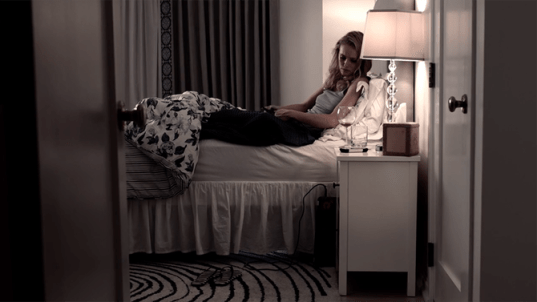
Last night, I watched the latest Lifetime premiere film, Under the Bed!
Why Was I Watching It?
Well, there were a few reasons why I watched it. First off, it was on Lifetime and, by this point, it’s kind of a tradition around these parts that I always live tweet every Lifetime premiere. Secondly, I watched it so that I could write this review. After all, it’s a new year and that means that it’s time for a new set of What Lisa Watched Last Night reviews!
Add to that, the film had the word “bed” in the title so I assumed there would be a lot of sex.
What Was It About?
It’s yet another Lifetime stalker film! This one, which is apparently based on a true story, features Hannah New as Callie Monroe. Callie’s an acclaimed journalist who has a beautiful home, a cute dog, and absolutely no love life. She’s just broken up with her longtime boyfriend and its going to take more than winning a Pulitzer for her article about climbing Kilimanjaro to fill the void in her life!
What Callie doesn’t know is that there’s a man (played by Pat Healy) living underneath her bed. Seriously. He’s broken into her apartment. He’s put secret cameras all over the place. And he is now literally living underneath her bed, from which he regularly sends her messages.
Say it with me now — Agck!
What Worked?
Under the Bed was directed by Daniel Myrick, who co-directed the original Blair Witch Project. There were a few effectively creepy scenes in the movie. I mean, just the idea of having a stranger living with you in your bedroom without your knowledge is creepy in and of itself. You could probably argue that the success or failure of this film depended on whether or not it inspired you to look underneath your bed after watching it. I know I did.
Hannah New gives a good and sympathetic performance as Callie and Pat Healy is appropriately frightening as her stalker. Beverly D’Angelo also provides some good support as Callie’s mother.
What Did Not Work?
(Spoiler Alert)
Freddy the Dog dies. Freddy is an adorable little dog that Callie owns. Unlike his owner, Freddy understands that there’s a man living underneath the bed. So, one day, the man puts Freddy in a bag and buries him alive. And we see all of this happen and, quite frankly, it’s too much. First off, there was no reason to kill Freddy. Secondly, the burial scenes ends on a somewhat ambiguous note so you’re not really sure whether or not Freddy was fully buried or not. I spent the entire final hour of the film waiting for Freddy to suddenly show up and it really depressed me when he didn’t.
There’s more to the thing with Freddy than just the fact that I don’t like scenes of animal cruelty. The scene itself didn’t only feel unnecessary but it also felt incredibly mean-spirited as well. If you want to kill the dog that badly, have him dragged off-screen and do the little whimper thing. Instead, by having us watch as Freddy’s buried alive, it felt like the film was saying, “Look how edgy we are! We killed the dog!” It felt terribly out-of-place and it soured me on the entire film.
It also didn’t help that the stalker was so obvious about what he was doing that, pretty soon, you started to resent Callie for being so naive. When Callie finally discovered her stalker and started to fight back, it never felt empowering. Instead, I was just kinda like, “Well, it’s good that you’re finally aware of what’s going on in your apartment but this could have all been avoided if you had just happened to glance under your bed once or twice over the past week.”
“Oh my God! Just like me!” Moments
In some ways, I could relate to Callie but — and this is the important thing — I know I don’t have to worry about anyone living underneath my bed because, between all of my scrapbooks and old magazines, there’s no room under there.
(That said, Doc Bowman does enjoy hanging out underneath my bed but I’m pretty sure he can be trusted.)
Eye in the Sky is many things. It’s a tense and involving drama. At times, it’s a satire of the bland and often cowardly bureaucracy that controls so much of the world. Occasionally, it’s an angry polemic and a sad-eyed look at the state of the world today. It’s a film about drone warfare, one that is remarkably honest about both the costs and the benefits of being able to randomly blow people up on the other side of the world. It’s a film that will make you think and it will make you cry and it will even make you laugh in a resigned sort of way.
But, at heart, it’s ultimately the story of two houses in Nairobi, Kenya.
In the first house, terrorists are plotting their next attack. The film leaves little doubt as to what they are planning. Thanks to a miniature drone controlled by Jama Farah (played by Barkhad Abdi and it’s good to see him giving as good a performance here as he did in Captain Phillips), both American and British intelligence are aware of what’s happening in that house. A British jihadist is planning her next attack. Guns are being loaded. Suicide vests are being prepared. If nothings done to stop their plans, hundreds of people are going to die.
Sitting nearby is the other house. And, in this other house, an apolitical Kenyan family is going about their day with zero knowledge of what’s happening just a few doors down. 11 year-old Alia Mo’Allim (Aisha Takow) twirls a hula hoop while her father watches. Later, in the day, she’ll go out in her village and, while the local militia harasses anyone who doesn’t look right to them, Alia will attempt to sell bread. She’ll set up her table directly outside of the first house.
And what no one in that village realizes is that an armed drone is hovering above them. As they go about their day, they have no idea that there are men and women in America and Britain who are debating whether or not to blow them up.
Colonel Katherine Powell (a steely and totally convincing Helen Mirren) is determined to blow up that house and the terrorists within, even if it means blowing up Alia in the process. However, before Powell can give the order, she has to get permission from Lt. Gen. Frank Benson (Alan Rickman, at his weary best) and Benson has to get permission from the government. And the government is full of people who are eager to take credit for killing terrorists but who don’t want to be blamed for any of the inevitable collateral damage. Everyone passes responsibility to someone else.
Powell may be the most determined of everyone to blow up that house but she is not the one who will actually be firing the missiles. That responsibility falls on two Americans, Lt. Steve Watts (Aaron Paul) and Carrie Gershon (Phoebe Fox). As the teorrists prepare and Alia tries to sell bread and the bureaucrats debate, Watts and Gershon are the only ones who seem to truly understand what’s about to happen. If they fire the missiles, Alia will probably die. If they don’t, hundreds of other definitely will.
It all makes for incredibly tense and thought-provoking film, one that is all the more effective because it actually allows both sides to make their case. In Eye in the Sky, no one is presented as being perfect. On the one hand, Powell may be willing to manipulate the data to get permission to fire that missile. But, on the other, the film doesn’t deny that Powell is right when she says that if they don’t blow up the terrorists when they have a chance, hundreds of innocent people are going to die. Towards the end of the film, Alan Rickman says, “Never tell a soldier that he doesn’t understand the cost of war,” and Eye in the Sky appears to understand that cost as well. Nobody escapes this film untouched.
Well-acted and intelligently written and directed, Eye in the Sky was one of the most thought-provoking films of the previous year. See it if you haven’t.