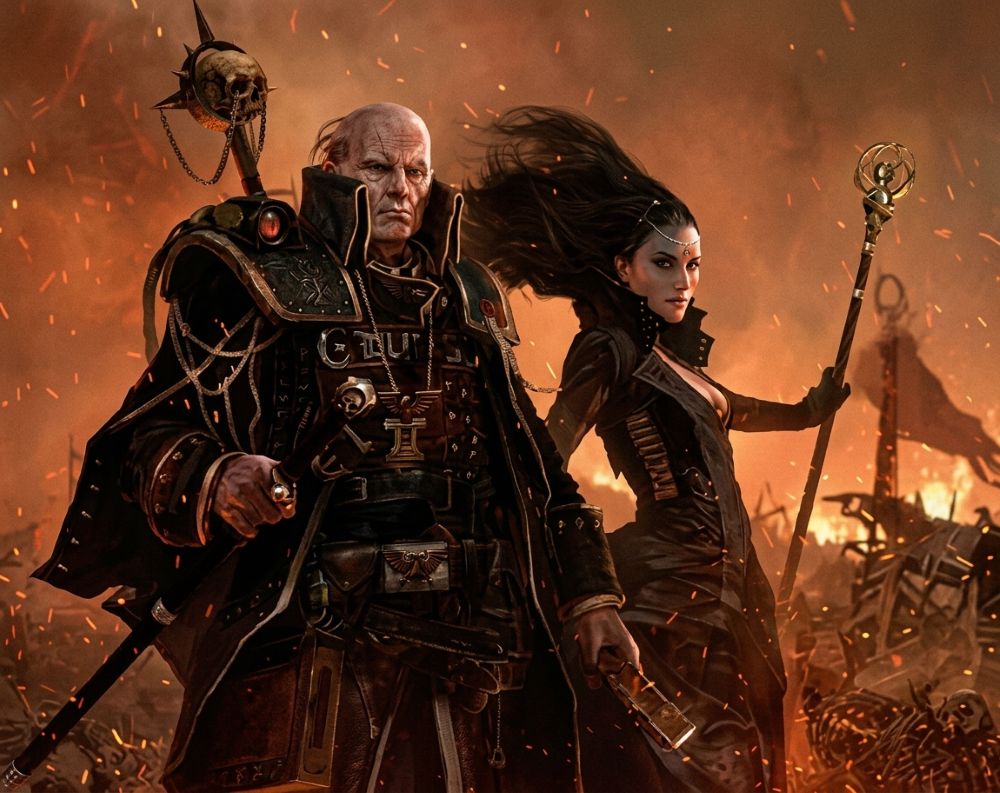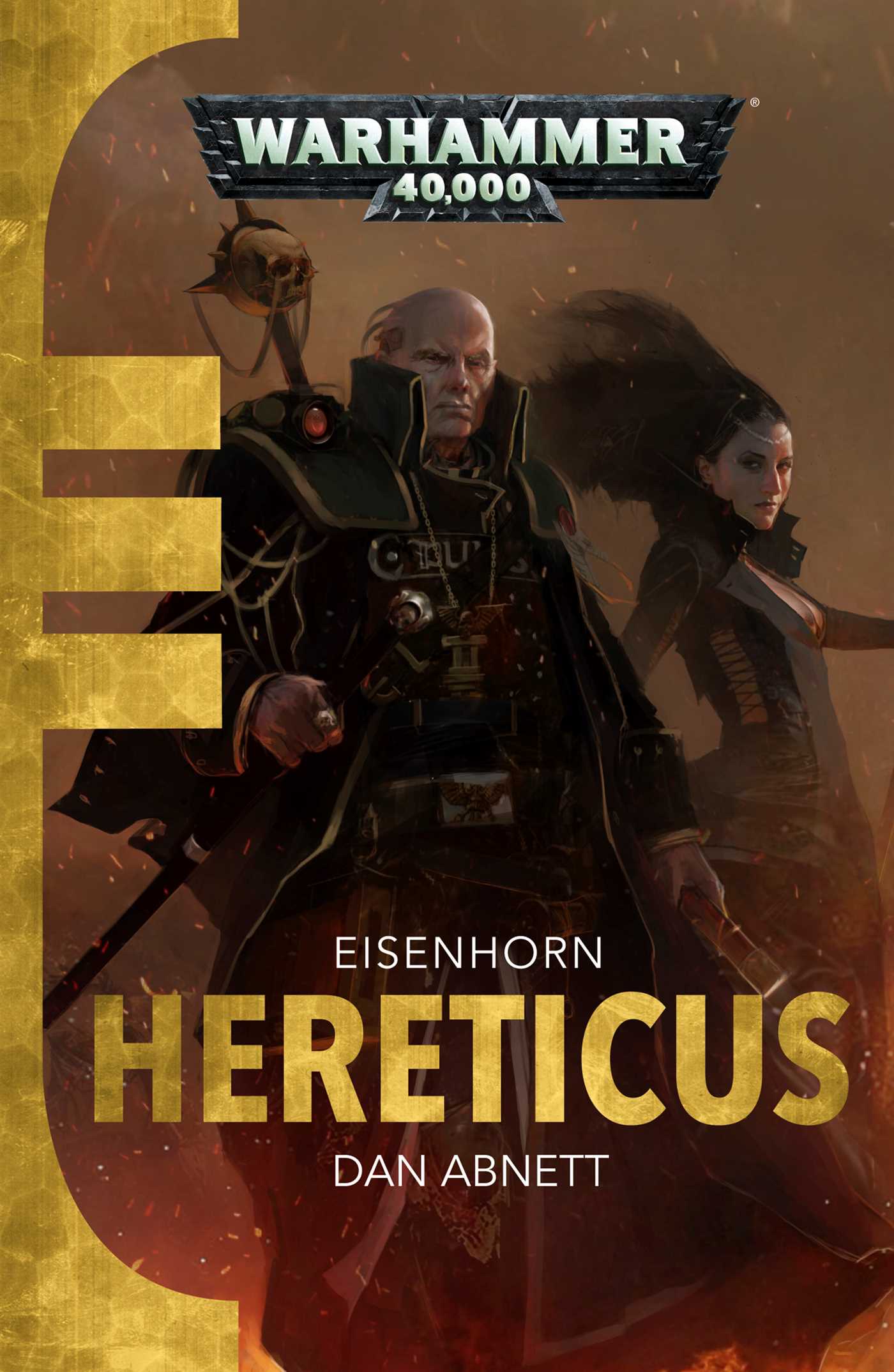
Hereticus: Eisenhorn (by Dan Abnett) Review


“Trust me, Eisenhorn, if I ever thought you were, I’d shoot you myself.” — Godwyn Fischig

Hereticus is a strong, satisfying, and frequently brutal conclusion to Dan Abnett’s Eisenhorn trilogy, turning the moral compromises that have been building since Xenos and Malleus into consequences that Gregor Eisenhorn can no longer evade. It is part detective story, part occult-horror thriller, part tragic character study, and it shows why the Eisenhorn books remain such a good way to begin one’s journey into the massive fictional universe that is Warhammer 40,000.

Following the more investigative structure of Xenos and the increasingly supernatural, morally uncomfortable territory of Malleus, Hereticus feels like the point where every bad decision, personal loss, old rivalry, and forbidden shortcut finally comes due. The novel does not merely ask whether Eisenhorn can stop a dangerous conspiracy. It asks whether he has already become the kind of man he once set out to hunt. That is the real engine behind the book, and Abnett handles it with the right mixture of action, melancholy, and grim inevitability.

As discussed in my review of Xenos, the first Eisenhorn novel worked so well because it introduced Warhammer 40,000 through a mystery rather than simply tossing readers into a battlefield full of Space Marines, bolters, skulls, and incomprehensible proper nouns. It let the setting reveal itself through an Inquisitor’s work: secret cults, criminal underworlds, alien dangers, Imperial bureaucracy, psychic threats, and the everyday oppression of life under the Imperium. Malleus expanded that formula into darker territory, showing Eisenhorn’s growing willingness to consider Radical methods and the dangerous temptation of using Chaos-tainted tools against Chaos itself. Hereticus brings that arc to its most painful and compelling form. The question is no longer whether Eisenhorn might someday cross a line. He has crossed several, and now the Inquisition is beginning to notice.

That setup gives the novel an unusually personal stake from the beginning. Eisenhorn has always been a complicated protagonist, but earlier books allowed him enough authority, competence, and narrative control that readers could often accept his arguments for taking extreme measures. He was an Inquisitor confronting threats most ordinary people could not understand, much less defeat. In a galaxy where daemons can possess human beings, forbidden books can destroy souls, and alien relics can doom entire worlds, it is not hard to understand why someone might conclude that conventional rules are inadequate. Hereticus does not pretend that Eisenhorn’s choices were foolish or made without cause. In fact, one of Abnett’s great strengths is making those choices feel disturbingly rational.

The trouble is that rationality can be a dangerous thing in Warhammer 40,000. Chaos does not always arrive as a screaming monster bursting through a warp gate. Sometimes it arrives as an argument: this one terrible act will save thousands of lives; this forbidden weapon can be controlled; this sacrifice is necessary; this rule is too rigid for the reality of the situation. Eisenhorn has spent years convincing himself that he is strong enough, disciplined enough, and committed enough to use dangerous methods without being consumed by them. Hereticus forces him to confront the possibility that good intentions do not erase consequences, especially in a setting where corruption is not just a moral metaphor but a literal, predatory force.

The title itself carries a lot of weight. In the wider Warhammer 40,000 setting, “Hereticus” evokes the Inquisition’s struggle against internal human heresy, and the book makes that idea painfully relevant to Eisenhorn. He is not dealing only with an external enemy, an alien menace, or a distant daemonic conspiracy. He is being judged by the institution he has served for most of his life. The Inquisition’s authority has always been one of the most fascinating parts of the Eisenhorn series. It is an organization empowered to investigate almost anyone, demand resources from almost any Imperial authority, and commit horrifying acts in the name of humanity’s survival. But even an Inquisitor has limits, at least in theory. Eisenhorn has spent much of the trilogy acting as judge, jury, and executioner. In Hereticus, he begins to understand what it feels like to be on the other side of that power.
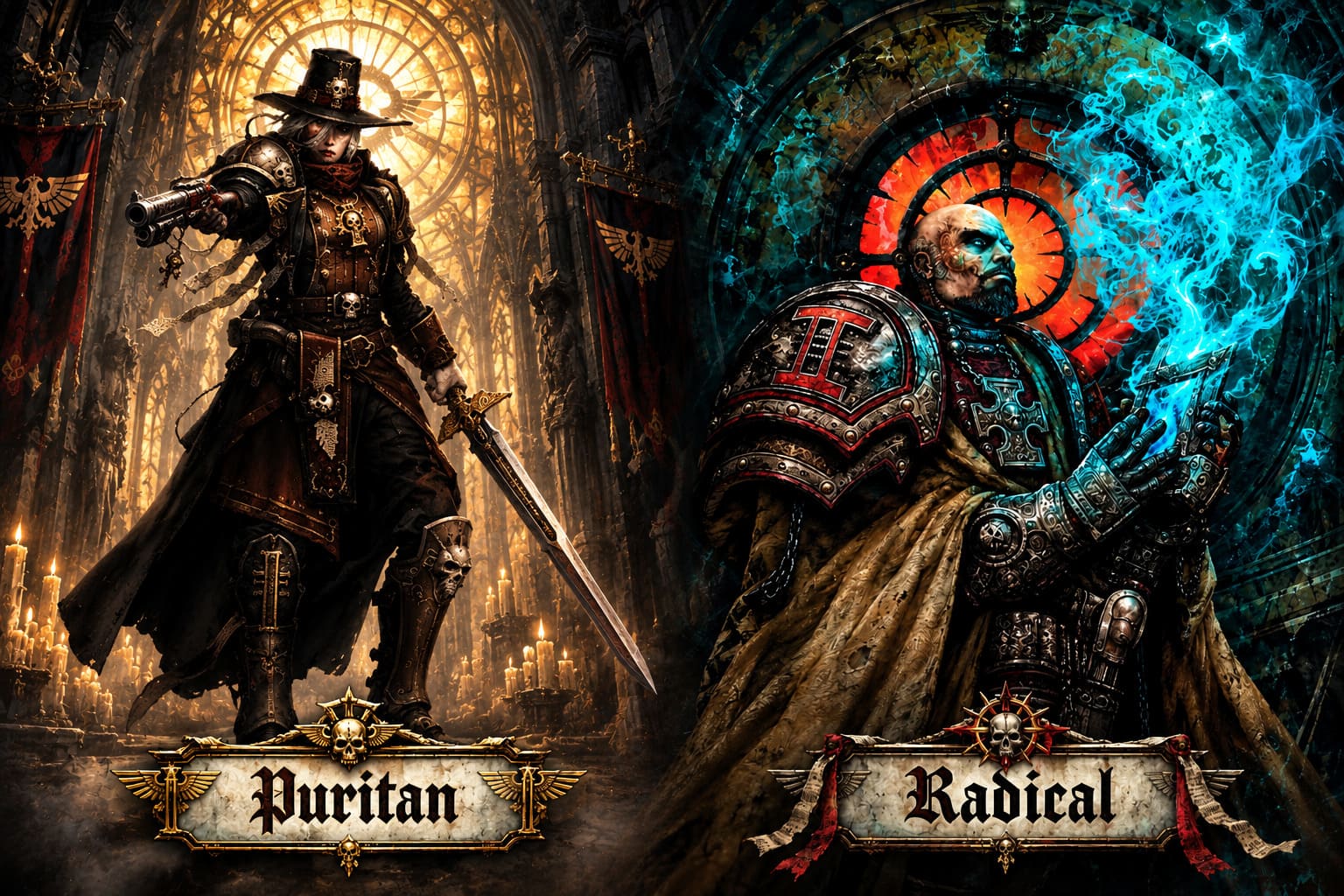
That reversal adds real tension to the story. Eisenhorn is still intelligent, resourceful, and capable of operating several moves ahead of many opponents, but he is no longer the untouchable figure who can simply arrive, announce his authority, and take control of a situation. He has enemies within the Inquisition, people who have watched his methods with growing alarm and who have every reason to believe that his use of forbidden powers is proof of Radical corruption. The Puritan-Radical conflict that was such an important undercurrent in Malleus now becomes intensely personal. Eisenhorn may still see himself as a loyal servant of humanity, but others see a man who has bound a daemonhost, embraced outlawed knowledge, and repeatedly decided that his own judgment matters more than Imperial doctrine.

The uncomfortable part is that the Puritans are not entirely wrong. This is what makes Hereticus more interesting than a simplistic “rigid establishment persecutes heroic rebel” story. Eisenhorn’s enemies can be self-righteous, politically motivated, and inflexible, but their fear of him is not baseless. He has genuinely moved beyond the boundaries that most Inquisitors would consider acceptable. He may not worship Chaos, seek personal power for its own sake, or want to destroy the Imperium, yet he has still convinced himself that he can master things that destroy other people. Abnett understands that this is how moral collapse often works: not through a single grand betrayal, but through an accumulation of exceptions.

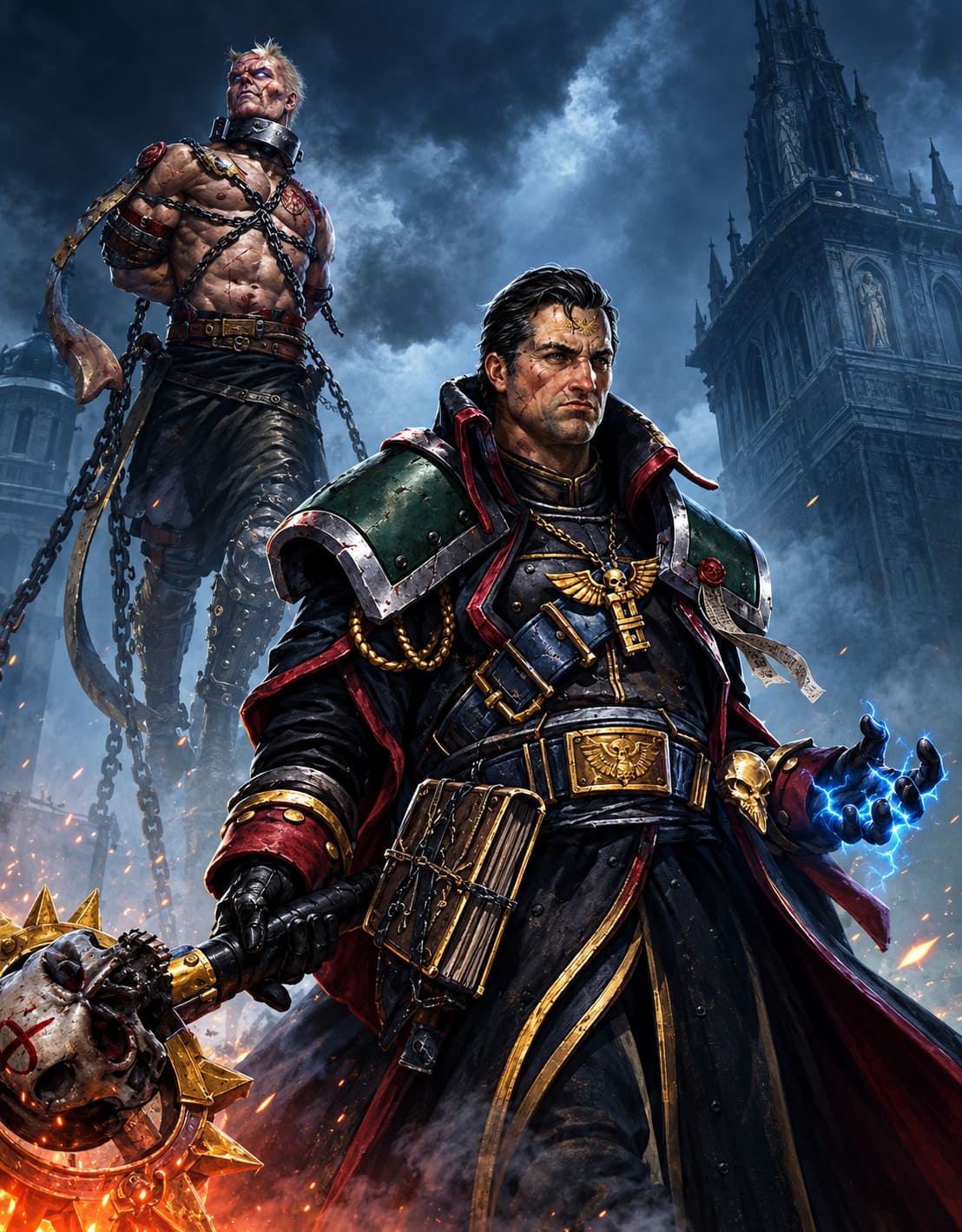
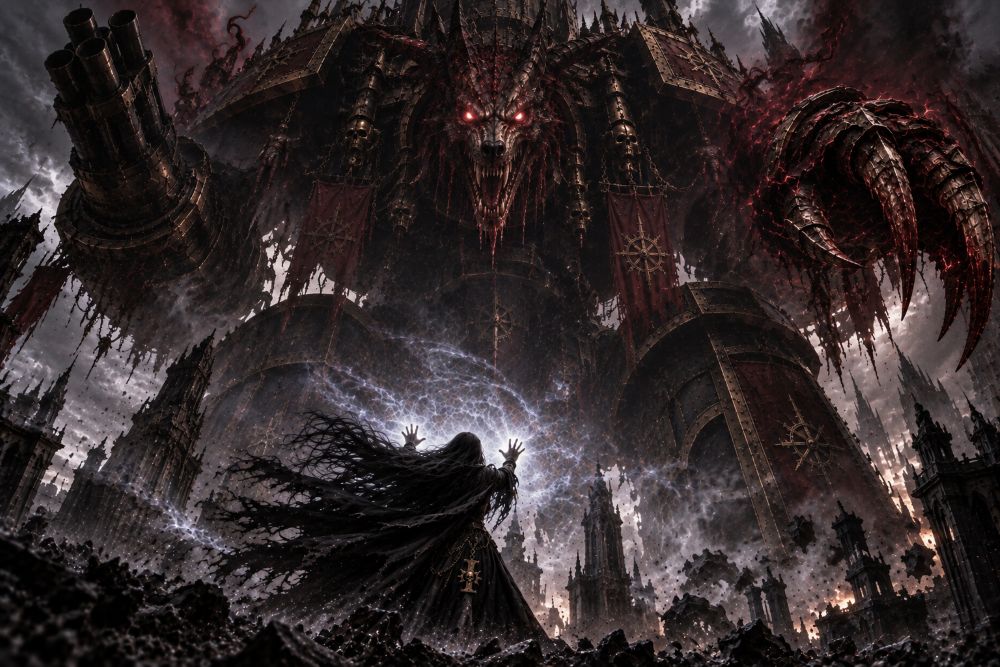
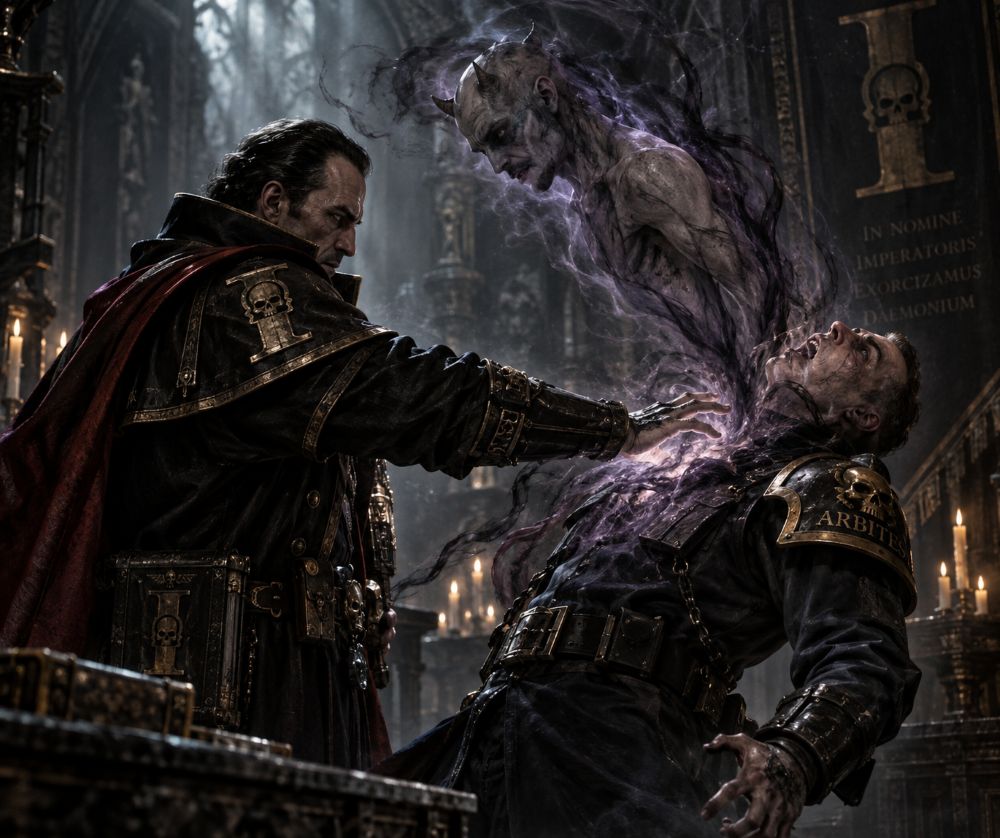
Cherubael remains central to that idea. The daemonhost is one of the most memorable creations in the trilogy because he embodies the exact temptation Eisenhorn cannot fully reject. Cherubael is monstrous, dangerous, manipulative, and fundamentally opposed to everything the Imperium claims to defend. Yet he is also useful. He possesses knowledge and power that conventional Imperial resources simply cannot match. Every time Eisenhorn turns to him, the decision can be explained. Sometimes it may even be the only practical way to survive. But that usefulness is exactly the trap. The more valuable Cherubael becomes, the more Eisenhorn has to tell himself that he remains in control.

Abnett wisely avoids making this dynamic feel repetitive. Cherubael is not just a magical superweapon that appears whenever the plot needs a burst of daemonic violence. His presence changes the moral temperature of every scene around him. He is a reminder that Eisenhorn has become willing to use what he once would have condemned without hesitation. Even if Eisenhorn’s goals remain noble, the means he employs have become harder and harder to separate from the evil he fights. In a less effective novel, this might come across as obvious or heavy-handed. Here, it works because Abnett has spent two previous books earning the reader’s investment in Eisenhorn’s perspective. Readers understand why he thinks he needs Cherubael. That makes it much more troubling when he reaches for him again.

The novel also benefits from the emotional history Abnett has built around Eisenhorn’s inner circle. Aemos, Bequin, and the other figures who have survived Eisenhorn’s investigations are not merely backup characters brought in for action scenes or exposition. They represent the human cost of Eisenhorn’s life and work. He may be one of the most powerful individuals in the Imperium, but power has not spared him loneliness, grief, or guilt. If anything, it has magnified them. His authority means that people depend on him, follow him into danger, and sometimes die because of choices he makes from behind the badge of the Inquisition.

Bequin remains particularly important because she has always complicated Eisenhorn’s tendency to turn everything into duty, strategy, and necessity. Her relationship with him is not treated like an easy romantic subplot, and that is one of the trilogy’s better decisions. In the grim, paranoid, endlessly violent setting of Warhammer 40,000, affection cannot simply be separated from danger. Eisenhorn’s work stains everything around him. He cannot protect people without exposing them to threats, and he cannot build a normal life because his role requires secrecy, ruthlessness, and a constant readiness to sacrifice personal happiness for the mission. Hereticus understands that this is not just unfortunate background material. It is part of the tragedy of who Eisenhorn has become.
The plot itself is suitably large in scale, but Abnett keeps it grounded in the characters rather than losing the story in lore. There are conspiracies, dark rituals, dangerous enemies, political maneuvering, high-stakes action, and more of the strange Gothic science-fiction imagery that defines the setting. The Imperium remains a fascinatingly ugly backdrop: a galaxy-spanning empire built on religious fanaticism, vast bureaucracy, fear, poverty, military force, and a permanent sense that disaster is always one hidden cult away. Yet Abnett’s real gift is making this enormous universe feel inhabited. The places Eisenhorn visits have social structures, histories, class divisions, institutions, and ordinary people trying to survive in a civilization so large that most of its citizens will never understand the horrors being fought in secret above their heads.

That perspective continues to make the Eisenhorn trilogy unusually accessible. A newcomer does not need to have memorized every Space Marine Chapter, every alien faction, or every detail of the Horus Heresy to enjoy Hereticus. The novel assumes that the reader can follow a story rather than requiring them to pass a lore exam. Terms and concepts appear naturally through the characters’ experiences, and the emotional stakes remain clear even when the setting becomes strange. That is why the series is still one of the best entry points into Warhammer 40,000. It offers the darkness, religion, cosmic horror, military violence, and massive scale that fans expect from the franchise, but it filters all of it through a compelling human story.

If Xenos introduced Eisenhorn as a determined investigator and Malleus showed him becoming increasingly willing to compromise, Hereticus is the book that asks the unavoidable question: what does all of that make him? The answer is not neat. Eisenhorn is not secretly a villain in the simplistic sense, nor is he a spotless hero unfairly accused by lesser men. He is a capable, brave, damaged, and increasingly isolated man who has spent so long fighting monsters that he has begun to accept monstrous tools. That does not erase his courage or his desire to save lives. It simply means that the line between salvation and damnation has become far more difficult to see.

Abnett’s prose remains a major asset throughout. He writes action with momentum and clarity, but he is at his best when building dread. A tense conversation, an accusation from a former ally, the discovery of forbidden evidence, or the appearance of something that should not exist can be more unsettling than the book’s gunfights and confrontations. The Gothic quality of Warhammer 40,000 is present, but Abnett does not bury the story under purple prose. His writing is vivid without becoming exhausting, and that readability is a big reason these books have endured beyond the audience that initially came to them from the tabletop game.

There are moments when Hereticus feels crowded, especially because it has to bring together plot threads, characters, rivalries, and consequences from across the trilogy. Readers who prefer the tighter, pure mystery structure of Xenos may find this finale more sprawling. But that messiness also feels appropriate. Eisenhorn’s world has grown too complicated for a clean solution. His enemies are no longer isolated cultists or external threats that can be purged and forgotten. They are connected to his past, his choices, his friends, and his own self-image. The story has to feel larger and more tangled because Eisenhorn himself has created a life that cannot be easily sorted into right and wrong.

Ultimately, Hereticus is a powerful conclusion because it does not treat moral ambiguity as an empty excuse for darkness. It makes Eisenhorn’s compromises matter. It makes his losses hurt. It recognizes that in a universe as cruel as Warhammer 40,000, purity can become fatal rigidity, but pragmatism can become corruption just as easily. The novel’s real achievement is that it lets readers sympathize with Eisenhorn even while making them increasingly nervous about the person he is becoming.

For longtime fans, Hereticus delivers the kind of grim Inquisitorial intrigue, occult horror, action, and Imperial paranoia that the setting does exceptionally well. For newer readers, it confirms why the Eisenhorn trilogy is such a smart place to start. Beginning with Xenos, continuing through Malleus, and ending with Hereticus, the series offers a full and approachable tour through the vast fictional universe of Warhammer 40,000 without ever losing sight of its central character. Hereticus is not just an entertaining finale. It is the book that turns Gregor Eisenhorn’s story into a genuine tragedy—and makes the reader wonder whether the man trying to protect humanity has become one more thing humanity needs protection from.

Eisenhorn Saga
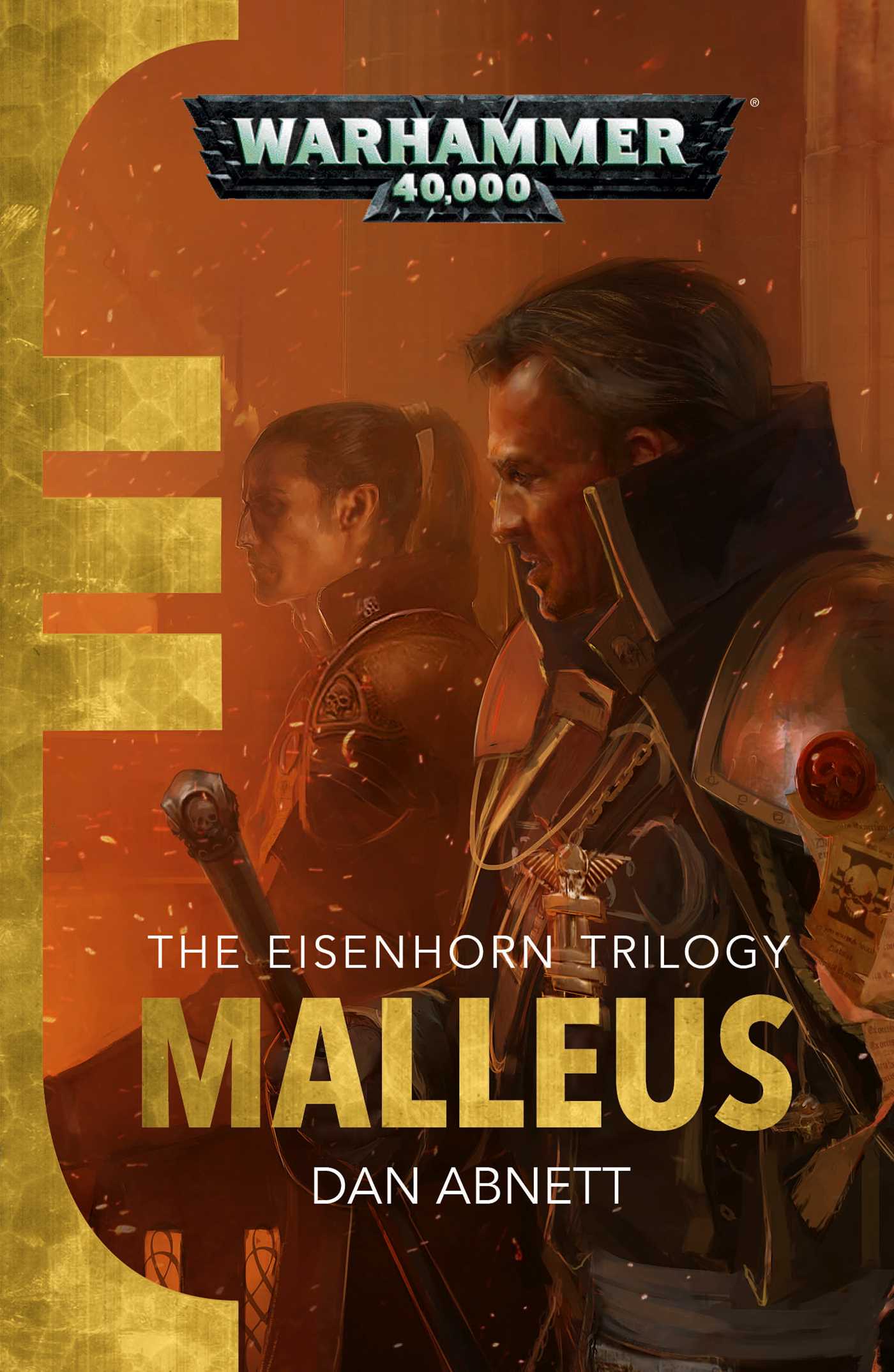
Malleus: Eisenhorn (by Dan Abnett) Review


“You have to understand the rules in the first place if you’re going to break them.” — Gregor Eisenhorn

Malleus is where Dan Abnett makes it clear that the Eisenhorn saga is not simply a highly entertaining Warhammer 40,000 detective series. It is the installment where the story grows darker, more unsettling, and considerably more interested in the price of fighting evil within a civilization that has already sacrificed much of its own humanity. Following the groundwork laid by XenosMalleus expands the scope of Inquisitor Gregor Eisenhorn’s world while also making its central figure far more morally complicated. The mystery is larger, the action is more openly supernatural, and the danger of Chaos feels much closer than before. More importantly, the novel begins forcing Eisenhorn to question whether the principles that have guided him are enough to survive the threats he faces.

As discussed in my review of Xenos, that earlier novel was such an effective introduction to the colossal setting of Warhammer 40,000 because it treated the universe as a place to be explored rather than a wall of lore to be memorized. It gave readers the perspective of an investigator moving through the Imperium’s strange social structures, criminal underworlds, religious institutions, and alien dangers. Malleus works especially well as the next step because it retains that accessibility while taking readers deeper into the setting’s darkest spiritual and ideological corners. Readers should still begin with Xenos, but the Eisenhorn trilogy as a whole remains one of the best ways to begin one’s journey into the massive fictional universe that is Warhammer 40,000. It proves that the franchise can support horror, crime fiction, political paranoia, occult mystery, and character tragedy just as effectively as battlefield spectacle.

Set years after the events of XenosMalleus finds Eisenhorn carrying the emotional and professional consequences of everything that came before. He is no longer simply the sharp, controlled, and confident Imperial investigator introduced in the first book. Time, loss, and years spent confronting horrors hidden beneath the Imperium’s rigid public order have taken their toll. Eisenhorn still believes in his duty and still possesses a strong sense of justice, but there is a growing exhaustion beneath his certainty. He has learned that the Imperium is too vast, corrupt, and fragile for justice to function in any clean or uncomplicated way. He has also learned that many enemies cannot be defeated by conventional means.

The plot begins with the kind of investigative intrigue that made Xenos so compelling, but Abnett quickly pushes the story into more dangerous territory. Eisenhorn is drawn into a conspiracy involving forbidden knowledge, hidden cult activity, old enemies, and threats that reach beyond the physical world. The story increasingly brushes against the realm of Chaos, a force that is far more insidious than a conventional military enemy. Chaos does not merely conquer territory or kill its opponents. It spreads through ambition, fear, resentment, desperation, and the belief that ordinary moral limits are unacceptable luxuries in a desperate situation. In Malleus, the greatest danger is not always a monster in a dark room or a cultist behind a mask. It is the argument that monstrous methods may be justified if they produce a necessary result.

That theme becomes even more powerful with the arrival of Cherubael, the daemonhost who becomes one of the defining and most disturbing presences in the Eisenhorn saga. Cherubael is not just an evil creature for Eisenhorn to defeat. He is a living contradiction: a being of Chaos bound into human form, capable of providing knowledge and power that could prove decisive against far greater threats. His existence immediately creates the kind of moral problem that no Inquisitor can dismiss lightly. Cherubael is useful, but he is also inherently corrupting. He is a weapon that cannot be separated from the horror of what it is.

Abnett makes Cherubael memorable because he is not written as a mindless, roaring monster. He is intelligent, articulate, mocking, and disarmingly calm. He understands human weakness and knows how to make temptation sound like logic. That quality gives him a more unnerving presence than a simple daemonic antagonist. Cherubael does not need to persuade Eisenhorn to worship Chaos. He only needs to make him consider whether he can control a dangerous resource, whether he can use forbidden power for a righteous purpose, and whether the alternative might cost even more innocent lives. In a universe where Chaos often appears through mutation, madness, ritual sacrifice, and overt possession, Cherubael represents a subtler kind of corruption: the conviction that evil can remain safely contained in the hands of a sufficiently strong and intelligent person.

Eisenhorn’s relationship with Cherubael is therefore one of the novel’s most important developments. Eisenhorn is not a reckless thrill-seeker, and he does not turn toward Radical methods because he wants power for its own sake. He understands the danger more clearly than most people could. Yet his years of experience have taught him that strict adherence to approved Imperial methods can fail when confronted with enemies who respect no rules, no laws, and no limits. The daemonhost becomes a test of whether Eisenhorn’s conviction remains rooted in principle or begins to bend around necessity. Every time he sees value in Cherubael’s power, he edges closer to a line that he once would have regarded as absolute.

That growing tension ties directly into the ideological divisions within the Inquisition. One of Malleus’ strongest qualities is that it refuses to depict the Inquisition as a single, unified force. From a distance, the Inquisition appears almost limitless in its authority. Its agents can command armies, seize resources, investigate powerful institutions, prosecute heretics, and condemn worlds in the name of humanity’s survival. But Abnett makes clear that the organization is full of competing doctrines, personal rivalries, jurisdictional disputes, and mutual suspicion. Inquisitors may share a broad mission, yet they can disagree completely on how that mission should be carried out.

The Puritan and Radical divide is especially important. Puritans believe that the Imperium must fight heresy, alien threats, and Chaos without using the weapons, knowledge, or powers of those enemies. Their position can be severe, even inflexible, but it comes from a real understanding of how corruption works in the Warhammer 40,000 universe. Chaos does not need a person to consciously embrace it in order to gain influence. A single compromise, a forbidden artifact, a dangerous ritual, or an attempt to master what should never be mastered can open the door to disaster. To a Puritan, a daemonhost such as Cherubael is not an asset. It is proof that someone has already crossed a line from which there may be no return.

Radicals take a more pragmatic and far more dangerous view. They believe that the Inquisition cannot adequately fight the galaxy’s darkest forces without studying, exploiting, or weaponizing the tools those forces use. In the abstract, there is a grim logic to that approach. If Chaos is a threat unlike any ordinary military opponent, then understanding its workings may be essential to resisting it. The trouble is that the line between studying Chaos and serving it can disappear with frightening speed. A Radical may begin by using a forbidden artifact to stop a greater evil, then justify a more serious compromise during the next emergency, and eventually become unable to see the difference between tactical necessity and personal obsession.

Eisenhorn sits uncomfortably between these positions in Malleus. He remains deeply suspicious of Chaos and possesses many instincts that could be described as Puritan. He does not romanticize the enemy or dismiss the danger of corruption. At the same time, the circumstances he faces begin pressing him toward Radical choices. Cherubael is the clearest symbol of that shift. The daemonhost embodies the seductive claim that terrible power can be harnessed responsibly if the person using it has the right intentions. Eisenhorn’s willingness to consider that possibility does not make him a straightforward villain, which is exactly why the situation works so well. His choices have reasons behind them. His decisions are understandable. They may even save lives. But the novel never lets the reader forget that understandable choices can still have horrifying consequences.

The schism between Puritans and Radicals also shows how the Inquisition’s internal divisions can hinder the work of the Ordos as much as the threats they are supposed to combat. The Inquisition exists to confront dangers that ordinary Imperial institutions cannot handle, but its members can become trapped in battles over authority, doctrine, and ideological purity. Inquisitors may distrust one another, conceal evidence, challenge a colleague’s methods, or focus so intensely on proving another agent compromised that they lose sight of the immediate threat. That infighting is especially dangerous in a universe where enemies such as Chaos actively benefit from paranoia, secrecy, pride, and division.

A Puritan can be so certain that Radical methods lead only to damnation that they fail to recognize an urgent threat until it is too late. A Radical can become so convinced that they alone are capable of responsibly wielding forbidden tools that they stop seeing their own corruption. Both sides believe they are defending humanity. Both can be right about the dangers posed by the other. And both can make the Imperium more vulnerable in the process. Abnett uses this conflict to give the setting real political and philosophical texture. The Inquisition is not merely an all-powerful secret police force with dramatic titles and unlimited permission to destroy things. It is an unstable, deeply human institution whose members are themselves vulnerable to dogma, ego, grief, obsession, and fear.

The supporting cast helps keep Malleus from becoming too relentlessly bleak. Aemos remains a valuable presence because his learning, loyalty, and history with Eisenhorn give the novel an emotional foundation. Alizabeth Bequin continues to be one of the more interesting figures in the series, not simply because of her unusual nature but because she complicates Eisenhorn’s tendency to view people through the practical lens of an investigation. Eisenhorn’s associates are not faceless retainers or disposable mission assets. They are people who have endured extraordinary dangers together, and their bonds create moments of warmth and loyalty amid the book’s Gothic horror.

Abnett also continues to excel at making the Imperium feel inhabited. The setting is famous for colossal wars, massive armies, and apocalyptic imagery, but the Eisenhorn books often work best when they explore the spaces beneath that scale. Malleus moves through worlds and institutions shaped by wealth, bureaucracy, religious repression, criminality, and desperation. It shows how ordinary citizens can live their entire lives under the shadow of enormous Imperial power without fully understanding the supernatural horrors being fought on their behalf. That ground-level perspective makes the setting’s oppressive atmosphere more convincing. The galaxy is not merely dangerous because wars are constantly happening somewhere. It is dangerous because its social systems create secrecy, inequality, fear, and countless opportunities for hidden corruption to grow.

The novel is somewhat more sprawling than Xenos. It includes a larger web of characters, conspiracies, locations, and occult ideas, which can make it feel less neatly constructed than the first book’s detective narrative. However, that expanding complexity suits the story. Eisenhorn is no longer dealing with a case that can be solved by following clues toward a single clear answer. He is moving through an environment where the truth is fragmented, alliances are unstable, and each revelation raises more questions. The disorder is part of the point. Chaos should not feel comfortably organized, and Eisenhorn’s own moral certainty becomes increasingly disordered as the novel progresses.

Abnett’s prose remains one of the great strengths of the book. He can write action with clarity and force, whether the scene involves gunfights, physical confrontations, psychic peril, or full-blown daemonic horror. Just as importantly, he knows how to make a quiet conversation threatening. Some of Malleus’ best material comes from interrogations, tense exchanges between allies, confrontations with ideological opponents, and moments where a character realizes that the person they trusted may not be what they seemed. The novel’s greatest weapon is not sheer violence, but suspense. Readers can often feel that something is wrong long before Eisenhorn fully understands what it is.

Ultimately, Malleus is an excellent middle chapter because it transforms Eisenhorn’s story from a clever Inquisitorial investigation into a more troubling moral tragedy. It raises the stakes without abandoning the human perspective that made Xenos work so well. Cherubael’s arrival gives the novel a powerful symbol of temptation and compromise, while the Puritan-Radical divide reveals that the Inquisition’s most dangerous enemies are not always found outside its walls. Eisenhorn still wants to protect humanity, and he remains brave, resourceful, and fundamentally committed to his cause. But Malleus makes an increasingly uncomfortable point: a person can begin with noble intentions and still become dangerous by deciding that only they are qualified to choose which rules no longer apply.

That is what gives the novel its lingering power. Malleus is entertaining as a mystery, action story, horror novel, and tour through the stranger side of Warhammer 40,000. But it is most compelling as a story about the cost of necessity. Eisenhorn’s enemies are terrifying, yet Abnett understands that the more frightening question is what Eisenhorn will become in order to defeat them.

Eisenhorn Saga

Xenos: Eisenhorn (by Dan Abnett) Review


“I’m excusing a lot because I recognize the trauma and the loss you have suffered. But my patience isn’t limitless… unlike my authority.” — Inquisitor Gregor Eisenhorn

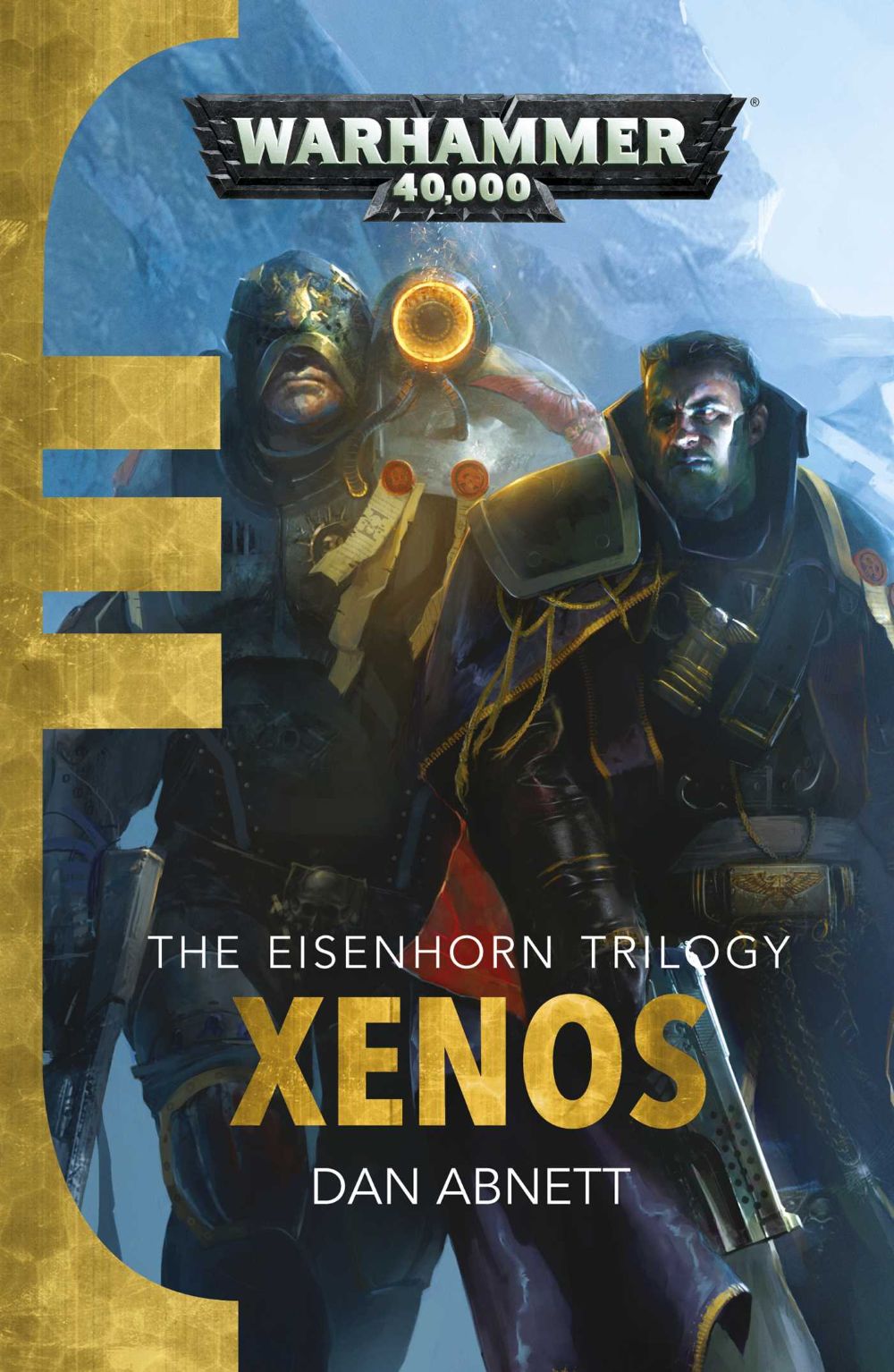
Xenos by Dan Abnett is one of the best places to begin a journey into the immense, intimidating fictional universe of Warhammer 40,000. The setting has decades of lore, countless factions, and a reputation for throwing newcomers into a blizzard of Gothic names, alien species, religious doctrine, and galaxy-wide war. Abnett gets around that problem by starting on a smaller, more personal scale. Rather than opening with armies of Space Marines firing bolters into a battlefield, Xenos follows an investigation. It is a mystery novel first, but one wrapped in political intrigue, supernatural horror, science-fiction adventure, and the oppressive atmosphere that makes Warhammer 40,000 unique.

The novel follows Gregor Eisenhorn, an Imperial Inquisitor investigating the suspicious death of another Inquisitor and the possible return of an infamous forbidden text. What initially appears to be a contained case grows steadily more complicated, carrying Eisenhorn from the polished halls of the powerful to the dangerous, hidden corners of the Imperium. Along the way, he encounters criminal networks, secretive cults, alien interests, old enemies, and clues suggesting that the threat he is following is far larger than it first appears. That is about as much as the plot should be revealed going in. One of Xenos’ greatest pleasures is seeing an investigation expand in unexpected directions as Eisenhorn realizes that every answer seems to reveal another, more disturbing question.

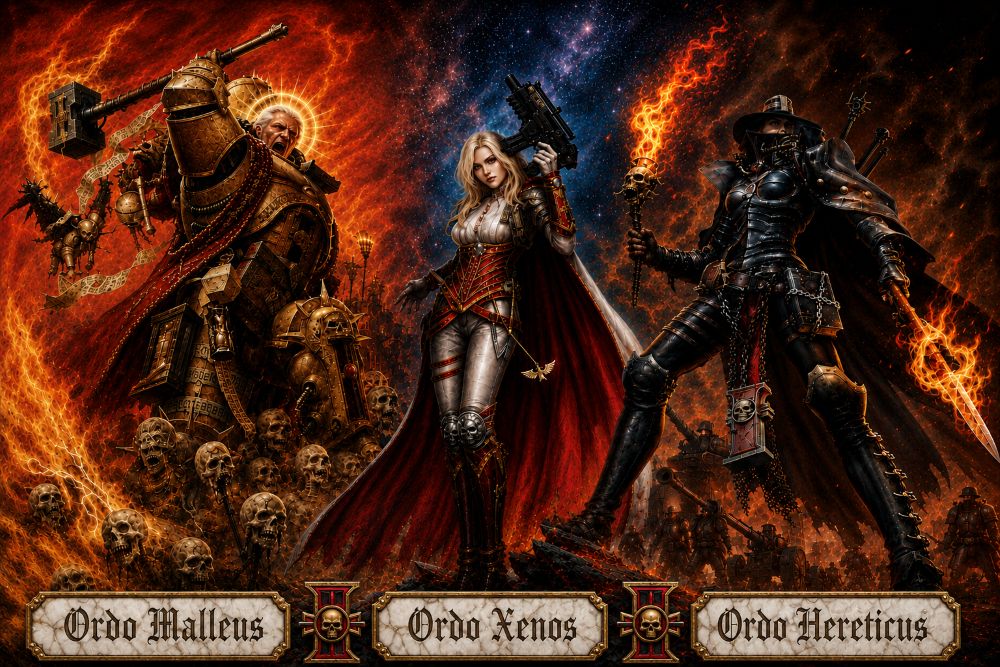
For newcomers, Eisenhorn is a perfect guide through the setting because his job gives him access to virtually every level of Imperial society. The Inquisition is the Imperium’s feared internal-security and investigative force, responsible for hunting down threats such as heresy, Chaos corruption, rogue psykers, dangerous mutants, and alien infiltration. Its three major branches are the Ordo Xenos, which deals with alien threats; the Ordo Malleus, which combats daemonic and major Chaos threats; and the Ordo Hereticus, which investigates internal heresy and corruption within humanity. Eisenhorn belongs to the Ordo Xenos, although Xenos quickly makes it clear that the lines between those responsibilities can become blurry when an investigation leads into forbidden knowledge and the influence of Chaos.

Inquisitors operate with enormous authority inside the sprawling hierarchy of the Imperium’s bureaucracy. They can demand cooperation from military officers, nobles, bureaucrats, religious leaders, and law-enforcement agencies alike, often placing them effectively above the normal chain of command. That vast authority makes them necessary in an empire as corrupt, unwieldy, and permanently threatened as the Imperium, but it also makes them frightening. Eisenhorn can investigate almost anyone, order arrests and executions, seize resources, and disregard ordinary procedure if he believes the situation demands it. The novel’s central moral tension comes from that power: what happens when someone entrusted with protecting humanity has the freedom to do almost anything in its name?

That question gives Xenos considerably more weight than a straightforward sci-fi detective story. Eisenhorn is not a traditional hero, though he is clearly written as the protagonist and often comes across as intelligent, disciplined, and committed to his work. He believes in the Imperium, believes in his duty, and believes that evil has to be confronted before it spreads. At the same time, he works inside a system where fear and brutality are normal tools of governance. An Inquisitor cannot afford to be naïve, especially when dealing with Chaos, cults, and conspiracies built around forbidden knowledge. But Abnett constantly pushes Eisenhorn toward uncomfortable choices, forcing him to decide how much compromise is acceptable when the enemy is capable of manipulating minds, corrupting souls, and destroying worlds.

That is one of the major reasons the book works so well. Warhammer 40,000 can sometimes feel like a setting built from giant concepts: eternal war, fanatical religion, ancient aliens, grim military hardware, and cosmic evil. Xenos does not ignore any of those things, but it makes them matter on a human level. The Imperium is not merely described as a brutal galaxy-spanning empire; Abnett shows how it functions through its people and institutions. There are noble houses, archives, cults, scholars, law officers, ship crews, bureaucrats, mercenaries, and citizens who have learned to survive under a regime where suspicion can be fatal. The book makes the Imperium feel less like a background painting and more like a living, oppressive civilization.

Abnett’s greatest strength is his ability to reveal the setting without drowning the reader in exposition. There are plenty of unfamiliar terms in Xenos, especially for readers coming in cold, but the novel rarely stops to hand over a rulebook-style explanation. You learn about the Warp because it is dangerous and uncanny whenever it enters the story. You understand Chaos because its influence produces paranoia, violence, and spiritual corruption. The Eldar are introduced not as a long historical lecture but as secretive, ancient, unsettlingly intelligent outsiders with motives that human characters cannot fully grasp. That approach preserves the sense that this universe is far bigger than Eisenhorn’s current case, while still making the plot easy to follow.

The pacing is helped by the fact that Abnett never lets the story remain in one mode for too long. Xenos begins with the mood of an investigative thriller, but it gradually expands into something stranger and more dangerous. The novel moves through crime scenes, aristocratic gatherings, interrogation rooms, alien ruins, dangerous underworld spaces, and moments of full-scale action. That variety keeps the book from becoming too bleak or static. The setting is absolutely grim, and the violence can be nasty, but there is also a strong sense of momentum and adventure. Abnett knows that the horror of the 41st Millennium is more effective when the reader is also excited to see what strange corner of it comes next.

His prose is another major advantage. Abnett writes in a style that is clean and readable without losing the ornate, Gothic flavor of the setting. He can handle action well, especially when Eisenhorn and his team are forced into sudden violence, but he is arguably even better with atmosphere. Some of the novel’s most memorable scenes involve conversations where nobody says exactly what they mean, tense interrogations, the discovery of forbidden evidence, or the lingering sense that an apparently routine lead has opened a door that should have remained closed. He gives Xenos the feel of a noir investigation filtered through a nightmare version of space opera.

Eisenhorn’s supporting cast helps keep the novel grounded. Aemos, his loyal savant, brings experience and knowledge to the team, while the warrior Midas Betancore adds a practical edge to their fieldwork. Alizabeth Bequin, whose unusual nature is tied to some of the setting’s stranger ideas, becomes one of the more intriguing figures around Eisenhorn. Each character has a defined role, but they are not simply pieces of equipment for the Inquisitor to deploy. Their reactions to danger, secrecy, and Eisenhorn himself make it clear that he may possess enormous legal authority, but he still depends on people he cannot completely control.

The relationship between Eisenhorn and Bequin is especially effective because Abnett does not force it into an overly simple romance. In a lighter setting, their dynamic might become predictable, but Warhammer 40,000 is not a world where emotional connection comes without consequences. Their growing trust is complicated by secrets, duty, personal history, and the fact that Eisenhorn’s work places everyone around him in danger. The novel is stronger for that restraint. It understands that Eisenhorn’s position makes ordinary human relationships difficult, and that the pressure of the Inquisition can turn even loyalty into something painful.

If there is a weakness in Xenos, it is that the middle section can occasionally feel rushed. Abnett covers a lot of territory, introduces several important concepts, and puts Eisenhorn in contact with a broad cast of characters. Some supporting figures and locations are memorable but could have used a little more time to develop. The book also has the feeling of a first installment in a larger story, particularly as Eisenhorn’s moral compromises begin to take shape. Still, that is not a serious flaw. The novel provides a satisfying central investigation while clearly establishing bigger questions that continue through Malleus and Hereticus.

What ultimately makes Xenos such a successful novel is that it understands the appeal of Warhammer 40,000 without relying entirely on surface-level spectacle. The setting has no shortage of memorable imagery: skull-covered cathedrals, psychic powers, ancient alien technology, daemon-haunted worlds, and armies fighting endless wars across the stars. But Abnett gives all of that a purpose by focusing on a man trying to hold onto his principles in a universe that rewards ruthlessness. Eisenhorn is not merely fighting cultists, aliens, and supernatural conspiracies. He is fighting the possibility that protecting humanity may require him to become something he once would have condemned.

For longtime fans, Xenos offers a welcome change from stories focused solely on battlefield carnage. It shows the day-to-day machinery of the Imperium, the political paranoia beneath its religious language, and the hidden wars being fought far away from the front lines. For newcomers, it is an especially good entry point because it does not require prior knowledge of the tabletop game, its codices, or its enormous chronology. It introduces the setting’s major ideas through a compelling story rather than a lecture.

Xenos is suspenseful, violent, atmospheric, and smarter than many people may expect from a novel tied to a miniature wargame. Dan Abnett turns the colossal scale of Warhammer 40,000 into a strength, giving readers glimpses of a universe full of horrors while keeping the narrative centered on one investigation and one increasingly compromised man. It is a highly entertaining science-fiction thriller in its own right, but it is also one of the clearest demonstrations of why Warhammer 40,000 has endured for so long. If someone wants to take their first step into this massive fictional universe, Xenos is a smart place to start.

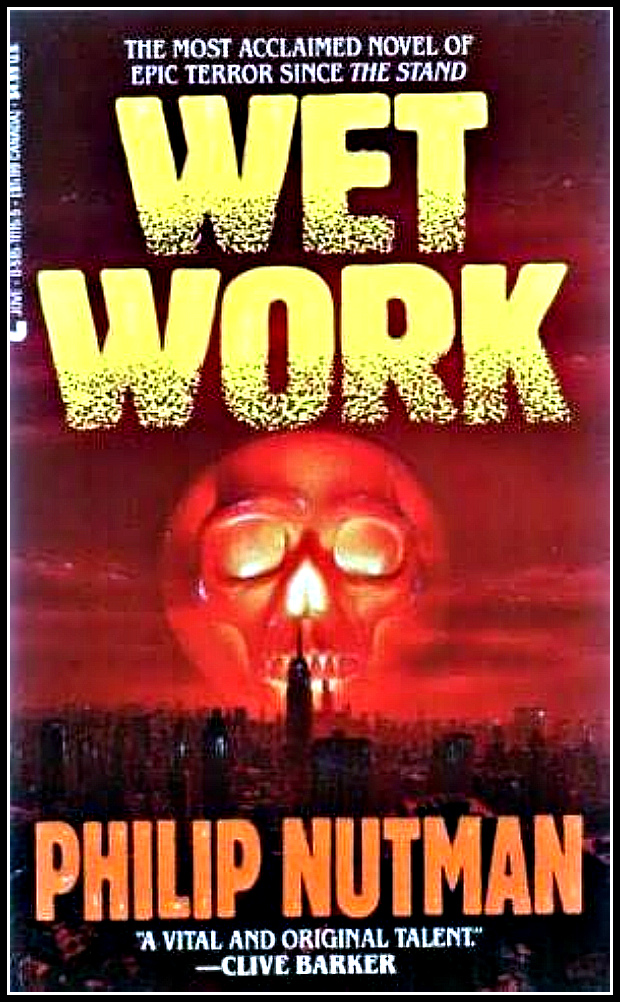
Horror Book Review: Wet Work (by Philip Nutman)


“Wet work” – intelligence community slang for covert operations involving assassination or killing, named for the ‘wet’ bloodshed such missions entail.

Philip Nutman isn’t a name most readers recognize outside of hardcore horror and zombie fiction circles, but within those communities, he’s remembered as an accomplished writer and journalist who carved out a unique space in the genre. For most of his career, Nutman worked as a freelance media journalist and film critic, contributing to magazines like Fangoria and Cinefantastique, where he covered the darker corners of cinema. As a fiction writer, he didn’t produce much in the way of novels, but the one he did publish—Wet Work (1993)—earned him lasting respect among fans who prefer their horror mixed with high-stakes action and cynical political undertones.

Wet Work began as a short story published in George A. Romero and John Skipp’s 1989 anthology Book of the Dead, a milestone collection that helped define zombie fiction as something literary rather than purely pulp. Even within that assembly of strong voices, Nutman’s story stood out for combining government espionage with apocalyptic horror. Expanding it into a full novel only amplified those elements, turning what had been a grim short tale into something closer to an action-horror epic with splatterpunk guts and a spy thriller’s pacing.

The novel opens with CIA operative Dominic Corvino, a member of an elite black-ops unit called Spiral, barely surviving a mission gone wrong in Panama City. From the start, Nutman gives the story a sense of distrust and paranoia—Corvino believes his team was deliberately sabotaged, their deaths engineered by someone inside the CIA. It’s an opening that reads more like a Cold War spy novel than a zombie tale, and that mix of tones is part of what makes Wet Work work so well. Nutman uses what he likely learned as a journalist—his knack for detail, the sense of how bureaucracies function (or fail to)—to give the early chapters an almost procedural authenticity. There’s a lived-in realism to the military and intelligence backdrop that keeps even the most outrageous elements of the story grounded.

Then comes the moment that shifts Wet Work from gritty reality into nightmarish surrealism. As the CIA plotline unfolds, a cosmic event takes place: the comet Saracen passes dangerously close to Earth and leaves behind some kind of invisible residue. It’s never fully explained whether it’s chemical, biological, or something beyond understanding, but its aftereffects begin to change life on the planet. Nutman uses the comet not just as a plot trigger but as a symbol of inevitability—a reminder that humankind’s end won’t always come from weapons or war, but sometimes from something as impersonal as celestial dust. It’s a bit of cosmic horror filtered through the lens of political and societal collapse, an end-of-days scenario that feels both mythic and strangely plausible.

Meanwhile, in Washington D.C., police officer Nick Packard becomes the reader’s main point of connection to the chaos on the ground. Packard starts the day leading a routine shift through the usual headaches of the city, but things unravel fast once Saracen’s effects take hold. Strange attacks start flooding police dispatch, cases of violence erupting in ways no one can explain, and what seem like random acts of brutality turn out to be part of something much larger. The city descends into panic as the dead begin returning to life. Nutman describes this breakdown with a sense of escalating dread that feels almost journalistic—each detail adds up, each scene observed as though through the eyes of someone trying to make sense of something senseless.

The zombies themselves are mostly what readers might expect from stories inspired by George A. Romero: slow-moving, decomposing, and relentless. But Nutman complicates things by hinting that not all of the reanimated are mindless. Some seem to retain fragments of human cunning or memory, enough to make them unpredictable and far more dangerous. This small twist gives the book a chilling edge, making it clear that intelligence doesn’t necessarily counteract monstrosity—it might even make it worse.

Corvino’s section of the novel runs parallel to Packard’s and serves as the darker, more psychological side of the story. He becomes consumed by his mission to find out who betrayed his team in Panama and make them pay. Physically, he’s battered and near his limits, operating in a world that no longer follows the rules of logic or hierarchy. Mentally, he’s trapped between loyalty, fury, and isolation—an operative trained for controlled violence now facing chaos that no training can manage. Nutman writes Corvino as a man unraveling in sync with the world around him. His search for answers feels less like a mission and more like an obsession, a desperate grasp at clarity in a world that’s literally stopped making sense.

Packard’s story, by contrast, brings everything down to a more personal survival narrative. As the crisis worsens, his only goal becomes reaching his wife, stranded in their suburban home outside the city. His journey across a collapsing Washington D.C. is one of the novel’s strongest threads, combining small moments of human connection with scenes of escalating horror. Through him, the reader gets a street-level view of societal breakdown—communications dying, infrastructure collapsing, and people reacting in unpredictable, often violent ways. What makes Packard’s arc compelling is its simplicity; amid government conspiracies and cosmic cataclysms, his is just a story about trying to save someone he loves.

Eventually, Corvino’s and Packard’s paths intersect, and both men come face to face with what’s left of the government. By this stage, authority itself has become just another form of predation. The people who once held power have adapted frighteningly well to the new world, shedding morality and decency like dead skin. Nutman doesn’t paint them as comic-book villains but as survivors whose ethics erode one decision at a time. In typical splatterpunk fashion, the line between humanity and monstrosity blurs completely.

Nutman’s writing in Wet Work is graphic, fast-moving, and unflinching. His descriptions of violence and gore are vivid without slipping into parody, and even when the pacing turns frenetic, it matches the story’s collapse into total madness. Where he stumbles is in a few awkward moments of dialogue and some stilted attempts at sexuality—scenes that read more forced than provocative. But those missteps never fully pull the story off course. If anything, they serve as reminders that Nutman, for all his journalistic precision, was still finding his rhythm in long-format storytelling.

The novel embodies everything bold about early 1990s horror fiction: big ideas, unrestrained violence, and a willingness to splice genres that didn’t normally coexist. Wet Work could just as easily sit beside Dawn of the Dead as it could a paranoid spy novel from the 1980s. Nutman understood that the systems people depend on—government, military, media—are fragile constructs that crumble the second survival becomes personal. That realism, drawn from his background in journalism, grounds the chaos he unleashes. Even at its most supernatural, Wet Work feels uncomfortably plausible because its human failures ring true.

After Wet Work, Nutman shifted back toward shorter forms, writing comics, novellas, and media journalism rather than more novels. In hindsight, that makes his one major book feel all the more significant. It’s the place where all his skills—his eye for detail, his fascination with moral gray areas, and his love of horror excess—come together.

For zombie fiction fans, Wet Work remains a hidden gem worth revisiting. It’s not just a gore-fest or survival tale but a demonstration of how horror doesn’t need to stay confined within its own walls. Nutman showed that the genre can bleed into others—melding espionage, political thriller, and cosmic dread into something distinct and alive. In a field that sometimes plays it safe, Wet Work reminds readers that horror thrives on experimentation, that it’s strongest when it’s hybridized and unpredictable. With Nutman’s death in 2013, any chance of seeing another full-length novel from him is gone, but what remains is proof that horror, when unafraid to evolve, can be far more than blood and fear—it can be reinvention itself.

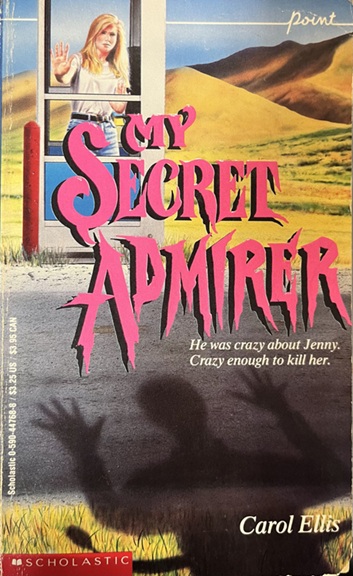
Horror Novel Review: My Secret Admireir by Carol Ellis


First published in 1989, My Secret Admirer tells the story of Jenny.

Jenny is a teenager who has lived in four different town over the past six years.  Her dad’s job requires him to move from town to town and her mother doesn’t like the idea getting tied down anywhere.  I have to admit that I could relate to Jenny because my family used to move all over the place.  By the time I was 12 years old, I had lived in Texas, Oklahoma, Arkansas, New Mexico, Colorado, and Louisiana.  Frequently moving meant that I had to continually get used to new towns, new schools, new teachers, and new friends.  Years later, I realized that spending my childhood on the go left me with massive trust and abandonment issues.  In other words, it really sucked.  My heart went out to Jenny.

When the book opens, Jenny has only been in her new home for a few days.  She’s still nervous about the house and the town.  She’s scared of the hills that are near her home and the rocky bluffs that sit behind the hills.  She worries about wild animals.  She doesn’t know anyone in town and school doesn’t start for another few days.

So, of course, her parents decide to abandon her.

When they are informed that their old house has been sold, Jenny’s parents buy plane tickets so that they can fly back to their former home and collect the rest of their belongings.  Jenny is left behind so that she can deal with the painters (who are scheduled to show up in three days).  Parents in YA book — especially YA horror books — are usually not that great but I have to say that Jenny’s parents take selfish parenting to a whole other level.

Fortunately, Jenny meets her neighbor, the very talkative Sally.  Sally ropes Jenny into taking part in a big scavenger hunt.  During the hunt, Jenny meets Dave and his bitchy girlfriend, Diana.  Diana and Dave are having a fight so Dave teams up with Jenny for the scavenger hunt and, within an hour or so, Jenny and Dave are in love.  Unfortunately, the scavenger hunt does not go as well for Diana.  A day after a sudden storm brings the hunt to a close, Diana is found at the bottom of the cliff.  With Diana in a coma, Jenny wonders if it’s possible that Dave pushed her.

Meanwhile, Jenny seems to have a secret admirer, someone who calls the house and leaves messages on her answering machine.  It’s all good and well until someone leaves a present on her porch.  When Jenny opens the package, she discovers the head of a rattlesnake!

This novel was fairly ridiculous.  Between Jenny’s parents basically abandoning her in a town and house that she barely knew to Jenny falling in love with Dave after spending 30 minutes with him, this book was all about people making bad decisions.  Unfortunately, despite all of the silly plot developments, the book never quite becomes the sort of over-the-top, melodramatic spectacle that one might hope it would become.  That said, I could relate to how Jenny felt about always being the new girl and it was a quick read.  For that matter, I don’t like heights either.

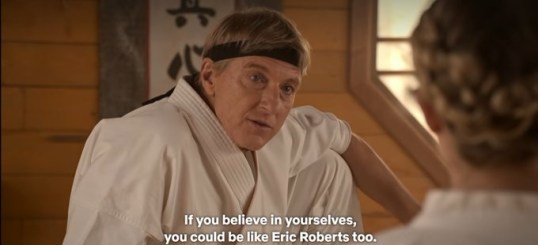
In the end, the book’s message was one to which I could relate:

No, not that!  Instead, if you believe in yourself, you can get a boyfriend and you can survive being stuck in a scary old house!  That’s an important lesson to learn!


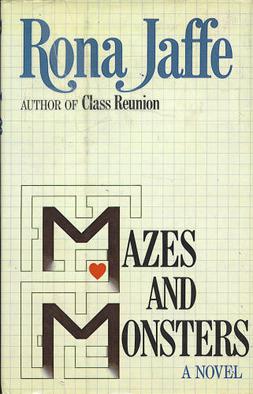
Novel Review: Mazes and Monsters by Rona Jaffe


The 1981 novel, Mazes and Monsters, tells the story of four wealthy college students who deal with the ennui of being rich and privileged by obsessively playing a role-playing game called Mazes and Monsters.

That’s right!  The game is Mazes and Monsters and most definitely not Dungeons and Dragons, even though both games are basically about people wandering around in dungeons and fighting monsters and searching for treasure.  (For the record, I’ve never played Dungeons and Dragons or any other role playing game and I’ve never really had any desire too.  That said, I did enjoy those episodes of Freaks and Geeks and Community.)  One of the four players is Robbie Wheeling, who has never recovered from the death of his brother.  When the players decide to move their game into the tunnels underneath their college, Robbie has a total break from reality and thinking that he actually is his M&M character, he flees to New York and lives on the streets.  Desperate for money and food, he turns to prostitution but ends up stabbing the first man who picks him up.  Agck!  He never should have played that game!

Mazes and Monsters is usually described as being one of the key works of the 80s Satanic Panic and there’s certainly an element of that to be found in the plot.  But the game is actually a fairly small part of the book.  The majority of the book just deals with teenagers struggling with the transition of adulthood and figuring out where they belong in the world.  The book isn’t quite as hysterical as its been described.  If anything, the book almost makes the case that the game is helpful to the players in that it gives them an escape from all the ennui.  Robbie was mentally unstable long before he played the game and it’s hard not to feel that something would have eventually set him off.

This is a rare case where the movie version is better than the book, if just because the movie features Tom Hanks as Robbie.  Robbie mistaking a man for a demon and stabbing him?  That’s really sad.  Tom Hanks doing it?  That’s cinematic magic!

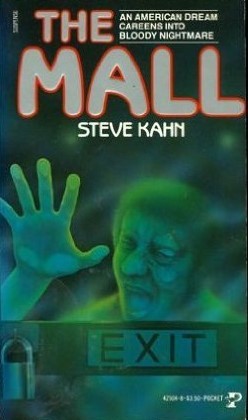
Book Review: The Mall by Steve Kahn


Just from the cover, you would think that The Mall, which was first published in 1983, was a horror novel about a bunch of shoppers getting trapped by a collection of angry spirits whose slumber was disturbed by the titular building being constructed on an ancient burial ground.

Or you might think that The Mall was a sci-fi story in the style of Jim Wynorski’s Chopping Mall, in which The Mall of the Future turned on shoppers and refused to let them escape while a bunch of robots struck a blow for machine rights everywhere.

That’s certainly what I thought when I came across this book and spent a few minutes starting at the cover at Half-Price Books a few months ago.  The cover seemed to show a man melting as he tried to open the doors of the mall!  I mean, seriously, who wouldn’t be intrigued by such a horrific image?  (If I did die at a mall, I would hope that I would at least die in an expensive store so people would be impressed when they heard.)  I bought the book because of the cover and the cover is why I waited until horrorthon to read it.

Unfortunately, it turns out that the cover is the best thing about the book.  It’s not really a horror novel, either.  Sure, it’s listed as being a part of the horror genre on every online listing that I’ve found for it but the book itself is more of a Die Hard rip-off.  (Yes, the book was published before Die Hard even went into production but that’s the power of Die Hard!  It was being ripped off before it even existed.)  The plot is that The Mall is a state-of-the-art playground for the upper and middle-classes.  It was built by Mel Goodman, an industrialist who built himself up from nothing.  On the same day that Mel is having his birthday party in the mall’s offices, his former employee, Jeffrey Prince, leads a group of criminals in an armed but surprisingly dull takeover of the mall.  Prince threatens to kill everyone unless his financial demands are met.  Unfortunately, no one can escape or enter the mall because the doors, I kid you not, have been superglued shut!

The frustrating thing about The Mall is that we are told that there are 40,000 people in the mall.  And yet none of them really try to do anything to thwart Prince’s plans.  Instead, they just wait patiently and some even continue to shop.  That might seem like a satirical commentary on American consumerism but this isn’t half as clever (or emotionally resonant) as Dawn of the Dead.   If anything, it’s the literary equivalent of one of those disaster films where a bunch of different people find themselves trapped in one location and they deal with their personal issues while waiting for the crisis to end.  I’m a little bit surprised this was never turned into a made-for-TV movie.

In the end, it’s not a very good book but the cover continues to haunt me.  Seriously, let that man out of the mall before he dissolves!

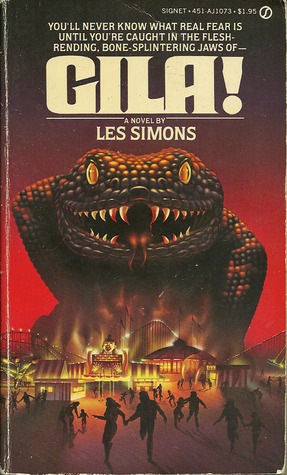
Horror Novel Review: Gila! by Kathryn Ptacek, writing as Les Simons


Watch out New Mexico!

Your long history of atomic testing is coming back to haunt you in the form of giant Gila Monsters!  Hiss, they say before they attack.  Hiss, they say as they look at the severed body parts that inevitably show up as a result of their rampages.  Hiss, they say as they make their way across the desert.  Hiss, hiss, hiss!

(Thanks a lot, Oppenheimer!)

Admirably, the 1981 novel Gila! is pretty straight-forward.  It’s about giant Gila monsters and it doesn’t pretend to be anything more than quick and rather pulpy read.  With the lizards cutting a path of destructing through New Mexico, Governor Bubba J. Roy wants something done and he wants it done now!

Heh heh — seriously, his name is Bubba J. Roy.  All of his dialogue is written phonetically, as if we might otherwise not guess that a character named Bubba J. Roy would have a fairly strong Southwestern accent.  That’s the type of novel this is.

It’s up to Dr. Kate Dwyer and her Native American lover, Chato Del KIinne, to figure out how to stop the mutated lizards.  It won’t be easy, both because the lizards are really big and, as always happens in this type of situation, there’s a bunch of ambitious bureaucrats who think they know better.  Before the humans can figure out a way to deal with the giant lizards, the monsters wipe out the patrons of a diner, the passengers on a school bus, and a huge amount of fairgoers, along with several soldiers and more than a few reporters.

(As I read the book, it occurred to me that perhaps the best solution would have been to build an electric fence around New Mexico and just let the Gila monsters have it.  Seriously, my family briefly lived in New Mexico and not one of us has ever had any great desire to go back.  I nearly stepped on a rattlesnake at one point.  Agck!  The state is dangerous enough even without all of the atomic monsters.)

Gila! is basically a throw-back to the classic giant monster movies of the 50s, though this book features a lot more sex than any of those films.  It’s relatively tame sex but still, there’s a surprisingly large amount for a relatively short novel about killer lizard.  Obviously, the writer knew what her readers were looking for and, to her credit, she gave it to them.

(It’s a bit of a shame that Gila! was apparently never turned into a movie.  Reading it, I kept thinking about how much this seemed like the type of story that just cried out to be the type of 70s movie that Leslie Nielsen made before he started doing comedies.  Ali MacGraw could have played Kate.  Burt Reynolds could have played Chato.  Bubba J. Roy?  Ned Beatty, of course!)

It’s a deeply silly book but entertaining and a quick read.  I picked up a beat-up paperback copy while visiting Snooper’s Book Barn in Fort Smith, Arkansas and I read the book the same day.

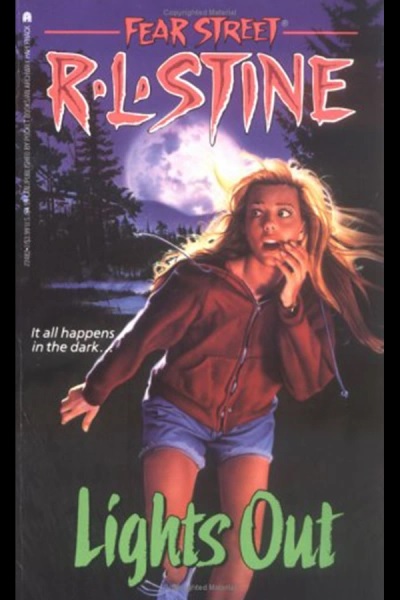
Horror Book Review: Lights Out by R.L. Stine


Never go camping!

Seriously, if there’s any lesson to be learned from the nearly 600 posts that showed up on the site through the month of October in 2023, do not go camping.  If you take nothing else away from Horrorthon, I hope you’ll take away a strong disdain for camping in general and summer camp in specific.  Seriously, the wilderness is full of monsters and summer camps seem to breed madmen.

Just consider R.L. Stine’s 1991 novel, Lights Out.

In Lights Out, Holly is spending the summer working as a counselor at her uncle’s summer camp and it absolutely sucks!  Not only does the summer camp have a long history of weird events and tragedy but no one seems to be happy about Holly being there.  Holly doesn’t like the outdoors and she doesn’t like bugs and she certainly doesn’t like snakes, even if they’re just made out of rubber.  The other counselors, rather than trying to help Holly out, spend the entire time bullying her and then threatening her to keep her quiet.  At one point, they even throw leeches at her!  Seriously, who does that!?  Who not only collects leeches but also throws them at someone!?

Why is everyone being so mean to Holly?  Well, a lot of it because the two resident mean girls think that Holly is going to steal the attention of the male counselors.  But Holly feels that there’s something even more sinister happening at the camp.  Someone appears to be vandalizing the camp and trying to force her uncle to shut the place down.  Eventually, one of the counselors dies when someone shoves her face against the pottery wheel.

Of course, the camp doesn’t shut down.  It takes more than just one murder to shut down a summer camp.  Things come to a head when, despite being terrified of the outside, Holly takes part in leading the camp’s nature hike.  Why is Holly even working as a camp counselor?  I know it’s because her mother demanded that she do something more than just hang out around the house during the summer but, seriously — there’s a lot to do in Shadyside!  There’s so much Holly could have done!

The main message of this book is that camping sucks and I could definitely agree with that.  If the girl on the book’s cover had red hair, she could have easily been me whenever I was up at my grandfather’s farm in Arkansas and I was trying to figure out if there was a snake in the nearby high grass or if all the hissing was just my imagination.  As for the plot, it was basically Friday the 13th with a much smaller body count.  (Christopher Pike would have killed off the whole camp.  R.L. Stine is a bit nicer.)  It’s a bit of a silly book but the message comes through loud and clear.

CAMPING SUCKS!

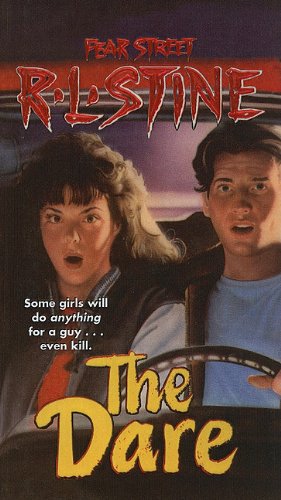
Horror Book Review: The Dare by R.L. Stine


If you were in high school and someone dared you to kill the school’s toughest teacher and then proceeded to tell the entire school that you were planning on killing the school’s toughest teacher, what would you do?

Me, I would probably pretend to be sick for a few days and stay home until everything blew over.  Or maybe I’d transfer to a different school or send an anonymous note to the police or maybe I’d even suggest to the teacher that he should take advantage of my state’s open carry laws.  What I’m saying is that I would do something other than consider the dare and agonize over whether or not I should actually kill the teacher.  I would like to think that killing the teacher would not even be an option for me.  You say to me, “Are you going to kill him?” and I reply, “No.”  What I don’t do is be like, “I don’t know, I guess.”

In 1994’s The Dare, Johanna has a slightly different response.  She knows that murder is wrong but the guy making the dare is Dennis Archer and Dennis is totally hot and rich and self-absorbed whereas Johanna is poor and kind of plain and a little bit insecure.  Dennis and his friends enjoy daring each other to do things.  All of their risk-taking actually does lead to one of Dennis’s friends accidentally getting shot.  That would be enough to convince me not to hang out with Dennis but Johanna is a bit more forgiving of accidental shootings.

Mr. Northwood is a total badass who teaches History, which was always my favorite class in high school.  Mr. Northwood doesn’t care whether or not Dennis and his family are planning on flying to the Bahamas for a week, he’s still not going to give Dennis a makeup midterm.  If Dennis misses the midterm, he’ll fail the course and he might not get to run track and eventually make his way to the Olympics.  But if Dennis stays for the midterm, he won’t get to go on a trip to the Bahamas that he could conceivably take any other time during the year.  As you can guess, it’s a difficult decision but Dennis ends up going to the Bahamas.  When Dennis discovers that Northwood was serious about not giving him a makeup midterm, Dennis starts flirting with Johanna and encouraging her to imagine all the different ways that they could kill Mr. Northwood….

YIKES!

As you can probably guess, the main problem here is that Johanna is kind of an idiot who can’t even find the strength to say, “No, I will not murder my neighbor and teacher, no matter how many times the hottest guy in school asks me too.”  Johanna actually does have other friends, none of whom have ever asked Johanna to kill anyone.  But Dennis is just so hot!

I guess it can be argued that this novel does capture the way that some students feel towards the tough teachers.  When I was in high school, I always assumed that any teacher who was tough on me was doing so because they had a crush on me or they were jealous of me and my naturally red hair.  I got mad at my teachers and I sometimes talked about how much I hoped they would quit or move away but I never made plans to kill them because I’m not psycho like that.

Anyway, The Dare is one of those R.L. Stine books where everyone was so consistently illogical, I assumed the entire thing was meant to be a dream.  Seriously, a hot guy is not worth going to jail over, Johanna!  This book suffered from a lack of likable characters and a lack of a believable plot.  Mr. Northwood was cool, though.  History teachers for the win!