Music Film Review: The Rocky Horror Picture Show (dir by Jim Sharman)


It feels strange to actually watch The Rocky Horror Picture Show without an audience.

I say this because the film is actually far better known for its fans than anything else.  First released in 1975 to middling reviews and, at first, anemic box office returns, The Rocky Horror Picture Show went on to become the first great cult film.  It’s literally been playing in theaters for 25 years, which has to be some sort of record.  When one sees Rocky Horror Picture Show in a theater, one does not merely sit back and watch in a state of suspended animation.  Instead, most of the audience becomes a part of the show.  They yell, they dance, and many of them return night-after-night.  I have been to two midnight showings of the Rocky Horror Picture Show and I have to admit that it was actually pretty intimidating both times.  The people in the audience — the veterans who knew every line and knew exactly what to do — were, more or less, friendly.  I’ve read some online horror stories about people who felt like they weren’t welcome the first time they attended a showing.  I had the opposite experience.  No one was rude, no one glared.  It was definitely a cliquey group but I felt as if they had earned the right to be in their clique.  No one seemed to be bothered by the fact that I was mostly there just to observe.  (I should also mention that neither showing that I attended demanded that the first-time watchers stand up or go to the front of the theater or anything like that.  Apparently, there’s quite a few people online who got upset over being singled-out as “virgins” and never got over it.)  But it was intimidating in much the same way as meeting a friend of a friend is intimidating or exploring a new town is intimidating.  I was surrounded by people who had a deep connection with each other, one that had been forged by sharing the same experience for years.  It was a communal experience that was actually touching to see, even if I never stopped feeling like an outsider.

It’s interesting to compare the midnight showings of The Rocky Horror Picture Show to the midnight showings of The Room.  I attended several midnight showings of The Room and I have to admit that I eventually soured on them as it became clear that many people were showing up to taunt the film as opposed to enjoying it for the odd, communal experience that it was.  The last few The Room showings that I attended were filled with a hostility that left me feeling a bit uncomfortable.  Whereas The Room’s cult has often felt a bit mean-spirited (as if everyone had gathered together to laugh at Tommy Wiseau for thinking he could make a movie), The Rocky Horror Picture Show‘s cult is based on a genuine love for the film.

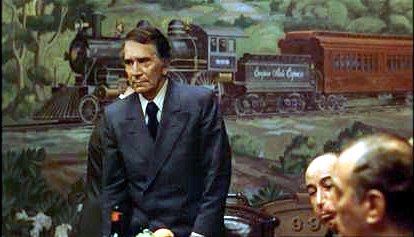
As for the film itself, I watched it last month without an audience and I judged it solely as a film.  The pacing is a bit off and, without the group experience, it’s a lot easier to notice that the film’s storyline doesn’t make a bit of sense, though that was undoubtedly deliberate on the part of the filmmakers.  That said, Tim Curry’s performance still gives the film a jolt of energy, recapturing your attention and holding it until the film comes to a close.  (The genius of Curry’s performance as that, as flamboyant as it is, he still plays Dr. Frank-n-Furter as being an actual characters with feelings and emotions.  He doesn’t just coast on attitude.  One need only compare him to Laverne Cox in the 2016 TV production to see how strong Curry’s performance is.)  Susan Sarandon brings some depth to her performance as Janet and, if Barry Bostwick is a little on the dull side of Brad …. well, the heroes who appeared in the film that Rocky Horror sends up were rarely that exciting.  I enjoyed the snarky humor of Richard O’Brien’s performance and the energy that Meat Loaf brought to the production.  Charles Gray, in the role of the Criminologist, really doesn’t get enough credit for holding the film’s disparate parts together.

In the end, when viewed as a film as opposed to a communal experience, The Rocky Horror Picture Show is undoubtedly flawed but it’s still energetic enough to work.  The love for the old sic-fi films comes through and Tim Curry’s uninhibited performance works with or without an audience.  The Rocky Horror Picture Show is a film that brings people together and I hope it continues to do so.

Horror Film Review: In A Violent Nature (dir by Chris Nash)


Johnny was perfectly happy being dead until some obnoxious college friends decided to take a camping trip and came across a locket hanging off of a fire tower.  The locket was what kept Johnny’s soul at rest.  When one of the group decided to take the locket so that he could give it to his girlfriend, Johnny came back to life.

Already haunted by the tragic memories of his life and how a bunch of bullies murdered him by tricking him into falling off of the tower, Johnny is determined to retrieve the locket.  Slowly and methodically, he walks through the wilderness, killing everyone that he encounters as he searches for the one thing that will….

Well, it’s a slasher movie!  You know how these things go!

Released in 2024 and directed by Chris Nash, In A Violent Nature‘s plot may be typical slasher stuff but the way the story is told makes the film unique.  Nash tells the story almost totally from the point of view of the undead Johnny.  The camera follows Johnny as he makes his way through the woods and what we learn about him and his motivations largely comes from the snippets of conversations that we hear from people in the distance.  Johnny’s victims largely appear in the distance, having typical slasher film conversations but we only hear them in passing, like fragments from a half-remembered dream or movie.  We’re learning with Johnny.

As such, this is the rare slasher movie that requires that one actually pay attention to what is being said.  It’s also a rare slasher movie that requires a good deal of patience on the part of the viewers.  Johnny moves slowly and so does the movie.  Though the kills are certainly bloody and there are plenty of genuinely frightening moments, the film is ultimately more about the sight of hulking, single-minded Johnny walking through the woods and through fields of brilliantly green grass than anything else.  If Terence Malick made a slasher movie, it would look a lot like In A Violent Nature.  Would Terence Malick have included the yoga kill?  Perhaps.  I think he would have included a voice-over though about nature, though.  (Speaking of the yoga kill, it’s notable that this non-traditional slasher movie features one of the bloodiest killings of the genre, as if the director wanted to make sure that we understood he didn’t consider his film to be too good for the genre.  I appreciated that.)

A film like this is great if you’re a fan of both Malick and horror, as I am.  If you prefer your slasher films to be a bit less self-consciously esoteric in their approach, you might wonder what all of the hype was about.  In A Violent Nature is one of those films that the viewer will either love or the viewer will give up on after several minutes of watching Johnny staring out at the lake.  It’s an experimental film and, like all experimental films, it’s not for everyone.  That said, if you have the patience for it, it’s an engrossing and off-beat slasher flick.


Horror On The Lens: Night of the Living Dead (dir by George Romero)


Happy Halloween!

Watching this movie is a Halloween tradition here at the Shattered Lens and I am honored to keep that tradition alive (heh) in 2025!

Be sure to check out Arleigh’s review!

For the record, you can count me amongst those who thinks that Ben got everyone killed.  We root for Ben because he’s the more likable character but, in the end, Harry was right and Ben ended up becoming a cold-blooded murderer.  These are the type of things that make Night of the Living Dead the scariest zombie film ever made.  The living are just as terrifying as the dead.

I should also note that, for all the criticism the character gets, Barbara has one of the most totally realistic reactions that I’ve ever seen in a horror movie.  She’s in shock and denial.  I would probably have the same reaction.

And now, here is the greatest zombie film ever made!


October Positivity: The Trial (dir by Gary Wheeler)


In 2010’s The Trial, Matthew Modine stars as Mac.

Mac is a Southern lawyer, even though it’s been a while since he practiced.  After his wife and children were killed in a car accident, Mac decided to retire from practicing law but he never surrendered his license.  A judge (Rance Howard) reaches out to him, asking him to serve as a public defender for Pete Thomason (Randy Wayne), a young man who has been accused of murdering his girlfriend.  The evidence is stacked against Pete and there are plenty of wealthy people who, for various reasons, want Pete to quickly be convicted.  Mac takes the case because he can tell that Pete is being railroaded.  When he discovers that Pete will possibly be facing the death penalty if he’s convicted, the case becomes very personal for Mac.

The prosecuting attorney (Bob Gunton) has managed to find a doctor (Brett Rice) who is willing to testify that Pete is a sociopath.  (The doctor has a reputation for finding just about anyone on trial to be a sociopath.)  Mac finds a doctor of his own, Dr. Anne Wilkes (Clare Carey), his testifies that Pete is nowhere near being a sociopath.  The problem is that Pete has no memory of what happened the night of the murder.  Mac may believe that Pete is innocent but can he convince the jury when the evidence all seems to suggest otherwise?

Like The List, The Trial was based on a novel by Robert Whitlow and it was directed by Gary Wheeler.  I was pretty hard on The List in last night’s review but I actually rather enjoyed The Trial, which was a solid and well-made legal thriller.  (The film’s status as a faith-based film largely comes from a scene in which Mac quotes the Book of Provers in regards to how, during a trial, it’s easy to believe the first person who speaks but it’s equally important to listen to how the accused replies.)  I enjoyed the twists and turns of the plot and the film’s ending worked well.  Though the film had a a made-for-television feel to it (despite having been a theatrical release), it still held and rewarded my interest.

It helped that the cast was well-selected and everyone gave good performances.  Matthew Modine, in particular, gave a strong performance as Mac, playing him not as being a saint but instead as being someone who was just determined to give his client the defense he deserved and to ultimately do the right thing.  Robert Forster played Mac’s brother-in-law and lead investigator and he brought his own brand of world-weary determination to the part.  Nobody plays a smug prosecutor as well as Bob Gunton, though it should be noted that the character himself never became a caricature.  Rance Howard was the ideal judge, tough but fair.  Randy Wayne was sympathetic as the confused Pete.  The cast really brought the film’s world to life.

I always enjoy a good legal thriller and The Trial was certainly that.

Late Night Retro Television Review: Highway to Heaven 4.20 “Aloha”


Welcome to Late Night Retro Television Reviews, a feature where we review some of our favorite and least favorite shows of the past!  On Thursdays, I will be reviewing Highway to Heaven, which aired on NBC from 1984 to 1989.  The entire show is currently streaming on Tubi and several other services!

This week, Mark is a disappointed again.

Episode 4.20 “Aloha”

(Dir by Michael Landon, originally aired on March 2nd, 1988)

Jonathan gets Mark all excited by saying that their next assignment is a Hawaiian mission.  Mark says, “We’re going to Hawaii!”  He’s looking forward to it and who can blame him?  After a countless number of assignments that found him working in crummy jobs and depressing neighborhoods, Mark thinks that he’s going to be most beautiful place on Earth.

Nope, sorry, Mark.  You’re going to a rundown apartment complex called the Hawaiian Sands.  The complex is managed by Aulani (Mokihana), a singer who found fame in Hawaii but not in Los Angeles.  Instead, in L.A., she was hit by a truck and left in a wheelchair.  Now, she spends her days bitter, constantly yelling at her handyman and former partner, Alvin (Danny Ing).  Alvin loves Aulani and Aulani loves Alvin but she’s too angry and scared of opening up emotionally to admit it.  When Alvin learns that he doesn’t have much longer to live, he plans to return to Hawaii.  Aulani refuses to admit that she cares.  Luckily, her new tenant Jonathan is there to set her straight.

As I’ve often said, the main strength of this show was its nonstop earnestness.  Even at its most sentimental, it still worked because the show was just so dang sincere.  That’s ultimately the case here.  Danny Ing gives a very touching performance as Alvin.  Your heart breaks for him.  Mokihana overacts in the role Aulani, to the extent that she actually becomes pretty annoying.  But, despite that, the show itself was so sincere and well-intentioned that it was impossible not be touched by the end of this episode.

Add to that, Hawaii — there’s no place more beautiful to visit.  I wonder what Halloween is like in Hawaii.  Maybe I’ll find out next year!

Brad reviews DEAD TONE (2007), starring Rutger Hauer!


DEAD TONE (2007), also known as 7EVENTY 5IVE, opens with a group of kids entertaining themselves while their parents are drinking and partying downstairs. The kids are playing a prank-calling game called “Seventy-Five,” where the goal is to place a random phone call and tell such a believable story that the person who answers will stay on the line at least 75 seconds. One guy seems particularly upset with the kids when they call him. Later that night, while everyone is sleeping, a psycho with an axe comes in the house and brutally murders all the parents while the kids hide and watch in terror. Jump forward ten years and most of the kids who survived the night of terror are now college students. Invited to a weekend party at a wealthy classmate’s mansion, the group resumes their prank-calling game. Needless to say, when the maniac from ten years earlier answers the phone, the members of the group find themselves being stalked and murdered again. Hopefully Detective John Criton (Rutger Hauer), who worked the original murders 10 years earlier, and his partner Anne Hastings (Gwendoline Yeo), will figure out who killer is and stop him before everyone dies! 

DEAD TONE is directed by Brian Hooks and Deon Taylor, who also star in the film. They’ve created a gory, low-budget slasher that blends elements of ‘80s and ‘90s horror films with an urban twist. For a guy who did his share of prank calls as a kid, I think the “psycho on the receiving end of a prank call” storyline is pretty cool. And the opening scene where the kids watch as their parents are killed because of their phone calls is horrific and pulls you right into the story. Unfortunately, once we get past the interesting open, there’s nothing that special about the rest of the movie. The characters aren’t particularly memorable or likable, and they sure as hell aren’t very smart. Call me crazy, but I’m thinking that I would never make another prank call again if I survived a mass murder event that was brought on by prank phone calls. These folks have no such qualms, which may not make any sense in the real world, but I guess is necessary if you need more axe murders for your plot. I will admit that there are a few awesome kills in the film, especially if you enjoy a good beheading. I won’t spoil the scenes, but the ones I’m specifically thinking of are both surprising and jarring at the same time. I’m also the kind of guy who will watch anything featuring the legendary Dutch actor Rutger Hauer. DEAD TONE’s Detective John Criton isn’t a character highlight of his career, but I still enjoy watching him go through the motions of investigating the crimes both in the present and in the past. It’s a part that he could have completed in his sleep, but this movie would have benefited from more “Hauer time.”

Overall, DEAD TONE is the kind of movie to watch with little to no expectations. My wife and I enjoyed the film as we cuddled up on the couch and watched it a couple of nights before Halloween. It’s not great, but if you’re in the mood for a slasher movie with jump scares, silly characters, some decent gore, and even an acting legend thrown in for good measure, you could do a lot worse than DEAD TONE!

Horror on the Lens: How To Make A Monster (dir by Herbert L. Strock)


You’ve seen I Was A Teenage Werewolf….

You’ve watched I Was A Teenage Frankenstein….

Now, it’s time to watch How To Make A Monster!

Released in 1958, How To Make A Monster is a clever little horror satire from American International Pictures in which the stars of Teenage Werewolf and Teenage Frankenstein are hypnotized into believing that they actually are the monsters that they played!  The main culprit is a movie makeup artist (Robert H. Harris) who has been deemed obsolete by the new bosses at AIP.

Be sure to watch for the finale, which features cameo appearances from several other AIP monsters!  And read my full review of the film by clicking here!

Retro Television Review: Decoy 1.10 “The Scapegoat”


Welcome to Retro Television Reviews, a feature where we review some of our favorite and least favorite shows of the past!  On Thursdays, I will be reviewing Decoy, which aired in Syndication in 1957 and 1958.  The show can be viewed on Tubi!

This week, Casey makes the mistake of being nice.

Episode 1.10 “The Scapegoat”

(Dir by Teddy Sills, originally aired on December 16th, 1957)

Call this one “Casey Screws Up …. Again.”

Casey and Detective Hank Hopkins (John Connell) are escorting embezzler Dorothy Boyer (Lenka Peterson) to jail.  As they wait at an airport, Casey cannot help but feel sorry for Dorothy.  Everyone who sees Dorothy recoils from the sight of her handcuffs.  (“She’s a crook!” one little girl yells.)  Casey agrees to take off the handcuffs as long as Dorothy doesn’t try to run away.  Of course, as soon as Casey is distracted, Dorothy runs.

Casey and Hank try to track down Dorothy.  They discover that Dorothy was embezzling the money so that she could afford a special school for her son, who is repeatedly described as being “retarded” but whose noncommunicative behavior suggests that he would probably, today, be diagnosed as having some form of autism.  Casey and Hank fear that Dorothy is going to murder her child, to spare him from being sent to a “public institution” while she’s serving time in prison.

They’re right.  Dorothy is on the verge of throwing her son off a bridge when Casey, Hank, and the cops track her down.  Casey says that she understand why Dorothy is scared.  “You think your son will be sent to a public institution and people will be cruel to him!” Casey says.  “What about me?  I work for a public institution!  Was I cruel to you?”

“Who’s going to give love to a backward child!?” Dorothy cries.

Casey then taunts, “Go ahead, throw him over!”

This causes Dorothy to realize that she loves her son too much to toss him over the bridge.  The episode ends with Casey speaking directly to the camera.  Dorothy will only have to serve six months in prison.  As for Casey and Hank, they’re put on official probation for three months for letting Dorothy escape.  “You live and you learn,” Casey says.

This episode was a real time capsule.  Yes, it was weird to hear the term “retarded” tossed around so casually, though I found the term “backward child” to be far more offensive.  But, let’s be realistic here.  This show aired 1957 and it’s a bit silly to expect a 68 year-old television program to sound like it was written in 2025.  To me, what was really upsetting was how everyone that Casey talked to seemed to feel it was perfectly understandable that the father of Dorothy’s child abandoned Dorothy because of their son.  Everyone, except for Casey and Hank, acted as if Dorothy should be ashamed of her child.  To make clear, the show did not endorse that attitude but still, the callousness of almost everyone in Dorothy’s life was hard to take.  I was glad that Casey cared.

That said, I did cringe a bit at that “I work for a public institution” line.  One nice person does not signify a change in culture.

October True Crime: Holy Spider (dir by Ali Abbasi)


2022’s Holy Spider opens in the Iranian city of Mashahd.  We follow a woman as she spend her night as a sex worker, standing on a street corners, going off with any man who stops for her, and hiding in the shadows whenever the infamous morality police are nearby.  There’s nothing glamorous about her work.  The men who pick her up are brutes who treat her like property and there’s little about the city that is beautiful or aesthetically pleasing.  If anything, it looks bombed-out, as if no one could be bothered to repair any of the obvious cracks that are stretching across the city ancient’s facade.  Towards the end of the night, the woman is picked up by a man who, in a harrowing scene, proceeds to choke her to death.

Journalist Arezoo Rahimi (Zar Amir Ebrahimi) arrives in the city to investigate the recent murders of several sex workers and immediately discovers that the authorities have no interest in discussing the case.  When she pushes them, they taunt her about her private life and they snap at her for not properly covering her hair.  Whenever she steps out into the street, she’s told that she’s going to get in trouble if she’s spotted by the Morality Police.  (The attitude appears to be that it’s a greater crime for a woman to fail to fully cover her hair than for a man to kill a woman, whether her hair is properly covered or not.)   Eventually, she teams up with a newspaper editor named Sharifi (Arash Ashtiani).  Sharifi has been receiving letters from the murderer, ones in which he explains that he is cleansing the city in the name of Imam Reza, the eighth Shia Imam.

The murderer is a construction worker named Saeed Azimi (Mehdi Bajestani), a middle-aged man who previously served in the Iraq-Iran War and who it is suggested might be suffering from PTSD.  On the outside, Saeed seems almost normal.  He has friends.  He has a family.  He is very religious.  To the outside viewer, he might not look like a killer.  But, every night, he prowls the streets and he searches for potential victims.  When Rahimi goes undercover as a sex worker, she comes close to becoming one of them.

More than just a recreation of a serial killer’s crimes, Holy Spider examines the misogynistic attitudes that allowed Saeed that get away with so many murders.  Saeed himself becomes a folk hero amongst many Iranians, who are quick to say that they agree with his mission to cleanse the city.  Even when on trial, Saeed is approached by members of the government who promise him his safety, though it soon becomes clear that their promises don’t necessarily mean much.  The more that his crimes are celebrated, the more smug Saeed becomes.  Even when his sentence comes down, Saeed remains convinced that he will be protected.  Afterall, everyone seems to agree with him that the victims, and not the murderer, are to blame for their deaths.

Dark, disturbing, and ultimately infuriating, Holy Spider is a powerful film.  The film’s power can be seen in the fact that it was not only banned in Iran but that the government also announced that anyone involved in the filming would also be censured.  (Russia, a longtime ally of Iran, also banned the film.)  Saeed is a hateful figure but even more hateful are the misogynists who celebrated him and nearly allowed him to get away with his crimes.  Holy Spider may have been banned in Iran but it can still be seen in the rest of the world.

And it should be seen.

Horror On The Lens: Carnival of Souls (dir by Herk Harvey)


1962’s Carnival of Souls was the only feature film to be directed by Herk Harvey.  It was made on a budget of $33,000 and was filmed in Kansas and Utah, often without permits.  The film was also the feature acting debut of model Candace Hilligoss, cast here as a emotionally withdrawn church organist who is involved in a serious car accident and then finds herself haunted by pasty-faced ghosts and surreal visions.

When it was initially released, Carnival of Souls was dismissed by American critics.  Indeed, it would a little over twenty years before the film started to be appreciated as both a classic independent film and also a truly eerie horror movie.  Today, it’s recognized as a classic of the genre, an expressionistic ghost story that also works as a character study of a woman who is haunted by not just physical death but also emotional malaise.

Carnival of Souls is a Halloween tradition here at the TSL offices.  This year, the tradition continues.