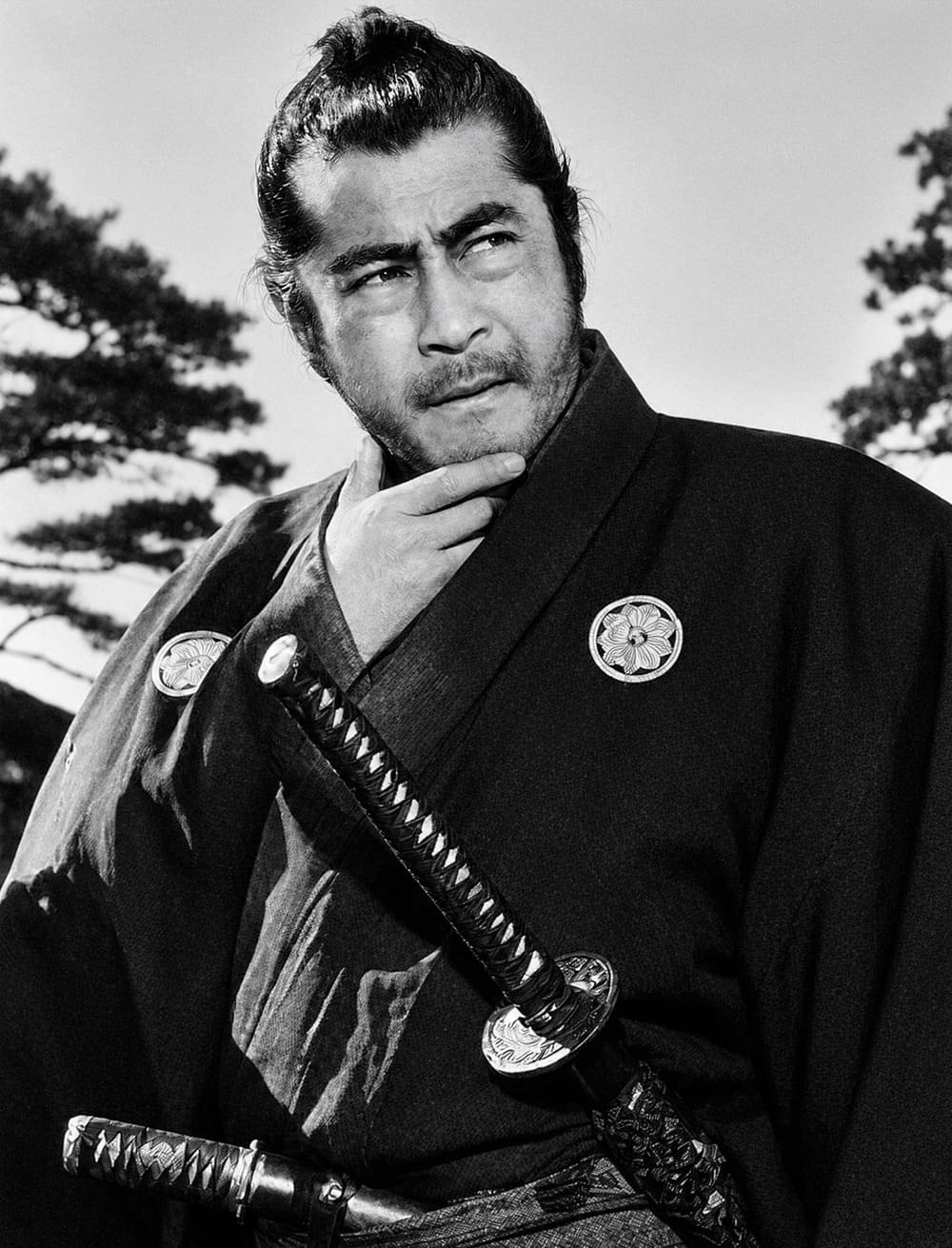
“I’m smarter when I drink.” — Sanjuro Tsubaki
Sanjuro is the sort of hero who makes you glad he’s on your side and grateful you don’t have to spend the afternoon with him. In Akira Kurosawa’s Yojimbo (1961) and Sanjuro (1962), Toshiro Mifune plays a masterless samurai who can read a room in seconds and barely conceal his irritation at what he finds there. He scratches, slouches, and keeps his hands tucked inside his kimono; the sudden precision of his movements when he draws his sword is all the more striking for it. The performance makes a joke of the idea that a great swordsman ought to look dignified, without ever making his skill a joke.
Even his names are improvised. In Yojimbo, a glance at a mulberry field gives him Kuwabatake; in Sanjuro, camellias give him Tsubaki. The offhand aliases suit a man who wants to be judged by what he does, if he wants to be judged at all. They also make a small joke at the expense of people who expect a name to tell them whom they’re dealing with. Sanjuro, meanwhile, has usually figured out whom he’s dealing with before anyone thinks to ask his name.
In Yojimbo, that talent makes him a wonderfully suspect hero. He walks into a town divided between two gangs and offers his services as a bodyguard, turning each side’s greed and suspicion against the other. There’s a relish in the way he makes fools of men who think they’re buying his loyalty. Yet the clearest evidence that he cares about someone besides himself comes when he jeopardizes his own position to free a captive woman and reunite her with her family. He’s heroic precisely when he stops doing the clever thing. That choice doesn’t erase his enjoyment of the game, and the film is more interesting for letting both impulses stand.
Sanjuro puts the same man in a situation where being the smartest person in the room is less fun. Nine earnest young samurai need his help, and their habit of mistaking respectable appearances for good character exasperates him. His scolding is funny because he can see their mistakes coming and still can’t quite believe they’re making them. But the chamberlain’s wife sees something he misses: her image of the best sword staying in its sheath suggests that his readiness to draw is not always a virtue. He spends much of the film trying to teach the young men judgment, only to find himself on the receiving end of the lesson.
That reversal gives the final duel with Muroto its sting. The fight ends almost before it begins, in a startling eruption of blood. The young men have just seen a feat they might ordinarily admire, but Sanjuro won’t let them take it as a lesson in how to be a samurai. He recognizes something of himself in the man he’s killed, and the victory leaves him angry rather than triumphant. His temper, so often directed at other people’s foolishness, now seems directed at himself as well.
“Antihero” fits Sanjuro if it describes his methods and manners; it fits less well if it implies that he doesn’t care. He risks his life for people he has no obligation to help and often no patience for. What makes him compelling across the two films is that Kurosawa changes the question without changing the man. Yojimbo asks what a town at the mercy of violent men might gain from a swordsman who sees through them. Sanjuro asks what that swordsman might lose if drawing his blade remains the thing he does best. Mifune makes both questions feel at home in the same impatient shrug.
Hero of the Day
- Inspector “Tequila” Yuen Ho-yan (Hard Boiled)
- Josey Wales (the Outlaw Josey Wales)
- Vince Majestyk (Mr. Majestyk)
- Monkey D. Luffy (One Piece)
- Leo Kessler (Ten to Midnight)
- Senku Ishigami (Dr. Stone)
- Marcus Fenix (Gears of War)
- Samwise Gamgee (Lord of the Rings)
- Haven Hamilton (Nashville)
- Bernardo O’Reilly (The Magnificent Seven)
- Maj. Motoko Kusanagi (Ghost in the Shell)
- Spike Spiegel (Cowboy Bebop)
- Chief Martin Brody (Jaws)
- Raylan Givens (Justified)
- Ash Williams (Evil Dead Series)
- John Nada (They Live)
- Jeff Trent (Plan 9 From Outer Space)

