Retro Television Review: Crime Story 1.6 “Abrams For The Defense”


Welcome to Retro Television Reviews, a feature where we review some of our favorite and least favorite shows of the past!  On Mondays, I will be reviewing Crime Story, which ran on NBC from 1986 to 1988.  The entire show can be found on Tubi!
This week, David Abrams gets his time in the spotlight.

Episode 1.6 “Abrams For The Defense”

(Dir by Aaron Lipstadt, originally aired on October 14th, 1986)

In the slums of Chicago, Hector Lincoln (Ving Rhames) strikes his landlord, Sturkowski (Frederick Nuemann), after one of Hector’s children is bitten by one of the rats that roams freely through the apartment building.  Hector is arrested and facing time in prison.  Public defender David Abrams (Stephen Lang) defends Hector in court, claiming that conditions in the slums were so bad that Hector only struck Sturkowski in self-defense.  Helping David to make his case about the conditions in Sturkowski’s building is a crusader reporter named Suzanne Terry (Pam Grier).

This episode was all about showing us who David Abrams is.  David’s father was a mob lawyer but David has no interest in working with people like Ray Luca and Phil Bartoli.  Instead, he wants to defend the poor and the downtrodden.  Torello and Krychek happen to stop by the trail and they’re impressed with David’s passion.  Krychek is disgusted when Sturkowski says that Hector and his family don’t deserve to live a better life.  Who knew that two Chicago cops would be so liberal?

To celebrate Hector’s acquittal, a block party is held.  David is the guest of honor and, for reasons that aren’t really clear, he decides to invite Torello and Krychek to come celebrate with him.  Everyone at the block party is super excited that two cops are hanging out with them.  But then Sturkowski tries to evict the Lincolns and Hector strikes him again.  This time, he kills Sturkowski.  Torello and Krychek promptly arrest Hector as the episode comes to an end.

(And that is why you don’t invite cops to the block party.)

This episode was well-acted, if a bit heavy-handed.  (To a certain extent, it reminded me of those episodes of Miami Vice where Crockett would certainly start talking like an undergrad who had just read about Marx for the first time.)  It certainly allowed us to get to know more about David Abrams and Stephen Lang and Pam Grier had a good deal of chemistry as two people who appear to be poised on pursuing a relationship that was not all that common in 1963 Chicago.  The block party was where the episode kind of lost me, just because I found it hard to believe that Torello and Krychek would not only show up but be treated as the guests of honor despite the fact that most of the people at the party wouldn’t have the slightest idea who they were.  I can understand Abrams being welcomed because Abrams kept Hector out of prison.  But Torello and Krychek are just two random, middle-aged, white cops.

This episode established David Abrams as being a man caught between two different worlds, the law and lawless.  I can’t wait to see what the show does with him.


Retro Television Review: Crime Story 1.5 “The War”


Welcome to Retro Television Reviews, a feature where we review some of our favorite and least favorite shows of the past!  On Mondays, I will be reviewing Crime Story, which ran on NBC from 1986 to 1988.  The entire show can be found on Tubi!

This week, Luca has to prove himself.

Episode 1.5 “The War”

(Dir by Leon Ichaso, originally aired on October 7th, 1986)

Luca is in trouble.

Last week’s episode ended with Max Goldman on the receiving end of a beating from Noah Ganz’s goons.  Goldman survives and returns with a message.  Ganz is not happy that Luca tried to steal his book.  Bartoli, Weisbord, and Fosse all inform Luca will have to resolve the Ganz situation on his own.

Luca tries to get public defender David Abrams (Stephen Lang) to act as a negotiator for him but David doesn’t want to get involved in the mobster lifestyle that made his father rich.  David just wants to defend the poor and play sax in a jazz club.  When Luca is attacked while driving in Chicago, he realizes that negotiating with Ganz is a dead end.

Instead, he just kills Ganz.  In a bravura sequence, Luca shows up at a hotel and, with the help of sniper, takes down Ganz’s bodyguards.  Then he uses a bomb to take out Ganz while the latter is holding court in an elevator.  A plume of white smoke puffs out of the hotel’s exhaust vent.

Having taken care of the issue, Luca is welcomed back into the family.  Weisbord says, “Call me Mac.”  Fosse (played by Michael Madsen) nods and slowly smokes a cigarette.

Meanwhile, Torello’s wife miscarries.  This is the episode that features the clip of Torello walking down a lonely Chicago street on a rainy night.  (The clip is prominently featured during the show’s opening credits.)  In fact, both Torello and Luca end up spending a good deal of time walking around at night while David Abrams plays his saxophone.  It’s a scene that is so overstylized that it shouldn’t work but somehow, it does.  If nothing else, it reminds us that Crime Story of two dangerously obsessed men on a collision course.

This was a good episode, if just because it showed that Luca can be a clever criminal when he needs to be.  Before this episode, Luca seemed to be clearly outmatched by Torello.  With this episode, Luca proved himself to be Torello’s equal.

Retro Television Review: Crime Story 1.4 “St. Louis Book of Blues”


Welcome to Retro Television Reviews, a feature where we review some of our favorite and least favorite shows of the past!  On Mondays, I will be reviewing Crime Story, which ran on NBC from 1986 to 1988.  The entire show can be found on Tubi!

This week, everyone’s going to Missouri.  Can you blame them?

Episode 1,4 “St. Louis Book of Blues”

(Dir by Leon Ichaso, originally aired on September 30th, 1986)

After Ray Luca discovers that his henchman, Frank Holman (Ted Levine), has been compromised by Torello, he decides to deal with the situation by sending Holman down to St. Louis.  A gangster named Ganz (Raymond Serra) has a home in St. Louis and, according to Ganz’s associate Johnny Fosse (Michael Madsen, doing his slow-talking, cigarette-smoking Madsen thing), there is a book in Ganz’s shelf that contains the name of every bookie, coach, and sports-fixer in America.  Ray, who is hoping to start up his own nationwide gambling syndicate, wants that book.

Far be it for me to question Ray Luca’s strategy but it does seem strange that his response to one of his people screwing up is to give that person an even more important job to do.  I get that Ray is trying to be a manager now and, as a result, he no longer personally robs anyone but Frank really does seem like the last person he should trust to pull this off.

And, to no one’s surprise, Frank doesn’t pull it off.  Torello and his men follow him all the way to St. Louis.  They not only arrest him but they also get their hands on Ganz’s book.  They do this despite the operation nearly being ruined by an ambitious and publicity-hungry sheriff named Hartman (Allen Swfit).

Unfortunately, when Frank offers to inform on the entire “St. Louis mob,” Hartman releases him from jail.  Frank promptly flees town.  When he calls Ray, Ray orders him to stay out of Chicago and instead to go to Cleveland.  Frank replies that if he has to choose between Hell or Cleveland …. he’ll go to Cleveland.  Good thinking, Frank!

(Actually, I’ve never been to Cleveland so I don’t know if it’s really good thinking.  Wasn’t Dennis Kucinich from Cleveland?)

As this episode ends, Ganz is ready to declare war on Luca and it appears that Max Goldman might be the first victim.  The funny thing about Max is that he’s played by a young Andrew Dice Clay and, in every scene in which he appears, Clay’s facial expressions are totally and completely over-the-top, as if Clay was determined to make sure that no one forgot he was in the scene.  I hope that Max survives, just for the sake of entertainment,

This episode returned to the idea of Torelllo being dangerously and tightly wound.  Before he followed Frank to St. Louis, he nearly firebombed a furniture store because the owner hadn’t delivered the table that he had ordered.  Torello was talked out of doing so by his fellow cops but the store owner still got the message.  The table arrived at Torello’s apartment.  Of course, it was the wrong table.  That made me laugh.  People have no idea how close Torello is to snapping and killing everyone around him.

This was a good episode.  It was interesting to see a young Ted Levine, not to mention a young Michael Madsen as well.  The corrupt and incompetent sheriff was identified as being a Democrat. I appreciated that.  I’m looking forward to seeing where this show is going.


Retro Television Review: Crime Story 1.3 “Shadow Dancer”


Welcome to Retro Television Reviews, a feature where we review some of our favorite and least favorite shows of the past!  On Mondays, I will be reviewing Crime Story, which ran on NBC from 1986 to 1988.  The entire show can be found on Tubi!

This week, Torello’s war on Luca continues!

Episode 1.3 “Shadow Dancer”

(Dir by Leon Ichaso, originally aired on September 26th, 1986)

With the frequency killer now dead, Torello and his men are once again free to focus on trying to bust Ray Luca. The sooner they do it, the better. For one thing, Torello is becoming so obsessed that, even though his wife is pregnant, Torello’s dreams are still dominated by Luca taunting him. Also, Luca’s latest robbery has resulted in a death. Vincent Noonan (Michael Kemmerling), a former cellmate of Frank Holman’s (Ted Levine,) lost it during their latest home invasion and beat to death Mrs. Novak (Nancy Sheeber).

(Noonan, it turns out, has a history of losing control. It probably wasn’t a good idea to hire him in the first place but, with Luca no refusing to personally take part in robberies, the crew had to find a third man and quickly. Holman recommended Noonan because of how loyal Noonan was to him in prison)

Eager to solve the case and take down Luca, the Major Case Unit starts to put pressure on Luca’s boss, Phil Bartoli (Jon Polito). After his weekly craps game is broken up by Danny Krychek, Bartoli tells Luca that he has to do something to get the police to back off. Bartoli orders him to turn Noonan over to the police. Luca, who no longer handles dirty work himself, tells Holman to take care of it. Holman sends Noonan on a job and then tips off Torello. Despite Danny telling him that Noonan would die before turning into a rat, Torello is convinced that, if he takes Noonan alive, he’ll be able to get Noonan to give up Luca. (What Torello doesn’t realize is that Noonan has never actually met Luca. To quote Willy Cicci, “The family had lots of buffers.”)

It’s all for naught, though. Torello and the cops chase Noonan all over the streets of Chicago and, in the end, Noonan dies while trying to escape. Much like Homicide’s Luther Mahoney, Luca appears to be untouchable …. for now.

This episode worked best as a character study. After last week’s somewhat over-the-top villain, this episode reminded us that Luca and Torello are two tightly-wound men who struggle with emotion. Beyond his own self-absorption, Luca lacks the emotions necessary to truly understand his fellow humans. Torello, meanwhile, gets too emotional. Whether he’s pursuing Ray Luca or snapping at a condescending salesman, Torello is a self-styled crusader who appears to be going slowly but surely insane. This wasn’t a particularly complex episode but it felt important. It was a reminder of what this show is all about.

Retro Television Review: Crime Story 1.2 “Final Transmission”


Welcome to Retro Television Reviews, a feature where we review some of our favorite and least favorite shows of the past!  On Mondays, I will be reviewing Crime Story, which ran on NBC from 1986 to 1988.  The entire show can be found on Tubi!

This week, Torello and company search Chicago for a serial killer.

Episode 1.2 “Final Transmission”

(Dir by Leon Ichaso, originally aired on September 19th, 1986)

Mike Torello and the members of the MCU would really like to go after Luca and his crew but, unfortunately, there’s a serial killer on the loose in Chicago.  Realizing that the MCU is going to be tied up trying to track down Ray Pernell (John Snyder) before he kills again, Luca orders his crew to commit even more robberies.  Luca explains to a crestfallen Paulie that Luca will no longer be taking part in the robberies.  Luca is the boss and the boss doesn’t get his hands dirty.  Instead, Luca spends most of this episode meeting with Murray Weisbord’s man in Chicago, Max Goldman (Andrew Dice Clay).

This was an odd episode.  On the one hand, the show went out of its way to recreate Chicago in the early 60s.  The soundtrack was early rock and roll.  The cars all had tailfins.  The suits, the cigarettes, Luca’s haircut, all of the details screamed 1960s.  But then the episode revolved around a serial killer who thought his mother was addressing him through the television and who looked and dressed like a late 70s punk rocker.  I assume that Ray Pernell was based on Richard Speck, the notorious Chicago serial killer who, in 1966, murdered 8 student nurses.  Like Speck, Pernell had an identifying tattoo and both men were traced through the National Maritime Union.  That said, Pernell just seemed so out-of-place, with his sleeveless shirt and his punkish haircut that he just didn’t seem to belong in the world of Crime Story.

That said, I will give this episode some credit.  In the pilot, Luca often seemed like a clueless punk.  In this episode, he quickly realized that the MCU would be too busy hunting for Pernell to devote much time to him and he took advantage of that fact.  Luca’s not quite as dumb as he sometimes seems.  This episode also showed that he was capable of thinking ahead.  When he suspects that someone is listening in on his conversation with Goldman, he resists the temptation to burst into the room next door with his gun drawn.  (If he had, he would have run straight into Torello and Danny.)  This episode shows that Luca is learning and growing.  He not the buffoonish hothead that Torello originally assumed him to be.  In fact, he’s even more dangerous.

This episode ends with Pernell somehow (it’s not really clear how) taking an entire television news broadcast hostage.  Torello takes him down as the cameras roll and the entire city of Chicago watches.  It’s not a bad ending but it just doesn’t feel right for the show.  It’s a Miami Vice ending.  This is Crime Story!

Retro Television Review: Crime Story 1.1 “Pilot”


Welcome to Retro Television Reviews, a feature where we review some of our favorite and least favorite shows of the past!  On Mondays, I will be reviewing Crime Story, which ran on NBC from 1986 to 1988.  The entire show can be found on Tubi!

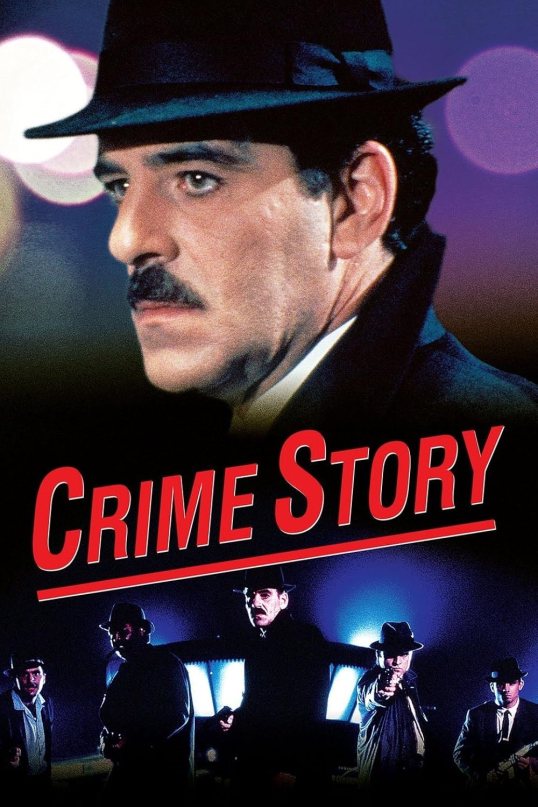
In 1986, riding high on the success of Miami Vice, Michael Mann signed on as executive producer of Crime Story, a cop show that Mann imagined would run for five seasons and which would follow a group of cops and gangsters from 1960s Chicago to 1980s Las Vegas.  The show was co-created by former Chicago cop Chuck Adamson and it starred another former Chicago cop, Dennis Farina.

Though generally well-received by critics, Crime Story struggled in the ratings.  The show’s highly serialized-nature made it difficult for audiences to follow.  (This was in the pre-streaming age, when viewers couldn’t just get online and catch up with what they may have missed.)  Crime Story only lasted for two seasons but it has since developed a strong cult following and is now regularly listed as one of the best cop shows ever made.

I’m going to find out if that’s true over the next few months.  Two weeks ago, I finished up Miami Vice.  Now, it’s time for Crime Story.

Episode 1.1 “Pilot”

(Dir by Abel Ferrara, originally aired on September 18th, 1986)

In Chicago, on a rainy night in the early 1960s, a group of masked robbers hold up a fancy restaurant and then try to escape with a group of terrified hostages.  On the scene is the Major Crimes Unit, led by the grim Lt. Torello (Dennis Farina, a former real-life cop).  The end result is that all of the robbers end up dead, the hostages end up traumatized, and one of Torello’s men, the obviously doomed Wes Connelly (William Russ), appears to be losing his mind over the violence that he has to deal with every day.

The plot of the pilot is actually pretty simple.  A gang of thieves is holding up restaurants, banks, and stores in Chicago.  Torello believes that an ambitious gangster named Ray Luca (Tony Denison) is behind the robberies and Torello is correct.  The cool and sociopathic Ray is working with Johnny O’Donnel (David Caruso).  O’Donnel may be a childhood friend of Luca’s but his parents are friends with Torello.  When gangster Phil Bartoli (Jon Polito) orders Luca to kill O’Donnel after the latter robs one of Bartoli’s jewelry stores, it’s personal all-around.

Plot-wise, it’s pure Michael Mann.  The cops and the gangsters are both obsessive.  Luca will kill anyone to get ahead in the underworld.  Oddly, his only real loyalty seems to be to his dumbest henchman, Pauli Taglia (John Santucci, a real-life former jewel thief who was once arrested by Dennis Farina).  Torello may be fighting on the side of the law but he’s often just as quick to resort to violence as Luca.  Director Abel Ferrara’s style can be seen in a scene where Torello is visited by the ghost of the recently murdered Wes Connelly.  Torello is burned out and paranoid, flying into a rage when he sees his wife, Julie (Darlanne Fluegel), dancing with another man at a wedding.  (The man in question turns out to be Torello’s cousin, whom Torello didn’t even recognize because he apparently doesn’t have much of a connection to anyone outside of the police force.)  Towards the end of the episode, there’s a shoot-out in a department store and it’s hard not to notice that neither the crooks nor the cops seem to be all that concerned with the innocent bystanders trying to not get caught in the crossfire.

The pilot is dark, gritty, and, in its way, as stylized as any episode of Miami Vice.  It never seems to stop raining and, even during the day, the skies are permanently gray and dark.  The early 60s are recreated like a fever dream of pop culture, with rock and roll on the soundtrack, cars with tail fins screeching down the street, and Bartoli living in a house that looks more like a tacky diner then a true home.  Torello and his men wear their dark suits and trenchcoats the way that soldiers wear their uniforms.

It’s an effective pilot, though we don’t really get to know much about the men working with Torello at the Major Crimes Unit.  Bill Smitrovich, in the role Detective Danny Krycheck, establishes himself as being Torello’s second-in-command but that’s about it.  Stephen Lang appears in a handful of scenes as David Abrams, a liberal public defender who is the son of a prominent gangster.  Both Luca and Torello seem to want to make David into an alley and the episode hints that he will eventually have to make a choice.  The episode ends with Luca in sunny Florida, meeting with veteran gangster Manny Weisbord (Joseph Wiseman).  Torello, meanwhile, remains in dark Chicago.

The Crime Story pilot was deemed good enough to be released as a feature film in Europe.  It also led to a series on NBC, which I will be reviewing here, every Monday!  On the basis of the pilot, I’m looking forward to it.

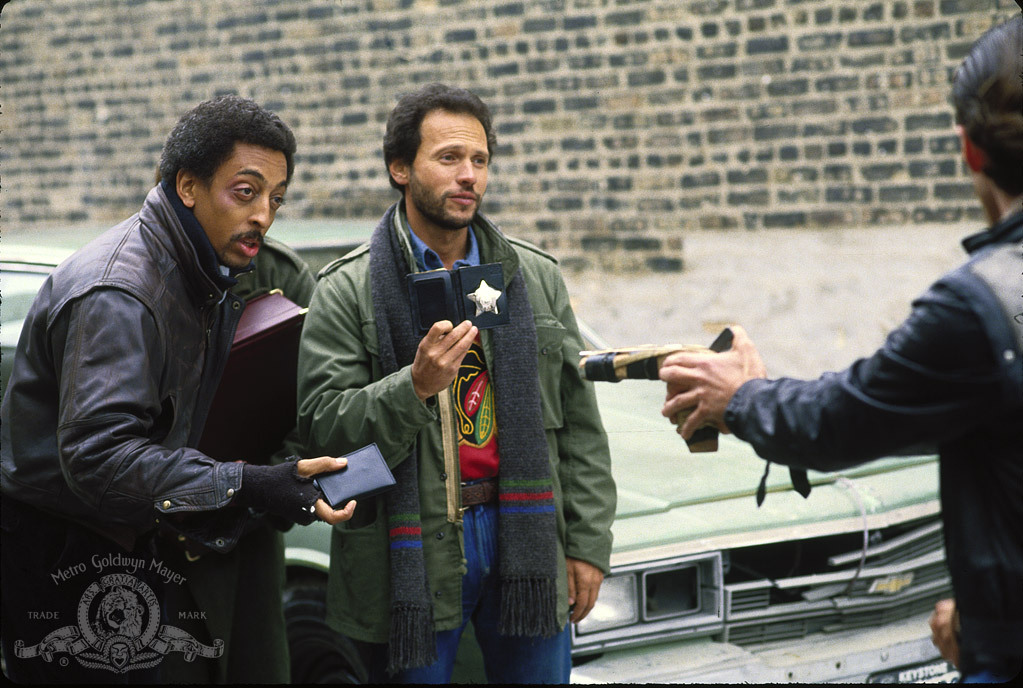
Live Tweet Alert – #MondayMuggers present RUNNING SCARED (1986), starring Gregory Hines and Billy Crystal!


Every Monday night at 9:00 Central Time, my wife Sierra and I host a “Live Movie Tweet” event on X using the hashtag #MondayMuggers. We rotate movie picks each week, and our tastes are quite different. Tonight, Monday, August 11th, we’ll be watching RUNNING SCARED (1986), starring Gregory Hines, Billy Crystal, Steven Bauer, Darlanne Fluegel, Joe Pantoliano, Dan Hedaya, Jon Gries, Tracy Reed, and Jimmy Smits.

The plot: Two street-wise Chicago cops have to shake off some rust after returning from a Key West vacation to pursue a drug dealer who nearly killed them in the past.

Peter Hyams directed RUNNING SCARED, and it’s one of the very best “Buddy Cop” films out there. So, if a night full of action and laughs sounds good to you, join us on #MondayMuggers and watch RUNNING SCARED. It’s on Amazon Prime, Tubi, and PlutoTV! I’ve included the trailer below:

April Noir: To Live And Die In L.A. (dir by William Friedkin)


Some people love money so much that they make their own.

In 1985’s To Live And Die In L.A., Williem DaFoe is magnetically evil as Rick Masters, a genius at counterfeiting who has gotten rich by selling other people fake money.  The film features a lengthy sequence showing how Masters makes his money and the viewer really is left feeling as if they’ve just watched an artist at work.  Masters has a talent and he’s a professional.  He’s good at what he does.  Unfortunately, he’s also a sociopath who is willing to kill just about anyone who he comes across.  There have been a lot of movies made about sympathetic counterfeiters.  They’re often portrayed as being quirky and rather likable individuals.  This is not one of those films.  DaFoe’s charisma makes it impossible to look away from Rick but he’s still not someone you would ever want to have to deal with for a prolonged period of time.  One gets the feeling that Rick eventually kills everyone that he does business with.

Secret Service agents Richard Chance (William Petersen) and John Vukovich (John Pankow) are investigating Masters.  They’re a classic crime movie partnership.  Vukovich is youngish and, when we first meet him, goes by-the-book.  Chance is a veteran member of the Secret Service, an impulsive loose cannon whose last partner was killed by Masters.  Chance is now obsessed with taking Masters down and he’s willing to do whatever it takes.  If that means threatening his lover and informant, the recently paroled Ruth (Darlanne Fluegel), so be it.  If that means defying the lawyers (represented by Dean Stockwell), so be it.  If that means committing crimes himself and nearly getting Vukovich killed in the process, so be it.  At first, Vukovich is horrified by Chance’s techniques but, as the film progresses, Vukovich comes to embrace Chance’s philosophy of doing whatever it takes.

What sets To Live and Die in L.A. apart from some other films is that, even as it concludes, it leaves us uncertain as to whether or not Chance and Vukovich’s actions were really worth it.  This is not a standard cops-vs-robbers film.  This is a William Friedkin film and he brings the same moral ambiguity that distinguished The French Connection to this film’s portrait of the Secret Service.  (When Chance isn’t chasing after a counterfeiter, he’s foiling an assassination attempt against the president.)

Like The French Connection, To Live and Die In L.A. features an pulse-pounding car chase, one that occurs as Chance and Vukovich make an escape from robbing a man who they believe to be a criminal.  (The man turns out to have been an FBI agent.)  This chase involves Chance and Vukovich driving the wrong way down a crowded freeway, desperately tying not to crash into any of the cars that are swerving out of the way.  It’s such an exciting scene that it’s easy to forget that Chance and Vukovich are actually escaping from committing a crime.  In The French Connection, Gene Hackman was chasing the man who tried to assassinate him.  In To Love and Die In L.A., Chance is fleeing the consequences of his own actions.

To Live and Die In L.A. holds up well.  DaFoe and Petersen both give charismatic performance but, for me, it really is John Pankow who carries the film.  Vukovich’s transformation from being a straight-laced member of law enforcement to being a doppelganger of his partner is both exciting and a little disturbing,  To Live and Die In L.A. is a crime film that leaves you wondering how far one can go battling the bad guys before becoming one of them.

Horror Film Review: Eyes of Laura Mars (dir by Irvin Kershner)


The Eyes of Laura Mars opens with Barbra Streisand singing the theme song, letting us know that we’re about to see one of the most 70s films ever made.

Laura Mars (played by a super intense Faye Dunaway) is a fashion photographer who is known for the way that her work mixes sex with violence.  Some people say that she’s a genius and those people have arranged for the publication of a book of her work.  (The book, naturally, is called The Eyes of Laura Mars.)  Some people think that Laura’s work is going to lead to the downfall of civilization.  And then one person thinks that anyone associated with Laura should die.

And that’s exactly what starts to happen.

Laura has visions of her friends being murdered.  Some people believe that makes her a suspect.  Some people think that she’s just going crazy from the pressure.  John Neville (Tommy Lee Jones), the detective assigned to her case, thinks that Laura is a damaged soul, just like him.  Neville and Laura soon find themselves falling in love, which would be more believable if Dunaway and Jones had even the least amount of chemistry.  Watching them kiss is like watching two bricks being smashed together.

There’s plenty of suspects, each one of them more a 70s cliché than the other.  There’s Donald (Rene Auberjonois), Laura’s flamboyant friend.  There’s Michael (Raul Julia), Laura’s sleazy ex-husband who is having an affair with the gallery of the manager that’s showing Laura’s photographs.  And then there’s Laura’s shift-eyed driver, Tommy.  Tommy has a criminal record and carries a switchblade and he always seem to be hiding something but, to be honest, the main reason Tommy might be the murderer is because he’s played by Brad Dourif.

If there’s one huge flaw with the film, it’s that the film never explains why Laura is suddenly having visions.  Obviously, the film is trying to suggest that Laura and the murderer share some sort of psychic connection but why?  (I was hoping the film would reveal that Dunaway had an evil twin or something like that but no.)  The other huge problem that I had is that one of the more likable characters in the film is murdered while dressed as Laura, specifically as a way to distract the killer.  So, that kind of makes that murder all Laura’s fault but no one ever points that out.

Personally, I think this film missed a huge opportunity by not having Andy Warhol play one of the suspects.  I mean, how can you make a movie about a pretentious fashion photographer in the 70s without arranging for a cameo from Andy Warhol?

The other missed opportunity is that the script was written by John Carpenter but he wasn’t invited to direct the movie.  I suppose that makes sense when you consider that Carpenter actually sold his script before he was hired to direct Halloween.  (Both Halloween and The Eyes of Laura Mars came out in the same year, 1978.)  That said, Carpenter would have directed with more of a sense of humor.  Director Irvin Kershner takes a plodding and humorless approach to the material.  When you’ve got a film featuring Faye Dunaway flaring her nostrils and Tommy Lee Jones talking about how sad his childhood was, you need a director who is going to fully embrace the insanity of it all.

With the glamorous background and the unseen killer, The Eyes of Laura Mars was obviously meant to be an American giallo.  Occasionally, it succeeds but again, it’s hard not to feel that an Italian director would have had a bit more fun with the material.  In the end The Eyes of Laura Mars is an interesting misfire but a misfire nonetheless.

A Movie A Day #263: Running Scared (1986, directed by Peter Hyams)


Running Scared is weird but good.

Ray Hughes (Gregory Hines!) and Danny Costanzo (Billy Crystal!!!) are two tough detectives in Chicago.  All they want to do is three things: retire, open a bar in Florida, and bust Chicago’s most ruthless drug dealer, Julio Gonzalez (Jimmy Smits).  Their captain (Dan Hedaya) wants them to leave for Florida as soon as possible but they are determined to take down Julio first.’

There are two strange things about this otherwise formulaic crime film.  First off, the two tough cops are played by Gregory Hines and Billy Crystal.  According to the film’s Wikipedia page, director Peter Hyams realized that Running Scared‘s plot was nothing special so he decided that the only way to make the movie stand out was by doing it “with two actors you would not normally expect to see in an action movie.”  The other strange thing is that Hyams’s gambit worked.  Gregory Hines may have been best known as a dancer and Billy Crystal as a comedian but both of them were surprisingly believable as Chicago cops.  Running Scared is actually one of Billy Crystal’s best performances.  For once, he’s believable as being someone other than a version of himself.  Even his frequent one liners seem like something that a detective would say instead of Crystal recycling punch lines from his act.  Whether they are chasing down perps and firing their guns at a moving vehicle, Hines and Crystal are never less than credible as action stars.  Lorenzo Lamas has got nothing on the team of Hines and Crystal.

Predictable though it may be, Running Scared is one of the better late 80s cop films.  The action scenes are exciting and Hyams does a good job capturing the grittiness of Chicago.  Jimmy Smits is a good villain and Joe Pantoliano, Steven Bauer, and Jon Gries all shine in supporting roles.  Keep an eye out for the always underrated Darlanne Fluegel, playing Danny’s ex-wife.